




Abstract

Engaging with theory, theoretical frameworks, and conceptual frameworks in research has been long acknowledged as helping researchers share common principles and assumptions, situate methodological and analytical choices, and allows for knowledge to be built and shared across an area of study. 1 However, achieving this is a task easier said than done. Determining what exactly is a theory, theoretical framework or conceptual framework can be a challenging task for all researchers. At times these terms are used interchangeably or are ambiguously articulated, which may be discouraging for researchers looking to incorporate such concepts into their work. Further, not all academic journals accommodate word counts conducive to deep engagement with theory or conceptual frameworks.
Acknowledging such challenges, we seek to further the advice on entering academic conversations in Paramedicine. Tavares et al. 2 identify that research submitted to Paramedicine could be strengthened by engaging with theory and conceptual frameworks. Many interesting manuscripts are submitted to the journal that unfortunately have unclear or underdeveloped theoretical and/or conceptual contributions that informed the research. This prevents researchers from entering broader academic conversations within and outside of Paramedicine, limits opportunities for linking to other studies, and may hinder our community of scholars’ understanding of foundational issues and problems. We take the position that engaging with theory, theoretical frameworks, and conceptual frameworks is an intentional and explicit part of conducting research, best done at the outset of a study to position and anchor the work.
Theories, theoretical frameworks, and conceptual frameworks all have a philosophical basis in a particular epistemology and ontology – a discussion of which is beyond the scope of this editorial (see Table 1 for definitions). However, we would be remiss to acknowledge that researchers should become acquainted with the ontological and epistemological underpinnings of the theory or concepts they are using to ensure philosophical alignment between their research question/aim, methodology, and theory or conceptual framework. This knowledge is also consequential to obtain, as empirical findings can inform a change to a theory or conceptual framework, but not to an ontological or epistemological position. 3 Further, while we primarily reference personal examples of research that use qualitative methodologies, our stance on the use of theory and theoretical or conceptual frameworks is applicable to all types of research. The onus is on researchers to ensure alignment between their ontological and epistemological stance and their choice of theory, theoretical or conceptual framework, and subsequent methodology.
Definitions.
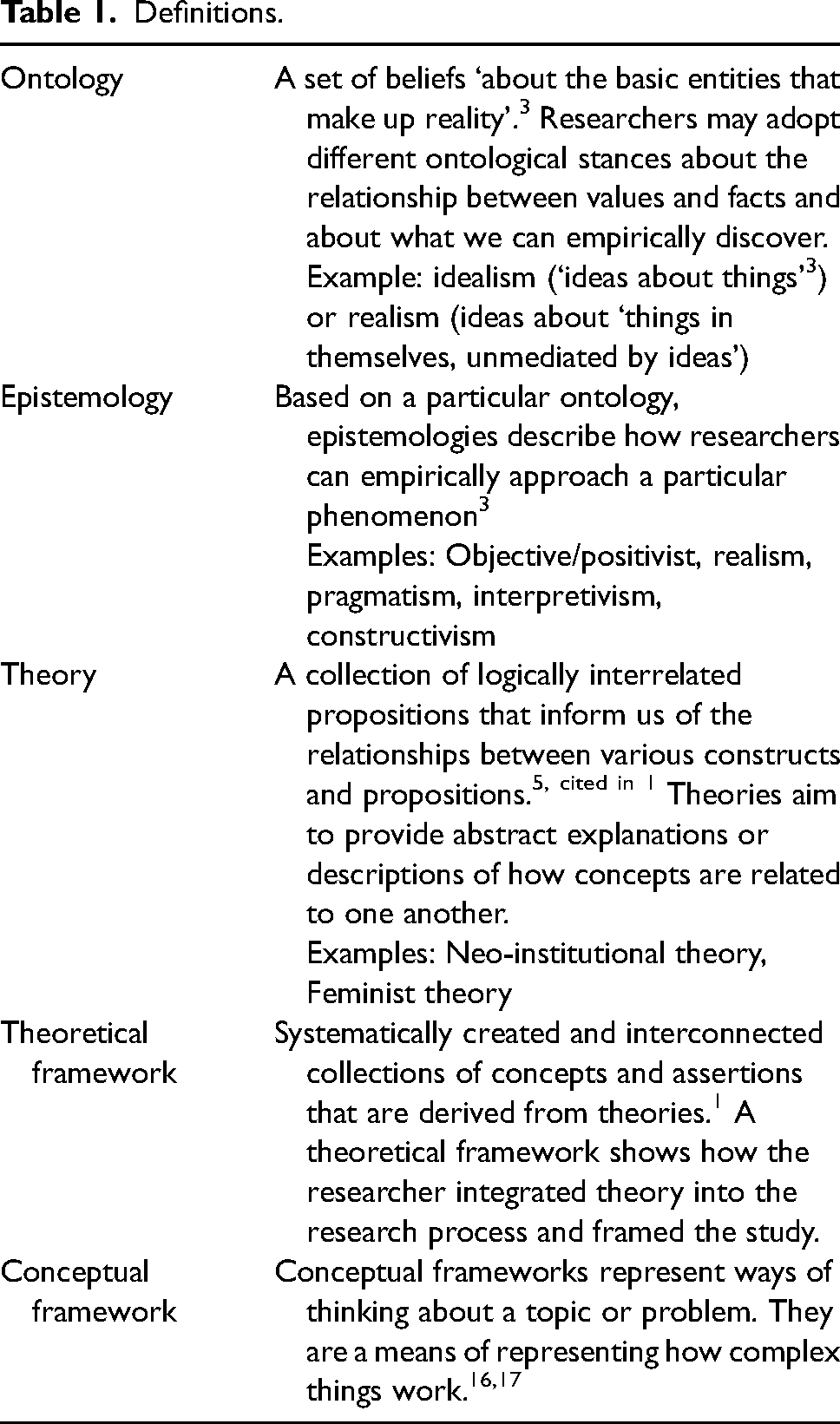
In this editorial, we will first make the case for engaging with theory and conceptual frameworks, and secondly, discuss ways in which paramedicine researchers can incorporate theory and/or conceptual frameworks into their research and publication in Paramedicine. Drawing on our own research, and furthering our previous guidance on this issue, 4 we aim to provide practical insights and guidance on how to untangle the dense web of theory and conceptual frameworks, and illustrate what such concepts can add to our understanding of paramedicine. This editorial provides guidance largely for those undertaking qualitative research, although many of the principles we describe are relevant to all researchers, regardless of methodology.
What are theories and theoretical frameworks?
Theories are a collection of logically interrelated propositions that inform us of the relationships between various constructs and propositions. 5 , cited in 1 Theories aim to provide abstract explanations or descriptions of how concepts are related to one another that can help us understand various situations or phenomena. Empirical findings underlie theories; the more empirical evidence supporting a theory, the stronger it becomes. Theories serve different purposes, including descriptive, emancipatory, disruptive, or predictive aims. 1 The scope of theories ranges from explaining broad societal patterns to individual-level interactions and exist in all disciplines. 3
On the other hand, theoretical frameworks are systematically created and interconnected collections of concepts and assertions that are derived from theories. 1 A theoretical framework shows how the researcher integrated theory into the research process and framed the study. Researchers can develop a theoretical framework by identifying what concepts and theories are needed to provide a basis for the research, establish connections between them, and show how these concepts are relevant to the study being conducted. 6
The importance of theory in understanding paramedic professionalization
Madison – In my research on paramedic professionalization in Ontario, Canada,7,8 I argue that a deeper understanding of professional change can occur when research is situated within a particular theory, or a theoretical framework, from the sociology of professions literature. Although there are some notable examples of research on paramedic professionalization that have utilized explicit theoretical frameworks,9–11 a significant number of studies in this area lack clear theoretical underpinnings. This absence is concerning as it hampers our ability to fully understand the complex dynamics and factors influencing the professionalization of paramedics.
The most common theory used in the research on paramedic professionalization, a trait approach, 12 originated in the 1930s to 1960s. 13 In paramedic research, the trait approach has documented the features by which paramedics have changed (or want to change to) as a profession, such as inclusion as a healthcare profession under the legislation and changes to education standards.12,14,15 However, trait theories are rarely used in the contemporary sociology of professions literature.
In my research on paramedic professionalization, I adopted a theoretical framework based on two contemporary sociology of professions theories: neo-Weberianism and neo-institutional theory. This approach allowed me to consider the broader sociopolitical context in which professionalization was taking place and explore less commonly accessed pathways to professionalization. These two theories allowed me to be attuned to numerous social and political features of paramedic professionalization (and broader trends impacting the professions) that a trait-based or atheoretical approach would not have accounted for. This approach also enabled me to situate and contextualize my own research within these conversations and reflect on how paramedic professionalization was similar or different to other professions undergoing professional change.
In summary, a very small body of paramedic research on professional change has engaged with the rich and expansive theories in the sociology of professions. Engaging with theories from the sociology of professions creates an opportunity to link research within paramedicine with other advances and research and presents a clear opportunity to advance our understanding of professional change in paramedicine.
What are conceptual frameworks?
Conceptual frameworks represent ways of thinking about a topic or problem. They are a means of representing how complex things work. 16 Ideally, they should provide you (and your readers) with a clear outline of the problem, how you think about it, and your approach(es) to it. They are both a process – helping you to align literature, design and methodology, and a product – helping you to ground your work and situate it for readers and other researchers who wish to build upon them. 17 Conceptual frameworks can be selected a-priori, developed from theories, developed from empirical evidence, developed from personal experience and values, or indeed a combination of several (or all) of these approaches. Paramedic researchers have access to a growing body of conceptual frameworks, and in doing so, can connect studies to further our understanding of paramedicine.
This is important – you make choices when you decide to use a conceptual framework. Such choices include decisions on what you consider important and not so important, and what you ‘see’ when you look at the issue (e.g. Madison's example earlier on engaging or not with theory). We liken it to choices you make when reading an ECG – individual leads may not provide you with a comprehensive enough view, but a combination of certain leads may provide you with a much more meaningful picture. Even so, you can build a more complete ‘model’ when you view the ECG in combination with a clinical assessment, and so on. No framework (or model) can consider all things – as with all models, they are only partial representations.
The role of a conceptual framework to understand and explore ‘professional practice-in-context’
Alan – The importance of practice-in-context had largely been ignored in previous descriptions of practice when developing competency frameworks.18,19 This was illustrated by a growing body of literature addressing a lack of engagement with structural and societal issues – such as equity of access to healthcare, anti-racism, climate change, and social determinants of health20–22 – when identifying the competencies required of healthcare professionals. This lack of engagement with context was concerning because practice is enacted within larger societal systems that influence what we do, when, why and how we do it, and with whom we should engage.
In my contributions towards improving competency framework development in health professions education, I developed a theoretically (via a combination of two systems theories) and empirically (via literature review) informed conceptual framework by which we can better understand professional practice in context. 18 By combining Ecological Systems Theory and applied complexity theory in healthcare,23–25 I was able to guide my own work, and the work of others in the future, to focus on the issue of context. This conceptual framework aids in understanding differing perspectives on ‘context’. These include, but are not limited to, differences in practice based on geographical location (e.g. rural versus urban), cultural complexities (e.g. working with Indigenous communities), and evolving societal expectations (e.g. providing care at home, climate change).
In summary, previous attempts to describe practice ignored the complex contexts in which such practice is enacted. Engaging with a systems-thinking informed conceptual framework presents a clear opportunity to advance our understanding of contemporary, and evolving, paramedic practice.
Strategies for incorporating theory and conceptual frameworks in manuscripts submitted to Paramedicine
To strengthen submissions to Paramedicine, we provide the following practical guidance to authors. First, include a clear statement in your research that describes the role of theory or theoretical or conceptual framework(s). For example, we often see submissions adopting a qualitative methodology that have no theoretical or conceptual approach to orient the reader. This makes it challenging for reviewers and readers to understand your findings or interpretations. To address this gap, describe your theory or theoretical/conceptual framework in depth, versus a passing mention. Be explicit about the key tenets of the approach (and possibly, its gaps), and how it guided your research questions, methodology, and findings. For notable examples, see McCann,9,10 Corman,26,27 Rees,28,29 and Seim. 30
We encourage you to engage with common principles or terms to allow others to translate your approach or findings. For example, conceptualising complex interventions as based on principles or theories allows others to compare their research based on the underlying theory rather than only the specifics of the intervention. 31 Using a common conceptual framework (e.g. a national role description for paramedics 32 ) allows researchers to further develop concepts related to paramedicine. This does not mean that new terms or principles can’t be created. Rather, it is important to know the terms used within a field, understand their implications, and be explicit about the inclusion of new ideas.
It is incumbent on us to acknowledge that not all research needs to be theoretically dense. Some journals specifically strive for practical, or applied work, and this type of work can be instrumental in advancing our understanding of programs, policies, or ideas. Specific disciplines will vary in this regard, and paramedic researchers can be found spanning across multiple disciplines. However, given our editorial remit as the ‘gatekeepers of the quality of the journal’, 33 we take the position that for articles published in Paramedicine, there is a need for direct engagement with theory, theoretical or conceptual frameworks to produce rigorous and thoughtful paramedic research and connect our growing community of international scholars.
Finally, as journal editors and peer-reviewers, we need to consider some sage advice ourselves: if it is justified, authors may require longer word counts to meaningfully engage with theoretical and conceptual issues, particularly with qualitative and mixed-methods study designs. We commit to flexibility on this issue but continue to encourage authors to be concise in their writing when engaging in this work.
Footnotes
Declaration of conflicting interests
The author(s) declared the following potential conflicts of interest with respect to the research, authorship, and/or publication of this article: MB is an Associate Editor, and AB is a Deputy Editor of Paramedicine.
Funding
The author(s) received no financial support for the research, authorship, and/or publication of this article.
