



Abstract
Motor skills and movement-related functioning significantly shape how children experience and interact with the world around them. Among infants and young children, developmental motor disorders contribute to delays with motor, cognitive, and psychosocial development. Early and accurate identification of these disorders is necessary to facilitate timely access to therapeutic interventions that minimize the long-term effects of disability on everyday activities and participation. In the United States, motor assessments commonly used among children 0 to 3 years focus on completion of specific motor skills at a single point in time, which provides only a part of the greater picture that is a child’s motor and movement-related functioning. Video-capture methods, like the General Movements Assessment (GMA) and the Infant Motor Profile (IMP), offer greater accuracy and predictive power to (1) identify motor deficits in young children and (2) facilitate early access to supportive, therapeutic intervention.
Keywords
Introduction
The first years of life are defined by rapid brain development, influenced by a child’s lived experiences. These experiences have the capacity to impact both physical and mental health across the lifespan. 1 While neurons begin to organize during the first month of gestation, brain development continues long after birth. 2 Decades of neurodevelopmental research have revealed that there is no single pathway for development, and consequently, early experiences may have the unique opportunity to influence long-lasting change during the first years of life.3,4 Motor skills are especially important in the first year of life. Early spontaneous movements become purposeful, and self-generated movement is used to explore and learn about the world. Developmental motor disorders are often subtle and difficult to diagnose at early ages. These motor disorders may only be observed as the child ages when motor skills become more complex and a greater number of standardized assessments are applicable. 5 Accurately and efficiently identifying developmental motor disorders early would enable timely intervention to diminish the long-term effects of disability on everyday activities and participation. 6
Since early indicators of developmental motor disorders can be difficult to detect, diagnosis is often delayed until the child is several years old, preventing early therapeutic interventions.7 -9 When diagnosis is delayed, there is a missed opportunity for intervention during this critical period of neural plasticity. 10 Alternatively, when neurodevelopmental delays are identified in infancy, caregivers and children can augment early experiences and exposures through therapeutic intervention that may affect when children master new skills. 11 It is imperative to identify children at an early time point to provide intervention to minimize disability.
Early Intervention (EI) consists of evidence-based, family-centered intervention programs that aim to engage caregivers in activities that promote their child’s development. In the United States, children 0 to 36 months of age with developmental delays are eligible for federally funded EI through Part C of the Individuals with Disabilities Education Act (2004). Participation in EI programs has been shown to contribute to improved motor development among children ages 0 to 3 years with or at risk for physical disability. 12 Within the United States, EI practitioners identify children at risk for developmental delay or disability and determine whether they are eligible for Part C EI. 13 They collect and interpret information on various factors that may support or inhibit children’s performance in activities and occupations, defined as “activities . . . of everyday life, named, organized, and given value and meaning by individuals and a culture.” 14 EI practitioners assess the individual child’s motor skills and movement-related functioning. They then determine how these will impact the child’s ability to interact with their environment and to complete the demands of age-appropriate play, self-care, and social participation. 15 The methods by which EI practitioners assess motor skill development among children 0 to 3 years can vary greatly.
Integral to the EI practitioner’s evaluation process are record review, caregiver interview, and clinical skill evaluation through the use of screening instruments and/or standardized assessment tools. While many standardized assessment tools used among children 0 to 3 years offer valuable information, the full impact of a child’s motor deficits may not be captured by the specific motor tasks required of each tool. Furthermore, parent questionnaires of motor skill and movement-related functioning can be prone to bias and may not be reliable indicators of real-world performance. 16 Thus, there is opportunity within the EI evaluation process to incorporate motor assessment tools that more specifically identify a child’s likelihood for continued movement-related dysfunction. This would then better inform a child’s need for timely intervention. This paper describes a couple of options for motor assessment that are not as frequently used in the United States but are applicable to the EI evaluation process.
Measurement of Early Development Using Video-Capture Methods
Video-capture methods are different than other skill or movement-based assessment tools in that they enable the assessor to record a child’s exact movement patterns for later review. This minimizes distractions that may affect clinical judgment. Additionally, video-capture methods allow for consistency and reliability while allowing for movement patterns to be reviewed by multiple skilled assessors prior to making a final determination of a developmental motor disorder. The following video-capture assessments can support the EI evaluation process by enabling identification of early movement-related dysfunction, and thus, justifying the essentialness of early intervention services.
General movements assessment
The General Movements Assessment (GMA) is a neuromotor observation-based assessment of spontaneous movement that has high predictive power in infants 2 to 4 months corrected age 2 and has been identified as a strong predictor of a later diagnosis of Cerebral Palsy (CP). 17 For this reason, GMA is used worldwide in follow-up services of high risk infants. The GMA captures movement variation and complexity and the presence of fidgety movements of the young child by scoring a 3-minute videotape of the infant lying in supine. From just 3 minutes of watching an infant move in their natural environment without external input, it is possible to gain a thorough understanding of the current integrity of the infant’s brain and the infant’s risk of neurodisability. 2 The powerful outcomes of the GMA indicate that accurate and reliable measurement of early child development is not reliant on providers eliciting specific skills on command. However the, GMA can no longer be used once the child begins developing purposeful movements (eg, reaching for a toy), as the GMA focuses on spontaneous rather than volitional movement of an infant. 18 Table 1 provides an overview of the GMA scoring procedures along with its relevance to the EI evaluation process.
Overview of scoring procedures for the general movements assessment (GMA).

Source. Adapted from Table 10.2 General Movement Assessment in Hadders-Algra. 10
While it would be advantageous to capture children at risk for disabling conditions within the first few months of life, referrals for EI may not be initiated until purposeful movement has already been established. The GMA also requires supervised training, either with a 2-day course or an advanced 3.5-day course, which may present a financial and/or time barrier to implementation. 10
Infant motor profile (IMP)
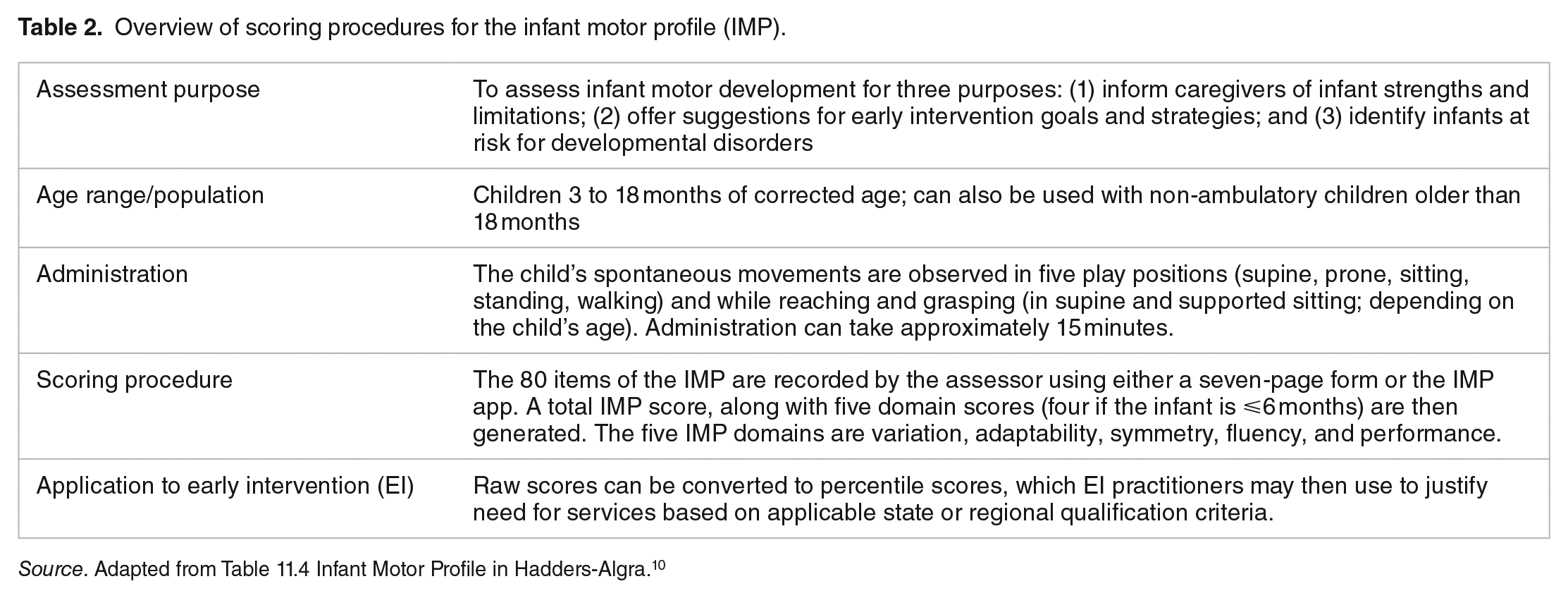
Similar to the GMA, the Infant Motor Profile (IMP) allows practitioners to detect motor dysfunction and delays via video-capture methods. The IMP is increasingly used across the world. Its manual is currently available in English, Spanish, and Portuguese, and will soon be available in German as well.19 -21 In contrast to the GMA, it is applicable to a larger population of children. The IMP is primarily intended for use with children 3 to 18 months of age, but can continue to be used for non-ambulatory children older than 18 months. 10 Through video-based assessment, the IMP analyzes movement quality in terms of variation, adaptability, symmetry and fluency, and motor skills while the child engages in specific play activities. 22 The IMP assumes that neuromotor development and integrity is especially evidenced by the infant’s or child’s movement variation (“repertoire”) and their ability to select the most efficient method from the available repertoire to respond to environmental stimuli (“adaptability”). Thus, greater variation, adaptability, symmetry, and fluency correlate with more promising neuromotor development, while lack of such may indicate and/or predict movement-related dysfunction. 10 Studies examining the predictive validity of the IMP have shown that lower IMP scores (ie, less variety, adaptability, symmetry, fluency, and/or performance of movement) are associated with increased risk for CP, as well as decreased cognitive function as measured by IQ at 4 and 9 years of age.23 -25 Table 2 provides an overview of the IMP scoring procedures along with its relevance to the EI evaluation process. Similar to the GMA though, the IMP requires participation in a 2-day course prior to practice implementation. 10
Overview of scoring procedures for the infant motor profile (IMP).
Source. Adapted from Table 11.4 Infant Motor Profile in Hadders-Algra. 10
Conclusion
Early identification of developmental motor disorders is critical during a child’s first years of life as it can facilitate access to early and supportive therapeutic interventions. EI practitioners are tasked with completing comprehensive assessment of motor deficits and movement-related functioning for children age 0 to 3 years. However, many commonly utilized methods for motor assessment among this age group focus primarily on whether a child can or cannot complete specific motor tasks. This only provides a small piece of the larger picture that is a child’s motor deficits and their impact on everyday functioning. 26 Video-capture methods, particularly the GMA and the IMP, offer alternative means for assessing motor deficits and movement-related functioning. These video-capture methods are also valuable for use with young children because of their predictive power for a later diagnosis of CP or for cognitive deficits. Video-capture methods for children 0 to 3 years support timely recognition of developmental motor disorders and early therapeutic interventions that will minimize lifelong disability and promote improved health, wellness, and participation among children. It is our hope that this article will further increase EI practitioners’ awareness and use of video-capture methods as assessment tools in the United States and in other countries where EI programs are offered.
Footnotes
Declaration of conflicting interests:
The author(s) declared no potential conflicts of interest with respect to the research, authorship, and/or publication of this article.
Funding:
The author(s) received no financial support for the research, authorship, and/or publication of this article.
