



Abstract
Background
Polycystic ovarian syndrome (PCOS) is an endocrine disorder whose symptoms include menstrual disturbances, hirsutism, and female anovulatory infertility. As medicinal plants, Nigella sativa and Salvia officinalis have been used and investigated due to their broad medicinal benefits.
Objective
The aim of this study is to assess the combinatorial effect of Nigella sativa and Salvia officinalis extracts on ovarian function in PCOS-induced mice. PCOS was induced in female Balb/c using dehydroepiandrosterone (DHEA) then were treated with Nigella sativa and Salvia officinalis extracts or their combination. Control groups (normal saline, sesame oil, extracts) were included, Positive control group was metformin, a medication commonly used to treat PCOS.
Methods
Histological analysis of the ovaries were performed. Serum hormone levels: Testosterone (T) and Estradiol (E), oxidative stress markers Glutathione (GSH), Malondialdehyde (MDA), Super Oxide Dismutase (SOD), Catalase (CAT), and the proinflammatory marker interleukin-1β (IL-1β) were quantified.
Results
Nigella sativa and Salvia officinalis or their combination were able to significantly minimizing markers of PCOS as shown by decrease the number of cysts in the ovaries, decrease in serum Testosterone and Estradiol levels (50 and 55% respectively with P < 0.05), decrease MDA levels (by ∼90% with P < 0.05), normalizing the oxidative stress markers (CAT, SOD, and GSH) levels and decreasing IL-1β (by ∼40% with P < 0.05) levels compared to controls.
Conclusion
This study showed that the combined effect of Nigella sativa and Salvia officinalis was better able to treat PCOS and may replace Metformin to improve PCOS-induced abnormalities.
Background
PCOS is one of the most common endocrine disorders, affecting approximately 5-15% of women reproductive age world-wide.1,2 PCOS, also known as Stein-Leventhal syndrome, is a disorder that is due mainly to ovaries’ abnormalities. Additional factors, such as obesity and environmental factors, affect the development of the female symptoms. 3 PCOS increases risks of complications such as infertility and menstrual irregularities, affecting approximately one in five women. Stress, obesity, and fluctuation in hormonal levels are the major causes of PCOS worldwide. 4
PCOS symptoms include: menstrual disturbances, hirsutism, and female anovulatory infertility 5 ; thus, it affects the general reproduction, health, and quality of life. 6 There is no specific diagnosis for PCOS patients, but it can be detected from the pathogenesis of the syndrome, ie, metabolic disturbances like insulin resistance and obesity.2,7-9
Because PCOS tends to occur as a heterogeneous disease, it has been classified into 4 phenotypes using the Rotterdam criteria1,10: Overt or classic polycystic ovarian PCOS (chronic anovulation, hyperandrogenism and polycystic ovaries), classic non-polycystic ovarian PCOS (chronic anovulation, hyperandrogenism, normal ovaries), non-classical ovulatory PCOS (regular menstrual cycles, hyperandrogenism, polycystic ovaries), non-classical mild or norm androgenic PCOS (chronic anovulation, norm androgens and polycystic ovaries).11,12
Normal function of the ovaries mainly depends on the normal hormonal functions that regulate the menstrual cycle and maintain fertility. Change in hormonal regulation disturbs the ovarian function leading to cysts inside the ovarian sac. Furthermore, in PCOS females, increase in androgens is a main feature. PCOS patients appear to have numerous 8 mm cysts causing about 70% of females infertility.8,13
The genetic and environmental factors are considered major causes for PCOS, in addition to unhealthy lifestyle, diet or even infections that increase risk of PCOS. 14 Insulin resistance also disturbs the ovarian function by increasing androgen level resulting in anovulation. The levels of gonadotrophin-releasing hormone (GNRH), follicular stimulating hormone (FSH), luteinizing-hormone (LH) and prolactin are also disturbed in case of PCOS. 15
Metformin is frequently used to treat Type 2 Diabetes by lowering gluconeogenesis and increasing peripheral tissue sensitivity to insulin. It is the first insulin-sensitizing medication used to treat PCOS that has significantly improved menstrual cycle regulation and decreased hyperandrogenism in PCOS-affected women. 16 More research, however, is emerging that casts doubt on both the effectiveness of metformin in treating PCOS patients and its side effects, which include lactic acidosis, vitamin B12 malabsorption, and gastrointestinal symptoms.17-19 As a result, plants and herbs have received increased attention to treat PCOS. Herbal medicines are widely used worldwide, particularly in traditional and complementary systems, as safe and accessible options for managing hormonal and metabolic disorders such as PCOS.20-22
Among these, Nigella sativa and Salvia officinalis have attracted attention for their antioxidant and anti-inflammatory properties.
As a medicinal plant, Nigella sativa, known as the black seed, is historically known in herbal medicine, and investigated for its broad medicinal advantage. It is native to many countries in the world including the Mediterranean region, India, Syria, Pakistan, North Africa, Southern Europe, Southwest Asia.22-27
Salvia officinalis L. is a perennial round shrub of the Labiatae/Lamiaceae family, indigenous to the Mediterranean and Middle Eastern regions, although the plants in this genus are found all over the world. It has been used to cure a variety of ailments in Asian and Latin American folk medicine, including seizures, ulcers, gout, rheumatism, inflammation, dizziness, tremor, paralysis, diarrhea, and hyperglycemia. 28
Due to the diversity of side-effects of therapeutic therapies, scientists are reverting to study herbs and plants in treating diseases, evaluating their effects, and providing evidence to consider them as appropriate treatment. As a result, the aim of this study was to assess the combined effect of Nigella sativa and Salvia officinalis extracts on ovarian function of PCOS-induced in mice.
Methods
Collection and Preparation of Plant Extract
Salvia Officinalis
Salvia officinalis plants were grown and collected from Beirut Arab University, Beqaa campus in July 2023. The plant was identified and authenticated by Dr. Safaa Baydoun at Beirut Arab University. The leaves were thoroughly rinsed with distilled water and air-dried in the shade at room temperature (25 ± 2°C) for 5 days until constant weight was achieved. A 5% aqueous extract was prepared by adding 50 g of dried leaves to 1 L of boiling distilled water for 5 minutes, followed by simmering at 95°C for 30 minutes with gentle stirring. After cooling to room temperature (25°C), the mixture was filtered through Whatman No.1 filter paper. The filtrate was aliquoted in sterile amber containers and stored at −20°C until use.
Nigella Sativa
Organic Nigella sativa oil (lot# CKY1024) was purchased from Morjan Pharmacy, Saida, Lebanon, imported from the USA. The oil was cold-pressed, ensuring preservation of its bioactive compounds, and stored in a dark glass bottle at 4°C protected from light to maintain stability. Prior to administration, the oil was allowed to reach room temperature.
The doses of Salvia officinalis and Nigella sativa extracts were selected based on previously published preclinical studies demonstrating efficacy and tolerability in similar animal models.7,29 No dose-response experiments were performed in the present study.
Animals
All animal experiments were approved by the Institutional Board of Beirut Arab University. Female Balb c mice (21-days old), 9 per group were maintained under standardized conditions, 22-25°C, 40 ± 5% relative humidity, and 12 hours light/dark cycle. Water and pelleted food were available ad libitum. At the end of experiments, all mice were anaesthetized by intraperitoneal injection of ketamine (100 mg/kg) and xylazine (10 mg/kg) prior to blood collection via cardiac puncture. Mice were then sacrificed by decapitation followed by isolation of ovaries, for histopathological examinations and biochemical analysis.
Establishment of PCOS Model and Herbal Treatment
Experimental Design and Treatment Groups of DHEA-Induced PCOS Mice Model

The SO group received only Salvia officinalis extract, orally at 100 mg/kg for 21 days. 32 The NS group were given Nigella sativa extract at 200 mg/kg by oral gavage for 21 days. 29 NSSO group received combination of Nigella sativa and Salvia officinalis extracts at the same dose by oral gavage for 21 days. The ISO group represents a PCOS group treated with the Salvia officinalis extract for 21 days. The INS group represents a PCOS group treated with the Nigella sativa extract for 21 days. The COT group represents a PCOS group treated with combination of both plant extracts for 21 days. The metformin group represents a PCOS group received 21 days of SC injection of DHEA followed by 21 days of intraperitoneal Metformin injections (Sigma-Aldrich® cat # 317240) (500 mg/kg g of body weight). 30
Biochemical Analysis
Serum levels of estradiol, and testosterone were measured at the “Professional Healthcare Diagnostics (PHD) Laboratory” in Beirut, Lebanon, using Roche Cobas E411 analyzer that uses electrochemiluminescence system (ECL) technology for immunoassay analysis.
Histology
The ovaries were dissected, washed with cold saline to remove blood, blotted on filter papers, and then weighed. Part of ovaries, were used for histological studies, sent to the “Institut National de Pathologie” Beirut, Lebanon for histological analysis. The ovaries were fixed in 10% buffered formalin (from Sigma-Aldrich®; cat #15512 = 2.5 L-R), then dehydrated in graded ethanol (70-90 %) and embedded in paraffin. Five serial paraffin sections (5 µm thickness of each) were sliced from each sample and paraffin were removed using xylene. Tissue sections were stained with Hematoxylin and Eosin. The number of follicles and corpus luteum per field were counted. All slides were observed under a light microscope, and images were recorded using visualization software under optimum brightness and contrast settings at 40x magnification.
Pro-inflammatory Factor of IL-1β Detection
Ovaries were collected and homogenized in lysis buffer consisting of phosphate buffer saline (PBS) (from Elabscience; cat # E-BC-R187) at 50 mM, pH 7.4 containing 1 mM Phenylmethylsulfonyl fluoride (PMSF) (from Roche Diagnostics; lot # 70504 525). Homogenate was centrifuged at 6000 × g for 10 min and supernatant was collected for analysis. The level of IL-1β was detected by Enzyme-linked immunosorbent assay (ELISA) kits purchased from Elab Sciences, USA (cat # E-EL-M0037).
Determination of the Antioxidant Indices
Tissue levels of the antioxidant indices glutathione (GSH), malondialdehyde content (MDA), catalase (CAT) and superoxide dismutase (SOD) were determined according to Budget and Aust. 33
Statistical Analysis
Statistical analysis was performed using GraphPad Prism version 10.4.1. Comparisons between all groups were conducted using one-way ANOVA followed by Tukey’s post-hoc, where we compared all possible pairs of group means. We focused when drawing our figures on highlighting the comparisons relevant to our hypothesis. Results are presented mean ± standard deviation. A P-value of <0.05 was considered statistically significant.
Results
The Combined Effect of Nigella sativa and Salvia officinalis Extracts Restored Normal Ovarian Morphology in PCOS Mice
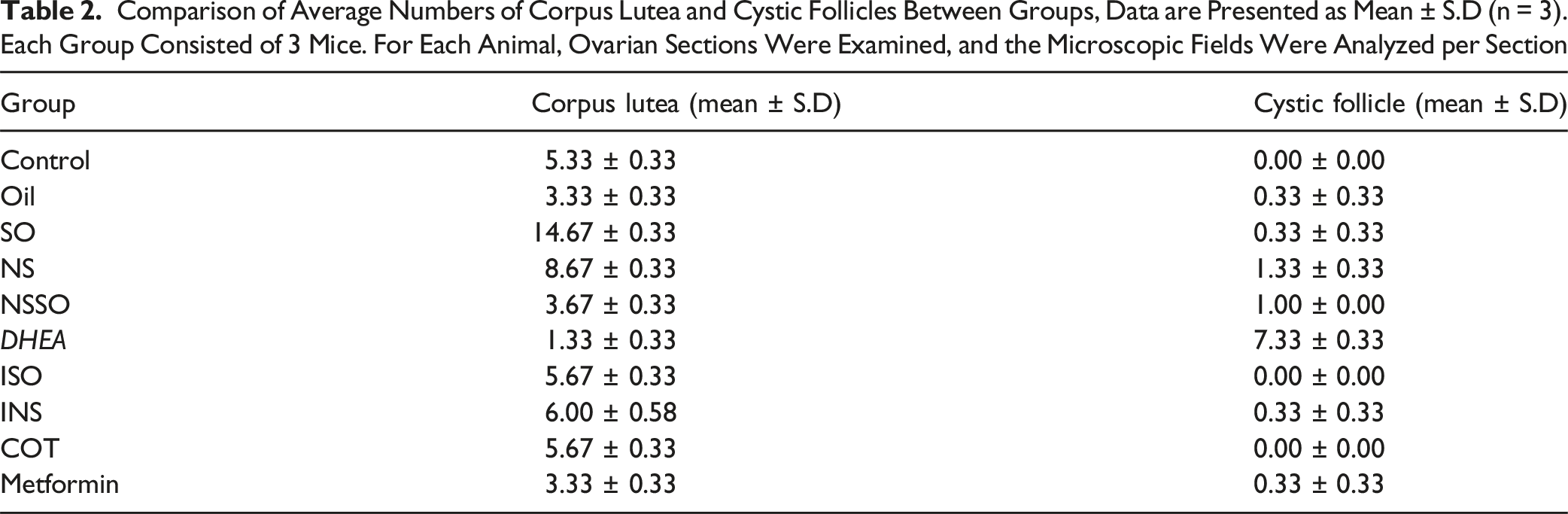
As shown in Figure 1F, ovaries from DHEA-induced mice exhibited numerous cystic follicles with a marked reduction in corpora lutea, confirming the successful induction of PCOS-like pathology. These histological characteristics are consistent with established diagnostic criteria for PCOS models. HE stained section of ovaries from all the groups were examined under light microscope (40x). The ovaries from: Control (A), Oil (B), and SO (C), NS (D), NSSO (E), DHEA (F), and ISO (G), INS (H), COT(I), and Metformin (J). CL: corpus luteum; CY: follicular cyst; and (→): primordial follicles
The therapeutic effect of Nigella sativa and Salvia officinalis on PCOS induced abnormalities in ovaries was evaluated for all groups using histological analysis. The ovaries from Control, Oil, and SO, NS, NSSO groups showed normal histological features such as follicles at various stages of development as well as corpora lutea (Figure 1A Control group showing normal ovarian architecture with multiple developing follicles and corpora lutea (CL). (B) Oil control showing comparable normal histology. (C) Salvia officinalis control, (D) Nigella sativa control groups. (E) Salvia officinalis and Nigella sativa combined treatment group showing preserved follicular structures and numerous CL (G) DHEA + Salvia officinalis, (H) DHEA + Nigella sativa, (I) DHEA + combination of both extracts, and (J) DHEA + Metformin groups showing marked reduction in cystic follicles and restoration of CL, indicating improved ovarian morphology.
Treatment with Salvia officinalis extract, Nigella sativa extract, their combination, or Metformin restored the histomorphological feautures, very comparable to those of the Control groups, where improvement in the ovarian features with fewer and smallers follicular cysts and presence of corpus lutea was noticed (Figure 1G-J).
Comparison of Average Numbers of Corpus Lutea and Cystic Follicles Between Groups, Data are Presented as Mean ± S.D (n = 3). Each Group Consisted of 3 Mice. For Each Animal, Ovarian Sections Were Examined, and the Microscopic Fields Were Analyzed per Section
The Combined Effect of Nigella sativa and Salvia officinalis Extracts Regulate Serum Hormone Levels in Mice with PCOS
As presented in Figure 2A and B, serum levels of (E) and (T) were similar in control, oil, NS, SO, and NSSO controls. However, PCOS mice exhibited a significant increase in serum E and T levels compared to control (80% and 60% respectively, P < 0.0001). Treatment PCOS mice with Nigella sativa and Salvia officinalis extracts or their combination significantly decreased E and T levels (75% and 80% respectively, P < 0.0001) when compared to the untreated PCOS group. A significant decrease in E and T levels was observed in PCOS mice treated with Metformin (40 and 90%, respectively, P < 0.0001) when compared to PCOS group. Combined effect of Nigella sativa and Salvia officinalis extracts on serum hormones levels. Serum levels of (A) Estradiol and (B) Testosterone. Data are expressed as the mean ± SD (n = 3). *P < 0.05, **P < 0.01, ***P < 0.001, ****P < 0.0001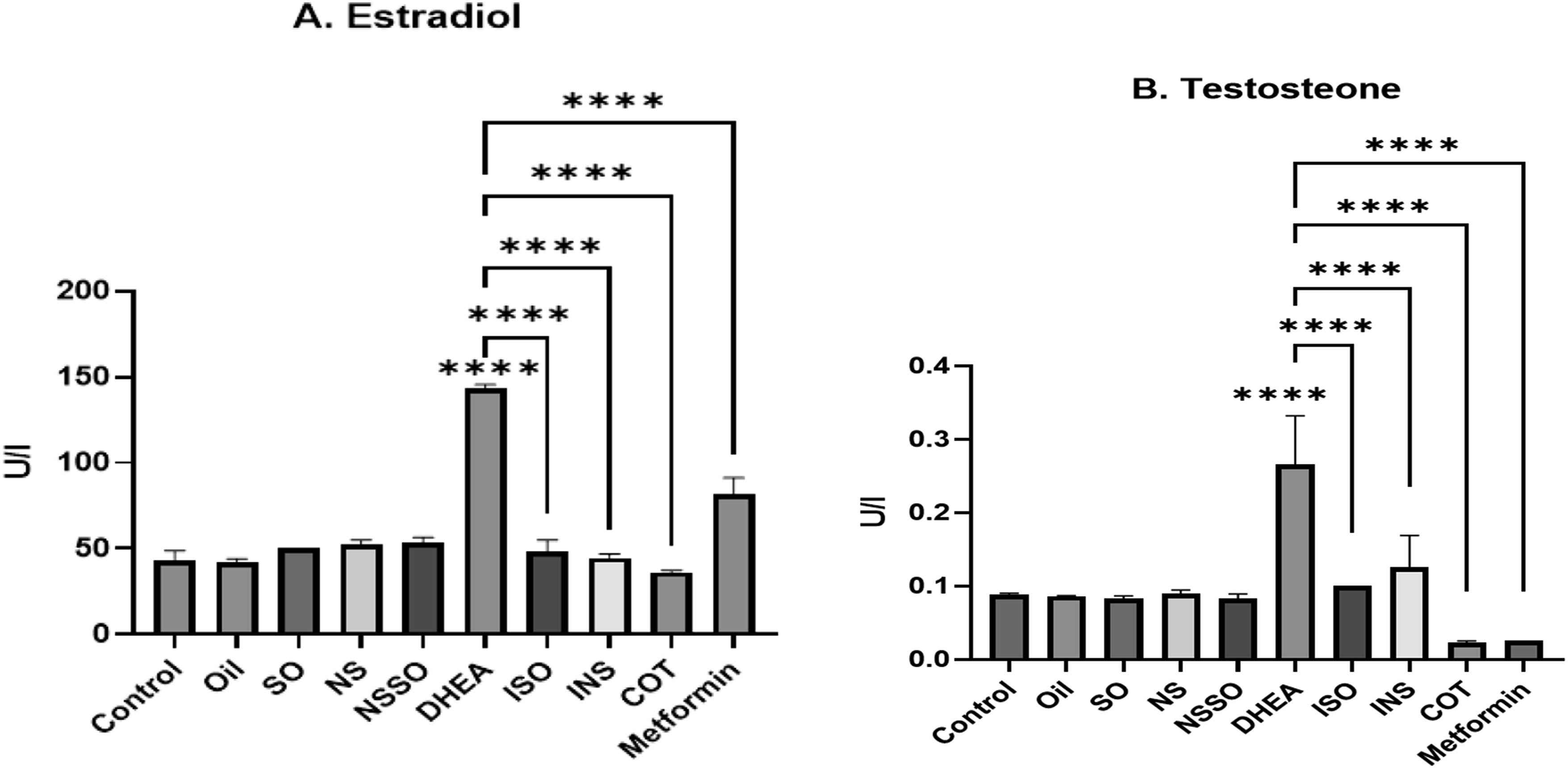
Effect of Nigella sativa and Salvia officinalis Extracts on Oxidative Stress in Ovaries of PCOS Mice
The levels of GSH and MDA, and the activities of SOD, CAT were measured in all experimental groups (Figure 3A-D). Combined effect of Nigella sativa and Salvia officinalis extracts on oxidative stress in ovaries of PCOS mice.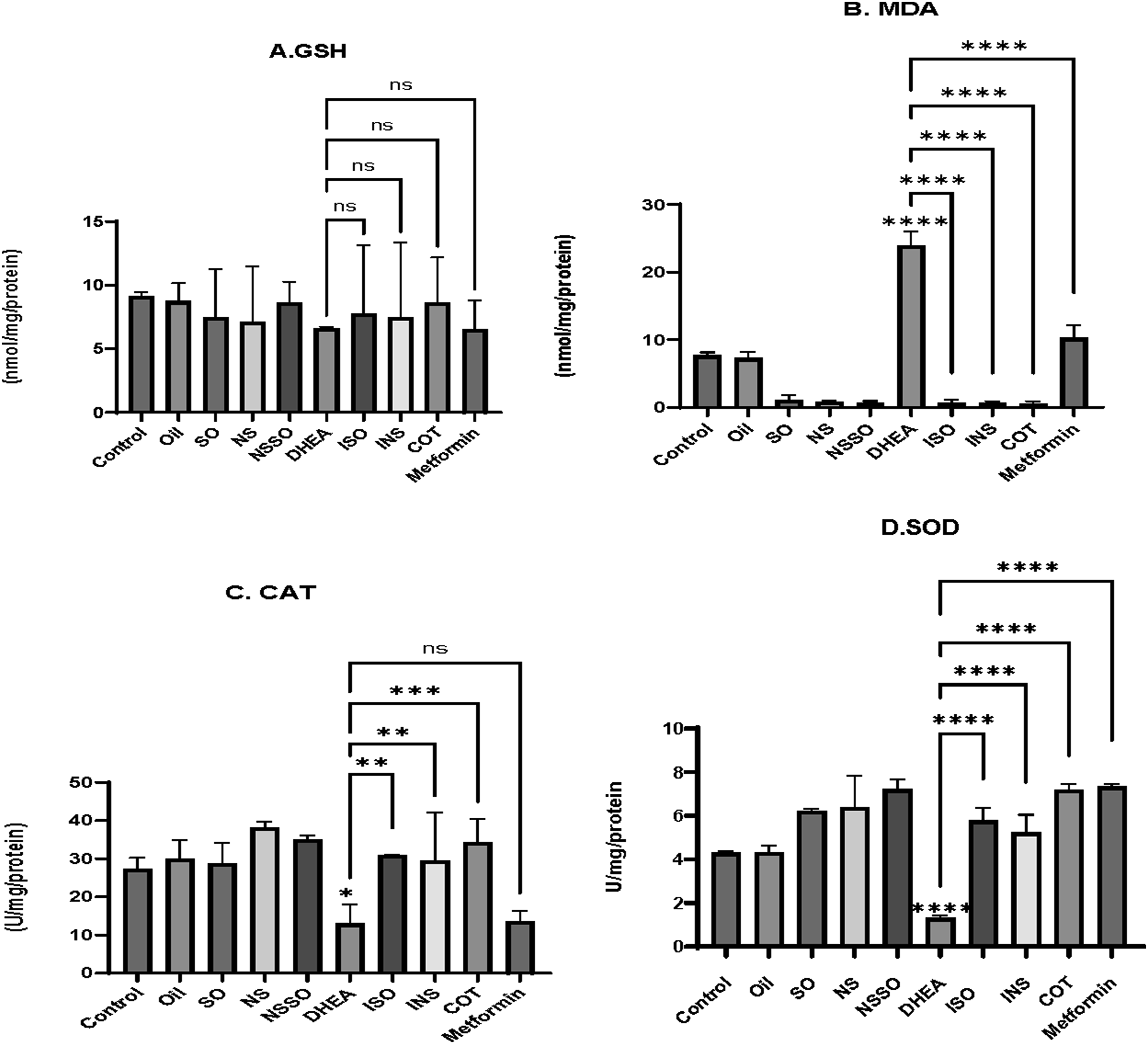
As shown in Figure 3A, no significant changes were observed among all experimental groups.
As for MDA levels (Figure 3B), their levels were significantly elevated in DHEA-induced PCOS group compared to control group (P < 0.0001). Treatment with Nigella sativa, Salvia officinalis and their combination (NS, SO and NSSO groups) significantly reduced MDA levels (∼20-fold) compared to untreated DHEA group. The decrease was even more pronounced compared to the Metformin-treated group which was only 2.5-fold (P < 0.0001, one-way ANOVA, GraphPad Prism V 10.4.1). These findings indicate that the effect of plant extracts was better than that of Metformin.
Next, we examined the effect on the extracts on CAT activity (Figure 3C). PCOS induction significantly decreased CAT activity (∼50%, P < 0.05) when compared to control. Treatment with the extracts significantly restored normal CAT activity in PCOS mice with a ∼60% increase (P < 0.001) while Metformin failed to enhance it.
Similarly, SOD activity significantly decreased in PCOS mice (70%, P < 0.0001) as shown in Figure 3D. Extracts administration (ISO, INS and COT) significantly enhanced SOD activity in PCOS mice, with higher levels observed in COT and Metformin treatment (70 % with P < 0.0001).
The Combined Effects of Nigella sativa and Salvia officinalis Extracts on the Pro-inflammatory Markers IL-1β in Ovaries of PCOS Mice
The level of the inflammatory cytokines IL-1β in ovarian tissues of all experimental groups is shown in Figure 4. No changes in IL-1β levels in SO, NS and NSSO groups compared to the control and oil group. On the other hand, a significantly higher level of ovarian IL-1β in PCOS mice was observed compared to the control and oil groups (∼40%, P < 0.0001). After treating PCOS mice with the extracts and Metformin, significant decrease in IL-1β levels was observed (P < 0.0001). Combined effect of Nigella sativa and Salvia officinalis extracts on pro-inflammatory marker IL-1β in ovaries of PCOS mice. Levels of IL-1β was measured in ovarian homogenates. The data are presented as the means ± SD (n = 3). ****P < 0.0001
Discussion
Common sage Salvia officinalis is an aromatic and therapeutic plant with well-known pharmacological effects, with woody stems, grayish leaves, and blue to purple flowers, spread in many countries in the world. It has a long history of medicinal and culinary usage. Salvia officinalis has been used to promote fertility, used as a diuretic, a local anesthetic for the skin, as an anti-inflammatory, anti-microbial, and antioxidant agent. 34 Similarly, Nigella sativa seeds and oil are largely attributed to their wide range of medicinal properties that also include antioxidant, anti-inflammatory, immunomodulatory, anticancer, neuroprotective, antimicrobial, antihypertensive, cardioprotective, antidiabetic, gastroprotective, nephroprotective, and hepatoprotective properties. 35 Previous studies have shown that Nigella sativa seeds have a positive impact on the male reproductive system and hormonal balance. Nigella sativa seed extract used as a natural remedy for managing female reproductive problems and enhancing fertility. 36 This study aimed to assess the combined effect of Nigella sativa and Salvia officinalis extracts on ovarian function of PCOS induced mice. PCOS was induced in mice by continuous subcutaneous injection with DHEA for 21 consecutive days to establish a mice PCOS model. 31
Normal ovarian function is primarily regulated by hormones with hyperandrogenism being a hallmark of PCOS. 14 The levels of serum Testosterone and Estradiol were assayed in our PCOS mice where high level were observed hyperandrogenism, along with follicular cysts in the ovaries, a diagnostic criteria for PCOS. 37 In this study, we proved that the extracts used alone or in combination were able to restore the morphological features of the ovaries, and were able to lower levels of Testosterone and Estradiol.
Several methods have been postulated to enhance menstrual cycles with normal ovulation in women with PCOS, including decreased inflammation, reduced oxidative stress, decreased insulin resistance, decreased insulin levels, lower plasma concentrations of LH and androgen. Oxidative stress is a general term that refers to an imbalance between the production of free radicals like ROS (reactive oxygen species) and RNOS (reactive oxygen and nitrogen species) and the body’s ability to protect against their harmful effects via antioxidants, resulting in DNA damage and/or cell death. ROS are known to induce DNA damage, apoptosis, necrosis, and cell death. 38 Cellular ROS generation is regulated by intricate antioxidant enzymatic and non-enzymatic mechanisms. Defenses against ROS rely on the activity of essential antioxidant enzymes such as superoxide dismutase (SOD), catalase (CAT), GSH and reductase. 39
Many studies have shown that oxidative circulating indicators are much higher in PCOS patients than in the general population, and they are thought to be a potential inducer of PCOS pathogenesis. 40 Oxidative stress is increasingly recognized as a key factor in the pathogenesis of numerous illnesses, including PCOS. 41 To assess the combination effect of Nigella sativa and Salvia officinalis extract on oxidative stress, the levels of glutathione (GSH) and malondialdehyde (MDA), and the activities of SOD and CAT were measured. GSH is a potent free-radical scavenger that helps maintain the cellular redox state and protects cells from oxidative damage. GSH is an essential antioxidant and its evaluation for its antioxidant effect in PCOS is reported in several studies. 39 One meta-analysis showed that the mean GSH levels were 50% lower in women with PCOS than in controls 40 and by 40% in PCOS mice. Although in our study GSH levels did not show significant changes among groups, this finding may reflect the relatively stable nature of intracellular GSH compared to more sensitive oxidative markers such as MDA, possibly due to compensatory redox regulation or the short experimental duration.
MDA is a result of lipid peroxidation, a well-known process of oxidative cellular damage. In a meta-analysis study, women with PCOS had 47% higher mean circulating MDA concentrations than controls based on their age and BMI. 41 Our results showed that MDA levels were 70% and were lowered upon treatment with the extracts groups better than Metformin treatment.
In our study, DHEA induced an increase in ROS levels and led to a decrease in SOD activity. Upon treatment with our extract increased, enhancement in SOD activity was observed. The hydrogen peroxide produced by SOD is directly degraded by CAT. Oyebanji et al, revealed a substantial decrease in CAT activity in serum samples of PCOS patients compared to the controls. 42 As a result, the decrease in CAT activity could be attributed to the overproduction of ROS inhibiting CAT activity in PCOS patients. In our study CAT activity decreased in PCOS mice by 70%. Treatment with our extract again enhanced CAT activity even better than Metformin.
PCOS is usually associated with low-grade inflammation with an increase in inflammatory cytokines that contribute to the pathogenesis of this syndrome. Many studies addressed the status of chronic low-grade inflammation in PCOS and assessed the circulating C-reactive protein (CRP), IL-6, IL-18, leukocytes, and tumor necrosis factor (TNFα). The reduction of interleukin-1β (IL-1β) levels observed in this study may be attributed to the bioactive phytochemicals present in Nigella sativa and Salvia officinalis. Nigella sativa contains thymoquinone, a potent antioxidant and anti-inflammatory compound known to inhibit NF-κB signaling and suppress pro-inflammatory cytokine release, including IL-1β, IL-6, and TNF-α. 43 Similarly, Salvia officinalis is rich in rosmarinic acid, carnosic acid, and flavonoids, which have been shown to downregulate inflammatory mediators and oxidative stress pathways.9,44,45 The combined administration of these extracts may therefore act synergistically to restore ovarian homeostasis through modulation of oxidative stress and inflammatory responses. Previous studies have demonstrated that Nigella sativa exhibits anti-inflammatory and antioxidant effects in various experimental models, including macrophage cell lines, hepatic tissue, and ovarian tissue in rodent models, through modulation of pro-inflammatory cytokines and oxidative stress markers.46-48 Similarly, Salvia officinalis has been reported to exert anti-inflammatory activity in immune cells, such as monocytes and macrophages, as well as in liver and reproductive tissues in animal models, partly via suppression of inflammatory mediators and enhancement of antioxidant defenses.42,49-51
In our study, we measured the levels of IL-1β where we observed increase in its level upon PCOS induction in the ovaries. Similar results were also obtained with Gundelia tournefortti extract that was capable of greatly enhancing PCOS features by reestablishing normal ovarian features as well as significantly decreasing testosterone levels. 52
Although this study highlights the combined administration of Nigella sativa and Salvia officinalis, it should be noted that the combined treatment did not consistently produce statistically significant improvements compared with each extract administered alone across all evaluated parameters. In most histological, inflammatory, and oxidative stress markers, the effects of the combined treatment were comparable to those observed with individual treatments. Notably, a more pronounced effect of the combined treatment was observed in testosterone levels, suggesting a potential additive benefit on androgen regulation. This limitation should be considered when interpreting the overall therapeutic advantage of the combined treatment. Further studies using dose–response designs and mechanistic approaches are required to determine whether true synergistic interactions exist between these two plant extracts.
The limitation of this study is the use of a single dose level without formal dose-response assessment. Future investigations are planned to evaluate multiple doses in order to establish the optimal therapeutic range and to further validate the translational relevance of these findings. While the present findings suggest that Salvia officinalis and Nigella sativa extracts may modulate hormone secretion, the underlying mechanisms were not directly assessed. Previous studies indicate that these effects may involve regulation of ovarian morphology. Future in vitro investigations are warranted to confirm these mechanisms and to identify the specific cellular targets of the extracts, The biochemical assays were conducted using a relatively small number of samples (n = 3 per group), which may limit the statistical power of certain findings. In addition, the study duration was short, and long-term effects of the treatments were not assessed. Finally, as this work was performed in a DHEA-induced mouse model, extrapolation to human PCOS should be made cautiously. Further studies using human cell models or clinical trials are required to confirm these findings and elucidate the precise molecular pathways involved.
Thus, our results postulate and imply that Nigella sativa and Salvia officinalis can be utilized as an integrated agents for the management of PCOS in women, in conjunction with diet limitations and increased physical activity as encouraged by other studies.43,45
Conclusion
In conclusion, our study showed that the combined administration of Nigella sativa and Salvia officinalis extracts effectively reversed hormonal imbalance, restored normal ovarian histological architecture, and modulated inflammatory and oxidative stress markers in a DHEA-induced PCOS mouse model. Overall, the effects of the combined treatment were comparable to those observed with each extract administered alone across most evaluated parameters, although a more pronounced improvement was observed in testosterone levels, suggesting a potential additive effect on androgen regulation. These findings indicate that the two plant extracts exert complementary actions on both endocrine and inflammatory pathways, contributing to the restoration of ovarian function. Although this work was performed in an experimental model, the observed outcomes highlight the potential translational relevance of these herbal extracts as natural therapeutic candidates for managing PCOS in women. Future studies should further explore long-term safety, and the specific molecular mechanisms underlying their efficacy, as well as their effects on metabolic disturbances associated with PCOS.
Footnotes

Ethical Considerations
Approval of the study was taken from Beirut Arab University’s Institutional Review Board code number: 2023-A-0059-S-M-0563.
Author Contributions
All authors have read and agreed to the published version of the manuscript.
Funding
The authors received no financial support for the research, authorship, and/or publication of this article.
Declaration of Conflicting Interests
The authors declared no potential conflicts of interest with respect to the research, authorship, and/or publication of this article.