



Abstract
Background
Therapeutic music has been shown to reduce stress and anxiety, while boosting mood and overall well-being in numerous settings. Building on the success of Vanderbilt University Medical Center’s (VUMC) Therapeutic Music Program, and in collaboration with AARP Tennessee and the Blair School of Music at Vanderbilt, a community-based therapeutic music program was introduced, focusing on community assisted living centers and Veteran audiences.
Objective
To evaluate the experience and perceptions of Veteran and senior citizens to live therapeutic music performances in order to guide future program development and music selection.
Methods
Performances were held at a local Veterans Affairs Medical Center and assisted living facilities, involving 42 participants. Student musicians performed music pieces with violin, piano, saxophone, and vocals. After each performance, audience members completed an anonymous survey.
Results
Survey results revealed that 93% (n = 39) of participants recognized music as a significant or moderately significant part of their lives. Most participants enjoyed a wide variety of instruments and genres (60%, N = 24). Participants appreciated the live performance, vocal pieces, and the atmosphere it created.
Conclusions
Data on preferred genres and instruments can guide the selection of musicians for other therapeutic programs. Furthermore, insights into the most enjoyable parts of the performance can inform customization of future music performances to help better address the needs of different audiences.
Keywords
Background
Music has been shown to provide many health benefits in a variety of settings, including academic study environments, nurseries, workplaces, and hospitals. It is used commonly due to its effectiveness as an external source of emotional support and entertainment.1-5 Therapeutic music involves the use of music to promote positive physical or emotional responses without a credentialed therapist—for instance, calming music significantly reduced stress levels in hospitalized colonoscopy patients 6 —while music therapy is a stand-alone profession that uses clinical interventions led by a credentialed therapist, such as in a study where structured music therapy for premature infants and their parents improved bonding and reduced parental stress. 7
Music has been shown to provide significant physical and mental health benefits for distressed hospitalized patients, residents in assisted living centers, military populations, and patients with psychiatric illness, demonstrating its wide application with favorable outcomes when administered under appropriate conditions.8,9 Therapeutic music has been linked to positive physiological markers like reductions in respiratory rate, blood pressure, and heart rate due increased relaxation and positive patient well-being. It has also been shown to help improve overall patient satisfaction4,10-13
The Global Council on Brain Health, a collaborative from AARP, has identified the potential of music to promote brain health and mental well-being. 14 Music impacts different regions of the brain including those involved in hearing/listening, movement, attention, language, emotion, memory and thinking skills. 15 Imagery of the brain has shown that music activates brain structures that play a role in emotion including the hypothalamus, hippocampus and portions of the cerebral cortex.15,16 Music may also increase the levels of the brain chemical dopamine that is involved in pleasure, satisfaction, and motivation. 14
While the benefits of music to health are broadly known, limited information is available on the impact of music on senior citizens and Veteran audiences. In 2019 Vanderbilt University Medical Center (VUMC) launched a therapeutic music program to play live classical music for hospitalized patients. Several studies were conducted in conjunction with the hospital therapeutic music initiative which demonstrated that the music was well received and enjoyable to patients, clinical staff, and musicians.17,18 Positive effects on health, well-being, pain, anxiety, and mood are all widely recorded in the medical literature and serves as the basis for numerous music programs.2-4,19-21
Building from the success of VUMC’s Therapeutic Music Program and working in partnership with AARP Tennessee, Vanderbilt University Medical Center, and Blair School of Music at Vanderbilt, a community-based therapeutic music program for senior and Veteran audiences was piloted.
Research Approach and Methodology
Therapeutic music performances were hosted at three centers including a local Veterans Affairs Medical Center (VA) and two senior assisted living centers with data collected from a total of forty-two participants. Each performance consisted of five student musicians playing selections of classical and popular music pieces on violin, piano, saxophone, and vocals. Musicians and music selections were chosen based on musician availability and past community performance feedback. The performances began with a small introduction of the program and musicians by the principal investigator followed by an hour-long music performance. The VA performance was conducted in the main hospital lobby, and the assisted and senior living center performances took place in the community center.
After the music performances, research assistants and AARP volunteers distributed survey forms to audience members listening to the therapeutic performance. If an audience member was unable to fill out the provided form due to a physical limitation, a volunteer helped them respond to the survey. Surveys were based on prior research conducted with hospitalized patients to assess perceptions of benefit. The surveys were free response, anonymous, transcribed immediately after the therapeutic performances, and stored confidentially. The survey questions asked were. - Explain how the live music made you feel? - What kind of music/instruments do you prefer? - Is music a significant part of your day-to-day life? - What was the most enjoyable part of the experience? - What could be done to make this experience better next time? - Gender/Age (Optional) TN Valley VA Additional Question: - Why were you at the Veterans Affair Medical Center today - i.e. outpatient visit, family member of patient, etc.
Results
There were notable demographic differences between the survey respondents at each event. The VA audience was predominantly male (9M:2 F) with a mean age of 58 whereas the community assistive living audience was predominantly female (6M:12 F) with a mean age of 80. Of the VA participants who responded to “reason in the VA,” most were family/friends of patients, staff, and outpatients, with only some inpatients. Collectively, most participants identified that music was a significant or moderately significant part of their lives (93%, 39/42). Themes reported by participants identify that the music was a “very positive experience,” “provided social engagement,” and “created a peaceful environment.”
A majority of respondents indicated they enjoyed all types of instruments and genres (60%, 25/42) with other respondents suggesting specific instruments or genres they would like to hear more in future performances (Figures 1 and 2). Participants at the VA most enjoyed the live nature of the performance and the pleasant environment it created (50%, 13/26) whereas the community assisted living audience enjoyed the entire experience, especially vocal performances (94%, 15/16) (Figure 3). Preferred Music Genres Preferred Instruments The Most Enjoyable Part of the Experience (Direct Quotes From the Participants)


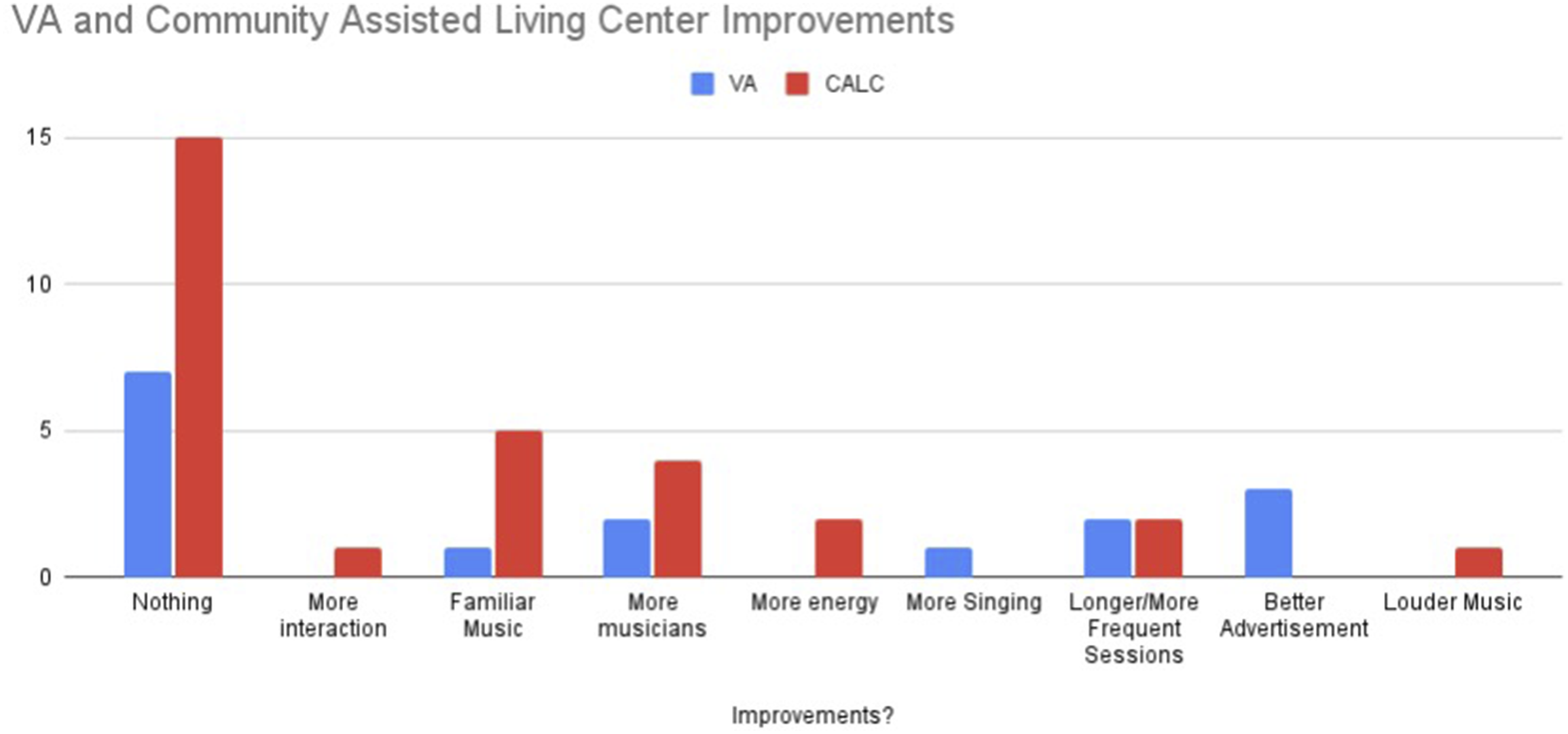
While a number of emotions were evoked during the therapeutic music performances (Figure 4), participants from both settings largely responded that the music made them feel good (31%, 13/42) and relaxed (24%, 10/42). Over half of the participants stated they would not change anything about the music performances (52%, 22/42). The other portion of participants suggested longer performances, more musicians, and more familiar music (Figure 5). Specifically, VA respondents recommended better advertisements about the event to draw more attendance and allow for sharing with friends/family. Feelings Associated With the Live Music Feedback for Future Performances
Discussion/Conclusions and Implications
This multi-location therapeutic music study assessed patients, visitors, VA staff, and community assisted living residents’ perceptions of listening to live music performed by volunteer musicians at a VA Medical Center and a community assisted living center in Nashville, Tennessee. While demographic differences existed between the participants, a majority indicated music was significant in their lives, that they enjoyed all types of instruments/genres, and had no negative feedback about their performances. Individuals readily accept therapeutic music in hospital and nonclinical settings and commonly have positive experiences associated with these performances.22-26 Therapeutic music has been shown to reduce patient stress and anxiety, coinciding with the responses of the study participants who appreciated the pleasant environment and relaxation the live music created.5,27-29
A majority of responses indicated no preference for type of music demonstrating that audiences value the overall music experience and performance energy more than any specific instrument or genre, which has been demonstrated in previous research. 18 Nevertheless, the data regarding what genres/instruments/artists patients and community participants enjoy can help inform which musicians should be recruited for the therapeutic music performances. Program facilitators can track participant responses over performances and update the music programming for maximal audience enjoyment and benefit, thereby addressing the feedback of “more familiar music.” Additionally, addressing the “marketing the event earlier” feedback provides the opportunity to take music suggestions ahead of time, further aligning programming to audience preference.
The data regarding what audiences at each specific location enjoyed most can also be used to tailor the music performances. For example, VA respondents appreciated the pleasant environment and relaxing break the music performance provided while the assisted living audience simply enjoyed having an event and interacting with young musicians after the performance. This is evidenced by the assisted living participants using words like “impressed, loved, at home, inspired” compared to VA respondents largely saying words like “peaceful, relaxed, calming, restful.” These findings are salient as they highlight the specific needs of each audience with VA audiences appreciating a calm environment away from hospital commotion and community assisted living audiences appreciating interaction and the event itself.
Overall, hosting community-based therapeutic music performances provides many benefits in a variety of settings both clinical and non-clinical. It also proves to be a successful way to engage local musicians for community involvement. Regardless of genre and instruments, participants enjoy live performances where they can relax and mitigate stress. Additional research on other aspects of therapeutic music benefits could help to inform program expansion to additional settings and audiences, helping to address the difficulties of long-term health needs, everyday limitations, and social isolation, and help create and support healthy communities.
Footnotes
Acknowledgement
Funding received from the Vanderbilt University Arts Discovery and Innovation Program and from AARP is gratefully acknowledged.

Funding
The authors disclosed receipt of the following financial support for the research, authorship, and/or publication of this article: This study is supported by Funding received from the Vanderbilt University Arts Discovery.
Declaration of Conflicting Interests
The authors declared no potential conflicts of interest with respect to the research, authorship, and/or publication of this article.
Data Availability Statement
The qualitative data is available and can be shared.