



Abstract
Background
Ayurveda Prakriti determines individuals’ physical, physiological, and psychological features. Prana—the vital life energy—flows throughout the body and is intimately linked to the tridosha.
Objectives
This pilot study aims to explore the relationship between tridosha and the intensity and distribution of Pranic Energy Sensations (PES), along with physiological parameters and mental well-being.
Method
This single-arm pilot study was conducted at a Government Ayurveda Medical College, Mysuru, Karnataka, India, using convenience sampling. Data collection encompassed demographic details, the Dosha self-assessment questionnaire, Positive State of Mind Scale (PSOMS), and physiological parameters including Body Mass Index (BMI), Peak Expiratory Flow Rate (PEFR), oxygen saturation (SpO2), and temperature. Following Sensitizing the Hands Practice (SHP) and Energising Prana Technique (EPT), the intensity and distribution of PES in the palms were recorded and analyzed.
Results
Ninety-one apparently healthy Ayurveda students with a mean age of 24.86 ± 2.32 years participated. Exploratory correlations suggested that PES intensity had a positive correlation with Body Vata (ρ = .224, P ≤ .05) and Pitta (r = .209, P ≤ .05). Mind Vata showed a negative correlation with Positive State of Mind (ρ = −.373, P ≤ .01). Body Vata also showed correlations with forehead temperature (pre: ρ = .282; post: ρ = .348, P ≤ .01), and Body Kapha with PEFR (ρ = .206, P ≤ .05). A small to moderate reduction in temperature was observed post-EPT.
Conclusion
This pilot study identified an association between higher PES intensity and Body Vata and Pitta dominance among Ayurveda students, suggesting a potential link between PES, Prakriti, physical parameters and psychological state. These findings align with Ayurvedic concepts connecting Vata and Prana, offering preliminary support for their relevance in biofield therapies. Further studies with control groups and objective validation are recommended.
Keywords
Introduction
The general consensus is that Prana, Chi, and Ki—the life forces (Pranahetutvat Pranah-Cha Chi 24/60 Teeka) 1 cannot be directly measured. However, their interactions with the biosystem have been studied extensively in Ayurveda and Yoga. 2 Classical texts describe Vayu as the primary entity that confers Prana in the body. All actions inside the body, whether voluntary or involuntary, are governed by Vayu 3 and it plays a crucial role in disease manifestation (Cha Su 25/40; 17/118). 1 Vayu referred to as Prana, flows through the Pranavaha Srotas—channels that distribute Prana throughout the body (Cha Vi 5/8). 1 These channels are akin to the Nadis in Yogic tradition, which are also pathways for vital energy. Additionally, Prana flows through the Chakras, which are whirling energy centers that correspond to various physiological and psychological functions. Thus, while Pranavaha Srotas, Nadis, and Chakras (energy centers or points) all serve as conduits for vital energy, they represent different aspects of the same fundamental principle: the distribution and influence of life force within the body.
Pranic Energy Sensation (PES)
The flow of Prāṇa is a fundamental characteristic that enables the activity of the sense organs—eyes, ears, nose, tongue, and skin (Cha. Sū. 9/4; Cha. In. 1/1) 1 In a recent review of complementary biofield therapies, subtle energy experiences — frequently termed Pranic energy — were reported to manifest as sensations like tingling, warmth, coolness, pressure, or a magnetic feeling. 4 Research into techniques used in complementary therapy of Pranic Healing (PH), including the Sensitization of Hands Practice (SHP) and Meditation on Twin Hearts (MTH), support the idea that Pranic energy sensations (PES) are experiential and have been shown to positively impact health and quality of life for participants.5,6 In PH, healers perceive and regulate Pranic energy within the Chakras- the energy centers as part of the healing process, 7 PH practitioners integrate various techniques from the Ancient Art of Pranic Healing, such as SHP, cleansing- the process of removal of negative or stagnant energy from the body and its energy field, and the reception- the process of receiving energy from the environment and projection- directing focused Prana, or life force energy, to targeted areas of the body or to specific chakras to facilitate healing, balance and rejuvenation, it is termed as Energising with Prana Technique (EPT). 8 The intensity of Pranic Energy Sensation (PES) during Pranic Healing practice can be measured using a Likert scale. 7 While participants reported sensations in their center of palms, tip of fingers, and other areas of palms during PES sensing practices, 5 a thorough investigation and measurement of the specific areas of the palm where Pranic Energy Sensations (PES) experiences have not yet been conducted.
Concept of Prana and Triguna in Ayurveda
Pranic energy influences physical and mental health remains a subject of investigation. In the context of Ayurveda, one of the core healing practices involving pranic energy is Marma Chikitsa, which entails the deliberate and controlled physical stimulation of Marma points—vital energy centers considered to be the seats of Prana (life force). This technique is applied with the objective of achieving specific therapeutic outcomes, such as balancing internal energies and promoting holistic well-being. The basic logic behind the use of these Marma regions rests on the theory of Panchamahabuta and Triguna, the fundamental constituents of all physical forms. 9 These principles serve as the building blocks of all matter, both living and non-living. Prior studies also indicate a relationship between triumvirate nature Triguna personality, where individual experiences are negatively correlated with Satva guna, and electric sensations are positively correlated with Tamas Guna. 10 The Panchamahabhootas (5 elements) arise from the Pancha Tanmatras (subtle elements), which are byproducts of Triguna (Sattva, Rajas, and Tamas). The Tridosha (Vata, Pitta, Kapha) are also composed of these elements and thus exhibit varying degrees of Sattva, Rajas, and Tamas.
Concept of Dosha Prakriti
In Ayurveda, Tridosha determines individuals’ physical, physiological, and psychological features. The relative proportions of Tridosha in an individual are established during conception, and the predominant Dosha is expressed by a unique constitutional feature called Prakriti.1,11-13 Ayurveda recognizes Prakriti, as determined by physical, physiological, immunological, and behavioral traits described in Charaka Samhita. 14 Understanding these determinants may reveal potential connections with contemporary scientific understanding of the human. Even though there are 7 types of Prakriti (Vata, Pitta, Kapha, Vata-Pitta, Vata-Kapha, Pitta-Kapha, Vata-Pitta-Kapha) (Su. Sha. 4/62), 15 majorly 3 constitutional types are considered- Vata, Pitta, and Kapha are considered as extremes. 16 Each Prakriti is characterized by specific physical, psychological, and digestive features, affecting individuals’ physiological and mental functions (Cha Vi 8/96-100). 1
Each Dosha is responsible for certain physiological functions. For example, Vata controls movement and flow, Pitta governs digestion and metabolism, and Kapha provides structure, lubrication, and stability in the body (Cha Su 12/8-10).1,13 Vata-predominant constitution (air + space dominance) is characterized by attributes of dryness, lightness, hyperactivity, and reduced sleep quality. Pitta-predominant constitution (fire + water dominance) types show higher metabolic rate, increased appetite, moderate build, oily skin, good memory, and short temperedness. Kapha-predominant (water + earth) constitution, on the other hand, shows tendencies towards weight gain, lower metabolism, increased sleep, and inertia (Cha In 1/5).1,17 Previous research indicates that Dosha types affect an individual’s brain function. Vata Dosha individuals tend to possess highly variable behaviors, and responses to the environment; Pitta is characterized by dynamism; Kapha types are steadier (Cha Vi 8).1,16 Individuals with Vata types tend to multitask, learn, and forget things rapidly, and demonstrate a high range of prefrontal functioning. 18
A cross-sectional study revealed a significant relationship between body composition—comprising body weight, height, body fat in percentage, fat mass, BMI, and Prakriti. 19 The findings were consistent with William Sheldon’s somatotype classification system. 20 Prana Vata and Udana Vata are the major types of Vata responsible for Uchwasa and Nishwasa Kriya (Inspiration and Expiration). Vata’s function in regulating bodily movements aligns with the vagus nerve’s control over heart rate variability, steady breathing, and efficient digestion.1,21 Furthermore, a correlation between Prakriti and genetic factors influencing the mental, emotional, and behavioral system.22-25 Pranic energy perception, PH and MTH studies also demonstrated the linking of PES and wellbeing.4-7
From these insights, we hypothesized that individuals’ unique personal traits (Dosha Prakriti) influence their PES. Observations suggested a correlation between Dosha Prakriti and PES, as subtle energy aids in balancing mental and physical well-being. Doshas reflect the unified functional principles of the mind-body system, arising from the shared substratum of the 5 elements. They potentially impact energy experiences, variations in perceptual capacities, and experiences prompted the design of this study.This study aimed to investigate the relationship between Tridosha and intensity of Pranic Energy Sensations (PES), the area of the palms (measured in square millimeters) where PES are felt during EPT, as well as the Positive State of Mind before practicing EPT, Body Mass Index (BMI), and Peak Expiratory Flow Rate (PEFR). The study also assessed the effect of Pranic Energy Sensations (PES) on the temperature of the forehead and palms before and after practicing EPT.
Materials and Methods
Study Design
This exploratory pilot study, using convenience sampling, examined the relationship between Prakriti, PES, and well-being measures. It included a pre-post analysis of body temperature.
Participants and Setting
91 apparently healthy students from Government Ayurveda Medical College & Hospital, Mysuru, Karnataka, India took part in the study.
Inclusion and Exclusion Criteria
Male and female Ayurveda students aged 18 to 35 years were included in the study. Subjects with symptoms such as fever, cold, cough, recently diagnosed cases of COVID-19, or any other infections were excluded from the study. Additionally, subjects who were already familiar with Pranic Healing, Reiki, and other energy healing practices and, those who did not sign the consent form, and those who withdrew consent during the session were also excluded. Ayurveda students who signed the consent form were seated in the hall.
Sample Size
A medium correlation of .30 with 95% confidence interval and 80% power was calculated 85 samples. 25 However, to account for group participation and convenience, 91 students were enrolled in the study.
Study Procedures
All participants assembled to receive information about the research. Each participant was given an informational sheet outlining the details of the study. The study procedures were verbally explained to the participants and they signed the written consent. Demographic information was collected, and forehead and palm temperatures were measured. Following the administration of the Energizing with Prana Technique (EPT), data were gathered on the outcome measures. The EPT technique was introduced by an experienced pranic healer, with support from a team of healthcare professionals, including Ayurvedic doctors, psychologist, and a registered Nurse.
Intervention
As a preparation, to familiarize participants with Pranic energy experiences, Sensitizing Hand Procedure (SHP) was introduced, demonstrated, and practiced. SHP involved standard gestures and procedures designed to enhance participants’ awareness of Pranic flow as explained in Figure 1.8,26 Intervention Procedure by Study Participants
Energizing with Prana Technique (EPT): Procedure
Stage 1
Stage 2
Stage 3
Water Bottle as Focus Area
After experiencing Pranic Sensitization and Pranic Energizing techniques, each participant received a 10 mL glass bottle with a cork lid, placed on the table in front of them as the focus area for the energy transfer. (Supplemental file 1) During the exercise, participants were instructed to note any energy sensations in both hands (receiving and projecting). All instructions were neutral, avoiding any suggestion or prompting.
EPT Practice
Preparation: Ensure that the armpits are slightly open. Press the center of each palm using your thumbs to activate the energy centers. This practice is to be followed after completing the SHP.
Drawing in Prana: Keep one of your hands with the palm turned upwards. Concentrate on the center of the palm for 10-15 seconds with an intention to absorb Prana. Inhale slowly and comfortably, and exhale slowly and comfortably.
Projecting Prana: Keep the other hand with the palm turned towards the target, maintaining a distance of 3-4 inches. Continue to concentrate on the center of both palms. Concentrate more on the receiving hand. Focus on the center of both palms while maintaining the distance from the target with an intention to project Prana (Supplemental file 1).
The researchers ensured all participants performed the technique as introduced, by checking each row, clarifying doubts, and correcting hand positions and posture if required.
The Pranic Energizing was carried out in 2 sessions:
Instructions: Participants focused on receiving energy with their left hand while simultaneously observing sensations and focusing on their breathing. They projected Prana from their right hand into the water bottle.
Instructions: The roles of the hands were reversed, with the right hand now receiving and the left-hand projecting. Participants again focused on the sensations in both hands during the session. To eliminate any preferential sensory perception associated with hand dominance, this method aimed for balanced sensation bilaterally.
The study was conducted on 30th January 2024. The duration of the study was 4 hours including informed consent, screening, experiment, and data collection (Supplemental file 2). An experienced Pranic healer introduced the EPT to the participants. 8
Ethical Approval and Consent to Participate
The Institutional Ethics Committee of Government Ayurveda Medical College and Hospital, Mysuru reviewed and approved the study before the commencement of the trial (Ref No: IEC/GAMC/SP (1) 2023-24 approved on 21/10/2023). The study was registered under the Clinical Trial Registry of India (Ref No: CTRI/2023/12/060520 registered on 19/12/2023).
Measures
Demographics
Case Sheet proforma was prepared to collect basic demographic details of participants like age, gender, religion, locality, socio-economic status, and medications in the last 24 hours.
The Tridosha Scale
is an internationally validated questionnaire to quantify the 3 Doshas, the constitutional type. 27 It is a reliable, open-source Prakriti self-assessment questionnaire targeting English-speaking adults with reference to best practices in health care scale development. It demonstrates satisfactory reliability for research purposes with Dosha-specific coefficients above 0.8. It is a 39-item ipsative questionnaire (13 for each Dosha) that serves as a basis for generating 108 Dosha-specific test items featuring a 7-point Likert Scale.
Positive States of Mind Scale (PSOMS)
It assesses the state patterns in an individual’s capacities to enter valued cognitive and interpersonal states. 28 This provides a discrete measure of 7 specific states as a summation of the individual’s ability to achieve each positive state of mind over a short time, mostly in recent weeks. The positive states include focused attention, productivity, responsible caretaking, Restful response, sharing, non-sexual sensuous pleasure, and sexual pleasure. PSOMS has high internal consistency (Crobach’s Alpha for 6 items was 0.77).
Pranic Energy Sensations (PES)
PES were reported using a semi-structured questionnaire developed by the WPHF Research Centre. This intensity of PES measure followed the biofield evaluation by Rowold. 29 Participants rated the intensity of energy sensations on a Likert scale, ranging from 0 (no sensation in the hands) to 10 (maximum intensity). To document the location of the sensations, participants were given diagrams of one third size of hands of both the right and left palms, and asked to mark the areas where they felt the Pranic energy. PES was measured across 2 sessions, where participants practiced 2 different hand positions to minimize any potential bias linked to natural hand dominance, which could otherwise lead to an uneven perception of sensations. These sessions allowed for the identification of the type of sensations experienced, and their intensity, and to mark specific areas of the hands where the energy was perceived.
Scoring
Intensity
The intensity of PES, along with the areas where participants felt the sensations and the types of experiences during projecting and receiving practices, were scored separately. The overall PES score for each participant was calculated by averaging the intensity of all types of sensations combined. The average PES during the 2 receiving sessions (1 with the left hand and 1 with the right hand) was calculated as the “Receiving PES.” Similarly, the “Projecting PES” was calculated by averaging the sensations experienced during the projecting sessions.
Area
The surface area of PES marked on the datasheets by participants was measured using the ImageJ image analysis software. The hand was divided into 4 sections- palm, distal, intermediate, and proximal phalange of the fingers (Supplemental file 3) Areas marked in each section were measured separately and documented. Participants had marked their PES in various shapes and designs, all shapes were measured separately using a freehand selection of measuring surface area, and the total area in a particular section was calculated by adding surface areas of all the shapes. The area in pixels was converted to square centimeters using the formula (2.54/200 dpi) 30 x Area in Pixels x 3 times. Areas from the 4 sections were added together, and the average of sensations received in sessions 1 and 2, as well as projected in sessions 1 and 2, was considered for analysis.
BMI = Weight (Kg)/ Height 2 (Cm).
Statistical Analysis
Quantitative
Inferential statistics, including Welch’s test, was performed to assess differences in study variables based on gender and location. Pearson correlation was used for normally distributed variables, while Spearman correlation was applied to non-normal data. Wilcoxon signed rank tests were done to analyze the pre-post changes in temperature. An outlier related to Kapha and Vata was excluded from the analysis. SPSS-21 and Image J software were used to analyse the data.
Qualitative Categorization
The elemental level sensations experienced by participants were categorized into physical sensations of energy, magnetic sensations, temperature variations, and awareness of the presence of energy. 5 Sensations were coded based on their presence or absence, and Spearman’s correlation analysis was conducted with other study variables. Associations with sociodemographic variables such as gender and location were also examined using the chi-square test. The presence or absence of sensations was correlated with Vata, Pitta Kapha scores using Spearman’s ranked correlation.
Results
The research was conducted in January 2024 at the auditorium of the Government Ayurveda Medical College in Karnataka. The study involved relatively healthy Ayurveda Medical students enrolled in Bachelor’s and Postgraduate courses. Out of the 96 participants who initially agreed to participate, 4 were excluded for the following reasons: 2 did not meet the age criteria, 1 had prior knowledge of energy healing, and 1 had a health condition involving fever and cold. A total of 92 participants practiced EPT, but 1 participant was excluded from the analysis due to being identified as an outlier in the Tridosha outcome (Figure 2). Flow Chart
Sample Demography
The study included 91 participants, comprising 31.52% males and 68.10% females, with a mean age of 24.86 ± 2.31 years. Nearly half of the participants (47.30%) were enrolled in postgraduate programs, while 38.04% were undergraduate students, and 14.13% were interns. The majority of participants were Hindu (94.50%), followed by Muslim (3.26%), with a small proportion identifying as Christian (1.08%) and Jain (1.08%). Most participants came from urban areas (65.93%), while 33.69% were from rural backgrounds. In terms of socio- economic status, the majority belonged to the middle class (87.91%), followed by lower class (6.52%), and upper class (5.43%).
Location and Gender-Based Variations in Tridosha and BMI

*Significant at 0.05 level (2-tailed), V: vata, P: pitta, K: kapha, Dig: Digestive.
There is a statistically significant difference (P ≤ 0.05) in body Vata (Welch t = 4.12, P = .046) and body Kapha (Welch t = 5.84, P = .019 between male and female participants. The female group had a higher mean (4.30) compared to the male group (3.84) in body Vata. Male participants found more (4.70) body Kapha than females (4.19). All other variables on gender were not significantly different.
Correlation of TriDosha, Quantity of Pranic Energy, BMI and PSOMS

**Correlation is significant at the 0.01 level (2-tailed), *Correlation is significant at the 0.05 level (2-tailed), r-Pearson Correlation (Parametric), ρ- Spearman (non- Parametric). V:vata, P:pitta, K:kapha, Dig: Digestive, BMI: Body Mass Index, PSOMS: Positive state of Mind Scale.
Correlation of TriDosha in Relation to Physiological Parameters

**Correlation is significant at the 0.01 level (2-tailed), *. Correlation is significant at the 0.05 level (2-tailed), PEFR: Peak Expiratory Flow Rate, SPO2: peripheral oxygen saturation.
Spearman’s Correlation of Presence of Sensations, PSOMS and Tridosha
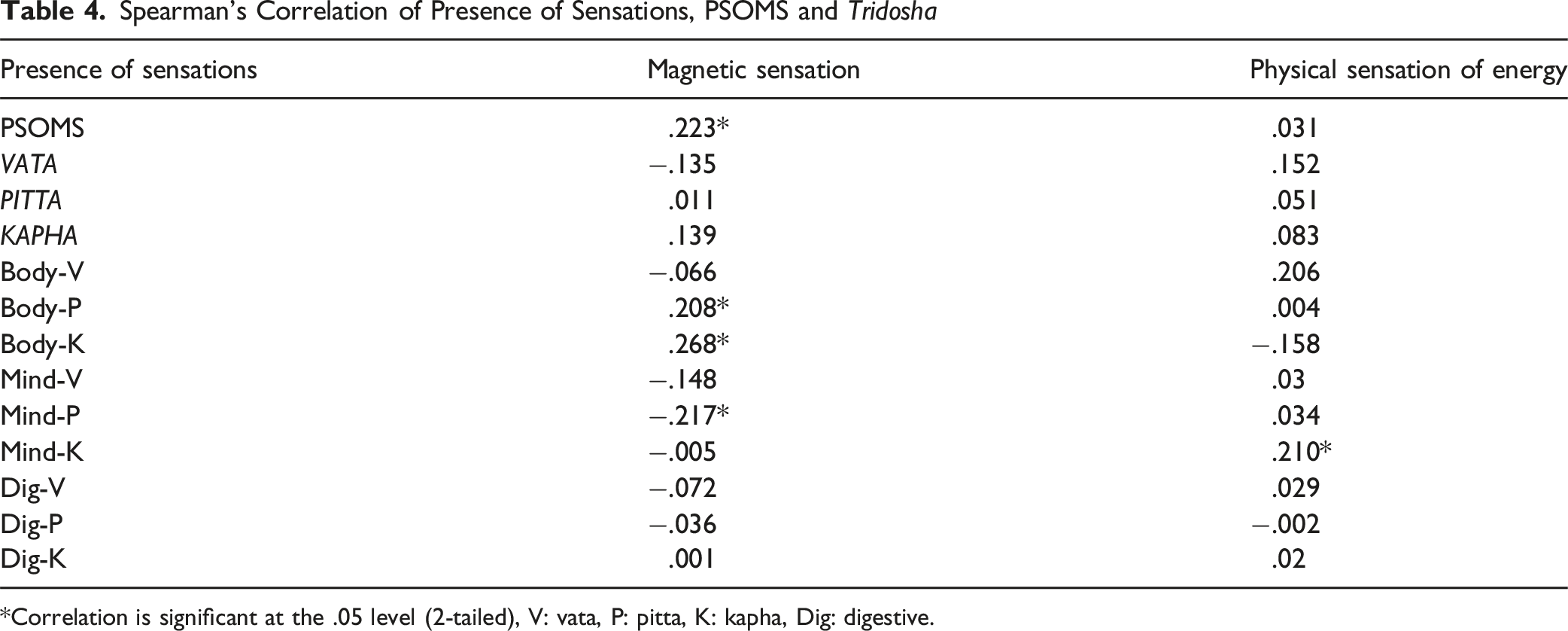
*Correlation is significant at the .05 level (2-tailed), V: vata, P: pitta, K: kapha, Dig: digestive.
Correlation of Presence of Pranic Energy Sensations During Receiving and Projection Procedures With Tridosha

*Correlation is significant at the .05 level (2-tailed), V:vata, P:pitta, K:kapha, Dig: Digestive.

Effect of Energising Prana Technique on the Body Temperature of Participants
Discussions
The findings of this study shed light on the intricate relationships between Ayurveda Prakriti, physiological variables, mental states, and PES. The observed correlations highlight the role of individual Dosha profiles in shaping energy experiences, as well as physiological and psychological markers. Notably, the interplay of Vata, Pitta, and Kapha with various aspects of energy projection, reception, and physical sensations underscores the complexity of subtle energy dynamics. These findings also suggest that Kapha and Vata, may significantly impact mental states, as seen in their respective positive and negative correlations with a positive state of mind. Additionally, the significant reduction in body temperature observed after practicing EPT indicates a measurable physiological effect associated with these practices. The associations between Doshas, body temperature, respiratory parameters, and energy perceptions further point to a potential integration of Ayurveda principles with measurable physiological outcomes. These initial insights pave the way for a deeper exploration of the Dosha-specific mechanisms underlying Pranic perception and their broader implications for health and well-being. This study employed the Tridosha framework to explore and better understand the perception of Pranic Energy. In classical Ayurvedic texts, human beings are described as Pranabhrita—carriers of Prana (Cha. Vi. 8/96; Cha. Su. 18/48)—emphasizing the central role of Prana in sustaining life. Physicians, in turn, are referred to as Pranabhisara, the protectors and preservers of Prana (Cha. Su. 9/18). These concepts not only underscore the profound significance of Prana in human physiology and consciousness but also highlight the relevance of integrating traditional Ayurvedic wisdom into contemporary explorations of subtle energy perception.
Demographic Observations
The urban group demonstrated a higher mean for Mind Vata than the rural group. While Patwardhan et al suggest that Prakriti is independent of ethnicity, race, geography, and language, Huang Z, et al argues that ethnicity (Jatiprasakta), familial traits (Kulanupatini), and geoclimatic factors (Deshanupatini) impact phenotypic variability.32,33 Urban participants also displayed higher BMI than rural counterparts, indicating an influence of dietary habits and physical inactivity on body weight. Mind Vata and BMI differ significantly between rural and urban groups, with urban individuals showing higher means. This can be linked to irregular eating habits associated with Mind Vata, where fluctuating moods and poor food control in urban areas increase BMI. Vata types exhibit frequent snacking and drinking habits due to a constantly shifting hypothalamic influence. 18
Among participants, females demonstrated a higher mean Body Vata than males, while males exhibited a higher mean Body Kapha. This novel finding could be influenced by various factors, including geographical location, sample characteristics, or other underlying variables, warranting further investigation to understand the contributing determinants. Sociodemographic factors such as gender and locality positively correlated with PES; females generally report greater sensitivity to physical sensations. 34
Vata Prakriti
Categorization of parameters to analyze Pranic perception and its influences are attached in Supplemental file 4.
Additionally, Vata Dosha plays a supportive role in perceiving Prana sensations, with a positive correlation observed between Vata and Pitta. The shared predominance of Rajo Guna in both Vata and Pitta explains this, as Rajo Guna promotes stimulation and activity. Vata’s role in kindling Agni, the core of Pitta located in the stomach (Amashaya) (Cha Chi 15/6-7), aligns with an increased sympathetic response system in such individuals, making them more reactive to stimuli and engaging the fight-or-flight response. 1
Reiki treatment led to higher body temperatures compared to placebo, indicating a thermogenic effect linked to biofield therapy. 36 Fingertip temperatures increased during the focus period and decreased during withdrawal, reflecting dynamic changes in peripheral circulation influenced by focused energy. 37 Similarly, meditation impacted temperature regulation, with forehead temperatures decreasing more during meditation than during rest, suggesting enhanced parasympathetic activity. Chin temperature increased during meditation, with experienced meditators showing notable differences in forehead and chin temperatures. 38 These findings suggest that EPT may induce thermoregulatory shifts through enhanced autonomic balance or localized energy redistribution. Further research is needed to explore temperature changes in palms. Slight reduction of body temperature can be considered as an indicator of better cognitive activity. 39
A positive correlation between Mind Vata and BMI suggests that stress and anxiety—stimulating the vagus nerve, drive frequent eating, raising BMI. Conversely, Digestive Vata shows a negative correlation with BMI. The Vishamagni (irregular digestion) associated with Vata impacts metabolism and BMI, as irregular digestive power often lowers metabolic efficiency (A H Su 1/8). 11 Additionally, Body Vata’s negative correlation with BMI is aligned with the tendency of Vata Prakriti individuals to maintain a leaner physique (Cha Vi 8/98). 1 Imbalances in Vata can cause anxiety and stress, impacting metabolism, while Vata is protective against obesity and associated with constipation and sleep disorders. These factors influence Body Mass Index (BMI), with this study providing evidence of the correlation between Mind Vata and BMI. 40
Additionally, Vata Dosha stimulates the functioning of Pitta and Kapha and all Dhatu and Mala, demonstrating its regulatory role across bodily functions.18,41 This is reflected in the correlations of Vata with Pitta, Kapha, Body Vata, Body Kapha, Mind Vata, Mind Pitta, and Digestive Vata. Known for its ‘Yogavahi’ property, Vata adapts qualities from other Doshas—displaying warmth when associated with Pitta and coolness when paired with Kapha (Cha Chi 3/38). 1 However, Body Vata negatively correlates with Kapha, underscoring the opposing qualities of each (Vata’s Ruksha (quality associated with dryness or roughness), Laghu(lightness), Sheeta(coldness) vs Kapha’s Snigdha (unctuousness), Guru(heavy), Sheeta) as per Samanya Vishesha Siddhanta- a fundamental principle in Ayurveda that uses the concepts of similarity and dissimilarity to understand and manage health and disease (Cha Su 1/44-45, 1/59-61). 1
Pitta Prakriti
Kapha Prakriti
Physical sensations, where individuals perceive an object’s presence or feel as though they are holding one in their hand, correlate positively with Mind-Kapha. This may arise from the Tamo Guna predominance and the Prithvi-Ap Mahabhoota constitution in Kapha, imparting qualities of stability, coolness, moisture, and weight. Prithvi (earth) and Jala (water) elements contribute attributes like Drava (fluidity), Stimita (stillness), Sheeta (coolness), and Snigdha (unctuousness), enhancing this tactile perception.1,11 Moreover, Mind-Kapha individuals display a composed and attentive mental state, with robust memory and cognitive skills, further strengthening this correlation (Table 4).
Body Kapha displayed a negative correlation with forehead temperature, aligning with its inherent Sheeta (cold) quality. The elemental composition and predominance of Mahabhoota (Prithvi and Jala) and Tamo Guna in Kapha contribute to naturally lower body temperatures. Kapha’s stable and less adaptive nature keeps it relatively unaffected by external temperature changes, which helps maintain cooler, steady internal conditions.
Significant findings also revealed a strong association between Kapha Prakriti and Peak Expiratory Flow Rate (PEFR); Body Kapha correlated positively with PEFR, while Mind Kapha showed a positive correlation with SpO2. The primary location of Kapha Dosha in the Ura Pradesha (chest region) aligns with respiratory function, as the heart and lungs reside in chest region. (A H Su 12/15; Su Sha 4/31)11,15 Kapha’s role in maintaining respiratory health is suggested by these correlations, indicating that optimal Kapha function is associated with PEFR in healthy individuals.
Recent Scientific Inquiries and Their Application to Tridosha Theory
Study Findings Linking Ayurveda Tridosha to Experimental Contexts

Vata Dosha is associated with movement and sensory communication, manifests in heightened tactile and energy sensations such as tingling, electrical impulses, and energy release from palms.5,10,42,44 For instance, studies on Pranic Energy Projection (PEP) with NCC students reported electric sensations that are sensed with the help of Vata Dosha.10,42 Vata is depicted as the controller of all physiological systems (Vayusthantra Yantra Dharah), governing vital life activities through Prana, Udana, Samana, Vyana, and Apana subtypes (Pranodana Samanavyanapanatma).1,40 The individual influence of specific sub-type of Vata is depicted separately in the Table 6. In MTH practices, increased sensitivity and physical lightness, highlighting its quick responsiveness to energy dynamics reflects Vata’s influence in stimulating enthusiasm, and joy, ensuring vitality and health.1,40 Across these studies, Prana enhances awareness and energy levels in PEP and COPD contexts, reflecting Utsahochwasa (vital breath), while Udana supports lung function and Vyana promotes locomotion, as seen in zebrafish studies.45,47 Apana governs elimination processes, aiding bladder function in elderly men. 7 PH has shown reduction in mild to moderate depression in subjects indicating Vata’s influence on Manas (Mind), inducing Harsha (Happiness).40,44 These insights validate the Tridosha framework by connecting it to observed physiological and energy dynamics.
Pitta, which governs metabolism, transformation, and sensory intensity, is associated with sensations of warmth in garment workers practicing PH, attributed to the innate function of maintaining the body’s temperature. 46 In agriculture, Pitta influences increased chlorophyll content, yield, and genetic variability in RAPD markers (47%), demonstrating its role in energy absorption and transformation, aligning with Pitta’s metabolic functions. 49 Kapha, linked to stability and nourishment, is reflected in higher yields, plant stability and physical sensations among nursing students.6,48
Vata, particularly Prana Vata, is observed to play a central role in the physiological processes discussed. While the subtypes of Vata are individually described, they can be understood as decentralized manifestations of Prana Vata, each defined by its specific function and location. Vata’s primary role as the governing force is essential for the movement and regulation of Pitta, Kapha, Dhatus, and Malas within the body. Much like wind propelling clouds, Vata Dosha facilitates the mobilization and functional integration of these bodily components. This integrative approach opens an avenue for the potential alignment of Dosha principles with modern therapeutic interventions offering a holistic integrative perspective for further research.
Strengths of This Study
This exploratory, single-arm study offers preliminary insights into the subjective experience of energy sensations among Ayurveda students following Pranic Healing techniques. It presents a novel approach by examining potential correlations between Prakriti (Ayurvedic typology) and physio-psychological attributes such as temperature, PEFR, SpO2, BMI, and mental state. The study contributes to a growing interest in integrative modalities by introducing an Ayurvedic lens to subtle energy perception, laying the groundwork for further inquiry into Prakriti-based physiological and psychological responses.
Limitations of the Study
The study was carried out at a single centre and did not include a control group, convenient sampling, which limits randomisation and restricts the generalisability of the findings. Being a pilot and correlation study, the variation seen in the data could be influenced by other factors—like environment, diet, lifestyle, or genetics—not just prakṛti. Some of the tools used have only face validity; additional validation is required to establish their reliability and applicability in larger-scale research.
Implications of the Research
Tridosha profiling can help predict and interpret individual differences in pranic energy perception during energising techniques. Dosha type, especially Vata or Kapha, helps guide and improve Energising Prana Technique and explains why people feel pranic energy sensations differently during these practices. This study provides initial insights into the possible use of Pranic Healing approaches, such as Energising Ayurvedic medicines to affect the perceived energetic quality of pharmaceuticals, as an exploratory experiment. The results point to a potential relationship between energy-based therapies and the Ayurvedic framework, especially in regard to Prakriti and the idea of Tridosha, even if no therapeutic claims can be made. These preliminary findings encourage more research into the potential for AYUSH systems and subtle energy modalities to integrate.
Conclusion
This exploratory study is among the first to document both subjective and physiological responses of Ayurvedic practitioners during the Energising Prana Technique (EPT). Increased perceptual sensitivity to pranic energy during EPT was linked to higher Body Vata and Pitta among students, underscoring the role of these doshas in regulating subtle energy and related functions. The greater pranic energy sensitivity (PES) observed in Vata-dominant individuals aligns with the shared Vayu nature of Vata and Prana, reinforcing their energetic sensitivity and the relevance of Ayurvedic principles in biofield therapies. Preliminary correlations suggest that the intensity of energy sensations may be influenced by physical constitution, particularly Body Vata and Pitta. Associations between Body Pitta and Kapha with magnetic sensations, and Mind Pitta and Kapha with PES, indicate that both somatic and psychological typologies may shape energy perception. Post-EPT reductions in forehead and palm temperatures, along with correlations involving Body Vata and Kapha, may reflect a calming physiological shift. While not conclusive, these findings lay a foundation for future controlled studies exploring the interplay between Ayurvedic typology and energetic experiences.
Supplemental Material
Supplemental Material - Tridosha Influence on Prana Perception and Well-Being: An Exploratory Study of Pranic Healing Techniques Among Ayurveda Students
Supplemental Material for Tridosha Influence on Prana Perception and Well-Being: An Exploratory Study of Pranic Healing Techniques Among Ayurveda Students by Vinushree M.K.S., Vinu V., Srikanth N. Jois, Venkatakrishna K.V. in Global Advances in Integrative Medicine and Health
Supplemental Material
Supplemental Material - Tridosha Influence on Prana Perception and Well-Being: An Exploratory Study of Pranic Healing Techniques Among Ayurveda Students
Supplemental Material for Tridosha Influence on Prana Perception and Well-Being: An Exploratory Study of Pranic Healing Techniques Among Ayurveda Students by Vinushree M.K.S., Vinu V., Srikanth N. Jois, Venkatakrishna K.V. in Global Advances in Integrative Medicine and Health
Supplemental Material
Supplemental Material - Tridosha Influence on Prana Perception and Well-Being: An Exploratory Study of Pranic Healing Techniques Among Ayurveda Students
Supplemental Material for Tridosha Influence on Prana Perception and Well-Being: An Exploratory Study of Pranic Healing Techniques Among Ayurveda Students by Vinushree M.K.S., Vinu V., Srikanth N. Jois, Venkatakrishna K.V. in Global Advances in Integrative Medicine and Health
Supplemental Material
Supplemental Material - Tridosha Influence on Prana Perception and Well-Being: An Exploratory Study of Pranic Healing Techniques Among Ayurveda Students
Supplemental Material for Tridosha Influence on Prana Perception and Well-Being: An Exploratory Study of Pranic Healing Techniques Among Ayurveda Students by Vinushree M.K.S., Vinu V., Srikanth N. Jois, Venkatakrishna K.V. in Global Advances in Integrative Medicine and Health
Footnotes
Acknowledgments
We acknowledge the contributions of Dr K.S. Radhakrishna Ramarao, M.D., Principal, Government Ayurveda Medical College, Mysuru (Ayu), valuable for his support. We would like to extend our gratitude to Guru Choa Kok Sui for the clarity on Prana and Pranic Healing techniques. Our thanks to Dr Nagendra Prasad, Mrs Roopa, Mrs Manasa, Dr Ganesh Prasad, Mr Lingraj and Mr Harish and other for their assistance during the data collection. We also recognize the efforts of Shailaja S. for her meticulous depiction of pictorial representations. We thank the Trustees of World Pranic Healing Foundation India for their support.

Ethical Considerations
Trial Registration: The study was registered under the Clinical Trial Registry of India (Ref No: CTRI/2023/12/060520).
Author Contributions
Performed the experiments: VMKS, VV, Conceived and designed the experiments: SNJ, VKV, Analyzed the data: VMKS, VV, SNJ, contributed materials/analysis tools: VMKS, VKV, Wrote the manuscript: VMKS, VV. Contributed equally to this paper: VMKS, VV, VKV, SNJ.
Funding
The author(s) disclosed receipt of the following financial support for the research, authorship, and/or publication of this article: This study is funded by the World Pranic Healing Foundation India.
Declaration of Conflicting Interests
The author(s) declared no potential conflicts of interest with respect to the research, authorship, and/or publication of this article.
Supplemental Material
Supplemental material for this article is available online.
Author Biographies
Appendix
References
Supplementary Material
Please find the following supplemental material available below.
For Open Access articles published under a Creative Commons License, all supplemental material carries the same license as the article it is associated with.
For non-Open Access articles published, all supplemental material carries a non-exclusive license, and permission requests for re-use of supplemental material or any part of supplemental material shall be sent directly to the copyright owner as specified in the copyright notice associated with the article.
