



Abstract
Having validated instruments for the evaluation of lifestyles becomes a necessity for professional practice in terms of promoting the adoption of health-promoting behaviors in various aspects of daily life, such as social interactions, nutrition, physical activity, oral health, environmental health, mobility, and psychoactive substance use.
Objective
To evaluate the construct validity and reliability of the ‘Lifestyle Questionnaire in the Colombian Population” over 18 years of age from the northeastern of Colombia.
Methodology
A psychometric study was conducted with the participation of 551 adults using the instrument proposed by the Pan American Health Organization (PAHO). A confirmatory analysis using the structural equation modeling (SEM) technique was carried out, in addition to an internal consistency analysis.
Results
The confirmatory factor analysis reports the same structure, with adequate goodness-of-fit indicators (X2/df = 2.10, CFI = .88, TLI = .87, RSMEA = .05, SRMR = .04). The reliability estimation of the test and its dimensions, with internal consistency coefficients Cronbach’s α and McDonald’s ω, reported optimal levels in the total test (ω = .93).
Conclusions
The instrument developed by PAHO showed adequate construct validity and reliability indicators for evaluating lifestyles in northeastern Colombian people over 18 years old.
Introduction
Lifestyles refer to a set of behaviors and conduct of individuals, considered an abstract and complex concept that has been studied for many years. 1 Various disciplines, including sociology, anthropology, and epidemiology have investigated this concept. Epidemiology has widely used the concept of lifestyles about health, though with a more restricted interpretation; it mainly associates it with consciously adopted behaviors that may pose risks to individuals’ well-being. 2
Consequently, the adoption of lifestyles develops throughout an individual’s life, indicating that it is a learning process that can occur through the assimilation or imitation of family models, as well as informal or formal groups. 3
During the transition to adulthood, individual behaviors, lifestyle, and well-being can offer valuable insights into how to promote health throughout the life cycle. During this period, it is common for individuals to adopt a variety of behaviors, some beneficial and others less healthy. 4 Consequently, it is confirmed that the adoption of unhealthy lifestyles in life is associated with the presence of various metabolic, cardiovascular, endocrine, and chronic disabling diseases.5-7
Moreover, research on successful aging emphasizes the need to recognize and adopt healthy lifestyles from an early age. 8 This is even more relevant given the growing percentage of older adults, projected to increase by 16% by the year 2050. 9
The Pan American Health Organization (PAHO) and the World Health Organization (WHO) highlight the importance of addressing various determinants of health, including a balanced diet, regular physical activity, stress management, adequate rest, and the elimination of harmful practices such as tobacco and alcohol consumption. Both institutions emphasize promoting healthy habits in all aspects of daily life to contribute to well-being and disease prevention in the population.7,10
In this context, the role of health professionals is fundamental in promoting healthy habits throughout an individual’s life. Thus, having properly validated research tools represents an opportunity to identify relevant variables that influence people’s health, particularly regarding lifestyles and their components, such as physical activity, nutrition, rest, relationships with others, oral health, sexuality, mobility, harmful substance use, life purpose, and the environment.2-4
The literature includes various instruments that evaluate lifestyles, such as the Health-Promoting Lifestyle Profile (HPLP), (six dimensions), 11 the Healthy Lifestyles Questionnaire (EVS), (seven dimensions), 12 the FANTASTIC instrument, (seven dimensions), 13 and the one proposed by the Pan American Health Organization (PAHO) on lifestyles, (ten dimensions). 14
The PAHO Lifestyle Assessment Instrument offers significant advantages over other tests, as it was specifically designed for the Americas, enhancing its applicability, regional validation, and utility in health policy formulation. In addition to enabling precise analysis of individual risk factors, it facilitates the integration of data into public health information systems, optimizing planning and decision-making. In this regard, the authors aim to verify its psychometric properties previously identified in Spanish. However, given the significant cultural and linguistic variability of the northeastern Colombian population, influenced by its border location, it is essential to assess its reliability and validity in this specific context.
In Colombia, some institutions, particularly in the education, health, and social services sectors have utilized the original instrument PAHO lifestyle assessment instrument to evaluate lifestyles (physical activity, nutrition, rest, social relationships, oral health, sexuality, mobility, substance use, sense of life, and environment)14,15; however, the psychometric properties of this questionnaire have not been rigorously evaluated with the population of northeastern Colombia, who have particular accents and verbal expressions, different from other populations in the same country.
Furthermore, a limited number of Colombian instruments exist for assessing healthy habits in the general adult population, 16 while one such instrument exists, its psychometric properties have not been reported. Available research primarily focuses on the psychometric properties of the adult 13 and adolescent 17 versions of the FANTASTIC instrument, as well as instruments adapted by Varela et al 18 and Niño-Bautista et al 19 for assessing healthy habits in children.
Therefore, this study aims to evaluate the construct validity and reliability of the lifestyle questionnaire in the northeastern Colombia population over 18 years old.
Methods
Type of Research
A study was conducted to validate the psychometric properties of a lifestyle instrument developed by the Pan American Health Organization (PAHO) in adults from Norte de Santander, Colombia. First, a description of the sample was provided, followed by the results regarding the lifestyles of the respondents. Finally, the psychometric analyses related to the test were presented.
Instrument
Item and Factors of the “what is My Lifestyle Like?” Survey.

Procedure
A convenience sample of 551 adult participants from the Norte de Santander (Colombia) region was recruited. This sample not only meets but exceeds the calculated size for an observational study (380), as well as the recommendation of authors such as Snook and Gorsuch, 21 who establish a minimum of 300 observations as sufficient to ensure reliable measurements. Additionally, it surpasses the suggested number based on factor loadings proposed by Hair et al, 22 which, in our case, was set at 350.
Characteristics of the Sample.

Source: Own elaboration.
A research team received a one-week training program on the application of the research instrument. Participants were provided with a link to a Google Forms questionnaire, which included informed consent, the Spanish Version of the Lifestyle (PAHO) questionnaire for the adult population, and basic sociodemographic variables (gender, age, marital status, educational level, and occupation).
Participants completed the self-administered questionnaire voluntarily and autonomously at the University of Pamplona. Researchers were available to address any questions and ensure unbiased responses by minimizing potential distractions or misunderstandings. The average questionnaire completion time was twenty (20) minutes. Upon data collection, the database was downloaded in Excel format for subsequent analysis.
Ethics
The data obtained in this study were handled with strict confidentiality and anonymity. Participation was voluntary and supported by informed consent. The guidelines of the Declaration of Helsinki of 1975 and Article 11 of Resolution #8430 of 1993 of the “Ministerio de Salud” of Colombia were followed. 23
Statistical Analysis
A descriptive analysis of frequencies and percentages was conducted to describe the sample, along with a descriptive analysis of continuous variables to establish possible significant differences according to sociodemographic criteria. A Kolmogorov-Smirnov analysis was performed to determine the distribution of the data. Those dimensions with a P-value >.05 were considered parametric. 24
For confirmatory analysis, the structure was evaluated considering acceptable fit indicators such as Tucker-Lewis Index (TLI) and Comparative Fit Index (CFI) > .90; Additionally, criteria such as RMSEA less than .010, SRMR close to zero, and X2/df close to 3.0 were used as defined by Brown. 25
A Spearman correlation was developed to determine how the factors of the evaluated scale are associated, and statistical significance <.01 was established. Finally, Cronbach’s α and McDonald’s ω statistics were applied to assess the internal consistency of the obtained factors as well as the total test, assuming values >.70 for the total test as adequate. 26
For the development of the referred calculations, the software tools SPSS version 26® and the graphical interface of the R Project - JAMOVI 2.3® application were used.
Results
A sample of 551 participants was analyzed (64.2% women), with a mean age of 34.9 years (SD 15.0 years). They completely responded to the instruments provided, leaving no items left unanswered. The remaining sociodemographic data can be seen in Table 1.
On the other hand, Kolmogorov-Smirnov analysis revealed that the data distribution for all instrument dimensions deviated from normality.
Confirmatory Factor Analysis of the ‘Lifestyle (PAHO) in the Adult Population’ Questionnaire.

Correlations Between the Factors of the Healthy Lifestyles Scale Proposed by the Pan American Health Organization.
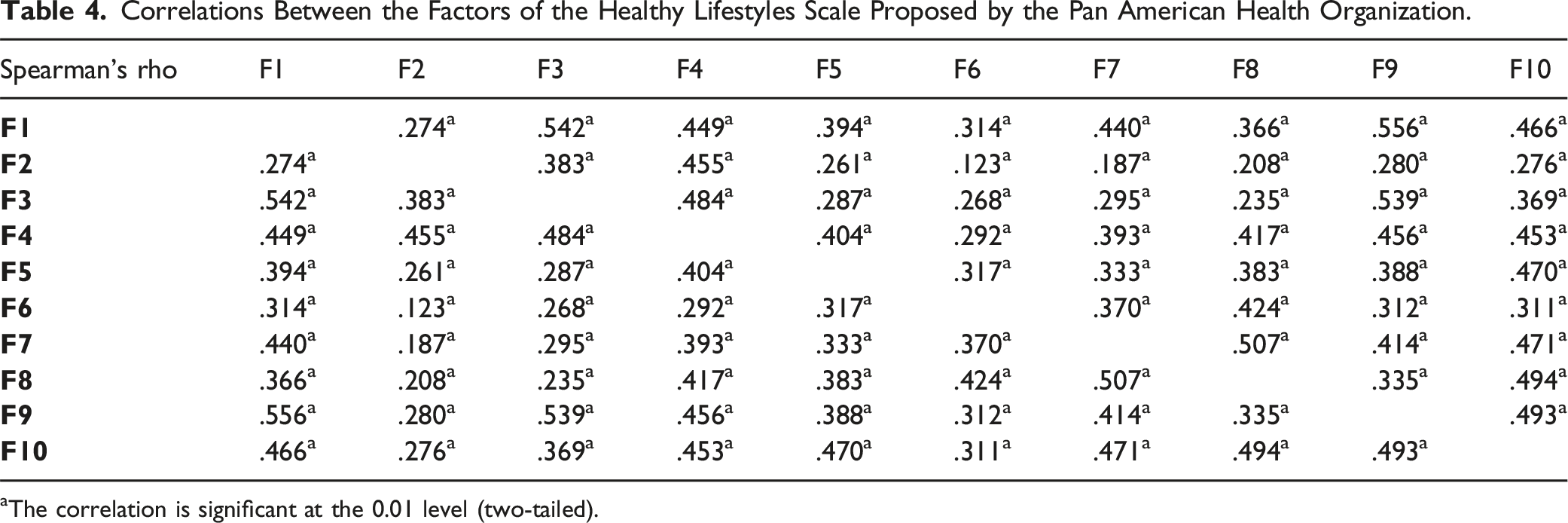
aThe correlation is significant at the 0.01 level (two-tailed).
Internal Consistency of the ‘Lifestyle (PAHO) in the Adult Population’ Questionnaire.

Source: Own elaboration.
Discussion
In response to the call to action of the “2030 Agenda for Sustainable Development”, which seeks to mobilize efforts to protect and improve lives worldwide, one thematic area gaining significant attraction focuses on individuals’ lifestyles, given their profound impact on health and quality of life. Consequently, governmental organizations and the Pan American Health Organization (PAHO) provide resources to guide and evaluate health behaviors, including instruments for assessing individual lifestyles. 27 This study demonstrates that the PAHO Lifestyle Questionnaire (Spanish Version) exhibits adequate construct validity and reliability for evaluating lifestyles in adults from the Colombian northeastern population aged 18 and older.
This finding underscores the scale’s utility in assessing healthy behaviors within the target population. Furthermore, optimal fit indices (χ2/df) suggest that the data align with the evaluated theoretical model. 28 While CFI and TLI values approach the acceptance limit (Brown), they may indicate a correspondence of the data with a neutral and independent structure. 24 Acceptable RMSEA and SRMR values suggest low approximation error between the proposed model and the evaluated population, along with good agreement between expected and estimated covariances.25,28
Therefore, the obtained model demonstrates reasonable fit, with potential for improvement. High and positive correlations between factors align with the instrument’s theoretical model, with no evidence of conceptual overlap between dimensions (correlations not exceeding 0.70). Adequate item-total correlations further support the instrument’s overall reliability. 26
Regarding internal consistency, the overall scale exhibits acceptable values, indicating coherent measurement of the construct. However, subscales F4, F5, and F6 exhibit values below 0.70, considered acceptable but not optimal. This may be attributed to the limited number of items (four) contributing to each dimension, potential heterogeneity among items within these subscales, or the items’ stronger association with the general construct of healthy habits than with the specific dimension. 27 Future research with larger, probabilistic samples will help determine if this trend persists or is incidental. 29
When comparing this study with other investigations using different lifestyle assessment instruments, both similarities and differences emerge. Psychometric evaluations of the FANTASTIC instrument (version 3) and the EVS instrument align with our findings, demonstrating reliable measurements and maintaining original dimensions.
However, regarding internal consistency within dimensions, the nutrition and oral hygiene dimensions of the EVS instrument exhibit Cronbach’s alpha values below the 0.70 criterion established for satisfactory internal consistency.25,27 In contrast, the Spanish version of the Healthy Lifestyles Questionnaire demonstrates higher values across its four dimensions. Findings diverge from those of the Health Promoting Lifestyle Profile-II (HPLPII), 30 which exhibited low convergent and discriminant validity in its 52-item version, necessitating the removal of six items to stabilize values for five of the six dimensions. In this context, the PAHO Lifestyle Assessment Instrument and the HPLPII, with over 30 items and 10 dimensions, contrast with the current study, which confirms the relevance of the original instrument’s dimensions while retaining all items.
The findings of this research should be interpreted considering several limitations. Despite the large sample size, its convenience sampling limits the generalizability of results to other Colombian or Spanish-speaking populations. Furthermore, as this was a cross-sectional study, test-retest reliability analysis to assess measurement stability over time was not conducted. Additionally, social desirability bias or overestimation of healthy habits among participants may have influenced the reported results. 31
Future research should address these limitations through a new study with a probabilistic sample and incorporate Item Response Theory (IRT) analysis to investigate differential item functioning (DIF) across subgroups. 32 Additionally, factorial invariance analysis (configural, metric, scalar, and strict) can be implemented to determine if the instrument’s structure remains consistent across different population profiles (sex, age, etc.), ensuring that observed differences in population studies are not attributable to inherent instrument biases. 33
Nevertheless, this study provides empirical evidence supporting the use of the Spanish version of the Lifestyle (PAHO) in the adult population of northeastern Colombia. The instrument exhibits acceptable goodness-of-fit indicators, supporting the proposed 10-factor structure and enabling a reliable measurement of healthy behaviors, particularly in healthy adults within this context. Additionally, it is recommended that future confirmatory studies apply the test-retest method to assess the instrument’s temporal stability.
Footnotes
Declaration of conflicting interests
The author(s) declared no potential conflicts of interest with respect to the research, authorship, and/or publication of this article.
Funding
The author(s) disclosed receipt of the following financial support for the research, authorship, and/or publication of this article: The author(s) received financial support from the University of Pamplona for the publication of this article.
