



Abstract

Nittur A, Pavan B, Ganapathy R, Dorai VK, Singhal S. Pranic Healing as a Complementary Therapy in Diabetic Foot Ulcer Management: A Randomised, Controlled, Double-Blind Trial. Glob Adv Integr Med Health. 2023;12. doi:10.1177/27536130231183429
In the above-mentioned article, the revised affiliation 5 should read:
5Independent Researcher, World Pranic Healing Foundation, Manilla
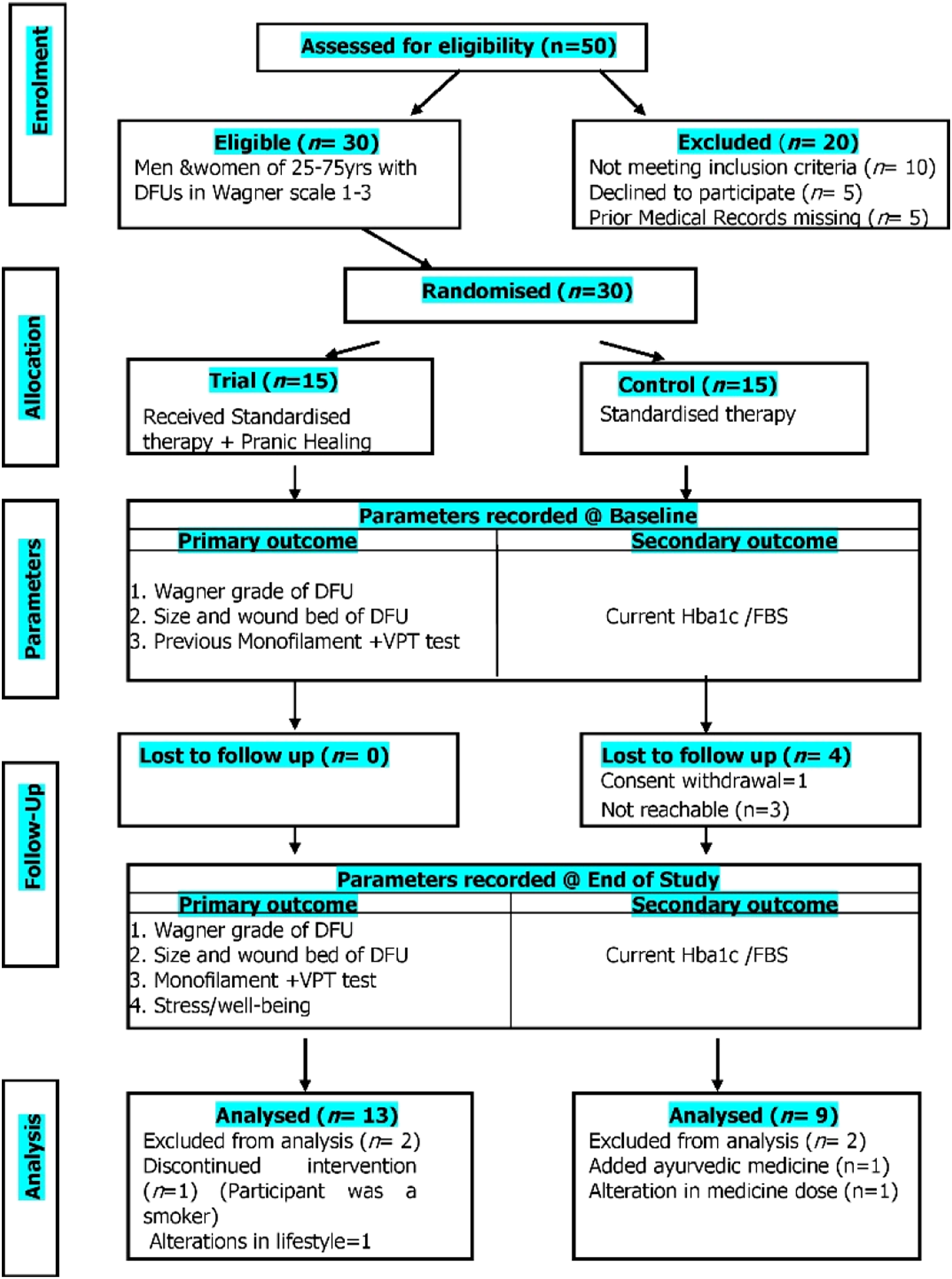
Minor textual changes are made in the text listed under “Eligible (n= 30)” and “Primary outcome” of “Parameters recorded @ End of Study” in Figure 1. The correct version of Figure 1 should be:
The presentation of the Results section has been revised and should be read as follows:
The summary of clinical results and analysis at the end of the intervention is shown in Table-2, Table-3, Table-4, Fig 2, Fig 3, Fig 4.
A two-tailed Independent T test used for intergroup comparison of change in wound size from D1 to D35 showed statistically significant reduction of wound size in the trial group with t(20) = -2.27, p = 0.034, 95% confidence interval [-9.33, -0.4]. The trial group reported a mean change of -2.59 ± 2.93 and control group reported a mean change of 1.84 ± 6.84 at the end of the trial. (Table 2(i)).
The Mann Whitney µ test used for intergroup comparison of the change in wound size from D1 to D35 between the trial and control groups exhibited a statistically significant reduction of wound size with z value, 2.13, p# = 0.021*. (Table 2(ii)).
In the Paired Sample T test, the trial group displayed a statistically significant reduction in wound size (t=2.91; P=0.014; 95%CI: 0.52 to 3.76) after intervention with Pranic Healing for 35 days. The control group did not exhibit a statistically significant difference in wound size between D1 and D35. (t=-0.807; P=0.443; 95%CI: -7.09 to 3.41). (Table 2 (iii)).
Similarly, a Wilcoxon signed rank test showed that in the trial group, wound sizes were significantly lower after the intervention (Md=0.55, n=13) compared to baseline (Md=3.59, n=13), z= -45.5, p+=0.0002*. Wound sizes in the control group were not statistically lower at the end of the study (Md=1.39, n=9) compared to baseline (Md=1.24,n=9), z= -2, p+=0.8438. (Table 2 (iv)).

*Statistical significance set at 0.05;

*Statistical significance set at 0.05;

*Statistical significance set at 0.05;

n: number of subjects analysed;
N: Sample size; SD: Standard deviation;
EoS: End of study; %: Percentage;
CfB: Change from baseline: EoS: (D35) – Baseline (D1).
The change in wound size in cm2 of each participant in the trial and control groups is shown in Fig 2. Complete wound closure was achieved in 4 (30.7%) participants in the trial group compared to 1(11.11%) in the control group.

About 10(83.33%) participants showed lowering of DFU grade in the trial group v/s 4(44.44%) in the control group at the end of the trial. (Table 3).

n: number of subjects analysed;
N: Sample size; SD: Standard deviation;
EoS: End of study; %: Percentage;
CfB: Change from baseline: EoS: (D35) – Baseline (D1).
About 3(25%) participants showed improvement in the damaged nerves (Monofilament) and 6(50%) in large fibre dysfunction (VPT test) in the trial group, compared to 0 and 2(22.2%) in the control group respectively at the end of the trial. The results of the Monofilament tests are shown in Fig. 3a (i) and 3a(ii) and Vibratory Perception Threshold test are shown in Fig.3b(i),(ii),(Table-3).


The change in HbA1c level of each participant of the treatment and control groups is shown in Fig.4 (i),(ii).


A two-tailed Independent t-test showed that the difference between trial and control groups for change in HbA1c levels was not statistically significant, t(17.06) = -1.78, p = 0.092, 95% confidence interval [-2.22, 0.19]. (Table 4.(i))
Similarly, the Mann Whitney µ test used for intergroup comparison of the change in HbA1c levels from D1 to D35 between the trial and control groups did not exhibit a statistically significant change with (z value:-1.313, p =0.208. (Table 4 (ii)).
Paired Sample T test for the trial group displayed a statistically significant reduction in HbA1c level (t=2.81; P=0.018; 95%CI: 0.301 to 2.607) after intervention with Pranic Healing for 35 days. The control group did not exhibit a statistically significant difference in HbA1c levels between D1 and D35. (t=0.33; P=0.311; 95%CI: -0.392 to 1.067). (Table 4(iii)).
A Wilcoxon signed rank test showed that in the trial group, HbA1c scores were significantly lower after the intervention (Md=7.55, n=11) compared to baseline (Md=9.20, n=11), z= -25.5, p+ = 0.0195*. HbA1c scores in the control group were not statistically lower at the end of the study (Md=8.15, n=8) compared to baseline (Md=8.90, n=8), z= -7, p+=0.3750. (Table 4(iv)).


*Statistical significance set at 0.05;

*Statistical significance set at 0.05;
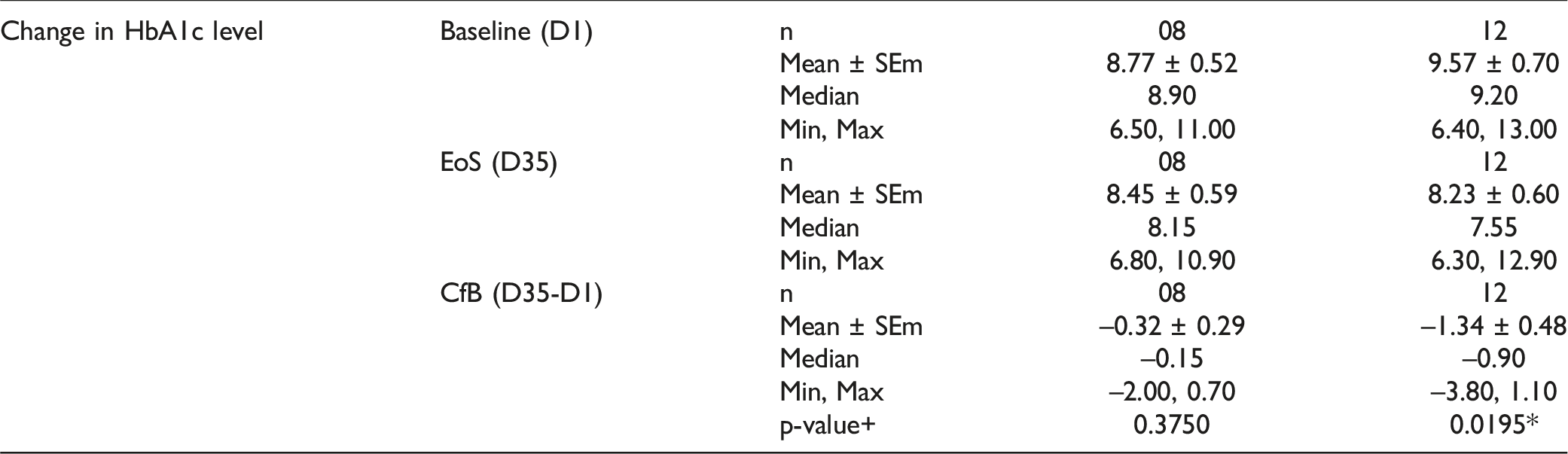
n: number of subjects in the specified treatment group;
N: Total no. of subjects;
SEm: Standard Error of Measurement;
EoS: End of study; CfB: Change from baseline
%: Percentage; * significant results.
P-value+: p-value using Wilcoxon signed-rank test.
Change from baseline: EoS (D35) – Baseline (D1).
In the trial group, 10 (76.92%) reported lower stress levels and improved well being a compared to 2(22.22%) in the control group. A third (33.3%) of the control group participants reported feeling worse and facing higher stress levels at the end of the study as compared to 0 in the trial group (Table-3).
Under the acknowledgments, the text has been changed from “The authors are indebted to Master ChoaKok Sui, Founder of Modern Pranic Healing; Master (Dr) Glenn Mendoza & Dr. Helen Salisbury, Directors, Pranic Healing Research Institute for awarding and guiding the project, Dr Raghavan G, Mr. Hemant Gupta, Mr Abhay Johri and Mr. Rajesh Srivastava for technical guidance and financial support and healings.” to “The authors are indebted to Master ChoaKok Sui, Founder of Modern Pranic Healing; Master (Dr) Glenn Mendoza & Dr. Helen Salisbury, Directors, Pranic Healing Research Institute for awarding and guiding the project, Dr Raghavan G, Mr. Hemant Gupta, and Mr. Rajesh Srivastava for technical guidance and financial support and healings.”. Additionally, the information of statistical analysis by Easystats team has been added. The revised acknowledgments should be read as:
Footnotes
Acknowledgments
The authors are indebted to Master ChoaKok Sui, Founder of Modern Pranic Healing; Master (Dr) Glenn Mendoza & Dr. Helen Salisbury, Directors, Pranic Healing Research Institute for awarding and guiding the project, Dr Raghavan G, Mr. Hemant Gupta, and Mr. Rajesh Srivastava for technical guidance and financial support and healings. Special thanks to Mr Shiv Gurunathan, Mr Shivam Singhal, Mr Krishna Murthy & Mr N.N. Murthy for financial support and healers from Sponsor a Healing group: Abhay Johri, Jeevan B, Swamini B, Pavinder, Maneesha T, Sonal, Ashwin, Nandeesh for their dedicated and selfless healings and support. Thanks to Easystats team for Statistical Analysis; Ananya Mehta and Padmapriya Ananda Ganesan for help in editing the manuscript. We gratefully acknowledge the role of patient advisers, nurses and other staff at KIER that referred the participants to the project and explained the intervention in layman’s terms.
In the funding section, the IRB fees details has been included. The name of Ada Alexndra Manola has been added to the list of Pranic Healers. The revised funding should be read as:
Funding
The author(s) disclosed receipt of the following financial support for the research, authorship, and/or publication of this article: The IRB fees was paid by Pranic Healing Research Institute, New Jersey ( ). The Article Publishing Charges (APC) was funded by Pranic Healers: Gagandeep Khurana, Archna Rajesh Aggarwal, Ada Alexndra Manola & Sonia Ganglani.
The correction has been updated in the online version.