



Abstract
There is current heightened public consciousness of the intersecting challenges of social and racial injustice, other forms of inequity, and the climate and biodiversity crisis. We examine how these current realities influence how we engage as Mindfulness-Based Stress Reduction (MBSR) and Mindfulness-Based Program (MBP) teachers and researchers. Although Kabat-Zinn developed MBSR as a vehicle to enable engagement with both the individual and the collective drivers of distress and flourishing, predominant research and practice trends within the MBP field have prioritised individual wellbeing, and have not been accessible to the full societal demographic. Furthermore, there is increasing recognition that the systemic social inequities that influence access to public services have not been addressed in the MBP field. In response, there is now an increasing trend exploring how MBP participation can influence ‘bigger than self’ concerns, with research, practice and theory suggesting that the inner personal transformation that mindfulness practice enables, supports individuals to compassionately reconnect to self, other and the natural world in ways that foster prosocial behaviour change, and enables awareness building of personal bias and conditioning. In this paper we present perspectives on ways of both retaining fidelity to the existing MBSR program, and simultaneously embracing anti-oppression teaching methods and content, and an inclusive recognition of the micro, meso and macro causes and conditions that drive distress and flourishing. We are a group of racially diverse MBP teachers and trainers from both sides of the Atlantic, who are engaged in training initiatives with people from Black, Latinex, Indigenous, Asian, and People of Color communities.
Keywords
Introduction
Mindfulness-Based Stress Reduction
It has been 40 years since Kabat-Zinn began disseminating MBSR and undoubtedly the program has been impactful. MBSR is now taught in every continent, 13 has paved the way for a new field of study and practice, and has enabled many diverse groups to access mindfulness training including children, teachers, clinical populations, parents, health care workers, parliamentarians and their staff, older adults, workers in business contexts, and participants in the justice system. MBSR and adaptations of it are available in multiple mainstream contexts including schools, health care, education, workplaces, the justice system, the voluntary and community enterprise sector, and environmental activism. In some countries, delivery is embedded into mainstream health care and education, free at the point of access. 14
There are, though, critiques of systemic gaps and imbalances in the MBP field (e.g).15-18 These include the tendency of teachers and researchers to view MBP participation primarily as an opportunity to optimise personal wellbeing, health, or performance, and therefore to focus on individualised outcomes rather than wider relational or societal level benefits (e.g.19-21); and a tendency to locate the drivers and alleviation of stress and depression within the individual rather than a broader recognition of the multiple intra and interpersonal, societal, inter-generational and systemic conditions that contribute to both human distress and flourishing (e.g.).22,23 This is probably partly driven by the need to make the empirical case for implementing MBPs in mainstream Western contexts, which themselves tend towards individualistic orientations, and the limits of Western empiricism which itself is embedded in a reductionist paradigm. It is also perhaps more complex to capture the wider societal outcomes of MBP engagement.
Furthermore, critiques include recognition that the social and racial inequities that can inhibit access to public services, have not been addressed in the MBP field – i.e. the benefits of MBP training have been more easily available to a narrow demographic (typically white, middle class and more often female).18,24-27 This has resulted in systemic structural imbalances impeding universal participation in an MBP or MBP teacher training. Engagement is invariably dependent on financial, social, cultural, and structural conditions and resources, that are not equally or equitably distributed. These often unspoken structural disadvantages lead to the imbalanced representation that we see in the majority of MBP learning spaces. Whilst these issues are ubiquitous across society, the mismatch between these realities and the ethical and value base of mindfulness (i.e., commitment to non-harming, recognition of the breadth of causes and conditions for distress and suffering, and an ethos of care and compassion for all living beings) is stark and disconcerting. Part of the ethical responsibility of being an MBP teacher or trainer therefore includes engaging in consciousness raising work around power, privilege, unconscious bias, oppression, and a recognition that we are living the effects of long-standing historical, societal imbalances and abuses, particularly in relation to race and social class. It is also important to highlight that these harms impact everyone negatively, but disproportionately affect marginalized communities and the living systems in which we are embedded, depend on, and exploit. Whilst some members of the current generation may care deeply about equity, in the west and other colonised countries, social conditioning operates within the context of a white patriarchal supremacist system; and whilst we are not to blame for inherited dominant societal norms, nor for the actions of previous generations, we do have an ethical responsibility to engage in the personal and collective work needed to recognize, and disrupt inter-generational patterns of identity-based harm and oppression.
What is the role and place of MBP teaching within the context of the time we are living in? The urgency of the climate crisis has been scientifically known for decades, but has only recently become part of the daily lexicon of governments, policy makers and the public. Similarly, whilst structural inequity and the societal harm of racism, misogyny, patriarchy, ableism, homophobia and so on, have been known for decades, public consciousness about these themes is higher than ever, in wake of the murder of George Floyd in the USA and of Chris Kaba in the UK, alongside other acts of hate, injustice and rupture. There is also widening recognition that the intersecting challenges of social, racial and economic injustice, and the climate and biodiversity crisis are themselves drivers of major public health challenges.28-30 How do the realities of and heightened collective awareness of societal and ecological disruption impact on how we engage as MBP organizations, trainers, teachers, supervisors, researchers, and practitioners?
There is already an increasing recent trend of research and practice in the MBP field on how MBP participation can influence ‘bigger than self’ concerns, by facilitating the inner personal transformation needed to support individuals to compassionately reconnect to self, other and the natural world in ways that foster prosocial behaviour change. There is evidence, for example that MBP participation can support skilful engagement with racial injustice,31-33 and the climate crisis,34,35 build relational leadership skills,36-38 and reduce inter-group prejudice. 39 Much of this work involves the development of new MBPs that are skillfully tailored and broadened to address these kinds of outcomes.
This paper aims to complement this work, and contribute to the MBP field interfacing skillfully with the challenges of our time, by exploring how ‘bigger than self’ concerns could be integrated within an expanded vision for all MBP research and practice going forward. We address this by specifically examining this within the existing frame of the MBSR program, and more generally examine how the pedagogy of other established MBPs could embrace an inclusive understanding of the individual and systemic causes and conditions driving distress and flourishing.
The issues addressed in this paper are more nuanced, complex and broad than we can do justice to in the space available. The themes we address are related to and relevant to social inequity and oppression across a range of characteristics and groups (i.e. disability, sexual orientation, sex, religion and belief, age), but due to the experience and expertise within this group of authors, we have chosen to foreground inequities linked to race. There is much cross over between these areas, and there are issues that are particular to each aspect of underrepresentation. We see the paper and accompanying resource as a contribution to the vital conversation about the breadth of social justice issues that we, as MBP practitioners, need to engage with. We are a group of racialised and categorised Black, Latinex, Indigenous, Asian, and People of Colour (from hereon we use the acronym BIPOC) and White MBP teachers and trainers from both sides of the Atlantic who have been involved in training initiatives with MBP teachers from BIPOC backgrounds; each of us is personally engaged in bringing the lens of our mindfulness practice to anti-oppression work, and to bringing these perspectives alive within MBP training and research centers globally. We came together to explore these challenging themes and the opportunity they present to awaken together.
Recommended resources on anti-oppression for MBP teachers.

Creative Tensions: Curriculum Fidelity, Tailoring and Adaption
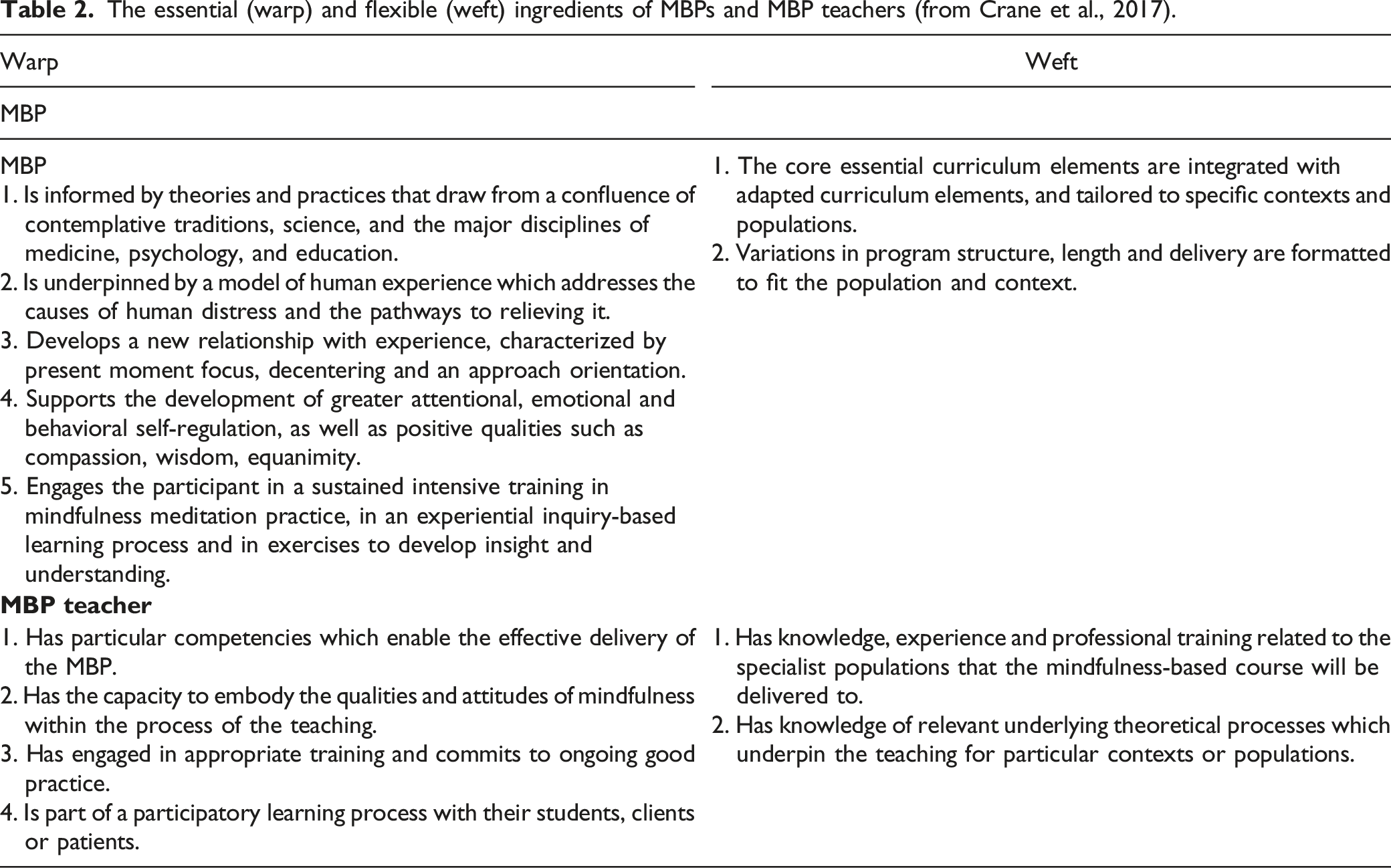
The essential (warp) and flexible (weft) ingredients of MBPs and MBP teachers (from Crane et al., 2017).
Mindfulness-Based Stress Reduction – core essential curriculum elements.

In this paper we focus on (i) the tailored processes and content that can be built around the MBSR skeletal curriculum framework outlined in Table 3; and (ii) the teaching sensitivities needed across all MBP teaching to ensure it is socially and culturally relatable, creates a sense of belonging, and is held in ways that are responsive to the realities of identity-based harm, intergenerational trauma of racism, social conditioning, power imbalances, and ecological stress (i.e. anti-oppression pedagogy). Our training experiences with BIPOC MBSR teachers has profoundly informed our sensitivity to differences across cultures and social groups; and more generally how all MBP teaching needs to evolve to ensure it is up to the task of catalysing awareness of the suffering that arises from systemic inequities. Awareness raising and responsive shifts in perspective on both personal and social levels are needed to support wellbeing, healing, and flourishing.
Although our focus here is on fidelity to MBSR, we recognise that existing MBP models do not always meet the specific needs of a particular context or population. However, before adapting, it is important to ask: is there already an MBP curriculum developed and tested out there for the intentionality, group, and context that I aim to serve? If a new adaptation is needed, Loucks et al communicate ways of undertaking the delicate work of developing a new MBP. 9 As a matter of integrity and clarity, if an MBP curriculum is not aligned with the essential curriculum elements for that particular program (i.e. for MBSR, the elements laid out in Table 3), the program is an adaptation and therefore needs a new title. However, and critically, a central aspect of fidelity to MBSR is flexing the teaching to the moment. Therefore, this person, this group, this emerging theme, this context etc are the curriculum, and, as we argue in this paper, the backdrop of the current societal and environmental realities are also an aspect of the curriculum. So, if curriculum tailoring is in the service of enabling the teaching to be more closely attuned to a particular cultural group or context, and the essential curriculum ingredients of MBSR are in place (see Table 3) – then it definitively is MBSR! We therefore examine the delivery of MBSR in its original form, whilst questioning how the program can meet diverse communities; how it can support all participants to connect with both personal and collective causes of distress and flourishing; how it can remain connected to the wisdom of over 40 years of the development of MBPs and over 2500 years of mindfulness teaching; and how it can embrace and connect to thousands of years of indigenous and global majority wisdom that is ubiquitous throughout our shared human genome and collective evolution.
How do We Teach MBPs in Ways that Speak to This Moment?
How do we teach MBPs in ways that inclusively welcome people from diverse backgrounds?; MBPs that are inclusive to people with a trauma history?; MBPs that enable participants to connect to the reality that ‘my’ wellbeing is completely contingent on the wellbeing of all humans and living systems?; MBPs that recognise that stress and distress are driven by unhelpful habit patterns within our own beings, within our relationships with others, and within the systemic, societal structures we live within and that flow through us in our taken for granted assumptions and unconscious perceptions?; MBPs that acknowledge historical power imbalances and abuses?; and so on. There are no quick answers to these questions – but they are vital frontier questions to live into.
MBP core practices and teaching themes aim to focus on human experience and are as relevant now as they were when disseminated more than two millennia ago. However, to be relevant to the range of participants’ cultural experiences and identities, it is vital to attend to how the teaching is contextualised and tailored to the zeitgeist and context in which it is delivered, and the particularities of each group. Just as Kabat-Zinn developed the MBSR form as a creative response to social justice challenges of that moment in history, 30 it is timely for the current generation of teachers and trainers to reconsider the curriculum, and how it is taught and facilitated in the context of now. There is a call for a broader and more diverse understanding and interpretation of mindfulness that speaks to different populations and cultural wisdom knowledge bases.
The Implicit and Explicit Aspects to MBP Teaching
A key distinctive feature of MBP pedagogy is that both how we teach (i.e., the values and norms that are implicitly communicated) and what we teach (i.e., the explicit form and content) are congruent with each other and are given equal attention and weighting.
41
In the next sections we explore how the teacher might engage with the implicit and explicit elements of MBSR through the lens of an expanded view of the micro, meso and macro influences on human experience (see Figure 1). The accompanying online supplementary resource (https://home.mindfulness-network.org/mbsr-for-our-time-resources/). offers a summary of the potentials and possibilities of how MBSR teaching can creatively emerge with an inclusive integration of these wider themes. The micro, meso and macro influences on human experience.
The Implicit Curriculum
There is always an implicit hidden curriculum in any teaching process. 42 These implicit communications are expressed through the teacher’s use of language, choices around sources and references, their social norms, practices, and behaviours, and through who is present and absent in the teaching space. These are harming when they reinforce existing power imbalances and inequities, even if this is unintended or due to a lack of awareness.43,44 By embodying equity and humility within the teaching space, the teacher’s implicit messaging is congruent with the explicit curriculum theme of cultivating new perspectives on the conditions needed for wellbeing.
At its best, MBSR teaching is responsive to the aliveness of the unpredictability of this moment of encounter, and embodies a fluidity and ethically informed engagement with the immediacy of the moment. These capacities are founded on and resourced by the teacher’s personal journey and engagement with mindfulness practice, 45 alongside their willingness to explore and engage with waking up to the full diversity of being human, including suffering and joys within self, others and the planet. Teaching in ways that do not perpetuate historical oppression relies on an ongoing engagement with awareness raising of internalized social and racial conditioning. The teacher’s awareness of the unique constellation of factors that have formed their own personhood becomes the embodied ground from which they authentically and responsively draw out learning themes in a cocreated process with participants. Developing capacities in this area does not involve acquiring new knowledge per se, but rather a sustained and intentional engagement with processes and practices that enable living life in a conscious and ethical way (see anti-oppression resources in Table 1), and that are inclusive of micro, meso and maco levels of experience in one’s life (see Figure 1).
These implicit hidden dimensions become expressed in the ways the teacher embodies both the practice and spirit of mindfulness through their own unique, natural personhood; the quality of the relational processes built between teacher and participants; and the ways in which the group learning container is collectively shaped and held. 46 In the online resource accompanying this paper we offer examples of how these implicit elements become known in the learning space, and how an anti-oppression ‘lens’ influences their expression (https://home.mindfulness-network.org/mbsr-for-our-time-resources/).
The Explicit Curriculum
A key challenge and creative opportunity inherent in teaching MBSR, is that there is no definitive session by session curriculum manual telling the teacher what to do. The integrity of MBSR lies in each teacher and in the structures of support that are built around them (e.g. British Association of Mindfulness-Based Approaches, 47 European Association of Mindfulness Based Approaches, 48 Mindfulness Ireland). 49 There is of course a lineage to MBSR and multiple resources to draw on, but there is no central power figure or structure telling us what flavour of MBSR is being called for in the communities we each relate to. This decentralised leadership model requires us to humbly empower ourselves to take responsibility for our contribution, knowing that we are part of something bigger than ourselves each time we engage and act in the world. This is a more challenging ‘ask’ than having a readily accessible protocol to follow, particularly for early stage MBSR trainees. However, it nudges us toward giving priority to what matters most from the outset. Namely, that we are not teaching a curriculum, we are sharing a way of living that is in tune with the diverse realities of lived experience imbued with awareness, compassion, and wisdom. If we are connected to this knowing, we will remember what is really going on, and then the curriculum becomes less important. Our participants are not learning MBSR – MBSR is just one of many learning vehicles. The ongoing evolution of MBSR therefore requires us to listen to each other, to our communities, evaluate practice in new ways, be willing to let go of cherished ideas of how things should be, and share learning and practice as we go.
The possibilities and potentials for tuning the content of MBSR are infinite. Discerning how to flex MBSR, both in the moment and during pre-session planning, involves embodied understanding of the core intentionality of the overall program, of each session, and of how each exercise or practice might catalyse learning that aligns with these, and with the needs and culture of this particular group. This skill of flexing the program is supported by teaching experience, by learning about themes such as anti-racism and anti-oppressive pedagogy through relational engagement with mindfulness supervision and peers, feedback from participants, and reflective practice. 50 It is important to discern when tailoring supports learning, belonging, safety, and cultural attunement, and when it is something that potentially diverts attention from the core intentionality of the session and program. The accompanying online resource offers session-by-session pointers for potential ways of opening an expanded understanding and responsivity to the personal and collective influences on wellbeing, and ways of welcoming the diversity of human experience represented in and beyond the teaching space within MBSR (see https://home.mindfulness-network.org/mbsr-for-our-time-resources/).
Conclusions
In this paper we offer an exploration of the process of embedding social awareness into MBP teaching. MBSR was originally developed as a public health intervention, with the potential to alleviate core drivers of population level psychological and physical health challenges including those underpinned by oppressive social structures and inequities.
We have experienced how working together across racial identity groups with humility enables learning, unlearning, and healing beyond any work we can do as individuals or in isolation. Our diversely represented collaboration has strengthened our confidence that (depending on the teachers’ experience, personhood, intentions, and motivations) MBP curriculums are able to be delivered in ways that compassionately hold, meet, and disrupt racist attitudes and patterned behaviours of oppression, and that enable teacher and participants to meet each other and themselves where they are. The voices and embodiment of MBP teachers from diverse backgrounds engaging with communities they are familiar with, and MBP teachers who are proactively engaged in anti-oppression awareness building, are vital in ensuring that the teaching viscerally connects with the lived experience of diverse participants. Furthermore, there is a reality that MBPs are currently built upon, validated by and rooted in Western empiricism and Eastern spirituality. However, MBPs are only as equal as the knowledge they are built upon. Widening the underpinning roots of MBP research and practice to include indigenous, and global majority wisdom, is essential if we are to truly increase access and build equity into the MBP field. It is also critical that we give as much attention to how we enable BIPOC colleagues to find a place and livelihood in the MBP world as we do to enabling current racialised white MBP teachers to expand their vision.
We hope the paper is a stimulus to further reflective exploration on these themes. Going forward, this collaboration has highlighted the need for ongoing inquiry into MBP curriculums. There is much work to be done to decolonise MBP teaching; to build understanding of how we offer teaching in socially aware and non-harming ways; and deep listening, cultural engagement, and validation of the wisdom of historically underrepresented voices is needed. Consequently the authors of this paper will continue to collaborate with the aspiration of further developing a BIPOC led, equity building re-imagined exploration of MBP curriculums. From a research perspective, an important challenge is to build knowledge of methodologies that meaningfully capture ‘bigger than self’ outcomes and outcomes for marginalised groups, which could in turn inform organizations and policy makers of the potential contribution of MBPs to alleviating current societal challenges.
We live in a time of huge challenge and potential. There is a renaissance of societal interest in contemplative practices; recognition of historical and current inequities and identity based harm, and of the linkage between the cultivation of certain inner qualities and outer relational and societal engagement; renewed appreciation of the wisdom traditions of global majority cultures; increasing evidence that mindfulness when taught with social awareness, can be a powerful change agent in the world; and a ‘waking up’ to the reality that current human obsessions with consumerism and economic growth are causing deep harm to us and all other living systems. This context offers potential for MBP teachers to be of service in the world in ways that have traction on some of the core drivers of collective distress, harm, and disconnection. Clearly, teaching mindfulness can only be a part of the multiple necessary responses to the intersecting crises of our times. It is however one meaningful response, provided we practise and teach in ways that speak to and are alive to this moment rather than prioritising an historical idea of MBP fidelity. MBP teaching was always intended to evolve and harness the power of now. And by definition the present moment, can never be free of both ancient and current expressions and practices, nor absent of future potential. Mindfulness has always been an innate faculty emerging within the first sapien sapiens, and it is perhaps this broader and more diverse resonance that is calling for acknowledgment in the MBP field, and that will offer a key to unlocking its wider social potential.
Footnotes
Declaration of Conflicting Interests
The author(s) declared the following potential conflicts of interest with respect to the research, authorship, and/or publication of this article: RC directs a university based mindfulness centre and is the author of two mindfulness books from which she receives royalties. AF and DF co-lead a Mindfulness Community Interest Company focused on anti-oppression and dismantling racism & social inequalities collectively and co-created the Mindfulness Based Inclusion Training program. DF is a Trustee and EDI co-lead at British Association of Mindfulness Based Approaches and EDI Consultant and Facilitator at Sussex Mindfulness Centre. BM is a Senior Advisor of MBSR teacher training at the UCSD Centre of Mindfulness and author of one book from which she receive royalties. BON is employed by organisations that deliver mindfulness based teacher training. MW and NKPW train MBSR teachers at the UCSD Centre of Mindfulness. MW teaches adult MBSR classes for the UW Health Mindfulness Program in Madison, WI, and is recipient of a grant from the Kataly Foundation to teach mindfulness classes on the Menominee Indian Tribe of Wisconsin reservation. ZV is faculty of a mindfulness community retreat center.
Funding
The author(s) received no financial support for the research, authorship, and/or publication of this article.
