



Abstract
Despite one of the most significant factors reducing photovoltaic (PV) efficiency is still shade of solar panels, the effects of shading vary widely depending on the type, material, and intensity of shading. This study examined the effects of three typical shading materials on the electrical, thermal, and efficiency parameters of an ADH ISO 15 W solar panel erected in Kansanga, Uganda: paper, cloth, and Ficus umbellata leaf. For three months, measurements of current, voltage, irradiance, ambient temperature, and cell temperature were made at 15-min intervals between 9:00 a.m. and 5:00 p.m. Descriptive statistics, efficiency computation, and ANOVA were used to examine the average data. The highest voltage, current, and power output were produced in unshaded situations, according to the results, demonstrating ideal panel performance under full sun exposure. Because of their increased opacity, paper and cloth produced the worst power losses among all shading options; leaf shading, on the other hand, allowed for partial transmission and produced rather moderate savings. More than 94% of the difference in voltage, current, and power was explained by shade, according to an ANOVA, with the paper exhibiting the highest statistical influence across parameters. The results show that even 25% partial shade significantly reduces energy output and modifies thermal behavior, underscoring the vital necessity of minimizing shading and preserving unobstructed panel surfaces in PV installations. These findings offer useful information for PV system installation, design, and shading mitigation techniques in tropical urban settings.
Introduction
Solar panels are becoming a significant alternative to non-renewable energy sources. However, their performance is influenced by shading effects from trees, clouds, and buildings. A study found a direct correlation between short circuit current and solar irradiation under uniform shading conditions, suggesting that non-uniform shading should be avoided for better performance (Sathyanarayana et al., 2015). Jamal et al., 2024 examined the shading effect of photovoltaic systems on the Polytechnic State rooftop in Indonesia, using PV system to evaluate performance ratio, loss diagram, and performance ratio. Bhallamudi et al., 2021 examined the performance of a solar photovoltaic module under clean, dust, and shadow conditions. Results show a significant decrease in electrical power and efficiency, with partial shadows causing more harm than dust. The study suggests that further research is needed to understand the long-term effects of dust and shadow on performance degradation and module life. Fatima et al., 2022 studied partial shading on PV solar panels, influence by material, shading rate, and panel type, significantly reduces performance, with shaded cell position not affecting outcomes. Bernadette et al., 2021 at the University of Rwanda/African Centre of Excellence in Energy Studied for Sustainable Development found that shading affects the performance of a 1.5 kWp PV system, increasing instability and degradation of output. Kumari et al., 2024 explored single cell shading in high efficiency monocrystalline silicon PV PERC modules, highlighting the critical shading scenarios and the need for researchers and manufacturers to consider this in PV technology. Senapati et al., 2025; Saha et al., 2019 examined the impact of partial shading on solar PV module output power, comparing two identical panels with one partially shaded, using P Spice software and thermal camera for experimental verification. Solar PV systems are cost-effective and eco-friendly, but their efficiency can be compromised by shading from sources like tree leaves, debris, or obstructions to reduce shading impacts. The study also explores the impact of environmental factors on photovoltaic system performance, revealing that dust, shading, and bird fouling significantly affect PV current and voltage, reducing harvested energy. Salimi et al., 2024 carried out experimental analysis and modelling of weather condition effects on photovoltaic systems’ performance: Tehran case study. Energy Sources, Part A: Recovery, Utilization, and Environmental Effects, 46(1), 8430–8442. Salimi et al., 2024 examined the impact of dust and shading on solar panel performance using a Matlab/Simulink simulation environment, comparing experimental data and simulation models. Sathyanarayana et al., 2015 suggested that Solar panels are becoming a significant alternative to non-renewable energy sources. However, their performance is influenced by shading effects from trees, clouds, and buildings. Özkalay et al., 2024 found that residential photovoltaic systems can form hot-spots due to partial shading, suggesting that testing temperatures should be increased for modules operating at high temperatures. Al-Jumaili et al., 2019 revealed that shading significantly impacts efficiency, fill factor, and output power of solar cells, suggesting that panels should be installed in shading-free areas for improved performance. Sun et al., 2013 examined shading phenomena in China on large-scale ground-based grid-connected PV systems, revealing shading and non- shading impact on system performance and electrical properties, and its varying positions on modules.
Mamun et al., 2017 investigated the effect of partial shading on photovoltaic performance, finding that increasing irradiation boosts power output and efficiency, but decreases efficiency with increased shaded area. Kappler et al., 2024 introduced a machine learning-based solar power forecast method that enhances forecast accuracy by up to 40% by adjusting shading intensity using internal inverter data and irradiance values. Adhikari and Singh, 2014 analyzed a solar photovoltaic system for residential use under partial shading conditions. The system uses batteries, a flyback dc-dc converter, and a single phase voltage source inverter. Results evaluate system performance and suggest measures to monitor performance in different shading conditions. Klasen et al., 2021 compared four PV module layouts with three solar cell sizes and shingle interconnections. Results showed shingle matrix layout had the highest shading resilience, outperforming shingle string, butterfly, and conventional full cell interconnections. This makes shingle solar modules suitable for vehicle and building applications. Al-Jumaili et al., 2019 revealed that shading significantly impacts solar panel performance, highlighting the need for panels to be installed in shading-free areas for best efficiency and power output.
Traore et al., 2021 examined the impact of Photo-Structured Components (PSCs) on the electrical characteristics of Series, Series-Parallel, and Honeycomb PV array configurations using a MATLAB/Simulink simulation model, focusing on 25 KYOCERA-KC200GT modules. Ismail et al., 2023 investigated the effects of complex shading on photovoltaic modules in Sabah, Malaysia, using I–V and P–V curves to analyze shading loss, particularly in hard shading, and its relation to power points. Shaik et al., 2023 discovered that the depletion of fossil fuels is causing global environmental pollution, necessitating cleaner, sustainable energy sources like solar PV cells. However, environmental factors impact PV performance, and this article discusses methods to mitigate these effects. Anshory et al., 2024 used an IoT-based monitoring system to analyse the impact of partial shading on solar panel performance, revealing that it reduces sunlight intensity, voltage drop, and power output. Rusiana et al., 2018 examined shading on PV systems, highlighting its impact on solar cell characteristics, temperature, and radiation. Modelling on a 1 kWp system revealed that shading generates 4.71 kWh/m2 in a solar active area at 6.9 m2, with 20.8% power losses. Rahmaniar et al., 2023 investigated the impact of shadows on the efficiency of polycrystalline solar power plants, revealing a 0.9% annual loss contribution power. Saxena et al., 2024 discussed integrating Renewable Energy Resources (RERs) into electrical grids, emphasizing real-time load forecasting and adaptive inertia control. Rocca et al., 2025 presented an overview of textile solar shading in urban areas, focusing on its effects on livability, usability, and energy savings in air conditioning across various climates. It highlights design considerations and presents data showing a 50% to 60% reduction in heat flow, a 10% to 40% decrease in thermal stress, and nearly 90% reduction in UV exposure in cities like Rome, Athens, and Tripoli.
Xu et al., 2024 conveyed that this research quantifies shading effects on solar radiation from PV panels at different positions, focusing on the south, with maximum sensitivities at 0°, 30°, and 60°, aiding PV system planning and layout improvement. Narne et al., 2022 discovered that the increasing demand for renewable energy sources, particularly solar, has led to increased efficiency in extracting energy from photovoltaic modules. However, the performance of these arrays decreases under partial shading conditions, affecting their power output. This study compares and analyses various configurations under different shading situations. Kushwaha et al., 2023 discussed the challenges of photovoltaic systems, including premature module failure due to partial shading, and proposes using module-level power electronics and maximum power point tracking to increase energy yield and efficiency. Ramabadran and Mathur, 2009 examined the detrimental effects of partial shading on series and parallel connected Solar PV modules using a PSPICE simulation model, comparing performance under different shading conditions. Huusain et al., 2017 investigated the impact of air dust particles on photovoltaic (PV) model performance. Scanning electron microscope analysis was conducted on dust samples and data was collected at different weights and solar irradiation levels. The study found a minimum power value of 3.88 W during rice husk accumulation on PV modules. Senapati et al., 2023 presented a hybrid method that merges modified invasive weed perfection (MIWO) with the traditional perturb and observe (P&O) algorithm to enhance power output tracking in photovoltaic systems. The method leverages MIWO for quick tracking and shifts to P&O for improved convergence and efficiency under diverse climatic conditions.
Olivares et al., 2024 evaluated five regression models for predicting shading percentages on PV panels, with XG Boost showing superior performance, suggesting that these models can improve drone efficiency, flight time, maintenance costs, and disaster response capabilities. Ramli and Salam, 2019 compared the performance of a PV system with DC power optimizer (DCPO) to a conventional system with bypass diodes, showing a marginal increase in energy yield for sub-module shading. Rashid et al., 2023 explored the effects of dust accumulation on solar PV panels in Pakistan's Islamabad and Bahawalpur regions, finding that dusty modules reduced efficiency, output power, and increased module temperatures. Mahto et al., 2020 found out that Partial shading in photovoltaic panels can reduce efficiency and create fire hazards. Bypass diodes reduce this effect. CMOS-embedded panels show more efficiency under partial shading conditions. Albatayneh et al., 2023 explored the shading effect of solar panels on residential roofs, revealing that PV systems significantly reduce cooling and heating loads, highlighting the significance of renewable energy. Ghosh et al., 2022 presented a model for calculating losses in photovoltaic power plants, utilizing data from a 30-kWp plant in Kharagpur, India, and provides recommendations for mitigating these losses.
Sarang et al., 2024 evaluated ten solar power extraction controllers, including conventional MPPT and AI, focusing on factors like voltage, current, power, weather dependence, cost, complexity, response time, stability, and accuracy, to identify the best controller. Pool, 2019 evaluated the daylighting and shading performance of thick Perforated Screens (PS) in office buildings, highlighting the importance of selecting suitable values for best performance in a Mediterranean climate. Brazil's photovoltaic installations have exceeded 32 GWp, with bifacial modules being the fastest growing technology. Braga et al., 2023 evaluated the performance of bifacial PV modules in Minas Gerais, Brazil, considering factors like albedo, site maintenance, climate, thermal behavior, and shading. A couple studies in the above literature have explicitly looked at how common urban shading materials like dust, buildings, and natural leaves affect the performance of small ADH ISO 15 W panels in Kampala's particular tropical urban climate, despite the fact that many studies have been conducted worldwide on the effects of shading regarding photovoltaic systems. There is a lack of experimental, material-specific, and location-specific analysis because the majority of the literature currently in publication concentrates on large-scale PV systems, simulated shading patterns, or broad shading categories dust, trees, clouds, also hanging wet clothes from low-mounted solar panels is a common method of drying them. A small quantity of clothes, papers, and tree leaves are also positioned on permanent panels and shaded on top of roofs due to shifting breezes. The investigation was initiated as a result. The absence of empirical data on how small scale use of solar panel and environmental shading objects in Kampala, especially in crowded locations like Kansanga, directly affect the electrical output, thermal behavior, and efficiency of small domestic solar panels is the research gap that this study attempts to fill.
Different shading types
Shading significantly reduces solar panel efficiency and can result from various sources including bird droppings, trees, dust, buildings, clouds, poor panel positioning, and shading by dry leaf. Bird droppings cause hard shading that blocks sunlight, creating hotspots and damaging cells, while tree shadows can reduce solar output by up to 40% due to the interconnected nature of solar cells. Dust accumulation, particularly in arid regions, can decrease efficiency by up to 60%, requiring frequent cleaning. Nearby buildings can block sunlight seasonally, affecting heating and cooling needs. Improper panel orientation and tilt can limit sun exposure, and dense cloud cover also lowers output, although some power generation continues. Additionally, when solar panels are shaded by dry leaves, it reduces energy production and overall system performance. Proper installation, positioning, and the use of technologies like micro inverters are essential for minimizing shading impacts and maintaining ideal performance Figures 1–8.
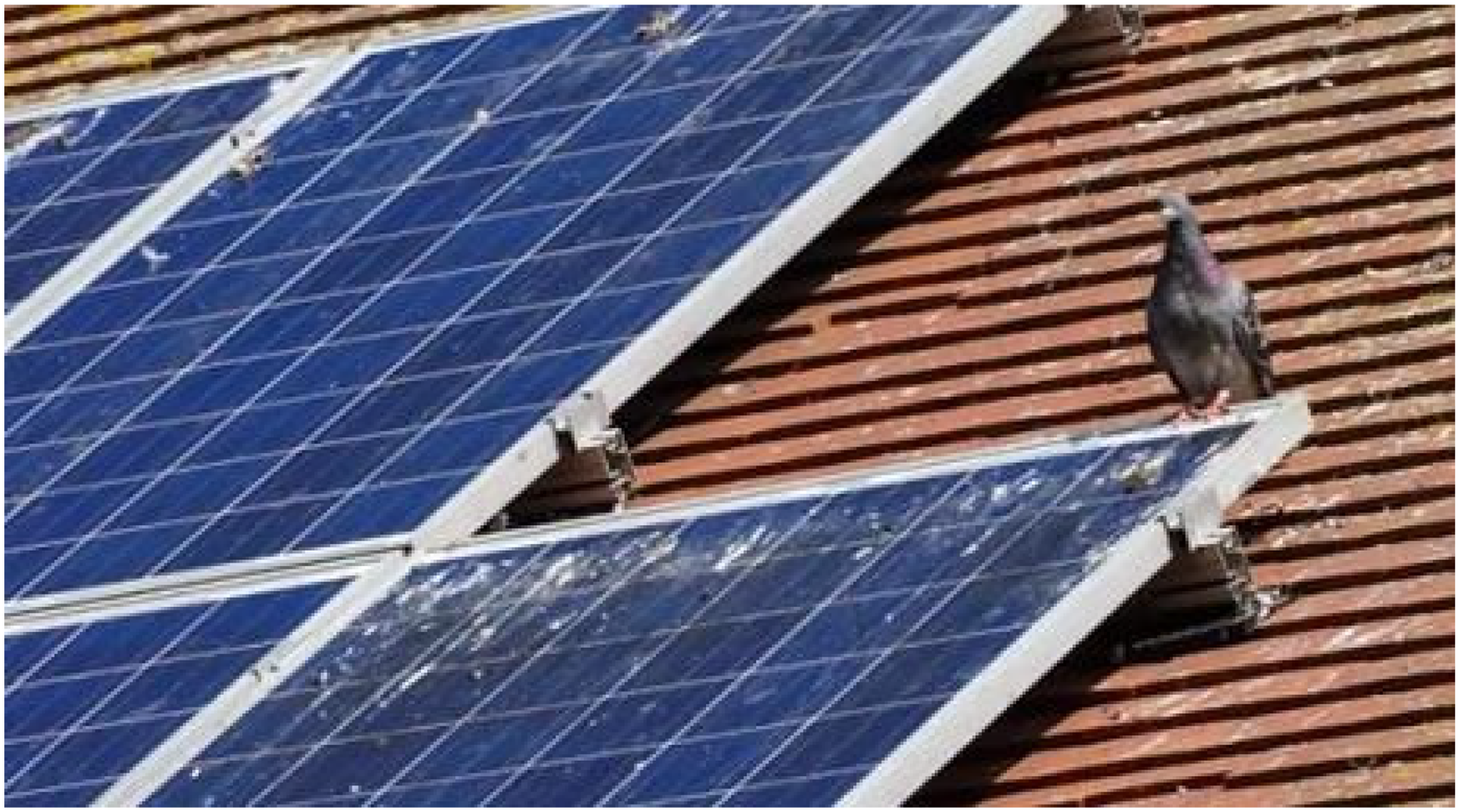
Shading by bird droppings. Source, Tenali and Narayana Sri Ranga, 2023.

Shading by trees Cohen and Hogan, 2018.

Shading by dust particles. Source, Darwish et al., 2013.

Shading by buildings. Source, Lam, 2000.

Shading by smoke. Source, Klugmann-Radziemska, 2020.
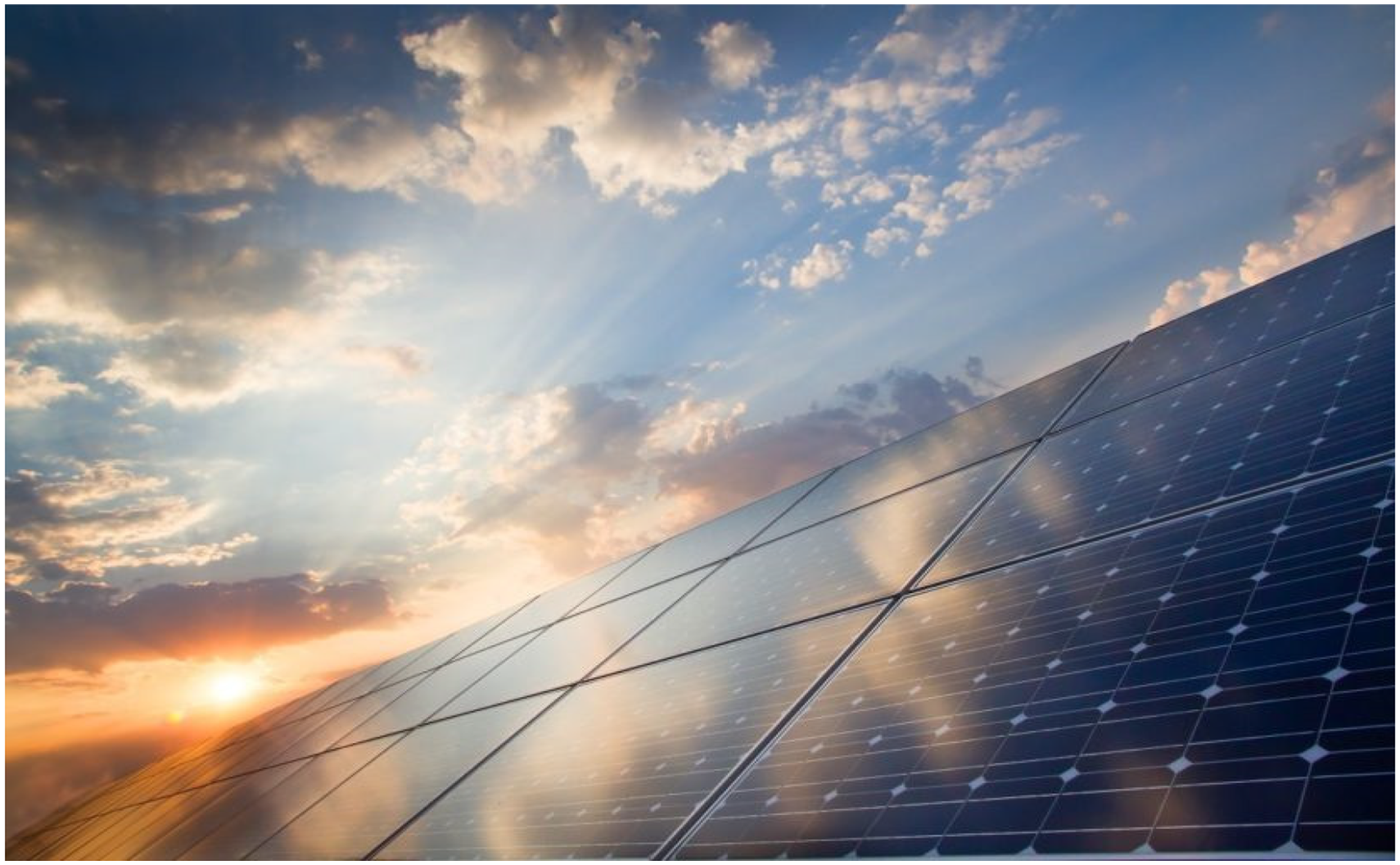
Shading by clouds. Source, Kelly and Gibson, 2011.

Shading by neighbouring solar panels. Source, Brecl and Topič, 2011.

Shading by dry leaf. Source, Dhimish and Lazaridis, 2021
Justification of the study
The study area was selected because Kampala, and neighbouring areas especially Kansanga, offers a typical urban setting where solar panels frequently encounter partial shadowing from trees, buildings, and other structures, making it perfect for evaluating the impacts of shading on photovoltaic performance in the real world. Reliable data gathering is made possible by its high solar potential, regular daylight hours, and easily accessible open spaces. Additionally, the findings are immediately applicable to improving system design and efficiency in comparable urban settings throughout Uganda due to the city's rapidly growing solar energy adoption.
Materials and methods
Study area
The study was carried out in Kansanga. The neighbourhood of Kansanga is located in Kampala, Uganda's capital and largest city. Kansanga's location is portrayed on the Kampala map in Figure 9. The coordinates of Kansanga are 0°17′14.0″N, 32°36′28.0″E (Latitude:0.287225; Longitude:32.607778) Kansanga is bordered by Kabalagala and Kisugu to the north, Muyenga to the north-east, Kiwafu to the east, Bbunga to the south-east, Konge to the south, Lukuli to the south-west, Kibuye to the west, and Nsambya to the north-west.

Map of Kansanga. Source: present study 2025.
Experimental set up
The experimental setup included two digital thermocouples (DM6802B K-type) to monitor cell and ambient temperatures, a digital multimeter (DT9205A C€) to record current and voltage, and an ADH solar PV module (ASO 15 W-18P) to a solar power meter (SM206) to measure irradiance. Using the arrangement, the impact of several shading materials on solar panel performance was assessed. These materials included paper, a piece of fabric, and a leaf from Ficus umbellata. In each study region, current, voltage, irradiance, and temperature data were collected at 15-min intervals from 9:00 a.m. to 5:00 p.m. every day for three months. Figures 10, 11, and 12 depict the setup.

Shading with Ficus Umbellata leaf. Source, present study 2025.

Shading with a paper. Source, present study 2025.

Shading with a piece of cloth
Figure 10 shows the solar PV module partially shaded using a Ficus Umbellata leaf to assess its impact on panel performance.
In Figure 11, a sheet of paper is placed over the solar PV module to provide the illusion of shade. Using this configuration, the paper's ability to decrease solar exposure and impact the electrical output of the panel was assessed.
In Figure 12, a piece of cloth is used to partially shade the solar PV module. Using this configuration, the impact of cloth-induced shadowing on the voltage, current, and overall efficiency of the panel was investigated Table 1.
Description of equipment used.

Methodology
Sources of data
The sources of data were primary and secondary in nature, primary sources include current, Voltage, ambient temperature, irradiance and cell temperature and secondary sources include published journals and text books.
Data collection procedures
Primary data under different shading conditions was collected for three months in every 15 min from 9:00Am to 5:00Pm using the ADH solar panel ASO 15W-18P which was inclined at angle of 15 degrees to the horizontal at Makindye Kansanga, the digital multimeter was connected to the panel to measure voltage across the panel and current, temperature sensor was positioned on the surface of the solar panel for measuring ambient temperature, the thermocouple was inserted in the under the panel on cell panel to measure cell temperature, the solar power meter was used to measure the ambient solar irradiance before each trial. For each shading material of paper, leaf and cloth used in shading the panel covered approximately 25% of the solar panel.
Data analysis techniques
The data for three shading types was analysed using Microsoft excel version 2013 by calculating electrical power output, averages, and plotting graph as presented in the subsection of results and discussion below
Results and discussion
Table 2 summarizes the effects of various shading materials on solar panel performance, demonstrating that the unshaded panel consistently records the highest voltage, current, irradiance, and power, while all shading types especially paper and cloth lower these values. Of the shaded conditions, leaf shading causes the least reduction Figures 13–18.
Statistical description of experimental data.
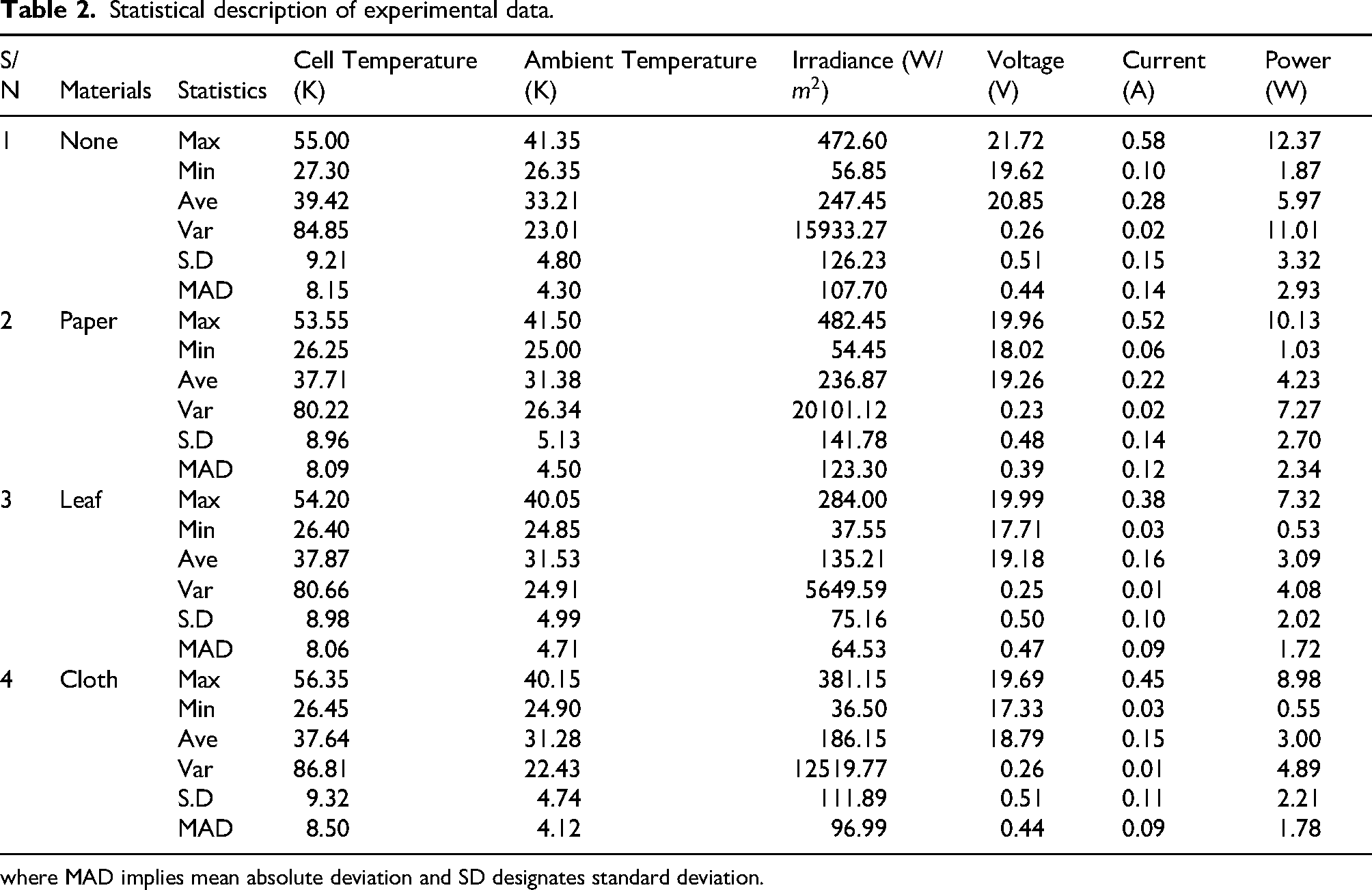
where MAD implies mean absolute deviation and SD designates standard deviation.

Variation of average voltage with time.

Variation of average cell temperature with time.

Variation of average irradiance with time.

Variation of average current with time.

Variation of average power with time.

Variation of voltage and temperature with time.
Computation of panel efficiency
The efficiency was computed using equation 1 presented below
Where
Efficiency analysis.

Where
The findings demonstrate that when the surface was clear, the solar panel absorbed light refine and operated at its best, generating the highest power output and efficiency. Because less sunlight reached the cells when the panel was covered with paper, leaves, or cloth, its performance was greatly diminished. Because they were more opaque, paper and cloth lost the most efficiency, whereas leaves let some light in and produced a respectable amount of production. All things considered, the results show that any kind of shading or covering reduces solar panel efficiency, highlighting the necessity of keeping panels clear of obstructions and clean in order to maximize power generation. Table 4
Cell temperature.
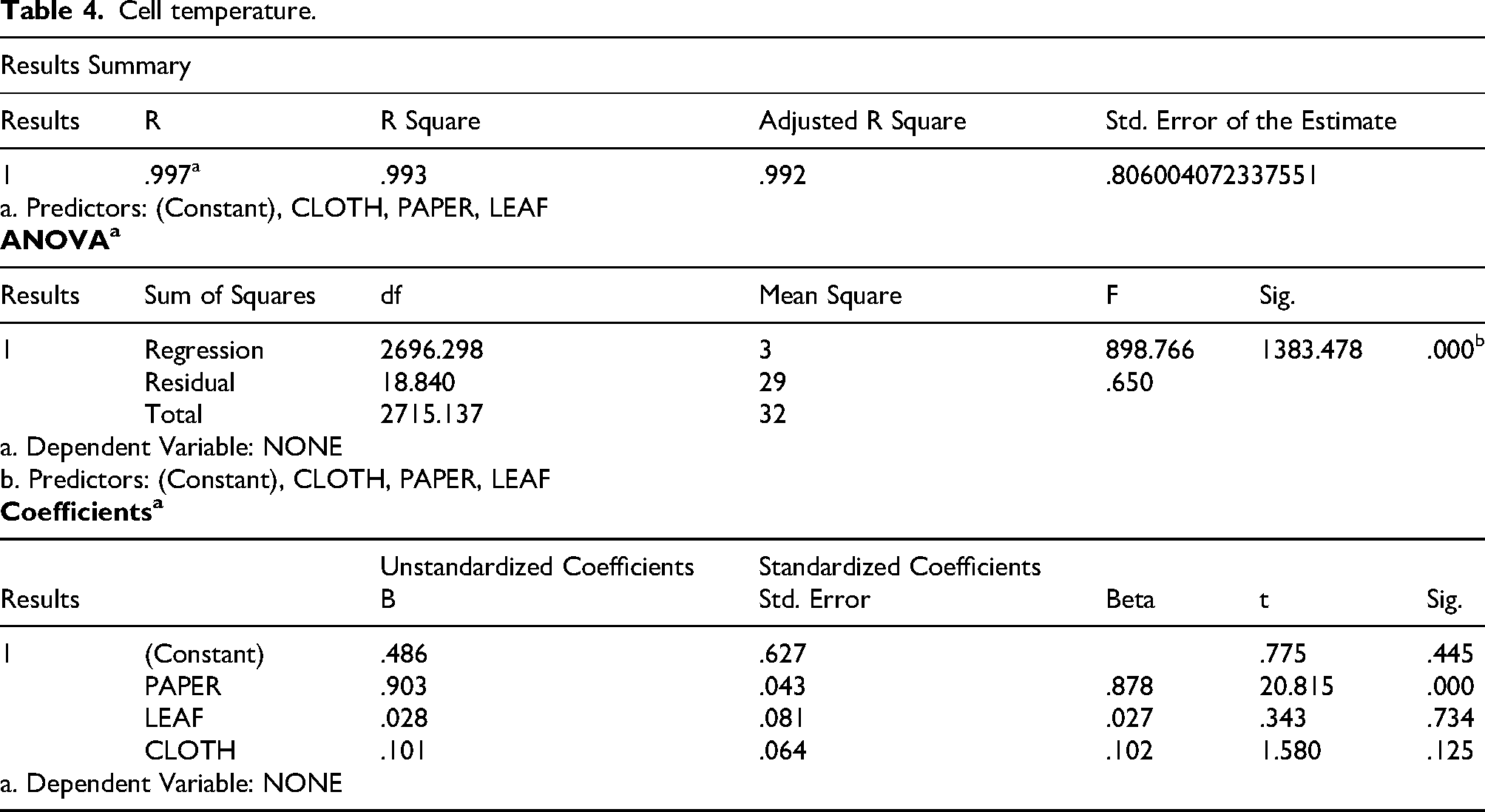
Computational of ANOVA
The cell temperature results explains 99.3% of the temperature variation in the unshaded solar panel (R2 = 0.993, p < 0.001). Paper shade significantly increases the cell temperature (B = 0.903, p < 0.001), indicating that it holds more heat at the panel surface. However, when compared to paper, shadowing by cloth and leaves has no appreciable impact on cell temperature (p = 0.125 and 0.734, respectively), suggesting that their influence on the panel's surface temperature is minimal. Overall, paper shading significantly raises cell temperature as compared to no shadow, although leaf and cloth shading has less impact.
Shading from cloth, paper, and leaves accounts for almost 95% of the variation in current, according to Table 5, which demonstrates a very strong and statistically significant association between shading and solar panel current (R = 0.972 and R2 = 0.945). The ANOVA results (F = 166.017, p < 0.001) verify that shade indeed lowers current. The results show that leaf shade has effect on current (p = 0.787) but much smaller compared to the cloth and paper, representing partial or less dense natural shading, whereas cloth and paper shading significantly reduce current (p < 0.001), corresponding with their considerable blocking of sunlight.
Current.

Table 6 demonstrates a high correlation between shading and solar panel voltage; R = 0.972 and R2 = 0.944 reveal that shading from cloth, paper, and leaves accounts for approximately 94% of the voltage variations. Shading has a significant overall impact on voltage, according to the ANOVA results (F = 163.472, p < 0.001). In comparison with cloth and leaf shading, which have low effects, the coefficients indicate that paper shading significantly lowers voltage (p = 0.001), indicating the actual condition where voltage is typically less sensitive to partial shading than current.
Voltage.

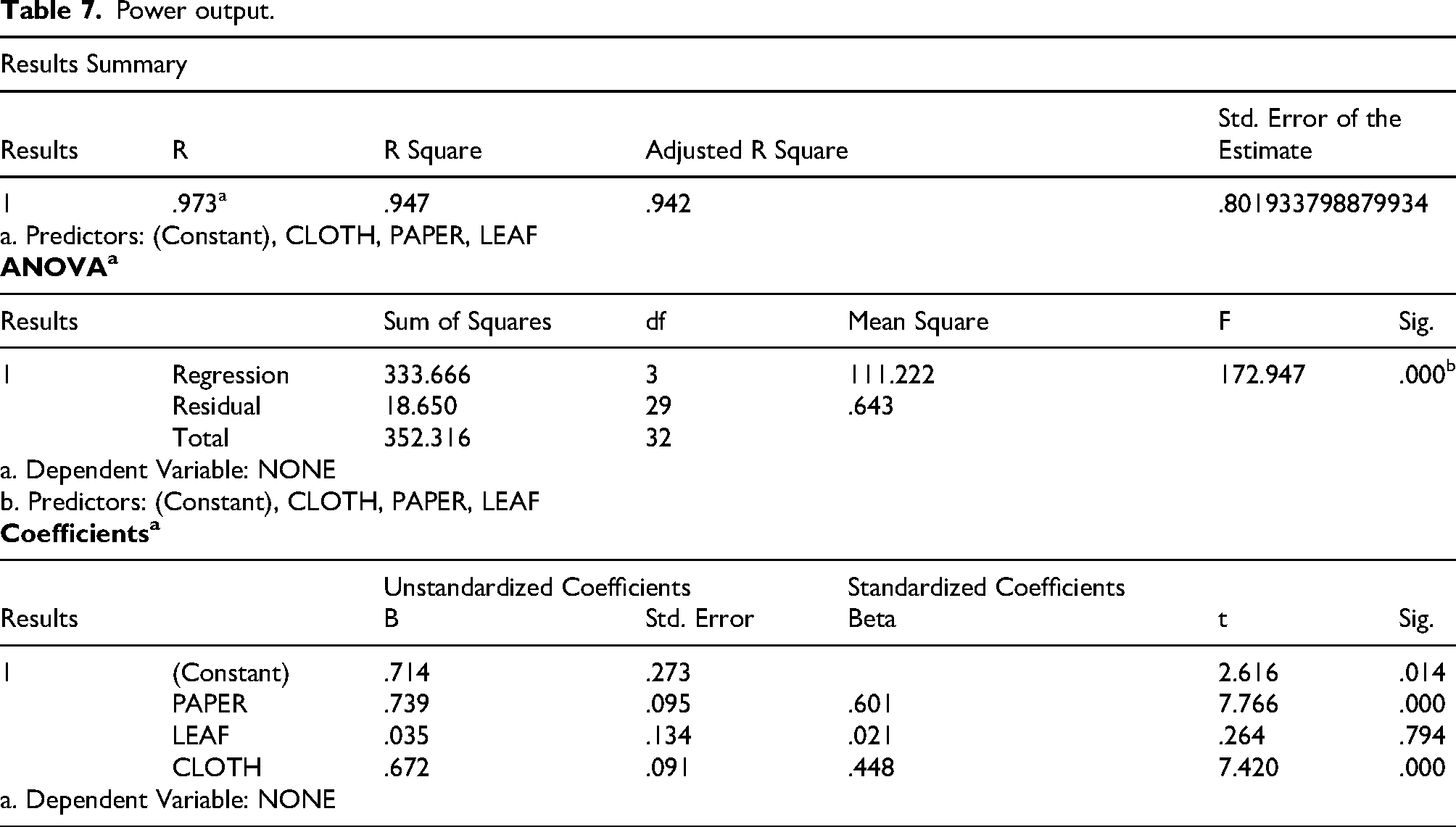
With R = 0.973 and R2 = 0.947 indicating that the shade from cloth, paper, and leaves influences around 95% of the power discrepancy, Table 7 reveals the clear and statistically significant effect of shading on solar panel power generation. The findings of the analyses of variance indicate that shading significantly affects power generation (F = 172.947, p < 0.001). Shading with leaves clearly has less effect on power output, while shading with paper and fabric significantly lowers power production (p < 0.001). The amount of light blocked and the density of the paper and cloth would both be contributing factors to this.
Power output.
Discussion
This discussion is composed according to the objectives of the study and its applications. The results obtained are made of tables and figures substantiating the objectives of this study. Shading a solar panel significantly impacts its power output and efficiency. Even partial shading can lead to substantial drops in energy production, and in some cases, can cause hot spots that damage the panel. This Research paper highlight the importance of understanding and mitigating shading effects for prime solar panel performance and system design. In Figure 13, the average voltage output of an ADH ISO 15W-8p solar panel is displayed with different shading materials applied. The voltage is highest with no shading, while paper and leaf shading reduce voltage as displayed in Figure 13. Cloth shading results in the lowest voltage output, with the strongest shading effect on voltage output, as it blocks sunlight and reduces the panel's output the most (Lesmana & Dewantara, 2024). In Figure 14, all curves show a similar trend
Conclusion
This study examined at how an ADH ISO 15 W solar panel's electrical, thermal, and efficiency performance was affected by partial shade by common urban materials including cloth, paper, and Ficus umbellata leaf in Kampala's tropical urban climate. The findings demonstrate that, when compared to unshaded situations, even a 25% shade significantly reduces the voltage, current, power production, and overall efficiency of solar panels. Full irradiance is necessary for top photovoltaic functioning, as demonstrated by the unshaded panel's consistent production of the greatest performance values. Because of their opacity, paper and cloth provided the largest performance losses among the evaluated shading materials, whereas leaf shading produced comparatively smaller reductions due to partial light transmission. The findings of the ANOVA also showed that shade explained over 94% of the variation in voltage, current, and power, highlighting the significant impact of shading on PV behaviour. Shading changed the temperature of the panel's surface and its ability to absorb light, which had an impact on thermal reactions as well. Furthermore, the results show that regular shadowing from leaves, hanging clothing, or misplaced paper can greatly diminish energy generation. This material-specific data is pertinent to Kampala's urban setting. These observations highlight the necessity of shading-aware system design, appropriate panel location, and routine maintenance to guarantee dependable operation of small-scale solar installations that are frequently found in homes around the city.
Footnotes

Ethics declaration
Not applicable.
Consent to publish declaration
Not applicable
Credit authorship contribution statement
Ounyesiga Living Conceptualization, Writing original draft, Formal analysis; Writing review & editing, Mwesige Richard Supervision, Review of original draft, Stephen Ndubuisi Nnamchic Computational/ANOVA analysis, Supervision, Jagulaine Pete, ANOVA analysis; Review of final manuscript
Funding
There is no funding behind this study.
Declaration of competing interest
The authors declare that they have not known competing financial interests or personal relationships that could have appeared to influence the work reported in this study.
Data availability
The data used in this research will be made available on request.