




Abstract
The global transition toward renewable energy requires efficient and locally sourced solutions to replace fossil fuels while reducing greenhouse gas emissions. Biogas production through anaerobic digestion (AD) represents a sustainable technology that simultaneously manages organic waste and generates renewable energy. However, its performance often remains limited by low conversion efficiency and process instability, particularly when treating high-load organic substrates such as livestock manure. This study investigates the use of catalytic microparticles as an emerging and promising strategy to enhance AD performance and energy yield. Batch experiments were conducted over 50 days using iron (II,III) oxide (Fe3O4), biochar, graphite, and Bio-Fe additives at two concentrations (5 and 15 mg/g VS), compared to a control without additives. Biogas production kinetics were evaluated using the modified Gompertz model, which provided excellent fits (R² > 0.96) and negligible lag phases. The control achieved a cumulative biogas yield of 431.8 mL/g VS, while Biochar L2 reached 667.4 mL/g VS, maintaining stable production throughout. Bio-Fe showed the highest biogas production rate (Rm = 38.3 mL biogas·g−1 VS·day−1), while Fe3O4 maintained consistent productivity over time. Furthermore, iron-based additives reduced hydrogen sulfide (H2S) levels by up to 39%, significantly improving biogas quality. These findings demonstrate that microparticle-assisted AD enhances both biogas yield and purity, offering a promising route for efficient renewable energy recovery from livestock waste.
Introduction
Global energy demand continues to rise due to industrial expansion, urbanization, and population growth. This persistent increase has intensified the exploitation of natural resources and developed society's dependence on fossil fuels. As conventional energy reserves decline and environmental pressures escalate, the need for cleaner and more resilient energy systems has become critical (European Biogas Association, 2024; Ullah Khan et al., 2017). Fossil fuel combustion remains one of the largest contributors to greenhouse gas (GHG) emissions, driving climate change and threatening long-term energy security (Al-Ghussain, 2019). In this context, the global energy sector is undergoing a profound transformation toward low-carbon and renewable energy sources (Liu and Feng, 2023). Among these, biogas stands out as a promising alternative to fossil natural gas, capable of directly substituting it for electricity generation, heating, and vehicle fuel. Beyond its role as a renewable substitute, biogas production integrates waste management and energy recovery within a circular bioeconomy framework, providing both environmental and economic benefits (Ayodele et al., 2020; Kabeyi and Olanrewaju, 2022).
Anaerobic digestion (AD) is the fundamental biological process for producing biogas. It converts biodegradable organic matter into methane (CH4) and carbon dioxide (CO2) through the coordinated activity of anaerobic microorganisms (Deublein and Steinhauser, 2011). AD has been widely applied for decades in the treatment of agricultural residues, animal manure, and wastewater sludge (European biogas Association, 2024). Despite its maturity, the process still faces limitations related to conversion efficiency, reaction kinetics, and process stability—particularly when treating high-organic-load substrates such as livestock manure, where elevated nitrogen content can lead to ammonia inhibition and further constrain methanogenic performance (Jiang et al., 2019).
These challenges have motivated research efforts focused on enhancing microbial performance and optimizing the energy yield of the system. Conventional strategies, including inoculum acclimation, co-digestion, and substrate pretreatments, have provided partial improvements (García Álvaro, Ruiz Palomar, Valenzuela et al., 2024b). However, new technological approaches are required to achieve more substantial gains in methane productivity and system robustness. One of the most promising innovations in this field involves the use of fine or nanoscale particles as catalytic additives in the AD process (Ajay et al., 2020; Zhu et al., 2021).
The introduction of these microparticles represents a novel approach to improve the metabolic efficiency of anaerobic consortia (Ragasri et al., 2022). Their addition can modify redox conditions, facilitate direct interspecies electron transfer (DIET), and enhance microbial aggregation and biofilm formation (Baek et al., 2018; Khalid et al., 2025). These effects can accelerate methanogenesis and increase methane yield without altering the reactor design. The type and composition of the particles determine their catalytic function and influence on microbial activity. Metal oxides, conductive carbon materials, and biochar-based composites have shown significant potential in improving the biochemical methanogenic potential (BMP) of organic substrates (García Álvaro et al., 2024a). Iron (II,III) oxide (Fe3O4) nanoparticles, for example, can act as redox mediators and electron shuttles, strengthening syntrophic interactions and promoting faster methane formation (Barrena et al., 2023). Biochar, a carbon-rich material obtained from biomass pyrolysis, provides a porous structure with high surface area that enhances microbial attachment and adsorbs inhibitory compounds (Cai et al., 2016). Graphite, owing to its high electrical conductivity, supports electron transfer among microbial populations, while composite materials such as Bio-Fe—biochar impregnated with iron oxide—combine the structural and electronic advantages of both components (Muelas-Ramos et al., 2024). These catalytic microparticles can therefore increase reaction rates and energy recovery efficiency in anaerobic systems when applied in suitable proportions.
Although several studies have reported positive effects of these materials on biogas production, the underlying mechanisms and optimal operating ranges remain uncertain. The efficiency of microparticle-assisted AD depends strongly on the particle type, physicochemical properties, and dosage (Ragasri et al., 2022). At appropriate concentrations, these particles can improve methane yield and process stability. However, excessive doses may lead to particle aggregation, mass transfer limitations, or toxicity to microbial communities, ultimately reducing performance (Zhou et al., 2021). The relationship between catalytic enhancement and inhibitory thresholds remains an open question in the design of next-generation AD systems. Understanding this balance is essential to achieving a cost-effective and scalable technology for renewable energy production from organic waste (Li et al., 2020).
The present study addresses this research gap by evaluating the catalytic influence of different microparticles on the anaerobic digestion of pig manure, a substrate with high organic load and significant potential for biogas generation under mesophilic conditions. Four particle types were selected for analysis: magnetite (Fe3O4), biochar, graphite, and Bio-Fe composite particles. Each material was tested at two levels of concentration (5 and 15 mg/g of volatile solids) to assess how both particle type and dosage affect biogas production, kinetic performance, and biogas quality. Biogas production was monitored and the experimental data were fitted to the modified Gompertz model to describe the kinetic behaviour of the system over 50 days. The study aims to identify the particle additions that most effectively enhance cumulative biogas production, accelerate generation kinetics, and reduce impurities such as H2S, thereby improving the overall energetic performance of the AD process. The findings contribute to the broader goal of advancing renewable bioenergy production from livestock waste through microparticle-assisted anaerobic digestion, supporting the global transition toward sustainable and circular energy systems.
Material and methods
Collection of feedstock and anaerobic inoculum
Pig manure used as the primary substrate was collected from a commercial farm located in Sauquillo de Boñices, Soria (Spain). This substrate was selected due to its high organic load and relevance as an abundant livestock byproduct for bioenergy production (Ruiz Palomar et al., 2024). The anaerobic inoculum was obtained from the anaerobic digester of the Soria Wastewater Treatment Plant (WWTP, Spain), which provided an active microbial community adapted to mesophilic conditions. Table 1 presents the main physicochemical characteristics of both materials analyzed before digestion. The total solids (TS) and volatile solids (VS) of the pig manure were 122.2 ± 3.5 mg/g and 97.2 ± 3.3 mg/g, respectively, while the inoculum contained 12.3 ± 0.1 mg/g TS and 9.5 ± 0.2 mg/g VS, with moisture content above 98%. The measured VS contents of the substrates enabled the preparation of an inoculum-to-substrate ratio of 1:1 on a VS basis, which is considered appropriate for achieving stable and reliable reactor performance (Córdoba et al., 2018).
Characteristics of substrate and inoculum.

Particle preparation
Four catalytic additives were evaluated: Fe3O4, biochar, graphite, and Bio-Fe. Commercial Fe3O4, graphite particles (Aldrich Chemistry, batch 310069-25G), and graphite were used. Biochar and Bio-Fe were synthesized locally in the facilities of the University of Valladolid (UVa, Soria Campus) following the standardized laboratory procedures.
Biochar preparation
The biochar was produced from the solid fraction of pig slurry obtained from the same farm, using a solid-phase muffle pyrolysis process. The method followed the procedure described by Torboli et al. (2024) and Kizito et al. (2015), involving intermediate pyrolysis at 500 °C for 6 h under limited oxygen conditions (He et al., 2023; Jassal et al., 2015; Kizito et al., 2015; Torboli et al., 2024). The organic material was enclosed in sealed crucibles and surrounded by activated carbon to maintain anaerobic conditions. The resulting biochar was cooled, ground, and stored in desiccators until use.
Bio-Fe synthesis
Bio-Fe composite particles were prepared by impregnating the biomass of Pinus pinea leaves with iron (II) sulfate heptahydrate (FeSO4·7H2O, 278.01 g/mol) following the impregnation protocol of Muelas-Ramos et al. (2024). The biomass was first cleaned, oven-dried at 105 °C for 24 h, and ground to < 1 mm. A mixture containing 10 g biomass and 25.25 g FeSO4·7H2O (Fe:biomass ratio = 2:1) was suspended in 80 mL of distilled water and stirred at 80 °C for 2 h. The impregnated biomass was then dried at 105 °C for 24 h and calcined at 500 °C for 2 h with a heating rate of 10 °C/min in a sealed crucible to ensure anaerobic conditions. The obtained Bio-Fe particles were repeatedly washed with distilled water, centrifuged, and dried prior to use.
All prepared particles were characterized visually and sieved to ensure particle sizes below 100 µm before use.
Biochemical methanogenic potential essays
The biochemical methane potential (BMP) tests were conducted in batch mode over a period of 50 days under mesophilic conditions (35 ± 0.5 °C). The experimental setup consisted of 120 mL sealed serum bottles with a working volume of 70 mL and a headspace of 50 mL. Each reactor contained the inoculum and substrate mixture at an inoculum-to-substrate ratio of 1:1 (VS basis) (Holliger et al., 2016). Two levels of particle loading were tested: 5 mg/g VS (L1) and 15 mg/g VS (L2). A control reactor without particle addition was included for comparison. To prevent pH fluctuations, 0.3 g CaCO3 was added to each bottle as a buffering agent (Alvaro et al., 2023). The systems were flushed with nitrogen for 2 min to eliminate oxygen and ensure anaerobic conditions before sealing (Ghofrani-Isfahani et al., 2020).
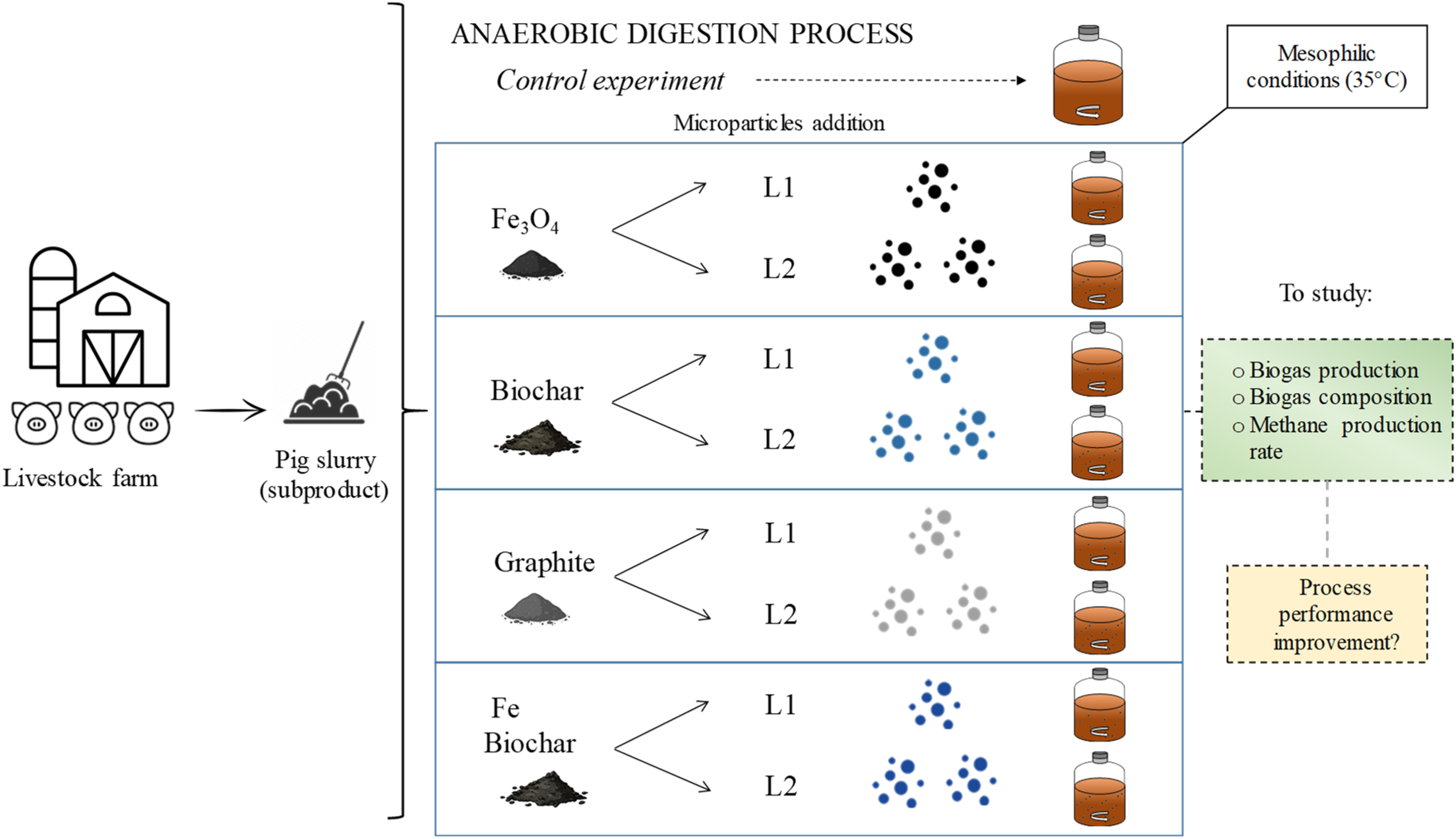
Reactors were placed in an incubator (Hotcold-GL Selecta, Spain) equipped with orbital shaking (Rotabit Selecta, Spain) to maintain homogeneity. Biogas production was measured daily by water displacement under standardized temperature and pressure conditions. Each test was performed in duplicate to ensure reproducibility, and the mean values were used for subsequent analyses. The methane (CH4), carbon dioxide (CO2) and hydrogen sulphide (H2S) concentrations in the produced biogas were measured periodically using a GeoTech Biogas 5000 gas analyzer. Endogenous gas generation from the inoculum alone was quantified in blank tests and subtracted from all biogas yield data. The complete procedure applied in the biochemical methane potential assays is summarized in the schematic diagram shown in Figure 1.
Schematic procedure of the experiment.
Analytical procedure
Standard analytical methods recommended by the American Public Health Association (2023) were used to determine the physical and chemical properties of all samples. Total solids (TS) were determined by oven drying at 105 °C for 24 h, and volatile solids (VS) were quantified by ignition at 550 °C for 30 min in a muffle furnace (American Public Health Association, 2023). The daily and cumulative biogas volumes were corrected to standard temperature and pressure conditions to ensure consistency between treatments.
Modelling
To evaluate the kinetics of biogas generation, the cumulative production data were fitted to the modified Gompertz model. This model provides a description of biogas production behavior in batch anaerobic digestion systems, and its mathematical expression is given in Eq. 1.
Statistical analysis
Data analysis and curve fitting were performed using Microsoft Excel. Graphical outputs, including cumulative biogas curves and kinetic model plots, were generated to visually compare the performance of different microparticle amendments.
Results and discussion
Effect on biogas production
Figure 2 shows the cumulative biogas yield profiles for all treatments during the 50-day digestion period. The control system, containing only inoculum and pig manure, reached a total biogas yield of 431.8 mL g−1 VS, establishing the baseline for performance comparison. All reactors amended with microparticles demonstrated higher cumulative gas production, which may indicate a catalytic enhancement of microbial activity.

Cumulative biogas production (mL g−1 VS) over 50 days for control and microparticle-assisted anaerobic digestion treatments.
Among the tested materials, Biochar L2 exhibited the highest cumulative yield (667.4 mL g−1 VS), followed closely by Biochar L1 (657.0 mL g−1 VS), Fe3O4 L2 (642.6 mL g−1 VS), and Fe3O4 L1 (630.2 mL g−1 VS). These values represent improvements of approximately 54–55% over the control. Bio-Fe also achieved a strong enhancement, with cumulative yields of 586.7 mL g−1 VS (L1) and 598.4 mL g−1 VS (L2), corresponding to an increase of 36 to 39%. The positive effect of iron-containing particles can be tentatively attributed to their role as redox mediators, facilitating direct interspecies electron transfer (DIET) between syntrophic bacteria and methanogenic archaea as other studies have reported recently (Fu et al., 2019; Gao and Lu, 2021; Rotaru et al., 2014). In contrast, graphite showed a more moderate catalytic response. The Graphite L1 treatment reached 613.6 mL g−1 VS, but a decrease was observed at the higher loading (Graphite L2 = 453.0 mL g−1 VS). This decline suggests that excessive particle concentration may tentatively hinder microbial activity, possibly by aggregation phenomena or shading effects that reduce substrate accessibility. The results highlight that particle dosage plays a critical role, and higher concentrations do not necessarily lead to proportional energy gains (Shen et al., 2020).
The observed differences among additives confirm that both the composition and surface reactivity of the particles determine their catalytic efficiency. Biochar and Fe3O4 provided the most favourable microenvironments for microbial colonization and electron exchange, while graphite's performance was limited to low concentrations (Aguilar-Moreno et al., 2020; Gómez et al., 2018). The overall trend supports that microparticle-assisted digestion can significantly enhance biogas production efficiency, provided optimized material type and dosage.
Biogas quality
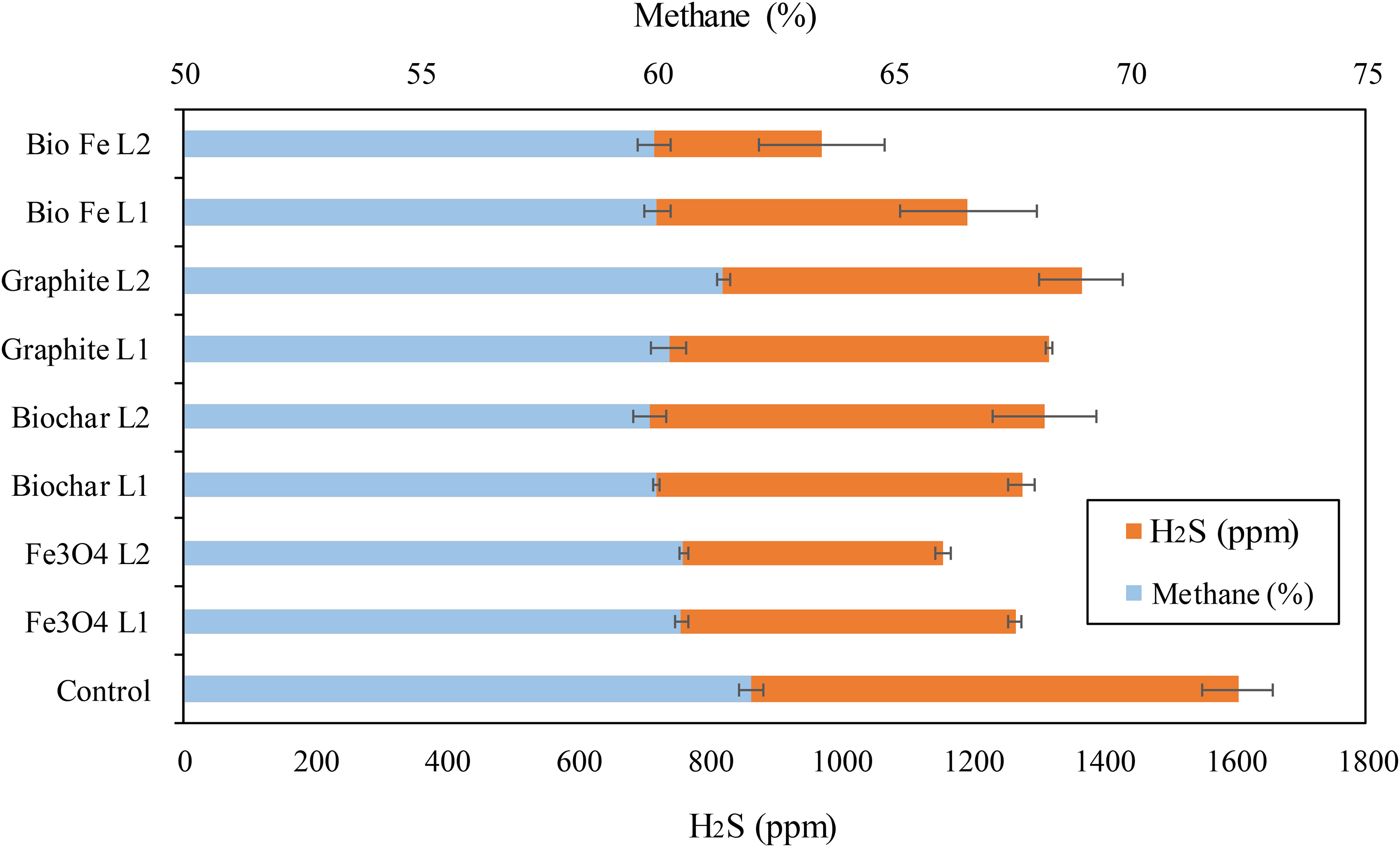
The results of biogas composition analysis are summarized in Figure 3. Methane (CH4) concentrations across all treatments ranged between 59.8% and 62.0%, with minimal variation between reactors. The control sample produced biogas with the highest methane fraction (62.0%), while reactors amended with microparticles maintained comparable levels, ranging from 59.9% to 60.6%. This consistency indicates that the catalytic additives primarily influenced the quantity of biogas generated rather than altering its methane enrichment.
Biogas composition: methane (CH4) content and hydrogen sulfide (H2S) concentration for all experimental treatments.
Parallelly, the hydrogen sulfide (H2S) concentration exhibited a significant decline in the presence of microparticles. The control reactor reached an average H2S content of 1606 ppm, whereas the lowest values were measured for Bio-Fe L2 (973 ppm), Fe3O4 L2 (1157 ppm), and Fe3O4 L1 (1267 ppm). These represent reductions of approximately 39.4%, 28.0%, and 21.1%, respectively, relative to the control. This decrease demonstrates the strong sulfide-scavenging capacity of iron-based materials, which promotes the precipitation of ferrous sulfide (FeS) within the anaerobic medium (Choudhury and Lansing, 2020).
This improvement has critical energetic and operational implications. Hydrogen sulfide is considered a major impurity in biogas, since its combustion produces sulfur dioxide (SO2) and other acidic compounds that corrode engines, turbines, and gas upgrading units (European Committee for Standardization, 2016, 2017). High H2S concentrations therefore, demand costly desulfurization treatments before biogas can be used for energy conversion. By naturally lowering H2S during digestion, iron- and biochar-based additives enhance both the quality and usability of biogas, reducing maintenance requirements and extending equipment lifespan (Park et al., 2015).
Gompertz model and biogas production rate
The modified Gompertz model accurately described the biogas production kinetics of all treatments, with coefficients of determination (R²) above 0.97, indicating an excellent fit between experimental and predicted data, as shown in Table 2. The maximum biogas production rate (R) is the most sensitive kinetic parameter for evaluating catalytic performance, representing the grade of biogas accumulation (mL biogas g−1 VS−1 day−1). The control reactor exhibited an R of 29.4, while all catalytic treatments showed higher rates. The highest values were obtained for Bio-Fe L2 (38.3) and Bio-Fe L1 (36.4), corresponding to increases of 30% and 24%, respectively. This improvement suggests that Bio-Fe not only accelerates the methanogenic phase but also enhances electron transfer efficiency between syntrophic partners, shortening the effective digestion time.
Kinetic parameters from Gompertz model fitting for biogas production under different microparticle additions.

* The fitted λ values were slightly negative and were therefore rounded to 0, since negative lag phases are not biologically meaningful.
Biochar and Fe3O4 also demonstrated elevated production rates, with R values ranging from 30.6 to 32.5 mL biogas g−1 VS−1 day−1, confirming their favourable catalytic effects. The shorter lag phases (λ = 0 days) observed in all cases indicate rapid microbial adaptation and active methanogenic activity from the start of the digestion process. In contrast, graphite L2 displayed a marked reduction in Rm (20.8 mL biogas g−1 VS−1 day−1), reinforcing that high particle loading may exert inhibitory effects on the microbial community.
Conclusions
This study evaluated the catalytic influence of different microparticles on the anaerobic digestion of pig manure with a high organic load, providing new insights into process performance, kinetics, and gas quality. The combined analysis of cumulative biogas production and Gompertz modelling confirmed that microparticle-assisted digestion can substantially enhance biogas yield and accelerate biogas generation compared to the unmodified control. The control system produced 431.8 mL g−1 VS, whereas the best-performing treatment (Biochar L2) reached 667.4 mL g−1 VS, representing an increase of 54%. Likewise, Fe3O4 L2 and Bio-Fe L2 achieved 642.6 mL g−1 VS and 598.4 mL g−1 VS, respectively, demonstrating strong catalytic enhancement.
Among the tested materials, biochar exhibited the most stable and balanced performance, maintaining high biogas productivity throughout the 50-day digestion period. Its porous structure and adsorptive capacity supported long-term microbial activity and sustained methane generation. Bio-Fe demonstrated the highest biogas production rate according to the Gompertz model, reaching 38.3 mL CH4 g−1 VS day−1, compared to the control value of 29.4 mL CH4 g−1 VS day−1, indicating strong catalytic stimulation of methanogenesis, although its activity declined after the initial acceleration phase. Fe3O4 particles addition also improved remarkably the kinetic performance, with maximum biogas production rates between 30.6 and 32.0 mL CH4 g−1 VS day−1, confirming its role as a reliable redox mediator enhancing microbial electron transfer. Conversely, graphite at higher concentrations showed inhibitory effects, reducing both biogas yield (to 453 mL g−1 VS) and production rate rate (to 20.8 mL CH4 g−1 VS day−1), underscoring the concentration-dependent behaviour of particle-assisted systems.
Overall, the results demonstrate that microparticle addition can optimize both the quantity and quality of biogas, In particular, iron-based additives substantially reduced hydrogen sulfide concentrations—Bio-Fe L2 decreased H2S from 1606 ppm (control) to 973 ppm, a reduction of 39%—improving the energetic value of the final biogas and reducing downstream corrosion risks.
Future research should focus on scaling up these findings in continuous digestion systems, exploring strategies to extend the catalytic lifetime of Bio-Fe and to functionalize biochar surfaces for improved long-term stability. In addition, detailed microbiological analyses are needed to elucidate the metabolic pathways affected by each type of particle, and to better understand inhibitory mechanisms at higher additive dosages for the design of efficient, durable, and economically viable particle-assisted anaerobic reactors.
Footnotes
Acknowledgements
This work was supported by the Regional Government of Castilla y León, the EU-FEDER (CLU 2017-09 and CL-EI-2021-07) and the program Erasmus + grant for the UVAMOBPLUS2 project (grant number 2023-1-ES01-KA171-HED-000135436).

CRediT authorship contribution statement
Funding
The authors disclosed receipt of the following financial support for the research, authorship, and/or publication of this article: This work was supported by the Junta de Castilla y León, Erasmus+, (grant number CL-EI-2021-07, CLU 2017-09, grant number 2023-1-ES01-KA171-HED-000135436).
Declaration of conflicting interests
The authors declared no potential conflicts of interest with respect to the research, authorship, and/or publication of this article.