




Abstract
This paper evaluates solar powered irrigation systems in Palestine. This practice is mainly to promote the use of these systems as currently there are only three such system in Palestine. The evaluation is done based on technical, financial, social and environmental aspects. The technical evaluation is done based on actual system's performance. Meanwhile, social impact study is conducted based on focus group discussion and questionnaire. Results show that a 1 kWp of photovoltaic panels can pump up to 1.5 m3 of water per hour at a cost of USD 0.025 per m3. This pumping rate is subject to a surface distance pumping up to 1500 meters with a collecting pond depth of up to 8 meters, and system's life time of 20 years. Meanwhile, the capital cost of such a system is found to be USD 1754 per kWp. On the other hand, the conducted social impact study shows that 70% of farmers believed that the government did not encourage investment in this area. Meanwhile, 50% of farmers believed that using solar powered irrigation systems had increased their income by 10% to 30%, while 56% of farmers were able to hire new workers after using the system. Finally it is concluded that solar powered irrigation systems have low impact on environment subject to not using fertile land for installation.
Introduction
In agriculture zone, accessing the water in aquifers often needs a source of energy to pump water, which can present a large problem for many developing countries such as Palestine. Expanding an existing grid system is often too expensive, especially in rural villages which are located too far away from the grid lines. Thus, the use of renewable energy is an attractive solution for water pumping applications in rural areas. Solar powered irrigation systems (SPIS) can be used to pump water from water sources such as artificial ponds, wells, boreholes, or rivers for irrigation purposes.
In general, SPIS are classified depending on the type of the pump used (AC or DC) and the configuration of the systems. There are two configurations of water pumping systems namely standalone systems and hybrid systems with more than one energy source. A SPIS generally consists of a PV array, an inverter with a centralized maximum power point tracker, and a pump. This system can also be accompanied with a block of batteries as a backup power supply. As for the pump, there are two broad categories of pumps that are being used namely rotating and positive displacement pumps. Rotating pumps such as centrifugal, rotating vane and screw pumps move water continuously when power is presented to the pump. The pump's output is dependent on head, operating current, voltage. They are well suited for pumping water from shallow reservoirs or cisterns. They can be tied directly to the PV array output, but their performance can be improved by using an electronic controller such as a linear current booster to improve the match between the pump and the PV array. On the other hand, positive displacement pumps move “packets of water”. These pumps are typically used for pumping water from deep wells. Their output is nearly independent of pumping head and is proportional to solar radiation. Pumps are also categorized as surface or submersible, where surface pumps are used for shallow reservoirs, while submersible pumps have a high lift capability. Both types of pumps can be driven by AC and DC motors. The choice of motor depends on the water volume needed, the efficiency, price, reliability, and availability of support. DC motors are used for low pumping rate and shallow reservoirs, while AC motors are usually used for larger applications.
Literature review
The performance of SPIS depends on weather conditions such as solar radiation, ambient temperature, shadow effect, wind speed, humidity, specifications of PV panels as well as motor-pump–hydraulic system characteristics. Thus, when assessing a SPIS, the annual productivity rate (amount of pumped water per 1 kWp) needs to be calculated to assess the feasibility of SPIS. The PV array, subsystem, and overall system efficiencies including the performance factor are also used to check the feasibility of SPIS. In addition, the yield factor and the capacity factor are other factors that can be utilized when evaluating the productivity of SPIS. Finally, the environmental and social impact of SPIS should be taken into consideration when evaluating such a system (Khatib et al., 2021).
There are many papers in the literature that evaluated SPIS for specific locations. The research trend is quite similar with this regards since 1996 and up to know. Alajlan and Smiai (1996), for example, evaluated SPIS based on the field conversion efficiency of the PV array which reached 8.5%. Bucher (1996) also reported overall system performance efficiency in the range of (3–10)%. The unit cost was also reported by Bucher (1996) as of 0.60 USD/m3. More expensive pumping was reported by Posorski (1996), who found the cost of water discharge as of 1 USD/m3 with overall system's efficiency of 3%. Hammad (1999) investigated the performance of SPIS for 13 distant wells. The studied wells had water depths between 18 m and 75 m, with the systems’ water demand being from 36 m3/day to 130 m3/day. The pumping power was between 0.5 kW and 1.94 kW. Mahmoud and El Nather (2003) studied the feasibility of using SPIS in Egypt. According to the results, the cost of an SPIS water pumping unit was cheaper than a unit pumped by a DG-based system. In addition, Kolhe et al. (2004) studied the performance of a SPIS located in India. The experimental results showed that the system had an average daily production of 38 m3 with a flow rate between 0.02 and 0.14 m3/min with overall system's efficiency of 2.75%. Similarly, Hamrouni et al. (2009) studied the influence of meteorological variables on the performance of a 2.1 kWp SPIS in Tunisia. It is reported in the research that average daily production was found to be 7.7 m3/day in January and 14.7 m3/day in July, with overall system's efficiency of 3%.
Boutelhig et al. (2011) studied the performance of three SPIS and reported that the is system capable of providing 4–6 m3 of water per day with a pumping head from 19 m to 35 m. The best overall system efficiency was 3%. Meanwhile, Vick and Clark (2011) reported a higher efficiency of SPIS as of 7%. Similarly Kaldellis et al. (2011) reported that the efficiency of SPIS was 5%. Mokeddem et al. (2011) investigated the performance of 1.5 kWo SPIS and found that the pumping water rate had a range of 6 L/min to 65 L/min with 6 to 8 pumping hours.
Furthermore, Belgacem (2012) evaluated a 2.1 kWp SPIS installed in, Tunisia. Each. According to the research, the system delivered a daily amount of water between 6.5 m3/day and 30 m3/day with a head from 65 m to 112 m. Al-smairan (2012) conducted an economic study of a SPIS powered. The daily water demand of the station was 45 m3 with a 105 m pumping head. The systems consisted of a 5.9 kWp PV array, with flow rate of 8 m3/h. Moreover, Senol (2012) discussed the feasibility of SPIS in Turkey. According to the results, the water unit cost is 0. 24 USD/m3 and 0. 26 USD/m3. Similarly, Benghanem et al. (2013) conducted a comparative study of SPIS with different configurations. According to the results, SPIS supplied the maximum daily water volume of 22 m3 with 80 m water head. Setiawan et al. (2014) evaluated a SPIS for a specific location in Indonesia. The system started pumping water at a solar radiation level of 300 W/m2 while the flow rate was between 1.44 m3/h and 3.24 m3/h. Benghanem et al. (2014) studied the performance of a SPIS in Saudi Arabia with a capacity of a 1.8 kW photovoltaic array. According to the results, the overall system's efficiency is about 7% at 50 m water head. More investigations for PV system performance were done in (Chandel et al., 2015; Sontake and Kalamkar, 2016; Islam et al., 2017; Wazed et al., 2018; Khatib et al., 2019; Kumar et al., 2020; Ara et al., 2021; Terang and Baruah, 2023). Same methodology was followed by all researcher but with performance characterization considering the location of the experiment. This actually leads to the need of investigating the performance of SPIS considering the weather environment for any location in the world. The reason behind that is the performance of SPIS cannot be generalized and can vary from location to another.
On the other hand, Durga et al. (2024) proposed an interesting approach for evaluating SPIS, where the barriers for SPIS development were reviewed is this paper. Aside of the proven ability of the technology, the authors have reviewed many of the barriers including technical and non-technical barriers. The author claimed that some non-technical barriers can ban the development and the adaptation of SPIS despite it's a pumping ability, reliability and affordable cost. This statement is also seconded by (Khatib et al., 2021) regarding the development of solar power systems in general in Palestine.
Therefore, this research aims to address the following research gaps regarding SPIS,
The ability of SPIS to pump water in Palestine: although, there are many researches on this topic, there is no research on the ability of SPIS in Palestine. The importance of this investigation is due to the fact the performance of SPIS varies depending on location and environment as illustrated in the conducted literature review. Social impact assessment of SPIS: The social impact as well as costumer attitude, awareness of SPIS should be measured In Palestine. This investigation can be even generalized to global farmers as it concludes the behavioral and structural barriers regarding this technology. Here there is a very few research that addresses the social impact of SPIS in general. The environmental impact of SPIS: in order to assure a sustainable development process, there should an environmental impact assessment of SPIS considering the ambient of the installation site. This issue is very critical and should seriously considered
Solar powered irrigation systems in Palestine
The most common method in Palestine is electric grid-based pumping due to its reliability and cost as compared to other methods. However, in rural and remote areas where there are no electric distribution grids, diesel generators are used for water pumping. However, the high costs of the diesel as well as the required maintenance are the main challenges for this method. Thus, solar-based pumping systems using photovoltaic systems are now being used as an alternative for the previous methods, either in direct or indirect ways.
In the Palestine, the cost of pumping a cubic meter of water varies greatly from one region to another, depending on the pumping technology, the season, and the field location. It can cost anywhere between USD 0.14 and USD 0.76.
SPIS is a technology that uses PV systems to pump water by using specific motor-pump sets. In Palestine the use of such technology is divided into three categories:
Direct-drive SPIS. The direct-drive method uses a PV array that drives a motor-pump that pumps water into storage tanks directly, without any need to use the electricity grid. This method is not widely used in Palestine due to behavioral and structural barriers. The disadvantages are the amount of land required to install the PV array On-grid solar-based pumping systems. These systems are conventional, grid–connected PV systems but located near the motor-pump sets on the farms. The aim of these systems is to export energy to the grid and sell it to the local distributor to compensate for the energy consumed by the motor-pump set. Standalone PV systems with water pump. In this system, a conventional standalone PV system with storage batteries powers many loads, including small water pumps for domestic usage.
In this research only direct-drive SPIS are considered as the other systems are not utilizing solar energy directly for pumping. In this research three SPIS with a capacity of 15 kWp are adapted. These systems pump water from artificial ponds which are filled by main water source as it can be seen in Figure 1. These systems are also equipped with diesel generators as a backup power source to ensure there is enough water for irrigation. It is worth to mention that the pumps are to irrigate the fields downstream rather than for lifting water up from the wells.
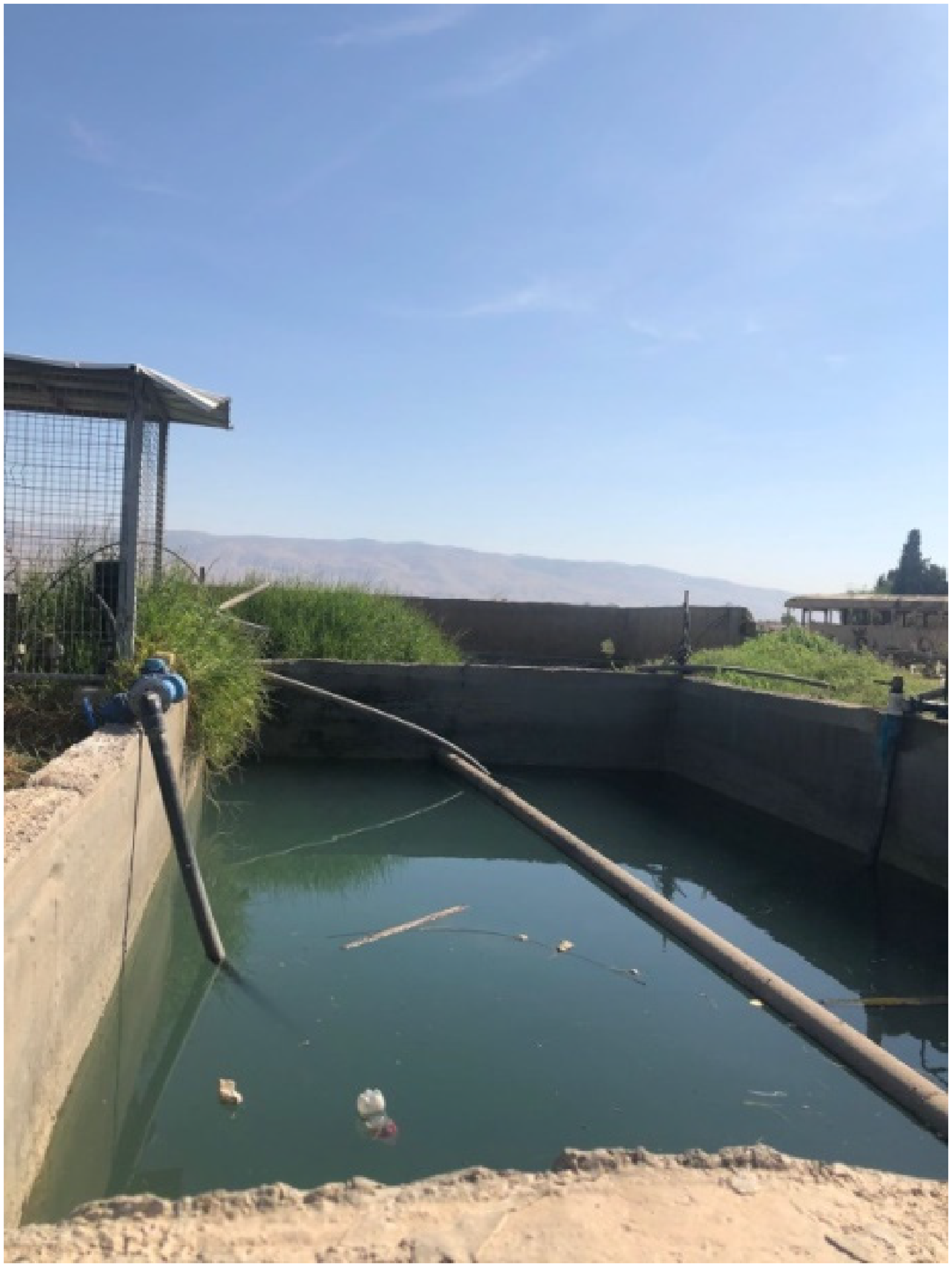
An artificial pond for storing water pumped from a central well in Jordan Valley.
Environmental and social impact evaluation methodology
The social impact of SPIS is assessed by two methods. A questionnaire was developed and distributed to all of beneficiaries of the existing SPIS. Then, focus groups were organized for those beneficiaries and stakeholder representatives, to receive feedback on SPIS expertise.
As for the environmental impact assessment, it should include specific information such as a summary of the project, and contains a description of the project's needs, project details and main alternatives. It also presents an assessment of the potential significant impacts of the proposed project on the environment and society and details the actions required to significantly mitigate any negative environmental impacts. The evaluation should also outlines the methodology of the monitoring and mitigation requirements throughout the lifespan of the project, including any responsibilities and legal requirements, and reaffirms the developer's commitment to the plan.
In this research numerous priority areas for the development of the project in the Jordan Valley are considered. Jordan Valley is an agricultural area that lacks access to electricity services and relies mainly on diesel generators to operate the pumps.
The construction of SPIS project consists of three main phases which are planning and construction phase, operation phase, and shutdown and dismantling phase.
The planning and construction phase consists of the detailed and final planning of the project and its components, the transfer of the project components to the site, and site preparation activities for the installation of photovoltaic arrays and various project components. There is additional construction work which may include excavation work, land clearing and leveling activities that must be carried out.
On the other hand, operational phase includes the work required for operating the station, producing electricity to operate the pump, and regular maintenance of all photovoltaic panels and all various electrical equipment. This includes, for example, regular cleaning of the photovoltaic panels to prevent dust accumulation. The work of this phase includes standard tests of photovoltaic panels, routine inspection of quality records for civil engineering works, and following-up on electrical fault repair or materials replacement. The operational phase of the project is expected to last for a maximum of 20 years (project's lifespan). Finally Shutdown and dismantling phase comes after the operational phase. The shutdown and dismantling phase of the various components of the project (for example, the photovoltaic panel arrays) include the final disposal of these components according to the requirements of the hazardous waste management system and the list of hazardous waste attached to these requirements.
Results and discussion
Technical assessment of direct-drive solar irrigation pumping systems in Palestine
In this research, three SPIS, located in the Jordan Valley are evaluated. These systems have a capacity of 15 kWp per each and it is assumed to fulfill a water demand of 20–25 m3 per hour during a ten-hour day. The capacity of the storage tank (the artificial pond in Figure 1) is assumed to be 350 m3, while the system's price is assumed to be USD 26,310.
The evaluation is done by evaluating the amount of water pumped from the system and hourly recorded data for solar radiation and ambient temperature. Based on hourly data for one year of ambient temperature and solar radiation on horizontal plane, the daily monthly solar irradiation is about 5131.6 Wh/m2 per day.
The performance of SPIS in December and January (the worst months in terms of solar production) are evaluated in this report first, and then general evaluation of the whole year is done. For example, the average daily monthly solar irradiation in December is about 3779.9 Wh/m2 per day. The daily average power of the PV array over the month is found to be 425.038 W, while the lowest average daily amount of pumped water is on December 24, at around 28.379 m3 (11.4% of the desired water). Table 1 shows an evaluation of the system during selected days in December 2021 and January 2022, based on an assumption of pumping 225 m3 per day with a flow rate of 25 m3 and an average solar day length of 10 h.
Performance of 15 kWp SPIS in winter days.

From the table it is very clear that the system production fluctuates depending on the solar potential. The demand is fulfilled on sunny days but not on rainy or cloudy days. This shows the importance of considering the importance of accurately sized artificial ponds and back up diesel generators to the system.
Table 2 shows the monthly productivity of the SPIS relative to the solar radiation, ambient temperature, and water demand throughout 2022. The maximum productivity of SPIS occurs in March at about 283.8 m3 per day (126% of the target), while the maximum shortage occurs on a day on December where only 30% of the desired daily water amount is achieved.
Monthly performance of the 15 kWp SPIS.

March and October are the most productive days although the available solar energy averages in these months are not the highest in the year. The summer months are not the best productive months due to the high temperature in the system's location (high temperatures affect system power generation and consequently its production) (Khatib and Muhsen, 2021). It can therefore be assumed that the best months for water production in Palestine are associated with months with high solar energy and for temperatures as low as 16 to 22 °C.
As a result, SPIS can pump up to 15.7 m3 per day (annual average) with a pumping rate of 1.57 m3/h. These averages are for horizontal pumping from an artificial pond with a 6 meter depth.
On the other hand, there are some environmental concerns regarding this method of pumping due to algal growth in the ponds, as can be seen in Figure 1.
As for the feasibility of the adapted SPIS, Table 3 shows an analysis of system life time cost. the system consists of a PV array, a motor-pump set as well as other power electronic features and electrical wiring. A steel structure for mounting the PV panels is also used. The lifecycle of all of these systems is 20 years except for the motor-pump set which lasts about 10 years. Thus, in calculating the lifecycle cost of the system, some assumptions are made. It is worth mentioning that the capital cost is USD 26 310.
Lifecycle cost of 15 kWp SPIS.

As can be seen in Table 3, the total production of the system is 85 750 m3 per year, meaning that the production over the 20-year lifetime of the system is 1715 million m3. As the system's lifecycle cost is USD 42 050.50, the m3 cost of the system is USD 0.025 per m3. This percentage should be compared with the cost of diesel generators used to horizontally pump the water. According to SPIS owner, the diesel generator consumes about USD 66.40 per day to pump about 20–25 m3. This means that the m3 cost produced by a diesel generator is about USD 2.65. However, it is important to highlight that the utilized diesel generator on this farm is old, having been in service since 1968. It is estimated that the cost of pumping 1 m3 of water using a new diesel generator is about USD 1.00 per m3. Thus, horizontal pumping of the water using a solar-powered system saves about 250% of the cost of pumping water by using a diesel generator.
However, the feasibility of the SPIS in this research is done considering the cost of pumping by electricity grid. The cost of pumping water using the electricity grid is about USD 0.1622 per m3. Here RETscreen software is used to analyze the feasibility of the system. Figure 2 shows the feasibility analysis page as a capture. From the figure the payback period a system is 4 years considering inflation rate of 3%, discount rate of 2%, project life of 20 years. Income tax of 15%, and depreciation rate of 4%. The analysis also shows that the IRR value is of 24.5%. This shows the feasibility of the system as compared to other power options.

Feasibility analysis by using RETscreen software.
Social impact assessment
In this research Seventy-three farmers that directly benefited from SPIS participated in the questionnaire and the focus discussion groups. First the reliability of the questionnaire is tested using cronbach's alpha test and found to be 0.724 which is acceptable. The responses were then analyzed and discussed as in Table 4 below.
Questionnaire results.
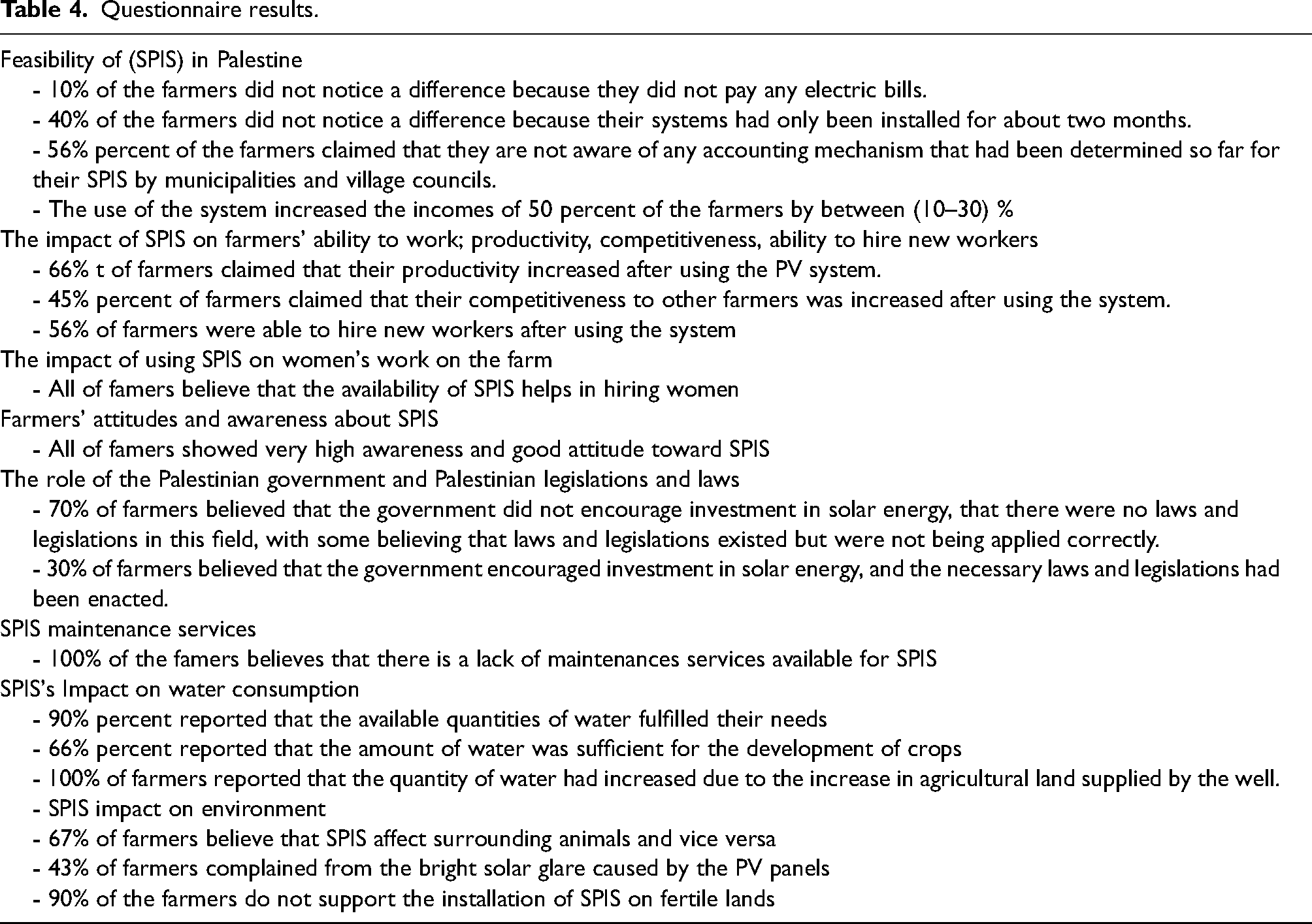
Based on the illustrated responses, we conclude that, there is a clear lack of access to technical information as well as an absence of a stakeholder engagement plan. Moreover, SPIS have had a positive impact on the farmers, but it is likely that that the provision of a better and clearer business model could provide even greater support.
On the other hand, most of the farmers knew that most of the implemented projects were funded by external international institutions concerned with agriculture, and that the role of the Palestinian government was to coordinate between farmers and donor institutions. However, it is worth noting that the farmers’ opinion on the role of the Palestinian government in such activities was also being driven by issues irrelevant to the research being carried out. Many of the farmers added extra statements about the Palestinian government when asked about the roles and laws for SPIS and solar energy investment. Such additional answers included the lack of unbundled markets as well as price fluctuation and market monopoly.
As for the impact of SPIS on women empowerment, it is found that the role of women on farms varies from one region to the other. However, in general, more production means more ability to hire people. Here as for women employment, one farmer in the study stated that women were more dedicated to work and had a high ability to work and accomplish it faster than men. Some participants believed in the necessity of women working on the farm, doing simple tasks not requiring much effort, such as sorting fruits. (The daily wage for a working woman on a farm may reach USD 50 for 10 h of work.) Other participants did not accept women working on the farm due to cultural and societal reasons. In general, the percentage of women working on the farm had not changed after using the system.
The lack of skilled people for maintaining SPIS was also reported. Here according to results, 60% of the village councils did not have a qualified person to maintain these systems.
Finally some of the farmers have shown some environmental concerns regarding SPIS.
Such concerns includes, allege growth on water ponds, the spread of mice in the areas adjacent to the solar system project, saying that they were having a negative impact on the project, due to them chewing and destroying the wires which the donor required to be maintained. In addition, the bright solar glare caused by the cells also was considered as an environmental concern. The habitat disturbance of rodents and other animals which causes in many times attacks on the system.
Environmental impact assessment of current SPIS in Palestine
In this section, comments on the impact of the system on specific environmental issues are posted. These comments and evaluation are done by the researcher who is expert in SPIS construction and operation. It is also worth to mention that this evaluation is done considering a 15 kWp SPIS. However, the researcher believe that such evaluation is still valid for bigger systems up to 50 kWp.
Landscape and visual
Land use
Soil and groundwater
Biodiversity
Archaeology and cultural heritage
Air quality and noise
Infrastructure and facilities
Socio-economic conditions
Occupational health and safety
Community health, safety, and security
The site of SPIS should be relatively flat, without any sensitive major optical receptors. Here, the PV plant causes glare which may affect the animals living in the ambient habitat. Such effect may push the animals to attach the system which may affect the system itself as well.
In general, SPIS project area should not be installed on fertile land with high agricultural value. Moreover, project area should be accessible. In addition, the local community should not be engaged in pastoral activities as a primary source of livelihood in the selected land. It is always good to consult the farmer regarding the best place to install the land where some less fertile spots can be used for such purpose.
SPIS systems are small systems without any opportunity to affect soil or groundwater at any chance.
No biodiversity risks are usually associated with SPIS projects. However, there should be a measure to deal with the materials that will be used during the construction process.
In the site of SPIS there should no antiquities or cultural heritage sites. However, it is worth to mention that there is no ground digging activities when constructing a SPIS.
When installing a SPIS system, the activities of establishing and operating do not result in any kind of air pollution or noise. However, construction activities may increase the level of dust and particulate emissions, which may temporarily affect the quality of the surrounding air. Dust levels can be significant during site cleaning operations. The use of machinery and equipment is usually expected to generate noise and vibration at the project site and the surrounding area. Thus, appropriate mitigation measures for dust suppression and noise control should be identified, particularly during the construction phase. This includes, for example, spraying water in all areas where construction activities are taking place, proper stock management, the use of silencers and noise suppressors for noisy equipment and machinery and so on.
Project's water requirements during the construction and operation phases are minimal and can be easily met by installing a 10 m3 water tank on the site. The average total water demand during the construction phase is expected to be around 10 m3/ day. During the operation phase, the consumption rate of water for drinking is likely to be about 0.7 m3/day, and an average annual consumption of 200 m3 for cleaning photovoltaic panels is expected (two cleaning cycles annually using water, and a dry-cleaning method for the rest of the year). Meanwhile, the wastewater and solid waste generated during the project's construction and operation phases are expected to be minimal, and it is expected that it will be easily dealt with through sewage tanks and waste vehicles, as the waste is considered non-hazardous and can be handled in the same way as household waste. Finally, there is no hazardous waste generated during the project construction and operation stages. However, there is should be a dismantling plan to get rid of the PV panels and associated equipment in the last phase of the project. This plan should include a recycling plan for the PV panels.
The main expected social and economic impact of the project is on potential food production and employment opportunities. During the construction and operation phases, the project is expected to provide several job opportunities for local communities.
There will be general occupational health and safety risks for workers on the site during the construction phase of the project (for example, exposure to electric shock hazards during maintenance activities). Thus, there is should an occupational health and safety plan, tailored to the project site and related health and occupational activities.
The potential impacts during the construction and operation phases are primarily due to unauthorized people passing by or entering the project site, which may lead to potential hazards such as electric shocks from the various components of the project. However, security measures in place can prevent unauthorized access to the project.
Conclusion
In this paper solar powered irrigation systems in Palestine were evaluated. The evaluation is done based on technical, financial, social and environmental aspects. According to the study, all irrigation methods are being powered either by the electric grid (88% of large underground wells), diesel generators (55% of surface pumping from ponds), solar energy (5% of large underground wells as an indirect energy source and 9% percent of surface pumping from ponds) or by hand pumping. The technical and financial assessments were conducted, based on system's real performance data. Meanwhile, the social impact assessment was evaluated based on a questionnaire and focus group discussion. Finally the environmental impact was assessed by describing project activities and its impact on the environment. According to the results, a 1 kWp of photovoltaic panels could pump between 1.3 m3 and 1.5 m3 of water per hour at a cost of USD 0.025 per m3, considering a 20-year life cycle of the system. Such a performance was subject to surface distance pumping of up to 1 500 meters with a collecting pond depth of up to 8 meters (total dynamic head 12–15 meters). It was found that the capital cost of such a system was USD 1754 per kWp. Moreover, it was concluded that 50% of farmers believed that using an SPIS system had increased their income by (10 to 30)%, while 56% of farmers were able to hire new workers after using the system. However, 70% percent of farmers believed that the government did not encourage investment in this area, while 60% of the village councils did not have a qualified person able to maintain the systems.
Footnotes
Declaration of conflicting interests
The author declared no potential conflicts of interest with respect to the research, authorship, and/or publication of this article.
Funding
The author received no financial support for the research, authorship, and/or publication of this article.
Author Biography