



Abstract
General music lessons in elementary school can offer a rare opportunity for students to engage in musical creation, yet despite theoretical support for this idea, lessons that focus on creativity in music are uncommon. This article presents the actions of four music teachers in Israel who successfully cultivate meaningful creative work in their lessons. It discusses the pedagogical means they take to integrate musical appreciation activities into their lessons to develop their students’ musical understanding and as inspiration for creative work. The teachers’ actions are presented within the framework of four stages: preparation, instruction, working, and feedback, with an emphasis on their combination with music appreciation. We also examine if and how these teachers’ actions align with the recommendations in the research literature and how their students responded, with an aim to portray the combined contribution of integrating creative work and music appreciation with the students’ ability to derive a meaningful experience from their musical practice.
Keywords
Introduction
There is a broad consensus among researchers, music teachers, and educational policymakers regarding creativity’s importance in contemporary society in general and in music education in particular (Gruenhagen & Whitcomb, 2014). A student’s ability to produce creative work enables personal expression, motivates growth, improves musical and social abilities as individuals and as a group, and enhances academic achievement (Beegle, 2010; Burnard & Cooke, 2024; Glăveanu, 2011; Nikolaou, 2024; Orman, 2002). However, lack of time, appropriate conditions, and proper training make creative work a rare occurrence in music lessons (Burnard & Cooke, 2024; Gruenhagen & Whitcomb, 2014; Hickey, 2015; Orman, 2002; Shmuelof, 2017; Strand, 2006). The gap between researchers’ recommendations and our observations of the general absence of creative work in music lessons encouraged us to explore the issue.
The Article’s Objective
This article presents four exemplary teachers—Lily, Lia, Yoni, and Shachar 1 —whose effective integration of meaningful creative work into their lessons offers valuable insights for educators. They also implement the four stages of creative work—preparation, instruction, working, and feedback—which will be introduced later (Beegle, 2010; Burnard, 2002; Gruenhagen, 2017; Veloso, 2020).
Two key foundational concepts were used to define successful implementation of this practice: “meaningful” and “musical creative work.” In our context, the term “meaningful” relates to both the creative process and the creative outcomes. Meaningful creative processes involve the exploration, mastery, and generation of musical gestures (Cohen, 1980). Meaningful outcomes reflect the student’s ability to organize and comprehend auditory input and to apply the musical ideas in their own compositions. (Cohen, 2015). The term “musical creative work” describes both the process and the product of improvisation and composition (Mitchell, 2011). We define creative activities also as modes of expression that are not necessarily the making of music, but rather a response to it, such as drawing, movement, and similar activities.
Attitudes Toward Creativity in Music Education in Israel
To gain a clearer understanding of the educational decisions made by teachers, it is essential to first outline the context of the music education system in Israel.
Music studies in Israel are not compulsory, but they are common in kindergarten and elementary school, though in most cases only up to third grade (Gluschankof, 2022). Elementary school students learn general music lessons as part of the school curriculum, which includes recorder lessons in groups in Grade 3 and also group instrument lessons. There is a structured and detailed curriculum in which creation (i.e., improvisation and composition) is one of the “three channels of musical activity” alongside listening (i.e., music appreciation) and performing (i.e., singing and playing instruments).
The Members of the Planning Committee in the Department for Planning and Development of Curriculum in the Israeli Ministry of Education recommend integrating the “three channels of musical activity” in the general music class practice. They claim that in Western musical culture, there is a distinction between the three actions, whereas in non-Western cultures, such separation usually does not exist. In non-Western cultures, the performer composes the piece that he plays or sings, and the listener becomes a creator and performer when he takes an active part in making music. The curriculum committee suggests implementing similar integration in the elementary general music class as well (Music Curriculum, 2011).
Music listening and music appreciation are taught in Israel through varied district concert programs (such as “Touch the Music” in Jerusalem). Performance is taught through “Playschool Projects,” which teach instrument playing in small groups during school hours. But there are no defined programs for implementing creativity in music lessons in Israel. The question that arises is whether and how listening and performance can be integrated with meaningful creative work. The integration of learning to play an instrument (i.e., performance) and the development of musical creativity deserves its own examination. In the current article, we seek to present how musical appreciation activities (i.e., listening) can deepen and expand creative work and how this creative work enhances students’ enjoyment and engagement.
Benefits of Musical Creativity in The Elementary School Classroom
Incorporating creative work into music lessons provides many benefits, including better student engagement with the music, more enjoyment, and a better classroom climate. When the student is fully committed, and the educational atmosphere in the classroom is positive, learning becomes an enjoyable experience, which impacts achievement (Robinson & Aronica, 2015). What may create these benefits is what is termed the psychological state of “flow,” a concept that expresses the quality of the creator’s mental process. Nakamura and Csikszentmihalyi (2002) defined this term and recognized the creative process as the generator of inner motivation (autotelic), that is, a source of internal drive and pleasure even if there is no external reward. When in a state of “flow,” the creator is fully focused on the activity, merging action and awareness and simultaneously losing their sense of self-awareness and time. Burnard (2002) found that the aspiration for “flow” produces social meaning within a group as children support each other to ensure the continuous flow of music. In this second aspect, flow describes the continuation of creative ideas (fluency) and musical flow (continuity) and is not connected to Csikszentmihalyi’s concept of “flow”. It is important to mention that simply engaging in these activities does not necessarily mean that “flow” will occur. However, the students still benefit from the musical understanding these activities instill.
If students successfully enter a phase of “flow,” it can influence the classroom climate. Teachers have reported that when students are deeply focused on creative activities, reverence and empowerment can be sensed within the classroom. They explained that most students “enjoy it” or “love it” because it allows them to create their own original music. The students value the opportunity to make choices and express their unique personalities through the music they create (Gruenhagen & Whitcomb, 2014). Why, then, do most teachers not implement creative work in their lessons?
Inhibitors to the Implementation of Creative Work in Music Lessons
The implementation of creative work in music lessons may be hindered due to several factors. One is that music teachers lack an understanding of the methodology of the creative process. This may be a direct result of their training, as most teachers do not obtain practical experience in teaching creative work during their studies (Burnard & Cooke, 2024; Gruenhagen & Whitcomb, 2014; Hickey, 2015; Strand, 2006). Another is the shortage of time. Some teachers have mentioned this as the most significant factor that prevents them from implementing creative work (Orman, 2002; Shmuelof, 2017). A third may be the lack of appropriate pedagogical tools to integrate composition into lessons without worrying about time running out or neglecting other important learning experiences (Strand, 2006).
Implementing creativity in the music classroom: Exemplars of practice. Considering the factors mentioned above, we found that all four teachers successfully implemented the four stages of creative work mentioned in the literature (see above) into their music lessons. These included preparing the students for the task (preparation), open or structured explanations on how they might do the task (instruction), allowing the students time to work on the task (working), and reflection on the working process and outcomes (feedback). We will discuss the significance of each component, followed by examples of how each can be applied in a lesson to contribute to meaningful creative work.
Preparation
Preparing the students for creative work begins with inspiring listening (Cohen, 2002; Murphy, 2013). There are two main concepts that construct the preparation stage to inspire listening: musical organizer and music appreciation (Cohen, 2015). The concept of musical organizers refers to the way the mind organizes auditory input into a coherent musical meaning. Musical organization schemas include structure (created by repetition and change and grouping), direction (melodic and harmonic), energy flow (tension buildup and release), and the build-up of expectations (Cohen, 2015). In fact, music appreciation, which is the study and enjoyment of music, is dependent on being able to thoroughly understand its elements (Barrett, 2007), which we refer to as musical organizers. It can involve listening to music attentively, using intuitive mediating actions, such as dancing, drawing, playing classroom instruments, and singing.
Researchers agree that musical appreciation activities provide one of the most accessible starting points for creative engagement with music. One place where this can happen is when one makes connections between unexpected and familiar experiences (Murphy, 2013; Strauss, 1987). Murphy (2013) explained the mechanism of the process: musical appreciation activities require asking questions that draw special attention to musical organizers (energy flow, grouping, melodic direction, etc.). Listening to music and then responding creatively to it initiates a problem-solving process, because one must examine how the music is structured, compare similar recurring sections and new parts, and create a mental image before representing the music in a concrete way. This process creates involvement and a sense of “ownership” of the music because the student experiences the work of the composer.
Examples of Preparation Activities
Jump Rope and Drawing
Lily designed a jump rope activity for her third-grade students to deepen their natural schema of musical phrasing, such as recognizing the beginnings and endings of musical sentences. Lily improvised melodies, and the students moved around the classroom. At the end of each musical phrase, they paused on a marked spot on the floor. Then the students listened to the gigue from Bach’s Cello Suite No. 1 in G major, BWV 1007, 2 while skipping rope. A different student was supposed to “jump in and then jump out” at the beginning and end of each phrase. After the activity, students were asked guided questions, such as how they knew when the next student was about to jump in and if all the phrases were the same length. Then Lily asked the students to draw the music in their own way. The drawing shown in Figure 1 clearly shows how one student recognized two musical organizers: grouping and direction. He noticed the endings of phrases and drew gaps between the lines, and he also attempted to express the ascending-descending direction of the melody.
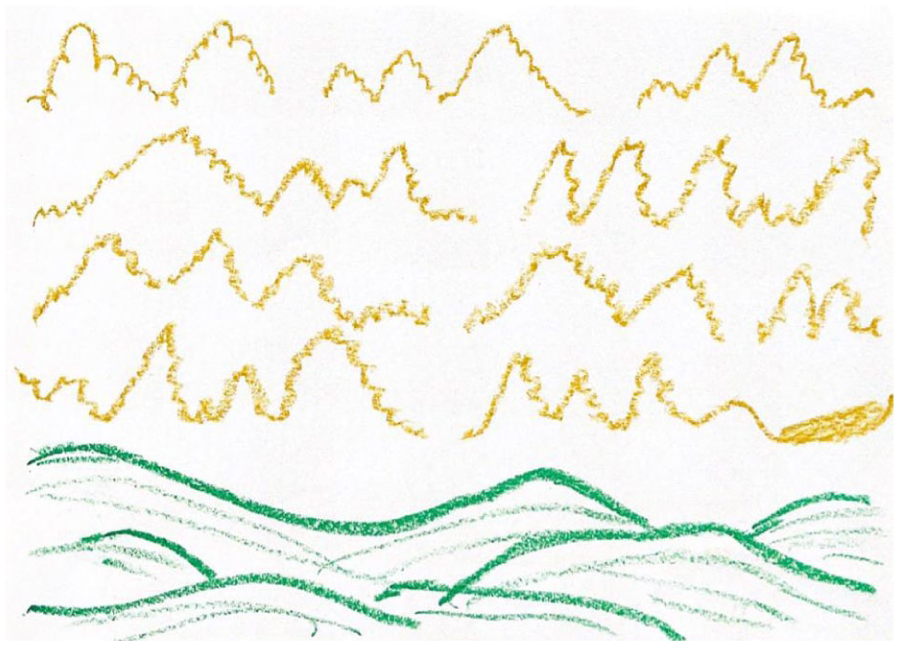
Student’s Interpretation of the Gigue from Bach’s Cello Suite No. 1 Showing Rising and Falling Lines Separated by Gaps.
Energy Flow
Another example refers to the musical organizer of energy flow. Lia (first-grade teacher) worked with the students on distinguishing between short, staccato sounds and long, flowing sounds. The students listened to the second movement of Ravel’s String Quartet in F Major. 3 Lia suggested to her students that the short pizzicato sounds might resemble rain, while the long arco sounds evoke the wind. To deepen creative expression around the musical theme, Lia connected body sounds to rain and wind. The students practiced various types of tongue clicks to represent rain and breaths, and rubbing sounds to represent the wind. Lia encouraged them to explore further ideas and variations, eventually consolidating the different sounds they discovered. In its final stage, the activity included coordinated movement: one group of students represented the rain and moved around the room holding ribbons that they waved to the rhythm of the pizzicato melody. Another group held scarves and waved them in the air in response to the arco melody, symbolizing the wind. Lia guided them by using conductor-like gestures to illustrate the changes in sound production with her movements. The students demonstrated high engagement in the activity, smiling with enjoyment. Movement within space allowed them to release energy and connect their entire bodies with the sounds of the piece.
At the end of the listening session, after the students sat down, Lia posed questions to connect the students’ movement experience to the sounds they had heard and to the musical organizer demonstrated in the activity: “Which instruments did we hear?” (Students responded, “String instruments.”) “How did we play rain and wind?” (“Rain was plucked [on the violin] and wind was made with the bow”; “Pizzicato for rain and the horsehair bow [used for the strings] for wind.”). The process concluded with a summary of the musical organizers that the students explored. In her summary, Lia connected the students’ experience listening to Ravel’s quartet, where they encountered different methods—pizzicato and arco—of sound production, with their shared creative engagement. In such a way, she enriched their musical knowledge and familiarized them with a variety of new compositional techniques and their impact on listeners.
Checklist for Preparation Stage
□ Begin with inspiring listening.
□ Address musical organizers through dancing, drawing, playing classroom instruments, singing, etc.
Instruction
After teachers expose their students to inspiring ideas in music pieces, the practical stage of creative work requires instruction. To remain in the desired state of “flow” discussed above, the creator needs a challenge, and the primary goal of the instruction phase is to create the right level of challenge. One that is too simple might lead to a loss of concentration, and one that is too difficult might cause tension and even anxiety, possibly leading to self-consciousness, which could undermine the individual’s engagement in the challenge (Nakamura & Csikszentmihalyi, 2002). Although the way teachers instruct students does not always lead to appropriate challenges, the teachers presented in this article found a way to create a challenge through instruction.
There are many types of instruction for creative work (Burnard, 2002; Gruenhagen & Whitcomb, 2014; Veloso, 2020). Those types found in the literature can be classified into two contrasting approaches to instruction: open and structured. With open instruction, students are allowed to simply play around with instruments individually or in a group. The students set their own challenges; the teacher is required to step back, intervene only through questioning, and act as a mediator that empowers the ongoing process. Teachers should avoid imposing their own aesthetics or values on the students (Burnard, 2002; Burnard & Cooke, 2024; Cohen, 1980).
In structured instruction, teachers inspire the creative process by providing external task challenges that gradually increase in difficulty. Gruenhagen and Whitcomb (2014) reported that teachers claimed that if the instruction is not structured, students tend to feel lost. Veloso (2020) also emphasized the importance of offering increasing challenges that transcend a one-time project, and that once students are familiar with the practice, the level of complexity should be increased, and new ways of thinking should be sought. Thus, teachers can generate challenges through well-planned instruction. The current research indicates that open-ended instruction is preferable because it preserves creative freedom and the students’ confidence throughout the process. However, it is contingent upon thorough and detailed preparation, as we have outlined.
Example for Instruction (Open Instruction)
Yoni provided open instruction but set clear goals for the students to aim to understand the structure of repetition and change, processes of energy flow, tension accumulation and release, etc. He explained these goals to the students in the preparatory lessons, but he did not oblige them to use any specific one. In the interview that followed his lesson, he explained his actions regarding the piece presented in Figure 2:
I gave them open instructions. I didn’t tell them “play in the ABA form” or “there must be bursts of energy.” I left it open. [. . .] But that’s what’s amazing – whenever you give open instructions, everything we talked about [during the preparation] has an impact.
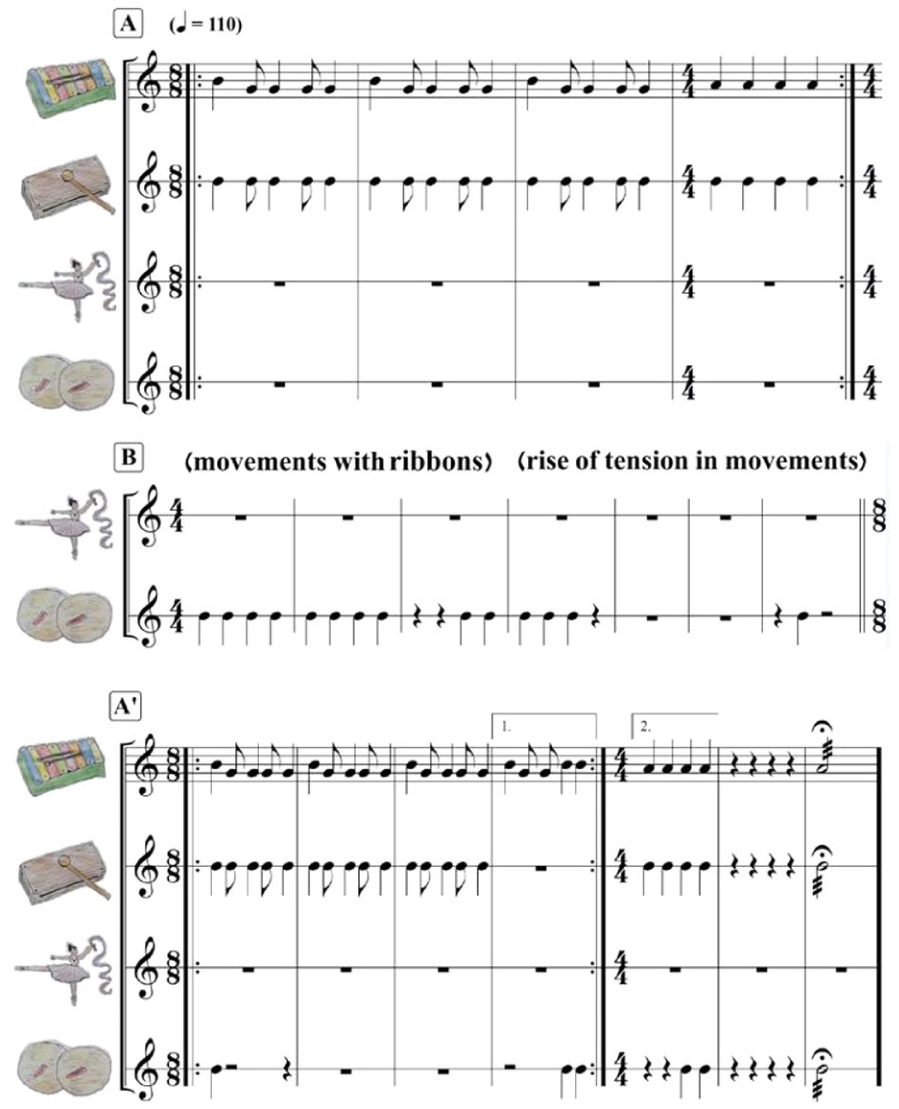
Combining Playing Instruments with Movement.
As part of his instruction, before sending his students to work in groups, Yoni gave a demonstration of how to incorporate the musical ideas they had learned into their pieces. Yoni claimed that “demonstration is the strongest way” to convey his intentions to his students. He explained that demonstrations generally allow a student who does not fully understand the task to release and feel freer to create something of their own. In the example shown in Figure 2, it is possible to identify a clear structure and energy accumulation processes.
The piece presented in Figure 2 also illustrates how the musical expression is complemented by movement. The student had aspired to express the musical organizer called “accumulated tension,” but she could not find a way to express it with sounds. So, she used movement. Such a phenomenon has been observed in previous studies (Cohen, 1980; Veloso, 2017). It appears that Yoni’s combination of thorough preparation, open instruction, and demonstration facilitated a meaningful and complex creative process that led his students to a state of “flow.” All of these will be reflected in the next phase: Working.
Checklist for Instruction Stage
□ Use open instruction after thorough preparation
□ Provide detailed demonstrations
Working
We observed that Yoni’s students experienced a complex creative process while working on the task. This process included the following three stages (mentioned in Cohen’s study, 1980): (a) exploration, (b) mastery, and (c) invention of musical gestures. Cohen examined kindergarten children’s free improvisation and discovered that when children explore sound, their experience combines movement and space with acoustic perception. In the mastery stage, the children have formed a mental image of the sounds that they want to realize. At some point, most children reach the stage of generating musical gestures, meaning that the experience of movement is translated into sounds and provides the pattern for the musical gestures.
In elementary school, the process described by Cohen occurs with an additional social dimension whereby the individuals and their peers collaborate as an organic musical entity (Burnard, 2002; Veloso, 2017). Figure 3 is an example of this process as observed in Yoni’s third-grade class. It shows how each of these stages transpired while the students were working on their composition.
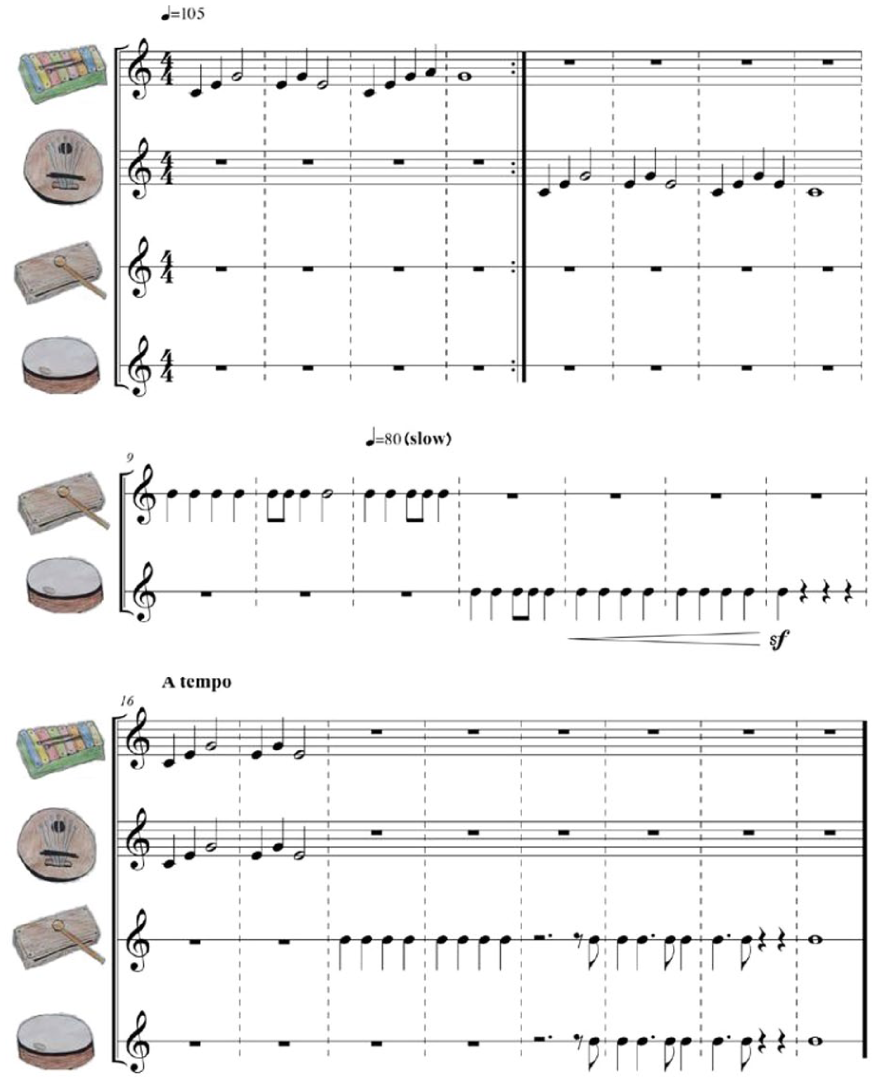
Composition for Metallophone, Kalimba, Wood Block, and Drum.
During their creative work, they were very immersed in the musical activity and seemed mostly undistracted by their surroundings. When other students passed by, David became temporarily distracted but refocused in time to play his part, which he did attentively. One could observe synchronized playing and eye contact. When the last rehearsal ended, Maayan (who was playing the metallophone) and Barak (wood block) stopped simultaneously—evidence of their nonverbal attentiveness generated through eye contact and the group’s shared responsibility for the flow of the music.
Checklist for Working Stage 4
□ Exploration
□ Mastery
□ Musical gestures
□ Flow
Feedback
The teacher’s feedback should lead students to reflect on how they coped with the given challenge. Then the teacher assigns the next one. The following mediators are required: using reflective conversation or questions to stimulate dialogue, accepting outcomes that may be different from what was initially asked for, encouraging unexpected or novel thinking, and fostering a supportive, nonjudgmental atmosphere (Alexander & Shoshani, 2016; Gruenhagen, 2017).
Reflective conversation was demonstrated by Shachar (fifth-grade teacher), whose feedback encouraged her students to reflect on the work process. By asking them, “How did you build this?” she led them to describe the process they went through. The children explained that, first, they each chose what they were going to do. Afterward, they distributed the instruments between them, each student invented his own melody, and then they tried to combine the melodies. Through such dialogue, students can verbalize their working methods and learn from each other how to create an efficient process that ultimately leads to a final product. Gruenhagen (2017) highlights the importance of holding a reflective conversation that points out the process that the group has undergone and emphasizes any musical quests, imaginative ideas, and insights that emerged during the creative process. She argues that reflective feedback is the key to keeping students engaged and interested in creative work.
During the feedback stage, the teachers also used reflective questions to better understand the original outcomes. For example, in one case, the students were asked to make drawings inspired by the gigue from Bach’s Cello Suite No. 1 in G major. In this composition, a nonstop rhythmic and harmonic motion creates a sense of gradually accumulating tension. The drawing in Figure 4 expresses one child’s intuitive sense of building up to a climax.
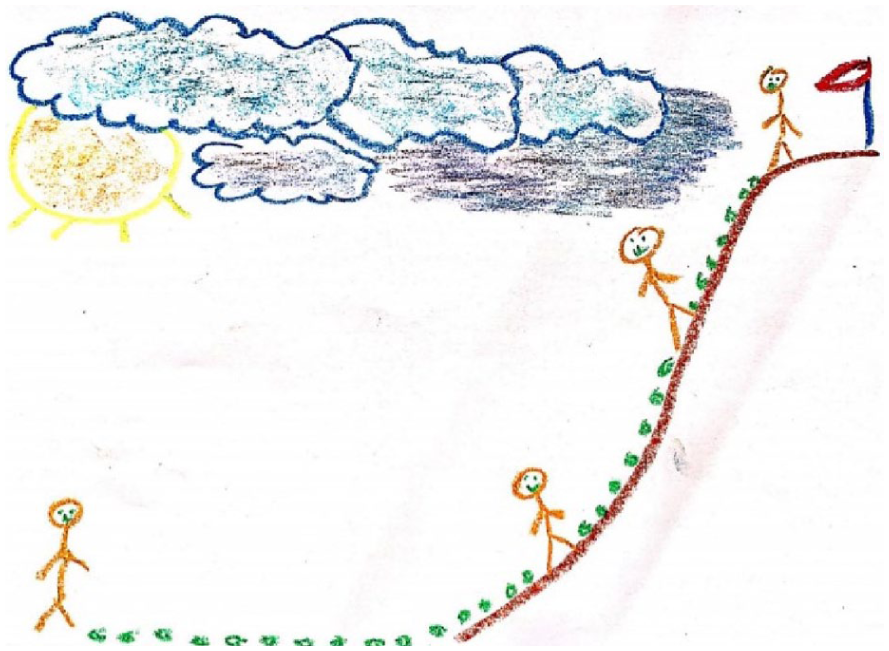
A Student’s Depiction of the Build-Up of Musical Energy as Climbing Up a Hill.
If someone were to look at this drawing, they might simply see figures on a hill, clouds, and a flag. However, the ensuing dialogue illustrated the importance of the creator’s explanation. Lily asked a reflective question, “What did you draw?” and the child’s explanation of the drawing revealed her insight into the musical organization that the drawing reflects: “It keeps moving ahead and climbing and climbing.” The student’s explanation exhibits her intuitive perception of the build-up of tension in the piece and is an example of how to creatively implement a musical organizer.
When delivering their feedback, all four teachers we observed were accepting of their students’ creations even when they did not meet the initial task requirements. They reflected on and assessed the students’ compositions based on their musical level rather than strictly adhering to the task definitions. The teachers recognized that the students took on new challenges, and they expressed appreciation for their efforts. For example, Yoni praised one student, Ella, on her movements with ribbons (see Figure 2), even though the task was related to playing music. Shachar shared her insights regarding her students’ outcomes: “It will be more original. [. . .] Maybe it won’t be exactly what I defined, but it will have a very innovative element” (Shmuelof, 2017), indicating that teachers are aware of a serendipitous process and understand that during the creation process, new objectives evolve.
Serendipity is where unexpected “surprising” circumstances and an insightful “aha” moment result in a valuable outcome (Maxwell et al., 2012). Serendipity processes in the world of science have led to groundbreaking scientific discoveries in various fields. Darbellay et al. (2014) assert that those who are open to being surprised have a higher chance of making new discoveries. Children who engage in musical creativity and discover new directions they did not initially intend to explore inadvertently experience serendipity.
Gruenhagen and Whitcomb (2014) claim that after experimenting within the framework of structured improvisation, some students will remain within the set structure while others “will break out of the box and freely improvise their own unique improvisation” (p. 388). Alexander and Shoshani (2016) also noted that sometimes an unexpected thinking process brings up original and innovative ideas, and is highly desirable.
All the types of feedback described above, as well as those we observed, fostered a supportive, nonjudgmental atmosphere as a condition for encouraging creativity. This aligns fully with numerous researchers’ recommendations (Alexander & Shoshani, 2016; Glăveanu, 2011; Hickey, 2015; Nikolaou, 2024; Treß et al., 2022). Without a sense of trust and self-assurance, group members will not take the risk of revealing their ideas and will not dare involve themselves in the ideas of others (Edmund & Keller, 2020; Glăveanu, 2011). Burnard (2002) explained that intervention strategies must allow psychological space for students to bring the richness of their experience and ideas to the world. Hickey (2015) emphasized that the teacher is responsible for teaching all participants to behave with sensitivity and respect toward their peers and thus establish a community where students feel trust and have confidence to play, create, and talk about their music. Indeed, the lessons we observed were characterized by a respectful and attentive atmosphere, both among the students and between the teachers and their students.
Checklist for Feedback Stage
□ Use reflective conversation or questions to stimulate dialogue
□ Accept outcomes that differ from the initial task
□ Encourage unexpected thinking
□ Foster a supportive, nonjudgmental atmosphere
Conclusion
In this article, we set out to explore creative practice in elementary school music lessons and reveal how four primary school music teachers in Israel incorporated meaningful creative work into their music lessons. These types of creative activities are very valuable, but do not occur in practice as much as they should. The teachers we observed followed the four stages of creative work described in the literature (preparation, instruction, working, and feedback), and maintained an inclusive and supportive atmosphere in their classroom. In these aspects, there is nothing new but rather a reaffirmation of the effectiveness of these stages.
This article presents practical examples that show how four elementary school music teachers integrated musical appreciation activities in their lessons to raise their students’ awareness of musical organizers and foster a deeper understanding of musical compositional means. This comprehension was then reflected in the students’ compositions. The in-depth, experiential preparation process facilitated the internalization of musical organizers. Such a situation enables open instruction, eliminating the fear of making mistakes. As a result, this process fosters a psychological state of “flow,” while simultaneously encouraging depth and complexity in the students’ outcomes.
The overarching premise is that musical appreciation activities can support each stage of the creative process, providing students with both musical insight and understanding on the one hand, and, equally important, enjoyment and engagement on the other. These findings and suggestions are also relevant in the context of musical education in the United States since “Creating” is an important dimension in the United States National Core Music Standards. 5 To encourage more music teachers to include creative work in their lessons, we recommend the following: (a) music teachers can emulate the activities of our “exemplars” to improve their own practice and incorporate more creative work into their music curriculum; (b) teacher-training and professional-development programs should provide music teachers with opportunities to experience the creative stages listed above, both as creators and facilitators; and (c) in-service teachers can use regional concert programs to provide a structured framework that supplies a rich repertoire for teaching since, within this framework, teachers receive instructional booklets and professional training that support the learning process of musical organizers through musical appreciation activities.
Footnotes

Funding
The authors disclosed receipt of the following financial support for the research, authorship, and/or publication of this article: This research was supported by a grant from the Zalman Aran Scholarship No. 205634 of the Chief Scientist at Israel’s Ministry of Education.
Declaration of Conflicting Interests
The authors declared no potential conflicts of interest with respect to the research, authorship, and/or publication of this article.