



Abstract
Play is the mechanism through which students learn and develop musical ideas. Students need time and space to engage in playful learning, and a commitment to developing playful music centers leads to engaged students who are choosing what to learn in a low-risk setting. This article explores what playful learning is and why it is important and then dives into centers that have been used successfully in general music classes. Descriptions of each center are also connected to the National Core Arts Standards.
Peek inside a play-based elementary music classroom and you might see students working independently and in groups on a variety of different learning experiences. Over here by the door, three first graders are using whiteboards to write music using quarter and eighth notes and then reading their work to each other. In the middle of the carpet, a few students are working together to create the world’s longest rhythm out of popsicle sticks and pom-pom balls. By the anchor chart, four more students have organized some small stuffed animals into a pretend class and they are teaching their class of animals how to read the day’s rhythm. Two more students are poring over a picture book that has been modified to be a rhythm book as well with notation written in around the words. These students cannot read standard English yet, but they can read the simple quarter and eighth notes that provide the rhythm of the poem. The room is buzzing yet purposeful; all of the students are deeply engaged in a chosen experience at the different centers.
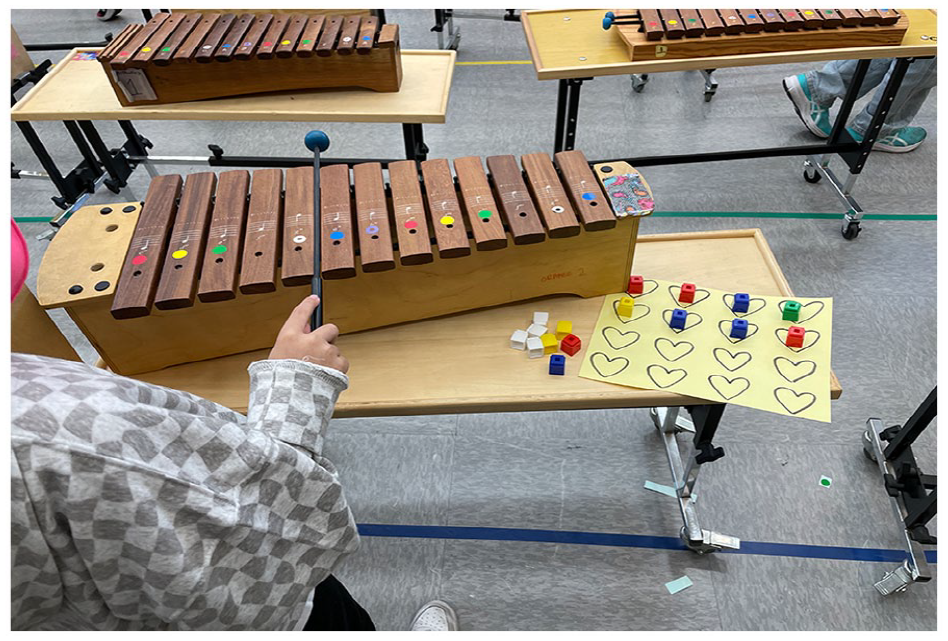
In a classroom of fourth graders, the lesson finishes with 15 min of “Choice Learning.” Some students remain on the carpet and repeat the learning activity of the class with the rhythm manipulatives. Other students move to the writing center and practice writing the new musical rhythm their class learned that day. Another group of students moves to the barred percussion instruments and selects one of five songs they have learned this quarter in music class to independently practice on the instruments. These songs have been written in standard notation with colored notes that correspond to colored stickers on the bars to support access for all learners. The students choose learning activities based on their preferences and interests; they do not all complete all of the activities but they are all deeply involved in musical learning.
When I first started teaching, my classroom would never have looked or felt like this. All of the learning happened in a tightly controlled large group setting. I never considered the benefits of setting students free to work independently and did not feel comfortable with the level of trust it takes to welcome this less structured time into the lesson. However, after my school district made a push for active student engagement through purposeful grouping, I was challenged to consider how I could have students working in groups in my class, too. I was also inspired by my art teacher colleague who worked to give students more voice and choice through centers and “studios” in her classroom and wanted to figure out how to give students the same amount of agency over their own interests in learning in my classroom as well.
Enter the humble center. Many elementary teachers are familiar with the concept of “centers” for learning. Often there are closed tasks to do at each center and students might rotate through each center for a prescribed amount of time. However, centers can also be used for more open-ended discovery and students can explore and play musically during their time in centers.
Playful Learning
Play is the main vehicle through which students construct their learning (Niland, 2009). Students cannot refine their musical thinking until they have had time to play and explore sound and musical ideas. These creative experiences lead to musical growth (Coss, 2019). As students have space and time to explore music with sounds and modalities interesting to them, they will grow as musicians. According to The Playful Classroom, “Constructivism is willfully seeking the answers to one’s own questions” (Dearybury & Jones, 2020, p. 22). Playful constructivist learning also builds community as students work together in a safe, respectful, low-risk space (McEvoy & Salvador, 2020; Wiens, 2015).
Playful learning also leads to increased student choice and agency over their own learning (Niland, 2009). When students are allowed to choose learning based on their own preferences, it increases their enjoyment of what they are doing (Davis & Culp, 2023; Koops, 2017). Giving students agency and choice also lets musical learning be relevant to students and their lives and lends itself to culturally responsive teaching, where students’ lived experiences are respected and drawn upon to shape learning (Abril, 2013; McEvoy & Salvador, 2020).
Yi (2021) defines play with four criteria:
(a) The play is spontaneous;
(b) Children engage in play for the simple pleasure of it (the means) rather than looking for the ends;
(c) The play is purposeful, which means children do not seek external rewards for it but do it for pleasure or enjoyment; and
(d) The play allows trial and error without worrying about the consequences of failure. (p. 21)
In playful music centers, students should be given time to explore without having to produce a finished result. During this learning time, students are expected to be engaged in a chosen activity or experience but are not required to finish a task by the end of the given time. Because students are choosing which centers to go to, they can choose the activities most pleasurable to them. Some students really enjoy playing barred percussion instruments; some do not. Not all students are required to complete the same learning activities, but all are engaged in musical learning around the concept we are learning.
Practicalities of Playful Learning in the Classroom
Playful learning centers require space and time, and they can be noisy. I have very flexible centers; most of my center activities are in plastic boxes that are usually stored on some open shelving. It is quick and easy for me to pull out only the boxes that are relevant to that specific class’s learning, or boxes that I feel will be appropriate for that day. I can quickly set up the centers, placing the box and a simple sign together, while I remind students which centers are available for learning that day. Signs can be as simple as a bright piece of paper folded in half to make a tent or a plastic cone with a paper label. Sometimes, I use hula hoops to designate floor space available for working at that center.
I usually leave 10 to 20 min at the end of the lesson for center work. I have found that less than 10 min is not usually enough time for students to settle in and find their learning flow. Because many of my centers stay the same from week to week, I do not have to spend as much time giving directions. Usually, I can quickly highlight which centers are open and give a few reminders about the expectations, maximizing student time to play and learn.
To counter the noise problem, I usually only open one or two centers that involve instruments. Other centers might include writing music, playing with rhythm manipulatives, listening to and describing music, or singing with others. I also appreciate the idea of taking “ear breaks” when a room gets particularly loud (Coss, 2019). During the time when students are playfully learning through centers, my room does get noisy, but as I scan the room, I can easily see where students are engaged in important musical learning and distinguish those students from those who are “banging” and need to be gently redirected.
Students need a certain level of independence to be able to work successfully at centers. Coss (2019) suggests that centers be taught first as a large group activity and then opened to small groups to choose from. I have found that having simple, open-ended centers is successful when I explain the expectations for those centers before students start working. The best centers have a provocation that leads to the creation of learning experiences (Dearybury & Jones, 2020, p. 69). They balance structure and freedom; new and familiar activities; and individual and community experiences (Koops, 2017).
As a bonus, while students are working independently, it frees the teacher to be able to work with students one-on-one; to build relationships with students; to reteach concepts to students who need more help; or to assess students one-on-one. I have found that during center learning I am finally able to get to know my students as individuals. I also find it a very important time to reteach concepts to students who are struggling: I can join them in the center that they have chosen and then gently direct their learning toward the concept I want to reteach. I can also use that time to circulate through the room to spend a little bit of time with each student and learn more about what they enjoy and how they choose to learn.
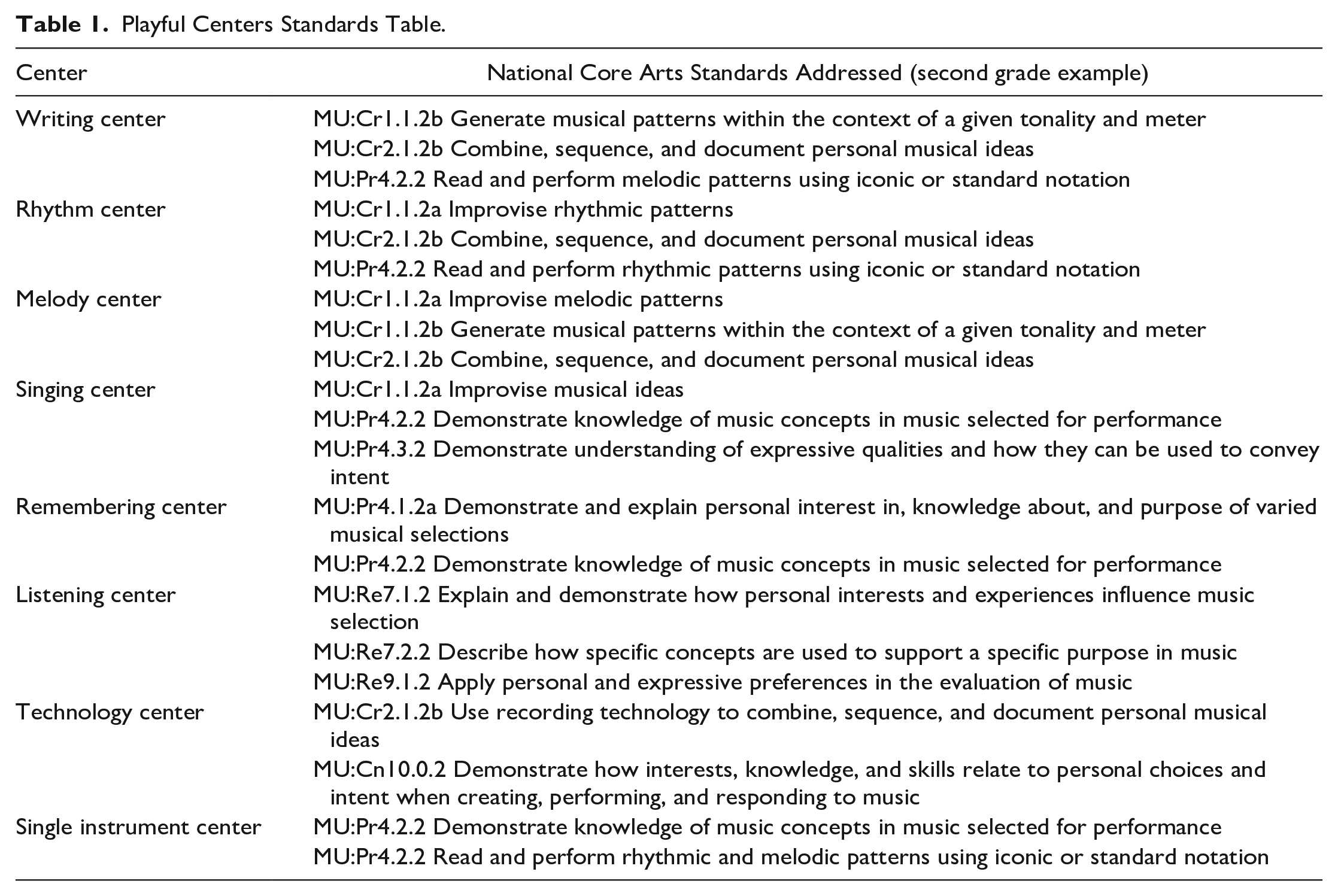
Every center leads back to musical standards from the National Core Arts Standards (National Coalition for Core Arts Standards, 2014) and these standards can also be assessed through student play in centers. In this case, it will take more time since students are cycling through many different centers, so teachers cannot assess one standard for every student all at once. However, the playful learning that occurs during centers can be a valuable real-world assessment time (Table 1).
Playful Centers Standards Table.
Examples of Playful Centers
Writing Center
In my writing center, I have a number of different ways for students to practice writing music, such as whiteboards and markers, index cards, staff paper of varying sizes, pencils, colored pencils, and colored dot stickers. I also keep some rhythm cards as references for students to copy. Usually, students practice writing their own musical patterns on whiteboards, and I encourage them to read their finished work to me or a friend. I keep the writing center materials in one set of shelving in my room so this center is always available for students to use. Some students prefer the easily erased low-risk of a whiteboard, and some like to write music on paper to bring home or save for later (Figure 1).
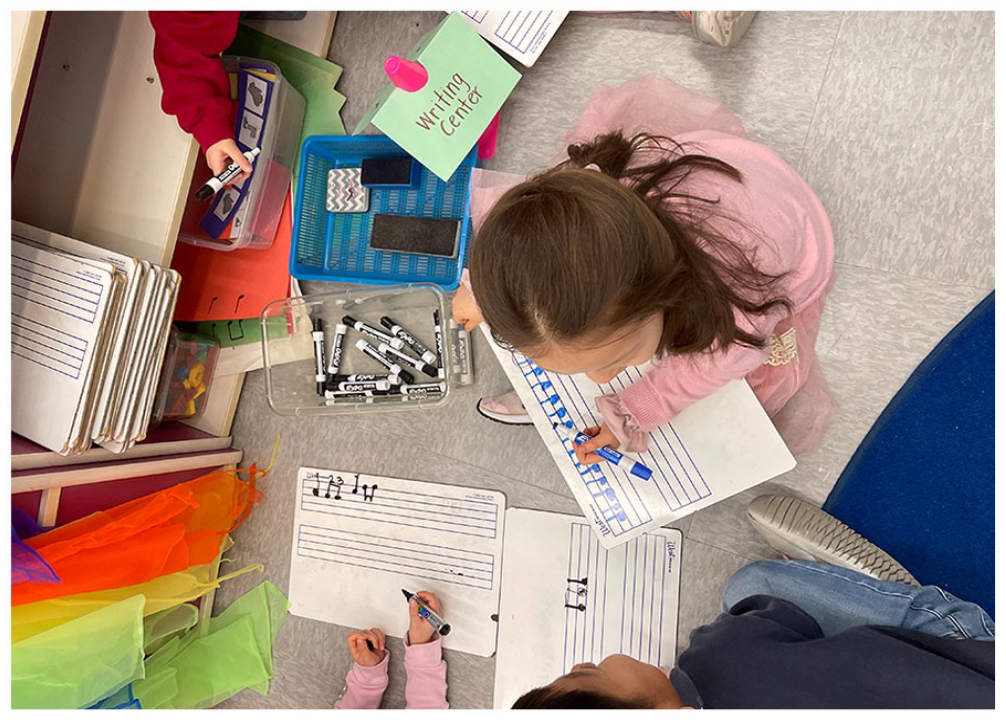
Writing Center.
Rhythm Center
Rhythm center is a loose title that I use to include many different learning experiences. I usually station my rhythm center on the carpet so there are some defined boundaries for the workspace. I usually only get out one or two sets of manipulatives at a time to aid with quick clean-up. My rhythm center manipulatives include popsicle sticks and pom-pom balls for creating rhythms on the rug; body percussion strips that I have added rhythms to; rhythm cards with simple rhythms written on each card; strips with four hearts that students can use “treasures” (clear math counters) to show rhythms on each heart; unifix cubes with rhythm elements written on each side; cards with simple rhythms and rhythm sticks to play the rhythms while students read them; cards with color words and their rhythms; and rhythm cards we have used for composing activities in class (such as “broccoli” and “squash” cards as we are exploring 6/8 rhythms). In the rhythm center, I often see students working together to create long rhythm chains and then collaboratively read their work (Figures 2 and 3).
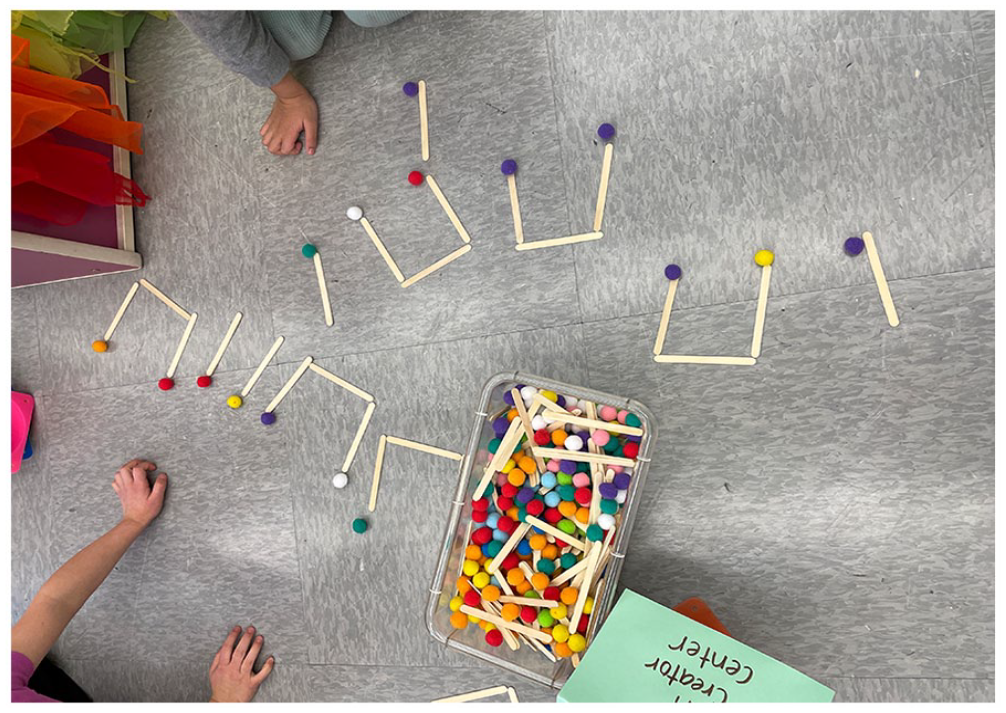
Rhythm center.
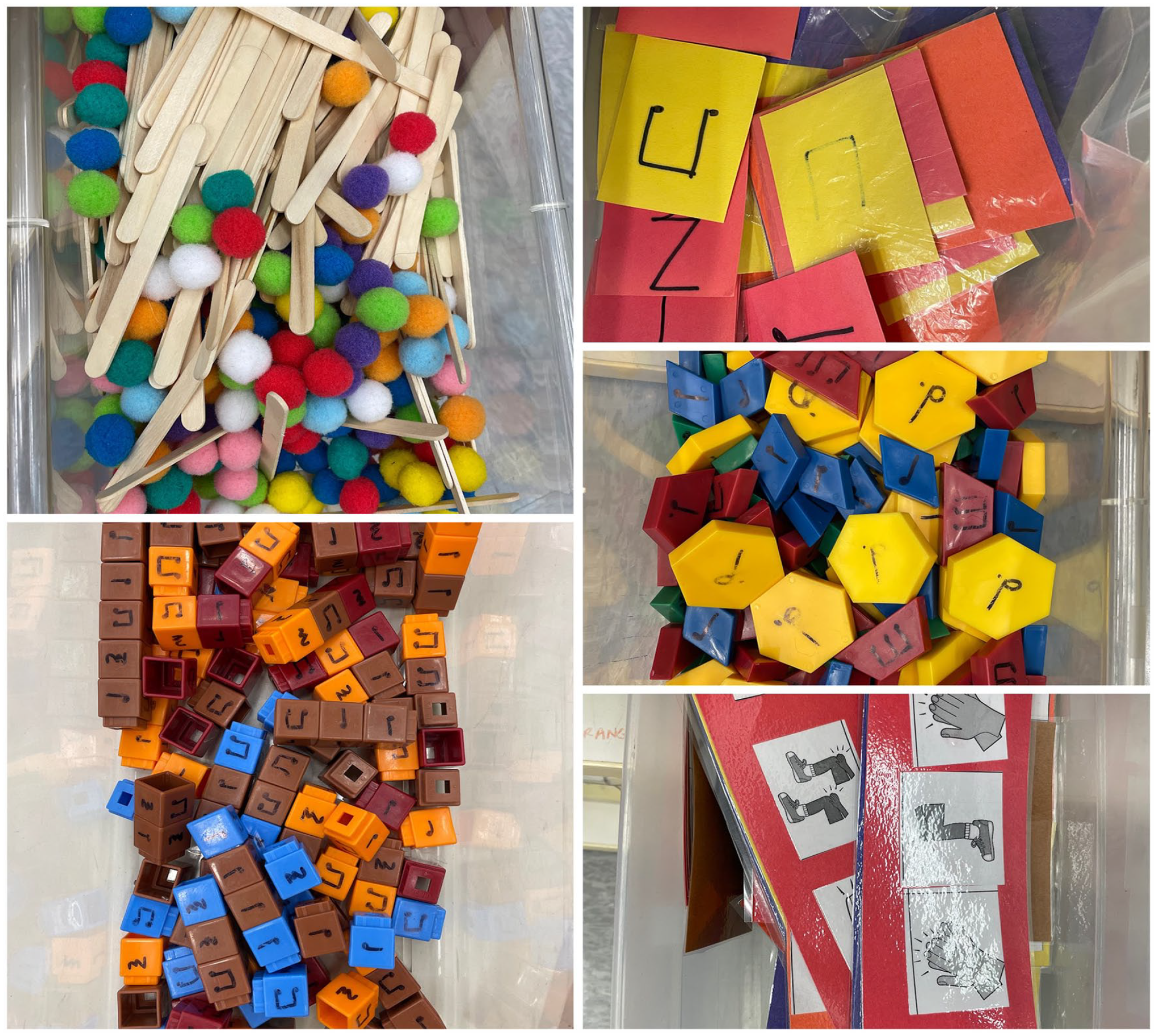
Examples of rhythm center manipulatives.
Melody Center
This is another broad title that flexibly encompasses different types of learning activities. Melody center usually gives students a chance to play with barred percussion instruments. Depending on our focus, the melody center might be more open or might have a more prescriptive task. My bars are all identified with colored stickers, so students who cannot read standard notation can still explore music reading by reading colored dots and matching the colors with the bars on their instrument. Some provocations in melody center might be to take a strip of four colored dots, play it, and then finish it by composing an ending; learn a familiar song that we previously learned in music class; play a melody game with a peer (Hatch, 2023); or create original musical works.
Melody center for kindergarteners and first graders usually involves just a few instruments so I can more closely monitor them to make sure they are playing responsibly. My oldest students usually have free range over all of my melodic instruments (Figure 4).
Melody center.
Singing Center
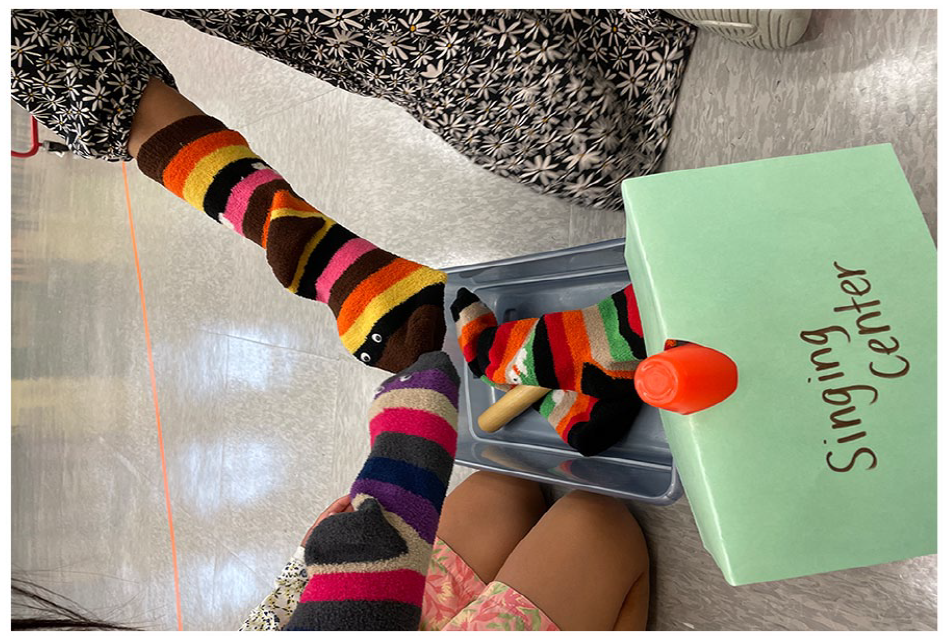
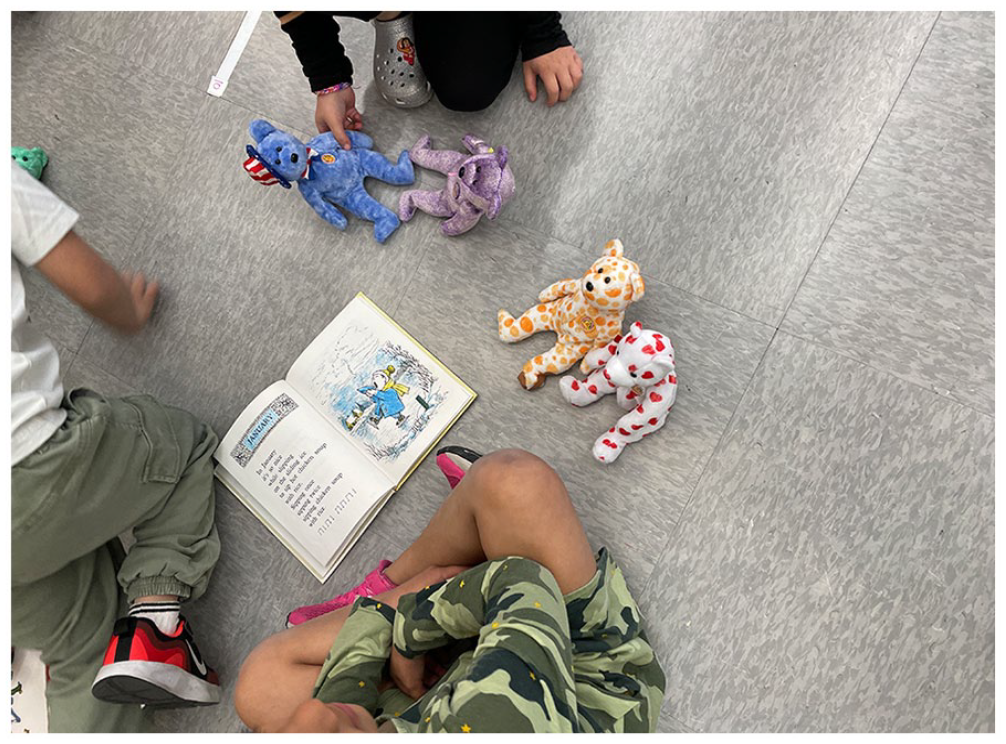
I use a simple sock puppet in my youngest grades to aid students with echo singing. I made five or six of these sock puppets and put them out as a “singing center.” Usually, students enjoy recreating our vocal warm-ups or echo songs together. Sometimes I can engage students in singing a musical conversation with me and improvising a song using their singing voice. Another toy that makes an appearance at the singing center is a collection of Beanie Babies (although any small stuffed animals would work). The students use the stuffed animals to re-create familiar songs through dramatic play. For instance, the song “Five Little Monkeys Jumping on the Bed” can be acted out with five stuffed animals. I remember a particular group of students who found great joy in using their stuffed animals to play the game “Apple Tree” over and over (Figures 5 and 6).
Singing center.
Singing center.
Remembering Center
In the remembering center, I put out words, rhythms, anchor charts, or other representations of songs that we have done previously in the year. It gives students a chance to review and revisit familiar and preferred songs. This is a new one for me this year; I was inspired by an idea I found in Amanda Niland’s article to empower students to be able to select musical cards with their favorite songs on them (Niland, 2009). In my center right now are two songs. The first is sentence strips with the lyrics to “Chop, Chop, Chippity Chop” on the front and the rhythm on the back that we will be emphasizing this next quarter as well as many pictures of vegetables with their corresponding rhythms written in so students can imaginatively play to “chop up” the vegetables into the soup. The second is a simple song that we learned at the beginning of the year called “Frog in the Meadow.” Those lyrics are written out and then there is a ring of cards with pictures and words of body parts that the students can use to playfully “stir” the frog as they sing.
Listening Center
I have explored with different ways to get musical listening into my students’ hands. For a while, I tried using an old setup that allowed five students to put on headphones and listen to the same CD. The problem with this was that students kept adjusting others’ volume levels and I did not love how they would get blasted with loud music. I have tried having a selection of different videos on the whiteboard for students to click on and listen to; this worked well when I could embed YouTube videos within Google Slides and specify the start and end points of the video when it was clicked on. This way I could have students listen to a 45-s excerpt of the climax of the piece, not just always the beginning. Currently, I have a CD player hooked up to simple speakers. Usually, I start the music, and students may gather around and listen. In the future, I hope to teach a few students how to change the CDs so they can have more agency over their listening. This was a good way to repurpose these collections of CDs that gathered dust in the cabinets of my classroom.
In the listening center, I have a copy of my word wall so students can easily discuss what they are listening to and be exposed to academic vocabulary. I also have rings of cards with listening questions, such as “If this music was a color, what color would it be? Why?” Coss (2019) also suggests including whiteboards in the listening center for students to doodle in response to their listening.
Technology Center
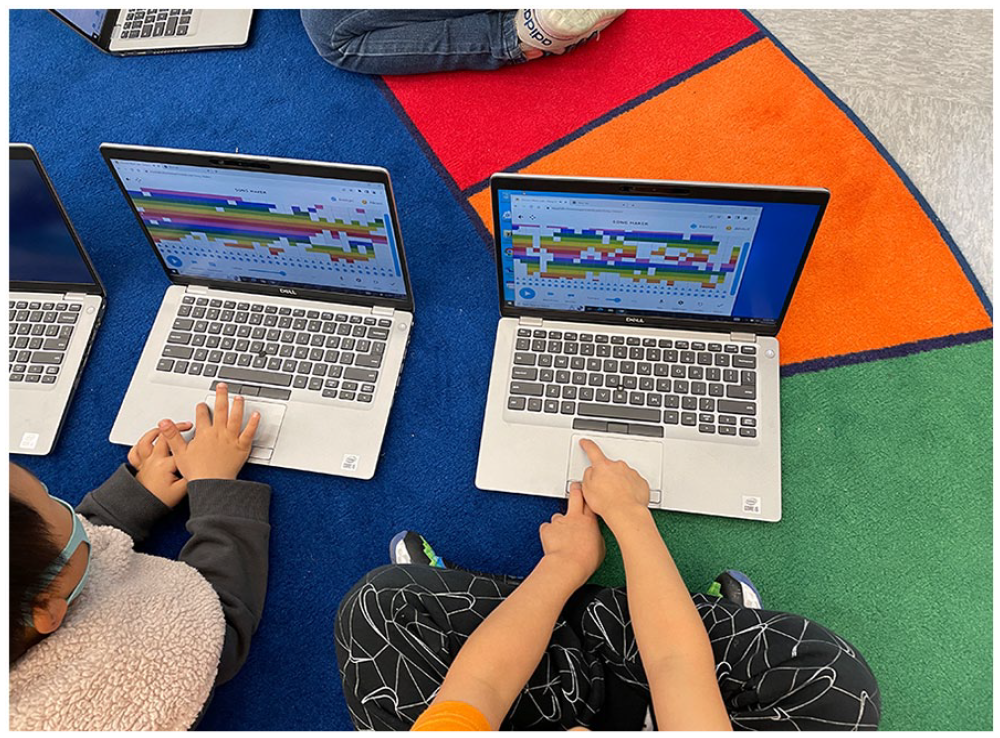
My school has a limited amount of technology available to my special classroom this year, so making technology available to students during center play is a good way to let a few students use it at a time. Students love to use composition programs like Chrome Song Maker or the tools available to them through Quaver to create their own music. Students also enjoy using recording devices to record themselves singing or playing songs. I also have an interactive smart board and sometimes open that to student play during technology center with a specific provocation like collaboratively creating music (Figure 7).
Technology Center.
Single Instrument Centers
In my classroom, we have ukuleles and recorders. Due to limited contact time, we do not play both of those instruments year-round. In the “off-season,” ukulele and recorder can both be available to students during center time for independent learning. For both instruments, I have created simple materials for students to practice old songs and learn new ones. Many students like the freedom to dabble in these instruments and try them out in a low-risk situation. I can also help those students one-on-one in a center’s context and address challenges individually.
Conclusion
Play is the mechanism through which students learn and develop musical ideas. Students need time and space to engage in playful learning, and a commitment to developing playful music centers leads to engaged students who are choosing what to learn in a low-risk setting. Incorporating music centers does not need to be overwhelming; teachers can start with just a few and can build on them as they go. Start by creating a writing center and a few rhythm manipulatives and allow students the choice to explore a few classroom instruments. Be observant and look carefully for evidence of student learning. It might be different than you expect but you might see all of the standards being met in your classroom amid the happy buzz of learning.
Footnotes
Declaration of Conflicting Interests
The author declared no potential conflicts of interest with respect to the research, authorship, and/or publication of this article.
Funding
The author received no financial support for the research, authorship, and/or publication of this article.
