




Abstract
Music education in the United States aims to be for every child, yet many students become less interested in school music as they mature. Although previous research reveals activities that upper-elementary students may prefer, much of this research may not represent 21st-century students, the instruments and activities that have enhanced curricula in recent decades, or more diverse musical offerings from around the globe. To guide decision-making regarding the activities most appropriate for their students, teachers can gather information from students through both formal and informal means (e.g., conducting research). In this third article in our research-to-practice series, we use data from our investigation into upper-elementary students’ activity preferences to create three hypothetical “classes” and provide suggestions for structuring activities that are responsive to our learners. Using a similar process, teachers may discover and tailor experiences to their own students’ interests, increasing motivation and persistence in music.
Although elementary school students are often enthusiastic about music class activities in the early grades, their interest has been found to decline in the upper grades (Bowles, 1998; Mizener, 1993; Warzecha, 2013). Students’ changing interest in school activities in general, and school music in particular, can be attributed to numerous interrelated factors. For example, musical self-esteem has been found to be a significant predictor of children’s participation in music activities (Austin, 1990; Vander Ark et al., 1980). Self-consciousness, behavioral conformity commonly experienced in the “tween” years, and the increasing importance of peer relationships and social status all may contribute to a hesitance to fully participate in school music (Jackson & Davis, 2000). As social comparison also becomes more widespread, students who believe they lack “talent” may begin to self-select out of music ensembles, seeking activities in which they feel more successful (Wayman, 2004). Students also may begin to become more interested in popular music styles, which teachers have struggled to authentically represent in school music curricula (Woody, 2007).
Tailoring music class activities to students’ interests may increase students’ motivation (see Deci & Ryan, 2000; Evans, 2015; Raynor, 1983) and provide successful experiences in school music during this critical time. When teachers encourage student ownership within the music activities, and allow more voice and choice, students can become more engaged. Composition, improvisation, and other creative activities that allow student choice have long been favored by learners (Boswell, 1991) and are much more common today than they were even 10 to 20 years ago, now reflected in U.S. national music standards (Shuler et al., 2014). General music curricula now frequently encourage a focus on student-centered learning, including activities, such as songwriting, guitar, bucket drumming, ukulele, and technology (Author, 2019; Clements, 2010). Valuable resources are available for incorporating culturally responsive pedagogy (e.g., Lind & McKoy, 2016) and informal learning practices (e.g., Green, 2005, 2017) in general music. In addition, time-tested approaches, such as Orff-Schulwerk and Kodály methods can be effective and are well-suited to adaptations for changing times, such as using popular music styles and repertoire (Vasil, 2020).
According to previous findings regarding music activity preferences, playing instruments (Bowles, 1998; Culp & Davis, 2023b; Nolin, 1973), listening (Culp & Davis, 2023b; Vander Ark et al., 1980), playing games, moving/dancing ((Culp & Davis, 2023b); Nolin, 1973), and singing (Vander Ark et al., 1980) have been found to be popular. Keyboard-based learning (Wig & Boyle, 1982) and popular music approaches (de Vries, 2010) may also be enjoyable for upper-elementary students. These studies, despite being decades old in some cases, represent key findings in student music activity preferences to date. Still, national and state standards, curricula, and teacher philosophies regarding student input in lessons have all undergone transformation in recent years. Therefore, more current information and relevant guidance about how to use students’ interests to shape musical experiences would be helpful to teachers. Music teachers who seek to understand students’ identities and musical engagements may provide students’ opportunities to see themselves represented in the curriculum (Williams, 2017). To do so, teachers should avoid making assumptions about students and instead get to know their learners and their unique preferences and needs (Robison & Culp, 2021; Salvador & Culp, 2022; Williams, 2017).
The purpose of this series is to provide suggestions to help teachers use students’ preferences to guide instruction in general music. In this third article in the series, we provide suggestions for practice, where teachers use students’ preferences to guide instruction. We use the data from our research study described in Culp and Davis (2023b) to create three hypothetical “classes” and provide suggestions for structuring responsive activities that are reflective of these specific learners. Our suggestions, though geared toward upper-elementary general music settings, could also be applicable to other settings and age groups. The following suggestions reflect possible choices for teachers and demonstrate the last part of the process described in this article series, in which we apply our students’ preferences to lesson planning. We continue to encourage teachers to seek information about their own students’ needs rather than rely solely upon these examples.
Honoring Students and Reshaping Curriculum
The importance of understanding and valuing learners’ needs when planning and implementing curricula cannot be overstated. To reach this goal, teachers must be (1) curious and open (not judgmental or inflexible), (2) confident, and (3) free to act without unnecessary constraint. As described the first article in this series (Culp & Davis, 2023a), we return to Salvador and Culp’s (2022) suggestions for music teachers. In the first article, we focused on helping teachers know and value individual student identities, circumstances, experiences, and goals. In this article, we focus on providing information to help teachers include student voice and choice to reshape curriculum. Curricular standards and outcomes may be predetermined in some districts, but teachers may also have great autonomy over delivery, assessment, and the repertoire. Even within stricter curricular structures, learning outcomes can be met with a variety of different activities, and teachers may be able to adjust objectives and help students set personal goals.
Brief Review of Findings From Exploratory Study of Upper-Elementary Students Music Activity Interests
In our study outlined in the second article in this series (Culp & Davis, 2023b), we sought to identify the music activity preferences of upper-elementary students. We developed an online questionnaire and recruited participants from online parenting groups. We included 42 children in the study: 17 third graders, 15 fourth graders, eight fifth graders, and two children who did not use grade levels. Findings aligned with previous research regarding upper-elementary children’s music activity interests and preferences (Boswell, 1991; Bowles, 1998; Mizener, 1993; Nolin, 1973; Vander Ark et al., 1980).
In this article, we use the data from our study to create “top 5” lists for activities, music selection strategies, and work modes, presented in Table 1. Two activities (listening to music and playing music games) were in the top 5 among all grades and two others (free creative movement/dance and playing drums) were in the top 5 for Grades 3 and 5. Instrumental activities were among the top 5 for Grades 4 and 5. When asked about selecting music for class, every grade level preferred to choose the kind of music themselves. For work modes, all grades preferred working with a partner most. However, working in small groups was the second choice for younger students (Grades 3–4), whereas working alone was the second choice for older students (Grade 5).
Most-Preferred Activities, Music Selection Strategy, and Work Modes by Grade Level.
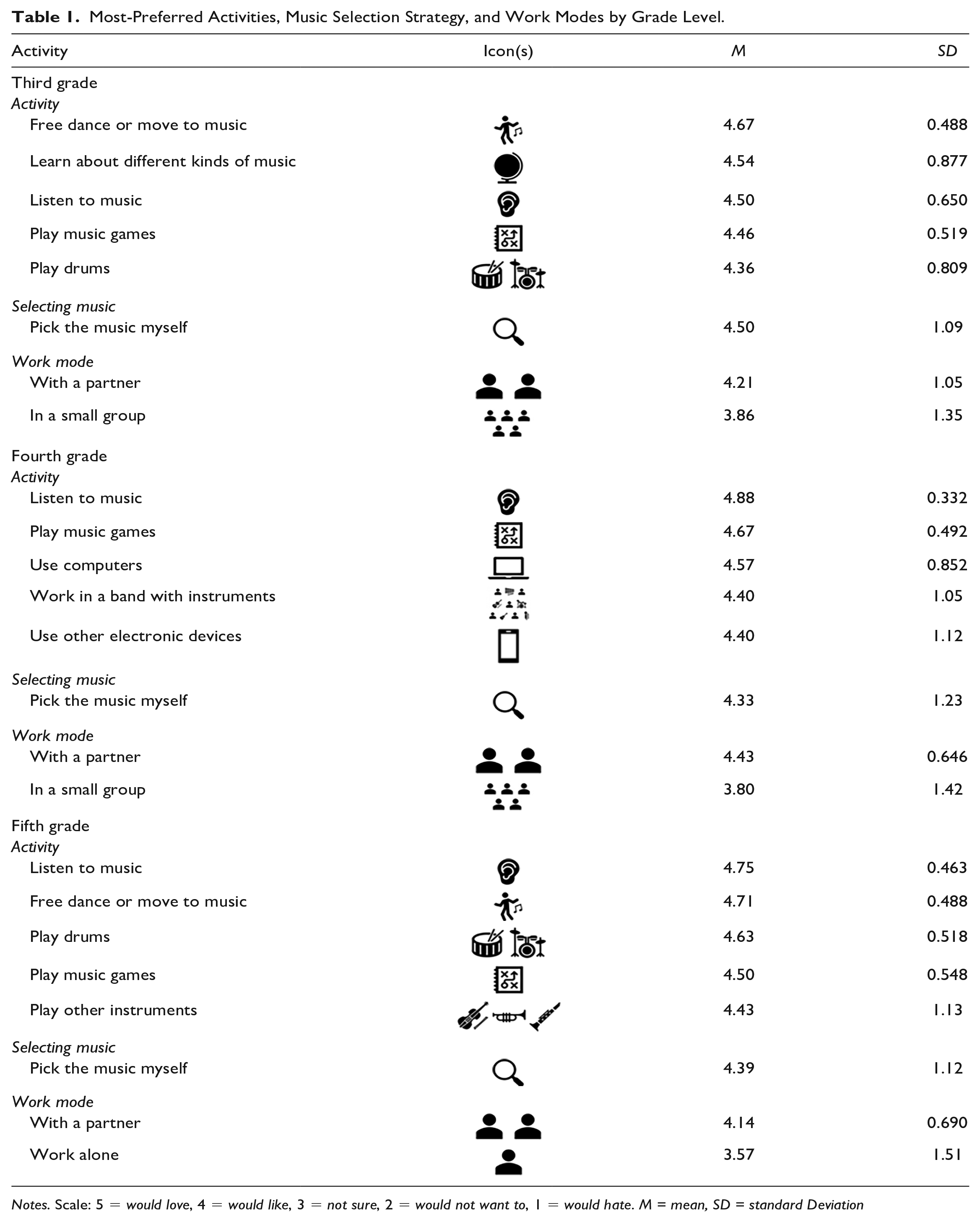
Notes. Scale: 5 = would love, 4 = would like, 3 = not sure, 2 = would not want to, 1 = would hate. M = mean, SD = standard Deviation
Suggestions for Practice Based on Results
Using our initial survey results to shape recommendations for practice, we divided our participants by grade level to create three separate “classes.” All told, our three groups consisted of 17 third graders, 17 fourth graders, and eight fifth graders. Our three sample classes are meant to serve as an example of how teachers may use what they discover about students’ interests to inform classroom activities.
We used the characteristics of our classes, as well as developmentally appropriate practice (e.g., Campbell & Scott-Kassner, 2014) and our experiences as general music teachers to create suggestions. As is the case with some student characteristics (e.g., race), a single student may be present in a category. When this occurs, teachers should be mindful not to essentialize or spotlight students as sole representatives of a demographic characteristic. Instead, teachers can work with all students to learn which parts of themselves they would like to share and how they would like to share them. In our examples, students who reported their demographics and their parents consented to share about themselves. Again, we must stress that teachers should get to know their own learners over time through multiple avenues. We offer the following suggestions as starting points using the data from our sample study. As we have tried to model in our suggestions, teachers can use principles from universal design for learning, trauma-informed education, and culturally relevant education (Salvador & Culp, 2022), as well as students’ individualized education programs (IEPs, see Crockett, 2017) to inform instruction.
Third Grade
As noted in Table 1, our “class” of 17 third graders enjoyed active participation like playing games, dancing, and playing drums. They also indicated an openness to different genres of music, which is characteristic of younger children (LeBlanc et al., 1996). To incorporate these interests, we suggest a lesson in which teachers work with students to select two songs. To generate ideas, consider asking students to talk with a person at home about (a) that person’s favorite songs from the past and present or (b) music that is culturally relevant in the students’ background. Once a song is selected, the class could compare the original recording (when available) to versions where artists cover the song in a different style or genre. For example, if Selena’s “I Could Fall in Love” is selected, teachers could visit the website SecondHandSongs to locate covers in different styles that students could listen to and select from. The band Postmodern Jukebox also covers popular songs in vintage styles, like swing or jazz. After selecting a second song, students could discover information about the music and artists, discussing signature elements of the different genres. Students might enjoy moving freely to one of the selections (perhaps the original recording) as a class or developing a simple choreographed routine to accompany it.
Because our third graders wanted to work with partners or groups and loved drumming, another fun activity involves splitting into small groups to play bongos/congas (or other available classroom percussion that suits the style) to the music and creating an accompanying ostinato; assistive technology can be used for any students with difficulty playing the drums (e.g., the Bongos! app on a smart device). Continuing with the drums, teachers could pair two groups to play a music game in the style of the game “Simon Says.” In this game, one student could develop a pattern, then the other students must imitate; students who do not play the pattern correctly stand until they get one correct. Each student could create four patterns before the next player’s turn, when the game would “re-start.”
Fourth Grade
As this age group begins to transition into the “tween” years, it is not surprising that our 17 fourth graders expressed interest in playing in a band and in using technology (see Table 1). To support these interests, teachers could design a project to learn what it is like to be in a band. First, the teacher could elicit input from students to create a list of six songs that are school-appropriate and suit students’ musical ability (e.g., songs containing chords that students know or are learning on an applicable instrument, transposing as needed to find comfortable keys). The class can listen to and discuss the tunes (e.g., artist, genre, musical elements) or teachers can allow students to complete inventories of selected characteristics in small groups. As students become more familiar with the songs and artists, teachers can allow students to divide into teams to informally assess their knowledge with an interactive game of Musical Jeopardy. Asking students to choose a “band name” for their team could be a fun way to build camaraderie among students as well. Teachers could be mindful to include opportunities for students to respond in musical ways (e.g., “sing the tune to . . .” or “hum the bassline to . . .” or even “play the chords for . . .”) and provide clues in the form of audio samples, as well as verbal clues.
Another fun band activity is asking students to select a song from the list to “cover” in small groups (3 or 4). This assignment can be completed using modern band instruments, classroom instruments, or with instruments students create from objects from home or those provided by the school. Having students watch videos of covers with classroom instruments created by television celebrities Jimmy Fallon and The Roots—which can be found through a simple internet search—may be a fun way to provide relevant inspiration. Once the cover song is selected, teachers can take students to the computer lab or help students use Chromebooks to listen to the song deeply, research more about the song, look up chord charts, and find additional versions of the song for inspiration. If school computers are not available, students could complete some aspects at home, or the teacher could project from their school computer or other device. From there, students can work together to choose instruments, approximate the different parts, practice their song, then use iPads or other technology (see Burns, 2016; Carlisle, 2014) to record their songs in an app (e.g., GarageBand) and perform for the class. Students could also use iPads or online digital audio workstations (DAWs) like Soundtrap or Bandlab to create and produce their own music, from beat-making to using loops and recording and arranging parts. Students could be encouraged to share their work with at least one person outside of the class, and performances could be recorded and distributed to families in an online event.
Fifth Grade
As our eight fifth-grade students expressed preferences for listening, movement, and games (see Table 1), many of the previous third- and fourth-grade activities would likely be appealing to this group as well. In addition, our fifth graders expressed interest in playing instruments, so teachers could consider making part of the curriculum an instrument exploration. Teachers could highlight a different instrument from around the world every month, or focus on the uses of one instrument, like drums. Smithsonian Folkways provides many helpful resources teachers and students can use to explore instruments from around the world.
Given our students’ interest in drumming, they could focus on different kinds of drums for a semester or part thereof. Drums from around the world could be highlighted; students could participate in drum circles and even make their own drums. The World Music Drumming™ curriculum and D.R.U.M. (Solomon, 1998) are excellent resources for active, musical drumming activities and teachers could also seek bucket drumming arrangements to further engage students. Students can be encouraged to improvise on the drums during group playing, engaging in call-and-response, echoing others’ patterns, or creating grooves by experimenting with different patterns in small groups. A game could also be played where students “add on” musical ideas to create a class composition. In this game that could work well with a group of eight, one student starts with a pattern, then another adds, and so on. The second person must remember what the first person did; the third person must remember what the first and second did, and so on, and everyone continues playing (i.e., player 1 performs their part, then player 2 adds; then, both players 1 and 2 perform player 1’s part and player 2’s part, then player 3 adds). Teachers can also allow students to select other instruments that they may want to play in class, either by letting each student select their own (e.g., bring in instruments from home) and/or use or supplement with school instruments. In the latter option, teachers can provide students a list of options and allow them to choose what instrument to play (e.g., ukulele).
As listening was a favorite activity, teachers could curate songs that contain the instruments students have been playing and watch videos of players of different genders in class (see Robison & Culp, 2021, for ideas regarding listening). Inviting community members (e.g., students’ family members) to demonstrate instruments in-person or via video conference is a great way to connect the school and local community! Students can work independently on music research projects, in which they choose an instrument and select music to listen to in class to introduce their classmates to the instrument and highlight a performer of their choosing to learn more about. Teachers can ask students to share why they selected the performer in class and with someone at home and discuss the experience of sharing with someone at home. Because our fifth graders liked working with a partner as well as working alone, allowing students to work with a partner of their choosing to discuss their performers and develop a list of musical similarities and differences between the two could be both enjoyable and educational. When students need a break, they could have opportunities to move freely or dance to the music, alternating focused work with periods of relaxation.
Conclusion
Considering students’ interests is an important facet of thoughtful, responsive instruction. In this article, we used data from our research study (Culp & Davis, 2023b) to demonstrate how teachers can use students’ preferences to structure interactive, reflective experiences. We encourage teachers to employ strategies to get to know their learners, which may include using action research methods (see Culp et al., 2021; Laprise, 2017). As the suggestions in this article align with the 2014 U.S. National Music Standards (Shuler et al., 2014), it is our hope that teachers have agency to meet the unique needs of the students in their communities, even within a curricular framework. Using students’ preferences to help reshape the curriculum could help students feel valued in music classes. Feeling connected to the music classroom could improve student engagement in elementary general music, enhance music achievement, and increase students’ persistence in school music and beyond.
Footnotes
Declaration of Conflicting Interests
The authors declared no potential conflicts of interest with respect to the research, authorship, and/or publication of this article.
Funding
The authors received no financial support for the research, authorship, and/or publication of this article.
