




Abstract
Sensory learning can be traced back to ancient Greek times, and the sense of touch holds multiple types of benefits for classroom music learning. Touch is also a prerequisite for children’s future intellectual and social development. Between ages three and seven, a child’s physical and perceptual development is in a formational stage. Despite challenges that can sometimes be associated with touch, for example, behavior issues, overcrowded classrooms, increased student needs related to touching, teacher liability, and spread of viral germs, tactile activities involving human touch and manipulatives can prepare students to play musical instruments, think abstractly, and achieve socioemotional competency. Human touch activities can foster self-awareness, awareness of others, and even empathy. This article examines past theories and practices involving tactile learning, discusses research findings relevant to music instruction, offers strategies and ideas for using tactile activities, and proposes a rationale for integrating tactile learning within general music instruction.
Since the time of the ancient Greek philosophers (750–480 BCE), our five senses have been associated with how we perceive our world. Baltussen (2019) noted that although touch did not receive as much emphasis as other senses until the writings of Theophrastus, it was acknowledged as one of the five senses and regarded as a way through which humans obtain knowledge and understanding. Toddlers and preschoolers explore constantly through touch wherever they go. While this can be perceived as misbehavior, it is actually a manifestation of the developmental stage the child is in. The child is exploring the world in a natural way. If we embrace young children’s desire to touch and feel things, we can create instructional experiences that are both natural and appealing to the child. A lesson ripe with manipulatives for children to touch, hold, move, or pass can captivate their attention and heighten their interest in music. Just as children can gather information by touching, they can also learn to give information by the way that they touch an object, person, or other living thing. Through touch, they can not only build fine motor skills necessary for playing a musical instrument but also learn to communicate and express feelings, thoughts, and moods. A developed sense of touch holds benefits beyond music proficiency; it is also useful for life.
Implementing touch in classroom instruction can be challenging and requires careful thought and planning. Over time, some schools have gradually implemented no-touching practices, whether explicit or implicit, for various reasons including behavior management, overcrowding and safety, student exceptionalities, teacher liability, and spread of viral germs. Although student needs and school guidelines inevitably vary, we find ourselves in a common position to take caution and care in what, who, and how students touch in our classrooms and take responsibility for the outcomes of our instruction. Researchers such as Marie Öhman (2017) and Andrezjewski and Davis (2008) examined touch within physical education settings and discuss the value of physical contact despite “no-touching” policies that have evolved. In Challenging Academia: A Critical Space for Controversial Social Issues, Leander et al. (2019) argue that fears of wrongful allegations have influenced practices and teacher-child relationships in preschool institutions throughout Western countries and that this broad moral panic has over time become institutionalized (Piper & Leander, 2021, pp. 65–70). The National Association for the Education of Young Children has argued against instituting no-touch policies stating they fail to recognize the importance of touch to children’s healthy development: Warm, responsive touches convey regard and concern for children of any age. Adults should be sensitive to ensuring that their touches (such as pats on the back, hugs, or ruffling the child’s hair) are welcomed by the children and appropriate to their individual characteristics and cultural experience. The National Association for the Education of Young Children (1996, p. 2).
Other challenges involving touch resulted from the COVID-19 pandemic. One example involved changes in how we used classroom manipulatives; touch had to be minimized because objects were suddenly either non-infected or infected. The recent pandemic also necessitated physical distancing. Moran and Green, in their article “Social Distancing as Scientization,” propose that reducing risks in one area creates further risks. They articulate children’s need for affectionate and nurturing touch and describe how isolation and deprivation of human touch actually resulted in violence involving abusive touch in some homes of at-risk youth. They state “Covid-related changes in how people are touched and experience touch require consideration” and argue that scientific policies must take human emotion into account (Moran & Green, 2021).
As much of music-making requires an ability to feel and touch, integrating (or in some instances, re-integrating) touch into early music instruction is important for learners and can have many positive benefits. To prepare children to play musical instruments by middle school, it is critical for them to be able to experience the sensation of touch and begin to develop fine locomotor skills early in their education. This article examines past theories and practices involving tactile learning, discusses research findings relevant to music instruction, and proposes a rationale for integrating tactile learning into our general music instruction.
Sensory Education and Physical Touch Within Child Development
Sensory learning dates back to the late 19th century, with one of the earliest pioneers being the Italian educator and physician Maria Montessori (1870–1952). Montessori believed “the education of the senses must be of the greatest pedagogical interest” and that training the senses prepares children for intellectual development (Montessori, 1964a, p. 215). In an effort to study diseases spreading among children in Italy, Montessori conducted experiments with children who were at the time referred to as “deficient” and “abnormal” (Montessori, 1964b, p. 31). She found that education of the child’s senses must take place in the formative period (between ages 3 and 7 years) during rapid physical development (Xu & Wu, 2021), else sensory dysfunction could occur, and other types of development could be impeded.
Montessori dedicated specific focus to the sense of touch within her method, establishing it as preparation for practical life. Insisting heavily on a play-based approach and frequently building her lesson activities around “games,” Montessori discovered that the joy of touching objects is natural in young children. Building on the work of German educator Friedrich Froebel, she emphasized the use of concrete objects to teach abstract concepts, the isolation of specific qualities of objects, and encouragement of repeated movements within the child’s exploration (Basargekar & Lillard, 2021). 1 It was through the use of “didactic material” in the classroom environment, such as smooth or coarse paper or wood, for example, that children could “auto-educate” their sense of touch in the presence of their teacher. To Montessori, the teacher’s role was that of an observer; she believed that the teacher should not intervene or interfere with the child’s process of discovery (Montessori, 1964c, pp. 87, 172, 174). Among the activities she devised, children would trace objects with their fingers; explore and recognize objects while blindfolded; discriminate between objects with contrasting shapes, textures, or weights; and move objects and place them in a location by type or order. To scaffold the didactic material in the classroom, she advised first putting out just a few stimuli of strong contrast in an alternating fashion, then building up the challenge to include many stimuli of more finely imperceptible differences (Montessori, 1964a, pp. 184–188). It is intriguing that some of Montessori’s tactile activities overlap with the muscular sense, such as one in which a blindfolded child distinguishes tablets of varying weight by lifting up different types of wood.
Following on the heels of Montessori, Swiss psychologist Jean Piaget (1896–1980) delved deeper into the concept of sensory learning through studying the cognitive development of children. He too identified physical touch as an integral prerequisite for a child’s future growth by stating, “the experience of objects, of physical reality, is [obviously] a basic factor in the development of cognitive structures” (Piaget, 1926/2003). Piaget defined physical experience as “acting upon objects and drawing some knowledge about the objects by abstraction from the objects.” He found that this physical experience eventually develops into logical mathematical experience once children begin to modify the objects.
Physical learning was not originally a component of American school curricula. It became implemented considerably later than cognitive learning. European countries, such as Germany and Sweden, preceded the United States in recognizing that learning could occur through the human body and in adopting systems of gymnastics within their schools (Williams, 1926a). Physical education programs existed in Massachusetts as early as 1823 (Barney, 1975) and throughout schools in California as early as 1860 (Kinnard, 1977), yet they did not start to become widely incorporated in school curricula until sessions of the Physical Training Conference took place in Boston in 1889 (Williams, 1926b). Spurred by early 19th-century influences such as the playground movement, the World Olympics, the rise of folk dancing, the prevention of rampant disease, and the philosophy of G. Stanley Hall, physical learning gradually joined the American school curriculum to develop students that were healthier and more disciplined (Crampton, 1913). 2 It is significant that physical learning at this time was viewed as a way to develop well-being, morality, and community. Although the premise of moral education within American public schools has subsided with widening separation between church and state, our schools now increasingly recognize the importance of developing students’ socioemotional competency, and the physical side of learning can help accomplish this.
Tactile activities took center stage in an American school in the year 1913 with Émile Jaques-Dalcroze’s system of Eurhythmics (Jacobi, 2012). As opposed to Montessori’s approach of using touch of concrete objects, historical accounts and photographs of early eurhythmic activities depict the use of touch between and among students (hereafter referred to as “human touch”). Although much of early eurhythmics instruction took place in private instruction settings, it emphasized activities in which students joined together physically to enact verbs, build representations of musical concepts, and form “human” props and scenery for stage performance. This type of touch reflects Dalcroze’s philosophy of social integration.
The rationale for human touch was that students would learn to feel using their own body; the same body which would later play a musical instrument. Figures 1 and 2 show mid-20th-century examples of eurhythmics activities involving human touch.
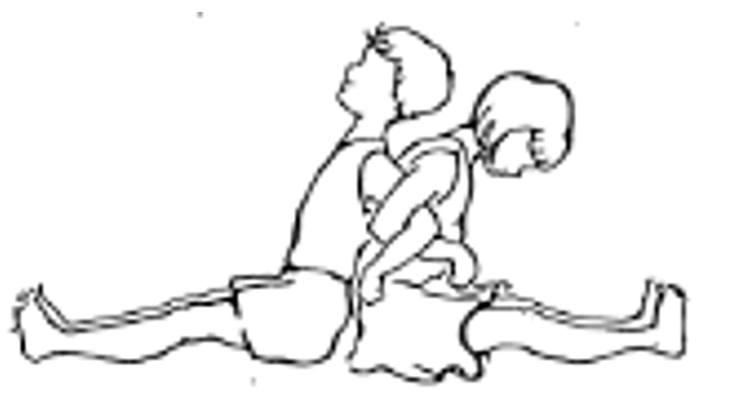
Preparing the Instrument.
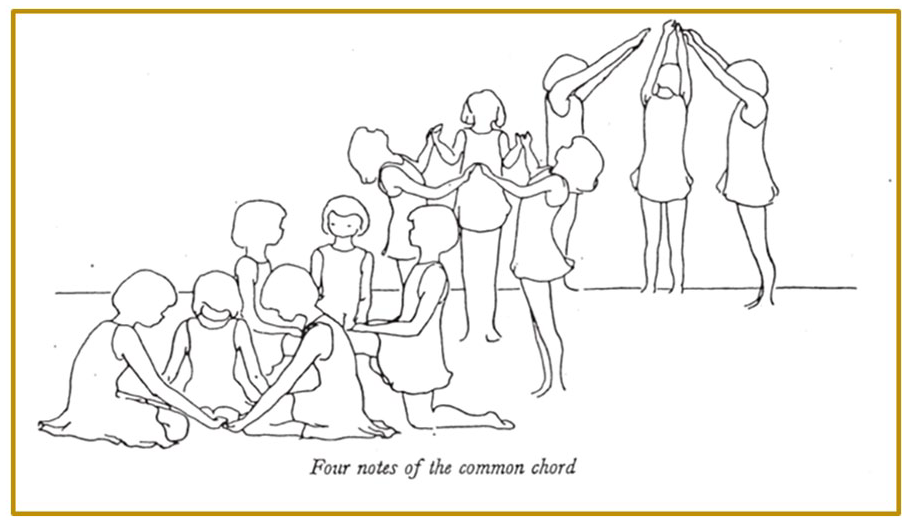
Ear Training and Movement.
In Figure 1, the children enact a compound musical meter; each child takes a turn swaying to the macrobeat. By linking elbows, they interact, work cooperatively, and assist each other in determining when and how the next sway must occur.
In Figure 2, the children join in small groups to portray notes heard within a tonic triad. Working together, they position their bodies spatially to show the level of the chord tone they represent.
While certain eurhythmics teachers prefer this traditional approach using human touch, which develops the child’s ability to feel musical concepts from within, many eurhythmics teachers today use concrete manipulatives such as balls, scarves, or elastic bands. This provides extrinsic motivation because children enjoy touching or holding an object. Grasping an object can also help a child develop self-control and fine locomotor skill with less behavioral risk than touching a classmate. Also, for children who may feel inhibited to move their own body, grasping an object can provide a sense of security and enable greater freedom of expression.
By the mid-20th century, physical education was common throughout the United States, and it became well established that touch could be used as a tool for human development. In 1949, German biologist G. Révész coined the term “haptic” (stemming from the Greek term “haptikos” = able to touch) while studying perception and creativity within people with visual impairment (Révész, 1949). The earliest haptic research studies were centered on learners with hearing or visual impairments, whereas more recent studies have centered on reading and writing letters of the alphabet. While instruction using multisensory modalities is promoted in many schools, tactile stimuli can sometimes be neglected, and there is a consensus among researchers that more research of the tactile modality is needed. The rise of digital and interactive technology within education has reinvigorated the use of tactile learning as children manipulate information that is seen or heard with their fingers and hands. Technology has multiple benefits, some of which include engaging learners multi-modally, utilizing the child’s desire to explore through touch, and enabling us to see and capture evidence of cognitive learning. However, it is important to identify our purposes for using technology and acknowledge its limitations. It does not allow a child to feel the warmth of a friend’s hand on a difficult day; build the feeling of a cooperative, accepting class community as students join hands in a circle; or show a child all the different touches that can convey a mood on an instrument.
Preparation for Playing an Instrument
Piaget’s connection between physical experience and the development of mathematical thinking is important for music educators. Tactile activities can help the child perceive musical pitch and feel the spacing of intervals on any instrument. One example is positioning familiar objects to allow the child to feel the distance between steps and skips. This can be particularly effective in teaching the child to sing pitches accurately in tune, as the voice is an instrument which is invisible to a child. Studies have found that children as young as 3–5 years use “adult-like exploratory procedures” with their hands to recognize objects (Kalagher & Jones, 2011; Overvliet and Kramp, 2018). Prior to age eight, children’s perception of size is dominated by the sense of touch. Beginning from age eight, it is helpful to integrate both visual and tactile information as this enhances spatial and perceptual judgments (Broadbent et al., 2020). By age twelve, tactile information once again dominates children’s perception, and their exploration through touch becomes more accurate and nuanced by patterns (Mjsceo et al., 1999).
Familiar objects, or “mystery” objects of varying sizes, shapes, or textures, can be used to introduce the child to articulations, such as smooth or prickly. Blind-folded, students can reach for a mystery object inside a bag or box. By isolating the sense of touch, students must rely on it to take in information. After asking them to describe what they feel, students can then work in groups to create improvised sounds or movement to evoke the object. In sharing out the group improvisations, the class can try to guess which object is being portrayed.
Mathematical thinking also comes into play with the child’s understanding of weight and force. The child will need to learn to use the fingers, hands, and body to produce heavy versus light tones on a musical instrument and how to shade dynamics ranging from soft to loud. Studies suggest that tactile exploration with both hands leads to more accurate object perception in children (Lederman & Klatzky, 1987). The child’s ability to play in various tempi and show metrical crusis on an instrument will also require refined touch as well as timing (another mathematical principle). Aural response games, in which the class must cooperatively move a parachute (or bedsheet) to a musical piece, can help children develop a broad array of tactile skills useful for instrument playing. Placing a ball, or other object, onto the parachute adds another level of challenge for tactile maneuvering. This type of game can be played with each individual student “rocking a cradle” with a ball on a scarf. Students can be challenged to show musical changes they hear using the ball and scarf. In another example, students take turns portraying different types of people coming up to ring a doorbell. The doorbell can be handcrafted by the teacher and is held by a student for reciprocal touch. Examples might include a toddler who loves to ring doorbells, a delivery worker being paid by the number of deliveries made per hour, or a person who tries insistently but realizes the doorbell is not working. Although the objects used for these activities are not musical instruments, they serve as “pre-instruments” and engage the child through play.
Although much early music training centers on the development of the child’s ear, tactile activities can help children build their fine locomotor skills needed for proficiency on a musical instrument. Manipulating simple objects in early classroom music experiences can also help children develop, improve coordination, physical response, timing, control, and sensitivity, so they will be able to adeptly maneuver in moving parts on instruments, such as keys, bows, strings, mallets, slides, valve levers, and so on.
Social Learning Through Touch
The benefits of touch extend beyond preparation for playing a musical instrument. Through clinical studies on infants, social psychologists and neuroscientists have found that human touch is a “fundamental, possibly necessary component of the development of the earliest social attachment bonds” (Barnard & Brazelton, 1990, p. 196). Infants not held or touched by their mother have shown signs of social deprivation and impaired health. Moreover, neuroscientists have found different neural profiles between interpersonal touch (i.e., human touch) and touch of an inanimate object (Cascio et al., 2019). This suggests that both are important to a child’s development. This said, it may benefit educators to ask ourselves if we are teaching our student to respectfully and cooperatively work toward a goal with others.
Compared to other senses, touch involves reciprocity. In the act of touching another person or living thing, we are also “touched back.” Reciprocal human touch in the classroom has enormous potential for building socioemotional competency. Two of the most basic but essential competencies that can be developed in young learners through tactile activities are self-awareness and awareness of others. Tactile activities involving partners or groups can foster competency in self-control, trust, cooperation, empathy, and acceptance of others. This reciprocity results in closeness, empathy, and sympathy (Barnard & Brazelton, 1990, pp. 22, 24). Hand-clapping singing games come to mind, which require both collaboration and trust. The Collaborative for Academic, Social, and Emotional Learning (n.d.) explains that relationships fostering collaboration and trust promote equity and excellence. Important to note is that assessment is part of the socioemotional learning process—the teacher must include SEL as a lesson objective and then assess whether students are making progress on SEL objectives. Another example of building empathy and sympathy might involve encouraging students to assume the role of a buddy. If the class is asked to point to the “heartbeats” of a song or a notated rhythm pattern, a child can hold the finger of a friend next to them to guide them as they point. The buddy helps their friend musically but also socioemotionally as well.
In looking back at Figure 1, a partner activity with students sitting back-to-back with elbows linked, it is important to think of ways we can maximize musical and SEL learning potential within our music classroom. Sitting back-to-back with elbows linked, students can feel the pull and sway of 6/8 meter while working cooperatively and respectfully with a partner to achieve a common goal. As Greek philosophers espoused, the sensation of touch helps us to know and understand new things, such as complex musical concepts.
A Few Types of Possible Tactile Activities for the Classroom
Hand-clapping games, circle games, folk dances, and playing instruments are among the most common tactile activities in music classrooms. Children in younger grades can also form a long line and step or march to the steady beat while chanting a known rhyme or song. A simple addition of having each child rest a hand on a friend’s shoulder in the line not only keeps the line together but fosters social, reciprocal touch. Children in upper-elementary grades can “draw” rhythm patterns on a friend’s back in a seated position, either using direct touch or with a soft object such as a paintbrush. The friend can tap the rhythm “felt” as an echo, simultaneously as the rhythm is drawn, or in canon with the drawing.
With the classroom as an imaginary skating rink, the teacher can invite children to skate to music in triple meter. Directing children to follow a leader in a circle around the rink while they skate can facilitate good behavior and minimize collision. If a one-voice texture is heard in the teacher’s improvised music, the children skate “solo.” But when the music changes to two-voice texture or both hands, the children must find a friend and skate together with linked elbows. By alternating back and forth, each child has opportunities to return to the no-touch zone while also responding to changes in the music.
Another tactile activity can be used which involves non-direct touch. Children pair off and become a marionette and puppeteer. The puppeteer must stand their marionette up from a lying position on the floor, using imaginary strings, limb by limb. Long limbs might require a slow, gradual, legato motion. Shorter limbs, such as a finger or wrist, will need a quick, staccato motion. It will be necessary for the puppeteer to use contour, comparable to the musical pitch continuum, to “raise” each limb to the height desired. Once standing, the puppeteer must move their marionette’s strings according to music that is heard by the teacher’s improvisation on an instrument. The teacher can alter the tempo, pitch contour, register, articulation, and so on, thereby necessitating changes in aural response. Both the marionette and puppeteer employ touches and responses to touch but with a barrier of imaginary string. If children in the class are on task, the teacher can invite a child to lead the activity by playing an improvisation on an instrument.
Recognizing and Meeting Challenges Related to Touch
It is important to recognize that there are differences in how students respond to touch. A 2012 playground study provides one example of how customs vary according to country and culture. Researchers found that compared to French children, American children touch their parents less, display more aggressive behavior toward their parents, have less tactile contact with their peers, and are more likely to grab the toys of peers (Field, 2012). Because children in American schools come from a vast array of cultures, we must be open to learning how to embrace these differences.
Beyond culture, student exceptionalities warrant thoughtful planning when choosing our instructional approach. Learners with a disorder, such as autism spectrum disorder, may experience sensory stimuli differently compared with other children (Baranek et al., 2006). Certain learners may react to tactile stimuli in ways that are defensive. Other learners may have a sensory disorder that makes it challenging to take in information or express information through their senses. Oftentimes, these disorders have not yet been diagnosed. See Appendix for a list of strategies for using tactile activities across different types of learners:
Concluding Thoughts
A well-thought-out rationale for using tactile activities in our instruction can strengthen our credibility and yield support from stakeholders in our school and community. Following are points that can form a rationale:
Touch is one of our five senses. Students can take in a lot of information through touch, can communicate information through touch, and express themselves through touch.
Playing an instrument requires many types of touch and control of the body.
Touch is an important form of human communication. Through touch, we can show emotions, respect for self and others, acceptance/tolerance, empathy, collaboration, and so on.
Displaying students’ tactile skills onstage can also empower and motivate your learners while publicly sharing their growth with your school community. There are multiple ways to integrate tactile activities into a grade-level program or ensemble concert. An entire scene built around socioemotional skills can showcase student development very overtly, whereas a purposeful design of “human” props or scenery could showcase these skills more discreetly. If students are successfully demonstrating these skills in music class on a regular basis, they will likely be eager and confident to show these onstage. Music teachers might consider giving voice to sample skills their students have developed, for example, in a talk at the start of the program or in a typed program note.
Like many trends in education that come and go, the pendulum of tactile learning has swung into and out of use. While challenges will always exist in using tactile activities, it is beneficial for us to think about how touch is pertinent to a child’s education, and perhaps even more critically to a child’s music education. Touch holds special importance in the subject of music in that it leads to music-making on instruments while also cultivating social skills that learners will use for life.
Footnotes
Appendix
Declaration of Conflicting Interests
The author(s) declared no potential conflicts of interest with respect to the research, authorship, and/or publication of this article.
Funding
The author(s) received no financial support for the research, authorship, and/or publication of this article.
