



Abstract
Textbook-centred mathematics teaching rarely allows teachers to draw on their valuable learning experiences. This narrative study explored how novice mathematics teachers draw on their learning experiences in their current teaching practice. The participants include three mathematics teachers – two from private schools and one from a public school in the Kathmandu Valley, Nepal. They participated in at least two in-depth qualitative interviews that collected information about their experiences as mathematics learners and how those experiences shaped their teaching. The findings indicate that novice teachers often draw on their prior learning experiences as a form of hidden curriculum that implicitly guides their classroom practices. The underprepared and unconfident novice teachers tend to reproduce the inherited, traditional approaches to mathematics teaching. Nevertheless, once novice teachers gradually collect some experiences and merge these experiences with their emerging knowledge, they gradually emulate their role model mathematics teachers and replicate the practices that they appreciated as learners. These results suggest that recognizing and critically engaging novice and in-service teachers with their own learning experiences can support student-centred teaching.
Keywords
Introduction
Mathematics teachers’ knowledge and beliefs about mathematics and its education significantly influence their instructional choices and methods (National Council of Teachers of Mathematics, 1989; Page & Clark, 2010; Radišić et al., 2024; Saritas & Akdemir, 2009; Thompson, 1984). Such knowledge and beliefs guide them in setting learning objectives, selecting appropriate instructional strategies, and designing activities to achieve them. Teachers often develop core beliefs about mathematics and teaching through their own learning experiences, which then serve as a hidden curriculum to interpret their formal curriculum and reproduce it within the formal educational framework (Acar, 2012; Jensen, 2018). A hidden curriculum is a set of activities that are not part of the formal curriculum but influence teaching and learning practices (Alsubaie, 2015; Rossouw & Frick, 2023).
The notion of a hidden curriculum and using teachers’ experiences as a teaching resource are relatively new concepts in Nepal because educational stakeholders primarily view textbooks as the primary source of knowledge, particularly in mathematics, often limiting instruction to textbook content (Acharya et al., 2022; Luitel, 2009). Mathematics teaching primarily focuses on students’ solving of textbook problems, which they reproduce on exams; consequently, it overlooks what teachers believe about mathematics and its teaching and their learning experiences. This study examined whether and how Nepali mathematics teachers draw on their learning experiences as a hidden curriculum in their early careers. The following are the research questions guiding this study:
What kinds of learning experiences, if any, do novice teachers utilize in their teaching? How do novice teachers select and implement their learning experiences in teaching?
This study identifies how and why early-career Nepali mathematics teachers draw upon their own learning experiences to inform instruction. These insights may support educators and policymakers in designing teacher education programs that integrate and build on such experiences. The hidden curriculum concept still does not get enough attention and practice (ProFuturo, 2025), especially in mathematics education, where studies connecting hidden curricula to teacher practice remain limited (Abramovich & Brouwer, 2004a). As such, the findings of this study may inform broader mathematics teacher education programs.
Hidden curriculum
The concept of a hidden curriculum refers to a set of activities, such as unspoken norms, values, and expectations, that are not part of the formal curriculum but shape how teachers teach and impact students’ social and cognitive development (Alsubaie, 2015; Nuryana et al., 2023; Smith, 2013). The term “hidden curriculum” was first introduced by Jackson (1968) in his book Life in Classrooms, referring to the “rules and regulations that regulate classroom life” (Rossouw & Frick, 2023, p. 6). Jackson's notion of hidden curriculum encompasses unspoken and informal norms, values, and beliefs that teachers internalize through their interactions with students and educational contexts and use to transmit acceptable forms of knowledge and behaviors (Rennert-Ariev, 2008). Although not explicitly documented or planned, the hidden curriculum profoundly affects formal academic practices and plays a crucial role in the implementation and success of the formal curriculum (Martimianakis et al., 2015).
Nuryana et al. (2023) identified three dimensions of a hidden curriculum: (i) institutional relationships and teacher-student interactions, (ii) educational processes and practices, and (iii) inconsistencies and intentional differences in treatment. These dimensions shape the overall academic experience by influencing structures, practices, behaviors, and the cumulative experiences students encounter throughout learning. Belbase et al. (2022) also viewed curriculum as a phenomenological text. Agreeing with Magrini (2015), they conceptualized curriculum as a way to develop teachers’ and students’ experiences and change standardized structures.
The hidden curriculum also includes implicit communication styles, modeling and behaviors, and student interactions and relationships, often conveyed without the teacher's conscious awareness (ASCD, 2025). Kärner and Schneider (2023) considered the hidden curriculum to be a byproduct of unconscious daily routines and practices. Teachers often bring external norms and values into the classroom, integrate them with existing classroom expectations, and embed them into their pedagogy, shaping what knowledge and behavior are acceptable (Basyiruddin et al., 2020; Kidman et al., 2013).
Small (2020) described the hidden curriculum as encompassing ordinary and extraordinary aspects in an educational setting and coexisting alongside the formal curriculum. The hidden curriculum adds emotional, relational, and experiential dimensions to the theoretical and practical components of the formal curriculum (Acar, 2012; Cubukcu, 2012). By drawing on their knowledge and experiences, teachers can identify implicit values and practices within the hidden curriculum and weave them into formal instruction. This integration enhances student learning and allows students to acquire knowledge that may not be explicitly available through the formal curriculum alone. Rossouw and Frick (2023) further defined the hidden curriculum as the gap between what is formally outlined in curriculum policies and what takes place in classroom teaching. This includes elements such as extrinsic and intrinsic motivation, beliefs about teaching and learning, confidence and growth mindsets, and a sense of belonging—all of which, though difficult to measure with formal and standardized tests, are vital for students’ learning and holistic development (ProFuturo, 2025).
According to Zorec and Došler (2016), the hidden curriculum includes well-established, ritualized elements of teaching closely linked to broader socio-cultural patterns and societal rules. The hidden curriculum aligns with Cobb and Yackel’s (1996) theory of constructivist learning from emergent perspectives; it may allow students to learn from their daily experiences and peer interactions, both inside and outside the classroom, as it reflects teachers’ knowledge, beliefs, past experiences, and personal philosophies.
The hidden curriculum extends beyond individual teachers or their sole effort to help students’ socialization (Acar, 2012); it also operates at the institutional level and as a social structure. Ule (1988), as cited in Zorec and Došler (2016), stated that it can be of any institution, consisting of “the symbolic framework of the social order” (p. 105). Similarly, Rennert-Ariev (2008) framed it within a broader socio-cultural theoretical framework that explores the relationships between social structures and actions. These frameworks offer opportunities to observe new institutional contexts and challenge traditional approaches to teaching.
Although the hidden curriculum offers numerous benefits to educational practices, it can also have negative consequences. Its impact varies based on how individual teachers interpret and apply their experiences. Alsubaie (2015) noted that it may sometimes hinder student learning. For instance, according to Basyiruddin et al. (2020), teachers’ informal or implicit messages may function as a hidden curriculum and negatively influence students. The authors illustrated this with an example: If a teacher holds and expresses negative views about mathematics, students may internalize these attitudes and develop similar perceptions. Nonetheless, the benefits of a hidden curriculum surpass its adverse impacts on student learning. Alsubaie emphasized that teachers should intentionally leverage their hidden curriculum to foster positive learning experiences and actively work on challenging and reforming negative beliefs and practices.
In summary, the hidden curriculum has been conceptualized in multiple ways––as the rules that make the classroom functional (Jackson, 1968; Kärner & Schneider, 2023), the unspoken/unintended values embedded in schooling (Alsubaie, 2015; Small, 2020), the gap between what is outlined in policy and what is practiced (Rossouw & Frick, 2023), and as a mechanism for implementing formal curricula effectively (Martimianakis et al., 2015). However, none of the studies focused on how teachers can use their learning experiences as a hidden curriculum.
For this study, we adopt Alsubaie’s (2015) view of hidden curriculum as something acquired through one's experience in the educational system. Here, the hidden curriculum refers to the implicit norms and values that mathematics teachers internalize through their learning and professional experiences. Teacher-student interactions shape these norms and values; school and classroom culture; socio-cultural norms and practices; their past educational encounters; and, significantly, how mathematics teaching and learning happen or should happen. Our view addresses all three dimensions of the hidden curriculum Nuryana et al. (2023) identified—one's hidden curriculum is shaped by institutional relationships and teacher-student interactions, educational processes and practices, and intentional differences in treatment experienced during their schooling. This view of the hidden curriculum also aligns with that of Kärner and Schneider (2023), who argued that the hidden curriculum emerges and is transmitted and maintained through rituals and routines and interaction patterns that shape the typical practices of everyday school experiences.
Hidden curriculum in teacher education programs
Although the hidden curriculum is associated with what and how students learn in school (Alsubaie, 2015) and influences the social reproduction of values and cultures (Acar, 2012; Kidman et al., 2013), it has not received enough attention in teacher preparation and educational studies (ProFuturo, 2025). Most research on the hidden curriculum focuses on teachers’ conceptions of it and its impact on student learning, with less attention given to its role within teacher education programs (Barrett et al., 2009). Still, some scholars argue that the hidden curriculum should be integral to teacher education as it provides valuable insights into the implicit messages students receive from teachers, classrooms, and schools (Langhout & Mitchell, 2008). They argue that incorporating the hidden curriculum into teacher education programs can enhance preservice teachers’ (PSTs’) content and pedagogical knowledge. For example, Abramovich (2009) applied the pedagogical framework of a hidden mathematics curriculum in a technology-enhanced inquiry on trapezoid representation with his PSTs. He concluded that incorporating the hidden curriculum helped improve PSTs’ content knowledge and enhance their ability to move beyond traditional curricula. Integrating the hidden curriculum into teacher education programs can offer PSTs diverse experiences that shape their social and professional behaviors (Basyiruddin et al., 2020). Rennert-Ariev (2008) also reported that PSTs might develop an inconsistent interpretation of teaching and learning without exposure to the hidden curriculum.
Semper and Blasco (2018) indicated three factors as the reasons for this lack of focus on the hidden curriculum: (i) the perception that the hidden curriculum is counterproductive and should not be formally practiced or studied, (ii) the shift from teacher-centered education to student-centered practices, and (iii) beliefs that a teacher's values and experiences are personal matters rather than technical issues relevant to student learning.
Hidden curriculum in mathematics education
Like teacher education, mathematics education has received little attention from the hidden curriculum perspective. Abramovich and Brouwer (2003) noted that the notion of a hidden curriculum is less connected with mathematics education, a trend that continues today. There are insufficient research findings explaining whether and how hidden curricular practices influence mathematics teaching and student learning.
For this study's literature review, we thoroughly searched databases including Google Scholar, JSTOR, Taylor & Francis, Springer Nature, and Sage Publications with keywords like hidden curriculum in mathematics and hidden curriculum and mathematics instruction. However, we found only a few articles linking hidden curriculum to aspects of mathematics education, including PSTs’ experiences, teaching with technology, and curriculum. Notably, S. Abramovich and P. Brouwer contributed over 80% of these articles, published mainly in the 2000s. These findings highlight a gap in mathematics education from a hidden curriculum perspective and vice versa. Consequently, there is insufficient evidence on whether and how hidden curricular practices contribute to mathematics teaching and learning.
Across their series of studies, Abramovich and Brouwer (2004a, 2004b, 2006) developed a robust framework for understanding the hidden mathematics curriculum as a component of mathematics teacher education. Each subsequent study, built on the previous one, added depth and clarity to the notion of a hidden mathematics curriculum while maintaining a strong focus on PSTs’ learning experiences, pedagogical development, and psychological readiness.
Abramovich and Brouwer (2004a) explained the hidden mathematics curriculum—mathematics from hidden curriculum perspectives—as implicit structures and concepts that underlie various mathematical activities. They argued that uncovering and internalizing hidden meanings requires teachers to have strong mathematical knowledge and confidence, which can be facilitated through an informal representation of formal mathematics. Abramovich and Brouwer reported how a hidden mathematics curriculum supports the mathematics learning experiences of elementary PSTs. The authors believe the hidden curriculum supports mathematics teachers’ content and pedagogical knowledge by embracing advanced mathematical concepts, technology, and connections between ideas. The authors also claimed that a hidden mathematics curriculum supports positive changes in PSTs’ psychological phenomena, like confidence and anxiety. They stated, “the notion of hidden mathematics curriculum has the potential to significantly broaden pre-teachers’ content knowledge and bring positive change in various teaching-related psychological phenomena, including self-confidence and mathematical anxiety” (Abramovich & Brouwer, 2004a, p. 314). Abramovich and Brouwer suggested that a technology-enhanced hidden curriculum framework has the potential to promote good learning, drawing on Vygotsky's ideas about learning through social interaction.
Abramovich and Brouwer (2004b) claimed that the hidden mathematics curriculum is significant to all levels of mathematics teacher preparation programs; they asserted that a hidden curriculum approach connects research and practice in mathematics teacher education and technology, potentially providing pedagogical mediation tools. The authors discussed how technology-mediated hidden mathematics curriculum practices with deep conceptual understanding and understanding of mathematical structures elevate PSTs’ mathematics learning experiences, broaden their content knowledge, and positively change several pedagogical aspects, contributing to their mathematics teaching as professional teachers.
Abramovich and Brouwer (2006) proposed a hidden mathematics curriculum from a positive learning framework to design instructional activities as opportunities to strengthen mathematics teacher education. They argued that the hidden curriculum should be central to mathematics teacher education. Abramovich and Brouwer (2006) concluded with four ways that the notion of a hidden mathematics curriculum contributes to mathematics teacher education by
Fostering a dynamic interplay between mathematical theory and practice “by highlighting the deeper meaning in what is commonly perceived as routine school mathematical activity” (p. 18), Enabling PSTs’ learning of mathematical concepts and promoting intellectual curiosity and reflective inquiry among learners, Providing modeling experience to PSTs, and Elevating PSTs’ learning experiences and their self-confidence in mathematics teaching abilities.
Though indirectly, the authors also highlighted the potential of using both teachers’ and students’ experiences in the classroom. Abramovich and Brouwer asserted that a hidden mathematics curriculum can potentially broaden PSTs’ content knowledge and teaching-related attributes.
The three works by S. Abramovich and P. Brouwer present a comprehensive and evolving view of the hidden mathematics curriculum. They moved forward the conventional conversation on the hidden curriculum from a focus on implicit norms, values, and behaviors to a more intentional, structured, and transformative tool in mathematics education. They highlighted the potential of the hidden curriculum to nurture reflective, confident, and well-prepared teachers who can recognize and leverage implicit dimensions of learning in their own classrooms.
Acar (2012) conducted an ethnographic study in an elementary math class in the Midwestern United States to explore how the hidden curriculum contributes to the social reproduction of academic knowledge. She concluded that how a teacher interacts with students significantly shapes the process, manifesting through textbook and workbook patterns, physical environment, mathematical activities, and the teacher's talk. Discussing these elements together, Acar described the hidden curriculum as emerging through classroom structure, teacher-student interactions, textbook selection, activity types and their cognitive demand, and how the teacher communicates with students. The teacher's communication may involve launching mathematical tasks, explaining solutions and concepts, or providing formal or informal support. Acar also discovered and emphasized the connection between hidden curriculum and life experiences, noting that students will likely reproduce life experiences as a hidden curriculum. She stated, “If a hidden curriculum is a way of learning and uses the life experiences, the students may learn about life unwittingly and repeat the information in the class environment and then through their lives” (Acar, 2012, p. 28). These findings suggest that in mathematics teacher education programs, PSTs will likely replicate instructional approaches they experienced and relate to real-world situations.
Influence of teachers’ learning experiences in mathematics teaching
Teachers’ experiences of learning mathematics, including their personal beliefs and attitudes, are pivotal in shaping their instructional practices (Page & Clark, 2010). Numerous studies have demonstrated a strong correlation between teachers’ mathematics learning experiences and their perceptions and approaches to teaching. These findings highlight the importance of providing meaningful, positive learning experiences during pre- and in-service education as such experiences can be a powerful model for classroom implementation.
Chamberlin (2009) conducted a study of 16 middle school mathematics teachers who participated in a 2-week-long summer institute to examine the impact of teachers’ mathematics learning experiences on their teaching. The 16 teachers shared several practices in the institute that they enjoyed and found helpful in their learning, and they shared their plans to implement such practices in their classroom teaching.
Similarly, Jensen (2018) examined the relationship between past mathematics experience and current teaching beliefs and practices among six elementary teachers, with a specific focus on mathematics anxiety. Jensen's study concluded that teachers’ past experiences directly impacted their present beliefs and practices. The study also suggested that targeted pre-service and in-service education could help disrupt the cycle of mathematics anxiety. Although Jensen's research focused on beliefs and practices related to math anxiety, the findings may also apply to broader teaching practices.
Lo (2021) explored the relationship between primary PSTs’ past experiences with mathematics and their beliefs about teaching the subject. The study revealed that all 19 participating teachers were influenced by their prior experiences, which shaped their beliefs about mathematics instruction. The teachers also expressed a willingness to learn from positive and negative experiences and create more effective learning environments for their students. Lo further noted that some teachers displayed more traditional, procedure-oriented beliefs, which he attributed to the emphasis on procedural knowledge during their practicum experiences. Based on these findings, Lo recommended fostering an open and supportive mentoring environment for PSTs during field experiences.
In addition to these findings, other studies (e.g., Muñoz et al., 2024) have indicated a vital relationship between teachers’ learning experiences and their teaching beliefs and/or practices. Muñoz and colleagues’ study included 252 mathematics teachers in Chile and reported that the future teachers mostly held beliefs about mathematics teaching, which they experienced and constructed during their secondary education. They concluded that a critical role of future teachers’ learning experiences is shaping their professional beliefs and competency. Likewise, several studies (e.g., Couch, 2016) have indicated that teachers’ past learning experiences shape their self-efficacy, which consequently impacts their quality of teaching.
These studies highlight the profound impact of mathematics teachers’ learning experiences on their instructional beliefs and practices. Such experiences often become embedded in their identities and directly influence their instructional practices. The findings point to a critical need for teacher education programs to address these learning experiences intentionally.
The conceptual framework
In this study, we conceptualize the hidden curriculum through the lens of teachers’ learning experiences. Specifically, we define it as the implicit norms and values (Alsubaie, 2015) that mathematics teachers internalize through their learning and professional experiences that subtly shape their instructional practices.
Rossouw and Frick (2023) proposed a model of the hidden curriculum in the context of private higher education, identifying it as the intersection of three components: student learning experience, graduate competencies, and relevance. They explained that the student learning experience is shaped by the lecturers’ implementation of the formal curriculum, graduate competence emerges from the interaction of the formal curriculum and professional context, and relevance refers to the alignment of taught knowledge and skills with workplace demands.
Building on Rossouw and Frick’s (2023) model, along with Nuryana et al.'s (2023) three dimensions of the hidden curriculum (institutional relationships, educational processes, and inconsistencies and intentional treatments) and drawing on research on hidden mathematics curriculum (e.g., Abramovich & Brouwer, 2004a, 2004b, 2006; Acar, 2012), we developed a conceptual framework (see Figure 1) to understand how the hidden curriculum operates in mathematics teaching.
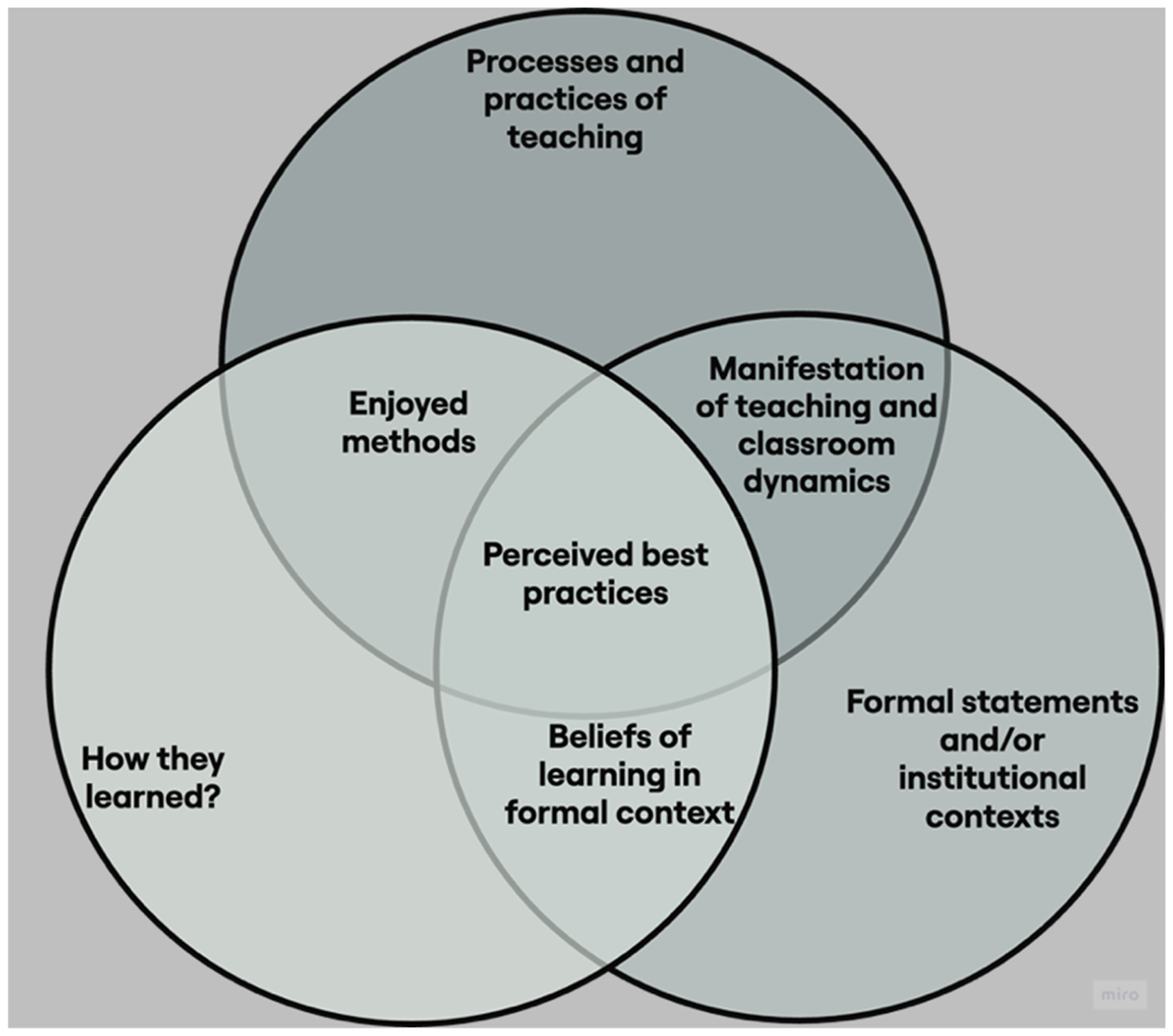
Conceptual framework for the hidden curriculum in mathematics teaching.
We view the hidden curriculum as the union of three elements:
Formal statements and/or institutional contexts. This includes textbooks, policy documents, institutions’ structures, and classroom norms, which mathematics teachers often reproduce as customary regulations (Acar, 2012; Zorec & Došler, 2016). Processes and practices of teaching. This element encompasses teaching methods and mathematical activities that shape their instructional practices (Acar, 2012; Nuryana et al., 2023). How the individual learned. This element involves the strategies that facilitate one's learning.
We assume that overlaps between these elements strongly influence the practice of the hidden curriculum.
The intersection of the institutional context and pedagogical practices manifests teaching and classroom dynamics, reflecting one's core beliefs and values, like on the nature of mathematics and its teaching, and the kinds of classroom dynamics (Alsubaie, 2015). This intersection closely aligns with the second dimension of Nuryana et al. (2023), educational processes and practices. The intersection between pedagogical practices and how the individual learned—that is, perceived values associated with formal experiences—shapes their formal instructional approaches; this overlap relates to Nuryana et al.'s (2023) third dimension, inconsistencies and intentional differences in teaching. The intersection of institutional norms and prior learning experiences is the enjoyed methods. This intersection demonstrates how teachers replicate values and methods they were previously exposed to and found effective. Such methods and values often have positive effects on student learning. This intersection aligns with Nuryana et al.'s (2023) first dimension, institutional relationships and teacher-student interactions. At the center, where all three elements intersect, lies the core of the hidden curriculum—a set of perceived best practices that teachers internalize and implement, consciously or unconsciously, across their teaching. These practices can significantly influence students’ learning environments and opportunities for as well as attitudes toward mathematics.
Local context: Mathematics instruction and teacher preparation in nepal
Nepal has committed to various global initiatives in education and undertaken reforms to provide quality education to all (Panthi & Belbase, 2017). The policy documents advocate for student-centered practices, emphasizing integrating hands-on activities and suitable technology in mathematics education at the school level (Curriculum Development Center [CDC] Nepal, 2019; Ministry of Education, Science and Technology of Nepal [MoEST], 2022). However, “a teacher-centered, examination-driven instructional approach emphasizing knowledge of facts and standard methods through drill-and-practice without the use of Information and Communications Technology (ICT) is still dominant in Nepalese high schools” (Mainali & Heck, 2017, p. 487). As a result, teachers focus on teacher-led problem solving (Khanal et al., 2021), emphasize knowledge transmission, and rely heavily on reproduction-based assessments, which typically require students to memorize mathematical facts, formulas, algorithms, and routine problem-solving techniques (Budhathoki & Pant, 2022; Pokhrel, 2018).
Standardized tests in Nepal primarily assess low-level cognitive mathematical tasks focused on memorization and procedural fluency (Budhathoki & Mainali, 2024). Consequently, teaching is centered on preparing students to excel on these assessments. Still, Nepali students continue to underperform in mathematics and fail the most in this subject; the success rate for Grade 10 students on national standardized exams is only approximately 35% (CDC Nepal, 2019). Moreover, over two thirds of Grade 10 students only possess basic mathematics proficiency (Education Review Office [ERO], 2020) and lack metacognitive problem-solving approaches (Khanal et al., 2021). Furthermore, there is a concerning downward trend in mathematics achievement; the average score for eighth graders decreased from 43 out of 100 in 2011 to 35 in 2013 (ERO, 2011, 2013). Similarly, the mean score for Grade 8 students in mathematics decreased from 500 in 2017 to 483 in 2020 (ERO, 2022; Poudel, 2018).
Textbook-based exam-centric instruction
Mathematics teaching in Nepal is predominantly textbook based and exam-centric (Mainali & Heck, 2017). Teachers use textbooks as a primary source of knowledge (Budhathoki, 2015; Budhathoki & Pant, 2022; Mainali & Belbase, 2023). Several studies (e.g., Basyal & Mainali, 2022) have discovered that mathematics textbooks in Nepal focus on routine problem solving, emphasizing low cognitive skills. This dependence on textbooks provides limited opportunities for meaning-making and promotes rote learning (Pant, 2017) as textbooks often convey messages related to what content should be learned and how it should be taught (Phipps & Wagner, 2017). Instruction prioritizes exam success (Belbase et al., 2022; Pokhrel, 2018). The exams are mainly paper-and-pencil tests that measure students’ lower order skills of Bloom's taxonomy, such as remembering and understanding, emphasizing procedural fluency. Many teachers who are aware of teaching mathematics for students’ conceptual understanding and ability to use mathematics in everyday contexts nonetheless feel compelled to prioritize exam preparation in their teaching. They report that national examinations rarely assess higher order thinking skills and conceptual understanding.
These situations raise key questions: How can Nepali mathematics teachers incorporate their cumulative learning experiences and local resources into their teaching? Moreover, what factors prevent them from doing so?
Mathematics teacher preparation
Only a few of the 11 operational universities in Nepal offer mathematics teacher education programs at the undergraduate level. Moreover, undergraduate mathematics teacher education relies largely on Tribhuvan University (Borg & Consult, 2023)—the oldest and largest university in the country—which continues to follow a traditional approach for several reasons, including the availability and rigor of its programs. Borg and Consult reported that this and other universities’ mathematics teacher preparation programs heavily emphasize candidates’ content knowledge, with minimal focus on pedagogical content knowledge (primarily theoretical) and negligible attention to technological knowledge. In their final year (or semester), candidates undergo a 45-day teaching practice, as reported by Borg and Consult, where they receive little to no support from mentor teachers. These mentors often treat candidates as substitute teachers rather than learners, expecting them to teach independently. As a result, many candidates experience what Abramovich and Brouwer (2006) called a vertical disconnect (Cuoco, 2001) wherein they struggle to see the connections between the theoretical concepts they learned in their training and the practical curriculum they are required to teach. This disconnect erodes their confidence in teaching after the internship. Similarly, as Stuart and Thurlow (2000) noted, Nepal's pre-service and novice mathematics teachers often lack necessary knowledge, skills, and authentic experiences during their undergraduate training.
Despite these challenges, albeit on a limited scale, a few graduate-level mathematics education programs at other universities in Nepal are actively working to transform mathematics teaching practices (Belbase et al., 2022). These universities offer a range of academic programs and conduct outreach training, focusing on equipping teachers with the skills to implement student-centered approaches. They support teachers in integrating innovative ideas and reflective experiences into instructional practices. However, only a small fraction of teachers, mainly from urban areas, benefit from these educational and professional support programs due to various barriers such as limited accessibility, high costs, and the perceived irrelevance of these programs to their specific teaching contexts.
Teaching licensures and hiring policies and practices
Becoming a public school teacher in Nepal is considered a desirable career option primarily because of the job security it offers. As a result, the Teacher Service Commission (TSC) examinations have become highly competitive. However, historical data show that more than 50% of candidates fail to pass the TSC exams, with their teacher education programs often bearing the blame for these outcomes. Borg and Consult (2023) noted that there is only 50–50 alignment between teacher education programs and TSC examinations. Consequently, many rural schools struggle to recruit qualified math teachers even after multiple rounds of advertisements. These schools often hire individuals without teaching licenses and sometimes without formal degrees in education. Borg and Consult reported that 14% of the teachers in Nepal do not have a degree in education.
To meet teacher demand in technical subjects, including mathematics, the government has revised its teaching licensure policies; now, candidates with a non-education degree in mathematics or science can take TSC exams provided they earn a year-long Bachelor's of Education degree within 5 years (Borg & Consult, 2023). Although such candidates often perform well on content-heavy TSC exams, they lack pedagogical knowledge and pedagogical content knowledge. Consequently, these teachers often struggle to facilitate conceptual understanding in their classrooms.
This issue is more pronounced in private schools, where teaching licensure is not necessarily required. The government of Nepal does not strictly regulate hiring practices in private schools, regardless of location. Consequently, most private schools prioritize teachers’ content knowledge over technological or pedagogical expertise and often prefer hiring mathematical science graduates over those with a mathematics education degree.
Research design and participant selection
This study examined whether and how novice teachers use their learning experiences as a hidden curriculum. For this, we first defined a novice teacher as anyone with 5 years or less of teaching experience (Curry et al., 2016; Kim & Roth, 2011). The first author utilized a narrative research design to collect and analyze teachers’ stories about their mathematics learning experiences and how these influenced their teaching practices. Before participant recruitment and data collection, he obtained approval from his degree-granting institution, detailing the ethical standards and quality measures guiding this qualitative study. The first author employed a purposive convenience sampling method and approached five teachers, but only three agreed. He had a prior relationship with one teacher, whereas his colleagues recommended the other two. This sampling approach allowed him to select teachers whose mathematics learning experiences shaped their beliefs and instructional methods.
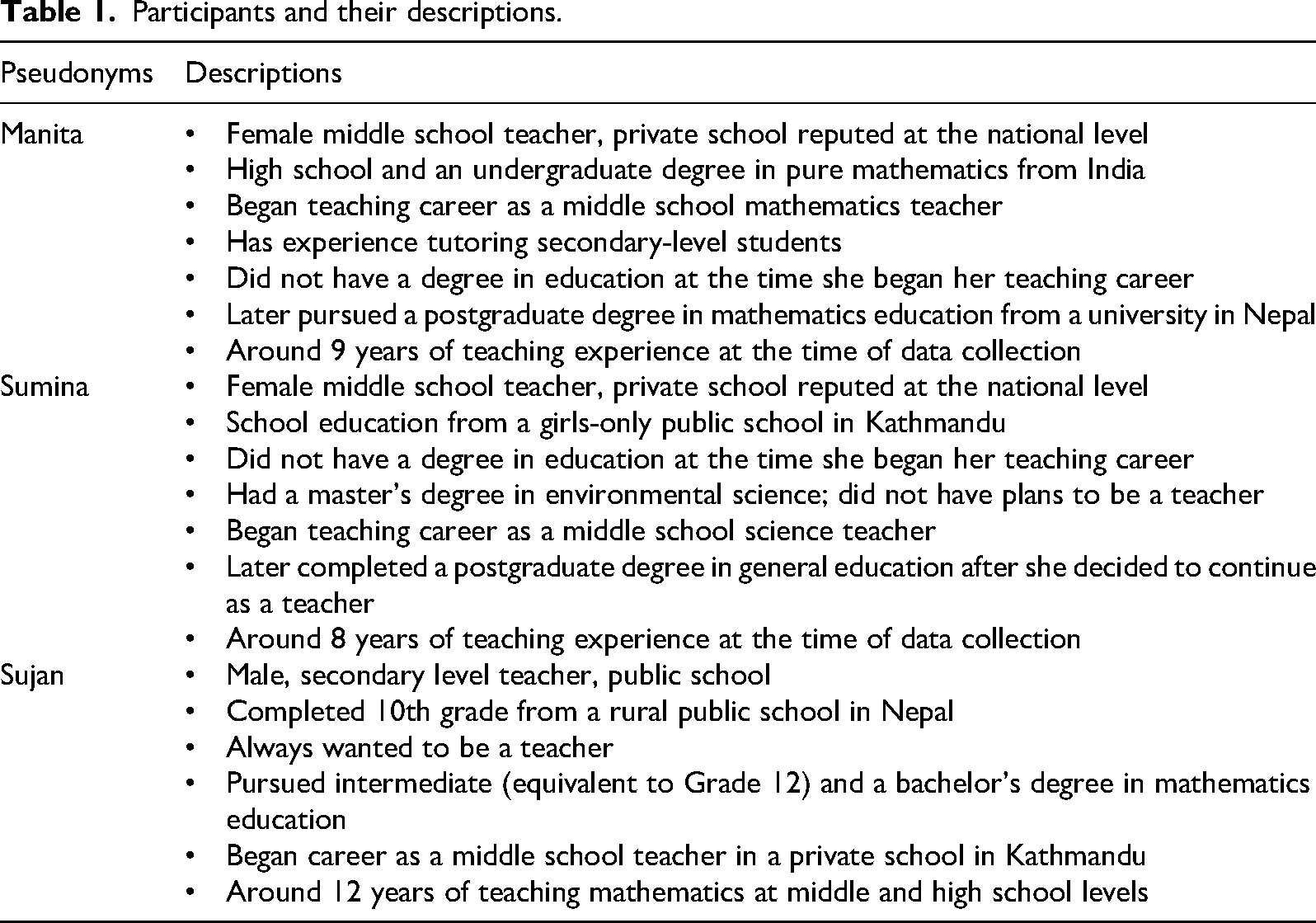
The three participants included two female teachers teaching middle school mathematics in nationally recognized private schools and one male teaching high school mathematics in a public school. As detailed in Table 1, the three teachers had diverse educational backgrounds but similar learning trajectories. The only male teacher, Sujan, always wanted to be a teacher, so he majored in mathematics education for his higher studies. Unlike him, the female teachers did not have a degree in education until they began their teaching careers. Manita wanted to be a mathematics teacher and pursued a Bachelor's degree in pure mathematics. Sumina never thought of becoming a teacher; she began her teaching career as a science teacher, which was her transitional job until she found a job in her own field, environmental studies. However, she found teaching fulfilling and chose to remain in the profession.
Participants and their descriptions.
Participants and their descriptions.
The first author conducted two face-to-face semi-structured interviews with each participant. He used the same interview questions, as listed in Appendix 1, to explore the teachers’ mathematics learning experiences, instructional methods, attributes and motivational factors for learning mathematics and becoming a teacher in the subject and behaviors and techniques they reproduced/implemented as early career teachers. The questions sought to identify any positive or negative experiences, the general instructional practices of their mathematics teachers, and how they perceived those practices. Additionally, the interviews examined whether and why the participants implemented their learning experiences in their early teaching careers and how they adapted their teaching to meet their students’ learning needs. The interview questions included: What were your mathematics teachers’ general teaching strategies? Which strategies did you use at the beginning of your career, and why? Which of those strategies did you like or not as a student? What made you change your teaching methods, and how?
For the second round of interviews, the first author prepared different questionnaires for each participant to seek clarification and elaboration on the themes that emerged from the first round of interviews. These follow-ups focused on obtaining more profound insights into specific strategies (e.g., those used by teachers they consider their role model and their reasons for implementing them in their teaching). The second round of interviews aimed to deepen understanding of key influences and how learning experiences informed their current practices.
The first author conducted each interview in Nepali as it was the interviewer's and interviewees’ primary language. He audio-recorded the interviews and then translated and transcribed them into English, taking care to preserve participants’ original message. The first author provided special attention to maintaining tone and context throughout translation. The first set of interviews was around an hour long, whereas the second one was shorter, 25–35 min long.
For analysis, the first author employed value coding, focusing on the participants’ intrapersonal and interpersonal practices, perceptions, and experiences (Saldana, 2016) at their early career stages. He grouped relevant lines and phrases into categories such as their teachers’ instructional practices; participants’ experiences in, perceptions of, and beliefs about mathematics and its teaching; their own methods at the beginning of their career; and instructional change over time. For example, we associated interview excerpts like “I was not experienced and initially followed the same way I had been taught,” “I strictly followed the textbooks and teacher's manuals,” “initially, I taught, however, I learned in my school days,” “I did what I had been seeing,” “I used to recall and apply the same ways and make similar examples my teachers made,” and “my solutions would be very similar to what I learned from my teachers. I would have thought of doing that [multiple solution-strategy] if I had seen my teachers do so” with early-career practices. We initially coded these statements and grouped them through pattern coding into more focused categories. The elements of the conceptual framework contributed to creating such categories. For example, we grouped the data related to their teachers’ instructional practices into Processes and practices of teaching, their learning styles and experiences into How they learned?, and any method their teacher used and they liked into Enjoyed methods. For example, we grouped the above initial codes mainly into two categories: (a) Actions (e.g., followed the way one had been taught, taught the way one learned in school days, did what one had seen, and used similar problem-solving strategies) and (b) Reasons (e.g., lack of [teaching] experiences, did not have knowledge about solving problems with multiple solution strategies). We then synthesized these categories into broader themes, presented in the Findings section.
Findings
The three participating teachers had diverse educational backgrounds, including differences in school types and university majors. Despite these differences, they shared similar, predominantly negative, and demotivating mathematics learning experiences, with a few exceptions. For example, their mathematics instructors primarily presented solutions and proofs on the board. They expected them to copy and reproduce them on exams—a practice they perceived as the only way to teach and learn mathematics. Moreover, as they view it now, their mathematics learning was decontextualized as their teachers neither connected mathematical concepts to real-world applications nor provided satisfactory answers to questions about the practical use of mathematics. The three participating teachers also reported receiving inadequate support during their learning; their teachers often left key concepts unclear, which led many of their peers—and, in some cases, themselves—to lose interest in mathematics over time. Sumina cited her negative experiences as a primary reason for not pursuing mathematics in her higher education: “My mathematics teachers did not answer most of my questions, which dampened my enthusiasm for the subject. I could not risk majoring in mathematics when I could not even convince myself.”
The participants also considered their undergraduate programs to be insufficient to prepare them as teachers. Like many mathematics teachers in Nepal, they agreed that the programs equipped them with sound content knowledge. However, they believed the programs did not offer sufficient pedagogical and methodological preparation (Borg & Consult, 2023). Although Sujan had some theoretical knowledge about pedagogies and some teaching experiences through an internship, he found them insufficient to build enough confidence. He said, “ [The internship] was for 35 days. I had to create lesson plans without anyone's support and teach independently. It might be better if the mentor teacher had suggested to me how to plan and implement a lesson.”
In contrast, Manita and Sumina neither had an education degree nor any internship before starting teaching. The lack of pedagogical and methodological preparation resulted in the three teachers relying on their content knowledge and personal learning experiences. As a result, they initially perpetuated the traditional approaches to mathematics teaching inherited from their own learning. However, each teacher applied their learning experiences differently during the early stages of their careers, primarily in three ways:
They replicated the inherited practices of mathematics teaching; They reproduced teaching methods that they personally valued; and They attempted to emulate teachers they considered role models.
These early teaching practices—whether replicated, reinterpreted, or inspired by role models—reflect how novice teachers draw upon their own learning experiences as a hidden curriculum. The following sections present how each participant applied these experiences in practice. We organize the findings around three emergent themes: replicating inherited traditional methods, implementing personally valued strategies, and emulating their role model teachers.
Novice teachers uphold inherited mathematics teaching practices
As novice teachers, the three participants reported initially adopting the methods they were familiar with. Lacking enough confidence and adequate skills, they defaulted to using the methods they had seen their teachers use in schools. This reliance was particularly evident in how they addressed classroom challenges and maintained control over the class. They leaned heavily on school-adopted textbooks, routine problem solving, writing proofs for students, and requiring them to reproduce solutions to problems on exams. Sumina said, “I had no idea how to make the teaching interactive. Therefore, I did what I had been seeing.” She added, “I taught, however, I learned in school days. I used to recall and apply the same ways [methods] and make the same examples my teachers made.”
The three participating teachers continued reproducing well-established, ritualized practices as their hidden curriculum (Zorec & Došler, 2016). Drawing on their learning experiences, as Rittle-Johnson and Schneider (2015) noted, they primarily relied on textbooks, chose theorems and problems important for summative and standard tests, provided model proofs and solutions, and sought accurate answers or procedures without any adaptation. The opportunities for conceptual understanding were scarce. They were unfamiliar with the concept of conceptual knowledge in mathematics. Manita reflected, “I had no idea about conceptual understanding. I learned that making students able to solve problems from the book is good teaching. That is what I had seen, I learned from my teachers, and what I did.” Likewise, Sujan recalled that he solved the textbook problems using the methods he learned from his teachers, and he never considered using different approaches to solve a single problem. He said, “I would have thought of doing that [using multiple solution strategies] if I had seen my teachers do so.” Consequently, such teaching prepares students for only the two lowest levels of cognitive demand (Stein et al., 2009): memorization and procedures without connections.
The three teachers employed disciplinary regulations as a hidden curriculum to control their classrooms (LeCompte, 1978; as cited in Acar, 2012; Rittle-Johnson & Schneider, 2015). Drawing on their own experiences, they replicated the authoritative approaches they had observed—namely, their mathematics teachers maintained strict control over classroom environments. They did not recognize the possibility of delegating authority to students. Instead, they often discouraged students from talking to fellow students and asking questions to avoid situations that might expose their lack of confidence. Woolfolk et al. (1990) reported that novice teachers may impose rigid discipline to mask nervousness, suppress classroom dynamics, and maintain the status quo of mathematics teaching. Sumina recalled that even the school she taught at at the time demanded silent students while teaching, and doing what her teachers did helped her.
In summary, the three participating teachers’ early career teaching relied heavily on their own learning experiences, resulting in a reproduction of traditional, teacher-centered, and decontextualized methods. This is coherent with Belbase et al.'s (2022) findings: Nepali educators in the document reported teacher-centered approaches as their learning experiences and reported following the same tradition as school teachers. Khanal et al. (2021) and Shrestha et al. (2021) also reported that mathematics teachers’ conventional teaching strategies, including a teacher-centered approach, were the primary cause of students’ misconceptions, low motivation, and disinterest in learning in Nepal. Although they possessed strong content knowledge, their limited pedagogical skills, confidence, and past experiences resulted in strict discipline-based teaching and classroom management, textbook-based instruction, and a narrow focus on procedural skills. Their dependence upon past experiences aligns primarily with Nuryana et al.'s (2023) second dimension of the hidden curriculum—implicit processes and practices within the educational setting—and, to a lesser extent, with the first dimension, which concerns the manifestation of institutional relationships.
Implementing self-appreciated practices
The three teachers began their careers by upholding their inherited culture of mathematics teaching and learning. They acknowledged teaching in ways they themselves did not like as students. They knew that such a heavy reliance on textbooks and a demotivating learning environment would negatively impact their teaching and hinder students’ happiness and learning. Sujan said, “I could see similar dissatisfactions on my students’ faces as I used to have as a mathematics student.” Likewise, Manita said, “I had been practicing the same ways, which I did not like as a student … I could see similar dissatisfaction on my students’ faces as I used to have. That made me realize the need to bring changes in my teaching.” However, they waited until they accumulated experience, gained confidence in teaching and managing classrooms, and reflected on what would or would not work.
The three teachers initiated changing their teaching by practicing the methods they appreciated. These included some non-traditional strategies such as discussions, fostering students’ active engagement in learning, peer interaction and collaboration, and providing additional support to struggling students. They blended such self-appreciated practices with their emerging knowledge and experiences and used them to support student learning.
Unlike most of their own learning experiences, the teachers enhanced communication with and among students. They encouraged students to share their thoughts, seek clarifications, organize mathematics-embedded games, and discuss the scope of the mathematics topics in relevant real-world contexts. Sometimes, the teachers even encouraged students to explore various mathematical phenomena within or behind their household activities and explain them in whole-class settings. They were confident that such interactions and treatments would contribute to student learning as they had lived experiences with them. Sujan explained, “I usually did what I liked as a student. I was sure that the things that worked for my friends [during peer learning] and me would work for students.” Sumina's immediate changes in her teaching were using the approaches that made her happy. She stated that she used some fun activities in her math teaching, which was radical then. She said, “If sometimes the students were not interested in learning, I conducted warm-up activities, brain gyms. I tried to bring the fun inside the classroom. I often started teaching with some interesting problems on sums and others.” Notably, Acar (2012) referred to such examples and games as part of the hidden curriculum that instills desirable values.
The teachers also encouraged students to collaborate and support each other's learning. They had positive experiences working in small groups, mainly offering and seeking help, troubleshooting errors, and exchanging ideas to further understanding. The participants considered that such practices were effective for their learning. Such practices were their personal choices rather than part of formal instruction. However, their experiences were reinforced as they participated in various professional development programs (PDs) and implemented them in their teaching.
Participating in the PDs supported the teachers’ understanding of student-centered teaching and validated their positive learning experiences. Like the other two participating teachers, Sumina credited participating in PDs with changing her teaching methods: “After I attended various trainings on mathematics, classroom teaching, educational philosophy, and language, I realized the varying teaching methods.” She combined insights from PDs with her own experiences to shape her everyday teaching. All three teachers also initiated mathematics-embedded extracurricular activities for their students. For instance, Manita once organized a mathematical running competition, which she learned and rehearsed in a PD workshop. Runners had to complete a race and solve math problems in that competition—a strategy she believed positively impacted students’ attitudes toward mathematics learning.
However, due to structural constraints and time limitations, the teachers implemented such activities mostly outside regular class time—mainly, using recess time or leisure classes. For example, they encouraged their students to form groups of three or four based on convenience and meet outside the class or during library hours. The group learning was especially effective for Manita, whose school consisted of about 60% boarding students. She frequently checked if students worked in groups, how well they worked, and if she needed to resolve any issues. She stated that her students mostly worked in groups to complete homework and prepare for tests and exams.
All three participants agreed that implementing the practices they had valued as students helped improve student learning. For example, fostering communication built a classroom culture where students could share their knowledge and ideas and strengthen teacher-student relationships. Likewise, collaboration enhanced student learning through mutual support, evaluative thinking, and recognition of teamwork's value in education.
As Acar (2012) discussed, the three teachers used their learning behaviors and positive experiences to produce desirable results in student teaching. As Alsubaie (2015) suggested, they blended their personal experiences with emerging knowledge, orchestrated informal interactions, and employed additional strategies to support students. Using their self-appreciated practices, rooted in reflection and praxis, as a hidden curriculum improved their teaching behavior (Langhout & Mitchell, 2008), strengthened their confidence in teaching (Abramovich & Brouwer, 2004a), and deepened teacher-student relationships, all of which fostered student-centered approaches. As Basyiruddin et al. (2020) and Kidman et al. (2013) noted, utilizing their norms and experiences helped shape students’ learning in a form acceptable to the classroom community. Their confidence in these methods fostered a sense of ownership and efficacy in their teaching. The teachers’ use of self-appreciated practices aligns with Nuryana et al.'s (2023) second dimension of hidden curriculum: the processes and practices that unfold in educational settings.
Emulating their role model teacher
The public image of mathematics teachers is not good (Juárez-Moreno et al., 2025; Martin & Gourley-Delaney, 2014), with students frequently expressing dissatisfaction with how they are taught and treated. Even the three teachers had similar sentiments. However, two of them—Sujan and Sumina—each had a role model mathematics teacher who left a lasting positive impact on them. They credited their role model teacher with strengthening their mathematical understanding, laying a strong foundation for their learning, and fueling their enthusiasm for the subject. As novice teachers, Sujan and Sumina found that emulating the practices of their idol teachers and trying to become like them helped them in their teaching.
Sujan's role model teacher was a college professor with whom he experienced highly interactive learning. Unlike his previous mathematics teachers, this professor emphasized deep understanding over rote learning and reproduction of procedures. Sujan reflected, “The [role model] teacher developed my capacities to explore real-life implications of mathematics, which always added to my knowledge and enthusiasm for learning mathematics.” He noted that the role model teacher always encouraged examining problems from multiple perspectives and solving them with a variety of strategies whenever possible. These practices helped him see interconnections between mathematics concepts and other subjects, deepening his overall understanding. As he gained confidence and experience in teaching, Sujan began to implement many of these same strategies, aspiring to emulate his role model.
Sumina identified one of her tuition teachers as her idol mathematics teacher. She recalled that this teacher often adopted interactive teaching, regularly asked questions to improve her understanding, explained concepts clearly, helped her find connections between concepts, and used multiple problem-solving strategies. In contrast to her regular mathematics teachers at school, Sumina felt comfortable asking questions of her role model teacher—a comfort she realized as essential for effective learning. She proudly stated that emulating her role model teacher's approaches tuned teaching into a passion; otherwise, she said, she might have left the profession early. Although Sumina had not majored in mathematics or mathematics education, her experiences with her idol teacher shaped her belief that students learn best when they feel at ease with their teacher. She said, “I did not know how to teach effectively and bring happiness to my students’ faces. Trying to teach in the ways he [her role model teacher] taught us helped me in many ways.” Like her idol teacher, Sumina emphasized students’ conceptual understanding and created a classroom environment where students could ask questions and seek clarification. She added that trying to emulate her teacher once led to her being recognized as the best teacher by her students, which is uncommon for a mathematics teacher.
One of the key strategies that both Sujan and Sumina adopted from their role model teachers was solving problems using multiple strategies. As a student, Sujan realized that solving problems in this way helps build connections between the ideas, and he found this effective as a teacher as well. He also emphasized that multiple problem-solving strategies deepen students’ understanding and engagement with mathematical content. Sumina also reported that offering varied problem-solving strategies allowed students with different learning abilities to find approaches they feel comfortable with. In addition, their other practices—such as enhancing communication, forming student learning groups, listening to students’ ideas and curiosities, and providing clarifications—could be traced to the influence of their role model teachers.
Sumina and Sujan agreed that trying to become their role model teachers helped make their classroom a learning community (Graven, 2002), resulting in strong ties with and among students. They used such ties with students to understand their learning capacities, design learning activities accordingly, and provide individualized support to needy students. They added that providing individualized support helps deserving students become active in their learning processes, allowing them to master higher level cognitive skills (Walkington & Bernacki, 2014). Sumina stated that fostering communication in her teaching helped her build relationships with students, provide constructive support to them, and develop affirmative classroom cultures.
Although Manita did not have any role model teacher, she aspired to become the kind of teacher she always wished for, especially one who treats students equally. She reflected that her mathematics teachers treated her better than her classmates, as she was a bright mathematics student. As a student, she observed that many teachers believed that not all students could succeed in mathematics. She provided extra support only to those who scored better on examinations, including her. She always felt this was an injustice to her colleagues. Drawing on these experiences, like Timmerman (2009) noted, Manita often resisted reproducing the unequal treatment she had witnessed. She believed every student could learn mathematics and structured her teaching accordingly to create a learning environment for every student in her class. Consistent with Jensen’s (2018) note, her beliefs about the capacity to learn mathematics influenced her pedagogical practices. In addition, Manita provided additional support and counseling to needy students. She remembered that she was able to improve the learning of a student who was bereaved by her dad's demise.
Students often carry impressions of their role model teachers throughout their lives, and these impressions frequently influence their teaching. Teachers often draw on such images and emulate them in their teaching (Lortie, 1976; Timmerman, 2009). Sujan and Sumina adopted strategies their role model teachers used, such as interactive teaching, emphasis on conceptual understanding, opportunities to ask questions and seek clarifications, and solving problems with various strategies. Manita deliberately rejected the unequal treatment she experienced as a student. The three teachers’ emulation or rejection of their role model teachers aligns with Nuryana et al.'s (2023) third dimension of hidden curriculum—intentional discrepancies. Whether by emulation or resistance, all three teachers asserted that shaping their teaching around their impressions of the role model teacher gave them confidence in what would or would not work in teaching and supported them in student-friendly ways. These impressions, which worked as a hidden curriculum in their teaching, also helped them understand students’ social and family contexts and respond with more effective support (Rennert-Ariev, 2008).
Discussion
We want to revisit the two research questions: first, what kinds of learning experiences, if any, do novice teachers utilize in their teaching? Second, how do they select and implement their learning experiences in teaching? This study identified three themes regarding how the three participating teachers applied their learning experiences during their early career teaching: (i) continuing the inherited culture of mathematics teaching by reproducing what they experienced the most, (ii) replicating the practices they appreciated, and (iii) trying to become their role model teachers. Collectively, these three themes respond to both research questions. They demonstrate how novice teachers draw heavily on prior learning experiences as a foundation of their teaching, albeit in different ways across their careers. Consistent with Martimianakis et al.'s (2015) suggestions, they used their experiences to influence their practice and the implementation and success of the standard curriculum. The themes also explain how the three teachers selected and implemented their learning experiences either directly or through integration with newly acquired knowledge to enhance instruction. Aligned with Rennert-Ariev’s (2008) socio-cultural framework, the teachers used their personal experiences to guide and reinforce their pedagogical choices and decisions. Their learning-experience-based hidden curriculum supported them in helping students connect classroom learning with their everyday contexts, foster students’ intellectual curiosity (Abramovich & Brouwer, 2006), and shape their social and cognitive development (Smith, 2013).
Initially, the teachers tended to reproduce their learning experiences directly, relying heavily on familiar routines and practices. They focused more on enforcing disciplinary regulations and achieving students’ success in content-based summative assessment while paying less attention to students’ engagement and conceptual understanding. The three teachers blended their significant learning experiences with their self-appreciated practices and impressions from their role-model teachers. The direct reproduction of learning experiences was stronger at the beginning of their career, with minimal use of self-appreciated practices and emulation of their role model teachers.
As the three teachers gained some experience and built confidence in teaching, they gradually began implementing their self-appreciated practices and emulating their role model teachers. The two kinds of learning experiences have several overlaps as many of the practices the teachers valued in their own learning were also reflected in their idol teachers’ approaches. The teachers either replicated these experiences directly or adapted them by blending them with emerging pedagogical knowledge and experiences. The emerging knowledge stemmed from reflections on their own practices, formal and informal learning, participation in PDs, and interaction with other teachers. Notably, the teachers noted that such emerging knowledge and experiences often reinforced their past positive experiences and helped them reframe those experiences constructively in their teaching.
These findings align with Kidman et al.'s (2013) argument that teachers often incorporate external norms and values into classroom culture, adapt them to the context, and transmit them to students as accepted forms of knowledge and behavior. Consistent with Alsubaie (2015), the teachers used their adapted practices to modify and improve their teaching, focusing on students’ happiness, meaningful understanding, and successes. This reinforces Abramovich and Brouwer’s (2006) assertion that the hidden curriculum can be a positive learning framework in mathematics education.
Conceptual analysis of the findings
Teachers often develop core beliefs through relevant experiences, which operate as a hidden curriculum, shaping how they consider teaching and learning, interpret their formal curriculum, and structure their teaching (Acar, 2012; Alsubaie, 2015; Page & Clark, 2010). Recall that the conceptual framework for this study (see Figure 1) consists of three elements: (i) formal statements and/or institutional contexts, (ii) processes and practices of teaching, and (iii) how the individual learned. We assumed that overlaps between these elements strongly influence the practice of the hidden curriculum. The findings illustrated that the three novice teachers’ learning experiences shaped their instruction during their early career teaching, aligning with the conceptual framework and intersections of its elements.
The first theme, replicating inherited mathematics teaching practices, represents the manifestation of teaching and classroom dynamics in the conceptual framework. The teachers’ reliance on traditional, teacher-centered teaching, such as textbook-based instruction, procedural and reproduction-focused teaching, and strict classroom discipline, reflects the values and methods they experienced as students, which were reinforced by institutional structures like textbooks, curricula, and school expectations.
Likewise, the second theme, implementing self-appreciated practices, corresponds to beliefs of learning in a formal context within the framework. The teachers selected the methods and practices—such as interactive teaching, peer collaboration, fun activities, and real-world connections—that they found effective as students, blended them with their emerging knowledge and experiences, and adapted them to address the formal teaching demands. These adaptive practices to change illustrate the dynamic and agentic aspect of the teachers’ hidden curriculum: negotiation between prescribed instructional practices and their own beliefs.
Similarly, the last theme, emulating the role model teacher, represents the enjoyed methods in the framework. Two of the teachers’ implementation of learning strategies they liked as students and their attempt to become like their role model teachers through fostering conceptual understanding, interactive learning, and emphasizing multiple problem-solving strategies shaped their instructional identity and classroom culture. Such identity and classroom culture can create a positive effect on student learning. One teacher's deliberate rejection of inequitable treatment, inspired by her desire to correct what she had experienced negatively, also constituted a form of role model emulation. This demonstrates the teacher's challenge to institutional norms, which illustrates a form of transformative agency within a hidden curriculum.
At the center of the conceptual framework is perceived best practices, formed through the intersection of all three elements of the hidden curriculum. It is the set of best practices that teachers internalize and implement across their teaching. The teachers adapted their learning experiences, implemented self-appreciated practices, and emulated their role models to provide meaningful learning opportunities within the constraints of instructional contexts and formal regulations.
Transferability of the findings
Though purposefully selected, the three teachers represent typical mathematics teachers in urban and suburban areas in Nepal, mainly with respect to their learning experiences, preparedness, and confidence level at the beginning of their careers. Sujan's sense of underpreparedness despite having a degree in education is common among many education graduates. Likewise, Manita and Sumina's experiences––starting their teaching careers without an education degree and lacking mentorship––are typical for mathematics and science teachers in private schools. Notably, all three teachers began their careers in private schools. As such, the findings are not generalizable. Instead, as a qualitative study, we suggest that the findings may be transferable to mathematics teachers in similar contexts.
Suggestions for teacher education programs
Based on the findings from this study, we provide the following suggestions for teacher education programs:
Strengthen PSTs’ ability to balance their technological, pedagogical, and content knowledge (Koehler & Mishra, 2009). Integrating technology effectively can boost their hidden curriculum practice through pedagogical mediation (Abramovich & Brouwer, 2004b). Providing PSTs with multiple teaching practices across the program with authentic experiences and appropriate mentorship may contribute to their confidence and self-efficacy in teaching (Borg & Consult, 2023). Engaging PSTs in reflective practice across coursework helps them internalize best teaching methods, develop their mathematical identity, and shape their teaching instructional approaches (Page & Clark, 2010). Offer sufficient professional support and mentorship to new teachers. Although the three teachers indicated the availability of some PD opportunities and their roles in improving their teaching, they did not suggest getting mentorship from fellow teachers.
In addition, we recommend creating space for teachers’ input in curriculum design and implementation, and assessment methods. Opportunities to draw on relevant experiences and implement personal beliefs can help them contextualize instruction according to their classroom settings and student needs.
Limitations and future directions
This study has several limitations. First, all participants were from urban schools, including two nationally recognized private schools. Second, the participating teachers were in at least the eighth year of their career at the time of data collection, and we relied on their reflections on early career teaching. Third, the data collection tools included the instructor's interview only. With these limitations, the findings of this study may not be generalizable across all the mathematics instructors in Nepal but rather may be transferable to instructors with similar experiences and contexts.
For related future studies, we suggest that other researchers study early-career mathematics teachers who represent the majority of school contexts in the country. Future studies should be longitudinal, collecting data at different stages of early-career teaching and from various sources, including teacher interviews, observations of their teaching, and students’ experiences of the teachers’ instruction. The findings of such studies may further the findings of this study or give other pictures of how novice mathematics teachers utilize their learning experiences in the form of the hidden curriculum.
Conclusions
A hidden curriculum represents the gap between what is stated in a formal curriculum or policy document and what is happening in classrooms (Rossouw & Frick, 2023). It affects many facets of student learning, including the transmission of cultural values (Basyiruddin et al., 2020), shaping positive dispositions (Acar, 2012), and enabling pedagogical mediation with students (Abramovich & Brouwer, 2004b). Novice teachers often rely on their learning experiences as a hidden curriculum to teach, interpret, and practice the standard curriculum. The nature of such experiences may influence student learning in both positive and negative ways (Alsubaie, 2015). Teachers’ positive learning experiences usually have constructive effects on student learning, whereas teachers with negative learning experiences often produce a lack of confidence and reinforce traditional methods.
We conclude that teachers commonly use their learning experiences in three ways–(i) reproducing the inherited culture of mathematics, (ii) employing self-appreciated practices, and (iii) replicating their role model teacher's practices—with variation depending on their level of preparedness and confidence. Because the three participating teachers mostly had negative learning experiences, reproducing those practices often hindered student learning, such as triggering students’ dissatisfaction with learning. Still, the teachers were compelled to rely on them for classroom control and continuity with the traditional status quo. At this stage, novice teachers may implement other approaches, such as their self-appreciated practices and emulating their role model teachers, but to a limited extent. These practices usually stem from positive past experiences and are more likely to promote engagement and deeper learning.
However, the three participating teachers in this study waited until they developed experience and built confidence in teaching, which took 6 months to a year. Teachers carry their learning experiences and images of their role model teachers into their classrooms and use them as a hidden curriculum to interpret and practice their formal curriculum. Reproducing these experiences and emulating their role model teachers’ strategies can help them create student-centered environments.
Therefore, teacher preparation programs should empower PSTs’ capacity to develop teaching strategies based on their learning experiences. Moreover, academic practices should provide sufficient space for teachers to integrate their experiences into their teaching. Only student-centered, inquiry-based teacher preparation can prepare future teachers as lifelong learners who can work effectively in diverse settings (Lowenstein, 2009). Providing good learning opportunities to PSTs and encouraging them to reproduce their relevant experiences can help them teach effectively. When PSTs draw on meaningful life experiences, they are more likely to replicate these experiences positively in teaching (Acar, 2012). Teacher education programs should provide relevant opportunities for PSTs to build confidence in mathematical content and pedagogy. In addition, teacher education programs should help them learn how to integrate their valued experiences with the formal curriculum as part of the hidden curriculum. Abramovich and Brouwer (2004a) reported that a hidden mathematics curriculum could increase PSTs’ knowledge of mathematical content and positively change teaching-related psychosomatic phenomena. Practicing a hidden curriculum may also help pre-service and novice teachers reduce their mathematical anxiety and develop confidence in teaching.
Footnotes
Acknowledgements
We are grateful to everyone who directly or indirectly contributed to this study. We especially acknowledge the participant teachers for sharing their stories and insights. We also thank our colleagues who took the time to review various manuscript drafts and provide constructive feedback. We gratefully acknowledge the reviewers for their rigorous and valuable feedback, significantly strengthening the article. In addition, we thank the University Grant Commission of Nepal for granting an MPhil fellowship to the first author and making this study happen.

Informed Consent
Author 1 obtained informed consent from all participants involved in the study.
Contributorship
The first author conducted the research part of this study under the supervision of the second author, and the third author contributed with his important ideas in analyzing the data and finalizing this manuscript. The first was responsible for participant recruitment, data collection and processing, and drafting the manuscript, whereas the other two authors contributed to analyzing data, provided their critical feedback to the manuscript, and approved the final draft.
Funding
The authors received no financial support for the research, authorship, and/or publication of this article.
Declaration of Conflicting Interests
The authors declared no potential conflicts of interest with respect to the research, authorship, and/or publication of this article.