



Abstract
One typical challenge in learning multiplication is that students apply multiplication algorithms without understanding why they work. To better enable students to develop a conceptual understanding of multiplication, the distributive property of multiplication over addition can be introduced, allowing students to comprehend and justify computational processes by emphasizing the underlying structure of multiplication algorithms. As a strategic contribution to understanding the distributive property, this study adopts representational reasoning, where mathematical concepts and principles are developed through engaging with and connecting various representations. Cuisenaire rods and arrays were employed to help students grasp the idea of the distributive property, and a qualitative analysis was conducted to investigate students’ representational reasoning. Results indicated that Cuisenaire rods and arrays were effective in helping students understand the decomposition of multiplication factors and in applying partial products to solve problems. However, students often modeled multiplication by interpreting it additively or struggled to connect the Cuisenaire rods and arrays with numerical equations. These findings suggest that while representational reasoning with Cuisenaire rods and arrays can enhance students’ conceptual understanding of multiplication, it does not necessarily ensure proficiency in transitioning between different representations. The study offers pedagogical implications for using representations to support students’ understanding of multiplication.
Introduction
Multiplication is a fundamental mathematical concept that forms the basis for understanding subsequent topics such as fractions, proportionality, and percentages (Downton & Sullivan, 2017; Siemon, 2019). While children initially grasp multiplicative situations through repeated addition, this additive approach becomes insufficient as the numbers involved expand beyond single digits and natural numbers (Thompson & Saldanha, 2003). Developing multiplicative thinking, which includes the ability to identify the distinct meanings of the multiplier and the multiplicand (Clark & Kamii, 1996; Downton & Sullivan, 2017), is essential for comprehending a wide range of multiplicative situations and for cultivating more advanced multiplicative ideas (Götze & Baiker, 2021).
Understanding the fundamental properties of numbers and operations plays a crucial role in developing multiplicative thinking. While students engage in decomposition strategies using the associative, commutative, and distributive properties, key concepts of multiplicative thinking such as restructuring composite units and unitizing can be utilized (Downton & Sullivan, 2017; Götze & Baiker, 2021). Empirical studies have shown that a profound grasp of the multiplication properties can steer children away from relying exclusively on the memorization of basic multiplication facts or standard algorithms as well as facilitating better comprehension of the underlying multiplicative structures (Kieran, 1989; Kinzer & Stanford, 2014). These properties extend beyond whole numbers to include fractions and decimal numbers, and are the groundwork for algebra learning, such as binomials (Carpenter et al., 2005; Schifter et al., 2008; Schüler-Meyer, 2017). Among the properties, this study focuses on the distributive property, as it forms the basis for both formal and informal multiplication algorithms. In addition, an implicit understanding of the distributive property can serve as a framework for learning multiplication by linking unknown facts to known facts (Kinzer & Stanford, 2014; Passarella, 2022).
Despite the significance of the distributive property in learning multiplication, research indicates that students, including those at the high school level, face challenges in understanding the distributive property (Carpenter et al., 2005; Schüler-Meyer, 2017). In addition, even when students implicitly apply the distributive property for solving multiplication problems, it does not necessarily lead to an explicit understanding of the property (Ding & Li, 2014). The challenges may arise from the abstract and compact nature of the operation (Linchevski & Livneh, 1999) as well as its perceived lack of relevance to students’ everyday experiences (Ding & Li, 2014). It has been shown that incorporating concrete representations during lessons and problem solving can be an effective strategy for improving students’ understanding of mathematical concepts (Lesh & Harel, 2003). Specifically, Cuisenaire rods, which come in various lengths, are effective representations that can help children understand abstract numbers and symbols (Ioannis et al., 2016) and explore flexible ways to decompose multiplication factors. Additionally, area models, which represent the factors as the dimensions of a rectangle, are useful for understanding multiplication as a binary operation with two distinct inputs (Anghileri, 2000).
Research on students’ understanding of multiplication has shown that using concrete representations to model multiplication helps students comprehend the concept (e.g., Ambrose et al., 2013; Baek, 2008; Schifter et al., 2008). However, despite considerable efforts at investigation, there remains a gap in the studies exploring how different representations can improve students’ comprehension, particularly when they apply the distributive property intuitively to solve multiplication. To address this gap, the present study aims to provide instructional implications for fostering a conceptual understanding of multiplication by introducing an instructional approach focused on teaching multiplication with 2-digit numbers, emphasizing the use of concrete representations. Grounded in representational reasoning as its theoretical basis, this research centers on two representations—Cuisenaire rods and arrays—which are recognized as effective tools for introducing the core concepts of multiplication during early learning stages (Barmby et al., 2009; Ioannis et al., 2016; Izsák, 2004; Young-Loveridge & Mills, 2009).
Literature review
Students’ understanding of the distributive property
Multiplicative thinking differs from additive thinking in that it requires a higher level of abstraction. While additive thinking involves only a single level of abstraction, multiplicative thinking necessitates a dual, nested abstraction by simultaneously considering both the number of objects within each group and the number of groups (Barmby et al., 2009; Clark & Kamii, 1996). Lamon (1994) described multiplicative thinking as “unitizing,” the cognitive process of assigning a unit of measurement to a given quantity (p.170), and highlighted the importance of using composite units, which reflects a more sophisticated unitizing process. This view aligns with Killion and Steffe (1989), whose research stated that “children's understanding of multiplication depends on their ability to work with what we call composite wholes” (p.1). Götze and Baiker (2021) further framed multiplicative thinking as unitizing and proposed two core concepts: the ability to think in composite units and to use these units through decomposition strategies requiring the application of the associative, commutative, and distributive properties.
Lampert (1986) described the laws governing multidigit multiplication as the principles of multiplication, which include place value, equal groups, composition, associativity, commutativity, and distributivity. Understanding these principles is crucial for developing procedures of multidigit multiplication, and demonstrates a conceptual understanding of multiplication. This study focuses specifically on the distributive property, a key principle in extending multiplication from single-digit to multi-digit numbers. By multiplying each term in the expanded form of one factor by all the terms in the other factor (Izsák, 2004), students can tackle complex multiplication problems by breaking the factors into smaller, manageable parts, using known facts to solve each segment, and then combining them to find the final product. Previous research has widely recognized distributivity as one of the most important principles in school mathematics (Ding & Li, 2014; Hurst & Huntley, 2020), as it underpins mental calculations and lays the foundation for a deeper understanding of algebra (Otto et al., 2011). Without a solid understanding of the distributive property, students might struggle to see the validity of equations like
Application of the distributive property to multiplication involves a two-step process (Ding & Li, 2010, p. 147). First, when multiplying A × B, the factor B is decomposed into
Representations for multiplication
Mathematical principles such as the distributive property are incredibly powerful but are often challenging for students to grasp, as these principles are inherently abstract and frequently lack clear connections to learners’ experiences (Ding & Li, 2014). Representations—defined as “both internal and external manifestations of mathematical concepts” (Harries & Barmby, 2007, p. 1)—can be leveraged to help students overcome these challenges and deepen their understanding (Barmby et al., 2009; Larsson et al., 2017). Concrete representations such as physical objects, manipulatives, or pictures can serve as foundational tools when introducing mathematical concepts because they reflect the structure of abstract ideas (Harries & Barmby, 2007). In addition, as different representations highlight different aspects of concepts (Smith, 2008), having a range of representations and being able to move both within and between them can lead students a conceptual understanding of the distributive property (Barmby et al., 2009; Goldin & Shteingold, 2001; Izsák, 2004; Tondorf & Prediger, 2022).
While employing representations for developing mathematical understanding, it is important to recognize that not all representations contribute equally to students’ comprehension. Schifter et al. (2008) outline three criteria for representations to be effective in providing proofs or arguments that contribute to a deeper understanding. First, the representations must involve the meaning of the operations. Performing multiplication with representations requires treating the operation as an object, rather than merely displaying specific numbers (Harries & Barmby, 2007). Second, representations need to cover a variety of examples within a given category. Maintaining consistency of multiplication concepts is essential as the number domain extends to include whole numbers, fractions, and decimal numbers (Goldin & Shteingold, 2001). Finally, generalizations should logically follow from the structure of the representations.
Concrete representations of multiplication, such as sets of objects, arrays, and the number line, are used to illustrate multiplication meanings and support problem solving (Barmby et al., 2009; Reys et al., 2014). Students’ use of representations reflects the strategies they employ for partitioning and recombining numbers, as well as their understanding of place value and the properties of operations, which are closely linked to reorganizing composite units and multiplicative thinking (Young-Loveridge & Mills, 2009). In this context, this study employs Cuisenaire rods and rectangular arrays as concrete representations for multiplication.
Cuisenaire rods are a set of colored blocks with lengths ranging from 1 to 10 cm, representing the numbers 1 to 10 (De Bock, 2020). Ioannis et al. (2016) argued that using these rods in arithmetic can help students explore numbers and operations while gaining insights into underlying mathematical principles. While learning multiplication with 2-digit numbers, modeling multiplication using Cuisenaire rods enables students to approach the concept of decomposing factors, as the lengths of the rods correspond to values from 1 to 1. Compared to base-ten blocks, where factors are decomposed based on place value, Cuisenaire rods can provide opportunities to explore diverse methods of breaking down factors and discovering more efficient decomposition strategies. This study highlights Cuisenaire rods as a valuable alternative for representing multiplication, promoting flexible and varied strategies for factor decomposition.
Arrays refer to the representation of rectangular arrangements, where the multiplication
Building on this, the present study posits that Cuisenaire rods, along with array representations, can be useful for young students as multiplication extends to 2-digit numbers. Specifically, Cuisenaire rods can help students explore decomposition strategies, while rectangular arrays can visualize and clarify these strategies, fostering a deeper understanding of multiplication and the development of multiplicative thinking.
Theoretical framework of this study
The theoretical basis of this study is grounded in the representational reasoning model of understanding proposed by Barmby et al. (2009). This model emphasizes that “developing reasoning and the representations we can link to should develop our understanding” (p. 6). It highlights the significance of reasoning across various representations as a foundation for building a structured and conceptual understanding of mathematical ideas. By examining students’ representational reasoning, we gain insights into how they comprehend mathematical concepts and principles. Additionally, considering that understanding a concept is not a binary state of either having or lacking it, but rather a matter of degree that is continuously constructed over time, students’ understanding can be enhanced through their ability to access diverse representations and reason among them (Barmby et al., 2009; Lampert, 1986).
Based on these implications, we established representational reasoning as a theoretical framework for investigating students’ understanding of multiplication. While the ability to work with representations involves both semantic and syntactic aspects (Kaput, 1987), this study focused on the semantic aspect, as students were at the initial stage of exploring multiplication principles and had limited experience with representations in multiplication learning. To support this focus, instructional efforts aimed to promote students’ engagement with representations by encouraging them to reason about the meaning behind represented ideas and to establish connections across different representations (Adu-Gyamfi et al., 2019). Moreover, applying representations and multiplication principles in problem solving was found to enhance and deepen students’ representational reasoning (Barmby et al., 2009). In this context, representational reasoning in this study encompasses exploring multiplication with representations, making connections among representations, and applying multiplication principles in problem solving.
Specifically, the representations focused on are Cuisenaire rods and arrays, along with student-constructed equations, to investigate how students develop numerical equations based on these representations. We expect that modeling multiplication using Cuisenaire rods and arrays will help students visualize multiplication structures and explore diverse strategies for decomposing factors. Additionally, making connections among different representations can support students in exploring multiplication strategies such as factor decompositions and partial products. Finally, applying these multiplication principles in problem solving can further strengthen and deepen students’ understanding of multiplication. Figure 1 presents the key elements of representational reasoning that facilitate the development of a conceptual understanding of multiplication in this study.
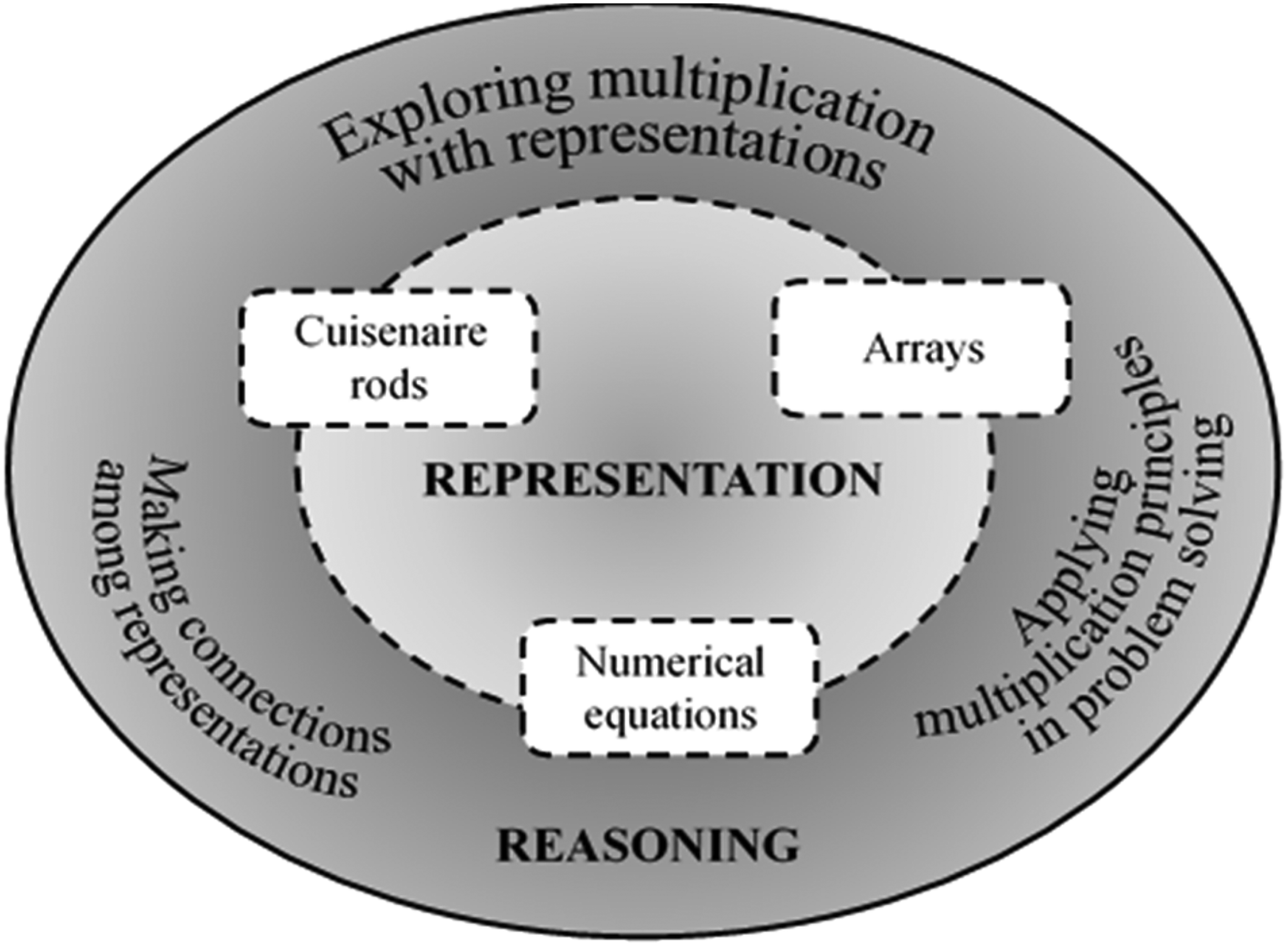
Key elements of representational reasoning.
This study aimed to examine how representational reasoning could support students’ conceptual understanding of multiplication. To address this, the study followed a design research method to develop a local instruction theory to offer a possible learning process for a given topic (Cobb et al., 2003; Gravemeijer & van Eerde, 2009). The cyclical process of three main phases was employed, with the expectation that local instruction theory would be refined and enhanced throughout the research design process (Gravemeijer, 2004). A teaching sequence was initially designed using a hypothetical learning trajectory. This was followed by a teaching experiment, and the subsequent activities were retrospectively analyzed.
Participants of the study
The study worked with students from a Year 3 class in a public elementary school situated in a low-to-medium socio-economic metropolitan area in Korea. The participants were 20 students aged 8–9 years (10 boys, 10 girls), and none of the students were identified as having major learning disabilities. They were not very interested in mathematics, and some of them demonstrated an incomplete grasp of basic multiplication facts. For example, when asked to evaluate the expression
The selection of third-grade students was intentional, based on the mathematics standards outlined in the Korean mathematics curriculum. In Grade 2, the standards emphasize understanding multiplication concepts in real-life contexts and performing multiplication with 1-digit numbers. In Grades 3 and 4, the focus shifts to conducting multiplication with 2-and 3-digit numbers, and understanding of the distributive property serves as a crucial foundation for tackling these multiplications (Otto et al., 2011). In this study, the students were just beginning to learn how to multiply 1-digit numbers by 2-digit numbers within the set of natural numbers. Notably, they had not yet been introduced to Cuisenaire rods or arrays in their mathematics learning, including in the context of multiplication.
Design of instructional activities
The learning goal is for students to develop a conceptual understanding of multiplication, focusing on the development of representational reasoning. The multiplication unit was designed with a focus on key elements of representational reasoning for multiplication. Instructional activities corresponding to each element of representational reasoning were carefully and sequentially introduced, first modeling multiplication situations, then exploring multiplication principles, and finally applying representations in problem solving. However, depending on the nature of the activities and students’ cognitive levels, multiple elements of representational reasoning may be emphasized simultaneously. Figure 2 provides an overview of the focus for each reasoning type.
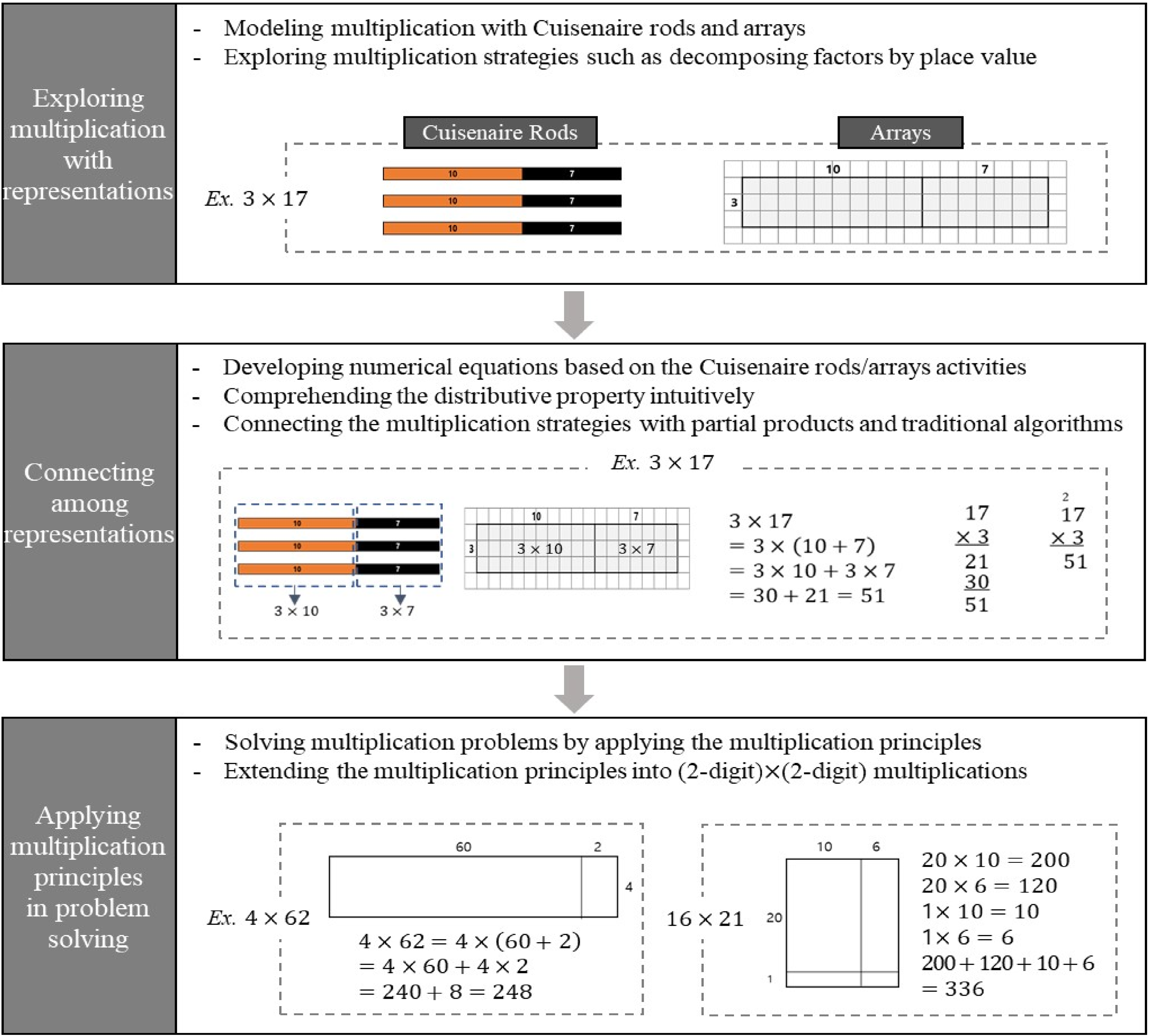
Main activities for representational reasoning of multiplication.
Firstly, to explore multiplication using representations, students were asked to model multiplication using Cuisenaire rods and arrays. As the multiplication factors involved numbers greater than 10, and students were only familiar with basic multiplication facts, they initially struggled to calculate products involving 2-digit numbers. Representing factors of multiplication using multiple rods and determining the number of square units by dividing arrays introduced students to the concept of factor decomposition. By having students explore multiplication using Cuisenaire rods and arrays, they can understand strategies for solving multiplication with 2-digit numbers, along with the underlying structures of multiplication. Next, the focus shifted to guiding students in transitioning their multiplication strategies, developed through concrete representations, into numerical equations, fostering to establishing connections between different representations. This made students recognize the distributive property and the partial products algorithm intuitively. Finally, students applied these multiplication principles to solve various problems involving two 2-digit numbers. Here, the problems were presented as numerical equations rather than word problems to eliminate potential difficulties related to students’ ability to interpret word problems and to focus on their competence in applying multiplication principles to larger numbers. Extending their learning to more complex multiplication problems provided opportunities to apply the distributive property to both factors of multiplication. Throughout this progression, reasoning through multiplication using representations was expected to help students comprehend the fundamental principles of conducting multiplication.
Based on the emphasis on representational reasoning, instructional activities for multiplication were developed. Table 1 outlines the objectives, focused key elements of representational reasoning, and activities covered in the lessons. Lessons 1 and 2 were designed to provide students with opportunities to explore basic multiplication facts using Cuisenaire rods and arrays. Multiplication involving 2-digit numbers was introduced in Lesson 3. Throughout the lessons, multiplication situations of equal grouping and areas were usually provided in contexts. Lessons 3 and 4 focused on the use of Cuisenaire rods, while Lessons 5 and 6 emphasized the arrays. Cuisenaire rods were introduced before arrays, as their composition and characteristics were expected to encourage young students to naturally and enthusiastically explore the idea and strategies of decomposing multiplication factors. Subsequently, arrays were introduced to help students visualize the structure and principles of multiplication and guide them in applying multiplication principles to multiplication with larger numbers. In subsequent lessons, students were encouraged to choose their own models to solve multiplication problems.
Summary of instructional activities.
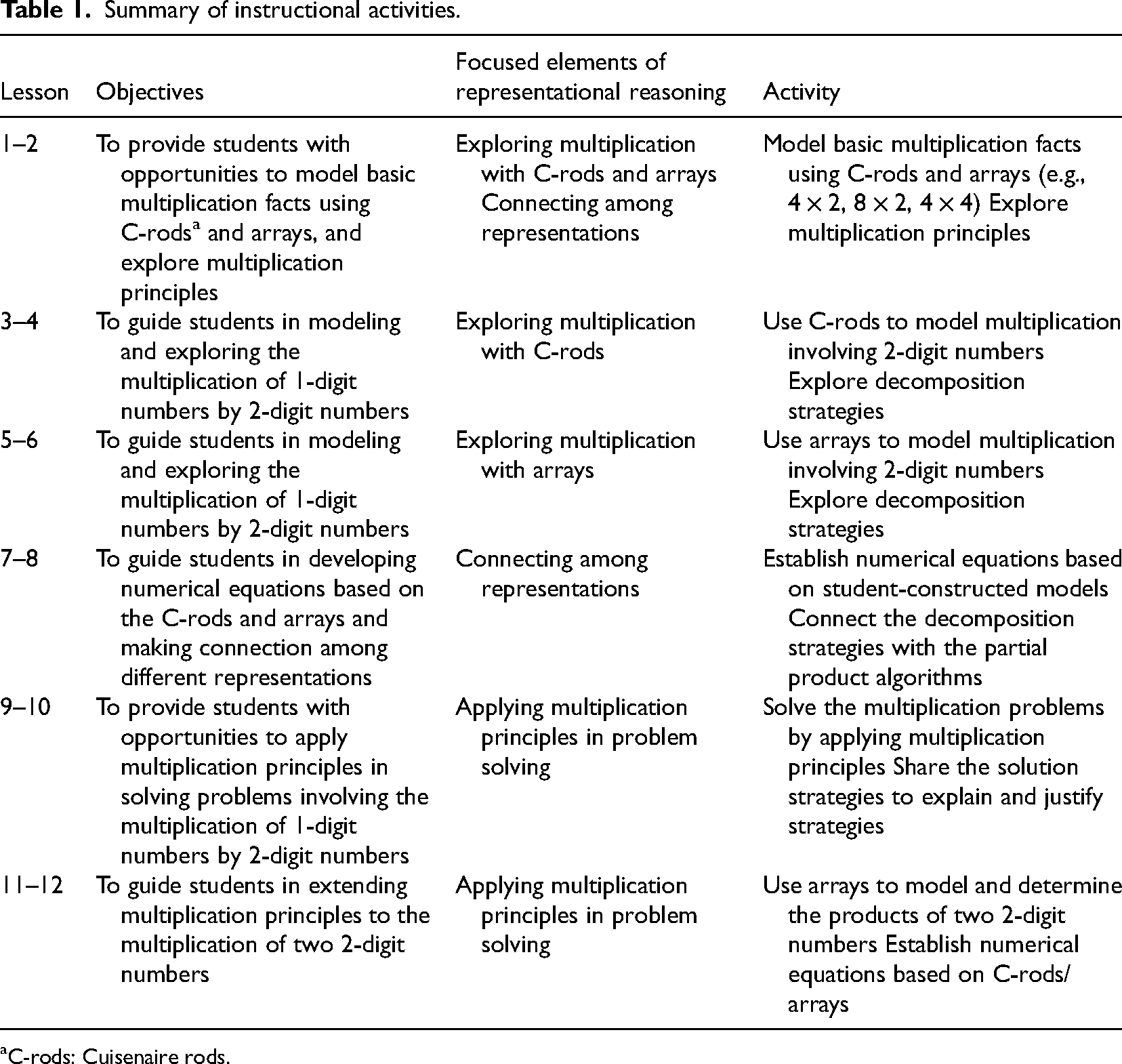
C-rods: Cuisenaire rods.
In this study, students were encouraged to generate numerical equations based on the Cuisenaire rods and arrays they constructed, with an emphasis on the connections between representations. Consequently, standard multiplication algorithms were introduced after students shared diverse numerical equations they had created. This instructional sequence was intentionally designed to encourage students’ independent exploration of multiplication principles.
The classroom teaching experiment spanned six weeks in a single classroom and was conducted by the classroom teacher. It comprised 13 lessons, each lasting 40–45 min, with sessions of approximately twice a week. A typical lesson began with a brief introduction to a task, followed by individual or small-group problem solving. Then, a whole-class discussion was held to share and justify different strategies. The tasks presented to the children were usually word problems inherent in diverse multiplicative situations involving the multiplication of a 1-digit number by a 2-digit number (e.g.,
Four types of data were collected from this study. First, the lessons were recorded on video and transcribed from the recording to comprehensively capture every aspect of the analysis, including the teacher's and students’ utterances, actions, and interactions. The transcripts of the lessons were organized into episodes based on activities and further divided into segments focusing on individual strategies or mathematics embedded. Materials written on the boards were also documented to fully understand the lesson contexts. Second, the students’ worksheets were collected to analyze their strategies, and physical productions with Cuisenaire rods were recorded using a camera. Third, interviews were conducted with specific students to gather additional information about their written works. Finally, lesson planning and reflection notes from the teacher were also collected before and after each lesson to capture the teacher's intentions and thoughts.
The data were analyzed with a focus on students’ representational reasoning during the instructions: students’ exploration of multiplication strategies with Cuisenaire rods and arrays, connections among representations, and the application of multiplication principles in problem solving. Specifically, we examined how students utilize Cuisenaire rods and arrays to represent multiplication and what strategies they employ to solve multiplication problems. We further analyzed connections between concrete representations and numerical equations and identified multiplication principles reflected in their work. Throughout the analysis, we aimed to provide implications on how students’ representational reasoning facilitated or hindered their conceptual understanding of multiplication. The analysis was thoroughly conducted by the author and carefully reviewed by a researcher with a doctorate in mathematics education. To ensure confidentiality, children's names were replaced with pseudonyms. Framed within representational reasoning as a theoretical perspective, this study addressed the following research questions:
How do third graders explore multiplication using representations? How do third graders make connections among different representations? How do third graders apply multiplication principles to solve problems?
Results
The results of this study are presented through the lens of the three elements of representational reasoning. However, given the interconnected nature of two of these elements during instructions, and considering the two primary types of representations emphasized—Cuisenaire rods and arrays—the findings are organized into three thematic sections: exploring and connecting multiplication with Cuisenaire rods; exploring and connecting multiplication with arrays; and applying multiplication principles in problem solving.
Exploring and connecting multiplication with Cuisenaire rods
The class began with students freely exploring the Cuisenaire rods. As the students had no prior experience with the Cuisenaire rods, they were intrigued by the different lengths and colors, referring to the rods with terms like “yellow rod” or “five-rod.” Following this exploration, the teacher asked the students to explore ways to model the multiplication expression 3 × 17 with the Cuisenaire rods, and students demonstrated various strategies for decomposing the multiplicand 17. The most commonly observed strategy, which was identified in five out of six student groups, involved using as many different rods as possible by decomposing the multiplicand into small factors. For instance, one group of students represented 3 × 17 by constructing 17 with a 6-rod, a 3-rod, two 1-rods, and three 2-rods, then repeating it to create three identical sets of 17, as shown in Figure 3. During a class discussion, one student asked why different rods were used to represent 10 instead of just a single orange rod, and another student in the group responded that it was because they wanted to use as many colors as possible. When the teacher suggested a strategy of decomposing 17 into 10 and 7 using one orange rod and one black rod, many students declined, calling it “trivial” or “uninteresting,” and opted for strategies that used more rods, which appeared more complex.
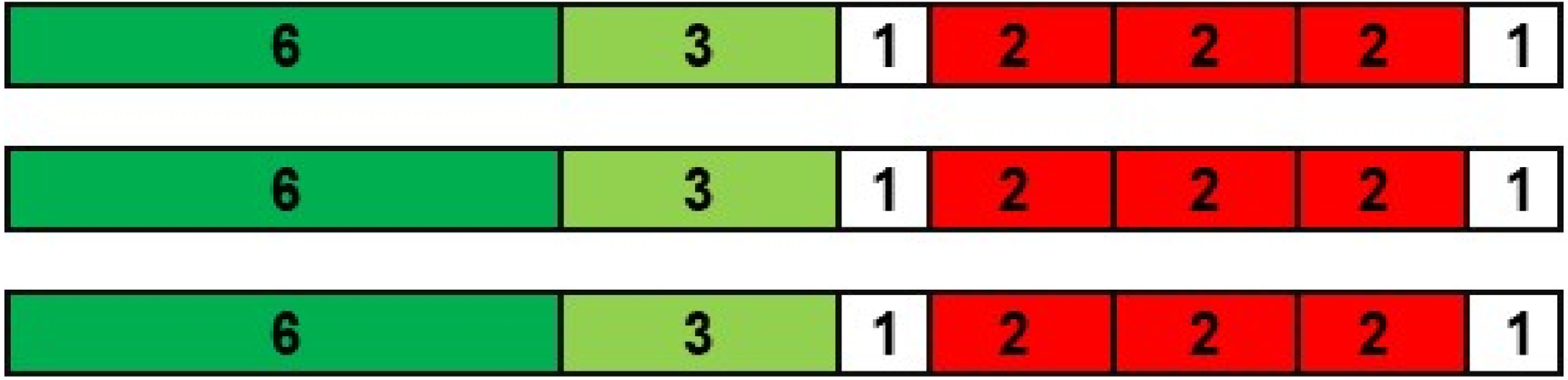
Representing
After modeling 3 × 17 with Cuisenaire rods, the students were tasked with constructing corresponding numerical equations. Despite the complexity of the representations, most students successfully derived equations based on their work. The following excerpt is from a whole-class discussion on creating equations aligned with the Cuisenaire rods shown in Figure 3. It is noteworthy that students began to consider the efficiency of calculations, as illustrated by one student (Mihee) who, while combining Cuisenaire rods, remarked, “It makes the calculation a bit easier.”
Likewise, engaging in activities that involved expressing Cuisenaire rods as numerical equations helped students realize that using more and smaller rods made calculations more complex and challenging. Unlike the initial attempt to represent multiplication expressions in a complex and novel way using Cuisenaire rods, students began prioritizing calculation efficiency. Figure 4 illustrates examples of students’ work for
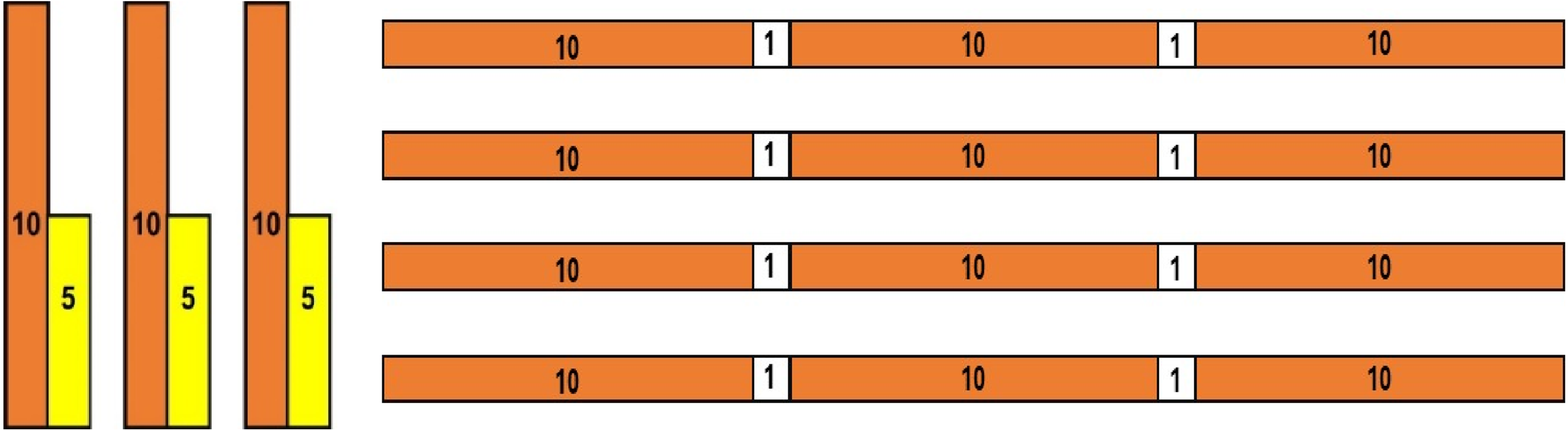
Representing multiplications by separating tens and ones using Cuisenaire rods (left:
Meanwhile, students’ representations with Cuisenaire rods revealed an incomplete understanding of multiplication. For instance, three out of six groups modeled multiplication by breaking down each multiplicand differently. Figure 5 illustrates an example of representing
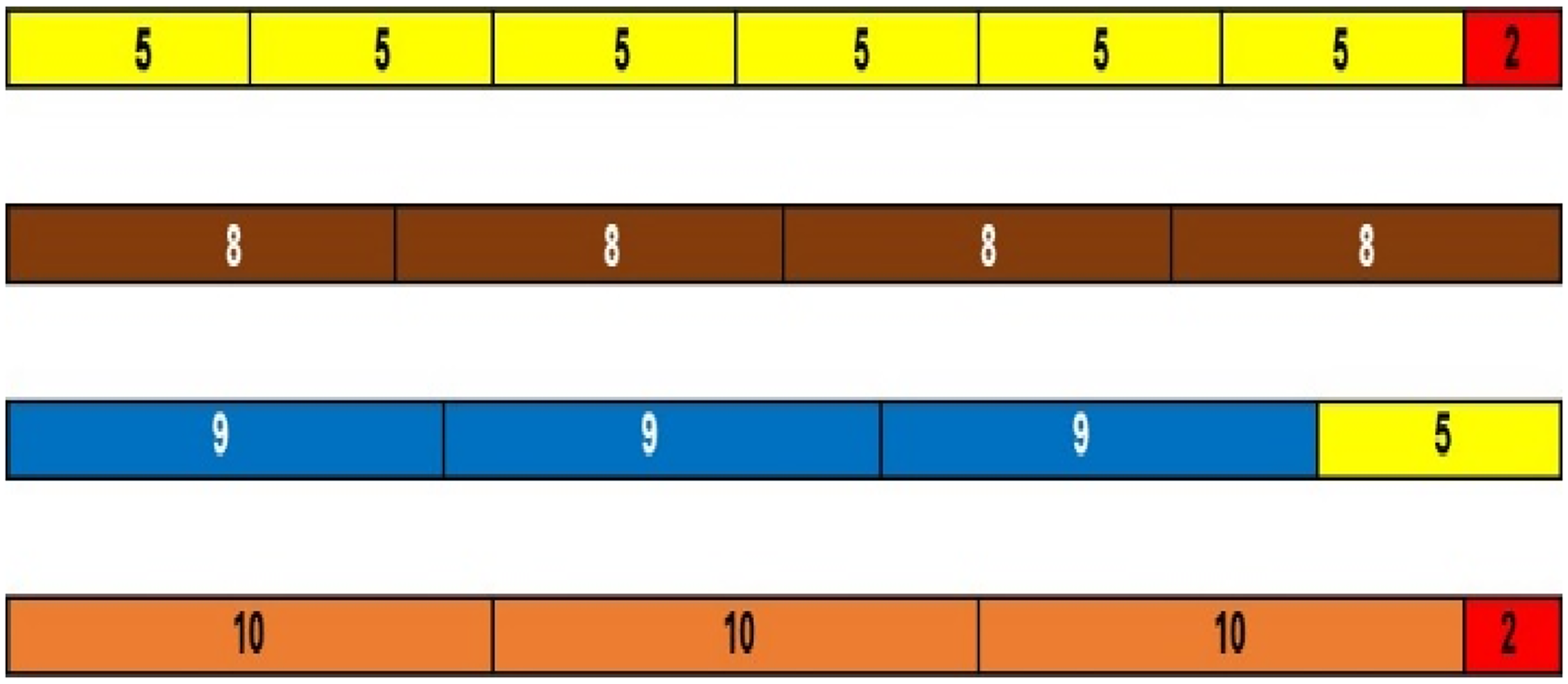
Representing multiplicand 32 s in
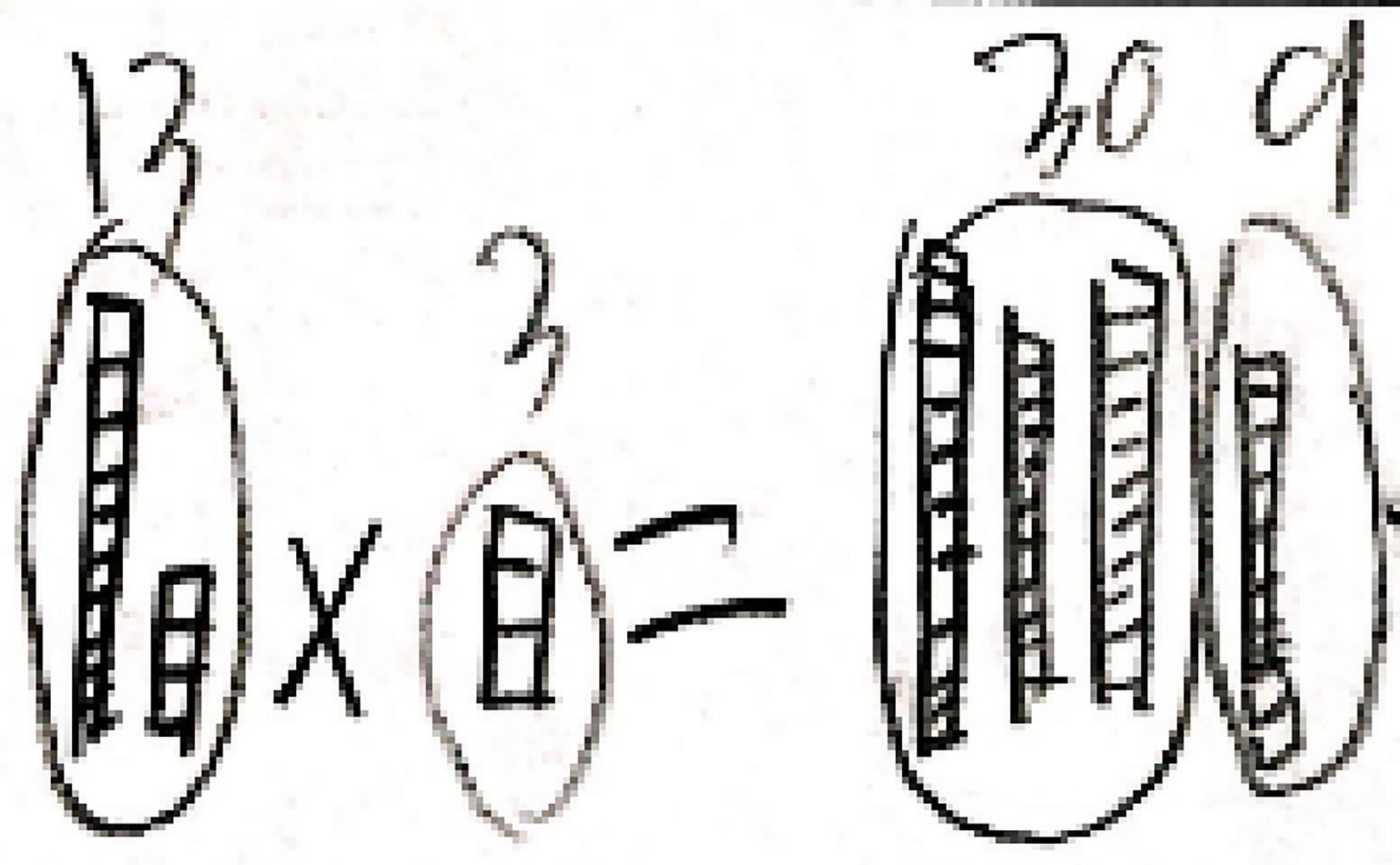
Representing the multiplier 3 in
After exploring multiplication with Cuisenaire rods, students were introduced to arrays. Since they had not yet learned about the concept of a rectangle's area, they were tasked with determining how many grid squares could fit inside a rectangle. For example, when it came to
Another strategy frequently observed among students was dividing one side of the rectangle based on place value or into equal parts. Alternatively, one group of students suggested a compensation strategy by extending one side of the rectangle to make it a multiple of 10 and then subtracting the excess amount. Most students successfully illustrated multiplication using arrays, but they often encountered difficulties when translating the arrays into numerical equations. Figure 7 provides an example of modeling 5 × 19 using arrays and transitioning them into numerical equations. The representations demonstrated that the student understood various decomposition strategies to determine the number of grid squares in a rectangular array. However, when expressing these strategies in numerical equations, the student tended to focus only on decomposing one side of the rectangle or struggled to construct accurate numerical equations.
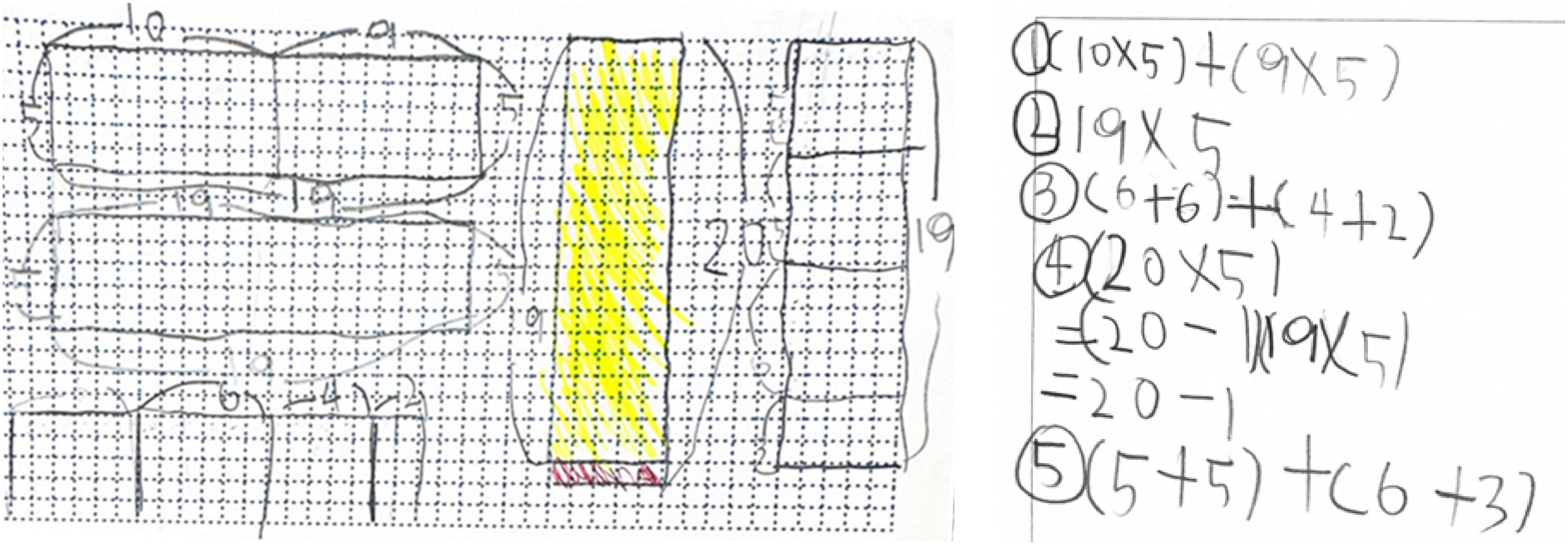
Exploring strategies for
Subsequently, students were asked to solve multiplication problems involving two 2-digit numbers. This extension aimed to verify their ability to use arrays in multiplication and apply the distributive property to larger numbers. When the teacher introduced the multiplication problem
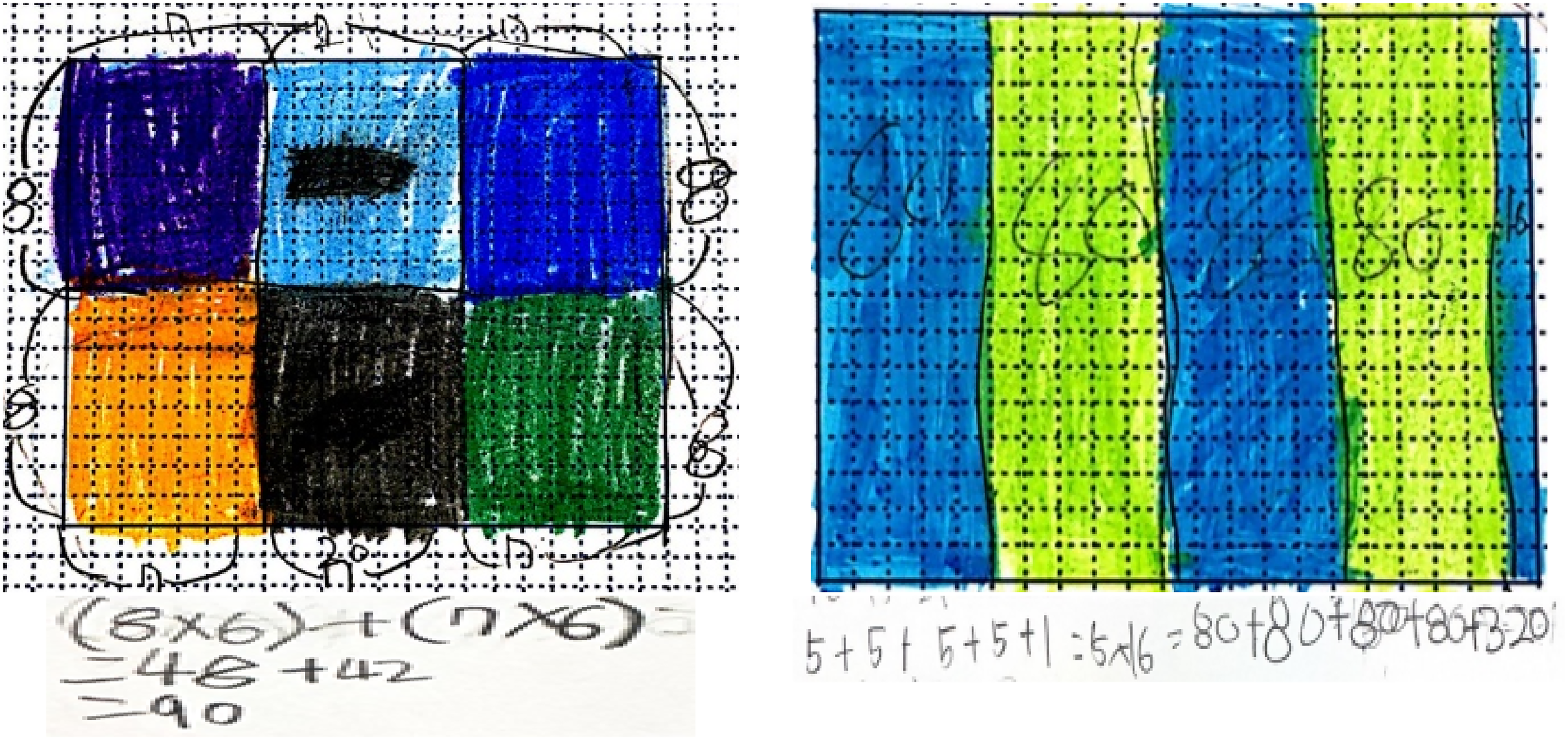
Examples of multiplication strategies for modeling
The arrays constructed by students suggest that they intuitively grasped the concept of the distributive property by representing the two factors of multiplication as the length and width of a rectangle and dividing the original rectangle into smaller parts. Students recognized that the total area of the rectangle is equal to the sum of the areas of its divided sections. However, they often perceived the area of each section as being determined solely by the divided length of one side. This led to errors in their multiplication equations, where only the decomposition of one factor was reflected, while the other factor was overlooked. Thus, these results indicate that, while arrays have the potential to help students visualize and solve multiplication problems involving multi-digit numbers, dividing the sides of a rectangular array to calculate the number of grid squares may not naturally translate into the application of the distributive property in equations.
After engaging in activities that explored and connected multiplication using Cuisenaire rods and arrays, students were tasked with independently solving multiplication problems by applying multiplication principles. The following outlines the characteristics of students’ strategies as demonstrated during problem-solving processes.
First, most of the students utilized the decomposition strategies to develop diverse multiplication equations, demonstrating their understanding of the roles of the multiplicand and multiplier as composite units. For example, to determine the product of 3 × 18, students decomposed the multiplicand 18 in various ways, such as 10 + 8, 3 × 6, 2 × 9, and 20–2, and then multiplied 3 by each decomposed factor. These strategies revealed students’ ability to conceptualize multiplication as equal grouping and composite units, highlighting their deeper understanding of multiplication and its foundational principles.
Second, students used the representations to justify their strategies. For example, when solving the multiplication problem 4 × 62, one student transformed the expression into
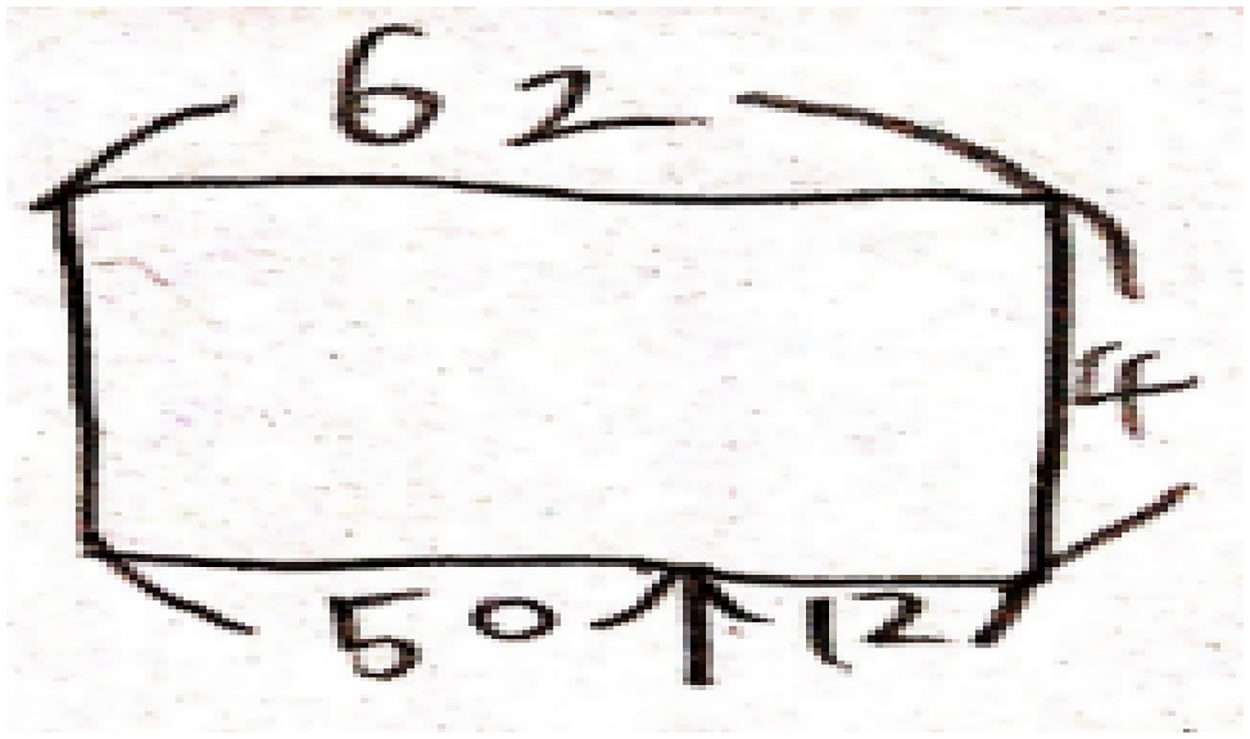
Using arrays for justifying the multiplication strategy.
Lastly, students created their own calculation methods by modifying array representations. As shown in Figure 10, one student created alternative representations resembling a rectangle and a triangle, which were adaptations of the arrays. The student added an explanation that he wanted to incorporate both the diagram and the numerical equations in his representation. These representations clearly demonstrated the distributive property by decomposing 62 based on place value, generating partial products, and summing them to find the answer. Notably, this initiative was not guided by the teacher but was actively undertaken by the students, indicating their ability to flexibly employ representations and internalize multiplication principles within their calculations. This process highlights their conceptual understanding of multiplication.
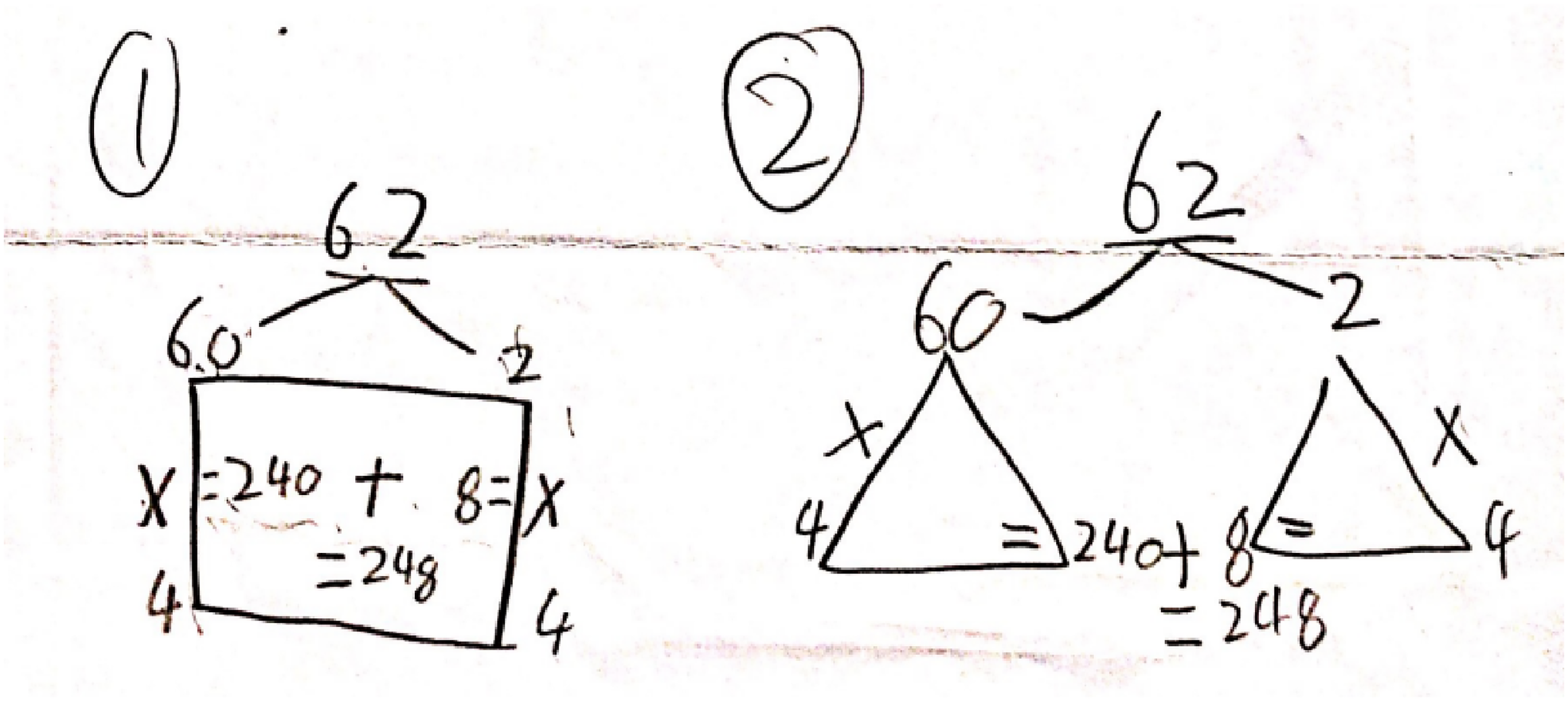
Student-invented multiplication strategies for
Understanding multiplication has been the focus of extensive research, while relatively less attention has been paid to how concrete representations support children's understanding of multiplication. This study hypothesizes that reasoning multiplication by using concrete representations can enhance students’ conceptual understanding. Previous research also highlighted the importance of connecting concrete representations to facilitate the acquisition of abstract and symbolic mathematical concepts (Lampert, 1986; Tondorf & Prediger, 2022). Through classroom observations and analyses of students’ work, the study scrutinized what strategies students developed and what challenges they faced in multiplication learning with Cuisenaire rods and arrays.
First, the findings of this study revealed some potential and limitations of Cuisenaire rods as a representation for exploring multiplication principles. Previous research in mathematics education has documented that Cuisenaire rods can be applied to grasp the concepts of whole numbers (e.g., Wittmann and Wittmann, 2021) and the principles of addition and subtraction with 2-digit numbers (e.g., Benson et al., 2013; Ioannis et al., 2016), whereas few empirical studies have reported the use of Cuisenaire rods for learning multiplication. Although representations such as counters, number lines, and base-ten blocks have been acknowledged as effective tools for developing multiplication principles (Reys et al., 2014), the findings of this study reveal that Cuisenaire rods are also applicable for exploring multiplication. The varying lengths of the Cuisenaire rods helped students understand that multiplications, even those involving large numbers, can be calculated by decomposing factors and applying known multiplication facts. This is significant as it connects to the concepts of the distributive property and unitizing into composite units. In addition, the activity of expressing C-rod representations with numerical equations prompted students to recognize that increased partitioning of the rods resulted in more cumbersome and inconvenient calculations, leading them to seek more efficient strategies such as decomposing by place value or into equal parts.
On the other hand, the diverse colors and lengths of Cuisenaire rods may distract students and hinder their focus on exploring multiplication principles. While the distinct colors of the rods allow for easy visual differentiation of numerical values, students are likely to be overly reliant on the colors, leading to inefficient decomposition strategies. As the first step in applying the distributive property is to decompose a factor (Kinzer & Stanford, 2014; Neagoy, 2015), emphasis should also be placed on decomposing it in a way that makes calculations more efficient. Additionally, students’ representations of Cuisenaire rods demonstrated whether they perceived multiplication as repeated addition or equal groups. Considering that the multiplication concept as an equal group should be preceded to capture the distributive property (Larsson et al., 2017), Cuisenaire rods can be an effective tool for diagnosing and enhancing students’ multiplicative thinking. De Bock (2020) also argued that the structure of Cuisenaire rods offers insights into elementary mathematics concepts, enabling students to “reconstruct arithmetic for [their] own purpose at a rhythm.” (p. 357) Similarly, Ioannis et al. (2016) emphasized that, by teaching with Cuisenaire rods, “a bridge is being built in a stable way, gapping the child's work on this particular mathematical stuff with its abstractive thought, relating to symbols and numbers” (p.80). Thus, although composition and decomposition activities with Cuisenaire rods have been shown to support students in understanding multiplication principles (Wittmann and Wittmann, 2021), it is important to guide students in decomposing factors in a way that reflects the multiplication principles.
Regarding the use of arrays for multiplication, this study found that they served as geometric representations of multiplication structures, facilitating students’ intuitive understanding of the distributive property. Although the concept of area had not yet been introduced in third grade, students were able to visualize multiplication through rectangular arrays, where the multiplicand determined the number of grid squares in each row and the multiplier dictated the number of rows. Students partitioned the whole into smaller sections in various ways, performed multiplication to determine the number of grid squares in each section, and subsequently summed these values to obtain the total number of grid squares, thereby identifying it as the result of multiplication. This process demonstrated that students could connect the decomposition and recomposition strategies within arrays to the partial products method in multiplication calculations. These findings suggest that arrays can be effectively utilized to support young students in learning multiplication involving two-digit numbers.
On the other hand, students faced challenges in expanding a sequence of numerical equations that corresponded to the array representations. When considering the two steps of the distributive property, algebraically expressed as
This finding suggests that while decomposition within arrays supports students in performing multiplication using partial products, it does not necessarily lead to a conceptual understanding of the distributive property. Previous research has established that arrays serve as important representations for learning multiplication, particularly when understanding the binary nature of multiplication is essential for effectively applying array-based strategies (Otto et al., 2011). However, if students do not conceptualize multiplication as a binary operation, in which rows and columns represent the two factors (Barmby et al., 2009), arrays may hinder rather than facilitate their comprehension of multiplication principles. Maffia and Mariotti (2020) emphasized that when using arrays to comprehend the distributive property, the focus should be placed on the operation itself rather than merely on numerical values. Therefore, when employing arrays to support students’ understanding of the distributive property, it is crucial to systematically coordinate both what is decomposed and what is distributed in arrays and numerical equations.
Lastly, the emphasis on representational reasoning was revealed to help enhance students’ conceptual understanding of multiplication. Three key elements of representational reasoning were important in helping students comprehend multiplication calculations by engaging with underlying principles. Through exploring multiplication using representations, students were able to grasp multiplication strategies of decomposition and composition, which are key ideas of multiplication calculation. In addition, making connections between different representations offered an opportunity to develop an intuitive understanding of the partial products and the distributive property. When applying multiplication principles to problem solving, students utilized multiplication strategies of decomposition and partial products by freely employing the representations to support their reasoning or justify their strategies.
However, the results also indicated the importance of emphasizing both the construction of representations and the reasoning that stems from them. Although the students explored decomposition strategies using Cuisenaire rods and arrays, many still struggled to connect their representations to the distributive property. This finding aligns with previous research, which asserts that learning with representations involves understanding how to use representations as well as grasping the relationship between the representations and the underlying ideas (Adu-Gyamfi et al., 2019). Another key observation was that students’ representational reasoning did not consistently emerge. Even when students successfully reasoned through multiplication principles using representations, their reasoning did not always carry over across different problems. Overall, although representational reasoning facilitated young students’ conceptual grasp of decomposition and partial products, it did not fully contribute to their understanding of the distributive property. Therefore, it is essential to move beyond merely producing representations and place continued emphasis on making meaningful connections and engaging in reasoning through representations.
In conclusion, the findings of this study suggest that Cuisenaire rods and arrays serve as effective representations for supporting young students’ conceptual understanding of multiplication. These representations encouraged students to recognize fundamental multiplication strategies, such as “partitioning factors in such a way that known facts can be used” or “partitioning factors into convenient chunks” (Izsák, 2004, p. 61). The activities using Cuisenaire rods and arrays assisted students in understanding the multiplication principle of decomposing factors when they were unable to compute multiplication using basic multiplication facts. Furthermore, since the application of the distributive property requires not only the decomposition of one factor but also the distribution of the other factor, this study revealed that additional effort is needed to explicitly address the distribution process.
In addition, this study demonstrates that different representations of multiplication necessitate distinct forms of reasoning. Specifically, Cuisenaire rods explicitly illustrate how one factor in multiplication can be decomposed to perform multiplication computation. However, arrays do not always convey this as clearly, as decomposition in arrays involves both the length and the total area. Instead, arrays primarily reveal the multiplication structure and partial product algorithms visually. Thus, reasoning about multiplication through Cuisenaire rods and arrays necessitates distinct approaches when exploring multiplication strategies, including the distributive property. As Steinbring (1997) emphasizes the importance of “a flexible switching between sign system and reference context” (p. 55), it is crucial to recognize how concrete and graphical representations can illustrate multiplication structures and be utilized effectively to perform multiplication (Maffia & Mariotti, 2020). When using Cuisenaire rods for multiplication, it is essential to conceptualize multiplication as an equal grouping. Additionally, decomposition activities should be explicitly connected to numerical equations, ensuring that the decomposition is both effective and conceptually meaningful. Similarly, when working with arrays, careful attention should be given to what is being decomposed and what is being distributed, both within the arrays and in the corresponding numerical equations.
Limitations
We acknowledge some limitations of this study, such as the small sample size of students confined to a single elementary school. Given these constraints, we suggest extending the scope to investigate students’ understanding and representation of multiplication across a larger and more diverse student population. Additionally, to ensure the potential of the Cuisenaire rods and the arrays as representations for multiplication, a control group could be employed to compare the effectiveness of the teaching sequence. Lastly, as the distributive property of multiplication is crucial in developing algebraic thinking (Kieran, 1989; Schifter et al., 2008), future research could continue to examine how students generalize the distributive property in multiplication procedures.
The representations proposed in this study appear promising for enhancing conceptual understanding of multiplication among third-graders. We do not claim that the proposed representations or learning processes are necessarily the most desirable or better than others, but rather that they deserve attention for fostering students’ conceptual understanding. We anticipate that the findings of this study offer valuable pedagogical implications for developing students’ representations and understanding of multiplication, as well as instructional guidance for teaching multiplication.
Footnotes
Acknowledgements
The researcher wishes to thank the teacher, students, and parents for their participation in the study.
Declaration of conflicting interests
The author declared no potential conflicts of interest with respect to the research, authorship, and/or publication of this article.
Funding
The author received no financial support for the research, authorship, and/or publication of this article.
Ethical considerations
The researcher explained the nature and the purpose of the research study to participants, and informed them that participation was not obligatory. To protect and respect personal data, students were informed that their names would not appear in the documents and would be replaced by pseudonyms.
Informed consent
Participants provided informed consent, having been informed about the use of the collected data and assured of the anonymity of their responses.
