



Abstract
The increase in international migration and the global number of students learning mathematics through a language other than their home language makes migrants’ educational pathways a particularly urgent issue. The current paper focuses on the German context as Germany is currently one of the major immigration countries in the Western context. Because German is widely perceived as the language of opportunity for migrants in the German school system, it is overwhelmingly the selected language of learning and teaching in the broader school system and within migrant classes. The article is based on qualitative interviews with mathematics teachers teaching migrant classes; and the data analysis followed the Grounded theory tradition. The central phenomenon that seemed to preoccupy all teachers was how to adapt mathematics teaching to the language- and mathematics-related diversity of their students while simultaneously helping them to transfer smoothly to the mainstream classes or pass the final examinations successfully. Due to the lack of institutional support for teaching in migrant classes and problems in dealing with multilingualism and mathematics-related diversity in mathematics lessons, they were generally frustrated with the situation despite being strongly motivated at first. Using three examples from the data, we illustrate teachers' strategies in relation to multilingualism and mathematics-related diversity. Overall, the study points to the necessity of supporting teachers in their mathematical practices in migrant classes to contribute to more inclusive mathematics education.
Introduction
Human migration has always been shaping the world across history and thus reshaped societies and cultures (Castañeda, 2017)—in Europe and Asia alike. However, due to increasing international migration since 2015, the equity of migrant or newly arrived students 1 within education systems has become a prominent issue within global public and academic discourse (Organisation for Economic Co-operation and Development [OECD], 2015).
The German constitution, United Nations conventions on children's rights, and European Union laws guarantee the right to education for all minors, including migrant students. In response, since then Germany has established thousands of classes for migrants to ensure that those students are included in the educational system (see Kultusministerkonferenz [KMK], 2013). As in other countries, migrant learners are integrated into the school system in different ways depending on the federal state. At one end of the spectrum, migrant students are included in mainstream classes from the beginning, with no additional language support. At the other end, students are placed in so-called “migrant classes” 2 that run parallel to the mainstream system (Terhart & von Dewitz, 2018). Those classes aim at teaching the German language and prepare students for the transfer to the mainstream system. As soon as students reach level B1 in German or latest after one year, they are usually transferred to an age-appropriate mainstream class—regardless of their previous experience or skills in mathematics (Behörde für Schule and Berufsbildung [BSB], 2018).
Migrant students in Germany are characterized by diverse life experiences and educational preparedness. Many of them come from war-torn countries, such as Afghanistan, Syria, or Eritrea, while others come from European countries as the children of migrant workers. Some students belong to Roma minority groups from Eastern Europe; others migrate from countries such as India or Ghana to reunite with their families. Some students have attended school continuously, but others have never attended school before migrating to Germany or do represent students with interrupted formal education. Depending on their country of origin, former school system, type of school, and the social position of their family, each student has unique background knowledge, personal needs, and language repertoires that teachers must accommodate (Fürstenau & Niedrig, 2018).
When working with migrant students, a migration-sensitive mind-set is essential to take the migration-related diversity in schools into account, ensure that migrant students have the same opportunities and are not left behind, and counteract the emergence of discrimination (Mecheril et al., 2010). However, several studies have shown that teachers are not sufficiently prepared to teach in migrant classes (Daschner, 2017; Panagiotopoulou & Rosen, 2018). Research has revealed that students who learn the language of instruction 3 alongside mathematics may face difficulties in accessing mathematical content presented orally or in written form (e.g., word problems; Halai & Clarkson, 2016). Additionally, mathematics curricula and the teaching and learning of mathematics vary significantly across countries (Bishop, 1994; Mullis et al., 2016). Migrant students must make sense of a new (mathematical) environment in which they may be exposed to unfamiliar and specialized interdisciplinary demands or ways of “doing mathematics.” In other words, lessons may differ considerably from the ones to which they were accustomed in their country of origin.
To date, the mathematics education of migrant students has attracted little international attention (Civil, 2014, 2020), although increasing migration has led to more studies in recent years (Xenofontos, 2016). With only a few exceptions (Fürstenau & Niedrig, 2018; Höhr, 2021), our exploration of the literature revealed that more research on mathematics education for migrant children and youth is necessary, especially in Germany, which has experienced high levels of migration in the last decade. However, there are several studies on multilingualism in mathematics education and diversity as presented later.
This article aims to shed light on how German mathematics teachers deal with the diversity of their students in migrant classes by conducting an interview-based study. The data analysis used methods of Grounded theory (GT).
The German context of schooling migrant students
In urban areas such as Hamburg, where this study was conducted, and especially in the western regions of Germany, migration has a long history, resulting in higher numbers of children with a migrant background in all types of schools than in most rural areas. However, the recent increase in refugee migration since 2015 has resulted in a large influx of migrant students into the school system across Germany within a short period of time. To cope with this sudden influx, most schools in Germany and in Hamburg (every second school) introduced separate classes, which were previously only available in a few places. While most schools continued with segregation, a few opted for a more inclusive approach.
In the following, we are focusing on the school policy in Hamburg. Migrant classes are regulated by the guidelines of the Hamburg federal ministries (see BSB, 2018), which provide policies for school and classroom practices but offer individual schools considerable freedom regarding their implementation. According to these guidelines, the emphasis in migrant classes should be on German language instruction (10–20 hr per week). Subjects such as mathematics, geography, physical education, history, and similar subjects may be taught from the beginning or introduced later, depending on individual schools’ decisions and the learning levels of students.
In most cases, teachers educated in teaching German-as-a-Second-Language are responsible for teaching German. Subject-specific lessons such as mathematics are taught by subject teachers. Studies show that those often lack training in German as a second language (Karakayalı et al., 2017; BSB, 2018). In lower migrant classes (grades 5 to 8), teachers are required to teach students subject-specific, interdisciplinary (e.g., common school cultures and practices) and German language knowledge within one year to enable them to cope in mainstream schooling.
At the end of the preparation period, students usually transfer to different grades within ordinary secondary schools and receive additional language support for another year (Massumi, 2019). A common policy is to integrate students into migrant classes at any time throughout the year. This enables students to participate in education as quickly as possible, but it creates difficulties for teachers, as they must plan and deliver lessons for a constantly changing group of learners. Although the purpose of this practice is to allow students time to settle into the German school system, it also leads to a high level of diversity within each class, partly due to the already high level of diversity among learners that teachers must deal with, as already indicated in the introduction (Gogolin & Duarte, 2016).
The above-mentioned guidelines do not offer or mandate specific curricula for mathematics and other subjects. Rather, they refer to the official mathematics curriculum for the class level and type of school and encourage teachers to meet its minimum requirements (BSB, 2018).
However, there are also an increasing number of classes—so-called higher immigrant classes—in Hamburg in which teenage-aged students are prepared directly for the centralized final secondary school exams (SSEs) in years 9 and 10. Thus, the requirements of the final state examinations, which solely examine mathematics, English, and German, provide a point of reference for teachers. Nevertheless, that means that students may never mix with German peers within the classroom. 4 In other words, students may be formally included in the school system, but they are excluded from mainstream classes and their German-speaking peer group (Antoninis, 2018; Mason & Orcutt, 2019).
Theoretical framework and state-of-the-art
A growing body of research investigates the effectiveness of different organizational models, instructional environments, and types of language education for migrant students. Much of this research explores how students can be best included in the existing school system and society, with a special focus on equity (Custodia & O’Loughlin, 2020; Diehm & Radtke, 1999; Karakayalı et al., 2017). According to these studies, students’ diverse backgrounds are often neglected in the mathematics classroom. Students usually find themselves in disadvantageous situations, “whether through a lack of recognition of their multilingual proficiency, a lack of infrastructure to support the use of multiple languages in mathematics classrooms or the systematic suppression of students’ home languages” (Barwell, 2018, p. 166).
The few studies that deal with teachers’ experiences teaching mathematics in migrant classes come from countries with large (im)migrant populations, including Spain, Greece, Germany, and the United States (Fürstenau & Niedrig, 2018; Gorgorió & Planas, 2001; Höhr, 2021; Lüssenhop & Kaiser, 2020; Xenofontos, 2015, 2016). In those studies, teachers articulate difficulties in addressing students’ diverse languages and differences in their preparedness. For instance, De Abreu (1995) reports that difficulties in building upon students’ prior knowledge, for example, because of language barriers, often leads to the devalorization of certain types of knowledge within school systems, which may negatively affect both migrant and indigenous students.
Xenofontos (2016) conducted a small-scale qualitative study of 16 Greek–Cypriot elementary mathematics teachers working in schools with high percentages of migrant students. The study showed that teachers focused solely on providing linguistic support for their students, without attempting to incorporate their students’ diverse cultural backgrounds into the classroom or to cultivate social justice in mathematics by considering students’ diverse background knowledge in mathematics.
Based on vignettes from mathematics lessons, Fürstenau and Niedrig (2018) described their experiences with the inclusion of multilingualism in a migrant class. They show that by establishing multilingual practices in the classroom, for example, through a student-created German–Persian podcast on the addition of fractions, it is possible to legitimize practices of multilingualism in the classroom and provide students with the ability to learn from each other.
Overall, our analysis of the literature points to a research desideratum of studies in Germany dedicated to mathematics teachers’ and migrant students’ perspectives on teaching and learning processes in migrant classes. In our opinion, there is a need for research on how teachers can design mathematics lessons when there is no common language upon which to draw. Although only some of the research and concepts presented in the following section deal with migrant students, and thus do not consider all aspects specific to this group, migrant classes are multilingual classrooms, too. Therefore, research and concepts from the area of multilingual classrooms may be fruitful for our chosen context.
From language-as-a-problem to translanguaging
Prediger (2019) argues that “language is a major learning medium used for communicative and epistemic purposes in mathematics classrooms,” making it imperative that language “becomes a learning goal in mathematics classrooms” (p. 11). However, research has shown that many teachers, policymakers, and other staff working with migrant students view mathematics as “language-free or seem to think that the central (if not only) challenge that those students face in mathematics education is learning the language of instruction” (Barwell et al., 2006; Gorgorió & de Abreu, 2009). Languages of migrant students are often assigned a lower prestige than German. In addition, social, political, and educational discourses, and policies place migrant students’ languages in a hierarchical relationship to each other; for example, Arabic is less valuable than French (Terhart & von Dewitz, 2018).
For our study, we can refer to an established body of research on the learning and teaching of mathematics in multilingual classrooms (Barwell et al., 2016; Prediger & Schüler-Meyer, 2017), second-language mathematics classrooms (e.g., Barwell, 2014) and plurilingual mathematics classrooms (e.g., Adler, 1997). As Barwell (2018) summarizes, the typical orientation in this research sees more than one language as productive rather than a problem and challenges deficit perspectives that portray multilingual learners as less capable of learning mathematics. This orientation generally includes the notion of language-as-resource or language-as-political (Planas & Civil, 2013; Planas, 2018).
Planas and Civil (2013) viewed language-as-resource as a potential for thinking and doing, particularly for learning and teaching mathematics, and language-as-political as a potential for transformation through processes that place certain languages and their speakers at a distinct disadvantage. The idea of language-as-resource also indicates that allowing students to use their home language (L1) in multilingual mathematics classrooms benefits their learning and expands their mathematical practices for interpreting contexts, representing quantities, modeling real-life situations, and communicating (Planas & Civil, 2013). Planas and Civil (2013) searched for discourses on the status and roles of languages other than Catalan (in Barcelona) and English (in Tucson) that may have an influence on how language is used as a resource in the learning and teaching of mathematics.
Barwell (2018) criticizes the notion of language-as-resource because it tends to emphasize the role of language as a “tool” and decouples it from the broader social aspects of language use, such as in constructing identities; reproducing social norms and structures; or maintaining various ideological positions about mathematics, languages, and learners. He proposed an expanded theoretical position, called sources of meaning, which draws upon a Bakhtinian perspective on language to address these problems. Students and teachers work with repertoires of practices relating to discourses, voices, and languages to do mathematics: they language mathematics, rather than use mathematical language. Mathematical meaning-making happens through the dialogic relations between the diverse discourses, voices, and languages that arise in written and spoken classroom interactions. Language itself plays an active role in the meaning-making process, as each utterance is a response to preceding utterances. The tension between diversity and standardization of ways of languaging mathematics results in stratification, with some (“standard”) forms of discourse, voices, and language having higher status than others. This “sources of meaning” perspective offers a more fluid, complex approach to understanding the role of language in multilingual classrooms as well as some organizational concepts that allow for a more systematic examination of classroom interactions. For the sources of meaning position, the notion of translanguaging has emerged as particularly valuable. This notion refers to the fluid and often deliberate interweaving of repertoires of more than one language in educational contexts. It has become widely adopted in second language education, bilingual education, and other educational contexts featuring language diversity (see García et al., 2017). In mathematics classrooms, multilingual learners may display translanguaging behaviors with a repertoire of multiple languages.
García et al. (2017) identified four key functions of translanguaging in education as a planned and purposeful pedagogy (p. 7):
Students are supported when working with texts that are complex in terms of content and language. Students are given the opportunity to develop their language skills for academic contexts. A space is provided in which students’ bilingualism or multilingualism and the corresponding access to knowledge can come to the fore. Young learners’ bi- or multilingual identities and socio-emotional development are supported.
García et al. (2017) described three necessities for translanguaging in education: stance (beliefs), design (planned approach), and shift (change).
Students’ (mathematics-related) diversity
Terms such as heterogeneity, homogeneity, and difference as well as diversity have recently become buzzwords in the public, political, but also scientific discourse on school education. Also in mathematics education, the question of how to deal with different needs and prior knowledge for instruction is much discussed. Currently, one can speak of a heterogeneity orientation (Budde, 2012) as a new paradigm. Research dealing with migrant students emphasizes the challenges or opportunities associated with this heterogeneity (Doğmuş et al., 2016; Fürstenau & Niedrig, 2011). Therefore, in the following, we use the term diversity when talking about differences between students, as this term is more commonly used in the Anglophone world.
In the school context, students’ differences and similarities are reflected in various dimensions, such as their social situation, religion, age, gender, mathematics achievement, and language proficiency. The concept of doing differences (West & Fenstermaker, 1995), for example, emphasizes the socially constructed character of differences and understands diversity not as a natural given, but as a social process of negotiation. By institutionalizing teaching and learning processes, school implies a conception of norms according to which there is a presupposed “default.” This aims at reducing differences within the student body (e.g., the age at which students start school) while simultaneously producing them (e.g., the knowledge content and competencies to be acquired).
How politics, policymakers, and teachers should deal with students’ diversity in the classroom to create more inclusivity in mathematics education is a widely discussed topic (see Bishop et al., 2015). Bishop et al. (2015) argued that the challenge of diversity, referring mainly to student profiles or contextual features, is endemic to mathematics education. Following this argument, Askew (2015) claims that the discourse in some schools, classrooms, and policy circles frames diversity as a barrier to effective teaching or learning. Diversity must be either reduced through practices like setting and streaming into different class levels or types of schools, or it must be “managed” through individualized learning, different curricula, text materials, task structures, or pedagogies to reduce its impact. However, such practices still result in considerable differences in achievement among students. Bishop et al. (2015) further argued that if mathematics education seeks to challenge that status quo, more research must focus on diversity and the inclusivity of practices in mathematics education.
Research has pointed out that educational policies in many countries, including Germany, aim for the assimilation of migrant students. This means that schooling practices continue to be based on a monolingual and monocultural approach that supports migrant students in acquiring competence in the dominant language, knowledge, and culture, without acknowledging the resources that such students bring to the classroom (for more studies about the international discussion, see Alrø et al., 2005; Anastasiadou, 2008; for more studies about the German discussion, see Diehm & Radtke, 1999).
Especially when working with migrant students, teachers must deal with student mathematics-related diversity, such as by recognizing that students may have studied different curricula and topics and learned alternative ways of “doing mathematics” in their home country or during stopovers in other countries (e.g., using other forms of notation; Gorgorió & Planas, 2001; Moreira, 2007). Research, however, has shown that many teachers do not productively include the resources that students bring to classrooms, thus devaluing students’ prior knowledge and prioritizing local knowledge of host countries. No studies are yet available on whether this is true for teachers who teach mathematics in migrant classes in Germany which reveals a further research desideratum.
Aim of the study and research question
The purpose of the study described in this article is to contribute to the filling in of the research gaps that have been identified in the previous chapters. The study explores how teachers respond to students’ language and mathematics-related diversity and how they subjectively justify their pedagogical strategies. It is also of interest what kind of consequences these strategies had or have in the respective situations. By focusing on how teachers deal with the diversity of their learners in the light of the research question, one result of the data analysis according to the Grounded theory (GT) tradition could be anticipated. This methodological contradiction is due to the iterative evaluation process of GT and the structure of scientific papers: GT requires flexibility and openness to the data, whereas scientific papers require narrowing down to a research question. In the next chapter, we will explain the data analysis and the emerging theory.
Research design
The current study used a qualitative research design in the GT tradition (Breuer et al., 2019; Corbin & Strauss, 2014), in which the critical and reflective stance of the researcher is central. Such a perspective is particularly important for research in the context of migration due to the uncertain status of the refugees, for example regarding their residency permits, and the vulnerability of the researched groups (Gal et al., 2020). As the overarching aim of GT is the development of new theories based on the analysis of real-world data, and it may be best applied to the study of phenomena that lack a solid theoretical foundation, we considered it to be appropriate for the current study.
Data collection
Our data collection was guided by theoretical sampling (Corbin & Strauss, 2014). We selected cases that were as diverse as possible in terms of the type of school, the grade of migrant classes, and the experience of teachers. In the school context, however, there are limits to the implementation of theoretical sampling as, for example, the approved period for carrying out the study may be limited. The theoretical saturation of the study was only partially achieved and limited to the comparison of cases. In 2018 and 2019, six semistructured interviews were conducted with teachers who were teaching mathematics in migrant classes (refer to Table 1). Declarations of consent were obtained, and data protection, anonymity, and confidentiality were respected. The interviews varied in length from 34 min to 2 hr and 13 min. All interviews were audio-recorded and transcribed. The interviews were guided by three open questions that related to teachers' teaching biography, previous experience with teaching in migrant classes, and their current teaching practices.
The participating teachers and further information.
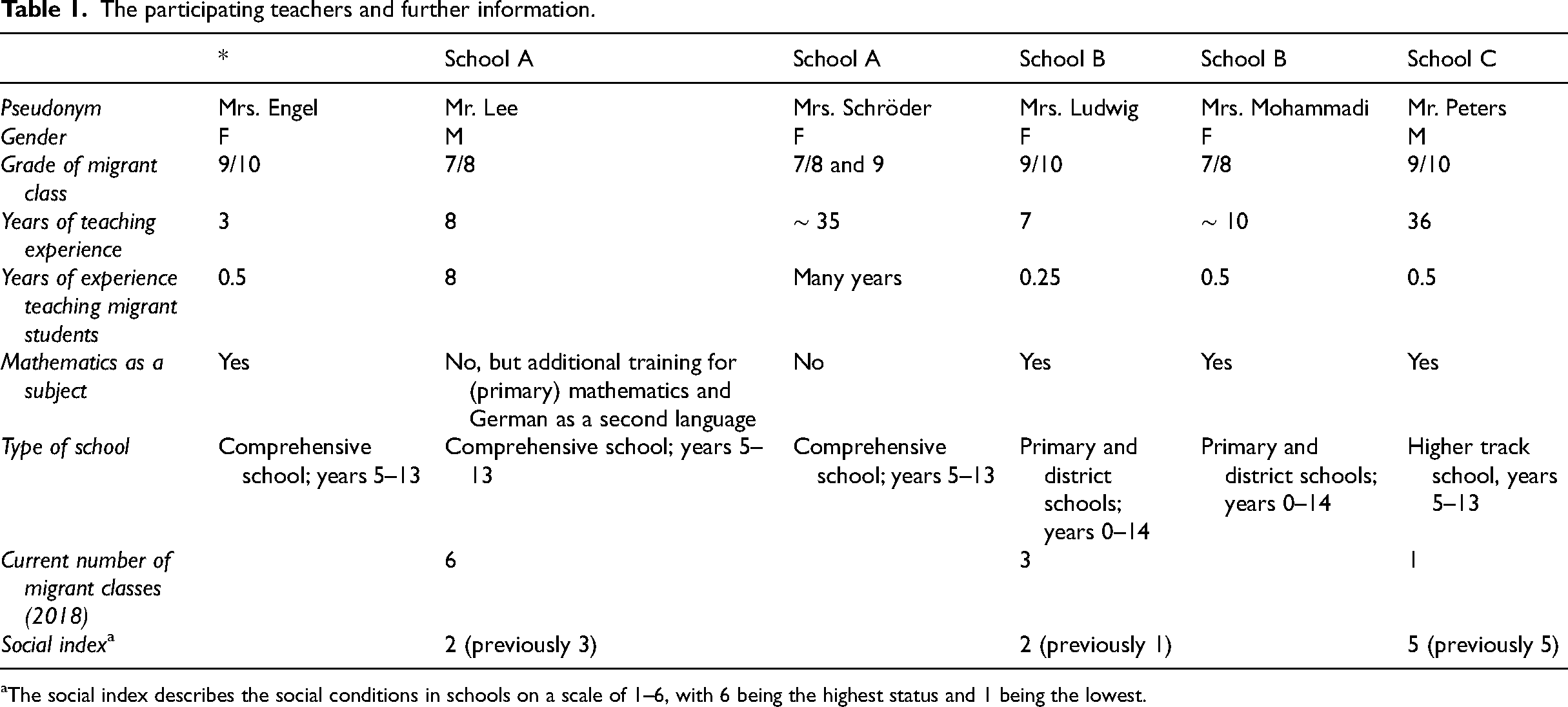
The participating teachers and further information.
The social index describes the social conditions in schools on a scale of 1–6, with 6 being the highest status and 1 being the lowest.
We interviewed six teachers, of whom four were educated as mathematics teachers (see Table 1). Mrs. Schröder was educated as a work and technology teacher and had been teaching mathematics for a long time. Mr. Lee had no mathematics degree but had taught mathematics in grades 5 and 6 since he started his career, and he was the only teacher who had an official degree in teaching German as a second language. Two of the teachers (Mrs. Engel and Mrs. Ludwig) were at the beginning of their teaching career; two (Mrs. Mohammadi and Mr. Lee) had around 10 years of work experience; and two (Mrs. Schröder and Mr. Peters) had been working as teachers over 30 years. Mrs. Mohammadi was multilingual, speaking English, Farsi, and some Arabic. She considered herself as a migrant; years ago, she had moved to Germany from central Asia, where she had gained experience working as a mathematics teacher in schools in which English was the medium of instruction. Mrs. Engel was on maternity leave at the time of the interview and spoke about the class she used to teach. Mr. Peter's second subject was English, and he had worked in an Arabic-speaking country where he learned some basic Arabic. The other teachers did not talk about their own multilingualism, so we assumed that they were monolingual. All except Mrs. Engel had good proficiency in English. They all seemed to like working in migrant classes and were very motivated to help students settle into the German school system, as Mr. Peters quote illustrates: “This is not work for me at all. I like doing it. No, it's a very pleasant working atmosphere, I have to say. […] I must ensure that they pass their final exams.”
Data analysis
All data were analyzed through open, axial, and selective coding and constant comparison (Corbin & Strauss, 2014), and several categories and concepts were identified and clustered under general themes. There was no set order for coding; we moved back and forth between coding stages to confirm or reject ideas and concepts. We followed an iterative-cyclical course of problem solving, in which inductive and deductive forms of reasoning intertwine.
The open coding strategy we applied has been led by questions such as What is this about? Which strategies are used? Why? First, one or more texts were read, and then open codes and further questions were noted in memos. In GT, memos are short documents that are written by the researchers as they proceed through the analysis of a corpus of data (field notes, code notes, and theoretical notes). They can constitute anything from a Post-it to a three-page theoretical paper. In the following, we illustrate the open coding process with an interview segment and the corresponding memo (see Figure 1). Bolded words represent initial coding ideas. The memo does not claim to be comprehensive and is, of course, always influenced by the perspectives of the analyzers.
An initial theoretical model following the coding paradigm
Through axial coding, we began to relate codes, concepts, and categories to each other developing a coding paradigm (see Figure 2; Corbin & Strauss, 2014). We also wrote theoretical memos on codes and categories that seemed important. For example, the code “frustration” and the perceived challenge of making the “transition to mainstream classes” were classified as consequences in the coding paradigm (see Figure 2). To ensure reliability, the codes and categories were discussed and further developed in various academic working groups. Using selective coding, we searched for a “main” category, defined as a category that seemed central to most teachers and their actions and could be given a central place in the coding paradigm. Later, all other categories and concepts were arranged around this phenomenon to create a possible theory for our chosen research field. According to Vollstedt and Rezat (2019), the coding paradigm is a theoretical framework or orientation used within GT to develop theory, which encompasses a particular perspective on social reality. The coding paradigm (see Figure 2) focuses on action and interaction in social contexts and related strategies and their consequences. It usually involves, in addition to the phenomenon, causal conditions, intervening conditions, contexts, consequences, and actions, or interactional strategies (Corbin & Strauss, 2014).
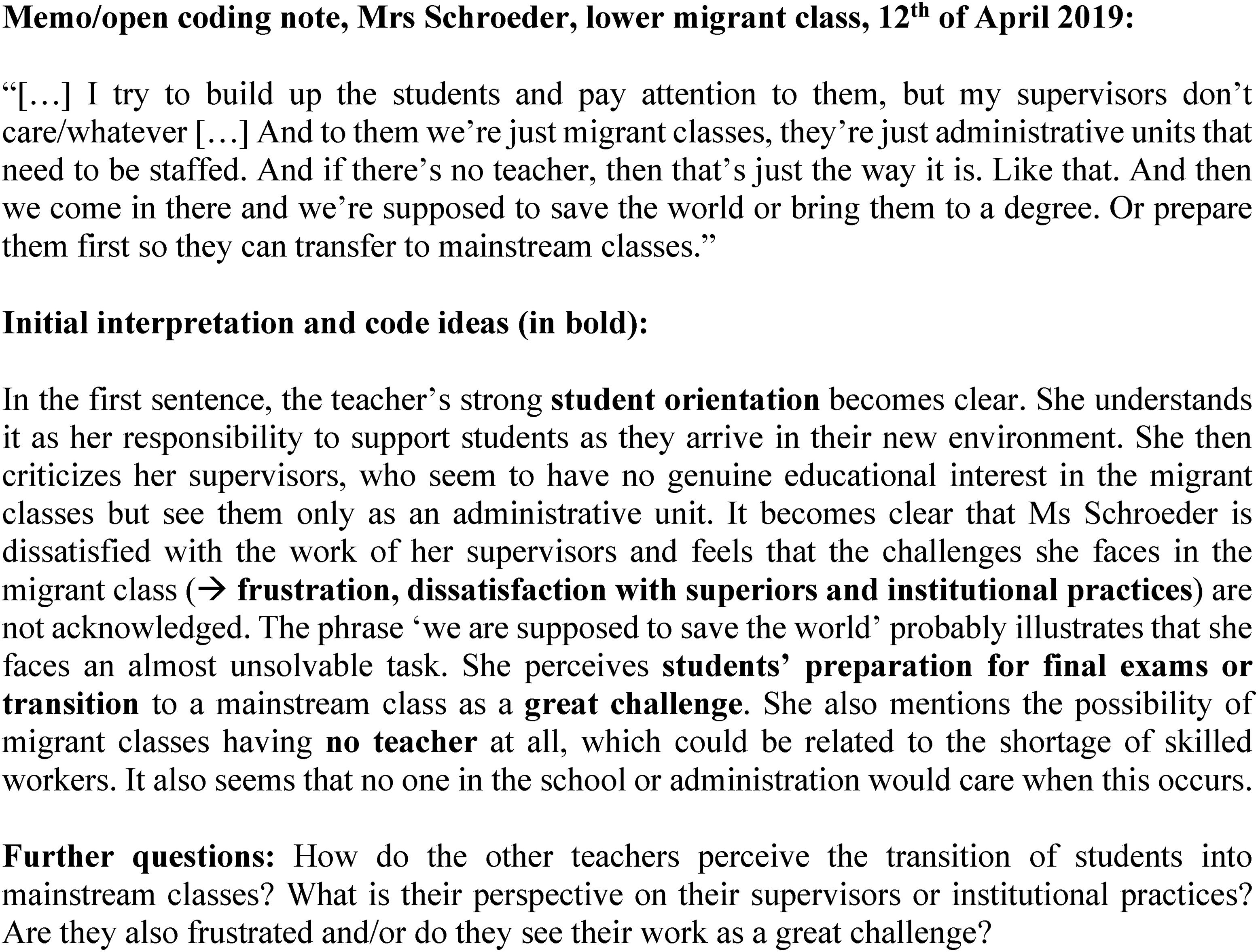
Memo of open coding.
Our exploration of the interview data revealed that the interviewees perceived students’ language- and mathematics-related diversity to be highly relevant for their classroom practice, which is reflected in the following quote of Mrs. Schroeder: How do I meet the needs of 19 or 20 students when they have such different levels, languages, and needs? Interestingly, all teachers spoke separately about addressing either language or mathematics-related diversity, but never spoke of strategies that could promote both at the same time. However, teachers saw the importance to support all students and treating everyone equally, instead of just accommodating the high-achieving ones, for example. This demonstrates that they perceived the school's role as an inclusion engine and a promoter of educational equity.
The causal conditions within the coding paradigm (Figure 2) for teachers considering the language and mathematics-related diversity central to their teaching practices were, on the one hand, the strong discourse on dealing productively with heterogeneity in Germany (Budde, 2012) and, on the other hand, a strong discourse that sees the learning of the German language as central to the integration of migrants (language as the key to integration, Bundesamt fü r Migration and Flü chtlinge [BAMF], 2022). Furthermore, school organizational practices in dealing with migration movements also played a role. These usually lead to children being sorted into migrant classes only according to age and thus producing a highly diverse learning group according to other diversity dimensions.
Teachers directed their strategies predominantly towards coping with and dealing productively with that diversity, aiming toward supporting students’ transition to mainstream classes or passing exams, as can be seen in the box on the far right of Figure 2. Thus, strategies also depended on the type of school. Students who were to be placed in mainstream classes received a holistic education, while those who were preparing for the final exam received special teaching offers in German, English, and mathematics in preparation for the final exams. The data show that the anticipated goals contrast with what teachers perceived as consequences for students, namely frustration for themselves about the challenging transition to mainstream classes for their learners and challenging exams or students’ even failing exams. Another consequence found in the data was that mathematics learning tended to be subordinated to language acquisition.
Furthermore, teachers' strategies were organized into four distinct categories: language, lesson objectives, teaching approaches, and teaching material. These can be dimensioned between two poles on a spectrum of possible strategies to which the teaching strategies reconstructed in the data can be assigned. Some teachers used or tried several of the strategies, others stuck to certain strategies. The strategies were influenced by the individual (work experience and teachers’ training, language ideologies, and time management) as well as structural intervening conditions ([non-] presence of curriculum and instructional guidelines, [non-] presence of assessment tools). In the following chapter, three examples from the data are used to illustrate how teachers' strategies are differentiated and which intervening conditions play a role for each strategy, as well as the consequences for the teaching-and-learning environment.
We chose three interview sequences that best illustrate how teachers deal with multilingualism, mathematics-related diversity, and the embeddedness of those strategies in the socio-political context (see Gutiérrez, 2013). Within this analysis, we will also look at the intervening conditions and consequences of the strategies. As already mentioned earlier, the conditions, aims and consequences may partially apply to individual teachers and strategies to a greater or lesser extent, which the following analyses also illustrate. It is important to note that the respective practices are embedded in their corresponding social contexts and individual circumstances. Therefore, it makes more sense to present the strategies in an episodic manner rather than focusing on the scarce similarities among them.
The first example is from the category “language” and belongs to the third strategy, “supporting students’ learning process.” The second example is from the category “teaching approaches” and belongs to the first strategy, “differentiation.” The third example is from the category “language” and belongs to the strategy “building upon teachers’ and students’ multilingualism as a resource for learning mathematics.”
Example 1—German-only-policy in the mathematics classroom
We selected a sequence from the interview with Mrs. Engel that exemplifies how teachers deal with students’ multilingualism in the classroom. Mrs. Engel was a young, motivated teacher who had recently completed her teacher education. In her lessons, she used several translation methods common to second and foreign language pedagogy, thus nurturing the German language acquisition of her students. For example, her students kept a dictionary in their L1 to increase their understanding of the lesson's content by individually looking up subject-specific vocabulary. However, beyond translation and promotion of the German (mathematical) language, there was little evidence of multilingual practices within her interview: I never let students with the same mother tongue work together, but I place students with different languages to sit next to each other so that they must speak to each other in German or English (the languages I certainly know) because I don’t want them to talk about something completely different without me noticing.
The quote illustrates that students’ L1 was even not allowed in group work and by that indirectly considered subordinate to German (German-only policy; see Fürstenau & Niedrig, 2018). Thus, Mrs. Engel proactively prevented collaborative solving of a mathematics task in students’ L1. She argued that students should use only the languages she knows to communicate because she did not “want them to talk about something completely different without me noticing.” This might imply a lack of trust in her students’ authentic learning processes. The quote also indicates that Mrs. Engel desired to be in control of what was happening in the classroom. She excluded students’ linguistic repertoires/resources and everyday language practices from the migrant class because of that and thereby maybe unconsciously (re)produced language hierarchies. Only the language(s) mastered by her were attributed as functional for learning mathematics, and students’ L1 was not considered to be potentially valuable. Her strategy corresponds to the research evidence that often teachers’ lessons and practices are significantly shaped by language ideologies and discourses of language (Planas & Civil, 2013). In reproducing language hierarchies, she forced students who spoke neither German nor English to remain silent. Thus, her strategies were influenced by the socio-political dimension, including the strong monolingual agenda prevalent in Germany, which promotes German as the “key to integration.” Exclusion of students’ home languages from the classroom denotes, as Cummins (2001) observed, the “devaluation” of an essential aspect of students’ identity (p. 651). Presumably, like many teachers, Mrs. Engel had inherited the public discourse on language as the key to integration and saw this as the best and only way to integrate migrant students successfully into the German school system.
Example 2—Differentiation as response to students’ mathematics-related diversity
Mr. Lee's interview exemplifies the problem-oriented view of diversity in mathematics teaching and how teachers struggle to deal with mathematics-related diversity. This view was also shared by most of the other teachers, except Mr. Peters. By the time of the interview, he had been teaching migrant classes for several years at a secondary school. In this sequence, he talked about the time he first took over a migrant class: … it was hard to find teaching materials for them. […] And it was very difficult to create some material myself. In other words, you don't differentiate three times, you would have had to differentiate on one, seven, eight different levels, and I didn’t have the time. […] Accordingly, I helped myself with what I had. That was, above all, Faktor. It's a math book—it's the precursor of Sekundo, so to speak—and I wrote different work plans for the years five, six, seven.
Mr. Lee mentioned that “it was hard” to search for and create teaching material that catered to migrant students’ diversity. At the same time, the teacher perceived his students’ lack of German knowledge as an obstacle to learning. He stated, “My maths lessons are structured to be language-free at the beginning.” Therefore, dealing with mathematics-related and linguistic diversity, or the lack of German language skills in general, are closely linked and cannot be regarded as separate entities. This clearly shows that he aimed to do justice to his students’ mathematics-related diversity. In his view, quality teaching involves meeting all students at their current learning needs and guiding them toward the learning objectives, if necessary, in diverse ways. At the same time, however, he framed the students’ diversity as a problem that he found difficult to solve. At first, he implicitly located the problem within the individual learner. His words also seemed to reveal a longing for homogeneity, as a less diverse learning group would be easier to teach with the given teaching materials and under the given circumstances. In his study, Tillmann (2008) reconstructed such beliefs for German teachers, too.
The use of the word “myself” suggests that he had to rely on himself in his lesson planning and did not—or could not—cooperate with other teachers. None of the teachers interviewed in this study talked about cooperation with colleagues. Mr. Lee seemed to believe that his students’ diversity had to be managed through practices like differentiation or individualized learning experiences. This strategy corresponds to a strongly reform-oriented discourse in Germany that prescribes differentiation as a necessary way of dealing with diversity. Due to a lack of time (intervening condition: time management) and a lack of suitable teaching materials (intervening condition: nonexistence of teaching material), he could not provide the necessary differentiation and resorted to the mainstream mathematics books and teaching supplies he already possessed. To conduct lessons, he wrote work plans (strategy: differentiation) that were oriented not to the needs of each student, but to the requirements of the curricula of grades 5 to 7. This meant that students completed work plans on their own, and they were introduced to the content of the mainstream classes incrementally, without engaging in classroom discourse: So, there is very little classroom discussion, and then they come to the mainstream classroom, where there is relatively much classroom discussion, where they are expected to participate, where partner and group work are sometimes required, and of course these are social forms that they do not know…
In this way, he moved closer to the objective of supporting the students in their individual mathematical competences, however, this also resulted in the students not participating in classroom discourse about mathematics and not being able to practice and develop their subject and educational language. Leuders and Prediger (2012) considered this one-sided focus, which results in structural–methodological differentiation and complete individualization with weekly/work plans of various levels, to be alarming from the perspective of mathematics education. They suggest that such teaching strategies cannot meet the central criteria for instructional quality due to the neglect of social and communicative elements. Moreover, for ease of implementation, considerable sacrifices are made at the cognitive level in terms of content-related demands of the lessons. For example, it is much easier to completely individualize incomprehensible procedural cramming than a cognitively demanding and substantial examination of mathematical concepts. Drawing upon the work of Sullivan (2015), we suggest that Mr. Lee's differentiation approach should not be evaluated negatively per se. However, it would be necessary to allow students to have at least some common core experiences that can form the basis for later discussions, in which students can practice their social and communication skills. This would also reduce the negative consequences for the students’ transition to mainstream classes, which Mr. Lee reflects on in the interview, and enable his students to cope better with classroom approaches in mainstreaming.
Example 3—First step toward translanguaging practices in mathematics lessons
Mrs. Mohammadi had immigrated to Germany several years ago. She spoke Farsi, German, and English and had a basic knowledge of Arabic. In the classroom, her language skills proved to be very useful as many of her students spoke Arabic, Farsi, or basic English (see Lüssenhop & Stuhlmann, 2023). The strategies used by her exemplify the argument that multilingual teachers are more likely to value and incorporate their students’ multilingual repertoires in mathematics learning. This practice not only helps students to access mathematical content or German-language tasks but also shows appreciation for the students and facilitates translanguaging practices. For example, Mrs. Mohammadi facilitated language comparisons in the lessons by actively clarifying the meanings of mathematical words in students’ L1. She also hung up a multilingual vocabulary list, on which she wrote words in different languages and scripts, and then discussed these words with her students (language comparison). Furthermore, she grouped students in language-homogenous groups and encouraged them to use their L1 to access mathematical content and solve mathematical problems.
The beginnings of a translanguaging practice were also evident in Mrs. Schroeder's case. She did not directly initiate this practice or refer to it as translanguaging, but it was permitted and appreciated despite her own monolingualism: And the nice thing about the migrant class is that they help each other. If one of them sees that the other one can’t do it well, he immediately sits down, asks, “Can I sit down?,” and then they try to speak in a kind of language mix … they speak different languages.
These practices enable the promotion of the inclusion of translanguaging in the mathematics classroom and could be included in other teachers’ classrooms as well. Mrs. Mohammadi's strategies illustrate that multilingual teachers can support students’ transition into the school system because migrant teachers’ support can have an identity-building function for students. Meyer (2004) recommends that assistance from other persons with special competence be used for individual support of diverse student bodies.
Discussion, limitations, and concluding remarks
The aim of our study was to investigate how German mathematics teachers deal with the diversity of their students in migrant classes. For this purpose, we interviewed six teachers in open interviews and analyzed the interviews according to the GT approach (for results on the perspective of the students see Lüssenhop & Stuhlmann, 2023). The model developed (Figure 2) illustrates that teachers perceived the language- and mathematics-related diversity of their students as the central phenomenon at the center of their strategies. The model derived from the interview data shows that teachers’ strategies could be divided into four categories that were influenced by individual and education structural conditions. From the perspective of the teachers, students were inadequately prepared for the transition to the mainstream class or final exams, which caused frustration among the teachers and affected their initial motivation negatively. An overall finding of the study is that the strategies and rationales employed by the teachers vary considerably and show a high degree of individuality. This variation seems to depend on factors such as the specific classroom dynamics, the operational procedures within the respective educational institutions, and the type of school.
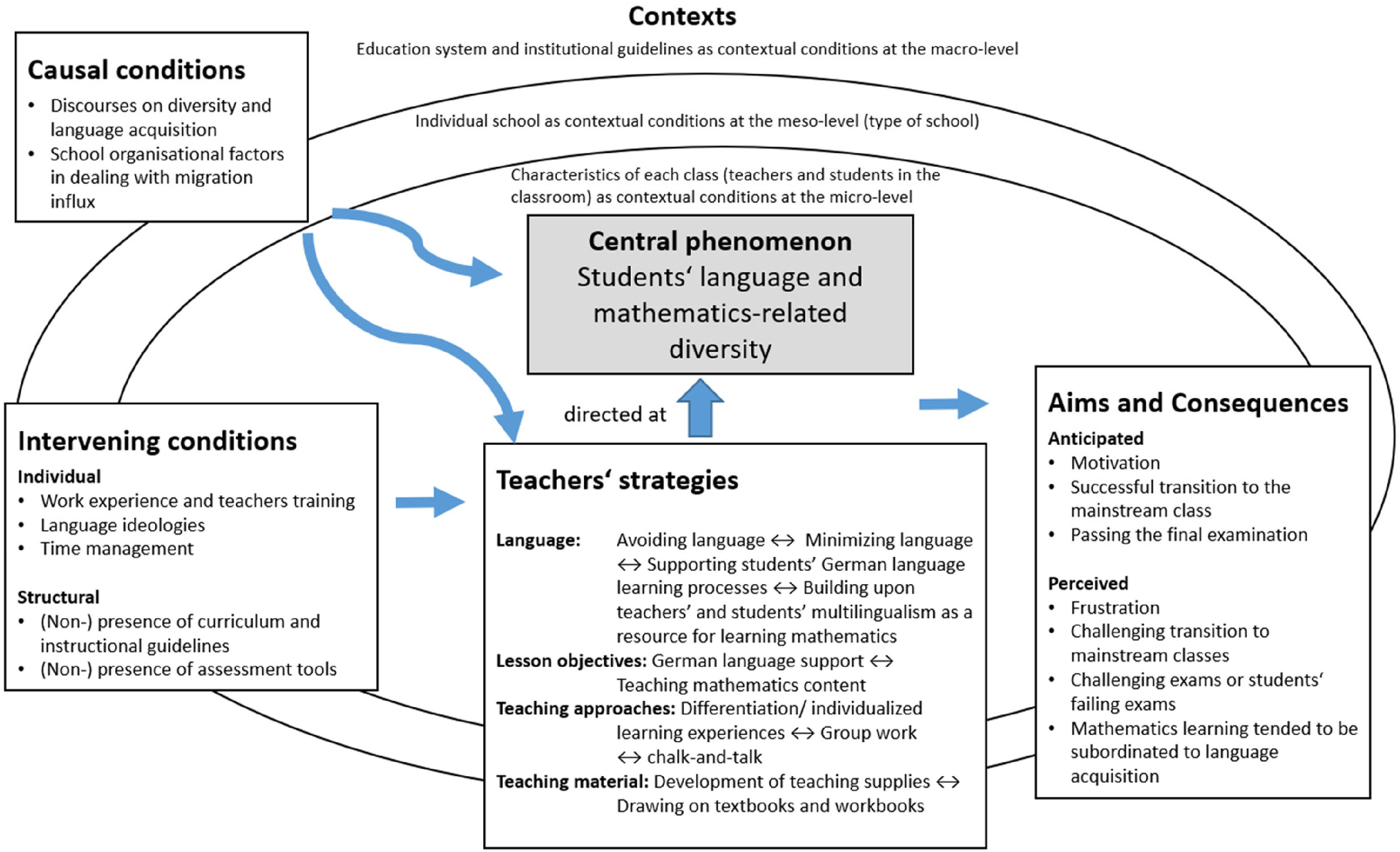
Coding paradigm on teaching practice in mathematics classes of migrant classes.
The socio-political context in which the teachers’ strategies were embedded at the time, for example, the criticism expressed by all the teachers interviewed in this study of the lack of support, such as missing curricula and teaching materials provided by the authorities, was also reflected in many studies from other countries and in Germany for subjects other than mathematics (see Diehm & Radtke, 1999; Karakayalı et al., 2017; Xenofontos, 2016). Teachers in many countries reported that it is a challenge to find appropriate learning and teaching materials for diverse student bodies. Materials adapted to students’ language levels are often not age-appropriate in terms of subject content, meaning that teachers must develop their own books and teaching materials (Norozi, 2019).
Some of the findings of our study are consistent with those of studies in other countries. For example, studies show that many teachers focus on using the dominant language for teaching and instruction (Xenofontos, 2016), many teachers have a rather deficit-oriented view of students’ multilingualism, seeing students as not being able to speak the dominant language rather than being multilingual. Teachers in our study and in the studies mentioned above avoided or minimized the use of verbal language, focused on mathematical problems with few language components and rather symbolic language, and lowered their expectations of students’ performance in mathematics. Many scholars have criticized this practice, arguing that it does not have a positive impact on (diverse) students’ mathematics learning (Adler, 1997; Moschkovich, 2012; Xenofontos, 2016). Approaches such as scaffolding (Gibbons, 2002) offer ways to gradually build language structures while supporting mathematics learning. The linguistically responsive teaching strategy developed and recommended by Prediger (2019) can help teachers to address both forms of diversity, mathematical and linguistic, at the same time.
Our findings are particularly important not only for Western cultures, but also for East Asia as a labor-sending and labor-receiving region (Zhu & Kaiser, 2019), because, on the one hand, students from this region can enter migrant classes in Germany and, on the other hand, East Asia also has to deal with the schooling of migrants, although most migrant students in China, for example, come from rural parts of China. However, many of them also do not speak the dominant language or dialect in the larger cities as their L1, and at the same time, there are migrants from outside China. Empirical studies have often reported that East Asian migrants and their offspring outperform native-born students in the host systems. This success is often attributed to the migrants’ heritage, culture, and home environment. Zhu and Kaiser (2019) conducted a secondary analysis of PISA 2012 within South Asia. They found a strong link between the immigration policy of the host system and the mathematics performance of migrant students. In Singapore, migrant status was an advantage, while in Shanghai and Hong Kong SAR, it was a disadvantage. The results were influenced by a number of factors, including students’ use of the test language at home and their socio-economic status. In many East Asian schools, little attention is paid to students’ multilingual resources and there is a strong push for assimilation into the local culture and language. Furthermore, the achievement gap between migrant students and locals in Chinese metropolitan areas is widening, as schools for migrants have fewer resources and teachers with lower teaching qualifications (Lai et al., 2014). Although studies have shown that these resources are valuable for mathematics learning, and academics and politicians around the world have recently changed policies and curricula to encourage educators to consider and incorporate students’ multilingual resources in the classroom, similar patterns of student–teacher interaction may occur in East Asia and many other parts of the world, as we were able to reconstruct in our study focusing on migrant students in Germany. Overall, there is a political consensus that it is important to better prepare migrant students for the demands of the labor market, which will promote the growth and security of each country's economy (Lai et al., 2014).
A key strength of this study is that it is among the first to address the perspectives of Western mathematics teachers with a specific focus on the German educational landscape working in migrant classes following the Grounded theory tradition. The methodologically open interviews and the data analysis shed light on teachers’ experiences and voices. In addition, this study has the potential to advance the field of mathematics education on migrant students’ schooling in Germany, providing space for researchers to reflect, act, and compare contexts across the world. We aimed to provide a detailed description of the setting and context so that readers can understand the degree to which our results may be theoretically appropriate in other contexts. As there is a lack of related studies in many parts of the world, not only Germany, but this exploratory research project also provides the basis for further studies in the field. Through the developed model, teachers’ individual strategies and their embeddedness in the context can come to the fore and an overview of possible strategies and their connections to other categories is provided. Subsequently, the relationships between the categories can be further explored through hypotheses and follow-up research.
The limited sample size and data restrictions meant that the teachers’ reported experiences, strategies, and reflections could not be taken as representative of German teachers in general. However, Guest et al. (2006) stated in their analysis that they found saturation within 12 interviews of 60, and meta-themes were present already within six interviews. This means that even a small sample size can point to interesting aspects. Furthermore, since the empirical research focused on a substantive reality, interviews as a primary source of data can be considered a limitation because, on some occasions, the interviewee can disagree with reality. Another limitation is that the field access was so tightly limited in terms of time and data protection that we could not thoroughly analyze the cases in parallel with their collection. As a result, we had to adapt the rules of conduct of the GT and conduct a condensed field phase at the beginning. We applied the rules of theoretical sampling only in the analytical processing of the data set, which meant that we had to accept the absence of desirable contrasting cases.
Overall, we believe it is useful to emphasize greater integration of diversity-sensitive strategies into school practice and teacher training. This approach will enable schools and educators to develop effective ways of dealing with the diversity of their students and to respond more sensitively to their needs. This means that teachers should also acquire knowledge about the cultural and socio-political aspects of mathematics education. For instance, they should learn about the experiences of discrimination faced by migrants in Germany—within the school system and beyond—and how it affects their daily lives and their readiness to learn, as Doğmuş et al. (2016) recommend. Additionally, it is crucial to continue researching whether separate classes, including separate mathematics instruction, contribute positively to the inclusion of migrant children within the school system or not. Duarte (2011) argues that migrants’ educational success can be achieved through innovation and presents a case study from Hamburg in which migrant students are schooled more inclusively.
It would probably be beneficial to increase collaboration between different roles within the school, including teachers, social workers, and others, to establish common educational goals and strategies. This approach would help meet the varied needs of the children more effectively. Such initiatives would address the teachers’ criticism of the lack of cooperation within the school and improve the cooperation. There are model projects for such initiatives, such as the Go-in-Project (www.kreis-unna.de), which integrates migrant students into mainstream classes from the beginning, with all school staff working collaboratively to make teaching more inclusive for all students. Teachers in the project received further training in language support and inclusive education before implementing the project. The project has had success in improving students’ language and social integration, including in the context of mathematics education (Daschner, 2017).
Furthermore, future research needs to address how the multilingual repertoires of individual students and whole learning groups can be used in translanguaging practices in the classroom. The present study highlights some of such teachers' practices. However, further research and teacher training are needed to better support teachers to incorporate students’ multilingual repertories in the mathematics classroom. Including the language-as-resource perspective and intuitive translanguaging (García et al., 2017) may have the potential to support the migrant students to rather use their language skills for sense making and mathematical discussions instead of restricting it. In recent years, some ideas for curriculum design and practice in STEM multilingual contexts have been published (see Essien & Msimanga, 2021). Zahner et al. (2021), for example, present three interconnected principles for designing mathematics classrooms that improve multilingual students participating in mathematical discussions. Considering example 3, multilingual individuals could support individual students on an hourly basis. However, this requires financial and human resources on the part of policymakers and schools. We think that assigning multilingual and/or migrant teachers to migrant classes can be beneficial for overcoming language barriers in the classroom and supporting students in their new environment.
Dealing with the diverse needs of students remains a relevant issue in the German educational landscape as well as in other regions of the world, especially in light of increasing migration from war-torn regions. It is crucial to continue to explore how the considerable diversity among children, including those who have not immigrated but may have different support needs, can be addressed in an equitable manner, with the aim of achieving greater inclusivity and participation in education and society for all children.
Footnotes
Contributorship
Maike Lüssenhop collected and analyzed the data and wrote the first version of the contribution. Gabriele Kaiser was the project coordinator, participated in interpreting the data, and was involved in revising the article. Both authors read and approved the final manuscript.
Declaration of conflicting interests
The author(s) declared no potential conflicts of interest with respect to the research, authorship, and/or publication of this article.
Funding
The author(s) disclosed receipt of the following financial support for the research, authorship, and/or publication of this article: This work was supported by the Federal State of Hamburg (grant number LFFFV 52).
