




Abstract
We conducted a cross-cultural experimental study, consisting of Australian students (N = 57) and Malaysian students (N = 75) on learning to solve one-step and two-step linear equations. Central to our research inquiry is the perceived difference between two instructional methods: the balance method of learning vs. the inverse method of learning. The balance method and the inverse method differ in their use of mathematical operations to solve linear equations (e.g., +4 on both sides, balance operation, vs. –4 becomes +4, inverse operation). According to cognitive load theory, the balance operation imposes twice the level of element interactivity (i.e., interaction between elements) than that of the inverse operation. Our findings, ascertained from univariate analysis of variance (ANOVA) testing, show that for the Australian students, the balance group outperformed the inverse group. Such results do not support our hypothesis and contradict with previous findings, where the inverse group outperformed the balance group in a Malaysian context. No statistically significant difference was found between the two groups of Malaysian students. In line with our hypothesis, the Malaysian students outperformed the Australian students with respect to the inverse method. We attributed the results, in part, to the impact of prior knowledge of the balance method (Australian students) and the inverse method (Malaysian students) upon subsequent learning of linear equations. Nonetheless, given that the differential level of element interactivity favors the inverse method, we advocate the exploration of the potentiality of the inverse method for enhancing the learning of linear equations.
Introduction
The topic of linear equations is universal in middle school mathematics curriculum across the world (Schmidlt et al., 2001). Mathematics educators regard the ability to solve linear equations as a basic skill (Ballheim, 1999). The one-step and two-step linear equations, which form the basis of the present study, act as a bridge between arithmetic reasoning of numbers and algebraic reasoning of pronumerals (i.e., variables)—for example, a pronumeral stands for a number in the context of solving linear equations. Despite the power of algebra in mathematical problem-solving (Kieran, 1992; Stacey & MacGregor, 1999), it appears that there is a gap between Western students and Asian students regarding the use of algebra to solve problems. Research has found that US students use the concrete method (e.g., draw a diagram depicting the problem structure), whereas Chinese students use the algebra approach (i.e., form an equation, solve for the variable) to solve word problems (Cai, 2000). In a similar vein, our own research undertaking of percentage problems indicates that Malaysian students scored higher than Australian students with respect to the use of the equation approach (algebra approach) but not the unitary-pictorial approach (i.e., use of a diagram to depict the unit concept) (Ngu et al., 2018b). Because solving linear equations represents part of the algebra problem-solving process (Mayer, 1992), improving students’ ability to solve linear equations is therefore an important educational goal for accomplishment. Moreover, there is a decline in student enrolments in the areas of science and mathematics in Australia (Kennedy et al., 2014). We purport that strengthening students’ foundation of algebra may, in fact, help to encourage them to pursue Senior Mathematics Education or Science, Technology, Engineering, and Mathematics (STEM) education in the future. Overall, a comparison of two cohorts of secondary school students (i.e., Australian students vs. Malaysian students) may yield evidence that could serve to highlight the relative effectiveness of the balance method and the inverse method for learning to solve linear equations.
Research development: In brief
An analysis of 3,010 Australian middle school students’ performance in solving linear equations has uncovered several notable errors made by students, such as reciprocal error, fractions, and negative numbers (Steinle et al., 2022), some of which are similar to the findings by Ngu and Phan (2017). For example, many students provide incorrect answers (e.g., p = 2 for 1 = 2p), suggesting that they have misconceptions about the concept of division that involves fraction—in this case, they divide a larger number over a smaller number (i.e., 2 ÷ 1). However, mathematics educators have not conducted similar studies in other sociocultural contexts (e.g., Malaysian context). While analysis of different errors allows mathematics educators to gain insights into the challenge(s) that students experience, Steinle et al. (2022) did not recommend any strategies that could be used to overcome such challenge(s). We firmly believe that reform in instructional methods for teaching and learning of linear equations (e.g., advocation of a particular instructional method) is needed to enhance students’ performance on linear equations. More specifically, from a cross-cultural perspective, are there differential instructional methods on learning linear equations that could improve students’ acquisition of skills to solve linear equations?
According to Ding et al. (2013), mathematics teachers tend to rely on unit materials that are mentioned in textbooks for guidance. In Australia, mathematics educators have recommended a few instructional methods for teaching and learning of linear equations, such as unwinding, trial and error, substitution, and the balance method, which commonly appear in mathematics education textbooks (e.g., Vincent et al., 2012). Of the different instructional methods mentioned, the balance method is the preferred method for teaching students the concept of linear equations. However, mathematics education textbooks in Malaysia (Cheang et al., 2003) differ somewhat and, instead, advocate the use of trial and error, substitution, and the balance method to introduce students the topic of linear equations. Personal communication between the lead author and a local teacher in Malaysia reveals cultural differences in terms of teaching and learning of linear equations. For the Malaysian teacher, he/she introduced the balance method, as detailed in relevant textbooks, and then summarized the solution procedure using the inverse method. Such manner of teaching linear equations is consistent with a study that was conducted in Finland (Andrews & Sayers, 2012), which shows the following: the teacher introduces the concept of equality via the balance method, and then he/she shifts to the use of “change side, change sign,” which is the inverse method for solving subsequent linear equations. In general, to our knowledge, many Malaysian mathematics teachers prefer the aforementioned instructional method: introduce the “=” sign concept via the balance method and then emphasize the use of the inverse method to solve linear equations.
The main difference between the balance method and the inverse method lies in the use of mathematical operations to solve linear equations (e.g., +2 on both sides, balance operation, vs. −2 becomes +2, inverse operation). Prior studies have shown that the inverse method imposes a lower cognitive load than that of the balance method, especially for linear equations that involve multiple solution steps (Ngu et al., 2015; Ngu et al., 2018a; Ngu & Phan, 2022). Having said this, however, these prior studies have been conducted in the Malaysian sociocultural-learning context. To date, to our knowledge, there are only two cross-cultural studies (i.e., Australian vs. Malaysian) that have explored the learning of linear equations (Ngu et al., 2019; Ngu & Phan, 2020). Significantly, it is observed that for one-step linear equations, the balance method was inferior to the inverse method, irrespective of the sociocultural-learning context (i.e., Australian students or Malaysian students) (Ngu et al., 2019). However, performance between the two countries favored the Malaysian students with respect to the use of the inverse method. The Malaysian pre-service teachers outperformed their Australian counterparts for the one-step, two-step, and multistep linear equations (Ngu & Phan, 2020). An analysis of the solution strategies revealed that the Australian pre-service teachers tended to use the balance method, whereas the Malaysian pre-service teachers tended to use the inverse method for solving linear equations. The authors attribute such results to an emphasis on using the balance method and the inverse method for learning to solve linear equations in Australia and Malaysia, respectively.
Based on the potency of cognitive load theory (Sweller et al., 2011; Sweller et al., 2019), the present study aims to examine the relative effectiveness of the balance method and the inverse method on learning to solve one-step and two-step linear equations across two sociocultural-learning contexts: Australia and Malaysia. This research inquiry differs from previous inquiries (e.g., Ngu et al., 2019) in terms of the following: (i) we include not only one-step linear equations but also two-step linear equations; (ii) we include not only a posttest that assesses students’ procedural knowledge but also a concept test that assesses their conceptual knowledge; and (iii) we examine students’ performance for both the balance operation as well as the inverse operation. Specifically, we have two major research questions:
Consider Australian students and Malaysian students separately on learning to solve one-step and two-step equations. Do the students in the inverse method outperform those students in the balance method irrespective of whether they are Australian students or Malaysian students? Comparing the Australian students and Malaysian students on learning to solve one-step and two-step equations. (i) Do the Australian students outperform Malaysian students with respect to the balance method? (ii) Do the Malaysian students outperform Australian students with respect to the inverse method?
Cognitive load theory and its implication
Cognitive load theory is an instructional theory that provides guidance to help educators design appropriate instructional materials for effective learning across different domains (Sweller et al., 2011; Sweller et al., 2019). Cognitive load theory highlights the importance of designing instructions to align with human cognitive architecture so that this would reduce the negative impact of cognitive load imposition on information processing. The working memory, in this case, can process about four elements of information (Cowan, 2001), and it can hold information for a short time only (e.g., 20 s). Long-term memory, in contrast, stores a larger amount of learned information in the form of “schemas” with varying levels of sophistication (Tricot & Sweller, 2014). At any moment in time, we can retrieve schemas to enable us to function effectively under a variety of contexts, given that the working memory can process schemas as a single element. Different characteristics of the working memory and long-term memory have implications for designing instructions. A critical point for consideration is to design a specific instruction that would avoid or minimize the overloading of the working memory, so that pieces of information can be successfully processed and then stored in long-term memory.
Element interactivity is a basic concept of cognitive load theory (Sweller, 2010; Sweller et al., 2011; Sweller et al., 2019) that differentiates and explains the three types of cognitive load: (i) intrinsic cognitive load, (ii) extraneous cognitive load, and (iii) germane cognitive load. The concept of element interactivity arises from the interaction between elements within a piece of learning material. An element refers to anything (e.g., number, symbol, concept) that requires learning (Chen et al., 2017). The complexity of a piece of learning material reflects the level of element interactivity, which in turn determines the intrinsic cognitive load of the learning material itself. Intrinsic cognitive load is relative to a learner's level of expertise in a specific domain of functioning. With an increase in expertise in a domain of functioning, multiple interactive elements would incorporate into a schema and process as a single element, thus helping to reduce one's working memory load. Capitalizing on prior research studies (e.g., Ngu & Phan, 2022), the present study considers the important nature of element interactivity to discern not only the complexity of one-step and two-step linear equations but also the design of the balance method and inverse method for learning to solve linear equations.
The element interactivity that arises from inappropriate instructional designs would, in this case, constitute extraneous cognitive load. We can redesign inappropriate instructions to minimize extraneous cognitive load. Redesigning of an inappropriate design, for example, may involve the placement of textual information at the relevant location in the diagram in order to avoid what is known as the “split-attention effect” (Sweller et al., 1990). The element interactivity that arises from the design features of an instruction, which are essential for learning, constitutes a germane cognitive load. Germane cognitive load does not exert an independent source of cognitive load; rather, it is part of the intrinsic cognitive load. Of the three types of cognitive load, the intrinsic cognitive load that reflects the level of element interactivity of the learning materials is relevant to this study. An important theoretical tenet that we want to examine in this cross-cultural study is the following: the relative effectiveness of the balance method and inverse method on learning to solve linear equations from an element interactivity perspective.
The balance method, inverse method, and element interactivity
Similar to prior research studies (e.g., Ngu et al., 2018a), we use both the relational line and the operational line to describe the solution procedure of a linear equation (Figure 1). A relational line refers to the quantitative relationship whereby the left side of the equation is equaled to the right side of the equation. An operational line, in contrast, refers to the application of a mathematical operation to alter the state of the equation, and such a procedural step maintains its equality. An example is shown in Figure 1, which illustrates some interesting facts: both the balance method and the inverse method share two relational lines (i.e., Line 1 and Line 3), but they differ in the operational 2 (i.e., Line 2).

Using the balance method and inverse method to solve a one-step equation.
In relation to Figure 1, we note that for the balance method of learning, Line 1 has five elements: a pronumeral (x), two numbers (+6, 3), and two concepts. As described earlier, we consider a concept as an element because it needs learning (Chen et al., 2017). The two concepts are as follows: (i) the “=” sign that shows a quantitative relationship where the left side of the equation is equaled to the right side of the equation and (ii) the number 6 is added to x. Moreover, Line 2 has seven elements: a pronumeral (x), four numbers (+6, –6, 3, –6), and two concepts—namely, cancel +6 with –6 on the left side (i.e., Concept 1), and perform 3 and –6 on the right side to maintain the equality of the equation (i.e., Concept 2). Line 3 has three elements: a pronumeral (x), one number (–3), and one concept—namely, once Line 1 and Line 2 have been processed successfully, x equals to –3 being the solution would be obvious.
The inverse method of learning
As we mentioned earlier, the balance method and the inverse method differ in the operational line (Line 2). A learner, in this case, would conceptualize +6 as an inverse to –6, as such, he would move +6 from the left side of Line 1 to become –6 on the right side of Line 2 to preserve the equality of the equation. For both the balance method and the inverse method, the learner is required to process multiple interactive elements within and across one operational and two relational lines in order to comprehend the solution procedure of the one-step equation. Differential levels of element interactivity in the operational line would favor the inverse method. The interaction between elements occurs on the right side of the equation for the inverse method (i.e., –6 interacts with 3), but on both sides of the equation for the balance method (i.e., –6 interacts with +6 on the left side and 3 on the right side). Having said this, however, we contend that the inverse method is not better than the balance method for one-step equations, given that the total cognitive load required to process element interactivity would have been low, irrespective of whether it is the balance method or the inverse method (Ngu et al., 2015).
Given that the present study includes both one-step and two-step equations and that the latter has a higher number of relational and operational lines than the former, we expect the inverse method to be better than the balance method. For consideration, then, a question noteworthy for development is as follows: is there credence, as some existing research studies have found (e.g., Ngu et al., 2018a), to advocate for the use of the inverse method over that of the balance method?
Prior research on the balance method and the inverse method
A majority of secondary school mathematics textbooks use a balance scale to scaffold the “=” sign concept in the context of solving linear equations (Vincent et al., 2011). Aligning the concrete items (e.g., unit block) in a balance scale and the elements (i.e., number, pronumeral) in linear equations (e.g., x + 3 = 10) can, in fact, encourage analogical comparison between the two, leading to the acquisition of the “balance concept” in linear equations (Vlassis, 2002; Warren & Cooper, 2005). Having stated this, however, it is impossible to “take away” a negative pronumeral or a negative number from both sides of a balance scale (Vlassis 2002). As highlighted in a review by Otten et al. (2019), researchers have yet to discover the optimal condition by which the balance model would work effectively to solve linear equations. Despite its limitation, mathematics educators have used the balance scale to scaffold and to develop the balance method for learning to solve linear equations (Vincent et al. 2011). For example, using the balance method, students are taught to cancel identical items (e.g., pronumeral, number) from both sides of the linear equations to preserve equality and then to solve for x (Linchevski & Herscovics, 1996). Interestingly, more capable students were able to generate a shortcut version of the balance method (i.e., the inverse method) to help them solve subsequent linear equations.
In a previous study, we used the balance method to assist eighth-grade students to solve various types of one-step equations, some of which have special features, such as the presence of a negative pronumeral (e.g., 5 – x = 12) (Ngu & Phan, 2017). We found the mean posttest scores to be relatively modest across different types of one-step equations—for example, the mean posttest score was 0.41 for linear equations that involve a negative number (e.g., w/5 = –5). Such results are somewhat similar to those results obtained by Rittle-Johnson and Star (2009) (e.g., posttest, 44.5%), who also used the balance method to facilitate middle school students’ learning of linear equations.
Over the past several years, we have conducted a few empirical studies to compare the balance method and the inverse method for learning to solve linear equations. We noted that the inverse method is better than the balance method for the learning of two-step equations (e.g., 6x + 10 = 22) (Ngu et al., 2015), multistep equations (e.g., 5x – 2 = 3x + 9) (Ngu et al., 2018a), and linear equations with negative pronumerals (e.g., 7 – x = 15) (Ngu & Phan, 2022). To our knowledge, there is no other research study that has used the inverse method to promote effective learning of linear equations. An earlier study by de Lima and Tall (2008), interestingly, found that some students could not appreciate and understand the role of the inverse operation when using the inverse method. For example, when solving a linear equation such as 4x – 7 = 26, some students mechanically pick a term from the equation (e.g., –7) and perform the procedure of “change side, change sign” to solve for x. In other words, the students are not able to comprehend how the inverse operation actually works in the context of linear equations.
Preference: Balance method vs. inverse method
Prior studies have demonstrated an advantage of the inverse method over the balance method within the framework of cognitive load (Sweller et al., 2011; Sweller et al., 2019) mainly in Malaysian sociocultural-learning contexts (e.g., Ngu et al., 2018a). It is formally acknowledged that mathematics educators in Western countries (e.g., Australia), in general, promote the use of the balance method for learning linear equations. There is a firm belief, in this sense, that the application of the balance operation (e.g., +3 on both sides) addresses the concept of equality, which is central to the success of solving linear equations. By the same token, many mathematics educators in Western countries are skeptical of the inverse method, as this instructional method emphasizes the notion of “change side, change sign,” which may fall short of addressing the critical concept of equality.
A review by Cai et al. (2005) indicates that a number of Asian countries (e.g., China, Singapore, South Korea) have introduced the inverse method for learning linear equations in primary school education. Teachers in China, for example, provide ample opportunities for their students to learn about inverse operations, using word problems in real-life contexts (Ding, 2016). As an example, “There are four rows of students in a classroom. If the total number of students is 20, then how many students are there in each row?” Students, in this case, are expected to form () × 4 = 20 and then conceptualize “× 4” as “÷ 4” to solve for (). Interestingly, according to Ding (2016), mathematics teachers in China introduce linear equations using the balance method in order to meet formal curriculum requirements. Subsequently, students gain competence in solving linear equations, via means of the inverse method.
In their theoretical review, Rittle-Johnson et al. (2015) indicated that Asian mathematics educators, in general, have the view that “practice makes perfect.” Specifically, providing ample and continuing practice would enable the attainment of procedural fluency, resulting in the development and finetuning of conceptual understanding of mathematical concepts. Therefore, in general, many Asian mathematics educators consider the balance method of learning as cumbersome, error-prone, and ineffective. We acknowledge that there is a need, however, to substantiate such claim (e.g., that the balance method is error-prone) with evidence-based research data. We contend that Asian mathematics educators may prefer the inverse method of learning, which relies on theoretical understanding of the inverse operation to acquire the conceptual knowledge associated with solving linear equations.
Mathematical proficiency
The acquisition of mathematical proficiency in a mathematics topic reflects a sound demonstration of both conceptual knowledge and procedural knowledge (Baroody et al., 2007; Hiebert & Lefevre, 1986; Schneider et al., 2011). Conceptual knowledge refers to principal knowledge that connects interrelated mathematical concepts, whereas procedural knowledge refers to a sequence of actions that are involved to successfully solve problems (Rittle-Johnson et al., 2001). According to Rittle-Johnson and Alibali (1999), the acquisition of conceptual knowledge facilitates the acquisition of procedural knowledge and vice versa. For example, competence in solving linear equations reflects one's greater understanding of the “=” sign concept. Knuth et al.’s (2006) study involving middle school students also supported this theoretical premise. A relational understanding of the “=” sign concept correlated with student success in solving linear equations. As such, McNeil et al. (2006) advocated the importance of providing opportunities for students to gain a relational understanding of the “=” sign concept in linear equations, via means of practicing operations on both sides (e.g., 3 + 2 = 4 + 1).
Regarding the inverse method, how can we strengthen students’ understanding of the inverse operation in the context of solving linear equations? If middle school students find it difficult to understand “2 + 3 = 5” is the same as “2 = 5 – 3,” then we could in fact show them the following—see (i), (ii), and (iii) below. This would assist the student, hopefully, to reason the logic between (i), (ii), and (iii), and thus the application of the inverse operation in order to preserve the equality of these equations. Once students have acquired the conceptual knowledge of the “=” sign concept, they would be expected to apply the inverse operation appropriately to solve linear equations, resulting in the successful acquisition of procedural knowledge.
(i) 2 + 3 = 5 is the same as 2 = 5 – 3 (ii) () + 3 = 5 is the same as () = 5 – 3 (iii) x + 3 = 5 is the same as x = 5 – 3
As shown in Figure 1, the relational line and operational line reflect the interplay between conceptual knowledge and procedural knowledge in solving linear equations. When a learner performs a balance operation (e.g., –6 on both sides) or an inverse operation (–6 becomes +6) so as to maintain the equality of the equation, such action constitutes procedural knowledge. When a learner understands the role of “=” sign with respect to both the relational line and operational line, this constitutes conceptual knowledge. For example, with reference to the relational line, the learner can judge the quantitative relationship in that the left side of the equation equals to its right side (e.g., x + 6 = 3). With reference to the operational line, the learner can judge a pair of equations as equivalent: x + 6 = 3 and x + 6 – 6 = 3 – 6 (balance method) or x + 6 = 3 and x = 3 – 6 (inverse method).
The worked examples
Multiple empirical studies have affirmed the merit of worked examples to facilitate learning across different discipline areas (Hoogerheide & Roelle, 2020; Renkl, 2017; Sweller et al., 2019). Worked examples serve as a direct instructional tool, helping to facilitate effective learning. A worked example may consist of a problem with a step-by-step solution procedure to help learners solve the problem. According to cognitive load theory, studying worked examples imposes low cognitive load as a learner's attention is directed toward the learning of problem-solving operators, which are embedded in the solution procedure (Sweller et al., 2011; Sweller et al., 2019). In line with prior research, the present study seeks to implement multiple example-problem pairs (Sweller & Cooper, 1985; van Gog et al., 2011) to facilitate the acquisition of skills in the solving of linear equations. For each example-problem pair, students are asked to study the worked example and then transfer their understanding of the solution procedure to solve a practice problem that shares a similar problem structure (Reed, 1987).
The present study
Overall, then, the aforementioned review indicates that the interaction between elements occurs on both sides of the equation for the balance operation but only on one side of the equation for the inverse operation (Figure 1). Consequently, we contend that differential element interactivity favors the inverse method. As we discussed earlier, Western mathematics educators, in general, argue that the balance method addresses the “=” sign concept. They view the reliance on “change side, change sign” in the inverse method falls short of addressing the “=” sign concept. We do not necessarily agree with such premise, given our own existing research inquiries (e.g., Ngu & Phan, 2022) and teaching experiences. The lead author of the present article, for example, has previously taught mathematics education in both Australia and Malaysia. Regarding the topic of linear equations, the lead author noted that Australian teachers tend to use the balance method whereas Malaysian teachers, in contrast, prefer the inverse method of learning. Moreover, the lead author was surprised to find that many Year 11 Australian students struggled to solve linear equations (e.g., 5x – 3 = 4x + 7), which they should have learned in middle school education. Therefore, it is our purpose to elucidate the myth surrounding the comparative use of the balance method vs. the inverse method for students in Australia and Malaysia. This line of research inquiry, we contend, has potential cultural relevance and significance for further development. For example, does the effectiveness of learning linear equations depend on a particular instructional method (e.g., the use of the balance method), and, likewise, does preference for a particular instructional method associate with a specific cultural belief?
Method
We used a pretest–intervention-posttest design. The pretest was used to establish group equivalence prior to the intervention. We randomly assigned students to two groups: the balance group vs. the inverse group. We propose three hypotheses for statistical testing:
Because differential element interactivity favors the inverse operation, we hypothesize that irrespective of Australian students or Malaysian students, the inverse group would outperform the balance group for (i) practice equations, (ii) the posttest, and (iii) the concept test. Australian students might have been exposed to the balance method, whereas Malaysian students might have been exposed to the inverse method prior to their participation in the study. Therefore, differential performance between Australia and Malaysia for the practice problems, posttest, and concept test would favor (i) Australian students with respect to the balance method and (ii) Malaysian students with respect to the inverse method. We predict a positive learning effect for the balance operation (or the inverse operation) as a result of exposing to the balance method (or the inverse method). Thus, irrespective of sociocultural-learning contexts (i.e., Australian students or Malaysian students), (i) the balance group would outperform the inverse group for the balance operation, and (ii) the inverse group would outperform the balance group for the inverse operation. We predict the impact of prior knowledge (i.e., balance method vs. inverse method) on differential performance between Australia and Malaysia: (a) performance for the balance operation would favor Australian students with respect to the balance method, and (b) performance for the inverse operation would favor Malaysian students with respect to the inverse method.
Specifically, we used the univariate analysis of variance (ANOVA) test for the pretest to establish group equivalence within individual countries (Australia vs. Malaysia) and between two countries (Australia and Malaysia) prior to the intervention. We used 2 (country: Australia vs. Malaysia) × 2 (method: balance vs. inverse) factorial design to examine the impact of the balance method and inverse method on learning one-step and two-step linear equations cross Australia and Malaysia. The independent variables are the country and method, and the dependent variables are the practice problems, posttest, concept test, balance operation, and inverse operation. We used pairwise comparisons to determine differential performance between the balance group and the inverse group within individual countries and between two countries.
Participants
Australian sample
The Australian sample consisted of 57 Year 9 students (boy = 28, girl = 29) whose mean age was 14.94 (SD = 0.12). They were drawn from two top classes of a public secondary school in a rural community and were from diverse ethnic backgrounds (Australians, Greek, British, German, Japanese, Chinese, Korean, etc.). They followed the Australian Curriculum: Mathematics for secondary school. The head teacher indicated that students had learned linear equations when they were in Year 8. Data collection occurred in the second term of the school academic year. Two students did not complete all test materials and thus were excluded from the final data analysis.
Malaysian sample
The Malaysian sample comprised 75 Form 2 Chinese students (equivalent to Year 8 in Australia, 37 boys and 38 girls) whose mean age was 14.30 (SD = 0.14). They were drawn from two classes of a government secondary school in Malaysia. They followed the National Curriculum for Mathematics Education. The medium of instruction for mathematics education is English language. These participating Chinese students were from two ethnic groups such as Foochow (83%) and Hokkien (17%). Students learned linear equations a week prior to data collection, which occurred in the third term of the school academic year. Three students did not complete all test materials and thus were not included in the final data analysis.
As shown in Table 1, both the Australian sample and Malaysian sample share more similarities than differences, and thus this distinction of similarities renders the significance of this cross-cultural comparison study.
Australian sample vs. Malaysian Sample.
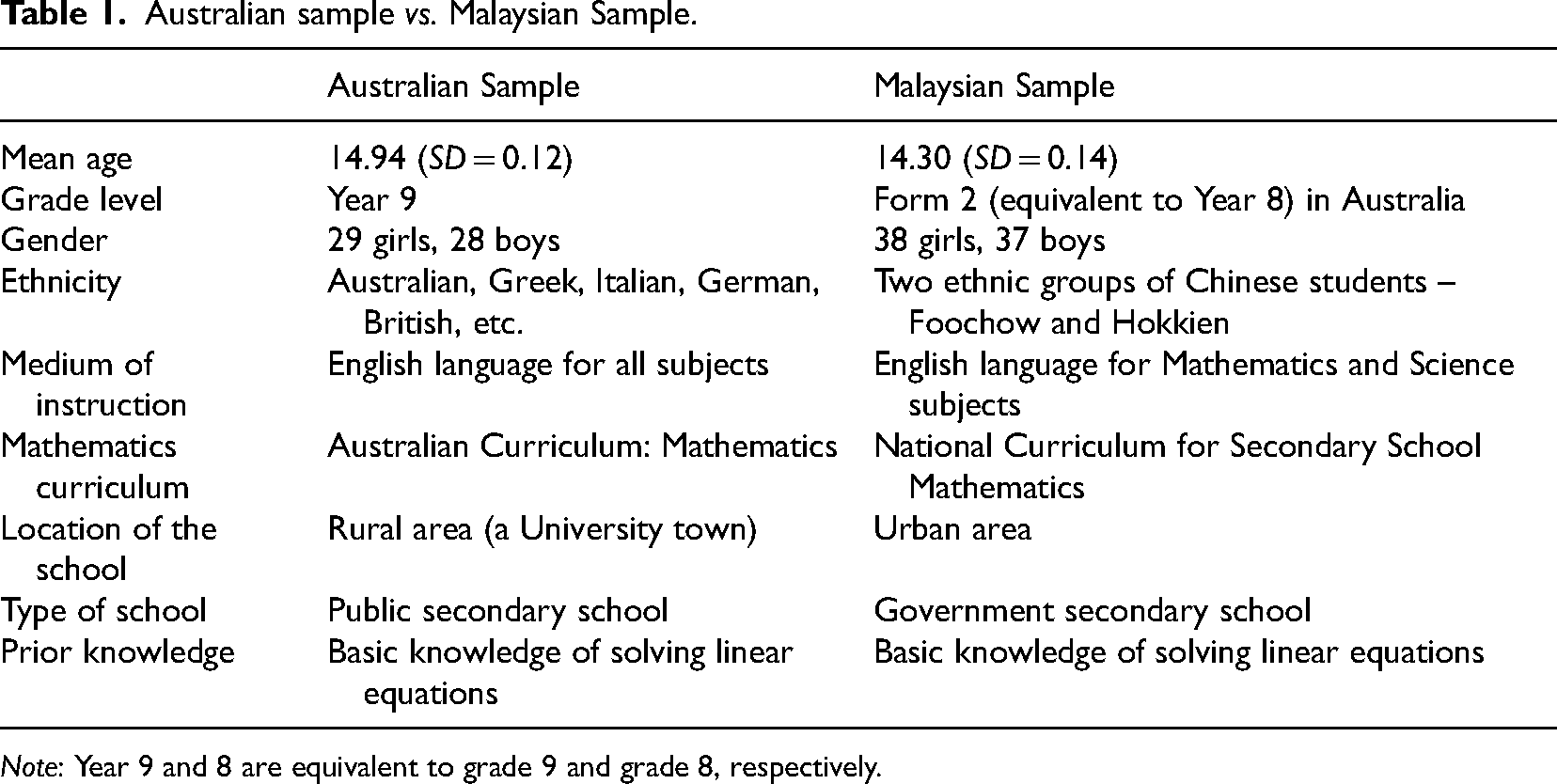
Australian sample vs. Malaysian Sample.
Note: Year 9 and 8 are equivalent to grade 9 and grade 8, respectively.
The materials used were adapted from a previous study (Ngu et al., 2021), which consisted of a pretest that has identical number and type of linear equations as the posttest, an instruction sheet, acquisition problems, and a concept test. The instruction sheet (Appendix) provided the definition of a linear equation, explained the solution procedure of linear equations, scaffolded the balance operation and the inverse operation, and presented four worked examples. For the balance method, a balance scale was used to scaffold the balance operation. Moreover, each worked example had a prompt “–2 on both sides” (Appendix) to assist students to apply the balance operation appropriately in the context of solving linear equations.
For the inverse method, we scaffolded the inverse operation such as 5 + 2 = 7 is the same as 5 = 7 – 2. Building on students’ prior knowledge of primary numeracy education, we expected them to understand the “=” sign concept where the application of an inverse operation (i.e., conceptualize +2 as the inverse operation of –2) would preserve the equality of the equation. Moreover, each worked example included a prompt “+2 becomes –2” as well as an arrow to show how to conceptualize an inverse operation (Appendix). We expected the prompts to help students apply the inverse operation appropriately when solving linear equations. It should be noted that academic success in senior mathematics education (e.g., differentiation and integration in calculus) requires a sound understanding of the inverse operation (Ding, 2016).
There were 16 one-step and two-step linear equations in the pretest (or posttest) (Appendix). Of the 16 linear equations, nine were one-step equations (e.g., 31 – m = 16), and seven were two-step equations (–7 + 3p = 11). We classified “31 – m = 16” as a one-step equation based on a popular mathematics textbook that has been used in Australia (McSeveny et al., 2004, p. 245). One may query that the linear equations with a negative pronumeral (e.g., 31 – m = 16) require the application of two balance operations, and, thus, this involves more than one solution step (Ngu & Phan, 2016): –31 + 31– m = –31 + 16 (–31 on both sides, first step), – m = 15 (divide –1 on both sides, second step). Instead of using the balance method, the inverse method has the flexibility by which one could apply two inverse operations concurrently to both sides of the linear equation: 31 – 16 = m (–m becomes m, 16 becomes −16, first step), 31 – 16 = m (simplify the answer, second step) (Ngu & Phan, 2022).
For the pretest and posttest, each correct solution was assigned one point with or without the solution steps provided. We chose to ignore computational errors. However, no point was assigned if a student made a conceptual error—for example, when solving 6 – k = 0, a student wrote +6 on both sides, which is incorrect. The acquisition problems (Appendix) comprised 12 example-problem pairs, and each pair consisted of a worked example paired with a practice problem that shares a similar problem structure (Reed, 1987).
There were eight example-problem pairs in relation to one-step equations, and the remaining were two-step equations. We graded the six practice problems only. Again, in this case, one point was assigned for a correct solution. For the concept test, for example, we assigned one point if a student could accurately judge 2x + 6 = 5 and 2x + 6 – 6 = 5–6 as being equivalent (Appendix). The first question required students to indicate the meaning of the “=” in the linear equation, x + 6 = 11. The answer was graded correctly if students wrote “the same as, equal” (Asquith et al., 2007). We did not analyze the result for the first question because only some students answered this question. The second question assessed students’ understanding of the “=” sign after they had applied the balance operation or inverse operation. Of the eight pairs of equations, five pairs involved the balance operation, and three pairs involved the inverse operation. For example, we assigned one point if students could accurately judge 2x + 6 = 5 and 2x + 6 – 6 = 5 – 6 as equivalent (Appendix). To encourage consistency in terms of grading, only one of the authors who is a mathematics educator and a mathematics teacher from a participating school graded the assessment tasks. The interscorer reliability for 25% of the sample was about .96. We resolved inconsistency through discussion.
Procedure
We obtained ethics approval from relevant authorities prior to the collection of data. Two of the authors in Australia collected the data in Australia with the assistance of two mathematics teachers. In a similar vein, two local mathematics teachers together with the two co-authors from Malaysia collected data in Malaysia. We used the same selection process (i.e., recruitment of participants) and the same experimental procedure across the two countries. We identified the targeted participants, sought consent for voluntary participation, and then randomly assigned participating students in each class to either the balance group or the inverse group.
For the Australian sample, the balance group had 29 students, and the inverse group had 28 students. For Malaysian students, the balance group had 37 students, and the inverse group had 38 students. We distributed the written task for each phase and collected it when the allocated time to complete the task had elapsed with one exception—the instruction sheet was collected after the acquisition phase. We informed the students to review their work if they finished earlier than the allocated time for the task.
We gave a briefing to all participating students about the experiment. We informed the students that the purpose of the experiment was to help us understand how to assist students, in general, learn linear equations. They were required to complete a number of written tasks individually and not to discuss the tasks with their classmates. Each task had a specific allocated time for them to complete: (i) a pretest (10 min), (ii) an acquisition phase that consisted of an instruction sheet (5 min), acquisition problems (15 min), (iii) a posttest (10 min), and (iv) a concept test (10 min). We encouraged the students to try their best to complete the written tasks and, likewise, informed them that their responses (i.e., correct or incorrect) would not count toward their school results. They were advised to read the instructions carefully, which appeared on the first page of each task before working on the task. They could seek help if they had trouble understanding the materials in the instruction sheet and acquisition problems; but they could not seek assistance to solve the practice problems.
Prior cognitive load research (Carroll, 1994; Chen et al., 2015; Cooper & Sweller, 1987; Kalyuga et al., 2001; Ngu et al., 2018a) has implemented variable intervention lengths to ensure that participants complete various tasks, which could take approximately one hour to complete. On this basis, likewise, we implemented an approximately 1-hour intervention, consisting of various learning tasks to examine the comparative effectiveness of the balance method vs. the inverse method for learning to solve linear equations. The experimental procedure consists of a number of steps in a sequential order: (i) all of the students sat for a pretest, (ii) all of the students studied their respective instruction sheets and then completed their respective acquisition problems (Appendix), (iii) all of the students sat for the posttest, and (iv) all of the students completed the concept test. Identical time duration and learning tasks were allocated to both the balance group and the inverse group. The only difference between the two groups, however, was in the design of the respective worked examples (i.e., balance method vs. inverse method) in the acquisition phase. We speculated that learning would predominately occur for both cohorts when the students completed the acquisition problems (i.e., study a worked example paired with a practice problem across multiple example-problem pairs), though they could also learn from studying the materials in the instruction sheet.
Results
As noted earlier, we performed a univariate ANOVA test for the pretest to determine group equivalence across Australian students and Malaysian students. We used 2 (country: Australia vs. Malaysia) × 2 (method: balance vs. inverse) to analyze performance on the practice problems, posttest, concept test, balance operation, and inverse operation. We used follow-up pairwise comparisons to examine performance between the balance group and the inverse group for each country (e.g., Australia) separately, as well as between the two countries. The means and standard deviations of the pretest, practice problems, posttest, and concept test are presented in Table 2.
Means (proportion) and standard deviations of the pretest, practice equations, posttest, and concept test.
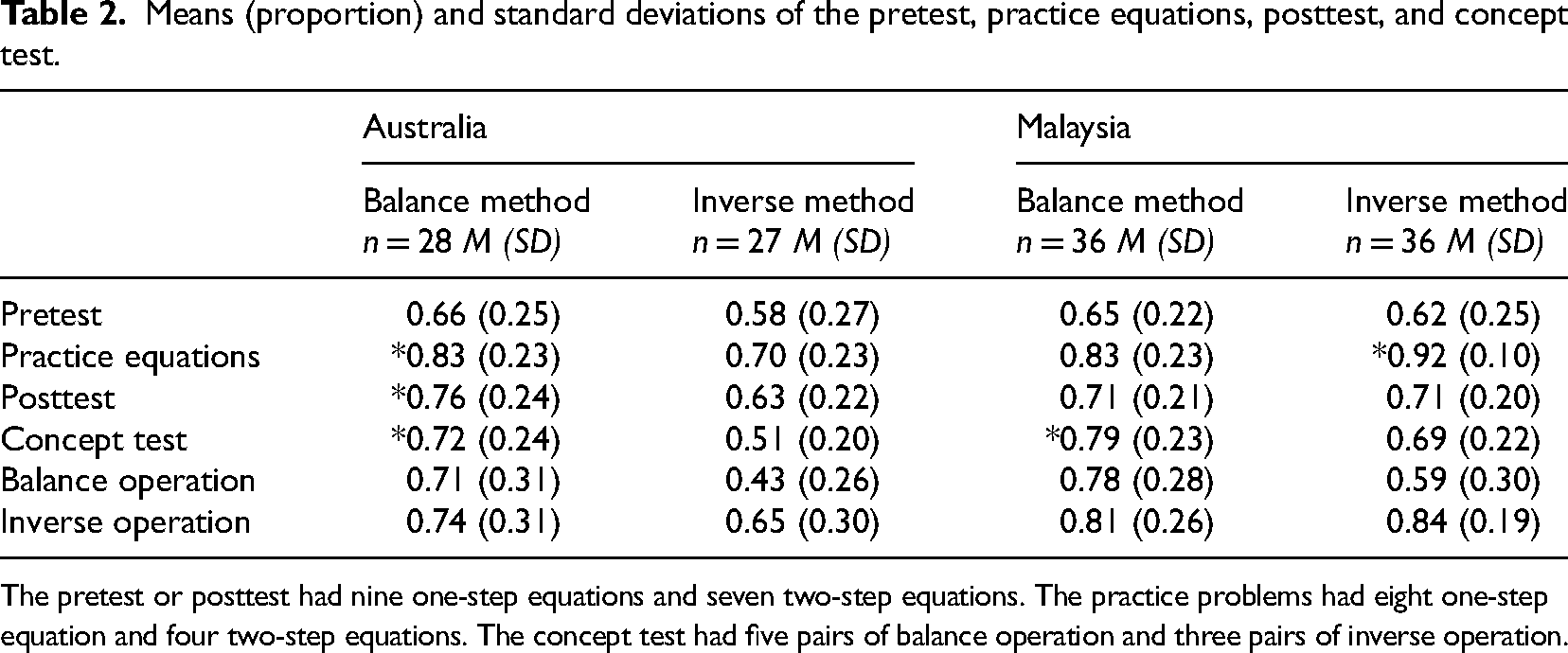
Means (proportion) and standard deviations of the pretest, practice equations, posttest, and concept test.
The pretest or posttest had nine one-step equations and seven two-step equations. The practice problems had eight one-step equation and four two-step equations. The concept test had five pairs of balance operation and three pairs of inverse operation.
The respective Cronbach's alpha values for the pretest were .86 for Australian students and .84 for Malaysian students. Using the univariate ANOVA test, differences were not found between the balance method and inverse method for Australian students, F(1, 123) = 1.46, p = .23, partial η2 = 0.01, and Malaysian students, F(1, 123) = 0.33, p = .57, partial η2 = 0.00. Furthermore, the Australian students and Malaysian students did not differ with respect to the balance method, F(1, 123) = 0.02, p = .88, partial η2 = 0.00, and the inverse method, F(1, 123) = 0.36, p = .55, partial η2 = 0.00. Thus, there was no statistically significant difference between the balance group and inverse group with respect to individual countries and between two countries prior to intervention.
We hypothesized that prior exposure to the balance method (i.e., for Australian students) and the inverse method (i.e., for Malaysian students) would impact on comprehension and learning of linear equations. As such, we analyzed the strategies (e.g., the balance method) used in the pretest for both Australian and Malaysian students. For the Australian cohort, about 48% of the students used the balance method to solve the linear equations, whereas the remaining provided answers but did not show the solution steps. For the Malaysian cohort, in contrast, 50% used the inverse method, 19% used the balance method, and the remaining provided answers without showing the solution steps.
Practice problems
The respective Cronbach's alpha values for the balance method and the inverse method were .87 and .78 for Australian students and .84 and .51 for Malaysian students. The rather low Cronbach's alpha value for the inverse method could have been caused by our removal of item 5, which had zero variance. The main effect of the country was statistically significant, F(1, 123) = 9.50, p < .001, partial η2 = 0.07. The main effect of the method was statistically nonsignificant, F(1, 123) = 0.30, p = .59, partial η2 = 0.00. The country × method interaction effect was statistically significant, F (1, 123) = 9.28, p < .001, partial η2 = 0.07. Within individual countries, we hypothesized that differential performance would favor the inverse group due to the lower level of element interactivity of the inverse operation, regardless of whether they were Australian students or Malaysian students. As revealed in Figure 2a, contrary to the hypothesis, the balance group outperformed the inverse group (p = .02) for Australian students. As hypothesized, for Malaysia students, the inverse group marginally outperformed the balance group (p = .06). Viewing the two countries together, contrary to the hypothesis, both the Australian students and the Malaysian students did not differ with respect to the balance method (p > .05); but the Malaysian students outperformed the Australian students with respect to the inverse method (p < .001), supporting our hypothesis (Figure 2a).
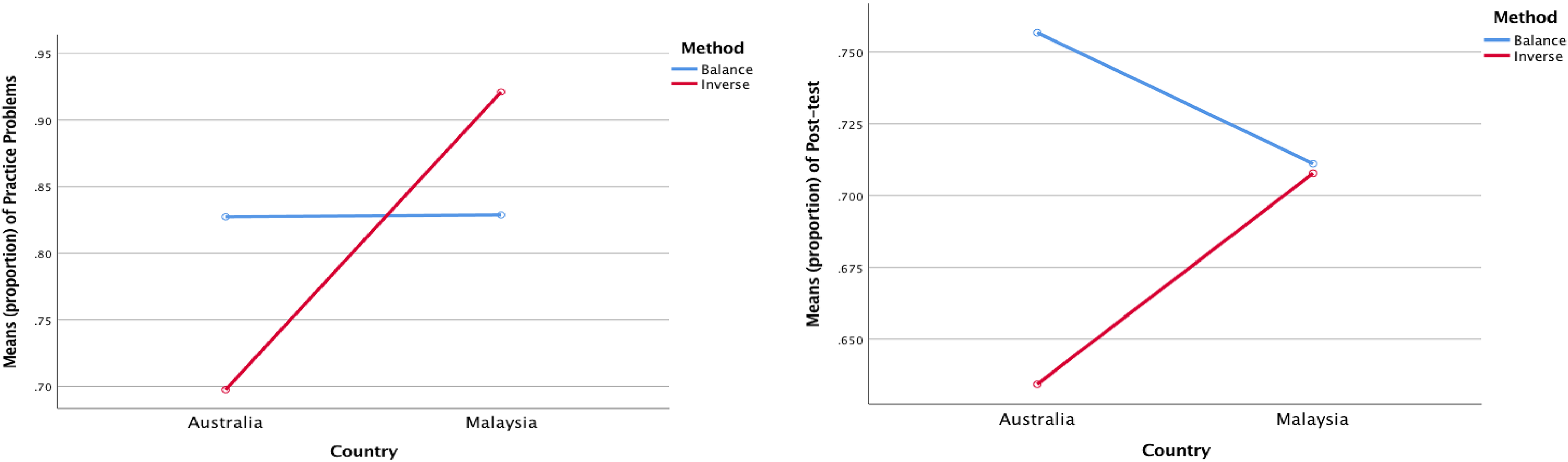
2 (country) × 2 (method) analysis of variance (ANOVA) on (a) practice problems and (b) posttest.
Cronbach's alpha values for the posttest were .84 and .78 for Australian students and Malaysian students, respectively. Statistically nonsignificant differences were found for the main effect of the country, F(1, 123) = 0.18, p = .67, partial η2 = 0.00; main effect of the method, F(1, 123) = 2.51, p = .12, partial η2 = 0.02; and the country × method interaction effect, F(1, 125) = 2.51, p = .12, partial η2 = 0.02. Consider each country separately, contrary to the hypothesis, for Australian students, the balance group outperformed the inverse group (p = .04), and the balance group and the inverse group did not differ statistically for the Malaysian students (p > .05) (Figure 2b). Examining two countries together, the Australian students and the Malaysian students neither differed with respect to the balance method (p > .05) nor with respect to the inverse method (p > .05). Such results do not support our hypothesis.
Concept test
The Cronbach's alpha value for the concept test was .64 for Australian students and .69 for Malaysian students. A statistically significant main effect for the country was observed, F(1, 123) = 9.21, p < .001, partial η2 = 0.07, and a statistically significant main effect for the method was found, F(1, 123) = 14.47, p < .001, partial η2 = 0.11. However, the country × method interaction effect was statistically nonsignificant, F(1, 125) = 1.54, p = .22, partial η2 = 0.01. Viewing individual countries separately, contrary to the hypothesis, which stated that differential performance would favor the inverse group owing to the lower level of element interactivity of the inverse method, the balance group outperformed the inverse group for both Australian students (p < .001) and Malaysian students (p = .05) (Figure 3a). Examining the two countries together, as hypothesized, the Malaysian students outperformed Australian students with respect to the inverse method (p < .001). But contrary to our hypothesis, no statistically significant difference between the Australian students and Malaysian students was observed with respect to the balance method (p > .05).
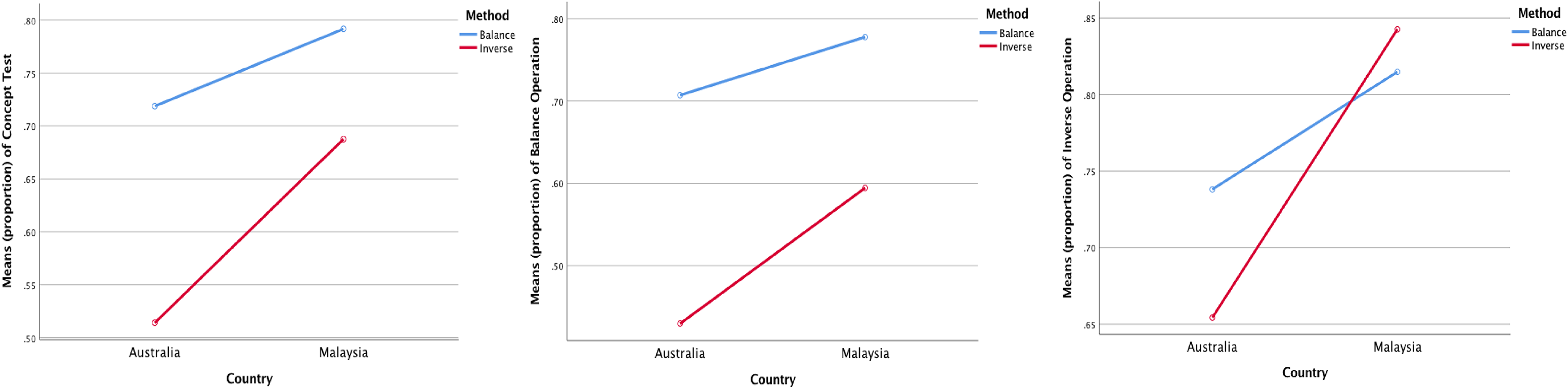
2 (country) × 2 (method) analysis of variance (ANOVA) on (a) concept test, (b) balance operation, and (c) inverse operation.
The main effect of the country was statistically significant, F(1, 123) = 5.17, p = .03, partial η2 = 0.04. The main effect of the method was statistically significant, F(1, 123) = 19.81, p < .001, partial η2 = 0.14. The country × method interaction effect was statistically nonsignificant, F(1, 123) = 0.83, p = .37, partial η2 = 0.01. Considering each country separately, the balance group outperformed the inverse group for both Australian students (p < .001) and Malaysian students (p = .01) (Figure 3b), supporting our hypothesis. Viewing the two countries concurrently, no statistically significant difference between Australian students and Malaysian students was observed with respect to the balance method (p > .05). Such results do not support the hypothesis.
Inverse operation
A statistically significant main effect of the country was observed, F(1, 123) = 8.02, p = .01, partial η2 = 0.06. Neither the main effect of the method, F(1, 123) = 0.36, p = .55, partial η2 = 0.00, nor the country × method interaction effect, F(1, 123) = 1.42, p = .24, partial η2 = 0.01, was statistically significant. With reference to individual countries, the inverse group and the balance group neither differed for Malaysian students (p > .05) nor for Australian students (p > .05). Such results do not support our hypothesis, which stated that the inverse group would outperform the balance group for the inverse operation. Viewing the two countries together, in line with our hypothesis, the Malaysian students outperformed the Australian students with respect to the inverse method (p = .01) (Figure 3c).
Discussion
Within the framework of cognitive load theory (Sweller et al., 2011; Sweller et al., 2019), the present study investigated the relative effectiveness of both the balance method and the inverse method on students’ learning of one-step and two-step linear equations across cross-cultural settings (i.e., Australia vs. Malaysia). Theoretically, for each operation line, the balance operation (e.g., +2 on both sides) incurs twice the level of element interactivity as the inverse operation (e.g., –2 becomes +2). Consequently, we argue that the differential level of element interactivity would favor the inverse operation of learning. Overall, then, we tested this hypothesis across two sociocultural-learning contexts: Australia and Malaysia.
From the present study, for Australian students, the advantage of the balance group over the inverse group was evidenced across the practice problems, posttest, and concept test. This evidence, interestingly, contradicts our original hypothesis and is not consistent with existing findings in which the inverse group outperformed the balance group in Malaysia (Ngu et al., 2015; Ngu et al., 2018a). It is possible that such results stem from the impact of Australian students’ prior exposure to the balance method (Ngu et al., 2021)—as noted here, 48% of the Australian students used the balance method in the pretest. Surprisingly, for Malaysian students, the balance group outperformed the inverse group for the concept test. Presumably, an emphasis on the “balance concept” within the balance method could have assisted the balance group to gain a greater understanding of the “=” sign concept.
For Australian students, the advantage of the balance group over the inverse group did not extend to an advantage of Australian students over Malaysian students with respect to the balance method across the practice problems, posttest, and concept test. In line with our hypothesis, the Malaysian students outperformed the Australian students with respect to the inverse method for the practice problems and concept test. The Malaysian students’ prior knowledge of the inverse method could have influenced such learning outcomes—for example, 50% of the Malaysian students used the inverse method in the pretest.
In line with our expectation, exposure to the balance method had enabled the balance group (Australia or Malaysia) to outperform the inverse group for the balance operation. Contrary to our expectation, exposure to the inverse method did not assist the inverse group (Australia or Malaysia) to outperform the balance group for the inverse operation. Comparing the two countries, performance on the balance operation did not favor the Australian students with respect to the balance method. However, in line with our hypothesis, performance on the inverse operation favored the Malaysian students with respect to the inverse method.
In summary, there are two main findings for consideration. For Australian students, performance favored the balance group, which contradicts prior studies in which the inverse group outperformed the balance group (Ngu et al., 2015; Ngu et al., 2018a). Consistent with prior research, however, differential performance favored the Malaysian students with respect to the inverse method (Ngu et al., 2019). We reasoned that, perhaps, prior knowledge of the balance method for the Australian students and the inverse method for the Malaysian students could, indeed, influence their subsequent learning experiences of linear equations.
Theoretical and research consideration
From a cognitive load perspective (Sweller et al., 2011; Sweller et al., 2019), the present study has emphasized the importance of the concept of element interactivity (Chen et al., 2017), which may help to discern the complexity of linear equations. Element interactivity, in this sense, enables us to classify linear equations hierarchically by using the number of relational and operational lines. Such discourse, significantly, may offer useful insights for mathematics educators to identify challenges that are associated with the learning of one-step and two-step linear equations. Furthermore, as existing research has shown, the notion of “level of element interactivity” can also distinguish the relative effectiveness of different instructional methods for usage (e.g., the balance method vs. the inverse method). As noted earlier in our discussion, Australian students tend to struggle with the solving of linear equations, as evidenced by the generation of multiple errors (Steinle et al., 2022). Given that the level of element interactivity favors the inverse method of learning, mathematics educators may wish to explore the use of this instructional method to assist students to overcome challenges that are associated with learning to solve linear equations.
We advocate for the advancement of our research inquiry, which considers the importance of the comparative effectiveness of different instructional methods. Central to this advocation, we contend, is the inclusion of cognitive load theory (Sweller et al., 2011; Sweller et al., 2019), which may help to provide a theoretical framework for the design of different instructional methods for usage. Over the past several years, researchers have situated cognitive load theory (Sweller et al., 2011; Sweller et al., 2019) within other theoretical concepts, inquiries, and contexts—for example, the importance of cognitive load theory and “achievement of optimal best” (Phan et al., 2017), “the negative impact of cognitive entrenchment” (Phan & Ngu, 2021a), and “the relevance of perceived optimal efficiency” (Phan & Ngu, 2021b). As such, researchers may wish to use cognitive load theory as a basis to conceptualize other instructional methods for future inquiries—for example, how does one's cognizance of a need to maximize optimal efficiency (Phan & Ngu, 2021b) influence his design of appropriate instructional methods for usage, which take into account the relevance of cognitive load theory?
Practical implication
How can mathematics educators use our findings to inform their classroom practices? By the end of the day, regardless of whether one chooses to use the balance method or the inverse method for learning, it is important to consider the notions of efficiency and effectiveness. Maybe a complementary use of both the balance method and the inverse method would showcase and demonstrate effective learning (e.g., better comprehension). From our point of view, introducing the use of the relational line and the operational line to describe the solution procedure of linear equations could help students to distinguish the interplay between both conceptual knowledge and procedural knowledge in the solving of linear equations. Exposing students to the balance method and the inverse method (Figure 1), via means of learning by comparison (Rittle-Johnson et al., 2017), likewise, may assist them to gain an in-depth understanding of the role of the “=” sign concept with respect to the relational line and operational line.
To reiterate, it is not our intention to specifically confirm that the balance method is superior to the inverse method or vice versa. To a certain degree, we contend, personal preference for a particular instructional method (e.g., the balance method) may arise from several factors—for example, a student's educational history (e.g., the student was taught using a particular instructional method from an early age), a teacher's personal teacher training, which emphasizes the importance of a particular instructional method. As mathematics education researchers, we are interested to seek new educational and research frontiers for development (e.g., establishing a new theoretical tenet for consideration). As a possibility, for example, we advocate for a formal reform of different mathematics curricula (e.g., Australian Years 7-10), which could consider the use of both relational line and operational line in order to improve middle school students’ acquisition of linear equations. By the same token, we recommend exposing pre-service teachers to a myriad of comparative instructional methods of teaching linear equations (e.g., the balance method vs. the inverse method) in higher education institutions.
Limitations and future directions
Despite the advent of our research development, as attested in the present article, we contend that there are several caveats that are noteworthy for consideration. We attain some unexpected findings, which we attribute to the impact of prior knowledge of the participating students (e.g., with reference to individual countries, the inverse group and the balance group neither differed for Malaysian students [p > .05] nor for Australian students [p > .05]). The advantage of the inverse method over the balance method has been observed in prior studies (e.g., Ngu et al., 2015) where participants have no prior knowledge of having used a formal instructional method (e.g., balance method) for solving linear equations. It is therefore of interest, theoretically and empirically, to replicate the same study with students who have no prior knowledge of solving linear equations using the balance method or the inverse method. Furthermore, previous research has shown that the inverse method is better than the balance method for complex and not simple linear equations (Ngu & Phan, 2022). Thus, researchers could consider a comparison between the balance method and the inverse method on learning to solve complex linear equations (e.g., linear equations with negative pronumerals) across different sociocultural-learning contexts.
We premise that there is a need for researchers to consider other methodological designs that may capitalize on our existing methodological design for implementation. One notable shortcoming of the present study, in this case, entails our time limitation—that our methodological design was contextualized within one time point. It would be more insightful to include a delayed posttest after the in-class intervention (e.g., 6 months after the intervention) to measure and assess the comparative effectiveness of the balance method and the inverse method. This potential line of inquiry (e.g., including a delayed posttest 6 months after the intervention), we contend, is similar to existing motivational research studies, which seek to explore temporally displaced effects of psychological variables on achievement-related outcomes (e.g., the positive effect of Time 1 self-efficacy on Time 2 academic performance in mathematics) (e.g., Bong, 2001; Phan, 2014; Salmela-Aro & Upadyaya, 2014).
Parametric statistics require the fulfillment of assumptions of multivariate normality (Tabachnick & Fidell, 2019). We performed preliminary statistical analyses to ensure that our data satisfied the assumptions of ANOVA (e.g., normality, homogeneity of variance). Using the G*Power statistical analysis, we obtained a sample size of 127 students, which is one student less than the minimum requirement of 128 participants, based on a priori power calculation for an effect size, f = 0.25 for power = 80% and Type I error rate = 5%. The Levene's test of equality of variances, likewise, indicated that the assumption of homogeneity of variance has been met for all dependent variables (p > .05) with the exception of the practice problems (p < .05). We acknowledge, however, that the reliability of the present results could be improved by the following: (i) increase the sample size by collecting data from multiple schools and, if possible, multiple grade levels for the purpose of comparison (e.g., grade level comparison × school comparison) and (ii) include a qualitative component (Esterberg, 2002; Lofland et al., 2006; Maxwell, 2005), which could help to support empirical findings derived from statistical analyses. For example, performing qualitative analysis to examine the misconceptions/errors made by students as well as the impact of the prior knowledge upon students’ strategy use (i.e., balance method or inverse method) to solve linear equations.
Conclusion
Overall, then, differing from existing research inquiries (Ngu et al., 2015; Ngu et al., 2018a), the present cross-cultural study has yielded some interesting theoretical insights for advancement—for example, it does not support the hypothesized advantage of the inverse method over the balance method from a cognitive load perspective (Sweller et al., 2011; Sweller et al., 2019), irrespective of students in different sociocultural-learning contexts (e.g., Australian students or Malaysian students). Having said this, however, the present study does support the proposition that differential performance between the two countries favors the Malaysian students with respect to the inverse method.
It appears that a student's prior knowledge (i.e., balance method vs. inverse method) contributes and, in this case, accounts for her learning outcomes. Nevertheless, as our findings have affirmed, it is important for educators and researchers to explore new instructional methods that may help to enhance students’ learning experiences of linear equations. The inverse method has the potential to complement the balance method or to serve as an alternative instructional method for effective learning of linear equations, given that it imposes a lower level of element interactivity than the balance method. A good starting point is to strengthen students’ knowledge of the inverse operation in primary mathematics education.
Footnotes
Contributorship
Bing Hiong Ngu and Huy P. Phan: design, conceptualization, data collection, data analysis and interpretation of results, and write-up of this manuscript. Kian Sam Hong and Hasbee Usop: data collection. All authors contributed to the article and approved the submitted version.
Declaration of Conflicting Interests
The author(s) declared no potential conflicts of interest with respect to the research, authorship, and/or publication of this article.
Funding
The author(s) received no financial support for the research, authorship, and/or publication of this article.
Informed consent
The authors obtained ethics clearance from the Research Ethics Committee, University of New England (Approval Number: HE13–262) prior to data collection. The participants provided written consent to participate in the study.

Correction (October 2023):
Article updated to correct reference “Vicki et al., 2022 as “Steinle et al. 2022” in the text citation and “Vicki S., Kaye S., Beth P. (2022)” has been changed as “Steinle, V., Stacey, K., & Price, B (2022)” in the reference list.
Correction (October 2024):
Article updated to add Informed consent section.