




Abstract
Students enjoy mathematics less as they move through their schooling and this may be reflective of more negative attitudes towards learning mathematics in general; although not necessarily less valuing of mathematics as a discipline. However, little is known about how stage of schooling influences the relationship between viewing mathematics as problem solving and student attitudes towards mathematics. To address this gap, 123 Australian primary and secondary students identified by their teachers as underachieving in mathematics completed a questionnaire exploring their attitudes towards, and views of, mathematics. We found that although attitudes towards mathematics became more negative as year level increased, this was entirely driven by students enjoying mathematics less; neither their valuing of mathematics, nor their ability to cope with mathematics declined. Similarly, the extent to which students held a problem-solving view of mathematics was unrelated to stage of schooling. Interestingly, however, we also found that students who viewed mathematics as being fundamentally about problem solving were more likely to value mathematics as a discipline, and that this was particularly the case for secondary school students. We discuss how providing opportunities for secondary school students, including underachieving students, to engage with open-ended problem-solving tasks may lead to perceptions of mathematics as useful, purposeful, and important.
Keywords
Introduction
Student attitudes towards mathematics were defined by Neale (1969) as “a liking or disliking of mathematics, a tendency to engage in or avoid mathematical activities, a belief that one is good or bad at mathematics, and a belief that mathematics is useful or useless” (p. 632). Chapman (2003) operationalized Neale's definition of attitudes through developing and validating a 10-item measure of attitudes towards mathematics. Chapman's measure comprised three sub-components: student enjoyment of mathematics; student valuing of mathematics as a discipline; and student capacity to cope with mathematical work. The current study explored how student attitudes towards mathematics, as operationalized by Chapman, are influenced by the extent to which students’ view mathematics as problem solving, and whether stage of schooling influences this relationship.
Past research has revealed that attitudes towards mathematics such as feeling enjoyment, feeling capable of learning mathematics, or perceiving mathematics as useful, have been positively associated with mathematics achievement (Abin et al., 2020; Grigg et al., 2018; House, 2006; Pinxten et al., 2014). Furthermore, a student's perceived capabilities have been shown to be just as important as a student's actual abilities for explaining their mathematics achievement (Abin et al., 2020). However, there is evidence that competence beliefs in mathematics decrease with grade level from primary through secondary schooling (Jacobs et al., 2002). Ma and Kishor (1997) reported on a meta-analysis of attitudes towards mathematics and achievement and concluded that the relationship was causal in the direction of attitudes to achievement but that this was stronger for secondary students. For example, House (2006) found that nine-year-old Japanese (n = 10,070) and American (n = 8,220) students who reported that they enjoyed learning mathematics, tended to perform better in mathematics. Furthermore, studies have shown that the more confident students believed they were in learning mathematics the more likely they were to engage and apply effort to the learning activities (Cheeseman & Mornane, 2014; Valeski & Stipek, 2001). By contrast, students who have been identified as disengaged with learning mathematics tend to achieve at a lower level (Hancock & Zubrick, 2015). Given the association between attitudes to learning mathematics and achievement, it is likely that promoting positive attitudes towards learning mathematics will have an impact on mathematics achievement, and this may be greatest for students who are low performing or underachieving.
Much research has reported that teaching mathematics through approaches that involve problem solving, inquiry, or open tasks have been found to improve students’ attitudes to mathematics and a change in belief about the nature of mathematics (Boaler, 1998; Carmenzuli & Buhagiar, 2014; McGregor, 2014; Russo et al., 2021), and this was also true for students identified as low performing in mathematics (Gervasoni et al., 2021; Taylor, 2009). For example, Taylor (2009) reported on the change in beliefs about mathematics of low performing students in seventh and eighth grade who participated in a summer make up course to pass into the next grade. After a 5-week course that incorporated “rich open-ended problems” (p. 105), students were more likely to agree that mathematics is useful and relevant and that they were capable of solving time-consuming mathematics problems.
Given the evidence that teaching mathematics through a problem-solving approach has the potential to improve students’ attitudes and ultimately outcomes in mathematics, the current study sought to understand the extent to which students who were identified by their teacher as underachieving in mathematics viewed mathematics as problem solving. Previous research into how students’ attitudes to learning mathematics changes across the years of schooling has generally involved heterogeneous groups of students, adopting either cross-sectional (Deieso & Fraser, 2019; Mason, 2003; Thomson et al., 2004), or longitudinal (Fredricks & Eccles, 2002; Jacobs et al., 2002; Watt, 2004; Wilkins & Ma, 2003) study designs. By contrast, the current study examines how attitudes towards mathematics differ across the primary and secondary years of schooling amongst a cohort of students identified by their teachers as underachieving.
Background literature
Underachievement
The notion of underachievement in an academic context can be understood as the difference between a student's academic potential and their actual academic output (Gallagher, 2005). Considerable research into underachievement has focused on gifted and talented students in particular, however it has been demonstrated that the notion of underachievement is salient across all levels of cognitive functioning (Preckel et al., 2006). Although a somewhat fraught concept, given the difficulty operationalizing notions such as “potential” and capacity (Clark, 2002), underachievement is nonetheless an important consideration, from both a utilitarian and personal well-being perspective (Hans, 2014). To the extent that achieving below one's potential leads to lower productivity than would otherwise be the case, society is worse off (Davis & Rimm, 1998); and to the extent that an individual is unable to actualize their personal objectives, the individual is worse off (Reis & McCoach, 2000). Underachievement has been associated with negative attitudes towards the learning environment and a lack of motivation to learn and to succeed academically (Lamanna et al., 2019). Consequently, inquiring into the learning experiences of underachieving students, including within mathematics education, appears to be a worthwhile research endeavor.
Within the context of the current study, we operationalize underachieving students in mathematics in line with the selection criteria put forward in the Getting Ready in Numeracy (GRIN) intervention program (Kalogeropoulos et al., 2020a, 2020b). Specifically, the notion of underachieving students in mathematics refers to those students:
who are somewhat disengaged from their mathematics learning, such that this disengagement stems from gaps in content knowledge, rather than additional issues beyond the mathematics classroom (e.g., significant behavioral issues); who are currently below average performers however do not have a mathematics learning disability (e.g., students in second bottom quintile for mathematics performance); for whom their mathematics teacher believes could “catch up” to (or even surpass) their average performing peers with additional, time-limited supports being made available (e.g., over 6–12 months).
From this definition, we distinguish underachieving students from low-performing students. In the research literature, low-performing students are usually identified through the administration of a standardized test, as those students who fail to meet some form of minimum standard (Han et al., 2015), or whose performance places them in, for example, the bottom quartile (Pedersen et al., 2022).
Attitudes to mathematics learning
Enjoyment has been described as one of the indicators of emotional engagement (Skinner, 2016) and is a strong intrinsic motivator for engaging in mathematics tasks (Middleton & Spanias, 1999). That is, students engage with mathematics because it is enjoyable or interesting. Furthermore, the extent to which students enjoy learning mathematics has been shown to be associated with both effort in mathematics (Pinxten et al., 2014) and achievement (House, 2006). However, not all students claim to enjoy learning mathematics (Markovits & Forgasz, 2017; Way et al., 2015) and this may be related to a range of factors including: teacher characteristics, teaching characteristics, classroom characteristics, assessments, achievement and the individual (Goodykoontz, 2008). With regards to teaching characteristics, the use of problem solving, or inquiry, approaches have been shown to improve students’ enjoyment of learning mathematics (Carmenzuli & Buhagiar, 2014; McGregor, 2014; Russo et al., 2021).
There is a long-standing recognition that values are central to school education (Clement, 2010; Halstead, 1996). DeBellis and Goldin (2006) suggested that values are “personal truths” (p. 135) that motivate our short-term priorities and long-term decisions. Seah (2019) argued that values should be considered as conative variables, given that they are predictors of decisions and actions. In Seah's (2019) model, conative values and motivation act as a bridge between cognition and affect, on the one hand, and behavior on the other. It has been suggested that values might be useful for facilitating students’ understanding and engagement in mathematics (Barkatsas et al., 2018).
Valuing the outcome of learning mathematics corresponds to being motivated extrinsically. One example of such extrinsic motivation is utility value (Wigfield & Eccles, 2000), which refers to how important or useful the subject of mathematics is to a student. In an international study, Mullis et al. (2012) measured the extent to which 8th grade students valued mathematics as a discipline or believed that it had utility, using Likert type scales and statements such as, “I think learning mathematics will help me in my daily life” and “It is important to do well in mathematics” (p. 329). Similarly, Gaspard et al. (2017) used items such as, “What we learn in mathematics is applicable to my daily life” and “Mathematics is important to me” (p. 82) to measure value beliefs in Grade 5 to 12 students (n = 830) in Germany. Items that address students’ views on how important it is to be good at mathematics and how useful mathematics is, have also been used with lower primary students (Jacobs et al., 2002). Others have investigated what students’ value about mathematics or mathematics learning, such as: problem solving and mathematical understanding; discourse; effort; ICT; or recalling facts (see Barkatsas et al., 2019, for a full list of categories). The current study has a focus on the former extrinsic motivator of utility value.
As explained previously, the term coping was proposed by Chapman (2003) to described one component of her attitude scale. She identified this component as being related to students’ confidence in learning a subject. Hence, we follow Chapman's definition and outline some literature around students’ confidence or self-efficacy when learning mathematics.
McLeod (1992) outlined a summary of the research on affect in mathematics in which beliefs, attitudes, and emotions constituted the main factors. However, he suggested there were other topics relevant to the affective domain that he referred to as “mini-theories” (p. 583). Some of these included confidence, self-concept, and self-efficacy. Though each of these were interrelated, he specifically reported the importance of studying students’ beliefs about their confidence in relation to the nature of mathematics. He defined confidence as “a belief in one's competence in mathematics” (p. 583) but advised that if someone viewed mathematics as purely about computation, rather than holding a conceptual or a problem-solving view of mathematics, then this would provide a different perspective of their view of their own competence. For example, Di Martino and Zan (2011) identified that perceived competence in mathematics could be related to success with respect to knowing rules and applying them; success with respect to understanding rules and why they work; or success with respect to academic achievement. Krapp (2005) argued that a person's view of their competence plays a crucial role in their orientation and motivation towards a subject.
Self-efficacy has been defined as “a student's judgement about their capabilities to perform specific math-related tasks” (Grigg et al., 2018, p. 74). It is unsurprising that many low achieving students have shown lower self-efficacy in mathematics than higher achieving students (Skilling et al., 2021). However, Skilling and colleagues (2021) noted that being engaged in learning, even for low achieving students, can contribute to more positive feelings about learning mathematics. The authors reported that low achieving students who claimed they were engaged with their mathematics learning also reported more positive feelings and persistence when learning mathematics. In contrast, low achieving students who were disengaged reported having negative emotions about learning mathematics such as feeling confused, hopeless, angry, or frustrated.
In summary, having positive attitudes such as feeling enjoyment, valuing mathematics and feeling competent in mathematics are often associated with greater engagement and ultimately greater achievement. However, these studies tend to report on heterogeneous groups, including contrasting high and low achieving students. Our aim is to investigate these attitudes amongst a group of students identified by their teachers as underachieving, and how they differ across years/stage of schooling.
Stage of schooling and attitudes towards mathematics
Previous studies (Fredricks & Eccles, 2002; Mullis et al., 2012) have found that stage of schooling is indeed related to student attitudes and, more broadly, their orientations towards mathematics. Overall students’ interest or enjoyment of mathematics and their perceived competence in mathematics has both been shown to decline over time and be less positive in the later years of schooling, whereas there is conflicting evidence as to whether their valuing of mathematics decreases, increases or remains relatively stable (Fredricks & Eccles, 2002; Gaspard et al., 2017; Jacobs et al., 2002). Each of the following studies described next report on a group or groups of heterogeneous students.
The Trends in International Mathematics and Science Study (TIMSS), a cross-sectional study involving 63 countries, found that fewer Grade 8 students reported liking mathematics than Grade 4 students (26% vs. 48%). Furthermore, although 34% of Grade 4 students expressed confidence in their ability to learn mathematics, this dropped to 14% for Grade 8 students (Mullis et al., 2012).
Jacobs et al. (2002) employed a longitudinal study involving a group of 761 students from Grade 1 to Grade 12 across eleven years (1989–1999) of schooling. The study showed that self-perceptions of competence and the value of mathematics tasks both declined across years of schooling. Indeed, they concluded that the decline in their beliefs about their competence in mathematics explained to a large extent the decline in values.
Another study that compared attitudes towards mathematics between the primary and secondary years showed similar disparities between attitudes. Using a modified version of the What is happening in this class? Likert type survey, Deieso and Fraser (2019) compared Australian students’ attitude towards mathematics in the last year of primary school (n = 207) and the first year of secondary school (n = 334). Their results indicated significant differences between each year level for three components of attitude. Specifically, compared with primary students, secondary students were less positive about doing mathematics through an inquiry approach in particular, had lower enjoyment in mathematics more generally, and greater mathematics anxiety.
In the United States, Fredricks and Eccles (2002) employed a longitudinal cohort-sequential design involving approximately 500 students (Years 1–12) to examine changes in mathematics interest, mathematics competence and valuing of mathematics. Somewhat in contrast to the TIMSS, it was found that although both interest in mathematics and perceptions of mathematical competence declined linearly as students moved through their schooling (i.e., from the beginning of primary school to the end of secondary school), their valuing of mathematics declined relatively rapidly in primary school and then stabilized through secondary school. In contrast, using a cross-sectional design, Gaspard et al. (2017) reported that utility value increased slightly in the upper primary grades, then decreased over the secondary years.
In the United States, Wilkins and Ma (2003) conducted a longitudinal study, investigating the change in attitudes and beliefs about mathematics of 3,116 students who were followed for six years from Years 7–12. The author reported that, overall, students’ negative attitudes towards mathematics increased with age. Similar results have been revealed in a study involving Australian students. Watt (2004), also adopting a longitudinal cohort-sequential design in a study involving over 1,300 Australian secondary students (Year 7–11), found that student self-perceptions with regards to their own mathematical talent declined in a linear fashion over time, whereas their intrinsic valuing of mathematics declined more steeply initially before stabilizing in the upper secondary years.
We have yet to find a study that investigates how the attitudes of underachieving students in particular differ across the years of schooling.
Students’ views of the nature of mathematics
There are different ways in which mathematics can be viewed. For example, Dossey (1992) described a dichotomy between external conceptions (a fixed body of concepts, facts, principles, and skills) and internal conceptions, whereby mathematics is personally constructed. Alternatively, Begg (2005) differentiated between a view that emphasized mathematics knowledge and procedures, and a view that emphasized processes such as reasoning, problem solving, and communicating. The current study considers the degree to which underachieving students focus on mathematics as problem solving.
Schoenfeld (1992) argued that students’ beliefs about mathematics are largely determined by their experiences of mathematics in the classroom. These beliefs subsequently shape a students’ behavior, potentially in a negative way. For example, in a study with college students, Schoenfeld reported many believed that if you understand the mathematics, you can solve any problem in 5 min or less; that mathematics problems have one and only one correct answer; and that there is only one correct way to solve any mathematics problem—using the rule that the teacher has most recently demonstrated to the class. He argued that students who believed this are likely to give up on a problem after a few minutes, even if they might have solved it had they persevered. Schoenfeld also demonstrated that teaching through problem solving can improve the ability of secondary students to think metacognitively, and this, in turn, increased students’ problem-solving success. Furthermore, he suggested that the cause of a students’ success or failure in a problem-solving attempt can be located in a person's mathematical knowledge, metacognition, self-regulation, and/or their belief system regarding mathematics.
Similar views have been found with primary students. Takeuchi et al. (2016) interviewed 131 Canadian children in Kindergarten to Year 2 students about their attitudes towards mathematics and their understanding of what mathematics constitutes. The authors found that, although the majority of children (70–75%) described enjoying/liking mathematics, they tended to hold very narrow views of mathematics that were largely procedural, describing mathematics as almost exclusively involving number concepts and performing number operations. In contrast, Di Martino's (2019) revealed that younger primary students (Years 1–2) held less stereotypical views of mathematical problems than older primary students (Years 3–5). Specifically, Di Martino described younger students as more likely to view problems as having multiple solutions, requiring sustained effort and persistence, and allowing for various problem-solving strategies and opportunities for collaboration.
It has also been shown that young students’ views of the nature of mathematics can be shifted. Gervasoni et al. (2021) surveyed approximately 300 Year 1 Australian students pre and post their participation in a mathematics intervention program. The small group intervention program focused on whole number learning, problem-solving and open tasks, and aimed to progress the learning of the children in the lowest quartile of the whole number growth-point scales as determined by the Mathematics Assessment Interview (Gervasoni et al., 2011). Gervasoni et al. (2021) reported that the intervention appeared to improve their disposition for learning mathematics. The survey, which included a set of 19 Likert-type items to assess change in dispositions and change in beliefs about the nature of mathematics, included two items that are relevant to the current study and students’ views about problem solving. These are:
Maths problems have one and only one correct answer. There is only one way to solve a maths problem.
The results showed that these students, who were prioritized for an intervention program because they were low performing in mathematics, were more likely to disagree with these statements in the post assessment. This may indicate that their experiences in the intervention program and the classroom had shifted their view of mathematics towards a problem solving or less traditional view of mathematics.
The current study
Synthesizing key findings from the literature, it has been well established that students enjoy mathematics less as they move through their schooling (Fredricks & Eccles, 2002) and that this may be reflective of more negative attitudes towards mathematics in general (Wilkins & Ma, 2003); although not necessarily less valuing of mathematics as a discipline (Mullis et al., 2012). However, little is known about how age and stage of schooling may influence the relationship between having a problem-solving view of mathematics and student attitudes towards mathematics, including their enjoyment, values, and capacity to cope with mathematics.
Consequently, in order to build on our understanding of the relationship between attitudes towards mathematics and the extent to which mathematics is viewed as problem solving amongst students identified as underachieving in mathematics, the current study investigated the following three research questions:
How do student attitudes towards mathematics (enjoyment, valuing, coping) differ across year/school level, amongst students identified as underachieving in mathematics? How does the extent to which students’ view mathematics as problem solving differ across year/school level, amongst students identified as underachieving in mathematics? How does the extent to which students’ view mathematics as problem solving relate to student attitudes towards mathematics (enjoyment, valuing, coping), amongst students identified as underachieving in mathematics? Moreover, does this relationship vary by school level? If so, how?
Method
The GRIN program, originally developed by Peter Sullivan, aims to reengage disengaged students by preparing them for the subsequent mathematics lesson. It involves students attending a tutoring session before their mathematics lesson multiple times per week, affording them an opportunity to work alongside a small group of peers with an appointed GRIN tutor. Students who are identified by their teachers as underachieving in mathematics are targeted for the program. However, the program is not designed for students who might have significant learning difficulties. Rather, schools are encouraged to try and select students who can realistically catch-up to their peers through the duration of their participation. See Kalogeropoulos et al. (2020b) for a comprehensive description of the program and its rationale.
Participants and procedure
Participants were drawn from 19 government, Catholic and independent, schools, including primary, secondary, and F-12 schools, across the state of Victoria (Australia), who were participating in GRIN in 2022. One hundred and twenty-three students selected for participation in the GRIN intervention completed an online questionnaire (Qualtrics) prior to their participation in the program at the beginning of the school year. See Table 1 for the breakdown by year level. The students ranged from 7 to 15 years old.
Number of participants by year level.

Number of participants by year level.
Overall, there were 63 primary students and 60 secondary students. The current study uses a cross-sectional data set to investigate how attitudes and beliefs about learning mathematics differ with stage of schooling.
Chapman (2003) developed and validated a Mathematics Attitude Scale that was suitable for primary aged children. The current study used this scale to measure students’ attitudes to mathematics (see Table 2). The instrument consisted of 10 Likert-type items which represented three subscales (Enjoyment, Value, and Coping). Chapman established the validity and reliability of the scale using a broad sample of 774 Australian primary school students employing factor analysis to identify the subcomponents of attitude. Although the third subscale that emerged, coping, had only two items and relatively low internal consistency (α = 0.55) compared with the enjoyment subscale (α = 0.83) and the values subscale (α = 0.69), Chapman argued that it should be retained for two reasons. First, the extent to which a student finds a particular subject difficult, confusing and overwhelming is a factor that has emerged from other scales looking at student attitudes. Second, factor analysis revealed that the coping component was well defined by the two items. In the current study, students responded to each item on a 5-point Likert-type scale, using the anchors: strongly agree (5), agree (4), neutral (3), disagree (2), and strongly disagree (1). Some items were reverse coded as identified in Table 2. The scores for the items included in each category were combined providing a single score for each subscale for each student. The possible range of scores is provided in Table 2. The overall Cronbach alpha for the scale was good (α = 0.82). Given that the current study involves both primary and secondary students, it is important to note that Lim and Chapman (2013) have used similar attitudinal scales with secondary students.
Chapman's (2003) attitude to mathematics scale.
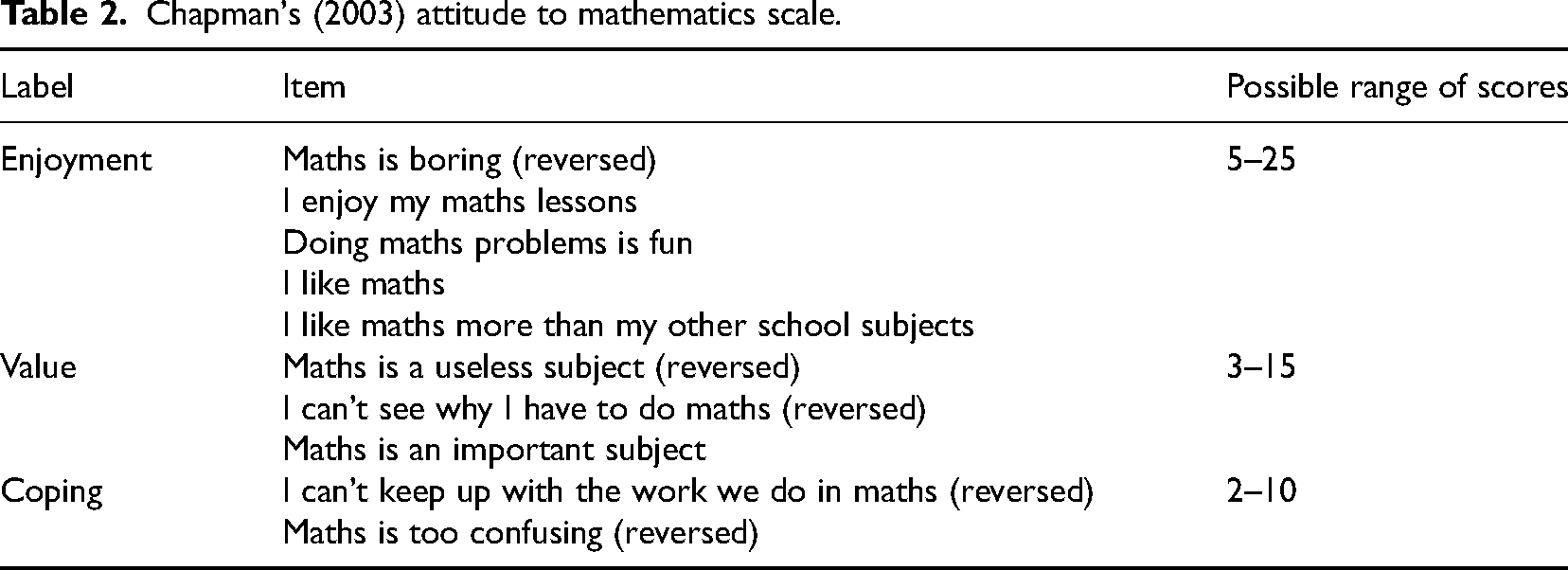
Chapman's (2003) attitude to mathematics scale.
Given the lack of measures of the extent to which students hold a problem-solving view of mathematics, a 5-item scale was developed for the current study. The items were developed through the third author initially considering literature that has raised the concern that particular experiences of learning mathematics may lead students to hold a limited or traditional view of mathematics in which all problems can and should be solved quickly (Schoenfeld, 1988, 1992; Stylianides & Stylianides, 2014). In addition, the third author also considered studies that have attempted to operationalize this more traditional view of mathematics, and the nature of the items included in such studies (e.g., Gervasoni et al., 2021). Next, the third author consulted with the first two authors, both of whom have substantial experience undertaking research in classrooms where learning mathematics through problem solving is the central pedagogical approach, about the potential wording and focus of the items. It was established that the aim should be to develop items that measured if students held a view about mathematics that included open problems in which there is more than one solution; that there are many ways to solve a problem; and that not all problems can be solved quickly. For example, it was decided that two of the items from Gervasoni et al. (2021) should be co-opted and rephrased such that a positive response indicated a problem-solving view of mathematics, in which mathematics problems might have multiple solutions (i.e., Maths problems have one and only one correct answer ⟶ Maths problems can have more than one correct answer) and multiple solution pathways (i.e., There is only one way to solve a maths problem ⟶ There are many ways to solve a maths problem). Following several rounds of iterative email and face-to-face communication, 5-items were decided upon that were considered to capture what it meant for a student to hold a problem-solving view of mathematics.
The Likert-type items for the problem-solving view of mathematics scale included:
Maths problems can have more than one correct answer; There are many ways to solve a maths problem; Many maths problems take more than 5 min to solve; You can solve a maths task any way that makes sense to you; You can work out the steps to solve a maths problem as you go.
The same scale was used as for the previous items about attitude (strongly agree (5), agree (4), neutral (3), disagree (2), strongly disagree (1)), which when combined provides a possible range of scores from 5 to 25 for each student. The overall Cronbach alpha for this scale was acceptable (α = 0.68).
SPSS v. 25 was used to generate descriptive and inferential statistics to address the three research questions. Specifically, product-moment (Pearson) correlation coefficients were generated to examine how the three subcomponents of student attitude towards mathematics were related to whether the student held a problem-solving view of mathematics (RQ3), rank-order (Spearman) correlation coefficients supported an examination between these measures of interest and year level (RQ1, RQ2), whilst t-tests were used to explore differences in scores on these measures between different stages of schooling (primary students vs. secondary students) (RQ1, RQ2, RQ3).
Results
Descriptive statistics
Descriptive statistics for attitude towards mathematics and the three associated subscales, as well as problem-solving view of mathematics, are presented in Table 3. Overall, the median student participant was neutral regarding their enjoyment of mathematics and their perceptions of their capacity to cope with mathematics, however they agreed that mathematics was a valuable subject to learn and endorsed statements describing mathematics as problem solving.
Descriptive statistics for attitude towards mathematics and problem-solving view of mathematics.
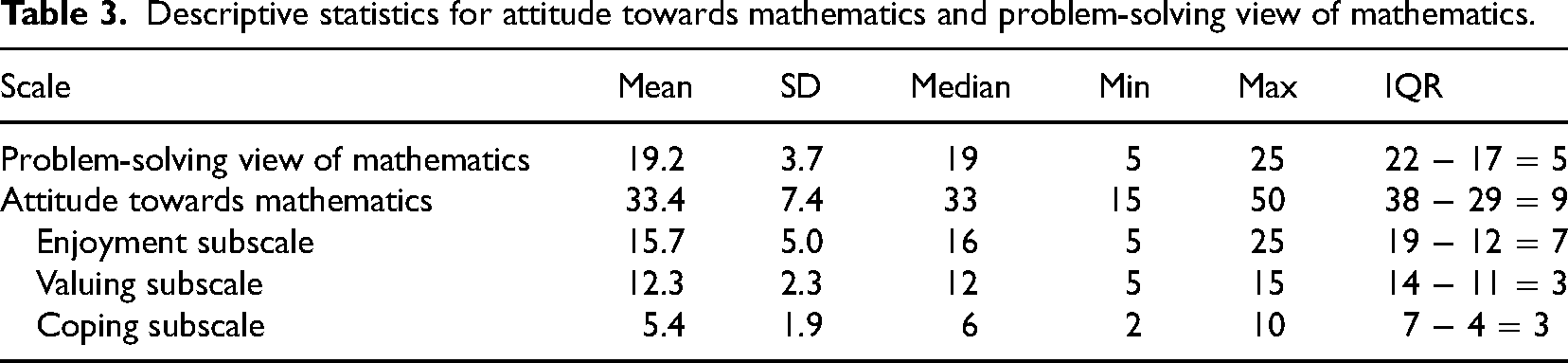
Descriptive statistics for attitude towards mathematics and problem-solving view of mathematics.
Three outlier values were identified, two in relation to the value subscale (scores of 5, representing low valuing of mathematics), and one in relation to problem-solving view of mathematics (a score of 5, representing a viewing of mathematics not aligned to problem-solving approaches). Given these were valid responses, it was decided to Winsorize these outlier values, rather than delete them (Hawkins, 1980). This process of Winsorization involved replacing the outlier with the next most extreme value. Following the Winsorization of these outliers, all scales and subscales were approximately normally distributed.
In order to address our first research question, Spearman rank-order correlation coefficients between year level and attitude towards mathematics were examined. It was found that attitude towards mathematics was weakly correlated with year level amongst GRIN students (rho = −.18, p < .05), implying that as students moved through their schooling, they had slightly more negative attitudes towards mathematics. Examination of the association between the attitude subscales and year level revealed that this relationship was exclusively a result of students enjoying mathematics less as year level increased (rho = −.38, p < .01). By contrast, there was neither significant correlation between year level and student valuing of mathematics (rho = .04, p > .05); nor between year level and student coping with mathematics (rho = .16, p > .05).
In addition, a series of independent samples t-test were undertaken in order to compare primary and secondary students’ attitudes towards mathematics. This analysis revealed that there was no difference in overall attitude towards mathematics between primary students (M = 34.1; SD = 7.9) and secondary students (M = 32.8; SD = 6.8), t(121) = .99, p > .05. However, there was evidence that primary students (M = 17.0; SD = 5.1) enjoyed mathematics more than secondary students (M = 14.3; SD = 4.5), t(121) = 2.72, p < .01, Cohen's d = .56. By contrast, it appeared that secondary students (M = 5.8; SD = 1.8) demonstrated higher levels of coping with mathematics compared with primary students (M = 5.0; SD = 2.0), t(121) = 2.29, p < .05, Cohen's d = .42. Finally, there were no differences in the valuing of mathematics between primary students (M = 12.0; SD = 2.5) and secondary students (M = 12.6; SD = 2.0), t(121) = 1.49, p > .05.
RQ2. How does the extent to which students’ view mathematics as problem solving differ across school level?
To answer our second research question, we again examined Spearman correlations; in this instance, between year level and the extent to which students held a problem-solving view of mathematics. We found no significant linear relationship (rho = −.08; p > .05), suggesting that there was no notable shift in whether students viewed problem solving as fundamental to their experience of mathematics across year levels. Similarly, an independent samples t-test revealed that, on average, there were no differences between primary school students (M = 19.2; SD = 3.7) and secondary school students (M = 19.4; SD = 3.5) views of mathematics, t(121) = .30, p > .05.
RQ3. How does the extent to which students’ view mathematics as problem solving relate to student attitudes? Moreover, does this relationship vary by school level? If so, how?
We examined Pearson correlation coefficients to inquire into the relationship between student attitudes towards mathematics, and the extent to which they viewed mathematics as problem solving, to answer our third research question. The correlation matrix is presented in Table 4.
Correlation matrix: All students.
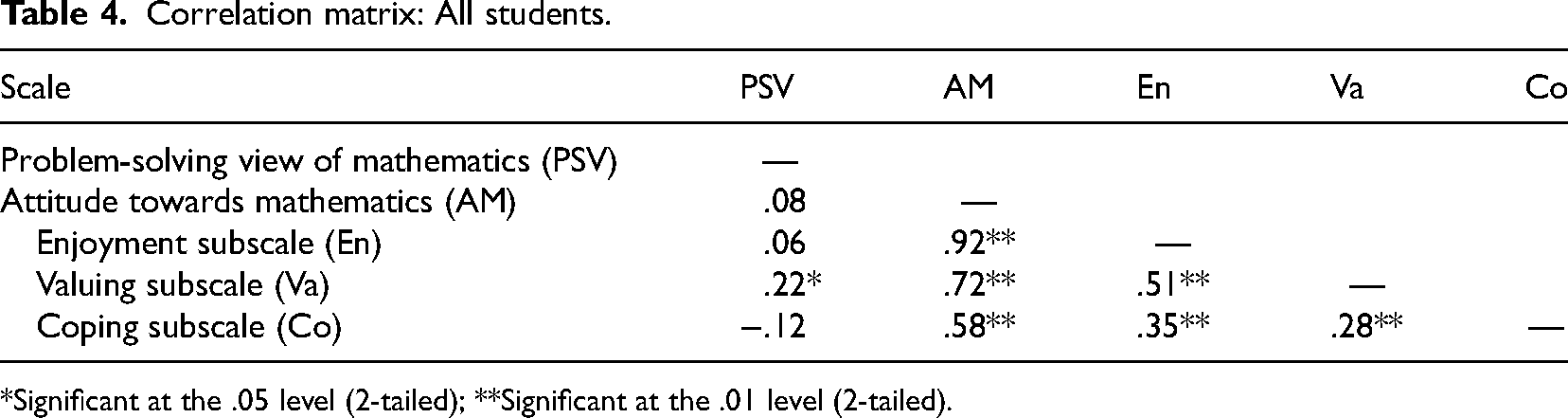
Correlation matrix: All students.
*Significant at the .05 level (2-tailed); **Significant at the .01 level (2-tailed).
From viewing Table 4, it is apparent that overall attitude towards mathematics, enjoyment of mathematics and coping with mathematics are all unrelated to holding a problem-solving view of mathematics. By contrast, students who perceived problem solving as fundamental to mathematics were somewhat more likely to value mathematics as a discipline.
We were also interested in examining whether the relationships between attitudes towards mathematics and holding a problem-solving view of mathematics were different for primary and secondary school students. Consequently, we split our data according to school level and reproduced the correlation matrix in Table 4 for primary and secondary school students separately (see Tables 5 and 6).
Correlation matrix: Primary school students.
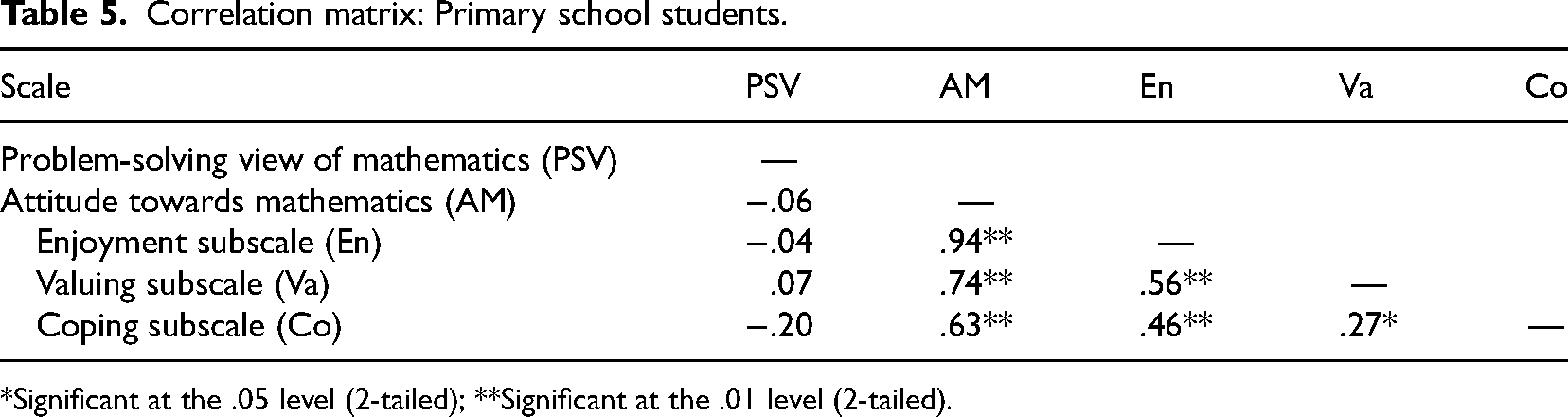
*Significant at the .05 level (2-tailed); **Significant at the .01 level (2-tailed).
Correlation matrix: Secondary school students.
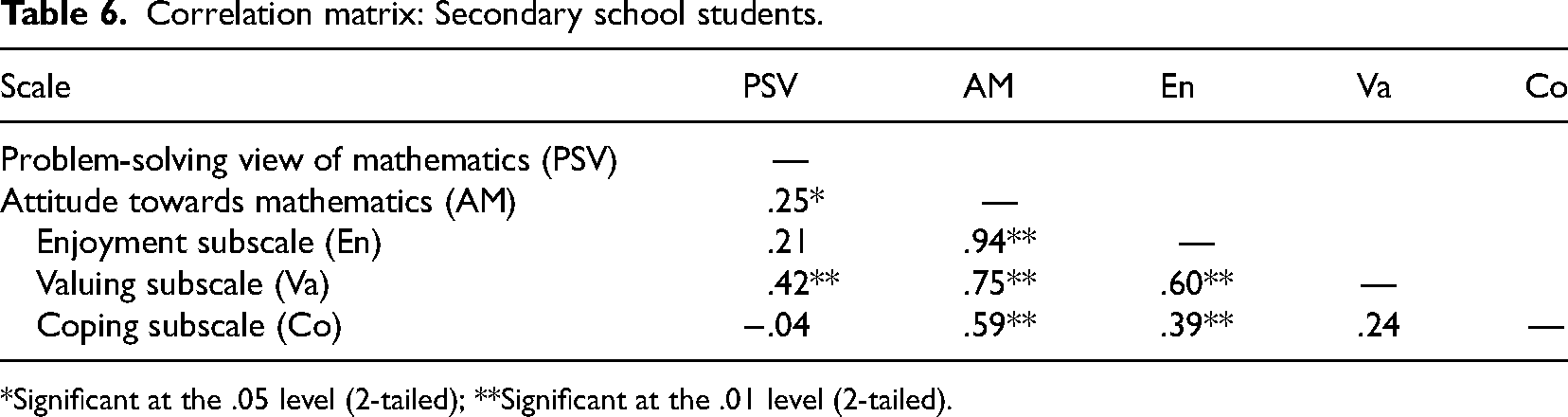
*Significant at the .05 level (2-tailed); **Significant at the .01 level (2-tailed).
Table 5 reveals that, for primary school students, there was neither a significant relationship between overall attitude towards mathematics, nor between any of the sub-components of enjoyment, value and coping, and holding a problem-solving view of mathematics. By contrast, Table 6 shows that for secondary school students, there was a significant, albeit weak, positive correlation between overall attitude towards mathematics and holding a problem-solving view of mathematics. Perhaps most notably, there was a moderate positive correlation between valuing of mathematics and holding a problem-solving view of mathematics (r = .42). This suggests that secondary school students who perceived mathematics as fundamentally about problem solving were more likely to value mathematics as a discipline.
To summarize, students identified as underachieving who view mathematics as being about problem solving were more likely to value mathematics as a discipline. This is particularly the case for secondary school students. More generally, secondary school students who viewed mathematics as being about problem solving were more likely to hold positive attitudes towards mathematics. This was not the case for primary school students.
Our first research question considered how attitudes towards mathematics shifted across schooling amongst a population of students identified as underachieving in mathematics. Consistent with previous research that focused on students more generally (Fredricks & Eccles, 2002; Mullis et al., 2012; Wilkins & Ma, 2003), we found that student attitudes amongst our underachieving cohort became more negative as they moved through their schooling, with secondary school students in our study reporting more negative attitudes than primary school students. This was entirely driven by primary school students in our study typically enjoying mathematics more than secondary school students; whereas the two other components of student attitude measured presented a somewhat different picture. Specifically, we in fact found that secondary students reported coping better with mathematics than primary students, whereas there was no relationship between valuing mathematics and stage of schooling. This latter finding is consistent with the more ambiguous and nuanced relationship between valuing of mathematics and stage of schooling reported in the literature (Fredricks & Eccles, 2002; Mullis et al., 2012; Watt, 2004). It is noteworthy then that our study involving a group of students specifically identified as underachieving in mathematics produced a pattern of results of attitudes towards mathematics across schooling that was not dissimilar to other studies involving a broader cross-section of the student population (e.g., TIMMS; Mullis et al., 2012).
By contrast, our second research question focusing on how holding a problem-solving view of mathematics changed across stage of schooling, failed to reveal any significant differences. Primary school students and secondary school students identified by their teachers as underachieving held similar views of mathematics, perhaps suggesting that they had similar instructional experiences in terms of how frequently problem solving was incorporated into mathematics. This finding contrasts somewhat with Di Martino's (2019) study, which found that younger students were more likely to hold a problem-solving view of mathematics (e.g., problems have multiple solutions, and require effort and persistence to solve) than older students. Indeed, Silver (1994) has argued that higher grade students might be more familiar and more accustomed to conventional teacher-led instruction because of their need for highly structured content, while lower grade students may have more experiences with inquiry-based instruction. Moreover, the fact that students on average in our study typically endorsed statements consistent with viewing mathematics as problem solving contrasted with Takeuchi et al.'s (2016) study involving a Canadian sample of early years primary school students, which found that around three-quarters of students held narrow, largely procedural perspectives on what constituted mathematics learning. This may suggest some idiosyncrasies associated with our particular participant group that were not evident when considering how attitude towards mathematics differs across stage of schooling, reinforcing the need for replicating the use of this new measure (i.e., problem-solving view of mathematics) with a larger, more diverse sample (see Section 7).
Our third research question examined the relationship between attitudes towards mathematics and holding a problem-solving view of mathematics. To the extent that students holding a problem-solving view of mathematics reflects the fact that they were more likely to experience problem-solving based mathematics instruction, we might expect a positive relationship between these variables, given past research suggesting that students enjoy learning mathematics in this manner (Russo et al., 2021; Russo & Minas, 2020). Contrary to these studies, we did not find any relationship between enjoyment and a problem-solving view of mathematics amongst our participant group identified as underachieving in mathematics. However, we did find a positive relationship between valuing of mathematics and perceiving mathematics as problem solving, with further analysis revealing that this was entirely driven by a medium size correlation between these variables for secondary school students.
This last finding seems particularly noteworthy and is worthy of some further commentary. If we consider the actual wording of the items capturing student valuing of mathematics from the instrument employed in the current study to measure student attitudes (Chapman, 2003), low valuing of mathematics is associated with mathematics being perceived as useless, pointless and unimportant. It is perhaps then not surprising that our findings suggest that being in a secondary mathematics learning environment which emphasizes following one correct method whilst working through a series of largely routine tasks requiring minimal cognitive effort (corresponding to a low score on the “problem-solving view of mathematics scale”) might result in the perception that mathematics as a subject is arbitrary and disconnected from anything meaningful (corresponding to a low score on the “valuing” subscale). By contrast, having opportunities to work on genuine problem-solving tasks that are presented in rich contexts, demand more cognitive investment from students, and allow for multiple solution methods (corresponding to a high score on the “problem-solving view of mathematics scale”), will likely be associated with perceptions of mathematics as useful, purposeful, and important (corresponding to a high score on the “valuing” subscale).
Moreover, our finding that perceiving mathematics as problem solving is connected to the valuing of mathematics as a discipline amongst students identified as underachieving also has equity implications. Given that there is evidence that lower performing students value mathematics less than higher performing students (Mullis et al., 2012), and that lower performing students are often given more procedural mathematical work (Desimone et al., 2005), it may be that providing additional opportunities for such students to engage in authentic, meaningful, problem-solving tasks can help to close this values gap.
Conclusion
There are several limitations of our study that need to be noted. First, due to the methods employed and the cross-sectional nature of the data collected, we cannot conclude anything definitive about causation from our study. For example, although we have assumed the contrary, it may be that higher levels of valuing of mathematics influenced the perception of mathematics as being problem-solving oriented, rather than vice versa. Alternatively, this correlation may be a result of a third, underlying factor. Second, the findings of this study were gathered from a small group of students and should therefore be replicated to include a larger, more diverse sample. This would also allow more sophisticated statistical techniques to be employed to address similar research questions. Third, it would also be interesting and important to triangulate student perceptions of problem solving with classroom observations and student interviews to further validate our study's findings. Finally, although the Cronbach alpha for the problem-solving view of mathematics scale was acceptable, additional enhancement and validation of this scale to support its future use in research is necessary. It is notable that addressing some of the previously noted limitations would also have the effect of enhancing the scale's reliability and validity. For example, the scale's Cronbach alpha might be improved by incorporating additional items, its factor structure could be examined through administering the questionnaire to a larger and more diverse group of student participants, and its validity could be further established through exploring its relationship with corresponding teachers’ views of mathematics and the pedagogical choices of these teachers (e.g., the extent to which these teachers employ problem-solving approaches to teaching mathematics).
To conclude, although we found in line with previous research that student enjoyment of mathematics declines as they move through their schooling, we did not find evidence that other aspects of student attitudes (i.e., their ability to cope with challenge, their valuing of mathematics) declined with stage of schooling amongst a group of students identified by their teachers as underachieving. On the contrary, our results suggest that the perception that mathematics involves problem solving is more important for promoting the valuing of mathematics amongst secondary school students than primary school students.
Given that students participating in our study were identified by their teachers as underachieving, and were currently achieving at a level below that of most of their peers, our findings may challenge some preconceptions regarding such students and how they perceive opportunities to engage with more cognitively demanding tasks. It seems important that teachers promote problem solving in their classes so that opportunities are provided for all students to broaden their thinking, struggle productively, approach mathematics creatively, and participate in a classroom environment that promotes mathematical flourishing (Greensfeld & Deutsch, 2022). Of course, given the heterogeneous learning needs and range of mathematical performance levels in a given classroom, such opportunities need to be carefully planned for (Herner-Patnode & Lee, 2021). In particular, in order to ensure such problem-solving tasks are within all students’ zone of proximal development, it is vital that teachers work through tasks in teaching teams before a lesson to allow them to anticipate student responses and modify tasks for their cohort of students as necessary (Hubbard & Livy, 2021), as well as attending to the preparation of appropriate enabling and extending prompts (Sullivan et al., 2009).
Footnotes
Contributorship
James Russo undertook the data analysis, contributed to the background literature and methods section, and led the writing of the first draft of the discussion and conclusions, and the final draft of the manuscript. Penelope Kalogeropoulos conceptualized the study, contributed to the background literature and the final draft of the manuscript. Anne Roche led the development of aspects of the questionnaire and the first draft of the background literature, and contributed to the final draft of the manuscript. All authors read and approved the final manuscript.
Declaration of Conflicting Interests
The author(s) declared no potential conflicts of interest with respect to the research, authorship, and/or publication of this article.
Funding
The author(s) received no financial support for the research, authorship, and/or publication of this article.
Informed consent
The research was pre-approved by the Monash University Human Ethics Committee (Project IDs 11455 and 40303). The participants provided informed consent to partake in the study.

Correction (December 2024):
Article updated to add Informed consent section.