




Abstract
Different kinds of resources, material and non-material, are used and developed with the aim of being part of an effective mathematics education. As a non-material resource, time seems to be of great importance to teachers and students. The aim of the present study is to focus on teachers’ views about time as a resource and its interactions with other resources in mathematics education. For this purpose, a large-scale examination of teachers’ opinions was undertaken, combining qualitative and quantitative methods, and involving teachers from different school levels. The results show that teachers highly value time as a resource, although with clear differences among primary, middle, and higher grade teachers. The participants of all levels complained to a great extent about not having as much time as they need for geometry topics, problem solving, and teamwork. On the other hand, the results show that textbooks and technology as material resources save teachers and students time, making lesson preparation and enactment more efficient, particularly in lower grades. The insight gained into teachers’ views about time, together with the literature review, indicate the importance of non-material resources within the discussion of resources.
Introduction
Resources in education include all means and actions used by teachers and students to support the learning of a particular subject (Ruthven, 2019). Pepin et al. (2013) introduce mathematics teaching resources “as all the resources which are developed and used by teachers (and pupils) in their interaction with mathematics in/for teaching and learning, inside and outside the classroom” (p. 929). Therefore, different kinds of resources are used and developed with the aim of creating an effective mathematics education, for example, textbooks, teacher guides, digital tools, and manipulatives. In many countries, textbooks are the central resources for the teaching and learning of mathematics and their impact on mathematics education has been examined in many studies worldwide (e.g., Fan et al., 2018; Rezat et al., 2021; Schmidt et al., 2001). The description of resources does not just cover tangible materials; Adler (2000) highlights that “[t]he notion of resources extends beyond material objects” and includes human, social, and cultural resources, such as teachers’ professional knowledge, language, time, and collegiality (p. 206).
Among the non-material resources used for effective mathematics teaching and learning, time has proven to be very important in education (Adam, 1990; Adler, 2000; Ben-Peretz & Bromme, 1990; Glasnović Gracin & Jukić Matić, 2021; Hargreaves, 1994). We may imagine a fantastic teacher and motivated students in a well-equipped classroom with excellent textbooks, but if the teacher does not have time to teach a particular topic, and the students do not have time to be involved and engaged with this topic over time, it is highly probable that the learning of this topic will not be successful. Indeed, the literature reveals teachers’ assertions that they need more time for teaching (e.g., Hargreaves, 1994) and that they feel a constant sense of time pressure in covering the mathematics syllabus (Leong & Chick, 2011). Further, Kilpatrick et al. (2001) highlight that some important aspects of contemporary mathematics education such as investigations, problem solving, and surveys naturally refer to time-consuming activities. And so, on the one hand, we have teachers claiming a lack of time, and on the other hand, the time-consuming nature of contemporary approaches. Since teachers today must find a balance between these two issues, it is important to investigate their experiences with time as a resource. The study presented in this paper refers to teachers’ perspectives on time in mathematics education and to the interaction of time with other resources. Such a study may contribute to a global discussion on time as a resource in different cultures and to its general significance in education.
Literature review
A review of the literature shows studies on various aspects of time as a resource. We attempted to divide these aspects into the following topics: the subjective and objective dimensions of time, time as a student resource, time as a teacher resource, and interactions of time with other resources. They are not, however, entirely separate issues and overlap in many respects.
Objective and subjective dimensions of time
The literature distinguishes between two dimensions of time: objective and subjective. The objective dimension of time refers to its duration (Meissner, 2007) and its organization provided by the authorities (timetables, lesson duration, duration of the school year, periods or quarters, breaks, etc.). Adam (1990) highlights that everything is timed in education, for example, timetables, schedules, deadlines, and instructional plans; such an organization is important in school life because it provides the participants with a routine and security. Ben-Peretz and Bromme (1990) label time allocated by teachers as instructional time, while time allocated by curriculum developers is labeled as curricular time. According to Hargreaves (1994), within the objective (technical–rational) dimension of teachers’ time, time is a finite resource or means which can be decreased, increased, manipulated, organized, or reorganized to fulfill chosen educational purposes. The literature review reveals that countries vary to a great extent concerning the time devoted to mathematics instruction (Mullis et al., 2020; OECD, 2016). These differences in the amount of time allocated to mathematics teaching lead to different teaching practices (Bodin & Capponi, 1996). Further, the OECD longitudinal study (OECD, 2016) showed “a recent trend of increasing classroom instruction time dedicated to core subjects such as mathematics, and a reduction in the time spent doing homework outside the classroom” (p. 1). Increasing instruction time of mathematics therefore may positively reflect on the efficacy of learning mathematics, because the research provides evidence that more time for mathematics education is positively associated with student achievement (e.g., Schmidt et al., 1998).
The subjective dimension of time refers to its flow as an inner duration (Meissner, 2007), which varies from person to person (e.g., time may fly quickly, or may drag). Ben-Peretz and Bromme (1990) call it experienced-personal time because it refers to the subjective perception of the temporal order by individuals. It is the lived time, labeled by Hargreaves (1994) as phenomenological time because different persons’ sense of time may vary, particularly in the decision-making process. In the educational sense, this means that, for example, the administrators’ and teachers’ inner sense of time may differ, which causes teachers’ sense of time pressure and frustration “because they are implementing the new program less quickly and efficiently than the administrative timelines require” (Hargreaves, 1994, p. 101).
The importance of both objective and subjective dimensions of time can be clearly seen within teachers’ work: Time is a fundamental dimension through which teachers’ work is constructed and interpreted by themselves, their colleagues and those who administer and supervise them. Time for the teacher is not just an objective, oppressive constraint but also a subjectively defined horizon of possibility and limitation. Teachers can take time and make time, just as much as they are likely to see time schedules and time commitments as fixed and immutable. (Hargreaves, 1994, p. 95)
Lastly, it is important to point to the different grasp of time in different contexts and cultures, which may affect the dimensions of time in their realization in school environments. For example, Walen and Williams (2002) discuss the features of time as widely accepted in the Western culture: “time is seen as objective, continuous, universal, linear and infinitely reducible” (p. 364). Other cultural contexts bring diverse meanings of time (e.g., Ben-Peretz & Bromme, 1990). Paine (1990) studied Chinese teachers’ views of time, and found that Chinese teachers live with both linear and cyclical perspectives of time: “[t]ests, for example, stand as an end point, but a teacher typically works with a cohort of students through a cycle of preparation, then begins afresh with a new cohort” (p. 154). Further, Adler (2000) claims that time may be used differently in urban and rural contexts, too. Both objective and subjective time dimensions may influence the learning of mathematics and the effectiveness of mathematics instruction.
Time as a student resource
Time is a fundamental ingredient for student learning and hence plays an important role within the term opportunities to learn (Carroll, 1963; Kilpatrick et al., 2001). Berliner (1990) distinguished different types of time, which affect student learning within the instructional time: allocated time, engaged time, time-on-task, academic learning time (time in which a student is engaged successfully in the activities which are related to valued educational outcomes), transition time (the noninstructional time before and after some instructional activity), waiting time (the time that a student must wait to receive some instructional help), aptitude (the amount of time that a student needs to reach some criterion of learning), perseverance (the amount of time a student is willing to spend on learning a task or unit of instruction), and pace (the amount of content covered during a given time period). These terms, or at least some of them, maybe considered as subtypes of time as a student resource.
Experience and time that students spend on activities are particularly emphasized in the literature (Adam, 1990; Kilpatrick et al., 2001; Walen & Williams, 2002). Adam (1990) discusses student activities as a part of the timetable, and as such, their duration and structure are pre-set. This may lead to stress if students feel they don't have enough time (Walen & Williams, 2002).
Another important aspect of time regarding student issues is assessment. Studies showed that academic achievement is related to the amount of time students spend in learning (Carroll, 1963; Fisher & Berliner, 1985; Schmidt et al., 1998). Boaler (2014) quotes a student's statement: “[i]t's too much answer time and not enough learning time” (p. 470), which may also be related to time as an important student resource for learning. Further, Clarke (1996) drew attention to the challenges and shortcomings related to mathematics assessment and time. The author provides an example of a student “who understands the content but requires more time to complete the required tasks than is available in the assessment context” (p. 333). In this case, a fixed duration of a lesson may be a constraint to students to show what they know. The lack of time and rush both in the learning and testing periods may develop mathematics anxiety (e.g., Boaler, 2014).
Time as a teacher resource
It seems that teachers recognized time as an important resource because they often claim that they need more time (Hargreaves, 1994). Leong and Chick (2011) highlight the issue of teachers’ sense of time pressure in mathematics education because of the demands of fulfilling various instructional goals within a limited time. Such time pressure consequently affects the teachers’ instructional decisions. Hargreaves (1994) highlights the need for a better exploration and understanding of what time means to teachers, for “giving time back to the teacher, both quantitatively and qualitatively, and for giving the teacher educationally substantial things to do with that time. If we do this, then time may no longer be the enemy of teachers’ freedom, but its supportive companion” (p. 114).
Teachers need time outside the classroom for preparation, lesson planning, reflection on the success of the lesson, reading students’ work, evaluating tests, collaboration, professional development, and other support activities (Clarke et al., 1996; Hargreaves, 1994; Kilpatrick et al., 2001). Further, time is a particularly important teacher resource during periods of curricular change. Curricular change refers to a developmental process aimed at improving the quality of education. In this period, time is a “resource worth supplying in greater measure to secure school improvement” (Hargreaves, 1994, p. 97). Glasnović Gracin and Jukić Matić (2021) investigated the use of resources during the implementation of a new mathematics curriculum. The results showed that time was a vital resource for the participating teacher because she, although an experienced mathematics teacher, needed more time for lesson planning: “[a]fter the reform was implemented, the teacher spent more time preparing and designing lesson plans for upcoming lessons” (p. 1381). Also, time was important to her in terms of implementing new methods and strategies. Implementing contemporary approaches, for example, problem solving, open answer tasks, and modeling, requires time because teachers should often participate in professional education to accept the new ideas before they present them in their classrooms (Clarke et al., 1996). The same can be applied to students, it takes time to adopt new things through various activities. Adler (2000) provides an example: “If there is novelty in the resource (e.g., a graphics calculator), time will be needed for learners to become acquainted with the resource and how it is operated” (p. 216). This example shows how a change in the material resource (i.e., introducing a graphics calculator) causes changes in non-material resources meaning that teachers should plan more time for students in activities.
Interactions of time with other resources
The sections presented above indicate that time is a very important resource in (mathematics) education. Still, can it stand alone, without interactions with other resources? There would be no efficient mathematics education if the teacher and students were provided with as much time as they needed, but they lacked other resources, such as teacher professional development or material resources. O’Meara and Prendergast (2017) highlight: “Although having time to teach and learn is a critical condition, policy makers, and teachers in particular, must also attend to the quality of instruction” (p. 9). For example, students’ time engaged in working with tasks was perceived as important (e.g., Berliner, 1990), but the next question that may be asked is: what kinds of tasks and activities? Sirotnik (1983) argues that the quality of instruction depends on a variety of resources related to collaboration and communication in interaction with time. Becker and Selter (1996) discuss the connection between time and the use of material resources such as mathematics textbooks and manipulatives, because “when using teaching aids, sufficient time is needed to negotiate the meanings connected with their use” (p. 521). These issues raise questions on the need for exploring teachers’ views on time as a resource and its interaction with other resources.
The literature review pointed to time as an important and multilayered resource in education. It also revealed some problems, such as the gap between the time prescribed for teaching and the time actually needed, from the teachers’ perspective. Also, the interaction of time with other resources has not yet been well examined, particularly in empirical studies regarding mathematics education. Therefore, it seems that there is a need for further explorations to better understand how issues of time are experienced by mathematics teachers experience in their work.
Research questions
The aim of this study is to explore teachers’ views on and experiences of the use of time as a resource and its interactions with other resources in mathematics education. For that purpose, we posed the following research questions:
In which aspects of mathematics teaching did teachers highlight a particular need for time as a resource and why? In what ways is the interaction between time and other resources experienced by teachers? How do the teachers’ experiences about time differ regarding the school level they teach?
In the first research question, the term “aspects of mathematics teaching” refers to the different terms derived from the literature (Clarke et al., 1996; Glasnović Gracin & Jukić Matić, 2021; Kilpatrick et al., 2001): lesson phases (motivation phase, acquisition, work-on-tasks, etc.), different teaching approaches and activities (e.g., teamwork and problem solving) required for effective mathematics teaching and learning, as noted in the literature review section.
Theoretical framework
Time as a teacher resource was clearly positioned in Adler’s (2000) categorization of resources in school mathematics. Basic resources may be material (e.g., school buildings, water, electricity, etc.) and human (e.g., basic teacher qualifications). Other resources are divided into human, material, social, and cultural. Human resources refer to persons (e.g., teacher knowledge base) and processes (e.g., collegiality). Material resources cover technologies (e.g., tablets and computers), school mathematics materials (materials with implemented mathematical and pedagogical intentions, e.g., textbooks, specialized computer software), mathematical objects (objects which are specifically mathematical, but with social history, e.g., proofs and number lines) and everyday objects (objects used outside of mathematics, e.g., newspapers, money). Adler (2000) also pointed to social and cultural resources, such as language (e.g., verbalization and communication) and time (e.g. timetable and length of school periods).
The categorization of resources in school mathematics provides a better and broader insight into the position of time as a resource within the resource organization: time is a non-material, cultural resource. As such, various situations from school practice bring its interactions with other types of resources, which relates to the second research question. Adler (2000) gives an example: teachers working with new materials (material resources) leads to a change in the structure of their time (non-material resources) because they need more time for preparation. The author claims that “time functions formatively in school through time-tables, length of periods, and possibilities for homework. It structures school mathematics practice to produce pacing, sequencing, and time-bound tasks.” (p. 211)
Glasnović Gracin and Jukić Matić (2021) used Adler's model for understanding both teacher and student practice in times of curriculum changes. Their framework encompasses the purposes for the utilization of resources: various resources are used for lesson preparation, acquisition of new knowledge, practicing, revision (exam preparation), homework, and studying at home. These purposes of the use of resources refer to the aspects of mathematics education indicated in the first research question.
Methodology
The study presented in this paper used a mixed-method approach, combining quantitative and qualitative methods. The quantitative approach refers to a survey for teachers about time as a resource in mathematics education, while the qualitative approach encompassed multiple case study research (interviews). In this way, we examined both the extent to which the participants needed time for different aspects of mathematics teaching and the in-depth reasons for that.
Croatian context
The school system in Croatia is divided into three stages: Grades 1 to 4 (primary grades), Grades 5 to 8 (middle grades), and high school grades (higher grades). In the primary grades, instruction is predominantly given as a class with a single teacher leading a class for four years, and teaching six subjects, one of which is mathematics. In middle and higher grades, specialized teachers teach the subjects. All pupils in Grades 1 to 8 in Croatia follow the national curriculum produced by the Ministry of Science and Education (MZO) and have mathematics lessons four times per week. After eight years of compulsory education, students attend high schools for three or four years. High school education comprises grammar schools, vocational schools, and art schools. At the end of high school education, the State Certificate is conducted, with mathematics as an obligatory subject. One educational unit in Croatia lasts 45 min for all school grades and subjects. As a result of the strong earthquakes in Zagreb and Petrinja in 2020, many schools were allowed to reduce lesson duration to 40 min due to organizational issues.
The mathematics curriculum in Croatia (MZO, 2019) includes five mathematical domains (Numbers, Algebra and Functions, Space and Shape, Measurement, and Data) and associated learning outcomes. All five domains are presented in each school grade, but to a different extent, depending on the students’ developmental abilities and the need to gradually build a comprehensive mathematics education (MZO, 2019).
Participants
The survey included 1,252 teachers who teach mathematics in primary, middle, and high schools in northwestern Croatia: 838 primary teachers, 254 middle-grade teachers, and 160 high school teachers. Table 1 presents the participants’ years of teaching experience.
Years of participants’ teaching experience.

Years of participants’ teaching experience.
The survey was approved by the senior advisors of the Education and Teacher Training Agency in Croatia. This approval allowed us to send the survey link to all primary, middle, and higher-grade mathematics teachers in the northwest region of Croatia, constituting about half of all mathematics teachers in the country. The number of responses received from primary participants (838) makes up 15% of all primary teachers in this region, middle-grade participants (254) make up 27%, and higher-grade participants (160) make up 27% of higher-grade mathematics teachers in the region.
The study also involved semistructured interviews with 12 of the teachers, using a convenience stratified sample: four primary teachers, four middle-grade mathematics teachers, and four higher-grade mathematics teachers. All the interviewed teachers teach in northwestern Croatia, six of them in city schools in Zagreb, and six in other towns. All of these participants are experienced teachers who regularly cooperate with the Faculty of Teacher Education in Zagreb in school practice. Nine of the participants have more than 15 years of teaching experience, while three teachers have between 6 and 15 years of experience. In this study, they are named T1PS, T2PS, T3PS, T4PS, T1MS, T2MS, T3MS, T4MS, T1HS, T2HS, T3HS, and T4HS. Codes PS, MS, and HS stand for primary, middle, and high school grades.
For the purposes of the study, two instruments were developed, one for the survey and another one for the interviews. The instruments were developed according to the research questions and based on the theoretical framework and literature review. Both instruments have the same structure, which consists of four parts: (1) participants’ demographic information (experience and region) and the teaching level (primary grades, middle grades, or higher grades); (2) role of time in preparation for teaching; (3) role of time during mathematics lesson; (4) interaction of time and other resources (Table 2).
Instrument structure and content.
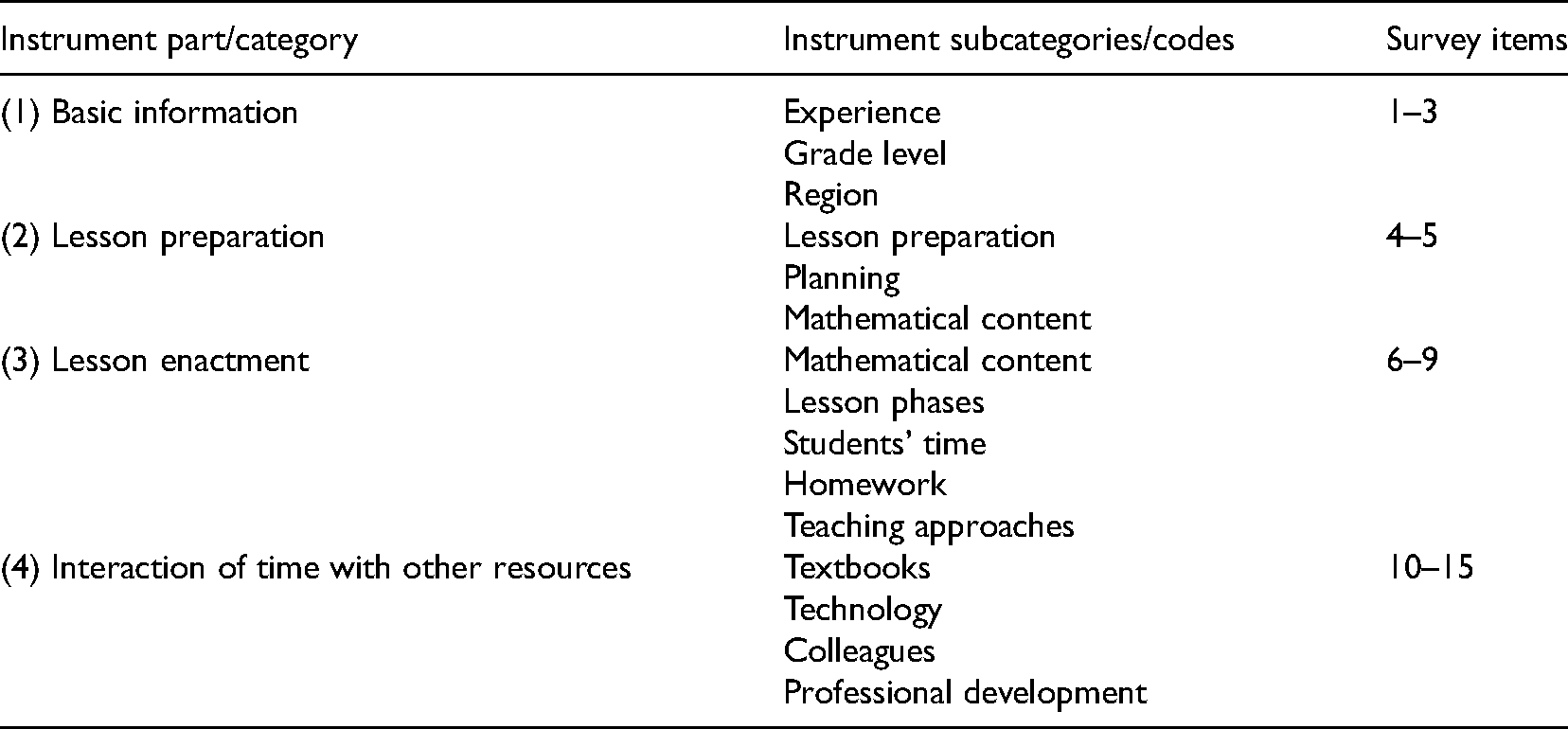
Instrument structure and content.
The questionnaire (Appendix A) altogether consisted of 15 questions, 3 in part one, 2 in part two, 4 in part three, and 6 in part four. Most of the questions used a 4-point Likert scale on the use of time (not enough time, mostly not enough time, mostly enough time, enough time) or on the agreement with the given statements (ranging from “I agree” to “I don't agree”). Other types of questions required selecting one or more statements with reference to participants’ opinions or experiences with time in mathematics education.
The questionnaire was produced as an online form. A pilot survey was conducted with a small sample of expert teachers from each group level. Based on their comments and the obtained results, the questionnaire was modified and improved. It was then sent to the Education and Teacher Training Agency for approval. Teachers were invited to participate in the survey through the Agency's regional mathematics teachers’ networks on an anonymous and voluntary basis.
The questions for the semistructured interview (Appendix B) are designed according to the four parts of the questionnaire with emphasis on the qualitative approach: explaining the reasons for the participant's use of time as a resource in a particular way and giving concrete examples from his or her own experience. The interviews were conducted via online meetings parallelly to the conduction of the survey in December 2021. All interviewees were also participants of the survey.
The survey was analyzed according to the descriptive parameters; the distribution of answers is presented using their relative frequencies. Since the survey included three different groups of teachers, we looked at the data for each group separately.
To ensure reliability of the questionnaire, a principal component analysis was carried out on the parts of the questionnaire involving Likert-type items (Q5–Q14). The analysis extracted three factors: instruction time and planned curriculum (Q5 and Q6), time in enactment (Q7–Q9 and Q14), and time and material resources (Q10–Q13). The Cronbach's alpha coefficient for the three subscales ranged from 0.770 to 0.871. For the remaining two items of the questionnaire (Q4 and Q15), in which multiple categories could have been selected as an answer, reliability was established by comparing the answers from the interviews with the responses to the questionnaire.
The validity of the questionnaire was ensured through the aforementioned consultation with the expert teachers and the subsequent revision of items. Furthermore, the analysis of the interviews showed some discrepancies in the participants’ understanding of the meaning of the notion of discovery learning, hence the item concerning discovery learning was excluded from the analysis.
For all the data presented, the χ2-test was performed to test the statistical significance of differences in answers between the three groups of teachers. The obtained test statistics and p-values are reported together with the distributions of participants’ responses.
The interview data were transcribed and then analyzed using qualitative content analysis (Mayring, 2000). The codes correspond to the instrument subcategories (Table 2) and were developed on the basis of the theoretical framework (Adler, 2000; Glasnović Gracin & Jukić Matić, 2021) and the literature review (Berliner, 1990; Clarke et al., 1996; Kilpatrick et al., 2001; MZO, 2019), as presented in Figure 1. The detailed coding scheme with codes, their descriptions, and exemplary items is given in Appendix C. Both authors coded the material with high consistency (98.9% agreement). In cases of disagreement, additional discussions were conducted.
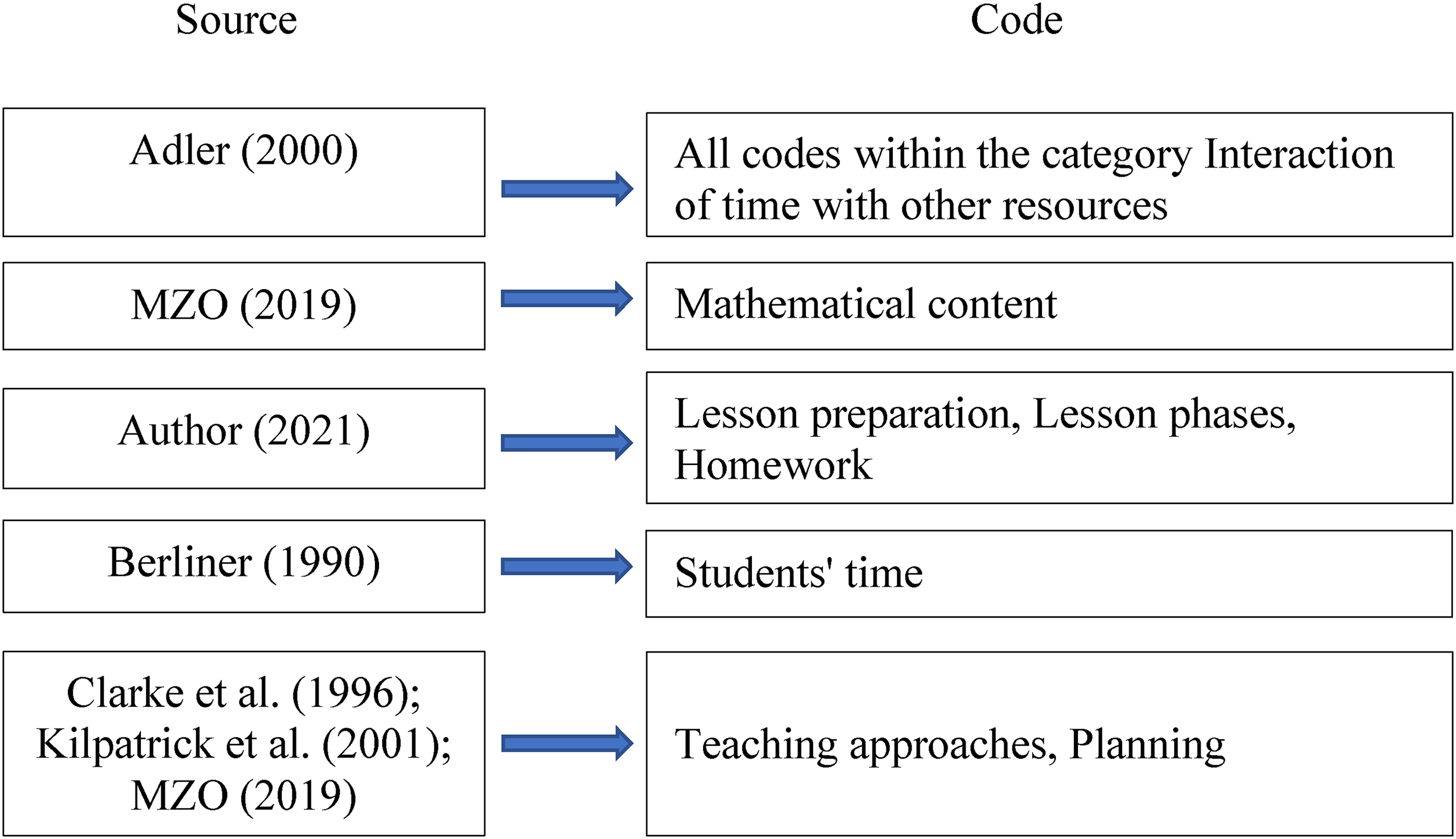
Development of codes.
The findings are divided into two parts: first, the role of time in different aspects of mathematics teaching is presented; this is followed by the findings on the interaction of time with other resources. Both of these two sections also cover the differences in teachers’ experiences about time regarding the school level.
How teachers experience time in different aspects of mathematics teaching
The survey results reveal which aspects of mathematics teaching (planning, specific content, lesson phases, different teaching approaches, activities, etc.) were highlighted by participating teachers as particularly time-consuming. Further, the interviews helped in finding why these aspects needed so much time.
Planning time
The official national educational documents outline the outcomes and the number of lessons per year to achieve them. The participants were asked if the given yearly lesson amount is enough to achieve all the prescribed outcomes for a particular grade level in mathematics. The results show a decrease in satisfaction regarding this issue as we go from primary to higher grade levels (Table 3): 53% of primary participants claimed that they have enough or mostly enough time for achieving all prescribed outcomes, 28% of middle-grade teachers agreed, but only 17% of high school teachers thought that they had enough time for all outcomes (χ2 = 111.9, df = 6, p < 0.001).
Is the amount of lessons enough to achieve all outcomes?

Is the amount of lessons enough to achieve all outcomes?
The interviews revealed some of the reasons for the (dis)satisfaction with the yearly lesson amount in mathematics education (all interview excerpts have been translated into English by the authors). Primary teachers explained that they manage to achieve all outcomes because they do not depend much on the school bell and they can combine more school subjects: [T4PS]: Sometimes we extend the lesson duration a bit, but we can afford to in the primary grades. So then… we get it all done. This is the most important thing for me, that we complete all these activities. And for it to be of high quality, and for the children to be active participants, it takes a little more than 45 minutes sometimes.
[T2PS]: It's a good thing in our work, that we can combine and connect various subjects. So we have that opportunity… in primary grades, and we combine it that way… Sometimes you can connect it with Science, sometimes with Croatian language.
Higher grade teachers do not have such opportunities. Some of the participants complained about not having enough time for all outcomes because of various reductions. Some participants mentioned the duration of lessons being reduced from 45 to 40 min after the earthquake: [T1MS]: This was really evident last year, when lessons lasted for 40 minutes. Those 5 minutes were sorely missed. I calculated that 17 and a half lessons were actually taken off the whole school year (…) and it really felt like it. I constantly had the feeling that I was running somewhere. I didn't have time for detailed analyses of exams, I had to “run” through content because the (amount of) content forced me to keep moving on…
Other participants complained about having too few lessons per week and related this to goals of mathematics education and ways of teaching and learning: [T4MS]: I think… mathematics, if we want it to be acquired well, if we want discovery learning, if we really want to emphasize higher levels of thinking… no, four lessons (a week) is not enough for me….
[T2HS]: Another problem is… in the third grade, when the weekly rate was reduced from four mathematics lessons to three, and it seems that the scope of content and everything that needs to be covered remained the same (…) I can achieve this, but it is very demanding.
The research encompassed the question of whether the teachers need more time to prepare any particular mathematical content. The participants could select one or more of the given mathematical domains. The results indicate geometry content (space and shape, measurement) as the most time-consuming in terms of teacher preparation (Table 4). Primary grade participants require the most time for lesson preparation of measurement content (65%) and space and shape (60%). Space and shape were highlighted as time-consuming in terms of lesson preparation by 73% of middle-grade teachers and as much as 78% of higher-grade teachers (χ2 statistics are reported in the table).
Most time-consuming domains for lesson preparation.
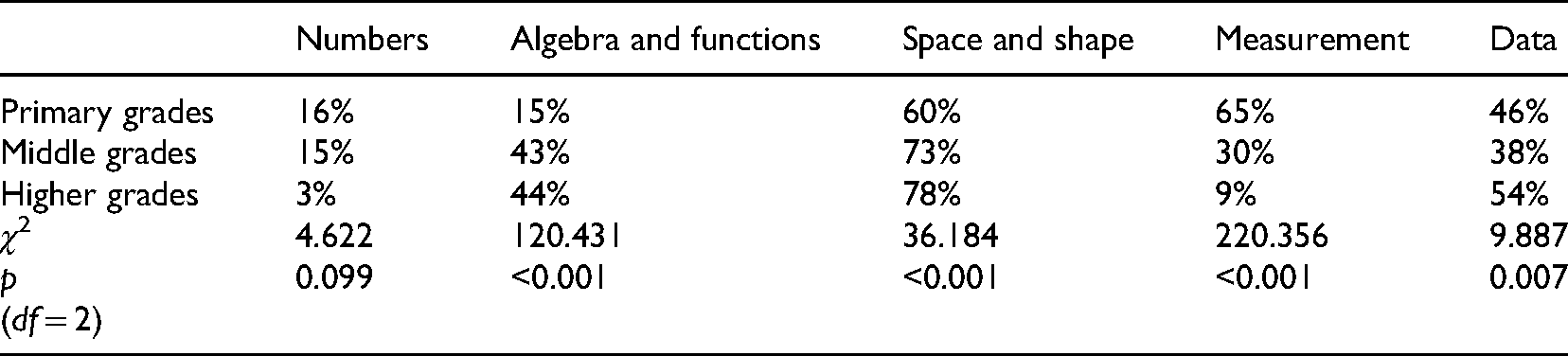
Most time-consuming domains for lesson preparation.
In another question, the participants highlighted the mathematics domains for which they do not have enough time in lesson enactment. Table 5 presents the proportions of participants for joint answers “not enough” and “mostly not enough”. The results show that more than 50% of participants of all three groups highlighted the lack of enactment time for space and shape as well as measurement (χ2 statistics are reported in the table).
Domains with not enough time in lesson enactment.
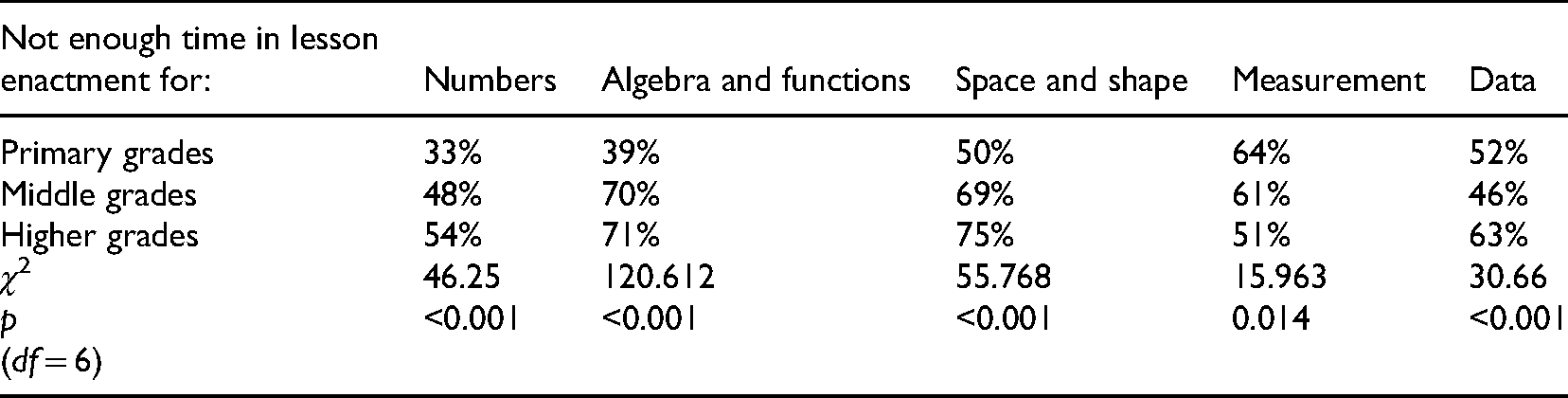
The interviews revealed some of the reasons why the participants highlighted geometry as the most time-consuming in terms of lesson preparation: preparation for geometry lessons requires providing a lot of material for students, which takes time. [T4MS]: I need more time because I need to draw my pictures first. In addition, the materials are not great quality and not easily accessible, so you have to really look critically at all these models, to figure out what and how would be best. And then, I think visualization is very important, you need to change a lot of images, animations. I make images, but I don't make animations, I find ready-made ones, but they also have to be reviewed, selected and that definitely takes a lot of time.
Further, the participants explained why they do not have enough time for geometry and measurement in lesson enactment. One reason is that these domains involve constructions or practical activities with manipulatives and measurement instruments, and that requires time. [T4MS]: I need more time for geometry, for sure… I don't think that enough (time) is planned for it, and for the children to visualize problems. I would like to have time for activities, for example, making 3D shapes out of clay, for constructing… I have a bunch of these puzzles, sticks, balls, but we just don't have as much time there as I would like. We do some (of these), but not quite the way I would like.
[T4PS]: And measurements, yes. We brought a weight scale and so on, so until they come, because I always like children to be active participants, and now if they are very involved, along with the preparation, that lesson also lasts a little longer…
[T1MS]: It would be great if more time could be devoted to geometry. I’m noticing that children are having more and more problems with geometry, they have difficulty with fine motor skills, it is difficult for them to draw precisely, they need an awful lot of time… For example, in the sixth grade they had to construct a triangle on paper, and I planned that 15 minutes should be enough for them to draw it. Some students needed 30 minutes.
In a subsequent conversation, teacher T1MS explained that it was not just drawing that took students so much time, but also planning construction and describing it in a more formal manner. Hence, a geometrical problem solving and a more formal approach to geometry that is introduced in middle grades could also be one of the reasons for the lack of time for geometry.
Another reason why the participants lack time for geometry lies in the fact that geometry topics usually come at the end of the school year: [T4PS]: For geometry there is always a lack of time… These lessons are usually (…) at the end of the year (…) they usually come in May and June, and somehow I think there should be more time.
Table 4 reveals that the time required for the preparation of measurement lessons decreases from primary grades (65%) to higher grades (9%). The reason may lie in the curricular requirements, because in lower grades this domain requires real measurement activities, and in higher grades pure calculating (MZO, 2019). Indeed, the primary-grade participants explained why they need a lot of time to prepare measurement lessons. [T2PS]: In geometry, say, when we do measurements… you also need to prepare a lot of things because it is abstract for the children. I was just doing the circumference of shapes and I had to show it to them. Because, what does the circumference of something mean to them? Then you need to think about…that moment when the child will practically understand. Then, bring this, then, think: shall we measure using this or that, what shall we measure?
About 70% of the middle- and higher-grade teachers stated that they do not have enough time for algebra and functions topics in lesson enactment (Table 5). This is higher than the primary grades (39%). The reason for this difference lies in the curricular requirements (MZO, 2019): the primary curriculum does not contain many algebra and function topics and so was not identified by the primary teachers as being time-consuming in lesson enactment. On the other hand, middle- and higher-grade curricula put greater emphasis on this domain. In the interviews, middle- and higher-grade participants explained that their students need a lot of time to manipulate algebraic terms properly. [T3HS]: I’m doing algebraic expressions, algebraic fractions in the first grade. I always need more time for that than the yearly plan allocates. (…) I didn't manage to cover addition and subtraction of algebraic fractions because the students were really bad, it took them a long time…
Participants were asked to estimate if, in general, they have enough time for each of the following lesson phases: motivation, acquisition phase, practice, and the final part of the lesson. Table 6 presents the joint answer proportions for the “not enough” and “mostly not enough” options. The results generally indicate a significant lack of time for practice and for the final part of the lesson, as highlighted by more than 50% in each group. Also, the results indicate an increase in the lack of time as we go from the lower to higher grade levels (χ2 statistics are reported in the table).
Indicate the lesson phases for which you would need more time for students.
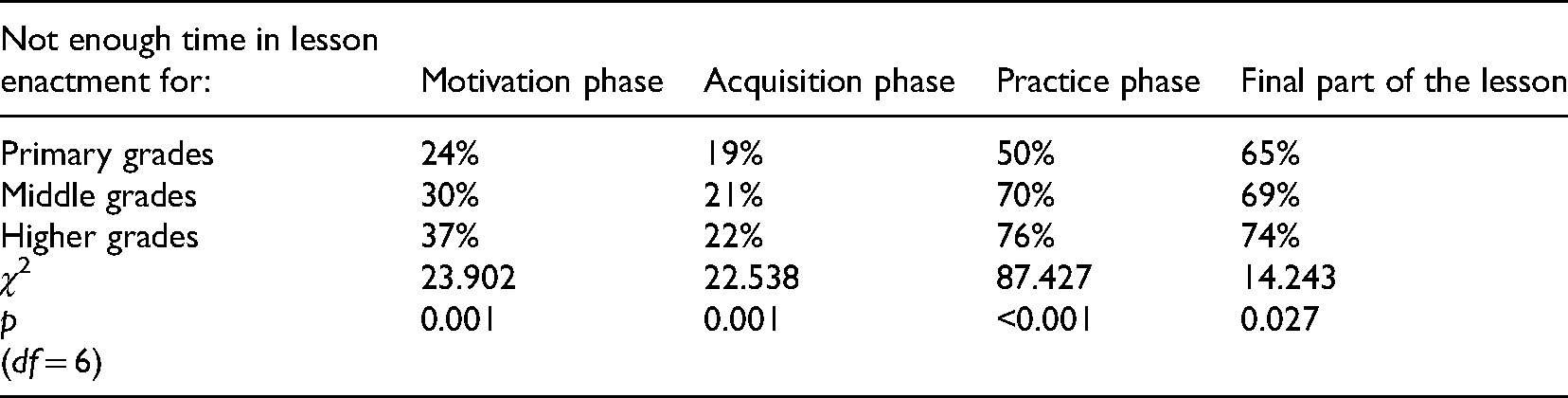
Indicate the lesson phases for which you would need more time for students.
Lack of time for practice was indicated by 50% of primary teachers, 70% of middle-grade teachers, and 76% of higher-grade teachers. In the interviews, some teachers highlighted that they wanted to be sure that students have acquired particular content, and therefore students need more time in this phase of the lesson. The other reasons given are: the mathematics curriculum is very comprehensive, practice phase is important because students will not study at home, and earlier lesson phases take up precious time. [T2MS]: I always lack time for revision. I would like the children to understand it properly…
[T4MS]: A lot of content is prescribed, what is lacking… is maybe more time for practice.
[T2HS]: It's very hard to expect them to solve something at home that they haven't seen during the lesson. That's why I always try to solve as many tasks as possible in class, as many different types as possible…
[T2HS]: There's never enough time for practice. If I’m introducing something new, then I always use a motivational example, and that takes too much time. Or… if we have to derive something, the lesson ends and we have barely managed to do it, whereas before we would get there and even do some exercises. It's like I don't have time for it… But the students are just too slow.
Some teachers explained that they assigned homework because the time spent on practice in lessons was not enough. [T1HS]: I think that math homework is really an integral part of math teaching. By giving it, I actually gain some time, of course, at the expense of the students’ free time. But I think they need it. I place great importance on homework.
The final phase of the lesson would usually be in the form of an activity that would give the teacher feedback on the students’ understanding of the topic and the effectiveness of the lesson. Participants from all three groups highly indicated that they do not have enough time for this lesson phase (65% of primary teachers, 69% of middle-grade teachers, and 74% of higher-grade participants). The reasons were similar to the practice phase. The primary teachers are able to simply take time from the following lesson to conduct the final phase of the lesson (see T4PS participant's quote in the section on time for lesson planning).
The literature review indicated that some approaches and activities (e.g., problem solving and teamwork) require more time in lesson enactment. Therefore, the survey contained a set of questions that referred to these issues. Table 7 presents the results of the following questions: Do you and your students have enough time in lesson enactment for (a) problem solving and (b) teamwork?
Having enough time for problem solving and teamwork.

Having enough time for problem solving and teamwork.
The results indicate a lack of time for problem solving within all three examined groups. Seventy-three percent of primary participants, 89% of middle-grade teachers, and 89% of higher-grade teachers stated that they do not have time for problem solving activities in mathematics education (χ2 = 92.909, df = 6, p < 0.001).
In the interviews, some of the teachers explained that they barely have sufficient time for basic content, and therefore there is not enough time for problem solving. Another issue is that students differ significantly in problem solving. [T2HS]: Somehow there are not many students who can solve problems. It's hard. I’m trying, but it's not going well.
[T1MS]: It takes us 20 lessons to go through a certain unit, and I should, for example, give them a test on the 24th lesson. Now, as we went through that unit, we actually managed to master new concepts, (…) new procedures, but we didn't touch on problem solving at all. Because… by that 20th lesson, we have students who are still struggling with, for example, if the unit is Integers, who are still struggling with addition and subtraction of two integers. How am I going to do problem solving with them? That's the problem, it would take me at least another 5 lessons of each unit to practice those things with them.
The results show that 66% of primary participants do not have enough time for organizing quality teamwork (Table 7). The percentage of the higher-grade teachers is even greater: 84% of middle-grade teachers and 79% of higher-grade teachers claimed that they need more time for teamwork during the lesson (χ2 = 60.143, df = 6, p < 0.001). The interviews highlighted time-consuming preparations and giving instructions to students, circumstances due to the pandemic, and individual differences among students as being the main issues concerning teamwork. Some of the participants admitted that they preferred to use pair work instead. [T2MS]: Working in pairs gives very good results (…) Because in group work there is always someone who will avoid doing anything, someone who will lag behind, who will try not to participate… A lot of time is wasted, with less gained.
[T2PS]: Teamwork especially has to be thought out, organized. In lower grades, the first and second, it's much harder for them, but by the third and fourth grade, with repetition, they know the procedure. But you have to make tasks for each group, they have to be connected, all together… So whether it's group work or pair work, more preparation is needed.
[T4MS]: At the beginning we all discuss something, then we start working in pairs or groups. Now with coronavirus, we don't use (group work) any more, now it's in pairs. I go around students and talk to them about what they are doing, and they work at their own pace.
This section presents the results on the interaction of time with other resources important for the quality of mathematics education, such as textbooks, technology, and communication with colleagues.
Interaction of textbooks and time
The survey contained two questions on the relationship between textbook use and time. The first of these was: Does the mathematics textbook set provide better and more efficient lesson preparation? The results (Table 8) show a strong relation between the use of the textbook set and the efficacy of the preparation process: 94% of primary participants, 83% of middle-grade teachers, and 71% of higher-grade teachers claimed that the textbook set helped the lesson preparation efficacy. The second question referred to the lesson enactment: the participants were asked whether the textbook set makes their enactment more effective. The results are similar to the previous question: 93% of primary teachers, 77% of middle-grade teachers, and 71% of higher-grade participating teachers said that the textbook set supported the lesson efficacy (Table 8). In both questions, a decrease in the proportion of positive answers can be seen from lower to higher levels: primary teachers rely on the textbook set more than their colleagues in the middle grades, and middle-grade teachers rely on textbooks more than their higher-grade colleagues (χ2 = 132.396, df = 6, p < 0.001 for preparation and χ2 = 142.345, df = 6, p < 0.001 for enactment).
The use of textbooks and lesson efficacy.

The use of textbooks and lesson efficacy.
Some of the interviewed teachers confirmed that the textbooks they used were in line with their personal approaches. As such, the textbook helps a lot in lesson preparation and enactment. For example: [T4PS]: The textbook certainly helps, absolutely, and shortens the preparation time. Because, the textbook I use… I am very satisfied with it, it guides students very well through all stages of the lesson, so it helps a lot.
On the other hand, some participants were not satisfied with the mathematics textbooks or with some parts of them. Subsequently, they spend more time preparing lessons. Still, the textbook remains the main source for homework. [T1MS]: The textbook set for the sixth grade did not have a sufficient number of tasks containing a triangle area which used a square grid. So I had to prepare and draw all these tasks myself in GeoGebra.
[T2MS]: I rarely use the textbook in my work. (…) I use textbooks… not one, but 15 of them, so it's more interesting. There is always something lacking in every textbook, so I’m not happy to follow that form (of work). Sometimes I use it for homework…
[T1HS]: I’m rarely guided by their worked examples, I always try to find other examples. I leave those in the book for students to do on their own, when they need explanations. I always tell them where it is in the textbook, in that sense I stick to the textbook, because that is what they bought as additional literature (…) From the textbook set I usually use the exercise book.
Another important material resource in mathematics education is technology. The participants were asked whether technology (computers, software, tablets, etc.) make their lesson preparation and enactment more effective and efficient. The results show that the technology makes lesson preparation shorter and more effective for all three groups (Table 9). Similarly, most of the survey participants considered technology as a benefit in terms of the efficacy in lesson enactment. As in the results for the use of textbooks, we notice a decrease in positive answers from the lower to higher grades (χ2 = 47.483, df = 6, p < 0.001 for preparation, and χ2 = 10.162, df = 6, p = 0.118 for enactment). This means that lower grades have more benefits from textbooks and technology in the preparation and enactment of lessons than the higher grades.
The use of technology and lesson efficacy.

The use of technology and lesson efficacy.
In the interviews, some of the teachers gave reasons for why using technology saved time, for example: storing and revising digital material is easy, it provides visualization and dynamics, and increases student motivation. Teacher T4PS stated that online teaching forced her to learn how to use digital content and now she sees the benefits of this experience: she is able to quickly create quizzes and other digital activities. [T4MS]: Technology is my friend. First of all, because you make materials and have them permanently. Changing something (…) is much faster. (…) Besides, let's say when someone is sick, I put all my presentations in the virtual classroom. (…) There are various applets which allow visualization. (…) Maybe sometimes I don't have to do an experiment, which would be complicated, which I wouldn't otherwise be able to do, but I can show it with the help of technology.
[T4PS]: Well, I have to admit it's easier this way. In terms of preparation (…) While we were in lockdown and had online lessons, we were simply forced to learn to use all these digital tools and master them in order to make it easier for the children, but also to motivate them to work. So now it really takes very little time to make a quiz.
[T3HS]: Definitely calculators have an effect… you can do some things a lot faster. Also, a computer, if they need to draw a graph or something. Or if I want to set some functions (with particular properties)… then it is much easier if you use the computer.
On the other hand, participants highlighted the problems they and their students experienced using technology. These problems created time-consuming and non-productive periods during lessons: [T1HS]: A quiz that (…) takes 5 minutes. However, in practice… slow internet, waiting for everyone to pull out their cell phones, to connect, to log in… it takes a lot of time. There are always some children who haven't been able to log in, so “what do we do now, do we go back”, and so on.
[T1MS]: It can happen that I have to draw these geometric shapes myself (using IT). Then it can take me longer. But if these are simple questions, for example, −3 + 2 = −1, and so on, I’m done in about 10–15 minutes.
[T1MS]: It turns out that when they work on tablets they feel like they’re playing a game. For example, if they’re running out of time for a task, then they rush. (…) It often happened that they were click-click-click, “I’m first, I’m done!” (…) I would say, “How much of it is correct?” “Ouch!” (…) We need to develop this culture of using technology so that they understand that it is not a game, but that it has an educational purpose.
Professional communication with colleagues is a significant non-material resource (Adler, 2000) which refers to teachers’ time outside the classroom. So, it is important to find out how much time teachers spend on exchanging experiences with their colleagues and how often they do this. In the survey, the participants had the opportunity to choose from different statements on communication with colleagues. Table 10 presents the three most frequently chosen statements.
Teacher's time outside the classroom—discussions with colleagues.
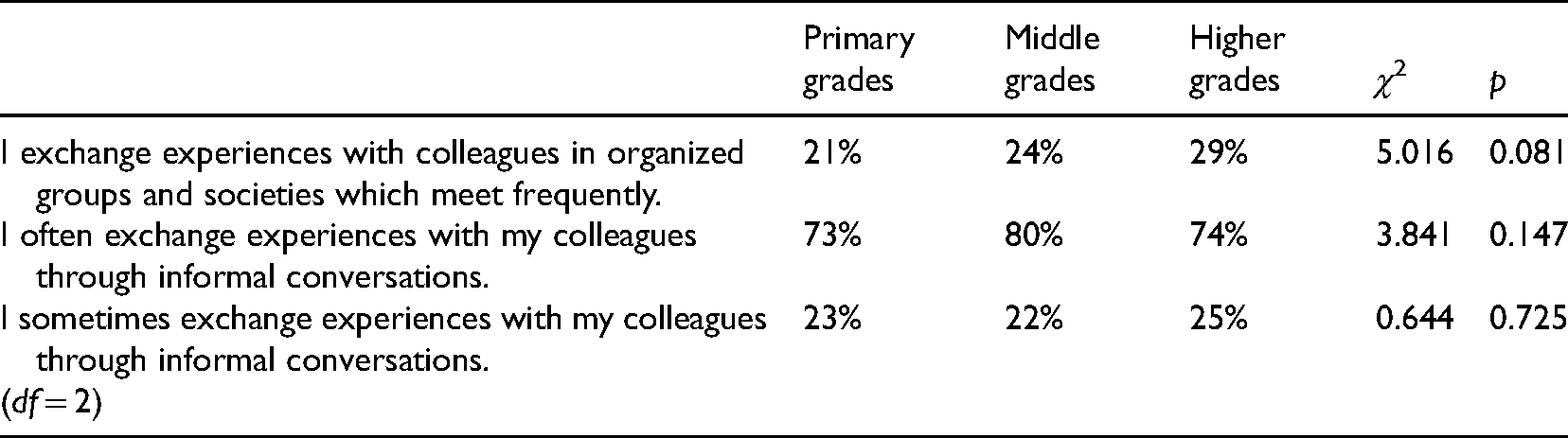
Teacher's time outside the classroom—discussions with colleagues.
The results show that about three-quarters of all participant groups often exchange experiences with colleagues through informal conversations. Twenty-one percent of primary teachers, 24% of middle-grade, and 29% of higher-grade teachers participate in organized groups for conversation and exchanging experiences (χ2 statistics are reported in the table). Working with colleagues is rather limited to informal conversations. The participants did not mention observing colleagues’ teaching, such as lesson study groups.
The interviews highlighted that the cooperation with colleagues within the same school depends on individual relationships, such cooperation is not obligatory. But most of the participants have colleagues from other schools with whom they share ideas via the Internet. [T4PS]: We work very well together at school. I have to admit that I am one of the lucky people who can say that they have colleagues with whom they truly cooperate. We cooperate, if we have an idea we always share it with each other. We have collaborative learning. Well, it's really rare and some find it hard to believe, but it's true. So it helps me a lot to work with colleagues, to share experiences, ask if we are not sure about something, if we have any concerns, talk about it, comment, plan everything together, and so on…
[T4MS]: Well, it depends a lot on my colleagues, (…) but I cooperate with people who are not from my school, I exchange ideas and materials with them, we talk, we share materials online, when someone makes something, they upload it and we give each other feedback on how it could be improved: “I tried this, it was great, maybe you could try”…
Many types of teacher professional training promote new approaches in mathematics education, new ideas, and activities. In the survey, the participants were asked if the ideas and activities promoted in recent professional training require more time in lesson preparation and enactment. The results (Table 11) show that the majority of primary participants (57%) consider that they have enough time for implementing new ideas presented in professional training. However, 55% of middle-grade teachers and 66% of higher-grade teachers disagree with this statement (χ2 = 50.05, df = 6, p < 0.001).
Applicability of professional training.

Applicability of professional training.
Teacher T1MS was a trainer in teacher education. She stated that she needed a lot of time to prepare good examples for introducing new approaches to teachers: [T1MS]: I prepared a workshop for the conference with my own examples (…) people liked it, but later everyone said “How much work is that (for implementing it in the classroom)!” Yes, it's an awful lot of work. (…) This was in the summer, I had time, and I really put a lot into it. I was preparing that lecture for a month.
Another participant stated that she only implements the “easily-applicable” aspects from professional development, which can be quickly implemented. [T2HS]: Those educations through the Loomen platform helped me. I could always come back to have another look. In general, professional development is only to get some ideas or something. I don't know, I wouldn't say they affect my preparation of a lesson much (…) I mean, I only take those ideas that are easily transferable for me.
Teacher T4MS uses international professional education via the Internet. But it takes time and money. [T4MS]: Professional training in Croatia is not…it doesn't meet my needs. (…) There are fantastic things abroad so I participate in professional training online, and I read a lot (…) Absolutely (I need more time for development). I mean, I watch it live at night, because it's somewhere abroad, so I have to wake up for it (…) I pay for this monthly, so I want to see as much as possible, it takes an awful lot of time.
The study presented in this paper encompassed teachers’ views on time as a resource in mathematics education. The survey participants highlighted that a lot of time is needed for geometry topics in terms of lesson preparation and enactment. The participants also stated that they do not have enough time for problem solving and teamwork as often and for as long as their students would need. The teachers particularly emphasized the lack of time for practice and for the final part of the lesson, especially in higher grades. The interviews revealed reasons for that, such as the comprehensiveness of the mathematics curriculum and the amount of time needed for the acquisition phase of the lesson. Regarding the interaction between time and other resources, the results show that textbooks and technology as material resources make lesson preparation and enactment more efficient, because they may save time and improve the structure of the lesson. However, the help of these material resources decreases from the lower to higher grades. Communication with colleagues is an important part of teachers’ time outside the classroom and is mainly limited to informal conversations, without formal support.
The results indicate the importance of understanding time as a resource for effective mathematics education. The participants specified various issues regarding time as being of importance to them: (1) lesson duration (40 or 45 min); (2) the number of mathematics lessons per week or per year (before the curriculum reform in 2006 they had more lessons per week); (3) the issue of extending the lesson if necessary (primary teachers can manage this, secondary teachers give the remainder for homework); (4) the lack of time for topics which are positioned “near the end” (i.e., not enough time in lessons for practice, revision, and the final activities, not enough time for geometry because it comes at the end of the school year); and (5) the finding that participants consider lesson preparation to be an official part of their professional time, unlike collaboration with colleagues.
The results confirmed the participants’ efforts to find a balance between the objective and subjective dimensions of time (Ben-Peretz & Bromme, 1990; Hargreaves, 1994), complying with the allocated curricular time, and making decisions concerning the instructional time. The literature review also highlights the gap in contemporary students’ and teachers’ activities which are, on the one hand, valuable and preferable, but on the other hand, time-consuming (Clarke et al., 1996; Kilpatrick et al., 2001; Walen & Williams, 2002). The findings help to provide a more in-depth understanding of this issue.
The results also revealed clear differences among the three participant groups of teachers: primary grade, middle grade, and higher grade. For example, primary teachers have greater flexibility regarding time because they teach six subjects to a single class and they can easily modify the lesson duration and structure. If they need more time, they simply extend the lesson duration or change the timetable. Unlike the other groups, they stated that they do not depend on the school bell. These results are in line with Hargreaves’ (1994) assertion on the subjective dimension of time—teachers “can take time and make time” (p. 95). In this issue, the objective dimension of time (e.g., the prescribed lesson duration) is in contrast to the subjective one (teacher's decision on a particular lesson duration).
Another issue that emerged during the study process was the relationship between fixed and variable aspects. Namely, the participants complained of not having enough time for “new” content or contemporary approaches, that is, the content and activities introduced with the new curriculum or encountered in professional training. This means that content and activities are to be added to their practice, but the number of lessons remains the same and there are no clear instructions of what should be omitted. The implication of adding more content and new activities to a fixed amount of lesson time is that teachers then have to compensate by reducing or excluding other aspects of the curriculum. For example, Jones (2000) claims that one of the reasons for reducing geometry content in curricula lies in the increase of algebra, data analysis, and probability within mathematics curricula. Also, geometry curricula have been criticized for a lack of coherence (Van de Walle & Lovin, 2006) because of the hasty content offloading. Interestingly, the results of our study identified geometry as a time-consuming content. This may signify a continued reduction of geometry in school practice.
Consequently, it is important to act in two directions: to include time issues in teacher educational programs (Adler, 2000; Bromme & Hömberg, 1990), and to raise the importance of time with curriculum developers and researchers (Ben-Peretz & Bromme, 1990). Teacher educational programs should encompass the time teachers need for planning and for assimilating new content and pedagogy, and highlight the importance of teachers meeting together (Clarke et al., 1996).
International implications, limits of the study, and future research
The study presented in this paper was focused on the teachers’ experiences with time as a resource and its relation with other resources in mathematics education. It helped in better understanding the gap between allocated time and preferred activities, and the decisions made by teachers in practice in trying to balance these two factors. In this way, the issues raised in the study may contribute to the global discussion on time as an important resource in education. In particular, the study sought to contribute to the qualitative and quantitative aspects of teachers’ views on time as a resource. Such discussions may be of use to researchers, curriculum developers, and teacher training educators. However, since the sample refers to Croatia, a small European state, the results cannot be generalized and applied to other countries. Time is a non-material cultural resource (Adler, 2000). Since different cultural contexts bring diverse meanings of time (Ben-Peretz & Bromme, 1990), it would be interesting to extend the research to other cultures and to investigate how teachers from Asia and other continents relate time to different aspects of teaching and other educational resources.
Future research will include investigating time as a resource through classroom observations and analyzing teachers’ lesson plans. Also, the results presented in this paper should be further analyzed regarding the differences in teachers’ educational backgrounds. Another direction for future research could be to focus on students’ time, including them in a study on time as a student resource. In this way, a better overall picture of the issues concerning time in mathematics education could be obtained.
Footnotes
Contributorship
Dubravka Glasnović Gracin conducted the literature review and drafted the manuscript. Goran Trupčević conducted the survey and data analysis. Both authors designed the survey and interview questions according to the literature review. Both authors also conducted interviews, discussed the results, and approved the final manuscript.
Declaration of Conflicting Interests
The author(s) declared no potential conflicts of interest with respect to the research, authorship, and/or publication of this article.
Funding
The author(s) received no financial support for the research, authorship, and/or publication of this article.
Informed consent
The participants provided informed consent to partake in the study and have been made aware of the publication.

Correction (December 2024):
Article updated to add Informed consent section.