




Abstract
The model method is synonymous with Singapore Mathematics. The spiral structure of the mathematics curriculum, with its focus on problem solving, and the concrete-pictorial-abstract approach to teaching, supports the use of the model method to solve arithmetic problems and enables the development of letter-symbolic algebra. The schematic representation of the model drawing encourages the decoding of information, and strengthens the development of the part-part-whole nature of numbers, beginning with whole numbers, followed by rational numbers, and finally the notion of the letter-symbolic algebra. First, the schematic representation is used to solve arithmetic-type word problems in the early years, then algebraic-type word problems. For some, the model method provides an avenue to track the ontogenetic development of algebra, from rhetorical algebra to, syncopated-Diophantine and finally letter-symbolic Vietan algebra, which provides a general solution to a set of problems, the crown of algebra.
The model method
The model method could be said to be synonymous with Singapore mathematics. In the paper “Mathematical Models for Solving Arithmetic Problems” presented at the 1987 ICMI-SEAMS, Kho highlighted the efficacy of the model method and offered examples of how the model method could be used to solve various types of structurally complex problems. Without using the model, one may have to resort to the algebraic method to solve structurally complex problems. However, the “model” method is less abstract than the algebraic method and can be introduced to pupils before they learn to solve algebraic equations. Indeed the models serve as good pictorial representations (emphasis by author) of algebraic equations (Kho 1987, p. 349).
The spiral structure of the Singapore mathematics curriculum allows for simple but fundamental concepts developed in the earlier years to be re-visited, expanded, deepened, and re-integrated at a higher level. The affordances of “pictorial representations” have meant that the rectangles, used to represent numbers, can be used to solve arithmetic problems in the early years, and with the progression through the spiral curriculum the rectangles are used to represent unknown numbers or variables. The model method was systematically introduced into the primary four mathematics textbooks published in 1983 (Curriculum Planning Division, 1990; Curriculum Planning & Development Division, 2000a; Curriculum Planning & Development Division, 2000b; Ministry of Education, 2009). In the early years, the model method was used to solve simple arithmetic problems such as finding the total of
The research literature based on behavioral studies demonstrates that many students are challenged by letter-symbolic algebra. The difficulties range from, but are not limited to, students difficulties interpreting the meaning of letters (Harper, 1987; Küchemann, 1981), interpreting algebraic notations (Koedinger & Nathan, 2004) understanding structures (Kieran, 1989; Sfard, 1994); identifying equivalent equations (Steinberg et al., 1991); translating word problems into equations (MacGregor, 1991; Stacey & MacGregor, 2000; Ng et al., 2006; Wollman, 1983).
Contrary to popular belief and research investigating the difficulties students face in solving word problems, Koedinger and Nathan (2004) showed that students found solving algebraic equations more challenging than using other methods to solve algebraic word problems which shared the same structure as the algebraic equations. They argued that the abstract nature of the algebraic equations meant that students had more difficulties interpreting the meaning of these equations than interpreting the meaning of word problems set in context.
Furthermore, new methodologies such as functional Magnetic Resonance Imaging (fMRI) provided evidence that letter-symbolic algebra was more resource-intensive for students. Students had to invest more resources to solve the same sets of problems. In Singapore, it was possible to gain access to students who were equally proficient with the model method and letter-symbolic algebra to solve structurally identical sets of problems. Two studies using fMRI methodology were conducted to examine whether the two methods drew on different cognitive processes and imposed different cognitive demands on those using these methods to solve problems. The first study (Lee et al., 2007) focused on the initial stages of problem solving: translating word problems into either model drawing or letter-symbolic representations. Eighteen adults, matched on academic proficiency and competency in the model method and letter-symbolic method, were asked to transform algebraic word problems into letter-symbolic equations or model drawings and validated the presented solutions. Both strategies were associated with the activation of areas linked to working memory and quantitative processing. These findings suggest that the two strategies are effected using similar processes but imposed different attentional demands with the letter-symbolic method being more working memory intensive than the model method. In the second study, Lee et al. (2010) focused on the later stages of problem solving, namely computing numeric solutions from presented model drawings or letter-symbolic representations. Seventeen participants who were equally proficient in the two methods were asked to solve simple algebraic word problems presented in either format. The findings suggest that generating and computing solutions from letter-symbolic equations required greater general cognitive and numeric processing resources than processes involving model representations. These two studies showed that constructing and solving letter-symbolic equations were more working memory intensive than the two methods. These findings were based on work with adults who were equally competent with two methods. If this is the case, then perhaps elementary students may find letter-symbolic algebra even more demanding to learn than other methods.
With the model method, there is no necessity to grapple with the difficulties related to letters as variables (e.g., Kieran, 1989; Koedinger & Nathan, 2004; Küchemann, 1981; Stacey & MacGregor, 2000; Steinberg et al., 1991; Wollman, 1983) for the rectangles are used to signify unknown numbers. However, the rectangles could also stimulate the ontogenetic development of letters as discussed by Harper (1987). The schematic representation in Figure 1 shows the spiral curriculum introduces, integrates, and deepens the knowledge of how to use the model method to solve problems, the focus of the Singapore mathematics curriculum.
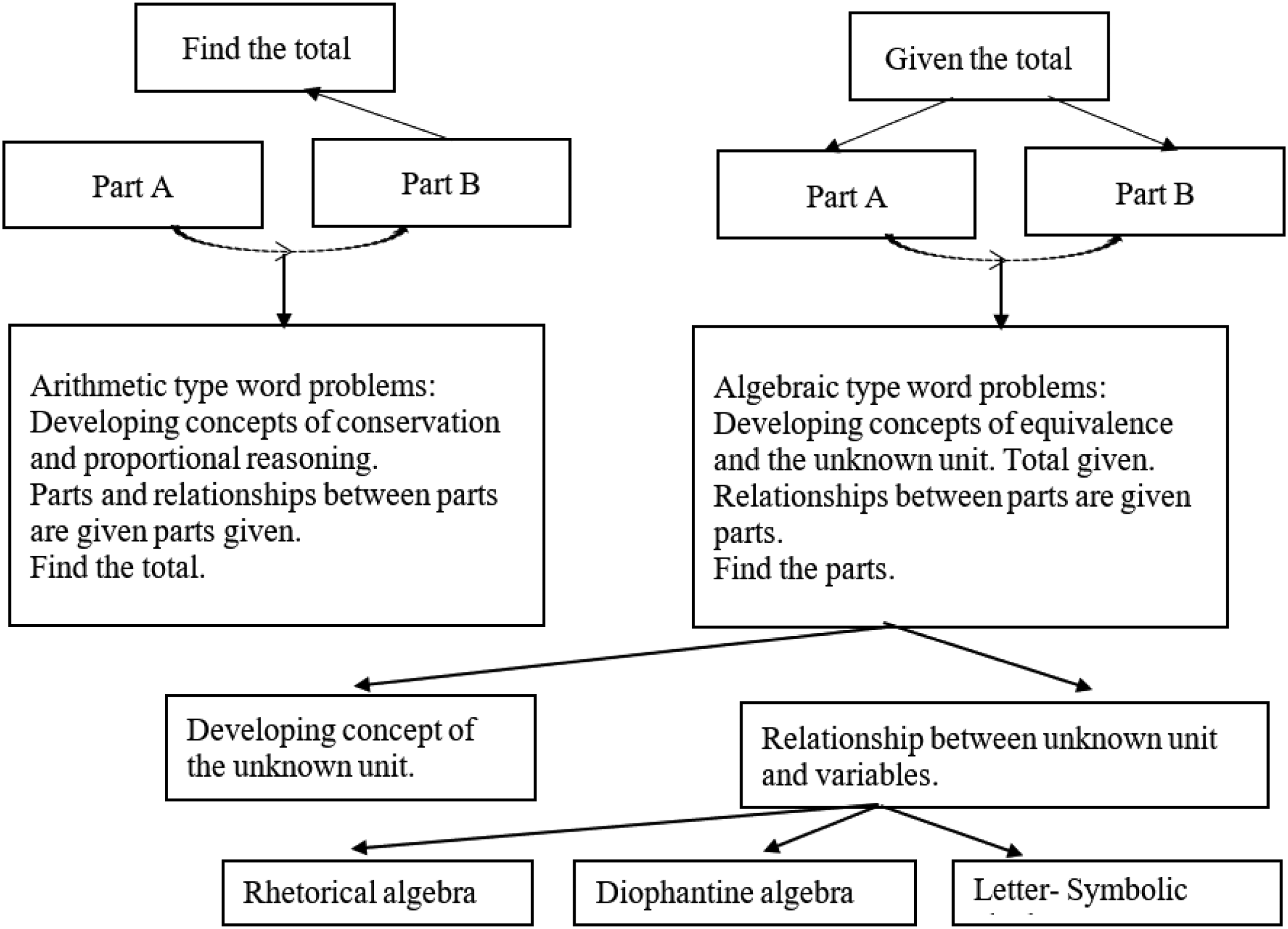
The spiral curriculum introduces, integrates, and deepens the knowledge of how to use the model method to solve arithmetic- and algebraic-type word problems.
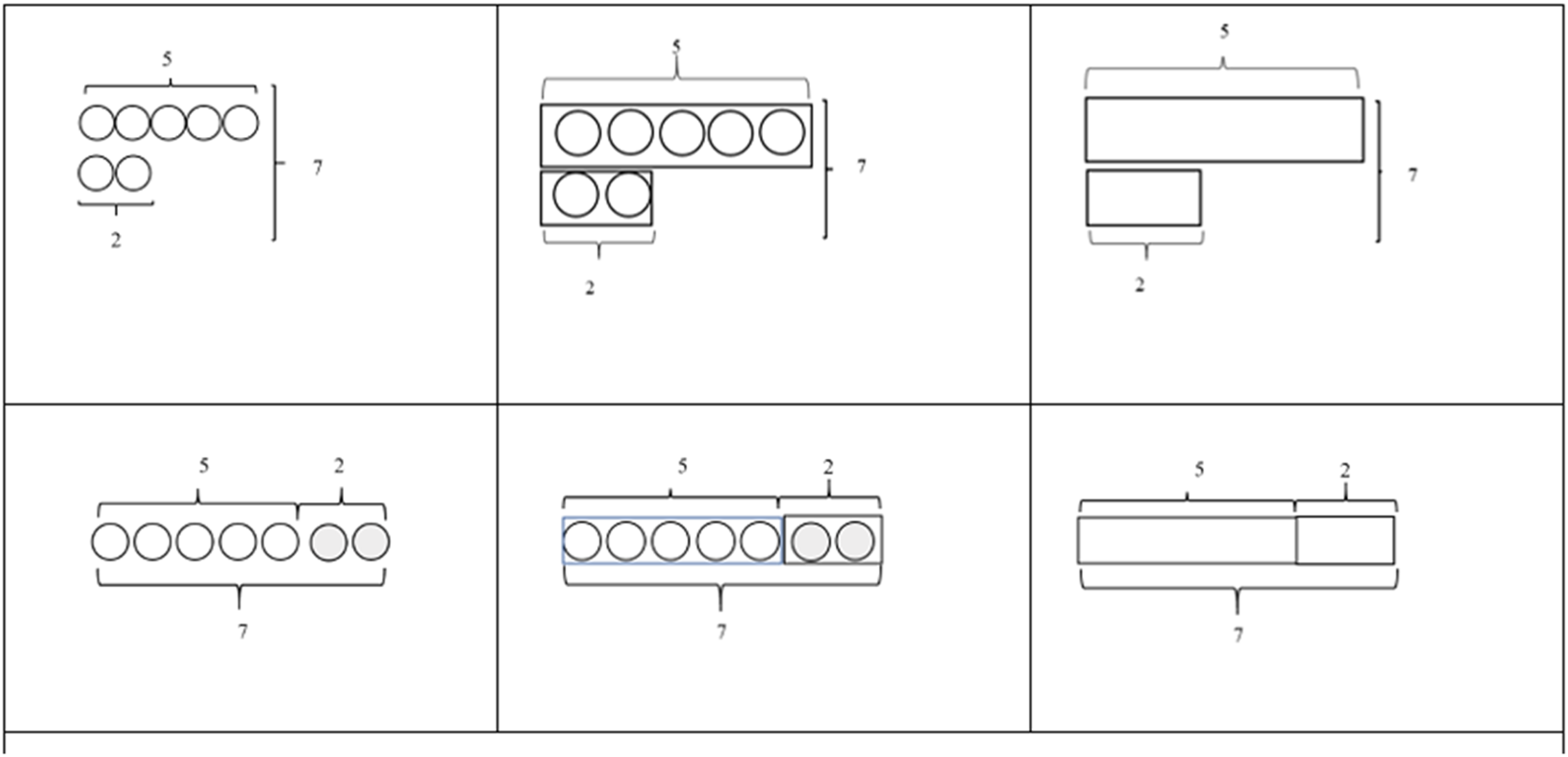
Two possible representations of 5 + 2. The extreme left column shows the actual number of counters. The middle column illustrates how rectangles are used to wrap around the actual number of counters. The extreme right column shows how the role of rectangles evolves to represent numbers; their lengths are proportional to the size of the numbers.
The following section discusses how the Singapore spiral curriculum progressively develops the use of the model method to solve increasingly conceptually demanding problems. In the early primary years, especially in Primary One and Two, the curriculum uses a concrete approach to introduce the model method. Concrete materials such as counters are used to represent the actual numbers. Moving up the spiral curriculum, concrete materials are replaced with rectangles of appropriate lengths, a longer rectangle for a bigger number, and a shorter rectangle for a smaller number. Thus the rectangles show the relationships between the numbers represented. Number sentences, the symbolic representation of the relationship between the rectangles capture the quantitative relationship. The primary curriculum increases the range of numbers in each subsequent year. The Primary One curriculum introduces numbers up to one hundred, one thousand in Primary Two, and a million in Primary Five. However, word problem sums at each primary level do not reflect the numbers developed at that level. Instead, numbers are kept small as the intent is to develop and deepen the understanding of relationships presented in the content of the word problems. Problem sums in Primary One and Two focus on the use of the operations addition and subtraction. In Primary Three the model method is used to represent and solve word problems involving multiplication and division as these concepts are developed in these years. As the curriculum spirals up the primary years, the model method is used to solve fraction problems in Primary Four and beyond. Ratio and percent problems are introduced and developed in Primary Five. Again the model method is used to represent and solve word problems involving ratios and percentages. The percentages used are multiples of 10 or five. This is because it is possible to partition a rectangle into five parts, each part representing 20%, or four parts with each part representing 25%.
Rudimentary concepts of algebra are first introduced in Primary Six. The curriculum requires the construction of linear algebraic equations in one unknown but does not require the solution of such equations. Construction and solution of linear equations are introduced and developed at Secondary One (13 +). Prior to 2020, there were at least three publishers of primary texts for schools in Singapore. It is difficult to select and cite examples from a particular scheme as it may suggest that those examples are particularly noteworthy. Thus the author has chosen not to cite contents from commercially produced texts. Instead, the author used examples that reflect the intent of the curriculum. Students’ solutions are a result of 20 years of teaching and research in the field. After 2020, the Curriculum Planning and Development Division of the Ministry of Education published instructional materials to be used in schools, and commercial texts are slowly phased out.
Developing proportional reasoning in the early years of primary school: First represent then calculate
Singapore curriculum encourages the Concrete-Pictorial-Abstract teaching sequence. For example, concrete materials are used to develop the concept of addition through combining materials. Thus, to find the sum of
Repeated use of such concrete representations followed by the use of rectangles to group the materials encourages the proportional representation where a > b. One possible explanation for the power of the model method is that it provides an avenue first to represent the problem before the process of calculating for the solution begins. Ng’s (2015) study showed how a Primary Two teacher taught a group of twelve children to construct appropriate part-part-whole models to solve simple word problems. Through repeated use of the model drawing, the children in this study were able to identify the parts that made up the whole and to use the model method to solve homework tasks.
By Primary Three, bigger numbers are used. Now it is no longer possible to use concrete materials to represent big numbers, it is, therefore, necessary to access the knowledge of constructing models which show the relationship between numbers. For example, proportional reasoning with numbers is further deepened with the use of the following comparison task introduced in Primary Three. A long rectangle is used to represent a large number and a proportionately shorter rectangle, is a small number. It also encourages the concept of estimation. How long should each rectangle be in relation to each other? Although the Primary Three curriculum develops concepts of numbers up to ten thousand, problem-solving activities focus on the use of small numbers (Figure 3).
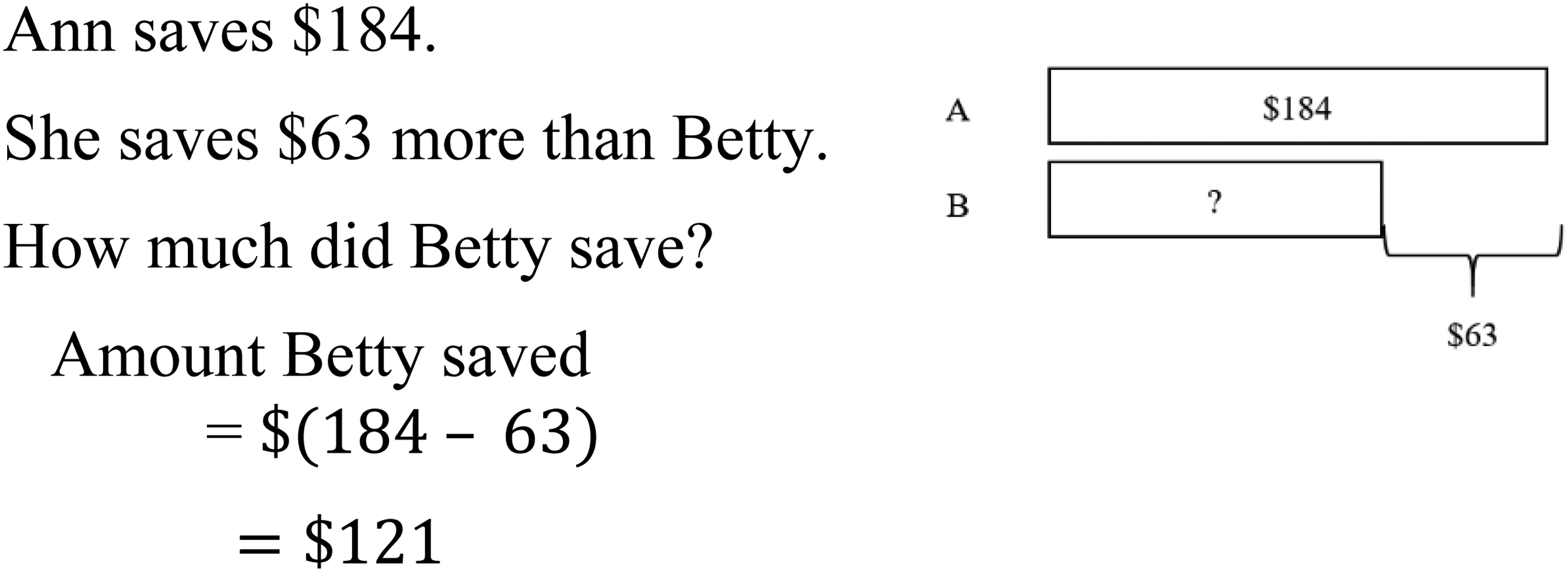
The use of small numbers to strengthen the part-part-whole nature of numbers, estimation, and the development of proportional reasoning at Primary 3.
The model method deepens the part-part-whole nature of numbers with fractions. The following example shows how the model method can be used to solve word problems involving rational numbers. Ann made 300 pies. She sold
Although this is a fraction problem, the affordance of the model method provides an avenue to use whole numbers and division to solve it. The whole has four equal parts, and the four parts represent the total of 300 pies, each part is equal to 75 pies:
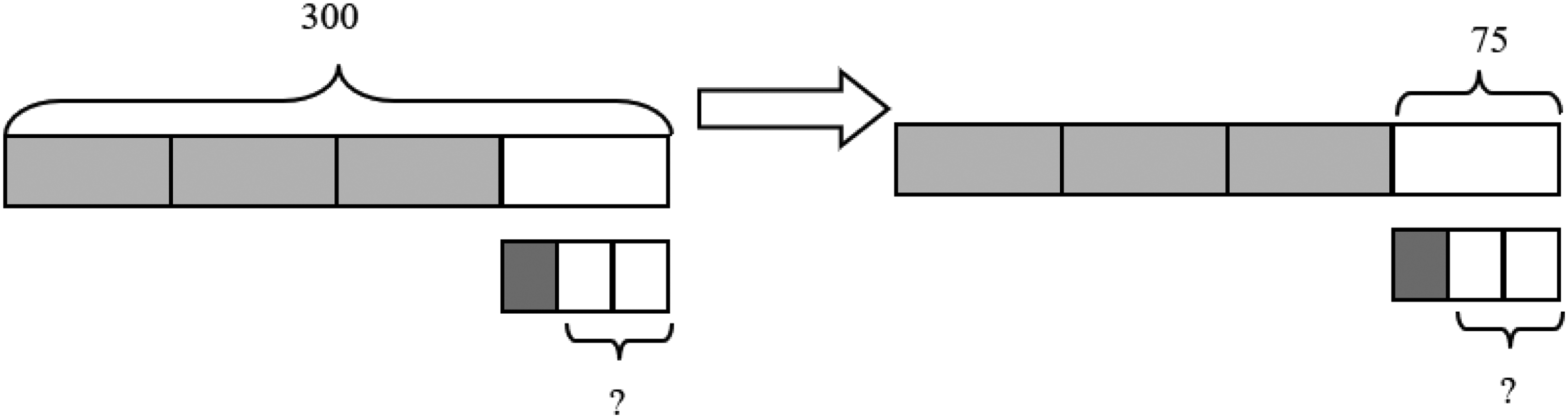
The model method can be used to solve word problems involving rational numbers.
Figure 5 shows how the model method is used to introduce the ratio concept in Primary 5, further deepening and integrating the part-part-whole nature of numbers. Ann and Betty shared $35 in the ratio
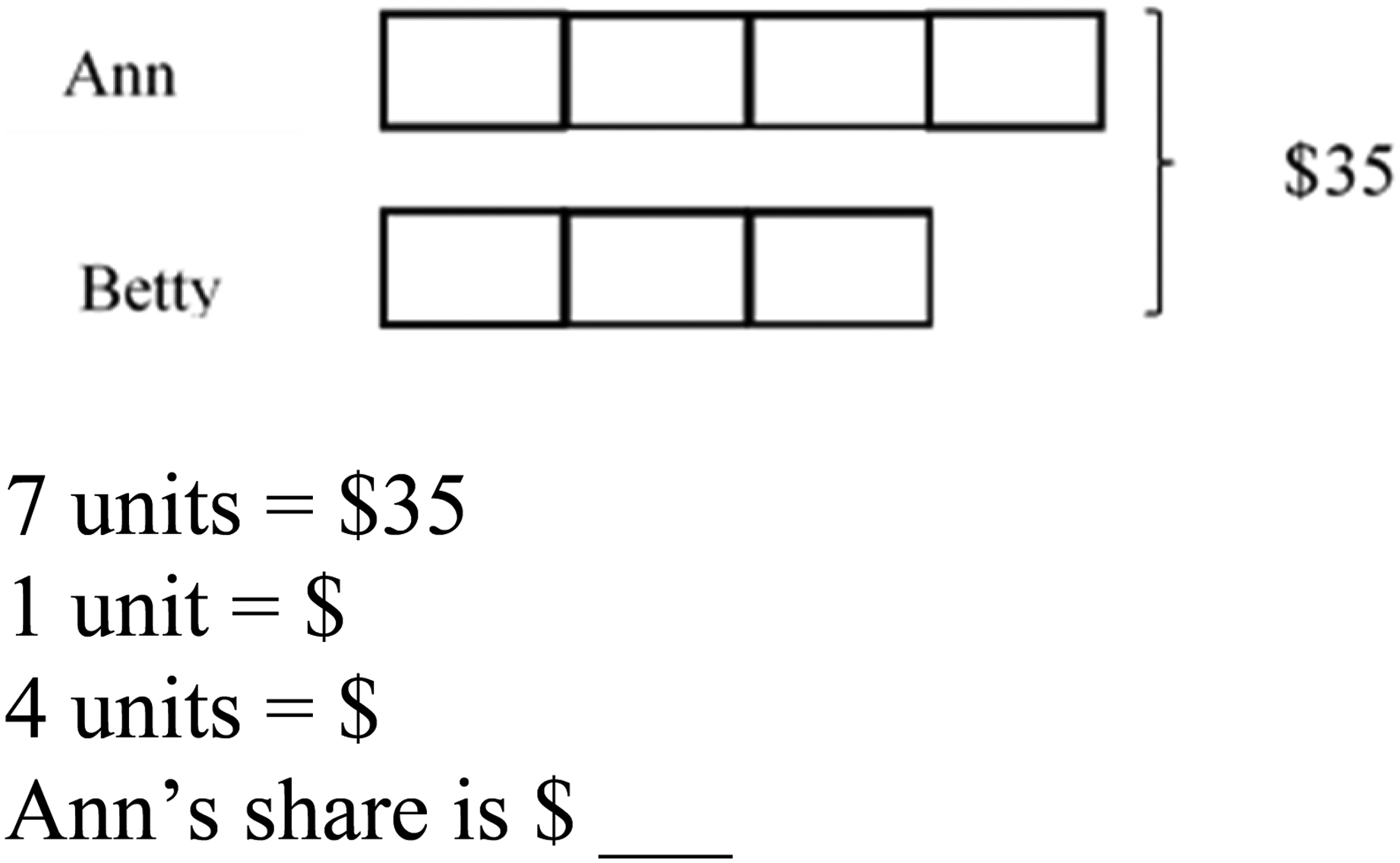
The model method is used to develop the concept of ratio.
What was Ann's share?
In the early primary years, Primary One to Primary Three, the curriculum focuses on the role of model drawings to solve arithmetic word problems. The transition from using model drawings to solving algebraic type word problems starts in Primary Four.
In arithmetic word problems, the parts are given. The objective is to find the total or the whole of these parts. However, in algebraic-type word problems, the total is given. Now the objective is to find the parts (Ng, 2004; Ng & Lee, 2005).
Figure 6 compares and contrasts how model drawings with the same structure can be used to solve arithmetic and algebraic word problems. Since Ann has 35 apples. Ben must have
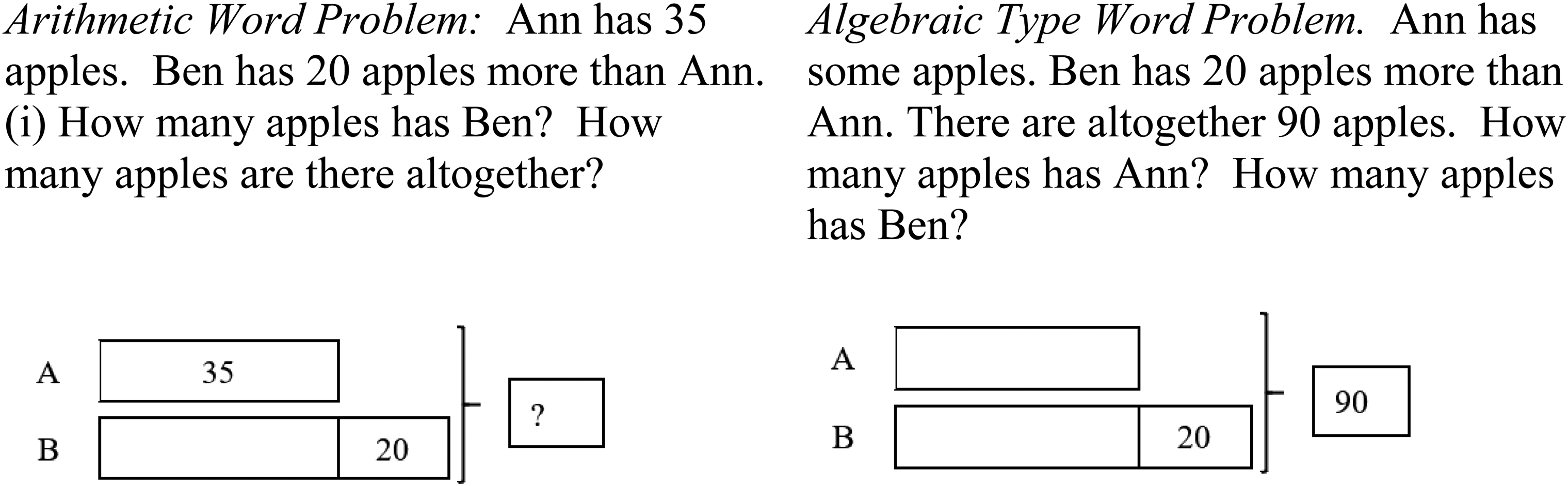
The model drawing to the left shows how the rectangles in the model drawing states the actual number in the parts. The objective is to find the total represented by the question mark. The rectangles in the model drawing to the right denote the unknown values. The total is given.
The same model drawing can be used to solve the algebraic word problem. Ann's rectangle is treated as the unknown unit. Thus Ben has (one unit + 20) apples. The resulting equation is: (one unit + one unit + 20 = 90). The value of the unknown unit can be found by the process of undoing. Two units = 90–20; one unit = 35.
Thus the spiral curriculum offers an avenue to weave lower primary children's knowledge of the affordance of the model drawing to solve arithmetic word problems to solve algebraic-type word problems.
Knowledge of the model representation to solve problems can be used to solve mental sums. For example, transitive reasoning could be used to justify the equivalence of the two arithmetic expressions:
The visualization of a representation helps to understand the difference between the solutions of the following sums. To find the sum of 38 + 19, it may be useful to activate the following equivalences. (a)
In addition, there is a need for one addend to compensate for the other addend. However, in subtraction of the two arithmetic expressions, 45 − 18 and 47 − 20, it is easier to solve the latter. In this case, it is acceptable to add to the minuend and the subtrahend without compromising the difference. Again, the model representation brings into sharp focus the reason for the difference in action for the addition expression versus the subtraction expression. The schematic representation makes explicit the thinking and reasoning of mathematics. The grounded image of the model drawing helps to focus on the part-part-whole concepts of numbers. Without the aid of the model drawing, it would be challenging to describe why in the additional sum, it is necessary to increase one addend and to reduce the other addend. However, in the difference problem, it is correct to add to the subtrahend and the minuend, that is, to compensate both the subtrahend and the minuend. Once these concepts are discussed, the same concepts can be applied to solve more challenging problems (Figure 7).
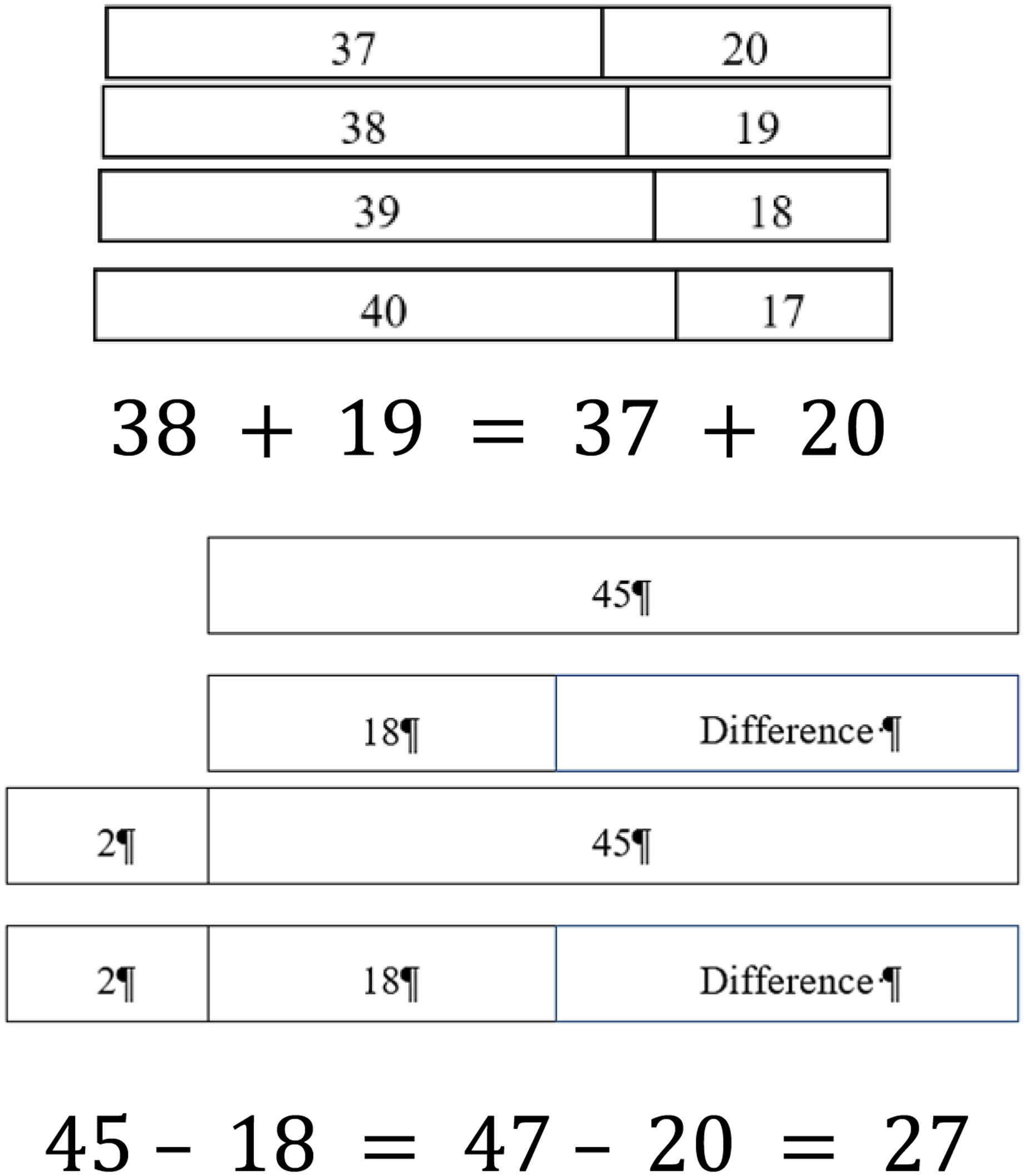
Numbers in the head: Model drawing at the top shows when is it necessary to compensate. The drawing below when and where to add and demonstrates the difference remains the same.
The concept where the difference remains the same can be used to solve age-related problems and at a higher level, ratio-type problems. The solution in the right panel of Figure 8 illustrates how the visual nature of the model drawings makes it possible to represent, despite a change of 6 years, the constancy in age difference between father and son. Knowledge of this fact is the key to the solution. The “after model” of the model drawing shows in detail the multiplicative relationships between father and son. Although the two methods, model method solution, and algebra lead to the resolution of the Muthu's age, the model method provides a visual aid to explain why the difference in age between father and son remains the same. The affordance of the model drawing provides added depth and insight to the algebraic equations. Age Problem: Mr Raman is 45 years older than his son, Muthu. In 6 years time, Muthu will be 1/4 his father's age. How old is Muthu now?
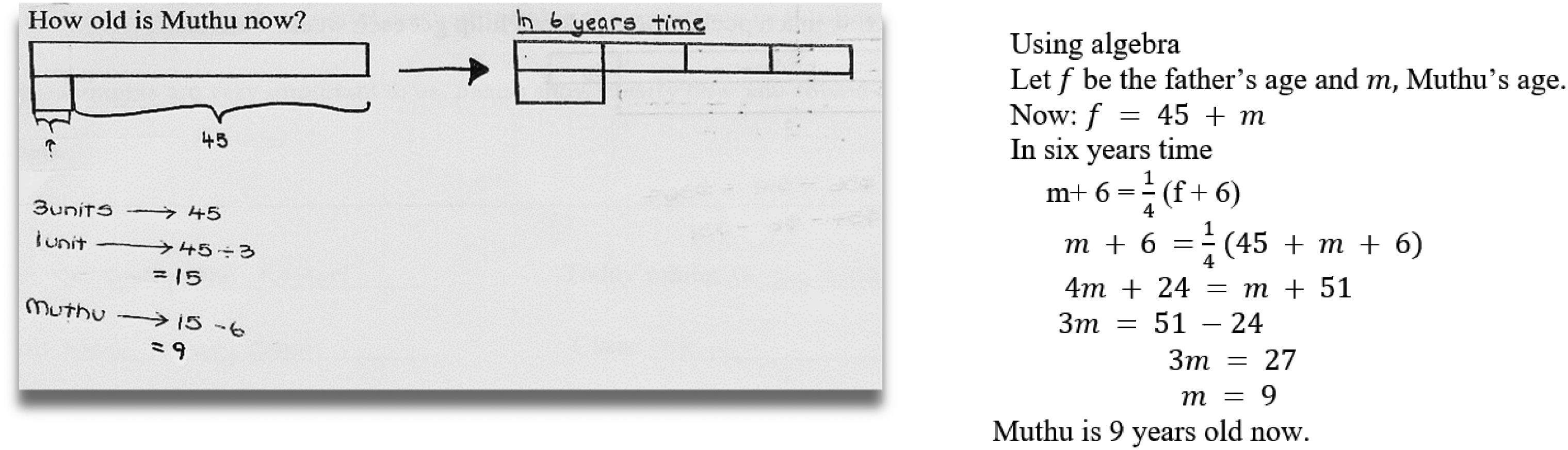
Model drawing to the left shows that age problems can be solved meaningfully. To the right algebraic solution may be efficient but does not add meaning to why in six years time, Muthu's age is one-quarter of the father's age.
Beads Problem: Peter had a total of 156 red and yellow beads in the ratio of
(a) Did the fraction of red beads that Peter had increase, decrease or remain the same?
(b) How many beads did he give away altogether?
This ratio problem is comparable to the age problem. The application of the concept that when an equal amount is added or removed from each item, the difference remains the same. Skillful use of the model drawing is needed to show why the difference remains the same. Unlike the age problem, it is necessary to know from which end to remove the equal amounts. Removing the equal amounts from the left of the model drawing shows that the difference before and after giving away remains the same, the two differences
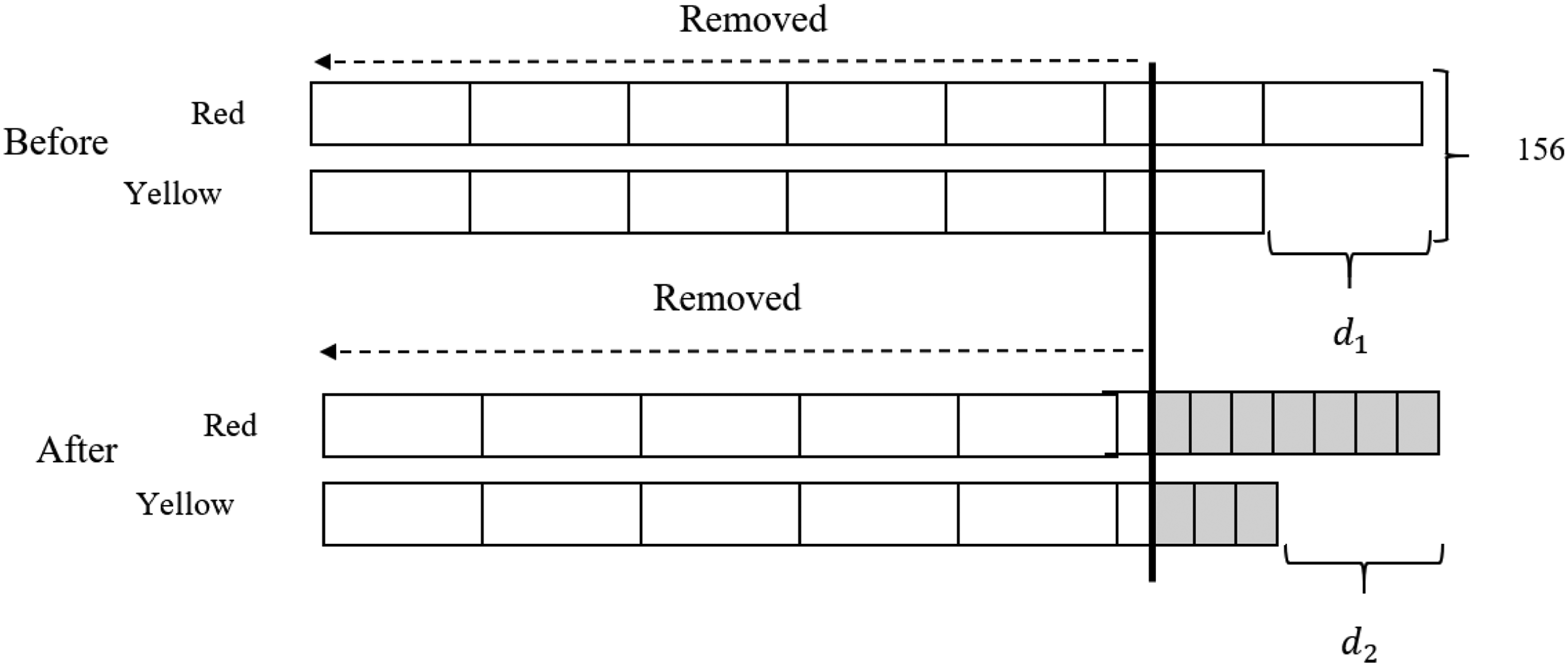
The sections to the left of the dotted line show that when equal amounts are removed from the left, the differences remain the same.
The Golden Apple problem, an algebraic word problem was presented to Primary Five (11 +), Secondary Three (15 +), and junior college (17 +) students. They were told they could use any method to solve this problem. The analysis showed that letter-symbolic algebra was not the preferred method of solution. Instead, the students used methods that made sense to them. Golden Apple Problem: A prince picked a basketful of golden apples in the enchanted orchard. On his way home, he was stopped by a troll who guarded the orchard. The troll demanded payment of one-half apples plus two more. The prince gave him the apples and set off again. A little further on, he was stopped by a second troll guard. This troll demanded payment of one-half of the apples the prince now had plus two more. The prince paid him and set off again. Just before leaving the enchanted orchard, a third troll stopped him and demanded one-half of his remaining apples plus two more. The prince paid him and sadly went home. He had only two golden apples left. How many apples had he picked? (Driscoll, 1999, p. 22)
Children decoded the information embedded in the text and translated this information into a structure that captured all the information in the text as a cohesive whole.
The solution to the left in Figure 10 is an example of how a Primary 5 pupil used the model method to solve the problem. A significant amount of processing is needed to construct this model drawing. Firstly, one has to decide how to begin drawing the model. Four important pieces of information are provided to help solve this problem: (i) how many apples are left after the third troll had collected the final payment, (ii) the proportion of apples demanded of the prince by each troll, (iii) the additional amount taken after half of the total was collected by the troll, and (iv) the terms of payment is the same for each troll. The recursive nature of the problem made it possible to draw the model.
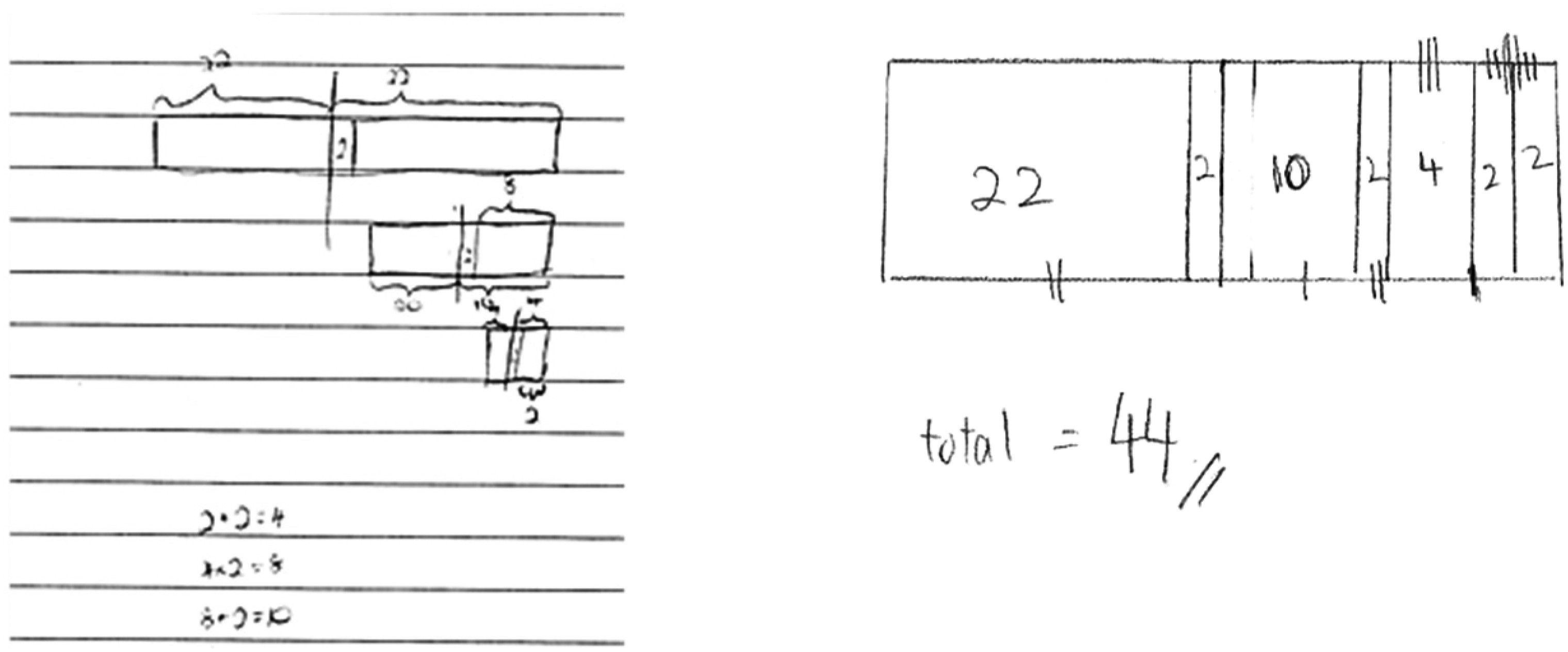
Solutions to the Golden Apple problem. Primary 5 pupil constructed the model drawing to the left. Secondary student, solution to the right, used the working backwards method to solve the same problem. The two methods anchor on prior knowledge of the model drawing.
Of the two methods, the formal algebra solution in Figure 11 is more succinct than the model method draw (Ng, 2003). However, the formal algebra method does not describe nor capture the interactions between the prince and the trolls. The function of the algebraic method is to find the unknown value. In contrast, the model drawing provides the solution as well as the process leading to the solution. The model drawing tells a story.
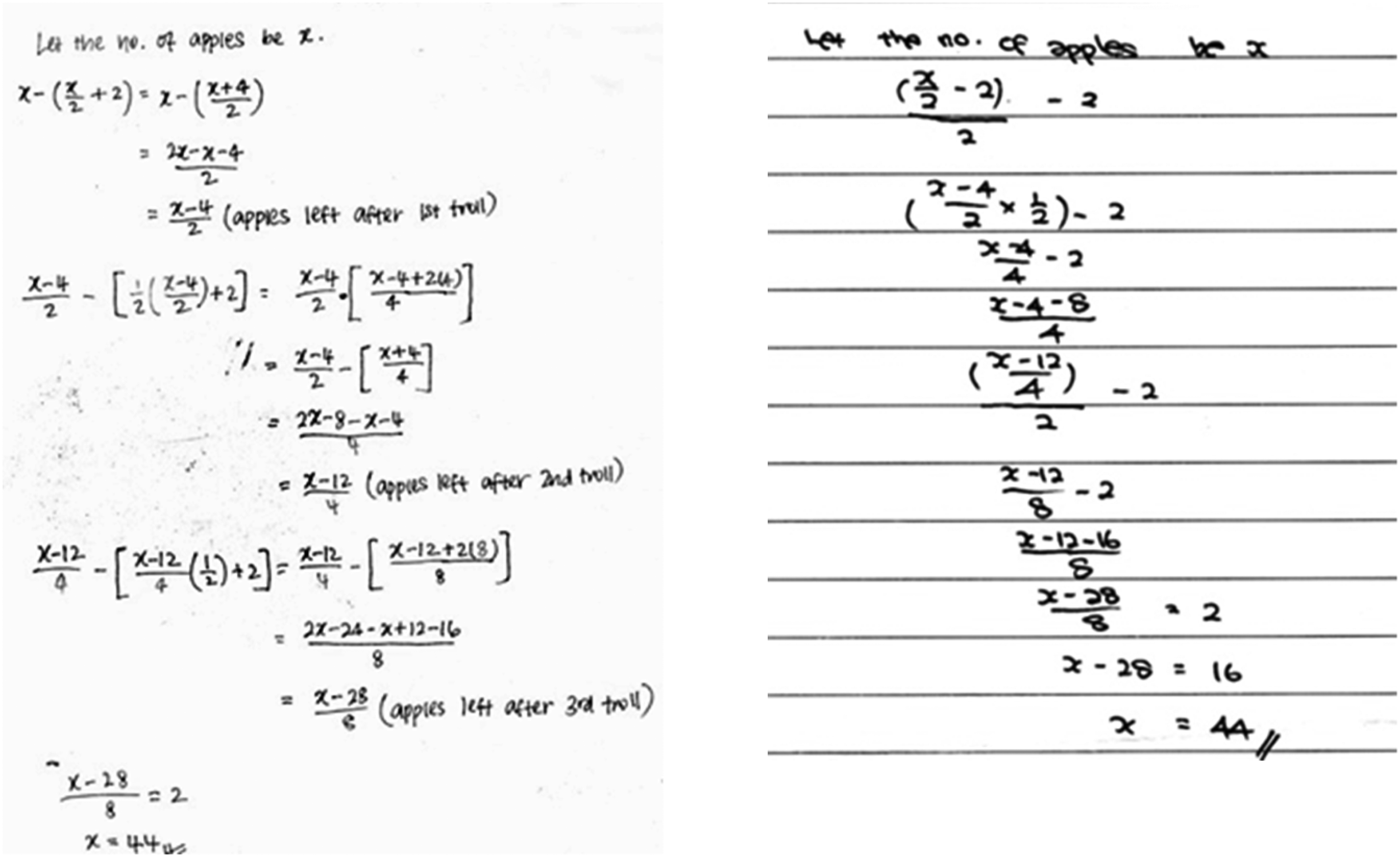
Junior college students used formal algebra to solve the Golden Apple problem.
The preceding discussion demonstrates how the model method is a problem-solving heuristic for arithmetic as well as algebraic word problems. In the former, rectangles are used to represent numbers while rectangles represent unknown numbers in the latter. The resulting schematic representation captures the information provided in a problem. Construction of the appropriate model drawing builds on children's understanding of parts and whole. The model method can be used to solve one-dimension algebraic-type word problems involving one or two variables. What makes the model such a powerful tool? One possible explanation for the power of the model method is that it provides an avenue to first describe the problem before the process of calculating the solution begins. This process of “first-describing-and-then-calculating” (Post et al., 1988) is one of the key features that make algebra distinct from arithmetic.
Harper (1987) theorized that the ontogenetic development of algebra progressed through three periods: Rhetorical algebra, Syncopated algebra or Diophantine algebra, and Vietan or letter-symbolic algebra. In the rhetorical period, circa 250 A.D., all arguments were written in longhand. No symbols were available to represent the unknowns. Algebraists from around 250 A.D. to the late 16th century, known as Syncopated algebra or Diophantine algebra period, used letters for unknown quantities. Diophantus first introduced this procedure to solve equations in both one and two unknowns, while using only one symbol. The second unknown is expressed as a linear combination of the first, for example, if Muthu's age is m, then the father's age is
However, it may be expedient to use a class of simpler problems to illustrate how the schematic representation of the model method could be used to evolve to letter-symbolic or Vietan algebra. Singapore mathematics curriculum introduces letter-symbolic algebra or Vietan algebra only at Secondary Three for students in the advanced stream (15+) and to the 16+ for those in the normal academic stream. Advanced stream students completed 4 years of secondary school and those in the normal academic stream, 5 years. Consider this simpler but less well-known example typical of the Diophantine period. Both sets of solutions were by students in the first year of secondary school (13+) who have yet to learn formal algebra. The two sets of questions A and B are not the same because the data were collected by two different teachers. Figure 12 shows solutions of two students taught by two teachers from different schools.
(A) Suppose the sum of two numbers is 100 and the difference between the two numbers is 40. (B) Suppose the sum of two numbers is 56 and their difference is 12. Find the numbers.
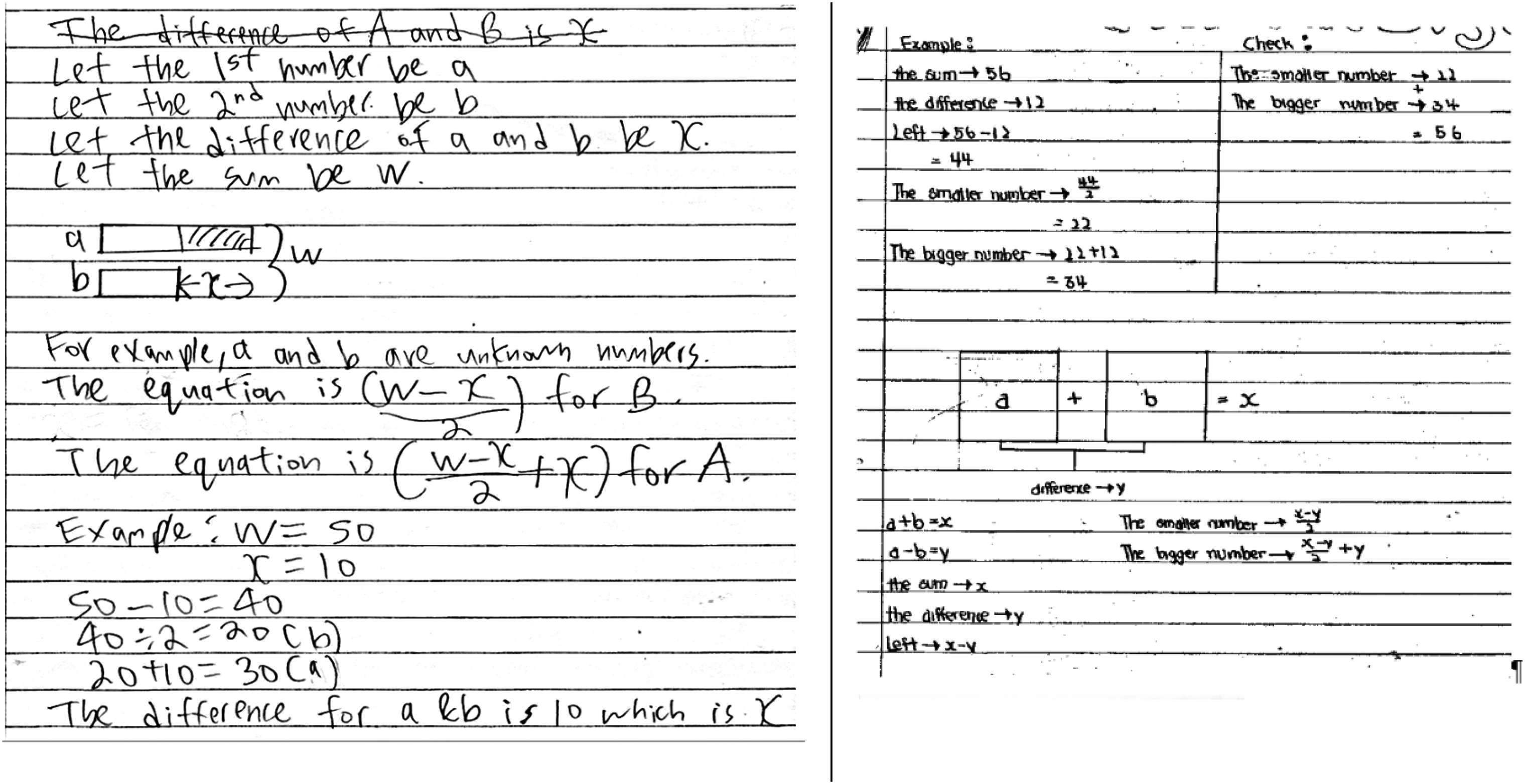
Ontogenetic development of algebra as offered by two different students (13+) withut prior knowledge of formal algebra. Solution A to the left and solution B to the right.
The model method encourages the use of schematic representation to solve problems.
Solution A starts with letter-symbolic algebra where letters are used to represent the total
Algebra is a language—a way of saying and communicating. But the language of algebra is abstract and succinct. Succinctness has the advantage of that it makes algebraic symbols more easily manipulated but, of course, because it is more compressed it is therefore open to incomprehension. The force of this characteristic of succinctness is that algebra language is a powerful means of communicating abstract and complex ideas. … it contains its own rules which need to be learnt and practised. (Mason, 1985, p. 1)
However symbolic expression is only valuable when the symbols are supported by rich associations and meanings. Authors of the Cockcroft Report (1982) do not consider formal algebra to be appropriate for all but they do believe that efforts should be made to discuss some algebraic ideas with all pupils. For some this may entail little more than the substitution of numbers in a simple formula given in words, discussion of problems of the kind “think of a number. …” Some people would maintain that by considering alternative methods of solving the same arithmetic problem one has embarked on the beginnings of algebra. (Paragraph 461)
The spiral structure of the Singapore Mathematics curriculum with its focus on problem solving encourages children to use the model method first to solve simple arithmetic problems and then are challenged to extend the heuristics to solve structurally complex word problems. Those who know the model method use the heuristic in simple ways. The model drawings capture the information and encourage the substitution of numbers to solve a problem. For many, this would suffice. However, for some, the model method encourages them to think beyond solving for the unknown. For some algebra may not be necessary, but a schematic drawing would suffice. For others who have yet to acquire formal knowledge of formal algebra, the model method provides them the tool to provide the general solution for a set of problems—the jewel of algebra.
The Singapore approach to problem solving has provided three important ideas to consider. First, it is important to have a clear view of what the curriculum hopes to achieve. In the case of Singapore, problem solving is the core. To achieve this goal, it is important to provide learners with the appropriate problem-solving tools or heuristics which can be used to solve a variety of problems. Second, this tool must be memorable. With the model method, the tool is the same schematic representations. The construction of the appropriate schematic representation highlighting the relationships provided in the problem may not be simple. But repeated use of the model drawing to solve different types of problems, from simple arithmetic problems to complex ratio problems provide learners a chance to keep revisiting the concepts underpinning the construction of the models. Third, the prescriptive nature of the pedagogy has meant that most teachers are familiar with the model method. The very prescriptive approach means that learners engage with the model method throughout their primary years. The evidence shows that although they may not know how to use formal algebra to solve algebraic problems, their knowledge of the model method offers students who struggle with letter-symbolic algebra a more visual and meaningful approach to problem-solving, the point made in Cockcroft Report Paragraph 461.
Footnotes
Declaration of Conflicting Interests
The author(s) declared no potential conflicts of interest with respect to the research, authorship, and/or publication of this article.
Funding
The author(s) received no financial support for the research, authorship, and/or publication of this article.
