



Abstract
Power is a pervasive and often underexamined force that shapes all aspects of participatory health research (PHR); however, translating theoretical understandings of power into practical strategies remains a challenge. This commentary critically examines the complexities of power in PHR, highlighting both its constraints and its potential as a transformative force in equity-driven research. The discussion is grounded in selective foundational theories of power, which provide the theoretical basis for understanding power in PHR. Building on these perspectives, expressions of power—Power Over, Power To, Power With, Power Within, and Power Through, serve as analytical lenses to identify and assess where power operates and how it can be navigated. To bridge the gap between theoretical discourse and actionable practice, the Power Assessment Reflexivity Tool for Navigating Equality in Research (PARTNER) is introduced as a heuristic. PARTNER, informed by lived and living experience co-researchers, is a tool designed to make the complexities of power more navigable, offering prompts to guide PHR teams in fostering equity and justice within their work. By recognizing power as both a barrier and a possibility, this commentary underscores the importance of moving beyond performative and abstract discussions of power. It offers a practical entry point for research teams committed to addressing power in ways that are impactful, substantive, and aligned with systemic change.
Introduction
The transformative potential of participatory health research (PHR) is often assumed rather than critically examined. While participatory approaches emerged, in part, as a response to historical research abuses against minoritized communities, their adoption does not inherently equate to equity or justice. As Egid et al. (2021) unequivocally stated, “Despite widespread assumptions about power sharing and trust-building dynamics, adopting a participatory approach is not in itself sufficient for addressing power inequities” (p. 12). Without sustained, intentional efforts to interrogate and address the power structures embedded within research processes, PHR risks reinforcing, rather than dismantling, systemic inequities.
Health research remains situated within historical and institutional power relations that privilege dominant epistemologies, often marginalizing alternative ways of knowing.1–4 These power dynamics are not relics of the past but active mechanisms that shape contemporary research practice, perpetuating epistemic exclusion and constraining the extent to which PHR can enact meaningful change.
Wallerstein et al. (2019), in their extensive analysis of community-based participatory research (CBPR), highlight a critical gap: the lack of a clear articulation of how power operates within partnership practices. They observe, What remains largely unexplored, however, are the nuances of how partnerships specifically address their contexts of power…power is operationalized through constructed racialized and gendered hierarchies, institutionalizing the subordination of people of color and other marginalized groups. Social processes and institutions have evolved to maintain associated structural inequities (i.e., poverty, environmental hazards, and health care access) that make injustices experienced by marginalized groups appear normal or routine. The power to sustain systems of privilege and advantage over oppressed people is often exercised covertly through “benign, abstract and inconsequential language” designed to evade or obscure critical dialogue about the sources of structural inequality” (p. 20S)
This commentary challenges the assumption that participation alone equates to equity and instead calls for a more rigorous engagement with power in PHR. Without this, participatory methods may deepen existing hierarchies, drawing members into direct engagement with structures of domination that perpetuate inequities, thereby reinscribing relations of oppression under the guise of inclusion. Numerous accounts of PHR underscore that power imbalances are a persistent obstacle to the co-creation of knowledge.4–7 This commentary offers an approach to understanding and analyzing the intrinsic tensions in co-creation in PHR.
In line with the literature, participatory research (PR) serves as an umbrella term encompassing a wide range of overlapping approaches including but not limited to emancipatory research (e.g., Freirean methodologies), community-based participatory research (CBPR), participatory action research (PAR), patient-oriented research (POR), service user–led research, survivor-led research (particularly in mental health), engaged research, public and patient involvement (PPI), inclusive research (IR) with people with disabilities, arts-based research (ABR), action science, democratic dialogue, and feminist ethics of care methodologies.6,8 Among these approaches, we focus specifically on those models that address health or healthcare, subsuming them under the umbrella of PHR for the purposes of this manuscript. While we acknowledge the nuanced distinctions and methodological variations across these traditions, the central insights of our work are broadly applicable across the spectrum. It is crucial to emphasize that the origins of PHR are deeply rooted in social movements, reflecting a foundational commitment to equity, justice, and the redistribution of power. 8
This commentary has two interrelated objectives. First, it offers researchers a conceptual grounding in power by synthesizing key theoretical frameworks relevant to PHR. Second, it introduces the Power Assessment Reflexivity Tool for Navigating Equality in Research (PARTNER). The tool was developed directly through the Helping Enable Access and Remove Barriers to Support (HEARTS) study,9–11 a national PHR project with young adults with mental health-related disabilities. Together, these two objectives work in tandem: the theoretical synthesis provides the conceptual language for naming and analyzing power, while the PARTNER tool operationalizes this knowledge into structured prompts for reflection, dialogue, and action within research teams.
To advance these aims, the manuscript is structured to bridge theory and practice. It begins by reviewing key theoretical traditions that shape our understanding of power, drawing selectively from foundational thinkers to provide researchers with an accessible conceptual grounding. From this review, we propose a working definition of power that emphasizes its structural, relational, pervasive, transformative, and contextual dimensions. These dimensions then guide the framing of “expressions of power,” which serve as analytical lenses for participatory research. Figure 1 illustrates how these theoretical, analytical, and practical components come together. The final sections introduce PARTNER, a structured yet flexible resource designed to support reflexive practice and more equitable engagement with power in research teams. From Theory to Action: A Structured Approach to Power in Participatory Health Research.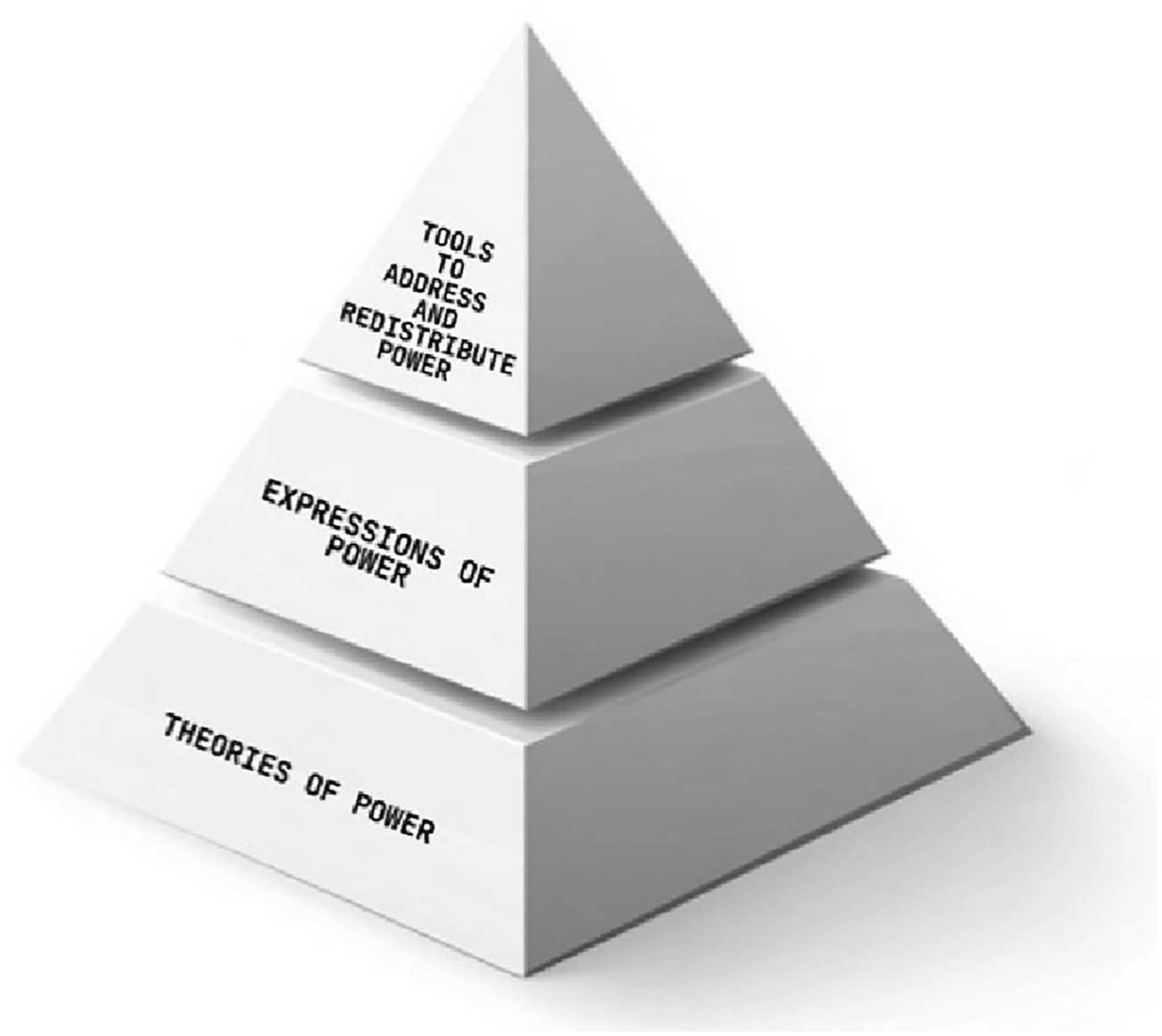
Centring and Situating the Problem: The Paradox of Participatory Health Research
Participatory research emerged from radical traditions that sought to challenge and disrupt the systems of power responsible for minoritization and inequality.5,7,8,12,13 At its core, it is an emancipatory process, centring the lived experiences of oppressed communities and enabling them to address the structural forces shaping their lives. Fundamentally anti-establishment, it aimed to create space for resistance and liberation. However, as PHR becomes increasingly institutionalized, its transformative potential risks being co-opted where its counter-hegemonic aims are neutralized and absorbed into dominant systems—ultimately serving the status quo rather than dismantling it.14,15
Co-optation occurs when a disruptive or counter-hegemonic practice is adopted by dominant institutions, not to advance its original aims but to neutralize its oppositional force and repurpose it to serve the system’s interests.14,15 In health research, this co-option operates through mechanisms like standardization, bureaucratization, epistemic constraints, and tokenism. For example, institutional systems demand standardized protocols for replicability and efficiency, stripping participatory methods of the flexibility and context-specific nuance essential to their ethos. Bureaucratic processes, including ethics reviews and reporting mandates, concentrate power within institutional gatekeepers, eroding community agency.7,10,16–20
Dominant epistemologies, such as positivist and biomedical frameworks, minoritize experiential and relational knowledge, further entrenching epistemic injustice; this dynamic often forces participatory approaches to conform to narrow definitions of “valid” knowledge, undermining the pluralistic and inclusive values participatory research seeks to uphold.1–4 Tokenistic practices compound these challenges, where participatory language is appropriated to signal inclusivity without substantively altering power structures, leaving communities symbolically involved but excluded from meaningful influence.9,21
The commodification of community narratives compounds historical and ongoing forms of marginalization. What was once a vehicle for collective resistance becomes an institutional asset, reframing stories of oppression as tools for advancing institutional goals while maintaining inequitable systems.4,5,22 This assimilation of PHR into institutional priorities risks transforming it from a mechanism for systemic change into a compliance tool, preserving existing hierarchies rather than dismantling them. The ultimate irony is that processes meant to liberate communities are co-opted to sustain their oppression, turning their very tools of liberation into mechanisms of control.5,7,9,13,16,18,20,23–25
To resist such co-option, PHR must retain an oppositional force. Reflexivity must remain central, requiring researchers to critically interrogate whether their methods truly redistribute power or merely reinforce entrenched hierarchies under the guise of inclusivity. This reflexivity cannot be a one-time exercise but an ongoing commitment to examining how institutional pressures shape participatory practices and outcomes. While engagement with institutions may be useful for scale and impact, it must be navigated with an unwavering dedication to preserving participatory research’s emancipatory intent. PHR must challenge the status quo rather than become a tool for its maintenance, anything less is a betrayal of its radical origins and an affront to the communities it seeks to serve.
Unpacking Power in Participatory Health Research
Power in PHR is neither singular nor static—it is dynamic, multifaceted, and operates simultaneously at individual, institutional, and systemic levels. To engage this complexity critically, we draw on select seminal theories to conceptualize power in PHR as structural, relational, pervasive, transformative, and contextual. These dimensions are deeply interconnected and co-constitutive, shaping and reshaping one another across diverse research environments. Together, they form a framework for systematically analyzing how power is enacted, maintained, and contested in participatory processes.
This framing serves a dual purpose: it anchors the discussion in established theoretical traditions and sets the stage for the next section, where we operationalize these insights through a typology of power expressions. These expressions—such as power over, power with, and power within—translate abstract concepts into practical tools for analyzing and addressing power dynamics in real-world research contexts. In doing so, the structure of the discussion reflects the central argument of this commentary: that addressing power in PHR demands both conceptual clarity and actionable strategies.
Structural power refers to the systemic and institutional arrangements that govern the distribution of resources, authority, and legitimacy.3,26–32 Theories from Marx and Gramsci33–35 provide foundational insights into how power is embedded within material and ideological structures, including control over production and the maintenance of hegemony through consent rather than coercion.3,26–32 In the context of health research, structural power is evident in funding hierarchies, authorship conventions, and bureaucratic requirements that privilege dominant institutions and marginalize alternative forms of knowledge and participation. These mechanisms shape what research is conducted, how it is evaluated, and whose interests it serves, often constraining the scope of participatory practice and reinforcing existing inequities within academic and health systems.
Relational power emphasizes how influence and authority are produced and reproduced through everyday interactions, norms, and discourses. Foucault’s conception of power as diffuse and circulating rather than concentrated highlights the importance of examining the practices and routines through which power operates.3,26–32 His notion of power/knowledge underscores the interdependence of authority and epistemology, where what is considered “truth” is shaped by those in positions to define it.3,26–32 Feminist and intersectional theorists such as bell hooks, Audre Lorde, and Kimberlé Crenshaw have further advanced this view by attending to the relational enactment of power across lines of race, gender, and class.22,36,37 These scholars compel researchers to attend to the affective, embodied, and often invisible dynamics that shape collaboration, trust, and accountability in PHR.
Pervasive power builds on these insights by foregrounding the ways in which power operates not only through visible authority or interpersonal relationships, but also through deeply embedded norms, assumptions, and expectations. Steven Lukes’ three-dimensional view of power—visible, hidden, and invisible—offers a critical lens to understand how certain issues remain unspoken, how dissent is suppressed, and how dominant agendas are reproduced.3,26–32 In participatory research, power is often assumed to be equitably distributed due to inclusive rhetoric, yet invisible forms of power can continue to shape whose voices are heard, whose knowledge is validated, and how decisions are ultimately made. Without sustained reflexivity, participatory processes risk replicating the very hierarchies they seek to dismantle.3,26–32
Transformative power introduces a contrasting perspective by recognizing the capacity of individuals and communities to disrupt and reshape oppressive systems. Freire’s concept of praxis—critical reflection coupled with collective action—articulates a form of power grounded in agency and resistance. 38 Similarly, the Black Power movement, as theorized by Carmichael and Hamilton, emphasizes the importance of autonomy and collective self-determination in challenging racialized systems of oppression. 39 These traditions inform PHR’s emphasis on redistributing decision-making authority and affirming community control over research agendas. Within this framework, transformation is not a byproduct of participation but its central aim.
Finally, contextual power acknowledges that all expressions of power are embedded within specific historical, cultural, and ontological frameworks. Indigenous scholars such as Linda Tuhiwai Smith and Shawn Wilson foreground relational accountability, sovereignty, and ethical obligations as essential to decolonizing research practices.3,4,40 Power, in this view, is not defined by control or domination, but by responsibility, reciprocity, and balance. Postcolonial theorists including Edward Said and Gayatri Spivak extend this critique by exposing how Western epistemologies have constructed and subordinated the knowledge systems of colonized peoples, contributing to ongoing epistemic injustice.28,29 These perspectives call for greater attention to positionality and the institutional structures that mediate who can generate, validate, and disseminate knowledge.
These five dimensions—structural, relational, pervasive, transformative, and contextual—provide a conceptual foundation for understanding how power operates across PHR. Taken together, they support a more deliberate and reflexive engagement with power, but must also be made practically applicable. To bridge this gap, the following section introduces a typology of expressions of power that translates these dimensions into actionable tools for assessing and navigating power dynamics within research settings. Before turning to this typology, we offer a working definition that synthesizes these five dimensions to ground subsequent discussion.
Power in PHR: Dimensions, Expressions, and Applications
We define power in PHR as: structural, such that it is rooted in systems of inequality that sustain dominance and privilege; relational, exercised through interactions, norms, and cultural frameworks; pervasive in that it is present across all aspects of research; transformative, capable of both oppressing and liberating depending on how it is enacted and distributed; and contextual and nuanced, shaped by historical, cultural, and societal factors, making it inherently dynamic and situational. This definition is not exhaustive, but it offers an entry point for research and researcher reflexivity and a framework to guide our understanding of the dynamics that shape participatory processes. With this perspective, we turn to the various ways power manifests. These expressions, including power over, power with, power to, power within, and power through, offer a practical means to analyze the fluid and complex interplay of power in PHR.
Traditionally, the concept of power over is what dominates the regular discussions of power in PHR; it emphasizes control and domination, where one group, individual, system, structure—or all simultaneously, holds authority over another. This form of power is entrenched in institutional policies, laws, and social norms that perpetuate inequities. Power over manifests across various domains in health research, influencing systems, institutions, and individual interactions. For a specific example, in Canada where the authors are located, colonial legacies continue to exert control over Indigenous sovereignty through policies like the Indian Act, previously residential schools, and ongoing land dispossession.3,4,41–43
Health policies frequently impose biomedical frameworks that marginalize Indigenous knowledge systems and exclude community leadership. Despite the adoption of the Truth and Reconciliation Commission’s Calls to Action, 44 many of these measures remain performative rather than structurally transformative. Systemic racism reinforces power over dynamics in healthcare and social services. Economic inequality further amplifies these disparities as neoliberal policies privatize care and research, making equitable healthcare access increasingly dependent on socioeconomic status.45–47 On a global front, Canada’s participation in international research often mirrors colonial power structures where Western knowledge systems dominate and marginalize the Global South.5,28,29,48 Globally, health research is dominated by Western nations that set agendas and control funding, marginalizing the voices and needs of the Global South.5,28,29,48
Research systems reflect similar dynamics, with funding bodies acting as gatekeepers that dictate priorities based on institutional prestige and profit rather than community needs.2,21 This imposes significant constraints on participatory approaches, often compromising their transformative potential. Epistemic power, rooted in Western “gold standard” methodologies, marginalizes qualitative and experiential knowledge, excluding minoritized communities from shaping research agendas.1,49 Academia, too, is steeped in hierarchical structures that sustain power over dynamics. Tenured faculty have authority over students, early-career researchers, and adjunct faculty, which can easily create and perpetuate inequities. Eurocentric theories dominate curricula, excluding Indigenous and non-Western perspectives, while critical and decolonial scholarship is marginalized as non-rigorous.3,4,41–43 The pressure to publish often prioritizes individual career advancement over ethical or community-centred research, furthering the disconnect between academic outputs and societal impact. 21 Institutional processes, such as rigid ethical review boards, impose biomedical frameworks that limit participatory and community-driven methodologies.50–53
On an individual level, researchers hold power over communities by virtue of their education, institutional affiliations, and positionality. Without critical self-reflection, this privilege often goes unexamined, perpetuating inequities under the guise of neutrality or expertise. Researchers also gatekeep knowledge production, determining whose voices are included and framing findings within dominant paradigms. Even well-meaning actions can unintentionally silence co-researchers or prioritize institutional researchers’ authority, reinforcing power over dynamics in subtle but impactful ways.
At a macro level, neoliberalism and capitalism deeply shape health research by prioritizing corporate interests and profit-driven agendas. These forces skew research priorities toward measurable outcomes rather than transformative change, further entrenching inequities. 54 Understanding the dynamics of power over in all its incarnations is critical to addressing inequities in health research. Without recognizing these dynamics, efforts to enact more equitable forms of research risk being undermined by unexamined forces of domination.
Power with represents the strength that arises from collective action and solidarity.5,8,23,24,27,55,56 It emphasizes collaboration and mutual support, fostering shared decision-making and enabling coalitions to challenge entrenched hierarchies. This form of power is particularly significant in participatory frameworks, as it disrupts power over dynamics by redistributing agency across individuals and groups. By centring collective effort, power embodies the ethos of PHR, emphasizing equity and shared accountability.5,8,23,24,27,55,56.
Power to reflects the capacity of individuals and groups to take action and effect change. Rooted in autonomy and self-determination, this dimension highlights the transformative potential inherent in agency. Power to is essential in contexts where systemic barriers inhibit individuals or communities from realizing their full potential. By enabling people to act on their circumstances, this expression of power provides a pathway for meaningful change and underscores the importance of addressing structural inequities that constrain opportunities for action.5,8,23,24,27,55,56.
Power within focuses on self-awareness, internal agency, and personal capacity.5,8,23,24,27,55,56. It calls for individuals to recognize their intrinsic value and capabilities, fostering resilience and self-determination. This dimension is foundational for building confidence and agency, especially for those navigating systemic and structural oppression. Power within is integral to cultivating the internal strength necessary for individuals to participate meaningfully in collective and transformative efforts.5,8,23,24,27,55,56.
Power through examines how relational and societal dynamics mediate empowerment (original meaning) or disempowerment.5,8,23,24,27,55,56. It recognizes that empowerment is often shaped by the influence of societal judgments, relational networks, and collective associations. Unlike other expressions of power, power through explicitly incorporates the role of social context and systemic conditions in determining who has the capacity to act and how that capacity is perceived.5,8,23,24,27,55,56. It highlights how external forces, including cultural narratives and societal biases, shape opportunities for action in ways that are often invisible but deeply impactful.
These expressions of power are not discrete; they are deeply interconnected and fluid, operating within and across multiple levels of interaction. For example, power with can amplify the transformative potential of power to by enabling collaborative efforts that build on individual agency. Similarly, fostering power within enhances individuals’ ability to engage in collective action, contributing to the strength of power with. Power through, meanwhile, serves as a lens for understanding how structural and cultural forces shape the conditions under which these other expressions of power are realized.
The Empowerer Wears No Clothes
A truly meaningful discussion of power in PHR is incomplete without interrogating the pervasive and often unexamined rhetoric of empowerment. Once a radical concept rooted in collective action and liberation,57–59 empowerment has since become a ubiquitous catchphrase in participatory discourse, frequently invoked as a marker of inclusion and equity. Yet, like the emperor in Hans Christian Andersen’s tale, 60 empowerment often wears the illusory garments of assumed virtue, celebrated but rarely scrutinized. Beneath its well-worn mantle lies a paradox: a term meant to signal transformation that can just as easily obscure the reproduction of inequities it claims to address.
Empowerment originated from radical traditions aimed at systemic change, with its most profound articulation in Paulo Freire’s Pedagogy of the Oppressed. 38 Freire envisioned empowerment as a process of conscientization, enabling the oppressed to recognize and dismantle systemic injustices through collective action. In this view, power was not something to be bestowed but an intrinsic quality to be realized and mobilized through participatory processes. Its roots aligned seamlessly with the foundational ethos of PHR, emphasizing collaboration, equity, and the dismantling of structural barriers.
However, as many scholars have detailed,13,57–59 empowerment has been co-opted, losing its radical edge. Once a rallying cry for liberation, it has been depoliticized and absorbed into neoliberal agendas, where it often signifies individual responsibility rather than systemic transformation.58,59 Its widespread adoption has rendered it a buzzword, commodified to the extent that it has been applied in contexts as trivial as self-help for pets, 59 reflecting a significant departure from its original intent in collective action and structural transformation. This shift reframes empowerment as a top-down process, legitimizing policies that prioritize institutional efficiency over genuine equity.
In PHR, the term is frequently used to describe an act of giving power, which paradoxically reinforces power over dynamics by positioning researchers or institutions as beneficent providers rather than collaborators. To reclaim empowerment as a tool for meaningful change, it must focus on dismantling systemic barriers rather than serving as performative rhetoric. For researchers and institutions, the imperative is not to act as “empowerers” but to recognize their responsibilities in creating conditions where agency and equity can thrive. Framing empowerment as something granted by those in authority undermines the intrinsic agency of individuals and communities, perpetuating paternalistic narratives that run counter to the transformative aims of participatory work.52,58 This language assumes that power is absent in equity-deserving/equity-owed groups and must be conferred upon them. This is a dangerous perspective that can obscure the responsibility of those in privileged positions to address the barriers they have constructed and maintain.
The work of empowerment must shift away from the notion of granting power and toward dismantling the systemic forces that constrain it. True empowerment involves stepping aside, relinquishing control, and using one’s privilege and positionality to remove structural, institutional, and cultural barriers.52,59 Within PHR, all members are power-holders, but those with greater privilege or authority carry heightened responsibilities to confront systemic inequities. Reflexivity becomes critical, requiring researchers to interrogate their own roles within systems of privilege and to commit to practices that actively redistribute power.
From Theory to Application: Navigating Power Dynamics in PHR
The Power Assessment Reflexivity Tool for Navigating Equality in Research (PARTNER)
61
—a sample shown in Figure 2, was created to support research teams in addressing the challenge of engaging with power in PHR. Rather than serving as a rigid framework or prescriptive guide, PARTNER functions as a dynamic tool that prompts reflection, encourages open discussions, and facilitates actionable steps to address power imbalances. It is particularly useful for researchers and teams who may not have extensive experience interrogating power but seek practical ways to embed reflexivity and equity within their work. Excerpt from the PARTNER Assessment Tool Complete tool freely available at Open Science Framework https://osf.io/gfae7/files/ad256.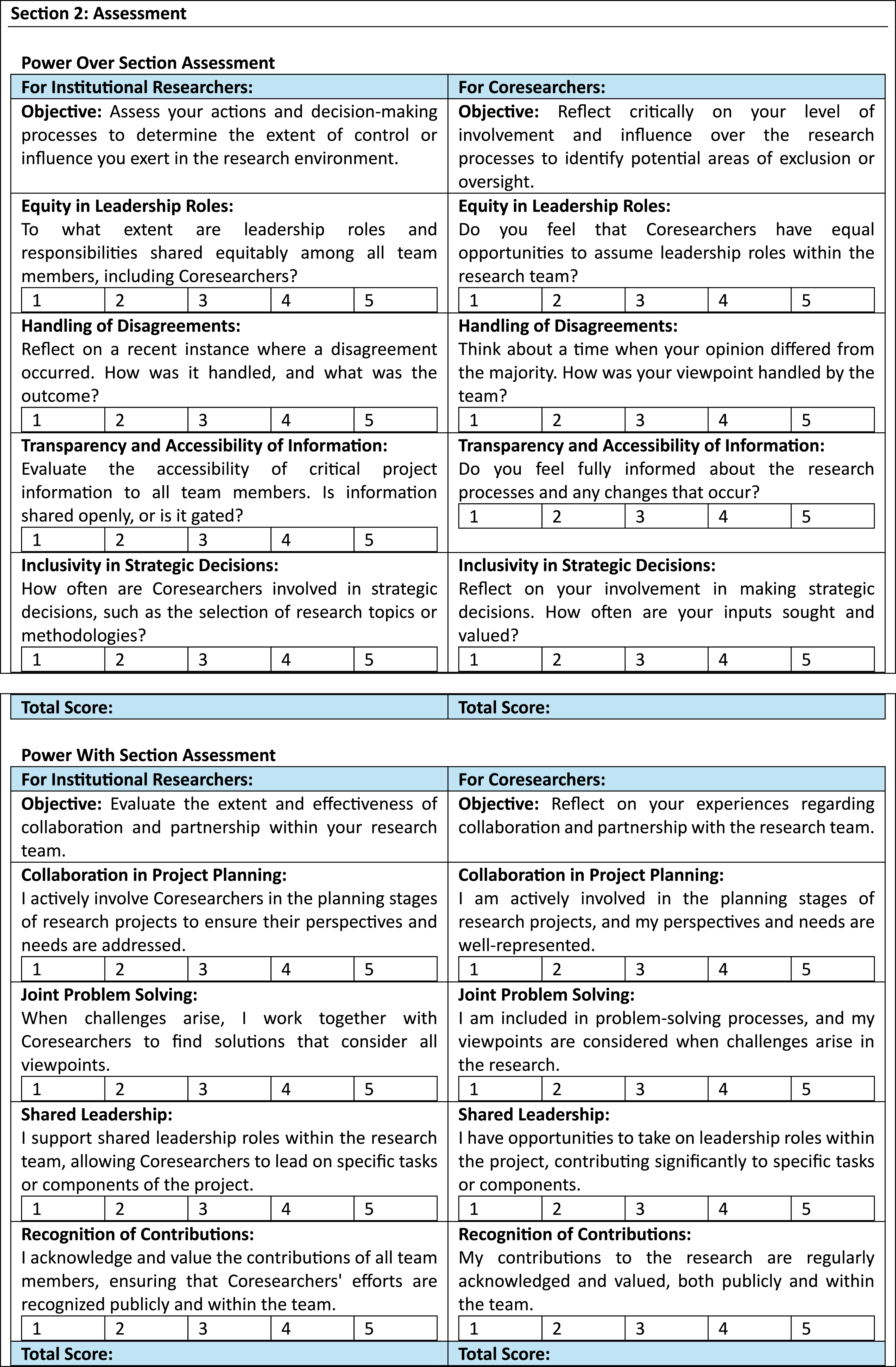
The PARTNER tool was developed directly through the HEARTS Study, a national patient-oriented project with young adults with mental health-related disabilities. The HEARTS study engaged 16 young adult co-researchers from equity-deserving communities across Canada in all stages of the research process, from design through interpretation. Its objective was to explain how structural and institutional mechanisms produce unmet healthcare needs and to identify pathways toward more just, inclusive, and responsive systems. Insights from co-researchers underscored that reflexivity and power dynamics were not abstract concerns but lived realities shaping participation, representation, and the credibility of knowledge claims. The PARTNER tool emerged from this grounding as a practical response to these concerns, intended to support other research teams in naming, interrogating, and addressing power as part of participatory health research practice.
PARTNER is structured around the five expressions of power, offering an analytical lens to explore how power manifests in research collaborations. Its guided prompts help teams examine decision-making authority, resource distribution, and barriers to participation. The PARTNER Tool was developed with an awareness of the asymmetrical power relations that shape participatory research contexts. The differentiation between prompts for institutional researchers and coresearchers reflects the distinct roles, responsibilities, and risks typically navigated by each group. These distinctions are intended to support accountability and encourage critical reflection, not to reproduce hierarchy. While no tool is values-neutral, the PARTNER Tool is designed to be used reflexively, prompting teams to engage with power dynamics in ways that support equity, reciprocity, and co-ownership.
The flexibility of PARTNER makes it adaptable to both individual and team-based reflection, supporting a culture of ongoing critical engagement with power. Its strength lies in its accessibility, as it integrates into various research workflows regardless of prior familiarity with power analysis. Through reflexive engagement, PARTNER enables research teams to transition beyond superficial participatory commitments toward practices that foster liberatory and justice-driven research environments.
Tools to Navigate Power Dynamics in Participatory Research.
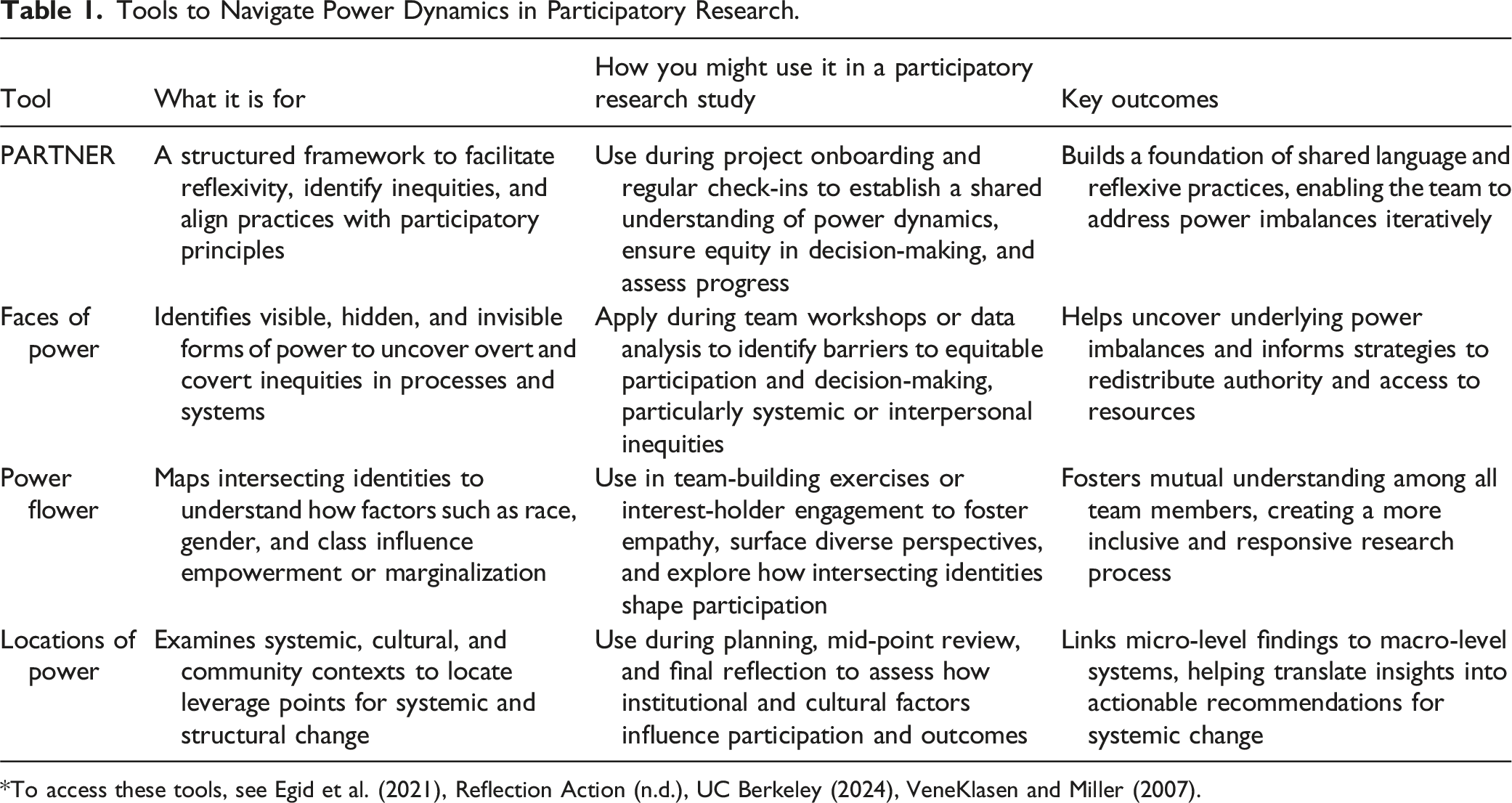
*To access these tools, see Egid et al. (2021), Reflection Action (n.d.), UC Berkeley (2024), VeneKlasen and Miller (2007).
From Reflection to Reflexivity: the Most Necessary Step
As noted at the outset of this manuscript, participatory approaches do not inherently address inequity, nor does the use of PARTNER guarantee emancipation. Its transformative potential lies in how these approaches are considered, utilized, and enacted. For PARTNER to hold meaningful value, its application must be grounded in reflexivity—a deliberate and continuous practice that critically examines how power operates throughout the research process.6,64–70 While reflection and reflexivity are often conflated, these practices serve fundamentally different purposes in PHR. Reflection involves thoughtful consideration of past actions or events to evaluate outcomes and derive insights. For example, a researcher might reflect on how a specific interaction unfolded during a focus group and what could be improved in the future. While valuable, reflection tends to focus on individual actions and immediate learning, often failing to engage with broader systemic forces.
Reflexivity, by contrast, demands a deeper level of introspection and critical engagement. It compels researchers to examine their positionality, biases, and the systemic contexts that shape their work. Reflexivity moves beyond individual actions to interrogate how methodological choices, institutional affiliations, and societal norms influence research processes and outcomes, urging researchers to question not only what they do but how and why they do it and with whom.6,64–67 For instance, reflexivity might involve examining how a researcher’s privileged position within an academic institution influences their interactions with research partners or how the framing of research questions reflects and perpetuates dominant epistemologies. By prioritizing reflexivity, researchers commit to an ongoing process of both self and systemic critique, recognizing their complicity in existing power structures and actively working to dismantle them.
Conclusion
PHR holds the promise of transforming inequitable research paradigms, but its success hinges on a rigorous, ongoing engagement with power. As this commentary has illustrated, power is neither a neutral nor singular force; it is a dynamic, multi-layered phenomenon that can be leveraged to oppress or liberate. Despite the aspirational commitments of PHR to equity and justice, the uncritical adoption of participatory approaches risks reinforcing entrenched hierarchies under the guise of inclusion. Without a deliberate interrogation of power—its manifestations, constraints, and redistributive potential, PHR runs the danger of replicating the very systems of domination it seeks to dismantle.
The PARTNER tool offers a structured entry point for research teams to move beyond performative rhetoric and engage with power in a substantive and actionable way. By providing a heuristic for reflexivity, it encourages researchers to systematically assess power dynamics, acknowledge institutional constraints, and cultivate more just and equitable collaborations. However, a tool alone cannot achieve transformation; its utility depends on the commitment of research teams to embrace discomfort, be brave, critically examine their own positionality, and take tangible steps toward redistributing authority and decision-making power. Reflexivity must not be treated as a one-time exercise but as an ongoing, iterative practice that informs every stage of the research process.
This commentary challenges the assumption that participation inherently equates to justice. True equity in research requires more than methodological inclusion; it necessitates a fundamental restructuring of the conditions under which knowledge is created, valued, and applied. By centring power as an explicit focus of inquiry, PHR can reclaim its radical roots and serve as a vehicle for systemic change rather than institutional preservation. The responsibility of researchers is not simply to “invite” communities into research but to dismantle the barriers that necessitate such invitations in the first place. Only through sustained critical engagement can PHR move from aspiration to actualization, ensuring that participation is not merely symbolic but a force for meaningful transformation.
Footnotes
Author’s Note
This manuscript employs the terms Global South and Global North to reflect historical and structural inequalities between regions. While these terms are widely used in academic and policy discourses, they are not without significant limitations. Such categorizations oversimplify the socio-economic, cultural, and political diversity within and across regions and risk perpetuating reductive dichotomies. These terms are used here for practical purposes, with the recognition that addressing global inequalities requires more nuanced and context-specific understandings.
Acknowledgements
The lead author extends profound gratitude to the HEARTS study co-researchers whose unwavering honesty and critical engagement shaped this work in ways that no structured methodology ever could. Their relentless questioning, pointed critiques, and at times, outright frustration were not signs of disengagement but rather proof of a space where truth was welcomed, not silenced. They shared their insights and their discontent, their skepticism, and their demands for better—not because they lacked trust, but because trust had been established. It is easy to accept praise, but it is much harder, and far more necessary, to create space where those we collaborate with feel safe enough to say, “This isn’t working,” or “This isn’t enough.” The HEARTS co-researchers took that invitation seriously, holding the research process—and me—to a higher standard. Their courage to voice discomfort, to challenge power, and to insist on doing things differently is not only deeply appreciated but is also the very reason this work exists. This acknowledgment is both a note of appreciation and a reflection of what participatory research at its best can be: messy, disruptive, uncomfortable, and profoundly necessary. To the HEARTS team: your honesty was the best kind of gift, and I am endlessly grateful. The Power Assessment Reflexivity Tool for Navigating Equality in Research (PARTNER) is freely available for use at https://osf.io/gfae7/ or  .
.
Author Contributions
All authors were involved in the initial discussions and conceptualization of the article. SR led the drafting and writing of the manuscript. GD and SP provided supervision, validation and guidance throughout the process. All authors edited, reviewed and approved the final manuscript. SR led the overall commentary and developed all figures, tables, diagrams and the PARTNER tool.