



Abstract
Introduction
Bicycling, as forms of recreation and travel, offers many positive physical and mental health benefits, though there are still many disparities in bicycling rates among underserved populations in the United States. Community bicycling advocacy organizations/coalitions promote and advocate for increased bicycling; however, have been shown to have a lack of organizational capacity for equitable programming to diverse populations (racial/ethnic minorities, women, low-income, LGBTQ+ communities, youth). The purpose of this study was to understand the current practices for providing underserved populations bicycling programming among advocacy organizations and to find major barriers and helpful tools for equitable programming.
Methods
This was conducted in a volunteer sample of U.S. bicycle advocacy organizations. An interview (n = 23) assessed organizational function, successful programs, and barriers to reaching underserved populations.
Results
Several themes emerged from the interviews. Participants stated that the lack of organizational leadership and member diversity, along with a lack of trust with underserved communities, presented major barriers to providing equitable programming. Partnering with other community organizations that place an emphasis on serving diverse populations was noted to have potential for increasing successful programming by allocating resources and connections.
Conclusion
Although barriers exist for bicycle advocacy organizations when attempting to reach underserved and diverse populations, groups should focus on creating successful and diverse partnerships to increase the capacity for providing equitable programming.
Keywords
Introduction
Active travel (AT), or the act of walking or bicycling for transportation purposes, is shown to produce positive health effects, including lowering the risks of cardiovascular disease and Type 2 diabetes.1,2 AT has also shown to be an efficient way to achieve the recommended minutes of daily physical activity throughout the day.3–6 Additionally, increasing the rates of AT decreases overall car trips, leading to decreased car emissions, improved air quality and increased the health and wellness of communities. 7 Although the health and economic benefits of bicycling are widely recognized, disparities in specific underserved and diverse demographic populations are seen. 8
In the United States, there is a well-documented lack of resources and infrastructure to support bicycling in diverse and low-income communities which lowers the rates of bicycling for transportation amongst these populations,9–13 and creates an overall negative perception and atmosphere for bicycling. 14 Disparities in bicycling for AT and recreationally can also be seen in women, who participate in bicycling at a rate two times lower than their male counterparts. 12 This disparity can be attributed to many social and environmental factors that may decrease support for women bicycling, including concerns about safety, crime, caregiving demands or a lack of social support.15,16 Other disparities in bicycling rates for AT and recreational riding can be seen in youth, due to the need for increased resources to educate new riders how to, where to, and when to ride.17,18 Although there is limited research surrounding this population, LGBTQ+ communities may also participate at lower rates of AT due to environmental and social norms, including the narrative of bicycling being a white, binary-male-driven activity.19,20 Many transportation and recreational bicycling disparities exist amongst these underrepresented populations, but producing a supportive environment and community, along with a strong environmental infrastructure, may increase participation in bicycling across all of these populations.21–23 Complete streets policies 24 aimed at ‘everyone’, and Safe Routes To School programs 25 aimed at youth, are just a couple of examples of ways that cities and towns can prioritize increasing AT and recreational bicycling participation in their communities.
Programming, education, planning and evaluation has shown to play an impactful role in successful bicycle promotion and advocacy in many communities. 26 Organizations known as bicycle advocacy groups/organizations/coalitions (hereafter known as bicycle advocacy organizations) are typically the key stakeholder for promotion and advocacy to increase overall bicycling and safety in communities. Nationally, many of these organizations self-describe themselves as coalitions of community members, partners, organizations and other local stakeholders focused on bicycle advocacy, education and encouragement for their communities. These organizations are generally operated by a combination of staff and volunteers, are non-profit organizations, 27 and attempt to educate, encourage, advocate and inform the community and local government on ways to increase the safety, infrastructure, benefits, build effective partnerships and increase overall participation of bicycling in a community. 28 Community organizing frameworks place emphasis on increasing overall organizational capacity for effective execution of organizational goals, improving the ability to better address problems throughout the community and increasing social capital and community connections. 29
Initial research has been conducted to understand bicycle advocacy organizations’ capacity for providing programming to underserved populations (low-income, racial/ethnic minorities, women, youth, and the LGBTQ+ community). 27 Results from this study suggested that there is a lack of programming towards underserved populations, compared to the general population and equity related issues were not considered to be the most important priority to these organizations. 30 Although initial studies have suggested that equitable programming capacity was low, there is deficit in the literature understanding why barriers are seen in different populations and how best practices can be used to increase capacity for equitable programming. This study aimed to quantitatively understand current bicycle advocacy organizations strategies for reaching specific population groups with programming and advocacy efforts and qualitatively understand the organization’s perceived deeper barriers, helpful tools to reach underserved populations, and programs that have to be successful/unsuccessful in these organizations by interviewing organizational leadership members across the United States.
Methods
Participants and Recruitment
In September- December 2021 bicycle advocacy group representatives were recruited from a volunteer sample of participants of a web-based survey (Qualtrics, Provo, UT) of bicycle advocacy organization leadership described elsewhere. 31 Advocacy organization participants were identified through the League of American Bicyclist’s (LAB.) website, a national bicycle advocacy organization. Leadership representatives from these organizations were invited to participate and respond on behalf of their group if they had a working knowledge of their organization’s activities and approaches to advocating for bicycling in their community. Participants who were interviewed had titles of, but not limited to, Executive Director, President, Board Chair and Founder. The survey response rate was 33.1% (n = 95). After incomplete survey data was discarded, the final sample results in n = 71, with a completion rate of 74.7%. A question at the end of the survey asked participants to provide their contact information if they were interested in participating in an interview in the future. Among the 43 organizations who expressed interest and were contacted to participate in the interview, 23 (53.5%) agreed to be a part of our study. Saturation was achieved through these interviews, with the same themes repeatedly being identified by participants, with a geographically dispersed set of participants as well as a diverse population where the organizations served. There were no incentives provided for this study. The Pennsylvania State University Institutional review board approved this study.
Procedures
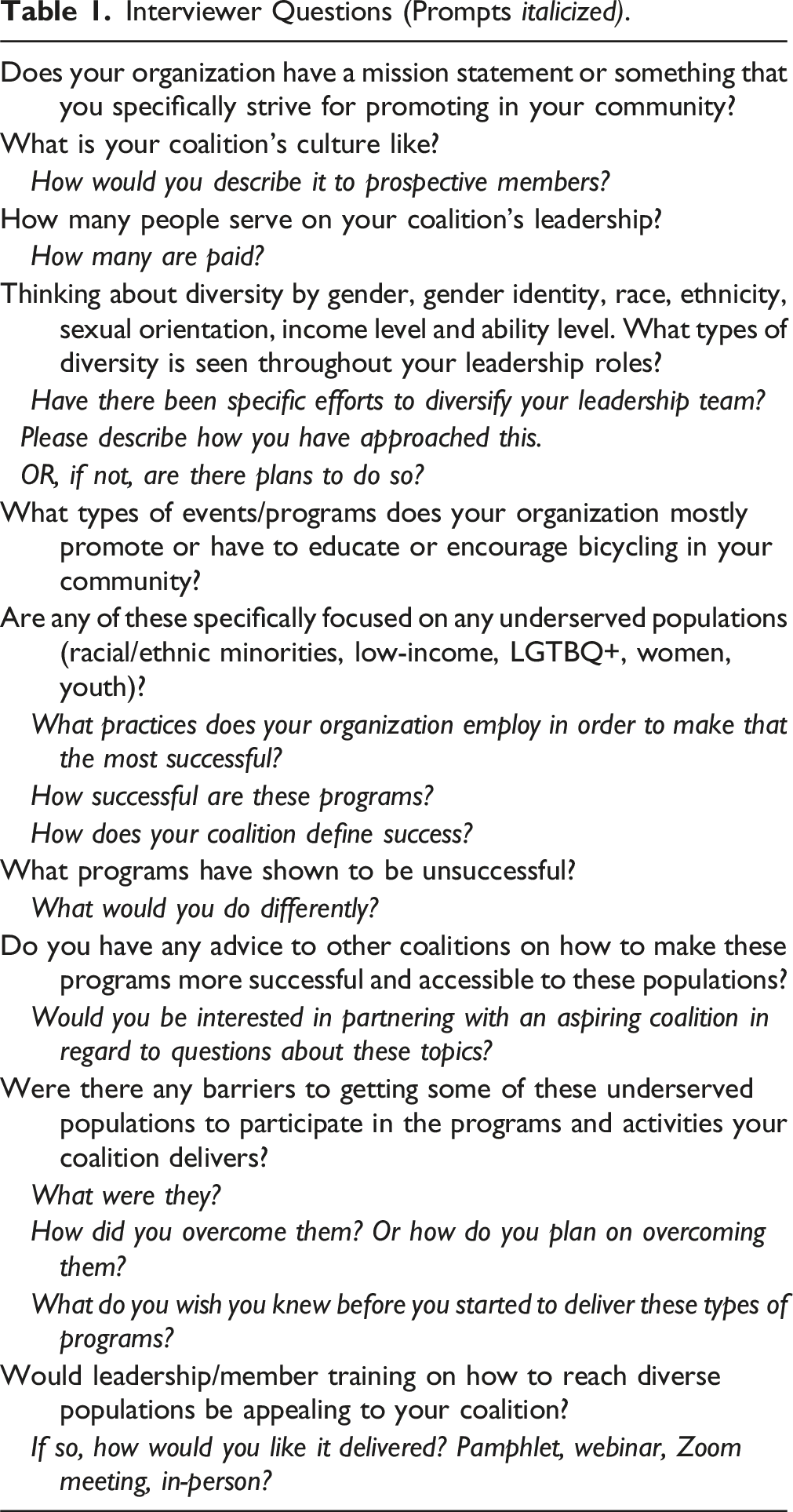
Interviewer Questions (Prompts italicized).
Measures
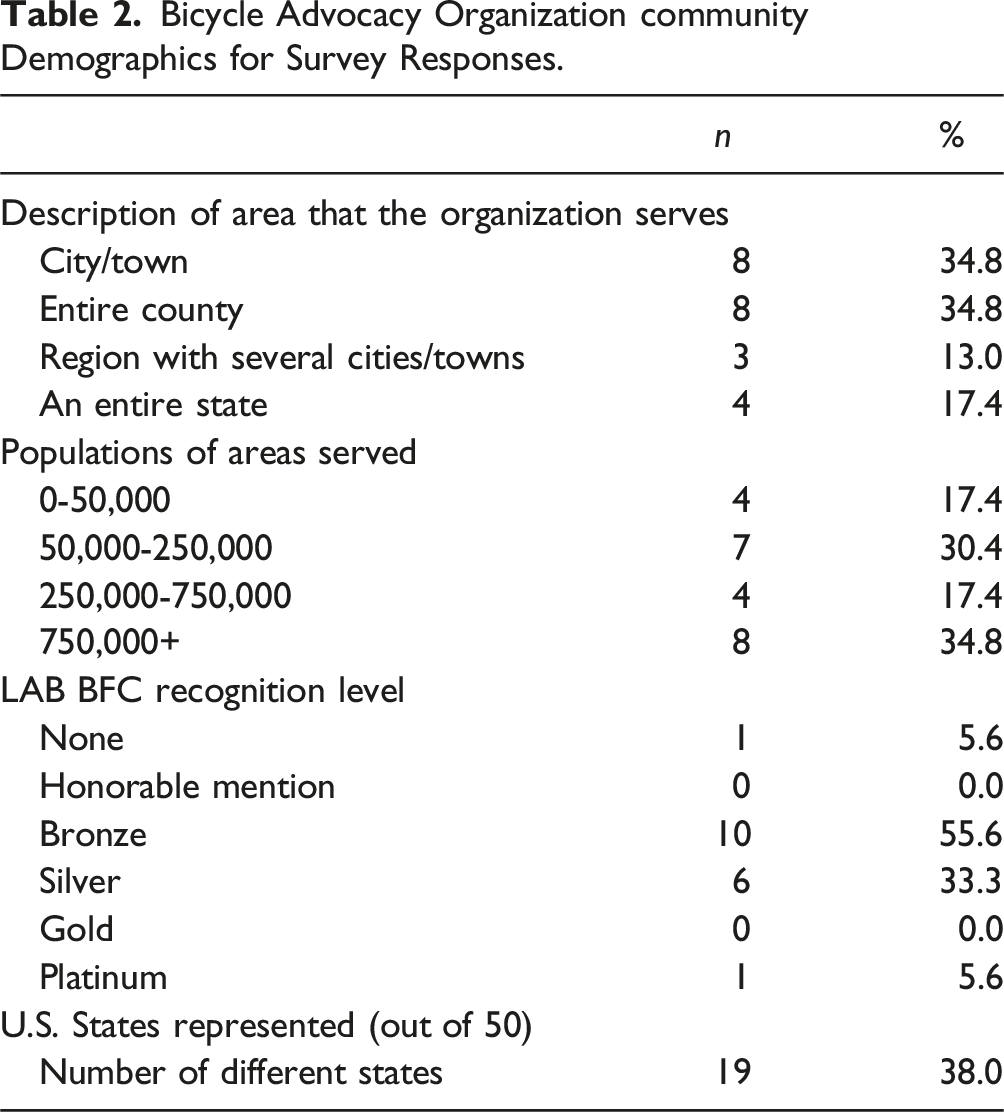
Participants were asked to describe the area that their organization serves (city/town, entire county, region with several cities, entire state), the approximate population served, and their community’s League of American Bicyclists (LAB.) Bicycle Friendly Community (BFC) recognition (none/honorable mention/bronze/silver/gold/platinum). BFC recognition is awarded to U.S. communities by the LAB. based on many bicycle friendly characteristics. 32
Data Analysis
Basic frequencies and descriptives were used to describe the sample. Using standard grounded theory qualitative methods, 33 the interview transcripts were initially reviewed by the first author to identify major themes as they emerged and a coding guide was created to group these themes. The guide included the main themes that were present in the data that were informed by the previous literature (barriers/challenges, organizational issues, successful approaches) and was refined as the coding progressed, adapting to be more specific and expanding or refining definitions of codes after discussion among the coders. Three independent coders analyzed the transcripts, coded the interviews individually, met to triangulate responses, and came to a final consensus on the themes that were represented in the data. Qualitative coding and thematic analysis were completed using Atlas.ti Version 8.4.5 (Berlin, Germany).
Results
After the thematic analysis was complete, five major themes were identified that were commonly noted by participants. These themes are outlined below, considering their level of bicycle friendliness (BFC) as well as provide a short description of the LAB. BFC recognition level (None, Bronze, Silver, Gold, Platinum, or State-serving [Note: state-serving coalitions/organizations do not receive BFC recognition]), as well as the type of population it serves (city/town, county, region, or state) for each organization’s representative.
Demographics
Bicycle Advocacy Organization community Demographics for Survey Responses.
Theme 1: Barrier to Reaching Underserved Populations is a Lack of Trust Between Community and Organization
There were many organizations (n = 7) that stated a lack of trust between the organization and community populations was a barrier to programming capacity. One participant spoke about personal interactions saying that “I’ve spoken with [Outside Community Organizations] who rightfully so are skeptical. They’re like ‘Who is this organization? Why do they want to talk to us now?’, but I think proving that there’s genuine interest there and that we really want it to be a relationship that evolves. You know, be skeptical, absolutely should be, until the organization has proven to them that we’re kind of in it for the long haul” (OR#10, State-serving).
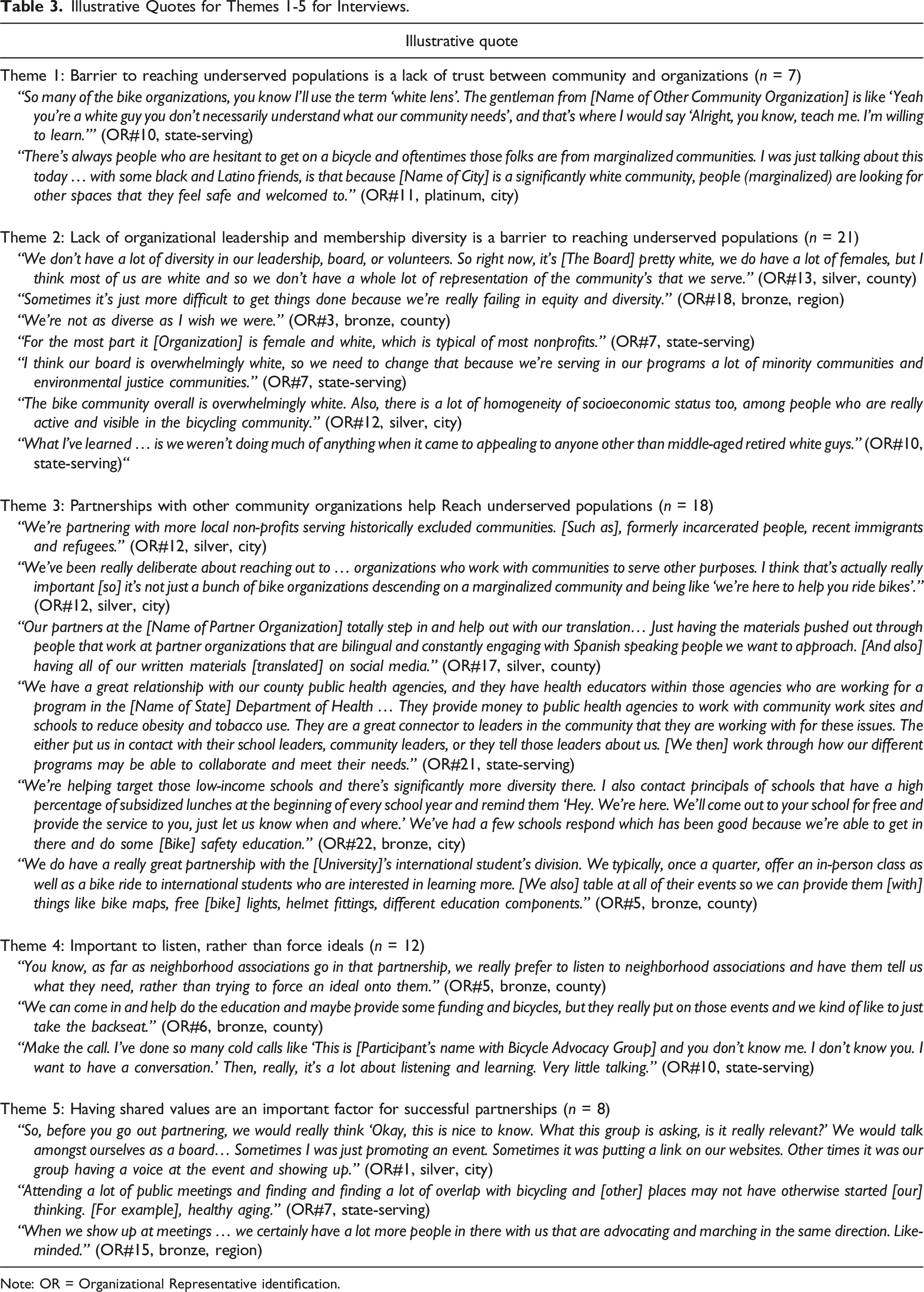
Illustrative Quotes for Themes 1-5 for Interviews.
Note: OR = Organizational Representative identification.
Theme 2: Lack of Organizational Leadership and Membership Diversity is a Barrier to Reaching Underserved Populations
This barrier was seen in the majority of groups (n = 21) that were interviewed. Lack of leadership and membership diversity can be seen in a variety of ways, from gender identity, sexual orientation, race/ethnicity, education, etc. One representative stated: “It [The Organization’s Board] leans very heavily male, there’s only myself currently active on the board that’s female. There is LGBTQ diversity. We don’t have any current board members that are black. Which, I don’t know how you go about like, specifically recruiting a black person without sounding like you’re crazy or racist” (OR#22, Bronze, City). When organizational leadership is struggling to have diversity on their board, it may be more difficult to connect to similar underserved populations of the community. .
Recreational bicycling has become a heavily upper class, white male activity to participate in, with a participant stating that “There are a lot of white upper-middle class, middle-aged or even beyond middle-aged bike club members, who have a certain outlook on biking” (OR#9, Silver, City), and another expressing “That it [bicycling] tends to be the cycling enthusiasts who get involved. And so, our demographics tend to be a little older, more affluent, more white. I’ll make myself the example, I’m retired and I’ve thrown most of my retirement into this” (OR#3, Bronze, County). Additional illustrative quotes surrounding this theme are in Table 3.
Theme 3: Partnerships with Other Community Organizations
There were a number of advocacy groups (n = 18) that stated that one of the reasons they were successful in creating programming to underserved populations was due to their partnerships with other community organizations. “It’s about, for us, making sure that we’re working with organizations that are embedded in the communities of people that we want to serve, and making sure we’re working with organizations that have developed trust with those communities so that we’re not just coming in and telling them how to ride bikes, but making sure that we’re working in collaboration with them to have their bicycling needs met” (OR#12, Silver BFC, City). Another organization’s representative gave advice to other organizations stating that “I would say that community organizations are a good place to start. And they may not be focused on cycling, a lot of underprivileged communities have bigger concerns, right? But it is something that is a consideration because maybe they have part of their population who have to get around by bike… So, I think finding those kind of community leaders, the people who really know what’s going on in the neighborhood and are just overall connected” (OR#10, State-serving).
Another positive association noted by participant’s partnerships with outside community organizations is the allocation of resources. For example, one organization currently implements a referral program for those who really need bikes stating that “Our referral program, or referral procedure, is a really big factor into our success of being able to create partnerships with the community… and having them make that connection with the kids and families that are in need, I think that’s a huge help. And not only does it save us a lot of time, but we just were not able to be out there in the way that they are, and so really utilizing their knowledge and their relationships to reach those families is a huge success for us” (OR#13, Silver, County). Additional illustrative quotes surrounding this theme can be found in Table 3.
Theme 4: Important to Listen, Rather than Force Ideals
Many advocacy groups (n = 12) that have partnered with organizations in the community which promote programs towards underserved populations stated that one of the most important things for a successful, long-term partnership, is the ability to listen, rather than forcing bicycling ideals. One representative stating that “I think it’s really just boiled down to having a good relationship with folks. I think my strongest partnerships have been born out of times where I’ve taken the time to really listen and hear what they’re doing and being completely honest about whether I see room for collaboration or an overlap” (OR#17, Silver, City).
Many organizations may have the resources for supporting bicycling, but often do not have the capacity to change all the issues that may be present in an underserved community. Understanding that underserved communities may have larger problems aside from bicycling is an important strategy when partnering. One representative said that “The approach that we’ve taken is kind of the you know, the listen approach. Like, first listen. Don’t come in there and be like ‘Hey, we’re going to save the day type thing’” (OR#10, State-serving). Additional illustrative quotes surrounding this theme are in Table 3.
Theme 5: Having Shared Values are an Important Factor for Successful Partnerships
Some advocacy organizations (n = 8) stated that it was important to have partners that shared similar values, whether it be from a non-profit standpoint or even just the individuals leading the organization. Partnerships with other community organizations could include other non-profits as well. One representative stating that “I think the reason that the partnership with [Name of Community Organization] has been so successful is they are also a non-profit, and so they’re coming at the program with a similar lens to us” (OR#8, State-serving). Success of the overall organization may be due to the members values as well, stating that “Most people joining are contributing because they believe in the mission, and they want to see change, see our advocacy work succeed” (OR#2, Bronze, County). Additional quotes for this theme are noted in Table 3.
Discussion
Community organizations and coalitions are important tools for advocating and promoting healthy behaviors, including physical activity and bicycling, through community wide educational campaigns, 34 interventions with behavioral/social support, 35 as well as increasing accessibility to places that may promote physically active behaviors. 36 Bicycle coalitions or advocacy groups, typically run by volunteers and funded by non-profit monies (e.g., 501(c) (3) funds), may also have this potential to significantly increase participation in bicycling for all members of their communities. Previous results suggested that there is a lack of organizational capacity for providing equitable bicycling programming and advocacy. 31 Capacity incorporates various characteristics, but most importantly stresses the ability to provide skills, resources, and leadership to overcome problems. 29 Without this, community organizations, advocacy groups and coalitions may struggle to reflect the changing needs and demographics of the communities, especially in diverse and underserved populations.
The current study suggests and adds to the literature by discussing the best practices that bicycle advocacy groups are taking to incorporate equitable opportunities into their bicycle programming. Comparable to research on physical activity coalitions, 37 the emphasis on strong organizational partnerships was a strong and consistent theme across both survey and interview results. A review of these multi-sectorial connections 38 has noted the importance of having diverse partners onboard to reach underserved population groups within the community, which is consistent with our findings. Other reviews 39 have noted the importance of having diversity of leadership for community coalitions or organizations to operate effectively, which is line with our major themes.
A major barrier to reaching underserved populations that was seen throughout the interview process was the perceived lack of trust between the underserved community populations and the organizations/advocacy groups. This lack of trust can make programming very difficult, if not impossible. This concern and problem may stem from the other major barrier commonly portrayed by representatives: having a lack of leadership and membership diversity. It is important to note the many social norms surrounding bicyclists that present challenges for reaching the entire community. Recreational bicycling is commonly portrayed as a middle to upper class, white, male-driven sport. These individuals may even be considered ‘spandex people’ or MAMIL’s (Middle Aged Men In Lycra), 40 or commonly seen individuals who wear race-level clothing to eliminate wind resistance when cycling.41–43 This generalization of bicycling has the potential to suppress underserved population participation by increasing the social and environmental norms of bicycling. Understanding that bicycling, in any shape or form (i.e., recreational or travel), can contribute health benefits to individuals who do participate should be important to community and public health leaders.29,44 Engaging with the community at a personal level in order to build trust is a potential successful initial strategy that will help create a more inclusive organization to serve a larger, diverse population. 45
One way that bicycle advocacy groups have shown to alleviate the barrier of trust and leadership diversity is through partnerships with other community organizations, especially ones who have an emphasis on serving diverse populations. Previous literature has also suggested this narrative, stating that partnerships with other community organizations (e.g. non-profit, government) has the potential to increase the reach, support, resources, and connections of the community. 46 These partners are more likely to have understanding of the specific influences on bicycling for a particular population, social and cultural norms or other relevant insights needed to develop culturally tailored programs and outreach strategies. Many representatives that stated their organization was doing this well and emphasized the need for partnering with organizations that already have ‘their foot in’ with specific diverse populations. A key example of this type of partnership comes from an organization who was part of a referral program. This bicycle advocacy organization partnered with another organization who works closely with refugee and low-income populations in their community. The refugee organization becomes close with these families to identify their needs. After understanding that a family is in need of a bicycle, they are then referred to this community bicycle advocacy organization, where then, they can use their personal resources to provide these families with the bicycles, educational materials, and other resources that they might need to support a ‘bicycle-friendly lifestyle’.
Partnerships are only as successful as the meaning behind them, which speaks specifically to the strength, depth and reciprocity of the relationship. Many underserved communities have other priorities relative to transportation equity (e.g., public transportation access, inequitable enforcement of transportation-related laws), however delivering bicycle programming may also consequently help alleviate these concerns (e.g., no access to car, improved health). For example in Los Angeles, the local bicycle coalition and other community organizations have been advocating against the unfair targeting of cyclists of color by local police organizations. 47 Bicycle advocacy groups should work towards being culturally sensitive of these concerns, while also understanding the true needs of the community through listening sessions, data and information gathering, or stakeholder interviews. It may be important to create a needs assessment to accurately understand what is truly going on with bicycling behavior and influences. Forcing bicycling ideals on community organizations and populations may have a negative response. Another commonly portrayed theme from organizations was the notion that having shared values with these partners is important, consistent with interorganizational relations theory (IOR). 48 These values and coordinated approach to solving a solution may be important to create successful, and effective programs that serve the needs of both organizations.
Although these themes and considerations for partnerships are insightful, there are a number of limitations that were seen in this study. One limitation is the survey, along with the interest to participate in our interview was voluntary, which could be subject to biases. As the participants were singular members of the organization, their views may be subject to opinion and may not accurately represent the organization/group as a whole. Future research in equitable bicycle programming should attempt to use a number of mixed methods analyses to understand the differences in capacity issues and the characteristics of the organization. Additional research should also attempt to answer other questions regarding specific programs, partnerships, and policies advocated for that have shown success in underserved and diverse populations. We did not assess the demographics of the survey or interview participants so we are unable to determine the gender, race/ethnicity, sexual orientation or ability level of the participants, and consequently the perspectives that were represented in the responses on behalf of the organization. Lastly, all of the information gathered is only from the perspective of the organization, not from the community they serve. Future studies should recognize the importance of learning from multiple perspectives and work to incorporate community perspectives to compliment organizational self-reports.
Bicycle coalitions and advocacy organizations have the potential to create a healthier and more bicycle friendly communities throughout the United States. Although there are organizations that have resources to promote bicycling, disparities among diverse and underserved populations continue to exist. Previous literature suggests that the organizational capacity, or ability to address problems, for equitable programming may be lacking. This study outlined themes that suggest that major barriers in programming to underserved populations are having a lack of trust between community populations and bicycle advocacy organizations, as well as a lack of diversity of organizational leadership and membership. The results also suggest that creating partnerships with other community organizations that have connections with underserved populations has the potential to increase the capacity for equitable programming. Moreover, listening to community partners, and having similar ideals may also have the potential to create more successful partnerships. By understanding the importance of these community partnerships, we hope that bicycle advocacy groups may begin or continue to nurture and create successful and useful partnerships to increase equitable programming in bicycling.
Footnotes
Declaration of conflicting interests
The author(s) declared no potential conflicts of interest with respect to the research, authorship, and/or publication of this article.
Funding
The author(s) received no financial support for the research, authorship, and/or publication of this article.
