



Abstract
The significance of mental health inequities globally is illustrated by higher rates of anxiety and depression amongst racial and ethnic minority populations as well as individuals of lower socioeconomic status. The COVID-19 pandemic has further exacerbated these pre-existing mental health inequities. With rising mental health concerns, arts engagement offers an accessible, equitable opportunity to combat mental health inequities and impact upstream determinants of health. As the field of public health continues to shift its focus toward social ecological strategies, the social ecological model of health offers an approach that prioritizes social and structural determinants of health. To capture the impacts of arts engagement, this paper creates an applied social ecological model of health while aiming to advocate that engaging in the arts is a protective and rehabilitative behavior for mental health.
Keywords
Introduction
Depression impacts approximately 280 million people worldwide. 1 Further, clear mental health inequities are evidenced by significantly higher rates of both anxiety and depression among racial and ethnic minority populations as well as individuals of lower socioeconomic status. 2 According to the National Institute of Health (NIH), an estimated one in five adults in the United States (U.S.) suffers from mental illness. 3 Notably, clear mental health inequities exist for marginalized and vulnerable U.S. populations. According to the NIH, 51.8% of White Americans with any mental illness received mental health services in 2020, compared to 37.1% of Black Americans and 35.1% of Hispanic Americans. 3 These disparities in access to care across marginalized populations often stem from socioeconomic barriers. 4 The American Psychological Association 5 has even identified lower socioeconomic status itself as a risk factor for mental illness. Further, marginalized or vulnerable populations that experience mental illness are often subject to compounding effects of stressful life events (SLEs) such as “abject or perceived racism, a dearth of education, communal violence, single-family households, or substance abuse” (p.604). 2 The COVID-19 pandemic has exacerbated these pre-existing mental health inequities. 6 During the first year of the COVID-19 pandemic, the World Health Organization (WHO) reported an unprecedented 25% increase in the global prevalence of anxiety and depression. 7 Today, innovative and interdisciplinary approaches are urgently needed to address the scale of these heightened mental health inequities.
The social ecological model of health promotion, developed by McLeroy et al., 8 helps illustrate that health is affected by multiple contexts ranging from individual factors to interpersonal, community, and policy influences. In 2020, Golden and Wendel adapted the social ecological model of health (SEMoH) by adding a cultural level, recognizing that culture and sociocultural norms affect all other social ecological contexts. 9 These models help visualize the fact that health inequities are fundamentally produced by the inequitable distribution of upstream drivers of health. Thus, the scope and range of the SEMoH offers a well-aligned approach to addressing the highly prevalent issue of mental health inequities.
The broad perspective of the SEMoH indicates the importance of utilizing interdisciplinary approaches which can integrate multiple contexts and experiences. One such approach is arts engagement, which has been shown to support mental health and ameliorate consequences of mental health inequities across multiple spheres of influence. 10 Engagement in the arts can also concurrently promote a greater sense of wellbeing, combat racism, address collective trauma, promote social inclusion, and support social, cultural, and policy change.10–15 Furthermore, according to a scoping review from the WHO, engagement in the arts not only promotes physical and mental health, but when considering prevention and promotion, can also affect social determinants of health by offering accessible health promotion and building community capacity. 10 Therefore, as it relates to prioritizing marginalized communities, arts engagement may offer an accessible, equitable approach.
This paper aims to advocate that arts engagement is a protective and rehabilitative behavior for mental health. An applied version of the SEMoH, depicted in Figure 1, offers evidence for this rationale by considering application at the individual, interpersonal, community, policy, and cultural levels. Applied Social Ecological Model of Health (SEMoH). Note. An Applied Social Ecological Model of Health as adapted from Golden and Wendel;
9
This model is available on University of Florida’s Center for Arts in Medicine’s website – www.arts.ufl.edu/academics/center-for-arts-in-medicine/researchandpublications/.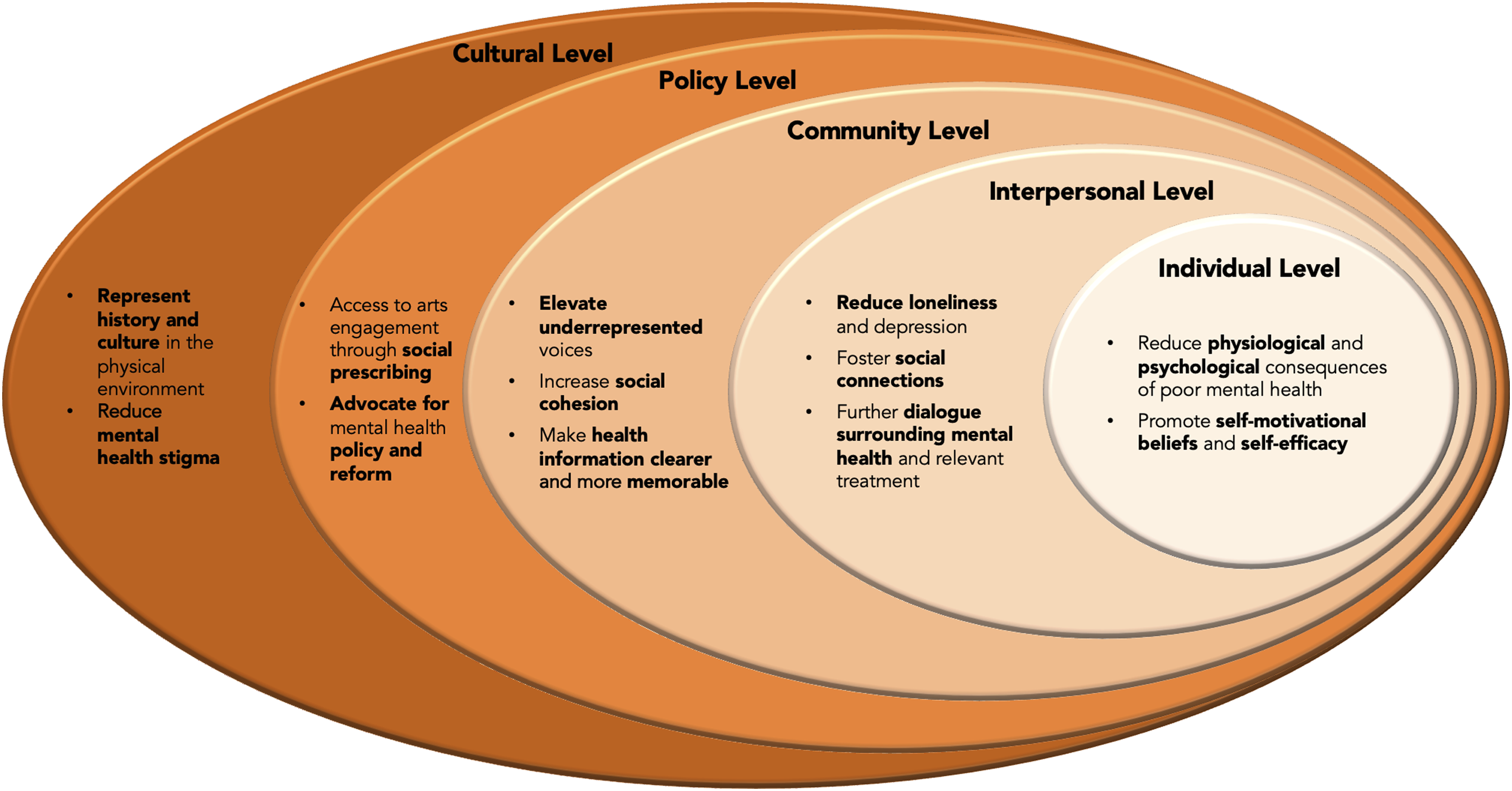
Individual Level
The individual level, the innermost level of the SEMoH, is characterized by an individual’s beliefs, attitudes, knowledge, self-concepts, behaviors, and skills.8,9 For mental health, there are several mechanisms by which the arts can be utilized for preventative and rehabilitative measures. Engagement with music can reduce physiologically and psychologically negative impacts of stress.16,17 Physiologically, observing or engaging with the arts, through all its diverse modes, can reduce blood pressure, cortisol levels, and heart rate — each of which can impact behaviors and skills.18–20 Psychologically, emotional states can be affected as well; for instance, engaging with art personally perceived as pleasant increases the relative intensity of emotional valence leading to a stress-reducing effect which can affect attitudes and self-concepts.10,16 Additionally, arts engagement promotes self-motivational beliefs and therefore enhances self-efficacy.21,22
According to the Substance Abuse and Mental Health Services Administration (SAMHSA)’s 2021 National Survey on Drug Use and Health, “Black adults were less likely than White adults to receive treatment for depression (51.0 vs. 64.0 percent)” (p.56). 23 Further, low rates of mental health service utilization are often associated with barriers to access including the propensity and ability to use services as well as one’s insurance and capacity to afford health services. 24 Given the disparities associated with the accessibility of mental health services, the arts present an opportunity to reduce burdens on the healthcare system through more easily affordable, preventative measures.10,25 The benefits of increased accessibility have been demonstrated in the context of suicide prevention and survivorship as illustrated in a systematic review conducted by Sonke et al. 26 As it pertains to vulnerable and marginalized individuals, forms of arts engagement present an equitable, economically accessible opportunity to reduce negative consequences of mental health while bolstering protective attributes of mental health and wellbeing.
Interpersonal Level
The second level, the interpersonal level, considers relationships such as family, friends, neighbors, workplace associates, and acquaintances that act as “sources of influence in health-related behaviors” (p.356).8,27 Important considerations include strengths of social networks and social support systems.8,27 As it relates to mental health, there is a strong association between loneliness and depression 28 — a pertinent concern since the onset of the COVID-19 pandemic. According to a research brief published by the WHO, the prevalence of anxiety and depression surged dramatically worldwide by 25% in the first year of the COVID-19 pandemic. 7 Induced by the pandemic, social isolation was a driving factor for this exceptional rise as the pandemic’s far-reaching effects were worsened by people’s incapacity to work, participate in, and engage with their communities. 7 As communities continue to heal, arts engagement can act in conjunction with other interventions to reduce the effects of both loneliness and isolation as they pertain to depression.29,30 Additionally, arts engagements foster social connection amongst people through “social opportunities, sharing, commonality and belonging, and collective understanding” (p.1).13,31
Another valuable facet of arts engagement at this level is its ability to promote dialogue. 32 Given prevalent stigma surrounding mental health, individuals may be reluctant to speak with peers about their mental health experiences or to seek out care.33,34 Additionally, forms of racial discrimination, such as verbal harassment or hate crime, further compound the effects of this stigma.35,36 As such, engaging in art, especially forms that promote empathy and understanding, can support meaningful discussions that can promote connectedness and the use of mental health resources.10,37
Community Level
Community, as it pertains to the SEMoH, considers structures of power, relationships amongst organizations, and how those structures and relationships are mediated.8,9 Low health literacy is a key impeding factor to community level health and is defined by the U.S. Institute of Medicine as a limited capacity to obtain, process, and understand the basic health information and services needed to make informed health decisions. 38 Vulnerable and marginalized populations, including older adults, people with disabilities, people of lower socio-economic status, racial or ethnic minorities, and people with limited English proficiency or formal education, frequently have low health literacy rates. 39 In communities, arts engagement can make health information clearer and more memorable by improving awareness of health issues and available resources as well as by increasing the sharing of knowledge.13,40 Such improvements and increases may associate with individual and collective perceptions of thriving, an assets-based concept similar to wellbeing. A greater sense of thriving may also have direct effects on multiple health outcomes as people establish meaningful relationships, connections, and fulfillment through arts-based participation in their communities. 41
Positive outcomes associated with participatory arts engagement include social cohesion 42 and wellbeing. 12 Arts engagement increases potential for social cohesion by generating social capital, 43 prosocial cooperation, 44 and community capacity building. 45 Moreover, participatory arts engagement elevates underrepresented voices46,47 and builds resilience in communities 48 by highlighting community health needs and priorities. 27
An example of an arts-based practice associated with community-level health outcomes is photovoice. Photovoice is a photography and storytelling-based qualitative data-collection methodology that emphasizes participant perspectives. It is used to elevate underrepresented voices, such as immigrant youth in the U.S., by empowering participants to contextualize and express their lived experiences. 27 Photovoice can offer people who may not be proficient in a given language the opportunity to share their perspectives visually as well as allow for youth perspectives to be centered in policy making narratives.49,50 Additionally, the use of photovoice also promotes accessibility to and retention of information through its photo-based approach to data dissemination and can encourage critical reflections upon traditional viewpoints of power.51,52 Overall, considering the dynamic interplay between psychological, physical, and social variables, associations between arts engagement and wellbeing at the community level may be critical to addressing the exacerbated mental health crises.10,53
Policy Level
Policy, the next level of the SEMoH, guides and impacts the practice of public health.8,27 Policies encompass “actions, structures and expectations” (p.14); 54 they affect health through the restriction or promotion of behaviors while guiding change across social ecological levels. As it relates to the arts, health care and social service policies can be designed to provide the public, and especially the underserved, with additional access to arts-based experiences that support personal health and wellbeing.55,56 This is especially important given the social gradient in arts engagement within the U.S. . 57 Social prescribing — a practice used in the United Kingdom (U.K.) and other countries to support mental health — recognizes that health and wellbeing must be addressed by improving social determinants of health. This involves connecting patients to non-clinical services ranging from diverse forms of arts participation to engagement with local community-based resources such as housing assistance, jobs training, or food pantries.58,59 Benefits of social prescribing have included increased mental wellbeing, decreased need for clinical health services, and promotion of health equity while allowing for creativity, meaning making, and the formation of new relationships.55,60,61 Social prescribing is a component of the national health system in the U.K.; 55 in the U.S., pilot studies are exploring feasible mechanisms for implementing social prescribing, exemplified through the CultureRx Initiative. 59
Policies supporting arts engagement can advance mental health policy and advocacy efforts.62,63 As indicated by a scoping review led by Sonke et al., 64 art advances mental health education and advocacy by creating innovative forms of health communication which increase public awareness. It can also offer new means of data collection that emphasize unique, and often overlooked, perspectives.65,66 Additionally, photovoice is a particularly valuable modality for equitably leveraging policy as it can foster critical dialogue surrounding direct perspectives of vulnerable populations. 67 Photovoice can also enable a strengths-based approach to policy making by visually depicting both the needs and assets of a community. 67
Cultural Level
The cultural level of the SEMoH encompasses social and cultural norms such as stigma, which remains a critical public health issue as it continues to restrict access to adequate healthcare and acts as a cause of persisting population health inequalities. 68 More specifically, stigma creates a barrier for persons who require mental health services but are hesitant or unwilling to seek assistance due to the possibility of prejudice and rejection from others. 69 The U.S. Department of Health and Human Services has considered stigma “the most formidable obstacle to future progress in the area of mental illness and health” (p.29). 70 Further, racism can compound this issue. Notably, after the start of the COVID-19 pandemic, heightened forms of stigma, racist harassment, sentiment, and violence against Black and Asian American populations in the U.S. have markedly contributed to the “increased risk of depression and anxiety via vicarious racism and vigilance” (p.508). 71
Arts and culture together can cultivate spaces that facilitate discussion around racial stereotypes which perpetuate mental health ailments as well as stigmatized aspects of mental health itself.72–74 Arts-based experiences, including installations and performances, have the capacity to transform participants’ perspectives including their “sense of being alone, or of being unable to articulate or share their experience” (p. 43). 75 This effect was examined through the Porch Light program, an arts engagement initiative which allowed community members to collaborate with artists to work on public murals that illustrated a broad spectrum of experiences with mental illness. 76 This initiative increased perceived safety and reduced mental health stigma amongst participants and residents while increasing social cohesion and trust.76,77 As such, the inclusion of cultural ecologies in the SEMoH emphasizes the importance of incorporating creativity and cultural collaboration into community development to create unique, culturally responsive, and deep-rooted initiatives that can address the mental health concerns of stigma and build toward community-wide wellbeing.
Promising Practices
To equitably address wide-spanning issues stemming from mental health experiences, it is imperative to consider modalities which employ multiple levels of the SEMoH. 9 With health equity as a central goal, arts-based initiatives have the capacity to propel theory into practice by cultivating wellbeing and health. The exemplar programs below utilize arts engagement to promote mental health across multiple levels of influence.
UnLonely Film Festival
Project UnLonely, a national initiative by the Foundation for Art & Healing, 78 is supported by partnerships with the AARP Foundation, Cigna, Americans for the Arts, and the Harvard T.H. Chan School of Public Health. It aims to expand public awareness of negative mental and physical health outcomes associated with loneliness, empowering both individuals and communities alike to connect with one another through art. Its annual UnLonely Film Festival curates award-winning short films which represent the loneliness epidemic while amplifying lived experiences with isolation. Its “front row” program promotes the films by customizing content suites for organizations, and its “film screening series” provides engaged group discussion and activities after viewing. Acting at the individual, interpersonal, and community levels, it addresses equity and caters to urgent needs by focusing on several vulnerable populations: older adults, employees, college students, and individuals with marginalized identities. Over 100 films are publicly available to raise awareness about loneliness and its effects while reminding viewers that they are not alone.
Project: Music Heals Us
Project: Music Heals Us 79 provides marginalized communities access to interactive programming and music performances to encourage, educate, and heal. It prioritizes disabled, elderly, homeless, and incarcerated populations. Acting at the community level, this project aims to make health information clearer while empowering communities, improving awareness around pertinent health issues, and sharing available resources. To realize its mission, three programs are utilized: a) Novel Voices: Distance Learning – free workshops and concerts for refugees that raise support and awareness for refugee-aid programs; b) Music for the Future: Prison Program – single-day concerts, week-long musical immersion programs, and year-long programming for incarcerated individuals led by classical musicians; and c) Vital Sounds Initiative: Virtual Bedside Concerts – live concerts in clinical settings, implemented after the onset of COVID-19, have reached over 10,000 patients with 1,700 concerts performed.
CultureRx
CultureRx employs a social prescribing framework to build public infrastructure to support the promotion of cultural experiences as protective factors for health and wellbeing. 59 Mass Cultural Council developed and funded CultureRx as a social prescription pilot program involving partnerships with twenty healthcare providers and twelve cultural organization grantees across the state of Massachusetts. The initiative allows healthcare providers to refer patients or clients to arts and culture experiences, which are then offered free of charge. As indicated by CultureRx’s evaluation data, providers are “excited about” and “recommend [the] expansion” of social prescribing; they see it as promoting overall wellbeing and improved health outcomes through a focus on increasing equitable access to upstream determinants of health (p.32).59,80–83
Conclusion
This work suggests that arts engagement can address mental health inequities while impacting upstream determinants of health. We account for interactions between the social ecological model of health and arts engagement to provide an integrated view of the value and power of the arts to facilitate positive mental health outcomes at individual, interpersonal, community, cultural, and policy levels. Arts engagement can act as a protective and rehabilitative behavior for mental health while also redefining and strengthening health at each of these levels. Use of the arts acknowledges mental health inequities by communicating their holistic and contextualized nature. The promising practices described above put theory into practice in this regard.
As the field of public health continues to shift its focus from individual to collective health behaviors, it is imperative to recognize that merely acknowledging the factors beyond the individual is no longer sufficient. This acknowledgment must inform and guide future practice to ensure the consideration of barriers and inequities while advancing health promotion. Promising future directions include community-led design, implementation, assessment, and evaluation of arts-based methods as means to positive mental health outcomes, particularly in marginalized and minoritized communities. It is essential to consider the impacts of inequities and culture while employing an interdisciplinary approach which looks beyond siloed practices.
Footnotes
Declaration of Conflicting Interests
The author(s) declared no potential conflicts of interest with respect to the research, authorship, and/or publication of this article.
Funding
The author(s) received no financial support for the research, authorship, and/or publication of this article.
