



Abstract
This article aims to categorise and theorise references to “interpreting” in ancient China. Based on a corpus and textual analysis of texts composed before 600 CE, I observe that these references are primarily the generic engagement of interpreting relating to China-bound tributary trips and assimilation or acculturation “achievements” and not so much the individual interpreter, less still interpreting competence. If interpreting competence received such limited attention, it raises the question: What aspects of interpreting were emphasised? How was “interpreting” presented in the Chinese narratives? The recurrent textual references suggest a conscious linguistic and chronicling choice, especially in the way China, in its strength, even supremacy, was perceived or romanticised. This observation leads to the question: Did the symbolic meaning of interpreting embodied in the character yi (译)—as associated with hurdles, indirectness, blockage, differences, and geographical remoteness between two political, ethnic, or cultural entities—bear an ideological dimension in classical writing? I argue that it indeed did and that this ideological dimension consisted in the construction of the Chinese image or identity. Simply put, the downplaying of interpreting competence becomes understandable at this time, in which interpreting played mostly an ideological role.
1. Introduction
Ancient Chinese references to interpreting, taking the form of either yi (to interpret) or chongyi (to interpret in relay), 1 are often found in official accounts of alien peoples and territories. These are treasure troves for exploring the ancient Chinese mindset and ideologies regarding the actual and symbolic roles of interpreting in China’s empire building and image construction. The treasure, however, remains under-explored because of its enormous volume and the challenge of reading Classical Chinese. The present study aims to first take stock of textual references to interpreting and its linguistic variants in ancient China up to 600 CE, before categorising them based on their salient features. The study also seeks to identify intrinsic relations between these categories and examine the ways in which these relations enhance our understanding of ancient ideologies relating to interpreting. Such ideologies are typically represented by cognates, such as yi and chongyi. The study is guided by two principal research questions: What aspects of interpreting were emphasised, and how was the idea of interpreting presented in historical narratives?
In earlier work, Lung (2023) analysed a dozen repeated references to China’s earliest account of interpreting, around 1042–1035 BCE during the regency of the Zhou duke, and considered the relevant passages—all connecting interpreting with the Yue envoy’s presentation of a white peacock to the king—as attempts to advance different political, ethnographical, and cultural causes across time. Inspired by Hung’s (2005) initial idea of the connection between chongyi and good omens in the archives, Lung (2024a) identified a rhetorical pattern in which foreign envoys’ visits mediated through chongyi were taken to authenticate or corroborate the good botanical or astrological omens observed in earlier periods, 2 although the connection could be challenged when the two events were years apart. Using corpus and textual analysis, Lung (2024b) identified a neatly differentiated usage pattern for yi and chongyi in the ancient Chinese archives. In this pattern, yi was predominantly used to describe outbound ethnographic accounts or exploratory trips on the periphery, while chongyi was mostly used for accounts reporting China-bound tributary visits. 3 It was shown that chongyi was deliberately used as a linguistic strategy to assert political and cultural supremacy over non-Chinese counterparts (Wang, 2010, p. 54). 4 Analysed from this perspective, the patterned and repeated differentiated usage would then effectively serve to conjure or project the image of “inferior” states sending envoys to forge ties with, and seek protection from, “strong” China, notwithstanding the inconvenience of relying on relay interpreters who had to navigate difficult terrain. This was the image systematically inscribed in Sinitic accounts for over a millennium.
While individual interpreters and their linguistic or demographic backgrounds are not often found in the Chinese archives, European diplomatic or royal dragomans were relatively well documented in the 17th and 18th centuries, partly because of their privileged social status earned from familial apprenticeships in which knowledge and multilingual skills were acquired and inherited. For example, in the Ottoman Empire (in which Istanbul was then one of the key diplomatic and economic centres of interlingual and cross-cultural exchanges), the dragomanate was typically preserved within families (sometimes labelled as dragoman dynasties) for generations. Similarly, the Republic of Venice also contained a thriving community of dragomans. Rothman (2021) maintains that “the Venetian dragomanate’s centuries-old endogamy fostered a community of practice whose training was overwhelmingly apprentice-based and familial” (p. 247). Dragomans were esteemed as they worked with, and for, court officials and aristocrats. The ties to high society enabled dragoman families to access status, power, and wealth. In reality, however, ad hoc interpreters were in huge demand in civilian or official contexts beyond the radar of dragoman dynasties in pre-modern Europe. In studying trust and mobilities of interpreters, Rizzi (2021, p. 14) describes temporary diplomatic interpreting tasks “occasionally” performed by underprivileged language brokers, who were poor, slaves, or criminals, because “professionally” trained dragomans were difficult to recruit (p. 13). In the Chinese tradition, by contrast, interpreting as a concept in promoting political and cultural ideologies was treasured in writings much more than interpreters per se, who were barely visible or ranked highly in the official or social hierarchies (Lung, 2011, p. 4).
One commonality in the three studies of Lung is that chongyi should not be understood literally because it carries a symbolic meaning connoting Sinitic political strengths and cultural supremacy. These studies take on three specific and nuanced themes, each addressing and supporting Lung’s different deductive narratives about the connection between yi and Sinocentric ideology. The present study, based on a conference paper inspired by the theme of translation competence, 5 adopts a mixed-methods approach. The approach is empirical and theoretical as far as the categorisation is concerned. While preparing for the conference, I reentered the archives looking for references to interpreting competence. This became one of the categories into which I divided the references. This article began as an investigation of interpreting competence in ancient China but has evolved into a discussion of a categorisation that has yielded insights and which I hope other scholars might find useful.
This article is structured like a mind map. First, a section sets out the evolution of my thinking and maps out the shift in focus from interpreting competence to categorising references to interpreting. This is followed by a methodology section, where the four categories are presented. In the last section, the article proposes to broaden the definitions of national interpreting capacity before implications and conclusions are discussed.
1.1 From translation and interpreting competence/capacity to categorising references to interpreting
Translation competence is both an additional language skill (Wei, 2015) and a communication asset. Discussions on definitions of translation competence (Pym, 1992, p. 3), the structure of competence and sub-competence (Neubert, 1994, p. 419) and the assessment of interpreting or translation competence (Campbell, 1991, pp. 332–333) were popular in the 1990s. In recent decades, increased attention has been drawn to institutional and national translation capacities at a more macro level, particularly with the inception of the annual ranking index exercise in China, engineered by Ren and her team at Beijing Foreign Studies University in 2021 (W. Ren, 2023; W. Ren & Zhao, 2023).
Broadening the research scope from translation competence (individuals) to translation capacity (country-wide), however, has not been accompanied by sufficient attention to Chinese terminologies, which causes confusion. For instance, the Chinese term fanyi nengli (翻译能力, literally translation competence) can be rendered as translation competence, capacity, proficiency or abilities (D. Ren & Gao, 2020, pp. 150–152; W. Ren & Li, 2021, p. 7). Without new Chinese terms to address such terminological profusion, we run the risk of talking about, or worse still investigating, entirely different topics, considering that the term fanyi nengli has been broadly used in recent Chinese research. The lack of a wider terminological repertoire suggests a semantic gap and poses challenges to the working definitions of translation or interpreting capacity. Meanings or coverage of fanyi nengli, of course, vary in different contexts. Are we talking about individual translators or interpreters, or are we focusing on translation services and training provisions in a locality, a region, a government, or a sovereign state? Such studies could cover translation measures and planning in relation to national policies, public-funded campaigns, or institutions. Similarly, the term guojia fanyi nengli (国家翻译能力, literally national translation capacity) can also be contested, because guojia (nation, state, country, and so forth) is rendered differently depending on the emphasis. D. Ren and Gao (2020, p. 151), for instance, have attempted to differentiate and evaluate the possible English translations for “guojia” (literally state-family) by tracing its etymological origins in Chinese archives. If nationalities are a central concern, then “nation” can be a suitable choice. But if the concern relates to geographical territory, “country” is preferred, and for that matter, “state” may be optimal for more politically-oriented studies.
W. Ren and Li (2021, p. 10) endeavour to develop definitions and create a detailed and sophisticated conceptual structure of national translation capacity. On a similar topic, Zhan and Zhang (2023, p. 37) discuss national interpreting capacity, in which the practice of institutional interpreting, individual interpreting, and AI-assisted interpreting, is elaborated. In their framework, interpreting is primarily considered a product or a service, but translation or interpreting, as a conceptual construct, can also function as an ideological tool. Furthermore, the recent efforts to broaden the scope by considering interpreting capacity at the sovereign level is instructive. My study builds on the literature by investigating the scope and key features of interpreting capacity in a historical context. What I mean is that, apart from the more conventional sense of interpreting resources that a state can afford and mobilise, we can also think of the ideological role played by interpreting in constructing a country’s image and prestige over time. The narration of interpreting in connection with, for instance, the process of empire building, as in acculturation conquests or China-bound tributary sojourns, can be strategically and linguistically crafted to assert superiority over China’s counterparts. The three studies by Lung are designed precisely to examine this point. Gao (2020, p. 8) found that the king of Zhou China (1046–256 BCE), known as Son of Heaven, considered remote territories as Zhou land and the remote peoples, sometimes labelled as “primitives” (referred to as yi 夷, ideographically a person with a bow, and generically referring to non-Chinese, not always derogatorily) as being obligated to pay tax in the form of tributary gifts. Therefore, tributary trips to China were taken as signs of submission. In this study, I seek to broaden the discussion and introduce more nuances to the definitions of interpreting capacity by categorising references to interpreting.
1.2 Downplaying interpreting competence in ancient China
Interpreting competence refers to the mastery, and proficient use, of two or more spoken languages for interlingual or cross-cultural communication. In the ancient Chinese context, gifted polyglots could have been residents along the borders with exposure to, or command of, at least two languages and cultures, or offspring of mixed marriages. They often managed two spoken languages but not necessarily two written languages, the acquisition of which, after all, warranted a formal education, which most people could not afford at the time. I started by assuming that interpreting competence is too modern a concept to be of central focus for historical research. In fact, the mention of analogs to such competence is seldom made in ancient texts. But then I started to ponder the bigger question: why was competence not an overt concern in the archives? Did officials not care about the accuracy of interlingual diplomatic mediation? If interlingual competence was mentioned, how was it documented, and why?
2. Sources and filtering principles
The data were retrieved from the Chinese Ancient Text (CHANT). 6 Using a keyword search of the character yi up to 600 CE, I generated 265 tokens embedded in passages of different text types, including words containing yi, such as chongyi, 重三译 (triple relay interpreting), chongjiuyi 重九译 (ninefold relay interpreting), yixian 译献 (to present gifts with interpreting assistance), gongyi 贡译 (to present tributary gifts with interpreting assistance), and so on. After removing 38 duplicated entries, 22 entries in a Buddhist context, 24 entries on titles of interpreting posts in the western regions (present-day Gansu and Xizang), and 55 entries in which yi functions as a noun, 7 tokens of passages where yi functions as a verb denoting interpreting total only 126.
After examining these 126 passages, no traces of interpreting competence, in its conventional sense, were found. Chroniclers or writers at the time were not found to be overtly interested in, or even aware of, the quality, accuracy, or effectiveness of interpreting, probably because perfect communication was assumed, and no further comments were raised otherwise. In this dataset, the generic engagement of interpreting was primarily documented, not the specific interpreter, and seldom the interpreter’s interlingual competence. These passages suggest a loose understanding of interpreting as simply necessary and useful for unblocking interlingual deadlock. What is more, the recurrent references to yi and chongyi imply a conscious linguistic and chronicling choice, especially in the way China, in its strength, even supremacy, was imagined, perceived or even romanticised in relation to the act of interpreting.
For interpreting studies, the significance of the above observations is that interpreting competence or interpreting capacity may have been understood differently in ancient China. Interpreting was valued ideologically for its more macro contribution to the identity and image building of a strong and superior China. In this construction, the focus was not on individual success in interlingual events; rather, the concern was largely on the symbolic contribution of interpreting as an instrument in elevating China’s supremacy. We should avoid applying, therefore, the modern sense of competence to specific interlingual events when assessing ancient China’s awareness of interpreting proficiency. Moreover, a new set of parameters for the classical context can be proposed for measuring interpreting competence, capability, or capacity, with the eventual goal of identifying what ancient China valued most in evaluating the success and effectiveness of interpreting.
According to the Oxford English Dictionary, 8 competence is “the ability to do something successfully and efficiently.” This broader meaning of “competence” suggests that interpreting competency will no longer be confined to the degree of interlingual accuracy or proficiency. With a focus on the success and efficiency of interpreting, I re-examined my data set and generated the following categories:
I must emphasise that the nature of success and efficiency of interpreting in the range of achievements listed in Table 1 is perceived entirely from the Sinitic perspective, through contextual analysis of the passages. The distribution of different categories of achievements associated with the use of interpreting is indicative of China’s ideological concern. Tribute presentation of gifts (n = 87) and submission (n = 21)—in the form of assimilation (understood as Sinicisation) (Dirlik, 2019, p. 125) and acculturation—to the Chinese throne with interpreting were most often recorded, while success in straightforward interlingual communication is least documented (n = 2). This marked discrepancy can be explained by the noted power asymmetry in China’s favour (in Categories 3 and 4), which is absent from the definition of category 1.
Proposed categories and frequency distribution of yi and its related variants as a verb.
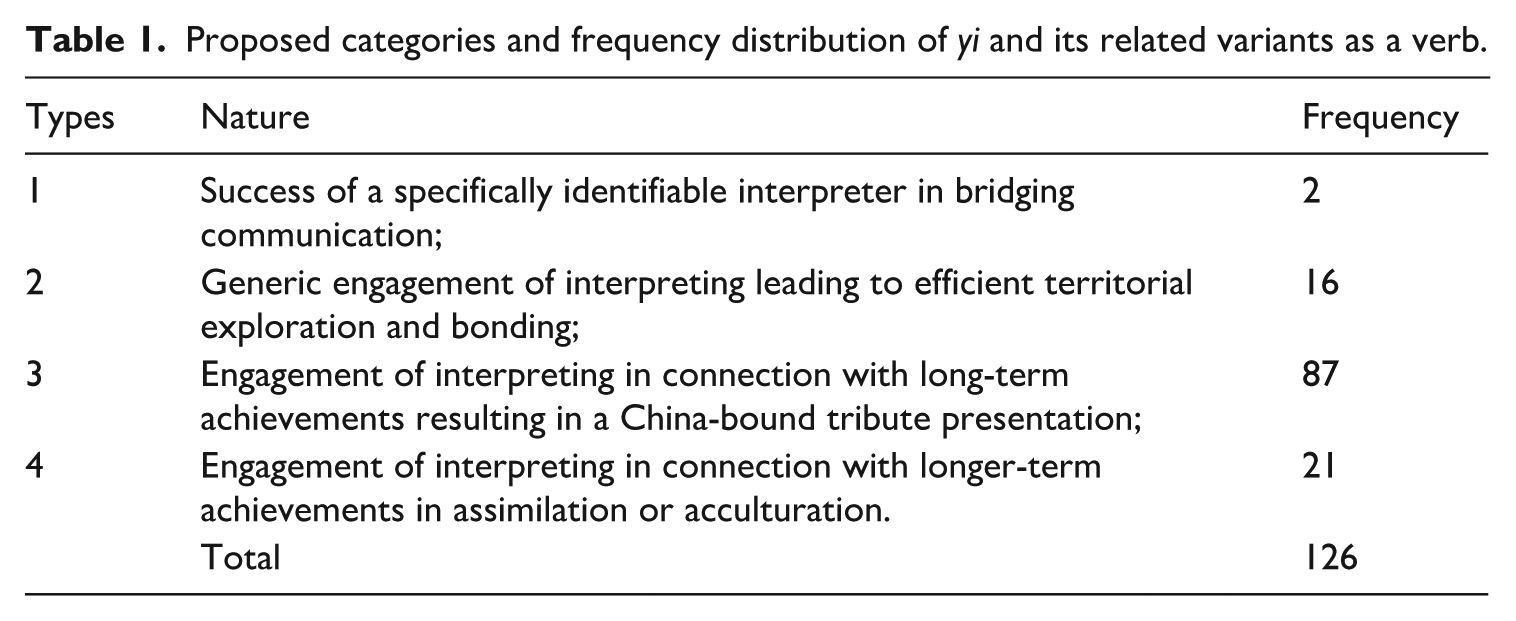
In the Chinese tradition, the usual focus of discourse about interpreting was not on interpreters, but on the events or acts of interpreting associated with their broader implications and significance in relation to political and cultural strengths. The names and identities of interpreters, as a rule, were seldom mentioned, unless they were martyred in military action, such as Tian Si 田汜 and Xia She 夏舍 (Xia, 2018, p. 26). Interpreters are but pure agents; they are usually unidimensional, immobile and not worth attention. They were only relevant in facilitating interpreting events, which were often generically discussed in relation to China’s success in territorial exploration, forging diplomatic ties, assimilation, and acculturation.
2.1 Success of a specifically identifiable interpreter in bridging communication
Interpreting competence was consciously highlighted for specific contexts in which cross-linguistic skill in overcoming communication hurdles was required. This was also a scenario in which the interpreter’s identity and linguistic background would often be made known. Two out of 126 passages belong to this category, accounting for 1.6% of the total references. In such texts, the interpreter’s efficiency in bridging communication gaps is emphasised.
Example 1 永平中,益州刺史梁国朱辅 . . . . . . 上疏曰,. . . . . . 远夷之语,辞意难正 . . . . . . 有犍为郡掾田恭与之习狎,颇晓其言,臣辄令讯其风俗,译其辞语。 《后汉书》卷86南蛮西南夷列传第76.莋都 (https://ctext.org/hou-han-shu/nan-man-xi-nan-yi-lie-zhuan/zh) In the middle of the Yongping reign period (Emperor Ming, r. 58–75 CE), Zhu Fu, the inspector of the Yi Province, [memorialised that] . . .spoken languages of remote peoples are hard to comprehend. . .a senior clerk in the Qianwei commandery, called Tian Gong, was familiar with the residents there and therefore had mastered their vernacular quite well. Your servant often had him investigate their customs and interpret their vernacular into Chinese. (Zuodu, biography 76, on minority peoples in the southwest, chap. 86, The Book of the Latter Han, my translation)
This is the first time interpreting activities were more thoroughly reported in China’s political history. Example 1 records, rather unusually, the background of Tian Gong, a clerk-cum-interpreter, who acquired the alien tongue through interaction with residents. 9 It was also through his interpreting competence that the Chinese official who wrote and presented the memorial understood the tribal customs and culture of the region (Lung, 2011, p. 9). Located in the present-day Sichuan region, Zuodu was on the outskirts of the Central Plains, falling loosely under the Sinitic provincial administration. 10 Its indigenous residents spoke different languages (or language varieties), entirely unintelligible to outsiders. This example showcases more specific references to interpreting scenarios and gives detailed information about language comprehension and linguistic transfer.
2.2 Generic engagement of interpreting leading to efficient territorial exploration and bonding
Classical records related to interpreting often appear to be generic. Rather than providing concrete details, such texts contain sweeping and imprecise references to interpreting in overcoming challenging landscapes and linguistic hurdles. Sixteen out of 126 passages belong to this category, accounting for 12.7% of the total references.
Example 2 汉世西译遐通,兼途累万,跨头痛之山,越绳度之险,生行死径。 宋书(420–479) 卷97.列传第57.豫州蛮
https://www.shidianguji.com/zh/mid-page/7340117762150268954
In the exploration of the Western Regions, to forge ties via interpreting, during the Han dynasty (202 BCE–9 CE), tens of thousands of miles of land were trodden, challenging mountains conquered, and dangerous and life-threatening paths taken with the aid of rope. (Minority peoples in Yu Province, biography 57, chap. 97, The Book of the Song, my translation)
Example 2 mentions interpreting in passing in a text mostly about the difficult terrain leading to the Western Regions. It is the conscious documentation of interpreting that draws my attention. Semantically, the accentuation of interpreting is not warranted, yet the emphatic addition of interpreting recurs in similar passages on the Chinese expeditions into alien territories. Lung (2024b, p. 21) observes that, . . . even without mentioning any interpreting element, the account is equally coherent and effective in expressing the uniquely alien languages and customs. Yet, the character yi in the Chinese records seems to be widely collocated with non-Sinitic peoples and regions all the same.
The repeated reference to interpreting in written accounts of the foreign territories or encounters with foreign peoples is necessary in asserting the ideology of China’s supremacy over other peoples or entities. This effectively serves to map out a “routine” power hierarchy (Mayr, 1988, p. 13) in China’s favour, which would gradually be reinforced through scripts or cliches containing yi, chongyi, or related terms. Such a practice lasting for millennia would likely be highly influential. The script would consist of some related characters, such as tong 通 denoting bridging of communication and/or forging of diplomatic ties. In this category, tong and yi are often collocated in texts on interpreting and territorial exploration, as in Example 3.
Example 3 倭人在带方东南大海之中、依山岛为国邑。旧百余国。汉时有朝见者、今使译所通三十国。 (《三国志》卷30.魏书30.倭)
https://ctext.org/text.pl?node=603372&if=en&remap=gb
The Wo people resided on the islands southeast of Daifang [commandery].
11
Its territory features islands and mountains. The region comprised over a hundred tribal groups. Its envoys were sent to Han China, and now ties have been forged with thirty tribes through envoys and interpreting. (The Wo, chap. 30 of the Book of Wei, scroll 30, Accounts of the Three Kingdoms (220–280 CE), my translation)
Example 3 archives the geography of the political entities of the Wo and its historical interaction with China from the Han dynasty to the Three Kingdoms era. The insertion of the character shi 使, denoting envoys, strongly suggests that this ethnographical account was not simply about territorial adventures or bridging communication. The passage indicates that formal ties were forged, evidenced in the use of tong 通, referring to a formal diplomatic connection, between China and the Wo people in the form of 30 political entities. The collocation of yi and tong surfaces again, which conforms to the linguistic pattern discussed earlier. The intentional reference to interpreting must have been a rhetorical technique in which yi, instead of chongyi, was scrupulously chosen for outbound exploration from China to the periphery.
Working on a database of 115 passages in which the verb form of yi and chongyi is used, Lung (2024b, pp. 20–23) finds that only yi is used in passages (n = 15) depicting Chinese explorations in alien territories outside the Central Plains, while only chongyi is used in passages (n = 100) describing foreign envoys’ China-bound tributary visits. In Examples 2 and 3, interpreting is closely narrated together with the success in the smooth and efficient territorial expeditions into the remote regions, eventually establishing ties with remote counterparts.
2.3 Engagement of interpreting in connection with long-term achievements resulting in China-bound tribute presentations
The data indicate that interpreting is most frequently narrated in connection to tributary presentations. 87 out of 126 (69%) passages fall into the theme of interpreting associated with long-term achievements resulting in China-bound tributary trips. This category builds on the second category, the foundation of territorial exploration, which eventually facilitated diplomatic bonding, from discovery to connection. For China, tributary presentation was a symbolic step forward in reinforcing mutual bonding or recognising submission with the goal of seeking China’s protection. As such, envoy visits to the Chinese court to present gifts were taken seriously and would often be recorded, using chongyi rather than yi.
Example 4 太戊于是修先王之政,明养老之礼,早朝晏退,问疾吊丧,. . . 三年远方重译而至者七十六国,商道复兴。《史记•殷本纪》 (https://inf.news/history/b9b8ba26880d8eae7127f43d990e257c.html) Emperor Taiwu (r.1535–1460 BCE) then followed the good practice of his predecessors and implemented the filial rites of caring for the elderly. He started working with his officials early in the morning and did not finish until late at night. He was also empathetic to those who suffered from illness and death . . .. Three years later, the Shang dynasty revived with seventy-six states, from distant lands, visiting the court through chongyi. (Annals of Yin [Shang dynasty (1600–1046 BCE)], The Records of the Grand Historian; my translation.)
Example 4 narrates Shang China’s diplomatic glory with visits from 76 political entities, because of its benevolent governance. In fact, “重译而” or “through chongyi” is semantically redundant and can be deleted without undermining the self-serving intention of the text. Yet the expression chongyi has been persistently retained in similar writings to reinforce a cultural and political ideology in which China’s supremacy was implied. Example 5 likewise illustrates the reiteration of such rhetoric in which chongyi is inserted without a clear semantic necessity.
Example 5 而晷纬呈祥,川岳效祉,代终之符既显,革运之期已萃,殊俗百蛮,重译献款,人神远迩,罔不和会。(《梁书》武帝本纪)
https://ctext.org/wiki.pl?if=gb&chapter=120534&remap=gb
The brilliance of the sun and the brightness of stars [commonly associated with imperial blessings] were auspicious, and the rivers and mountains affected the country’s well-being and security. The signs for the change of dynasty were revealed, and the time for transforming our fortune was imminent. Many foreign tribes with alien customs undertook tributary sojourns to visit China through chongyi. People and heavenly gods from afar all gathered in harmony. (Annals of Emperor Wu, Liang China, The Book of the Liang; my translation.)
Example 5 aims to assert Liang China’s mandate to unite the Central Plains, which was evidenced and justified by foreign endorsement, in the form of keen diplomatic bonding through envoy visits with the help of interpreting. Again, chongyi is collocated with tributary visits of other states. This linguistic pairing is not random, but a result of careful consideration on the part of the chronicler. As pointed out by Lung (2024b, p. 21): According to the ancient Chinese mindset, the verb chongyi suggests a modest gesture on the part of the “inferior” counterpart to admire and learn from the higher culture. The significant prefix of “chong” carries more sophisticated meanings and thus cannot be understood simply as “multiple” levels of interpreting.
In connection with this salient feature, we therefore have legitimate reasons to pose questions, such as: why was it a recurrent practice in ancient China to insert “the engagement of interpreting” in writings and what does it achieve? Often, the arrangement of interpreters was more of a matter of logistics, which was routinely preempted, or “absent from the sources” altogether, giving way to narratives of major political figures and actions from the two countries in official records (Alonso & Baigorri, 2004, p. 129). What were the inherent ideological agendas being promoted across centuries and dynasties that warranted and sustained this use of phrasing? Could it be the associated images derived from yi and chongyi—as in hurdles, indirectness, inconveniences, differences, alien territories, and geographical remoteness between two political, ethnic, and cultural entities—that help to accentuate Sinocentric superiority in such a way that foreign envoys would humbly visit in order to bond with, and learn from, China through chongyi? The earliest documentation of chongyi, as discussed in Lung (2023, p. 5), emphasises exactly this image and mindset.
Since China attached importance to the concept of interpreting, as witnessed in its exclusive use of chongyi for China-bound envoy visits, the repertoire of the cognate chongyi had also expanded. The following two examples showcase subtle variants of chongyi, unlike the more straightforward word formation of chongsanyi 重三译 (threefold relay interpreting) or chongjiuyi 重九译 (ninefold relay interpreting).
Example 6 自晋丧中原,戎狄侵扰,. . . . . . 大宋启祚,. . . . . . 而怀德畏威,用自款纳。陛下临御以来,羁縻遵养,十余年中,贡译不绝。 《何承天集》卷4〈安边论〉
https://ctext.org/wiki.pl?if=gb&chapter=947863&remap=gb
After the downfall of Jin China (266–420 CE), the Rong and Di caused trouble in the Central Plains . . . With the rise of the Great Song China (420–479 CE), . . . they were impressed by our kind and virtuous offering of funds and gifts. Since the emperor was enthroned, the far-away foreign people have been well treated and managed. Over the past ten years or so, they have continued to present tributes with interpreting help. (On pacifying the borders, chap. 4, Collected Essays of He Chengtian, my translation)
Example 6 gives the background of tributary sojourns of the periphery peoples in north and west of Song China. I argue that the compound word gongyi 贡译 (literally, tribute interpret), with yi as the suffix of gong 贡, and with gong modifying the verb yi adverbially, is considered a variant of chongyi, denoting the presentation of gifts to someone superior through interpreting. Probably out of stylistic considerations and linguistic constraints, chongyi is not used. For example, 贡译不绝 (continued to present tribute with interpreting assistance) cannot be replaced by the construction of 重译不绝 (continued to visit through interpreters in relay) semantically, which is never found in the archive. Besides, the compound of 重贡译 (relay tribute interpreting) or 贡重译 (tribute relay interpreting) would not work either semantically. Yet conveniently, the defining characteristics of chongyi can largely be represented by gongyi, in which gong 贡 emphasises the submission or presentation of precious gifts to someone superior or senior. In this sense, gongyi serves the same ideological function as chongyi. Semantically, the addition of the cognate yi is unnecessary as the text highlights continuous presentation of gifts to China, perhaps year after year. However, in line with the Sinitic ideology discussed earlier, the wording yi is necessary. Another similar variant of chongyi is found in the next example.
Example 7 六年春正月,永昌徼外夷遣使译献犀牛、大象。 《后汉书》卷4.孝和帝殇帝纪第4.和帝
https://ctext.org/hou-han-shu/xiao-he-xiao-shang-di-ji/zhs?filter=479713
In the first month of spring in the sixth year (94 CE), the foreign people beyond the border of Yongchang commandery dispatched an emissary to present, through interpreting, a rhinoceros and an elephant as tributary gifts. (Emperor He [r. 88–106 CE], section 4, Annals of Emperor He and Emperor Shang (r. 105–106 CE), chap. 4, The Book of the Latter Han; my translation.)
Example 7 effectively captures the linguistic features of typical text about a foreign state’s tribute presentation with the help of interpreting. Observing the recurrence of the cognate yi for interpreting in the Han dynasty official archives, Sinologist Allen (2019, p. 128) contends that: The most common use of the verb yi in the Hou Han Shu is linked less to verbal exchanges than to the transmission of tribute items to the court. . .It would be simpler to understand that these are acts of transmission of exotic materials from the borders to the courts, going through numerous intermediaries (thus the adverb chong). . .Most of the remaining occurrences of yi in the Hou Han Shu (also known as the Book of the Latter Han) use the same or similar language to describe the transmission of tributes from the various border regions. Although we can continue to suppose that this was a “translation” in some sense, it is almost always associated with material exchange . . . It is as if words and language were just additional exotic objects to be sent on to the court. (original emphasis)
Allen is aware of the peculiar use of yi or chongyi in such accounts, but he cannot quite make sense of it because he is not conscious of the ideological function of cognates denoting interpreting or relay interpreting. The compound word 译献, with yi as the prefix of xian, is coined as both a linguistic and semantic variant of chongyi. Probably not a coincidence, the cognate 献 xian also denotes presentation of gifts or performances from someone inferior to someone superior, or from a human to God. In this regard, gongyi, yixian and chongyi belong to the same semantic range and serve similar functions in reinforcing the asymmetrical relation between China and the others. The reiteration of chongyi and its variants is therefore a conscious linguistic measure to assert Chinese dominance. Here, chongyi and its variants are used rather generically without pinning down any specifics, either in relation to the interpreting context or the interpreter’s identity. In this sense, quite consistently, the use of chongyi, yixian, or gongyi serves to promote Sinocentric propaganda, rather than to retain a record of concrete interpreting events. In short, the tokens of yi identified in the classical archives cannot all be counted as references to specific interpreting events; some of the references, often sweepingly worded, to yi are ideological.
It is from this angle that I identified a well-crafted linguistic scheme, engineered to romanticise both the ideological function of interpreting and Chinese supremacy. The inclusion of interpreting in the texts would precisely fit into this self-aggrandising rhetoric. This would explain the conscious reference to interpreting in accounts of foreign encounters. When similar rhetoric on interpreting and distance sojourns recurs textually, the ideology of Sinitic superiority is reinforced. Likewise, the calculated addition of chongyi in diplomatic or political texts reporting China-bound visits was justified, regardless of semantic redundancy. The downplaying of practical issues, such as interpreting competence and impartiality, was therefore necessary because the symbolic importance of the interpreting act had to be accentuated. The coinage of terms from yi to chongyi, and later, extending to gongyi and xianyi, attests to the carefully contorted linguistic forms through which Sinitic hegemony operated and functioned. The systematic deployment of meticulously prepared texts—garnished with these “indispensable” wordings indicating submission, as in gong and xian, while compounded with the cognate yi—sustains a reliable tradition for consolidating Sinocentric supremacy. As sociolinguist Mayr (1988, p. 14) insightfully theorises, “hegemony operates largely through language” and “power is therefore not exercised coercively, but routinely” (p. 13).
2.4 Engagement of interpreting in connection with longer-term achievements in assimilation or acculturation
The last category of references to interpreting relates to the assimilation and acculturation of alien people to the Sinitic sphere and practices. Assimilation refers to the learning and understanding of something of value in a dominant culture to the extent that one’s original cultural practice is voluntarily and actively devalued or made obsolete. Acculturation produces similar effects but is often engineered through more active interventions, such as political, military, or legal means. The documented assimilation cases in ancient China were said to be voluntary because foreign peoples admired Sinitic culture and institutions, but whether they were active admirers cannot be verified. Notably such cases were also narrated in connection with references to chongyi in order to foreground the humility and proactive submission of the other political entities in their desire to assimilate to Chinese cultural practices. Gao (2020, pp. 19, 28) refers to classical Chinese texts on chongyi in the context of tributary sojourns and agrees that they do suggest the hope to be acculturated (guifu 归附) to China.
Example 8 . . . 加以殊俗慕义,重译来款,正朔所暨,咸服声教。 《宋书》卷6.本纪第6孝武帝
https://ctext.org/wiki.pl?if=gb&chapter=937136&remap=gb
. . . Besides, peoples from very different customs came to forge ties with [Song] China through chongyi, expressing their will and readiness to conform to, and adopt, the ritual proprieties of China by way of assimilation or acculturation and following the cultural practice and norms under the emperor’s leadership. (Emperor Xiaowu, 6, Annal, scroll 6, The Book of the Song, my translation)
Example 8 is a typical text documenting assimilation and acculturation requests from foreign people, again with the mention of chongyi. A distinction was always drawn between China and others in its scheme of the world, just as the agrarian lifestyle practised in the Central Plains was firmly demarcated from the nomadic economy of “primitives” in the north and west of China (Ge, 2016, pp. 53, 57; Li & Liu, 2015, p. 367). Fu (2020, p. 178) says “in the worldview (tianxia 天下) of Zhou China,
12
the presence of, and the harmonious relation with, ethnographic others in the four quarters was essential.” Notwithstanding its pride in Chinese cultural and ritual heritage, the Chinese court was never comfortable with peoples with different lifestyles and customs, especially the nomadic ones, whose mobility was driven by the will to survive. As Womack (2012, p. 39) remarks: The grasslands provided nomads with mobility and a cavalry-based military and, at the same time, the lack of a comparable base of agricultural production turned their envy of China into a necessity of raiding. In contrast, the settled kingdoms had more to lose in conflicts with China and proportionally less to gain from raiding. Hence, the great majority of China’s premodern military conflicts were with nomads . . .
Their dynamic nature made them hard to guard against, let alone govern. Their intuitive drive to survive undermined the Chinese sense of security when the Central Plains shared rather loose boundaries with nomadic peoples. It was for this reason that assimilation and acculturation of non-Chinese political entities was important for China’s security. The expansion of Sinitic control coinciding with the shrinking of the nomadic landscape would imply greater peace of mind for China. The wordings 殊俗 (different customs), 慕义 (looking forward to embracing ritual proprieties through assimilation or acculturation), 重译 (chongyi), 来款 (coming forward to request bonding), 正朔 (the right calendar, suggesting ritual propriety), 咸服 (submitted entirely), and 声教 (Chinese emperor’s leadership) used in this passage carefully crafted a picture of remote people’s decision-making: to not only forge ties with China but also to be assimilated and acculturated under the emperor’s governance.
For the purpose of this study, there is a need to focus on the juxtaposition of assimilation/acculturation and chongyi. As previously mentioned, in practice, chongyi was used for China-bound visits. What differentiates this passage from those in the category of interpreting and tribute presentations is that the impact of interpreting was now assimilation or acculturation of a people, an achievement of greater significance in the building of the Chinese empire. 13 The stereotypical addition of chongyi in such passages appears to have formed a linguistic pattern in ways that go beyond any semantic explanation. The next example displays almost identical linguistic resources for a similar effect.
Example 9 遐方款关而慕义,荒服重译而来庭 . . . 南齐书 卷1.本纪第一 高帝上
https://www.shidianguji.com/zh/mid-page/7428710626379366426
Non-Chinese people in rather alien costumes from remote regions came to bond with the Sinitic court through chongyi, expressing the will and readiness to be assimilated and acculturated with [Sinitic] proprieties and rites. (part 1, Emperor Gao, 1 Annal, scroll 1, The Book of the Southern Qi, my translation)
Example 9 displays a typical text in the narration of the acculturation achievement of Emperor Gao of Southern Qi China. The clustering of wordings, such as 慕义, 荒服 (in strange costumes), 重译, 来庭 (visited the Sinitic court), was typically found in Chinese passages suggesting the proactive assimilation or an inclination to acculturation of other peoples. This formulaic string of words denoting alien people of different costumes paints a picture of relay interpreters chaperoning them during their China visit for an official endorsement of their assimilation and acculturation request. When Examples 8 and 9 are examined together, a high degree of similarity is observed, suggesting the presence of a linguistic pattern in the way Sinocentric mentality was promoted. It is not difficult to detect the tone of a one-sided and uniform Sinocentric voice in the narration. Whether it was the whole truth, or whether the distant peoples had an alternative version of the visits, is anyone’s guess. However, yet again, the wording chongyi seems indispensable in the account of China-bound visits across the two examples discussed. This makes categorising references to interpreting even more significant in a historical and conceptual study of interpreting.
3. Implications and conclusion
Through the classification of 126 references to interpreting in ancient China, we now have a clear idea of the focus and distribution of such references across the four categories. Contrary to modern pedagogical and professional concerns, minimal attention was given to interpreters’ proficiency. Instead, interpreting was often reiterated in relation to three scenarios. First, it was mentioned in China’s territorial exploration and ethnographic accounts, both of which involved adventures into alien areas and exposure to strange languages. This kind of expedition is usually represented in archival accounts with keywords, such as tong 通, which denotes reaching out to and connotes a basis for forging formal ties. Second, interpreting was most overwhelmingly mentioned in its association with long-term achievements leading to potential China-bound tributary visits as a result of the discovery of, and bonding with, unknown territories and peoples, all postulating China’s diplomatic success. Third, the cognate for interpreting, yi, also recurs often in connection with more significant achievements, politically and culturally, resulting in the assimilation or acculturation of non-Chinese peoples, probably after tributary relations were forged earlier and for some duration. Understanding the implications of these distinctions is crucial because the three scenarios, in fact, neatly map out the stages and processes through which non-Chinese peoples, territories, and tribal entities in outskirt peripheries were gradually absorbed, practically or ideologically, on a continuum into the Chinese notion and scheme of tianxia under the rule of the Son of Heaven.
I mentioned at the beginning that the term fanyi nengli, which is widely used in recent research, cannot be adequately matched in English with either interpreting/translation competence or capacity. For research on a country’s provision of translation or interpreting resources, clearly, additional effort is needed to enrich the Chinese repertoire to cover intangible resources. One possibility might be to distinguish the ideological value of, say, scoring high or low on the index of interpreting capacity. To do that, it is important, first, to be aware of the relevance and symbolic significance of interpreting or translation across time (from antiquity to modern times) and across sectors (from government to private) and try to identify the key concerns in different historical periods in connection with the perception and deployment of interpreting or translation. 14 From these identified concerns or focuses, we can then make sense of what translation or interpreting capacity really means and what it should embody in its measurement, assessment, and cross-national comparisons. What I can offer from this study, I argue, is a lens through which ancient Chinese concerns regarding the documentation of interpreting can be examined. Following the definition of competence by the Oxford English Dictionary, and considering the classical context, interpreting capacity of states or kingdoms can be measured by the “success and efficiency” of interpreting as a pragmatic and symbolic tool in empire or state building. As discussed earlier, the pragmatic relevance of interpreting in language mediation in specific contexts was a minor concern. However, the perception of interpreting in China’s empire building was distinct, as found in 124 out of 126 passages. This points to the weight interpreting carried in conceptually building Chinese pride in the ancient past.
Much Sinitic pride and supremacy were notionally built on accentuating the cultural and ritual differences between China and others, the sedentary and the nomadic, and the agrarian and hunting survival modes. As Fu (2020, p. 178) says, “the goal of differentiating and demarcating China and others was to highlight the differences in their political, institutional, and cultural practices.” The isolated success in specific interlingual encounters was scarcely mentioned in the standard historical accounts because its impact was not nearly as significant as the more glorious and astounding achievements in periods of empire building and territorial expansion. The ambition of Emperor Wu to expand the Han empire is vividly captured on hearing Zhang Qian’s (164–114 BCE) report of his adventure and confinement in the Western Regions: [The emperor] also learned that to the north of them lived the Yuezhi [Tocharian] and Kangju [Sogdian] people who were strong in arms but could be persuaded by gifts and the prospect of gain to acknowledge allegiance to the Han court. If it were only possible to win over these states by peaceful means, the emperor thought, he could then extend his domain [by] 10,000 li (distance measure unit), attract to his court men of strange customs and languages requiring ninefold translation, and his might would become known to all the lands within the four seas. (Saussy’s translation, 2022, p. 2)
We see the variant of chongyi, as in “ninefold translation” (in Saussy’s translation, while I suggest ninefold relay interpreting), in use in this text, in anticipation of the arrival of foreign peoples in Han China. To imperial China, interpreting capacity can therefore be better understood as interpreting achievements in advancing the goals of building a greater kingdom in terms of population growth and territorial expansion. 15 In this mindset, preoccupied with image and identity construction as a truly superior culture and political entity, imperial China relied on writings, with frequent references to interpreting, to promote and reinforce its success in commanding respect and admiration from remote peoples and alien cultures, as illustrated in the examples. In this connection, I feel that a broader understanding and definition of interpreting capacity from a country’s perspective should be considered.
If we stretch the parameters of a country’s interpreting capacity to include interpreting achievements in nation building, the four categories of interpreting success and efficiency can be logically integrated into its new and broadened definition. These include: first, concrete evidence of interpreters’ success as linguistic mediators, as evidenced in verbal descriptions, such as “having interpreted their vernacular into Chinese” (译其辞语) (Fu, 2020, p. 163). The second parameter can include the broader impact of interpreting on China’s periphery-bound territorial exploration and expansion, as in descriptions, such as “to have communicated or forged bonding [with remote peoples] through interpreting” (译而通), “to have allowed access to the areas in the four directions through interpreting” (通译四方), and “to have forged diplomatic relations with thirty states through interpreting” (今使译所通三十国). Third, another new parameter, built on the second parameter, includes the success of interpreting in making China-bound tribute presentation possible, as in “to offer tributary gifts through interpreting” (译而贡 and 译而献). Fourth, the last unique parameter includes acculturation or assimilation requests initiated by tribal entities via chongyi, as in “the remote states from the present-day Yunnan region asked to be [politically] subordinated [to China] through chongyi out of admiration of its cultural supremacy” (徼外绝国,重译慕义). These new parameters in defining and enriching the key characteristics of interpreting capacity are important resources for an inclusive framework that can be applied across different time periods in future research, given their prominent corpus distribution in the archives.
These four parameters also signal an interesting linguistic pattern of yi and its related variants. The repeated usage of 译其辞语, 译而通, 通译四方, 译而贡(献), and 重译慕义 in the archives can be understood as the impact of interpreting ranging across different levels of Sino-foreign interaction. These range from linguistic mediation and territorial exploration via interpreting to tributary bonding and assimilation or acculturation success by way of chongyi. These functional aspects of interpreting impact form a continuum of interpreting achievements, like a rubric or system of connected thoughts. They start, initially, from a mutual understanding of two peoples through the ethnographic discovery of alien territories and cultures, followed by diplomatic bonding in the form of tributary delegation with gifts, and most significantly, assimilation or acculturation to China. This ideology, primarily engineered by yi and chongyi, had shaped a discourse or narrative consistently realised and reinforced in writings. Further research on the linguistic repertoires of yi and its variants can be expanded, leveraging the dynamic and centrifugal Sinitic worldview of tianxia across different periods on territories, peoples, and cultures. This strand of research will certainly be strengthened by collaborative efforts across disciplines in historical translation, linguistics, and cultural studies.
Finally, this study presents an original contribution to the history of interpreting through a focused analysis of archived records over eight centuries. It confirms that subtle nuances in conceptualisations of interpreting can be inferred by close analysis and organisation of written records in the remote past. The present study provides a sound alternative methodology to conducting historical studies of interpreting without being confined largely to profiling interlingual communication events chronologically. It has also proved the value of a combined methodology of data and textual analysis. If this approach can be adopted by interpreting or translation historians in exploring salient features of different time-honoured traditions, the field of translation studies can be further enriched and broadened. This avenue of inquiry is crucial, given the small number of published empirical studies on interpreting and its associated ideologies in ancient times.
Footnotes
Acknowledgements
I am grateful to Professor Darryl Sterk for his comments and suggestions on an early draft of this article. I am also thankful to the anonymous referees for their constructive feedback.
Declaration of conflicting interests
The author declared no potential conflicts of interest with respect to the research, authorship, and/or publication of this article.
Funding
The author disclosed receipt of the following financial support for the research, authorship, and/or publication of this article: This study was supported by a Faculty Research Grant (grant number: 101931) from Lingnan University, Hong Kong, China.