



Abstract
This study adopts McLuhan's media theory and Latour's Actor–Network Theory (ANT) as its analytical framework to examine how emerging digital technologies reconfigure glove puppetry as intangible cultural heritage (ICH). McLuhan highlights the formative power of media forms in shaping cultural perception, while ANT conceptualizes digital technologies as agential nonhuman actors within performance networks. Drawing on cross-group interviews with traditional puppeteers, digital designers, academic experts, and general audiences, the study investigates how human and technological actors negotiate in digitally mediated puppetry practices. Findings reveal that digital mediation transforms the traditional “hand–puppet” relationship into a composite system of “human–machine–puppet.” This shift not only disrupts the authenticity and situatedness of embodied craftsmanship but also engenders new modes of corporeality, esthetic expression, and fluid participatory identities. Moreover, it redistributes the agency of cultural translation, reconfiguring the performance network toward decentralization and collaborative multi-actor construction. The study contributes to heritage scholarship by demonstrating how digital mediation both challenges and revitalizes ICH. It argues that sustaining glove puppetry requires a dual strategy: digital media as a vehicle for broad dissemination and embodied practice as a foundation for deep cultural transmission. By integrating media theory with ANT, this research reframes the transformation of glove puppetry as a dialectical process of deconstruction and reconstruction, offering new insights into the negotiation between innovation and continuity in safeguarding intangible cultural heritage.
Keywords
Introduction
Glove puppetry, a significant form of intangible cultural heritage (ICH) in Taiwan, has a history spanning several centuries. Traditionally referred to as palm theater, it emphasizes the performance technique of “animating the puppet through the hand.” The puppeteer inserts the hand into the puppet, with the palm serving as the torso, the index finger controlling the head, and the remaining fingers operating the arms. Through intricate and coordinated finger movements, the puppeteer breathes life into the puppet. This art form relies heavily on the embodied craftsmanship of the hand.
Within the living transmission of ICH worldwide, the “hand” functions as a culturally significant corporeal medium, embodying both material and symbolic dimensions. In glove puppetry, the mastery of “skillful manipulation within the palm” (Lu, 1991) lies not only in the theatrical representation but also in the dynamic symbiosis between hand and puppet. The adage “the puppet moves with the mind, and the art flows through the hand” underscores the hand as more than a physical tool of control: it serves as a bodily interface linking lived experience with dramatic narrative, and as a cultural mediator between human and object, intention and form.
However, the integration of emerging digital technologies is fundamentally reconfiguring this centuries-old mediation paradigm. Digital technologies such as virtual reality (VR), robotic performance systems, and motion-sensing interaction are increasingly integrated into glove puppetry performance (Lin et al., 2025), challenging the traditional craft paradigm with profound transformations. Digital technologies introduce a radical shift in the mediating structure: the material and cultural meanings of the “hand” are being redefined, and the traditional hand–puppet symbiosis is being reconstructed into a multilayered, technologically mediated system.
This transition not only alters the modes of performance and cultural experience but also provokes deeper reflection on the future of ICH transmission. The process of digital mediation reveals the modern dilemmas and digital paradoxes inherent in heritage preservation. On the one hand, digital technologies offer glove puppetry the potential to overcome certain bodily limitations and to mitigate the risk of intergenerational discontinuity: puppet movements can now be precisely controlled, replicated across time and space, archived, and disseminated. On the other hand, the “bodily presence” essential to cultural transmission risks being diminished, as technological translation dislocates the symbiotic bond between cultural knowledge and its corporeal carriers.
Against this backdrop, the present study focuses on the profound implications of digital technology intervention for the sustainability of glove puppetry and the transformation of its cultural experience. Specifically, it investigates the intertwined dynamics of technological innovation, cultural transmission, and user experience in the shift from “manual craftsmanship” to “digital mediation.” To unpack this complex human–machine–puppet assemblage, this study adopts McLuhan's media theory and Latour's Actor-Network Theory (ANT) as its primary analytical lenses. McLuhan highlights the primacy of media form, encapsulated in the dictum “the medium is the message” (McLuhan, 1964). ANT challenges anthropocentric assumptions by placing technological artifacts and artworks on an ontological par with humans, examining how these nonhuman actors actively participate in constructing and reorganizing social networks through processes of translation (Latour, 2005). Accordingly, this research conceives digital technology not merely as an instrumental tool but as an active agent that reshapes bodily practice, power relations, and the performance network of glove puppetry.
Drawing on in-depth interviews with four key human actor groups—traditional puppeteers, digital designers, academic experts, and general audiences—this study addresses the following research questions:
As nonhuman actants, how are digital technologies perceived, translated, and negotiated differentially by various groups (puppeteers, designers, researchers, and audiences) in the context of their intervention into glove puppetry? How do the convergences and divergences in their cognition reveal cultural dialectics and transformative dynamics? How does digital mediation interact with human actors to collectively reconfigure the sustainability mechanisms and cultural experience of puppetry practice? Specifically, how does technology deconstruct the traditional “hand–puppet” corporeal relationship and its performance-economic network, and reconstruct new forms of digital corporeality, performance paradigms, and communication pathways?
These issues extend beyond the future trajectory of glove puppetry to engage with broader debates on the transmission and innovation of ICH within contemporary technological environments. To delve into these questions, this study innovatively constructs an analytical framework that integrates McLuhan's media theory with ANT. McLuhan's macrolevel perspective (e.g., “the medium is the message”) helps us understand how digital media forms, as structural forces, reshape the boundaries of cultural perception and expression. Meanwhile, ANT's microlevel insights allow us to trace how digital technologies, as agential “nonhuman actors,” are enrolled, translated, and negotiated with human actors (artists, audiences, etc.) within specific performance practices, collectively reconfiguring the performance network. Through this dual theoretical lens of “macro–micro” and “form-network,” this study aims to provide a more comprehensive revelation of the complex dialectics of digital mediation—both formative and negotiative—in cultural heritage transformation. By foregrounding the dialogue between ANT and media theory, this research aims to offer new theoretical insights and practical pathways for sustaining and reimagining intangible cultural heritage in the digital age.
Theoretical framework and related research
Mcluhan's theory of media forms and performing arts
McLuhan's media theory provides a critical foundation for understanding how digital technologies transform traditional performing arts. His core proposition, “the medium is the message,” asserts that the form of a medium exerts a greater influence than the content it conveys, as the medium itself shapes human perception and ways of understanding the world. As one of the seminal theories in cultural communication studies, this perspective has prompted sustained scholarly attention to the role of media forms.
McLuhan's renowned assertion that “media are extensions of man” further illuminates how technological media extend human senses and bodily functions, reshaping perceptual boundaries and cognitive patterns. His classification of hot and cool media—based on the inverse relationship between information clarity and audience participation—provides an analytical lens for understanding audience engagement with media. Low-definition cool media (e.g., novels) demand active audience involvement to fill interpretive gaps, whereas high-definition hot media (e.g., film) position audiences as relatively passive receivers. These insights are instrumental in analyzing how emerging digital media forms reconfigure bodily experience and cultural cognition in glove puppetry performance.
Building on McLuhan's framework, subsequent research underscores the pivotal role of digital media in performing arts. Coeckelbergh (2020) introduces the concept of “technological performance,” arguing that technology has transcended its instrumental function to become an organizer and constructor of performance practices. Matei (2024) identifies how motion capture technologies reshape authorship and identity within performance contexts. Luria et al. (2025) provide empirical evidence demonstrating that VR fosters higher levels of immersion and emotional engagement compared to traditional film. Similarly, Mishra et al. (2024) synthesize historical and contemporary evidence across artistic and entertainment domains, highlighting how media technologies shape human cognition, thought, and behavior. Recent research on Cantonese opera further illustrates this complexity: while practitioners welcome the potential of digital technologies to broaden audiences and enhance artistic appeal, they simultaneously voice concerns about the erosion of cultural authenticity and core artistry (Chung, 2024). Collectively, these studies reinforce McLuhan's proposition that the medium is the message, evidencing the profound influence of media forms on performing arts practice.
Nevertheless, existing scholarship has yet to fully elucidate the microlevel mechanisms through which digital media technologies intervene in traditional performing arts. This gap underscores the need for further research that critically examines the complex interplay between digital mediation, embodied practice, and cultural transmission.
The agential role of digital mediation through the lens of ANT
While McLuhan's media theory provides a macrolevel perspective for understanding how digital technology reshapes cultural cognition as a mediating form, a more granular analysis of the microlevel interactions and power reconfigurations within digital mediation requires the integration of Bruno Latour's ANT. This study does not merely place the two side-by-side but constructs a dialogue between them: McLuhan's theory illuminates the formative influence of media as a structural condition, whereas ANT unpacks the black box of the mediation process by analyzing how digital technologies, as agential actors, are enrolled, negotiated, and ultimately reshape glove puppetry practices. ANT's challenge to anthropocentrism, by placing technological artifacts on an ontological par with human actors, is crucial for analyzing the redistribution of agency within the new “human–machine–puppet” assemblage in glove puppetry.
ANT challenges the anthropocentric paradigm in social science, offering a distinctive lens for analyzing the emergence, stabilization, and transformation of sociotechnical systems. Latour conceptualizes society as a heterogeneous network constituted by dynamic associations among human and nonhuman actors (Latour, 2005). ANT emphasizes the agency of nonhuman actors in shaping social reality; through processes of translation, these entities actively participate in negotiating and reorganizing social order.
This theoretical approach has demonstrated significant explanatory value in research on how digital technologies reconfigure traditional cultural practices. Its application spans multiple domains, including theater studies (Rouse, 2018), museum curation (Kéfi & Pallud, 2011), and social design (Wei, 2024). For example, Moneta et al. (2025) show how immersive performances at heritage sites enlist space, live performance, and even methodological design as agential nonhuman actants that collectively translate and reshape heritage narratives. Prior studies underscore that technologies such as VR systems and motion capture devices should not be viewed as passive tools but as mediators that actively reconstruct the ontology of cultural practice. These transformations manifest both in the dynamic construction of the “corporeal world” of puppetry (Camilleri, 2022) and in the hybrid narratives of postdigital performance (Born & Barry, 2018). Collectively, these findings affirm the agency of digital mediation within cultural practice, offering critical insights into glove puppetry, where new nonhuman actors, operating alongside human practitioners, co-constitute performance networks and assume a relatively symmetrical role in reconfiguring cultural expression.
The transformative potential of digital technology within traditional cultural contexts can be understood through three interrelated ANT mechanisms: (1) the reconstitution of actor alliances through translation; (2) the generation of new esthetic possibilities via extended chains of mediation; and (3) the continuous negotiation of power relations within networked assemblages. As Hennion (2012) demonstrates in the context of music studies, digital mediation should not be reduced to a mere conduit of transmission but recognized as an integral component of the artistic work itself—a principle equally applicable to digital systems that reshape puppetry techniques or reconstruct the performative environment. This resonates with Praude’s (2018) notion of relational esthetics, which conceptualizes meaning as co-produced through iterative interactions between technological actors and human practitioners.
Nevertheless, the differentiated effects of digital mediation within the cultural practice of glove puppetry remain underexplored. Building on the application of ANT in performing arts (Pellegrinelli & Parolin, 2023) and cultural studies (Hennion & Grenier, 2000), this study examines how nonhuman actors—such as VR systems, robotic arms, and eye-tracking technologies—reconfigure traditional puppetry techniques and reconstruct the performance network of glove puppetry.
Technologically mediated glove puppetry
In recent years, emerging digital technologies—such as VR, augmented reality, holographic projection, and eye-tracking—have introduced diverse possibilities for the preservation, transmission, and dissemination of glove puppetry. Existing research documents innovative attempts to deeply integrate these technologies into puppetry practices. Early explorations primarily focused on virtual modeling to represent puppet gestures and costume esthetics (Huang et al., 2011), real-time reproduction of performing arts through computer animation (Lin et al., 2011), and digitizing puppeteer hand gestures using three-dimensional (3D) sensors (Polyak, 2012).
Subsequent developments shifted toward gesture-recognition systems for controlling virtual puppets (Lin et al., 2018), robotic arms for physical puppet performance (Liu et al., 2019), and internet of things (IoT)-enabled platforms for remote manipulation of physical puppets (Lin et al., 2021). Among these, the PuppetTalk platform developed by Lin et al. (2021) enabled multidevice coordination through smart gloves and smartphones for controlling puppet limbs.
Recent breakthroughs are evident in multi-user cloud-based theaters (Way et al., 2019), mixed-reality interactive performances (Lin et al., 2022), and eye-tracking technologies that trigger real-time puppet responses (Hsieh et al., 2023). Notably, Yen et al. (2024) employed a VR-based gesture recognition system to digitize traditional glove puppetry hand gestures while designing dynamic visual effects; and Luo et al. (2023) developed a cloud-based platform enabling real-time remote manipulation of virtual puppets.
These technological innovations and experimental practices have created new forms of performance, dissemination, and interaction, providing audiences with unprecedented experiences of technologically mediated glove puppetry in the digital era. However, the specific implications of these developments—particularly the deep-seated transformations in cultural transmission and user experience resulting from technological innovation—remain underexplored within scholarly discourse.
“Future Glove Puppetry” case study
Design of digitally mediated puppetry systems
“Future Glove Puppetry” is a long-term project in Taiwan that has been in development for over five years and remains ongoing. The project seeks to integrate digital technologies into glove puppetry performance through creative design, thereby catalyzing a paradigmatic shift from the traditional “hand–puppet” relationship to a composite “human–machine–puppet” system.
By incorporating technologies such as VR, IoT, robotic arms, holographic projection, motion-sensing interaction, and eye-tracking, the research team developed a multimodal framework for puppetry interaction. The initiative resulted in five distinct prototypes: VR-based glove puppetry, robotic-arm puppetry, holographic projection puppetry, motion-sensing puppetry, and eye-tracking puppetry. The “Future Glove Puppetry” project thus exemplifies the transition from hand-based manipulation to technologically mediated control. Originally confined to manual dexterity, the control logic now extends to other body parts and even to “extra-bodily” interaction modes enabled by digital technologies.
VR-based glove puppetry
This prototype utilizes the hand-tracking system of Oculus Quest 2 to capture puppeteers’ hand movements in real time. The system incorporates a specialized gesture-recognition algorithm capable of identifying 10 distinct puppetry gestures, designed and selectively simplified from the classic hand gestures of traditional glove puppetry masters (Yen et al., 2024; Hsu et al., 2025). When a specific gesture is recognized, the system triggers the corresponding virtual puppet movement and generates dynamic visual effects aligned with the character's personality (Figure 1).
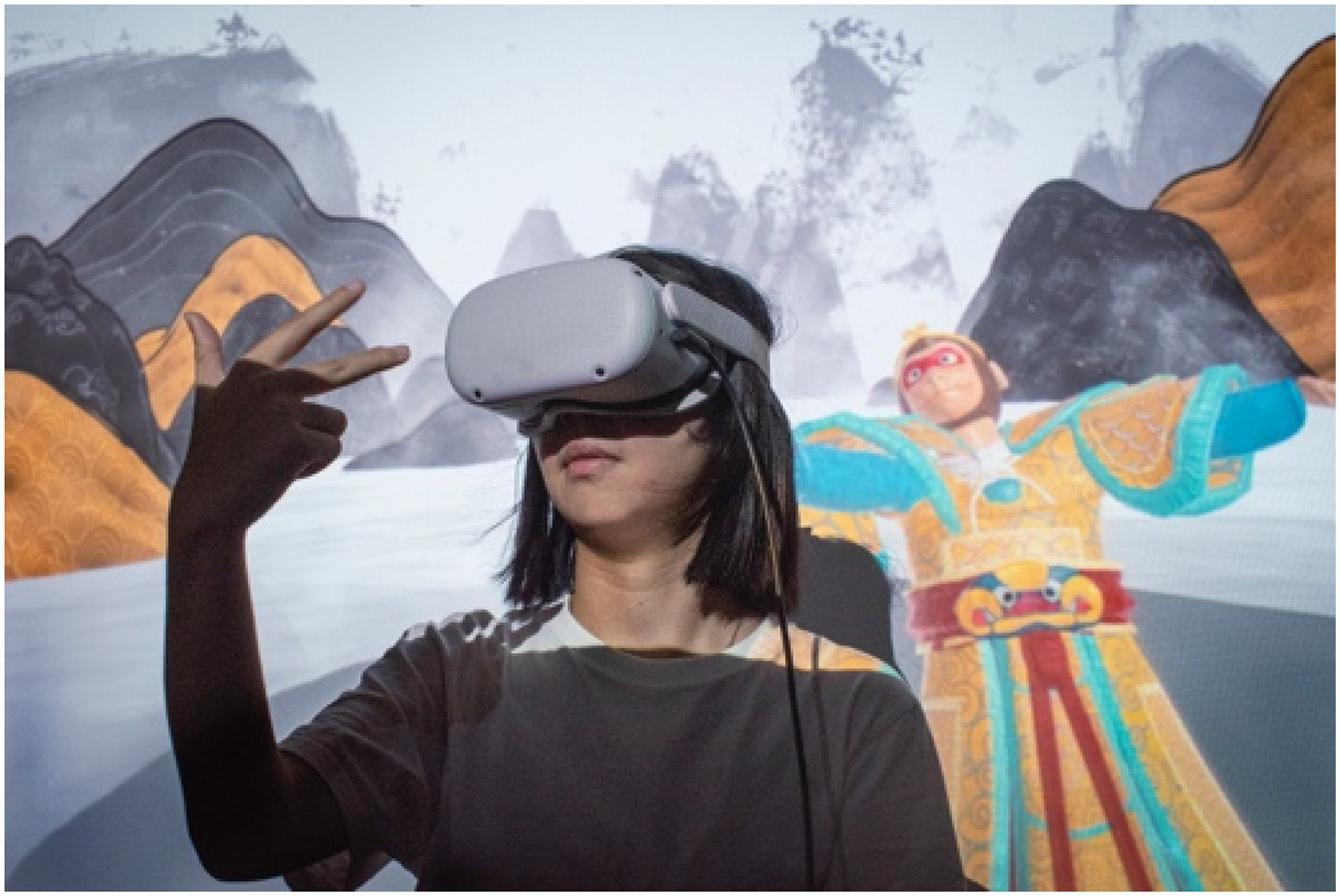
Virtual reality (VR)-based glove puppetry interaction. Source: Hsu et al. (2025)
Robotic-arm glove puppetry
Robotic-arm puppetry employs smart gloves embedded with IMU sensors as the technological intermediary. Puppeteers’ hand gestures are captured as joint-coordinate data and transmitted via Wi-Fi to the AvatarTalk platform server. Through inverse kinematics algorithms, human hand dynamics are translated into robotic joint commands that rigorously adhere to the physical constraints of traditional glove puppets (Lin et al., 2021). After calibration, these commands drive a robotic exoskeleton to accurately reproduce the classic movements of glove puppetry, enabling puppeteers to control physical puppets indirectly via smart gloves (Figure 2).
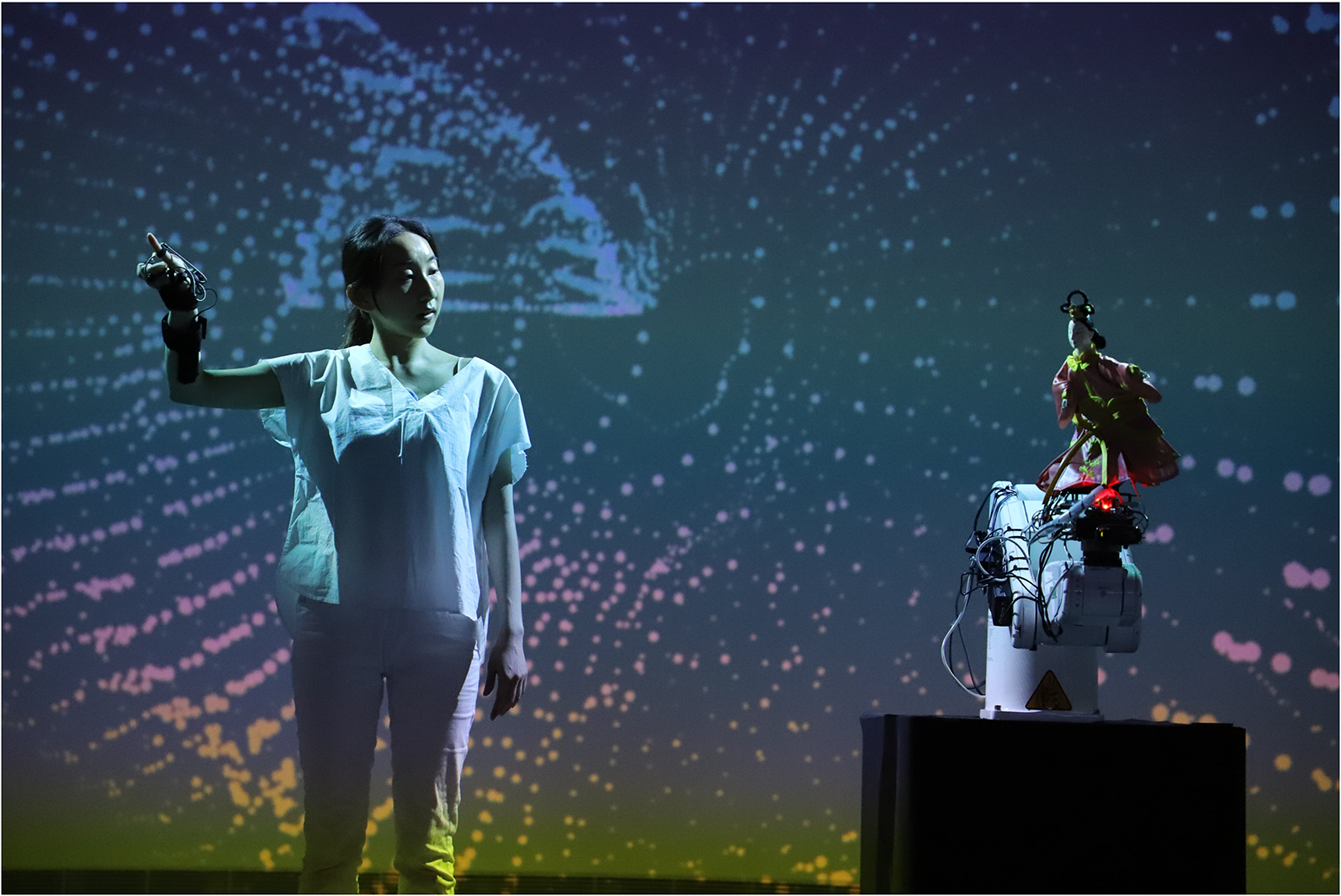
Robotic-arm puppetry control system. Source: Lee et al. (2025)
Holographic projection glove puppetry
This mode leverages the Xsens motion-capture system to record the full-body motion data of puppeteers, which are then processed using a custom skeletal-conversion algorithm. The algorithm's core function is to transform natural human body movements into actions constrained by the “hand-based skeletal structure” characteristic of glove puppetry. The converted data are transmitted in real time via a 5G network to the Unity engine, which drives the projection of virtual puppets onto a stage-mounted holographic screen (Lee et al., 2025). Within this process, motion-capture data, skeletal-conversion algorithms, and real-time rendering engines collectively constitute the digital mediation layer, enabling puppeteers to control virtual puppets suspended in midair through embodied motion (Figure 3).
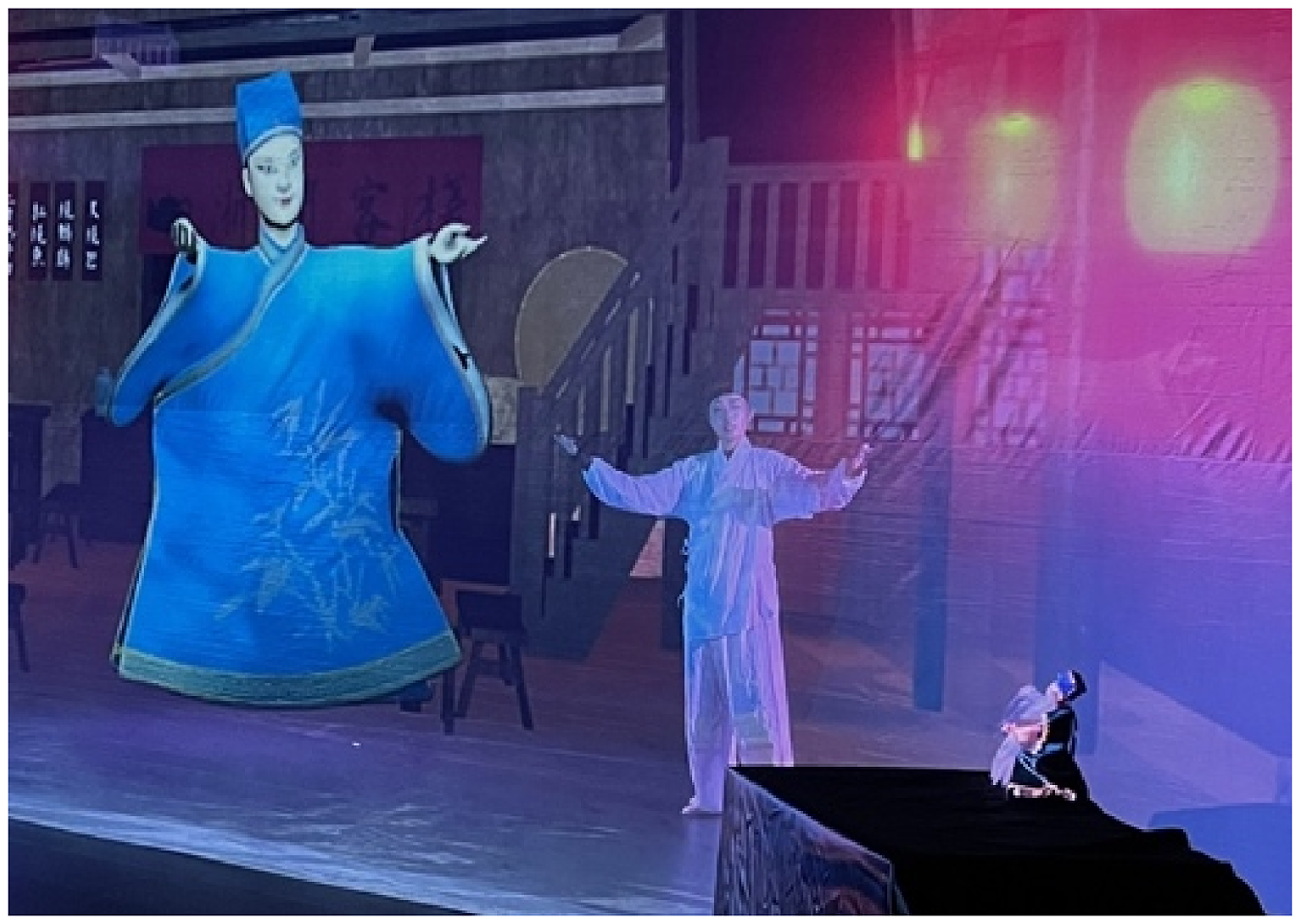
Holographic projection puppetry system. Source: Shen et al. (2025).
Motion-sensing interactive glove puppetry
This prototype utilizes the Kinect v2 depth-sensing device to capture participants’ full-body skeletal motion data, which are subsequently processed through a motion-mapping algorithm. The algorithm translates human biomechanical movements into mechanical actions aligned with puppet structural constraints (Shen et al., 2025). The processed data are then fed into the Unity engine in real time, driving the skeletal animation of virtual puppets displayed on screen. This configuration forms a control chain linking human motion, algorithmic translation, and puppet response, allowing participants to indirectly manipulate virtual characters through natural bodily movements (Figure 4).
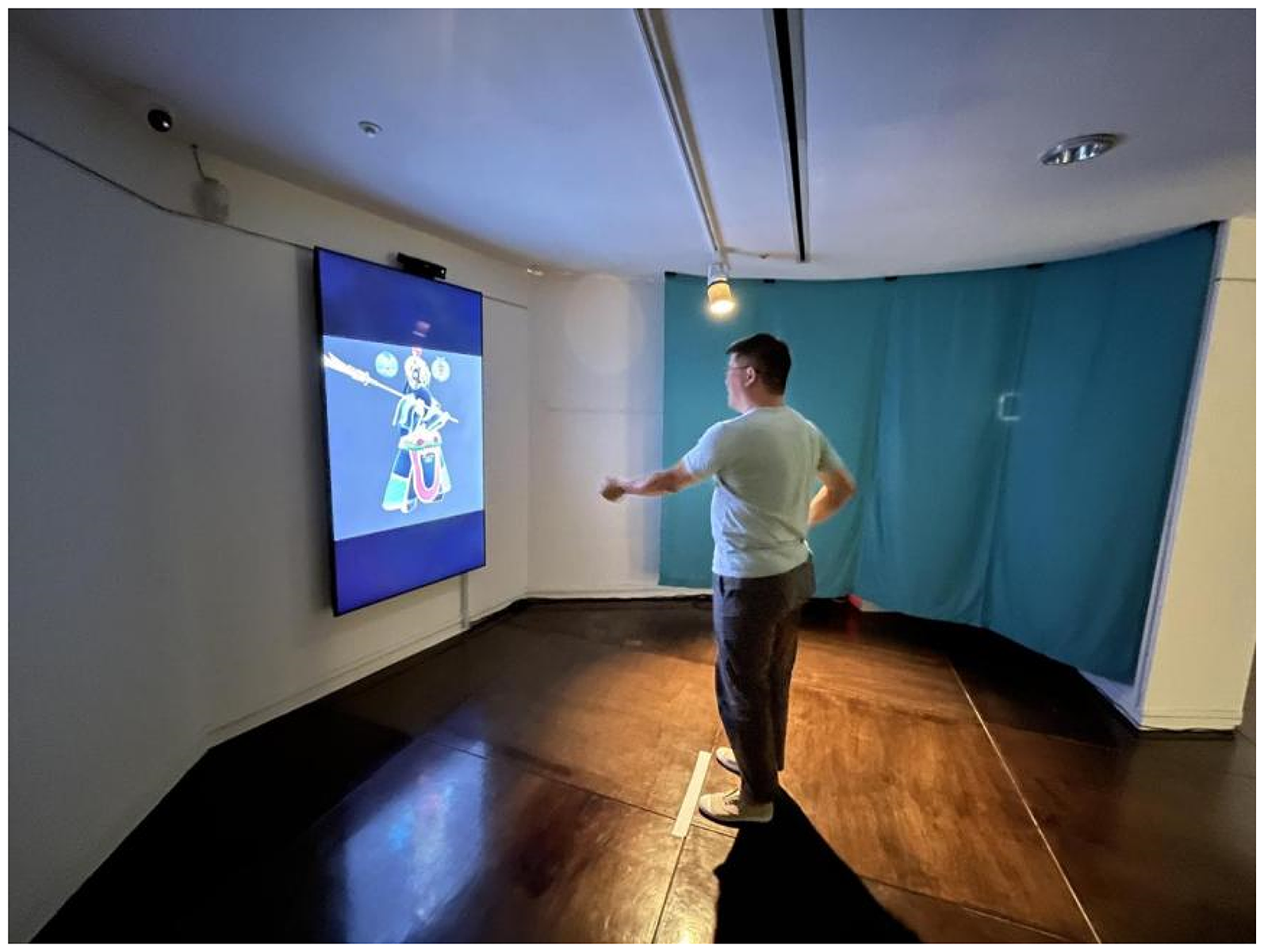
Motion-sensing interactive puppetry experience.
Eye-tracking glove puppetry
The eye-tracking prototype employs the Tobii Eye Tracker 5 to record participants’ gaze trajectories, implementing a triple-layered mediation process. First, an infrared camera captures real-time heatmaps of gaze concentration, accurately identifying areas of high visual attention. Next, the Unity engine maps gaze coordinates to predefined interactive nodes. When a participant fixates on a node for 2s, the system activates a dynamic response mechanism, magnifying specific puppet details (Hsieh et al., 2023). Furthermore, shifting the gaze can switch between main puppet characters and trigger corresponding performance actions, thereby enabling the manipulation of virtual puppets through ocular engagement (Figure 5).
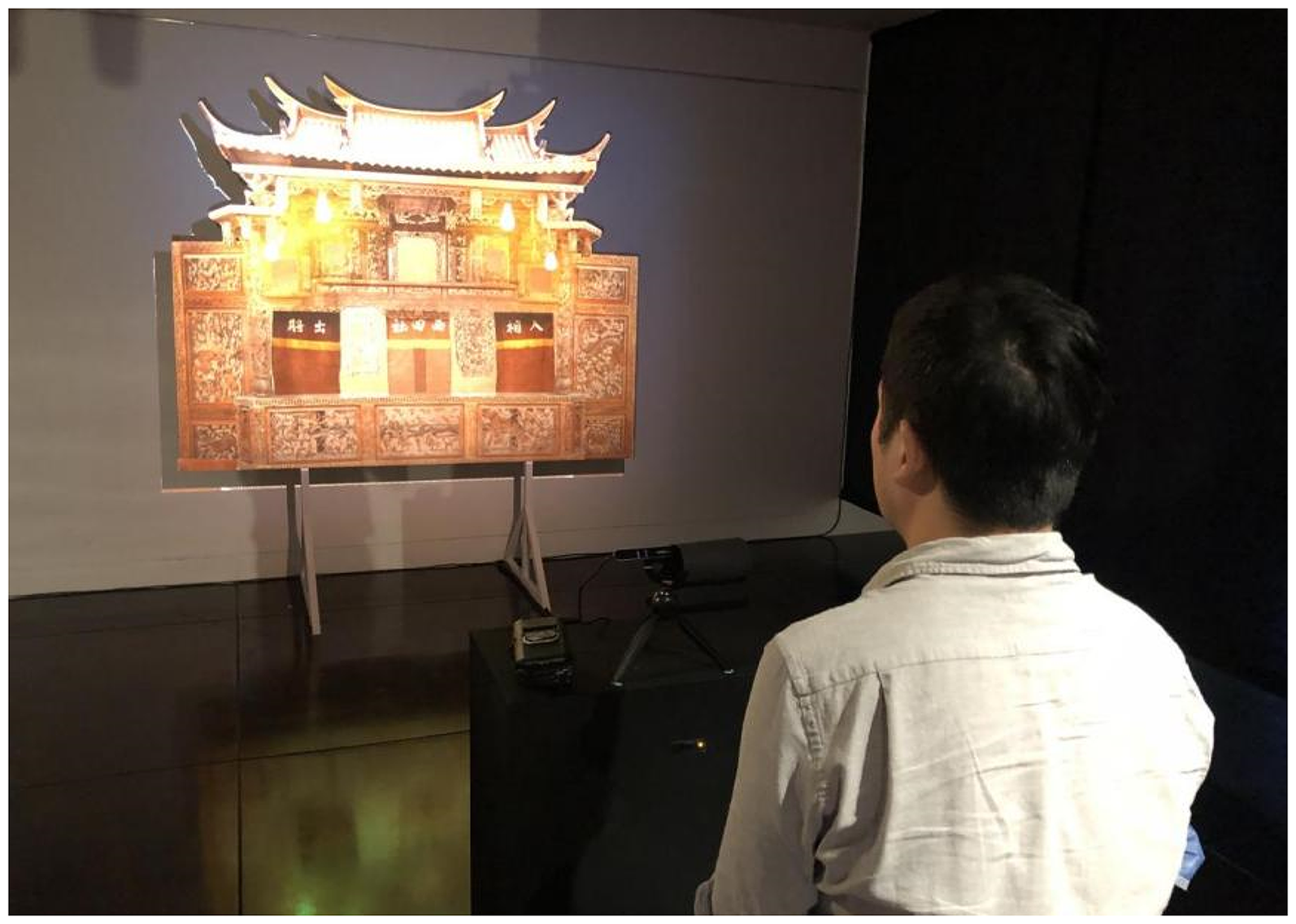
Eye-tracking-based puppetry interaction.
Across these five digital mediation modes, VR-based puppetry enables direct gesture-based control, while robotic-arm puppetry employs smart gloves to manipulate physical puppets indirectly. Both holographic projection and motion-sensing systems rely on full-body movement as the primary control logic, whereas the eye-tracking approach employs gaze as a trigger for nuanced puppet actions. Collectively, these modalities illustrate the progressive diversification of puppetry control systems—from hand-centric craftsmanship to a complex ecology of multimodal, technology-mediated interaction.
Comparative analysis of the five interaction modes
Across the five prototypes of digitally mediated glove puppetry, character design was deliberately standardized to ensure visual continuity. The VR-based system incorporates the complete set of archetypal roles—sheng (male), dan (female), jing (painted-face), chou (clown), and za (miscellaneous)—while the other modes selectively employ one to four of these roles. This design choice secures a coherent visual subject across modalities, thereby allowing participants to concentrate on the experiential distinctions introduced by different forms of technological mediation, especially the differences in bodily control and feedback forms (see Table 1).
Comparative Overview of the Five Interaction Modes.
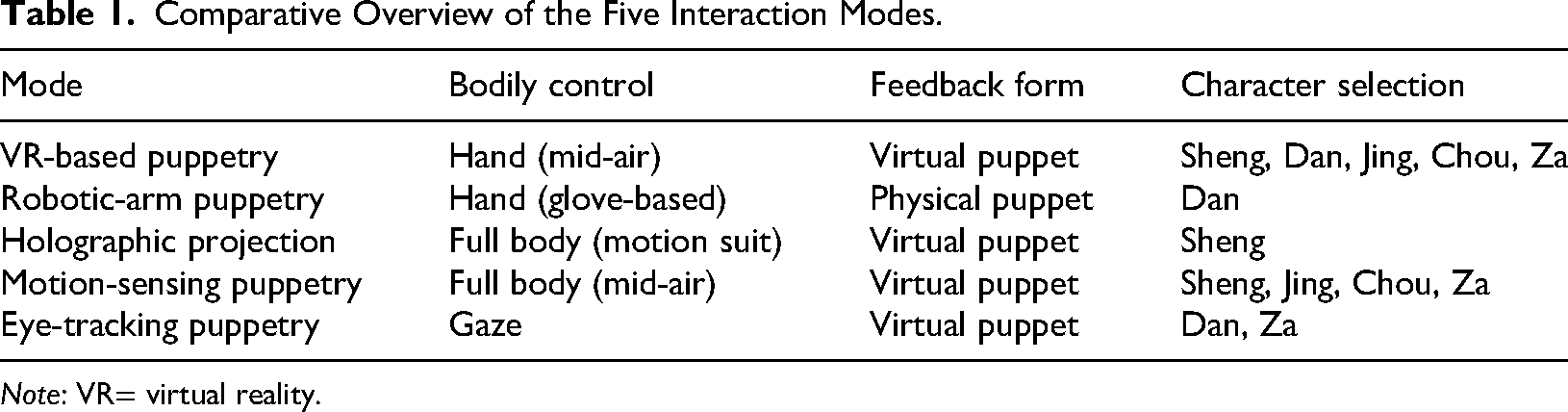
Note: VR= virtual reality.
The comparative analysis reveals three primary distinctions. First, both VR-based and robotic-arm puppetry emphasize hand movement as the central mode of control, though the former operates through mid-air gesture recognition mapped onto virtual avatars, whereas the latter relies on glove-based input to manipulate physical puppets. Second, holographic projection and motion-sensing systems extend manipulation to full-body engagement, translating embodied movements into digital puppet responses. Third, eye-tracking puppetry introduces gaze as the primary control logic, establishing an alternative paradigm of ocular interaction. Together, these prototypes illustrate the diversification of corporeal engagement and feedback forms, charting a progression from hand-centered craftsmanship to a multimodal ecology of digitally mediated performance.
Research method: Cross-group interviews
This study employs a qualitative research design, utilizing cross-group semistructured interviews to investigate stakeholders’ perceptions and evaluations of digitally mediated glove puppetry. The analysis is informed by theoretical frameworks, aiming to reveal the potential impacts and cultural implications of technological interventions on this traditional art form.
Participants
A purposive sampling strategy was adopted to recruit participants from four stakeholder groups: traditional puppeteers, digital designers, academic experts, and general audiences. To ensure both representativeness and relevance, participants were selected as core actors directly involved in, or closely connected to, the digital transformation of glove puppetry. For example, the traditional puppeteers interviewed in this study were senior masters with more than 20 years of professional performance experience. The participating digital designers had taken part in projects applying digital technologies to glove puppetry performance. The academic experts had long-standing research backgrounds in traditional culture or technology-related fields, while the general audiences were selected to reflect diversity in disciplinary background, viewing experience, interests, and age.
Three participants were recruited from each group, resulting in 12 interviewees in total. While the sample size is modest, each participant was deliberately chosen for their expertise and close relevance, ensuring that the study captured critical perspectives and in-depth insights into the ongoing digital transformation of glove puppetry. All participants provided written informed consent prior to data collection. The study was also reviewed and approved by the Institutional Review Board (IRB) of the authors’ affiliated institution, and pseudonyms were used to protect participants’ privacy.
Research setting
All interviews were conducted on-site at the “Future Glove Puppetry” exhibition, which served as the primary research context. The exhibition incorporated multiple advanced technologies—including VR, robotic arms, holographic projection, motion-sensing interaction, and eye-tracking—creating a multimodal environment for performance and interaction. This setting provided participants with an authentic experiential basis to evaluate and reflect on technology-mediated puppetry.
Research procedure
All 12 participants were invited to experience the “Future Glove Puppetry” exhibition. Each participant interacted with five forms of technology-mediated puppetry: VR-based puppetry, robotic-arm puppetry, holographic projection puppetry, motion-sensing puppetry, and eye-tracking puppetry. A guided orientation and technical briefing were provided prior to the experience. Each experiential session lasted approximately 30 min.
Following the experiential phase, in-depth semistructured interviews were conducted, each lasting between 45 and 90 min. The interview protocol covered topics including comparative experiences of physical versus digital puppetry, subjective impressions and cognitive evaluations of technology-mediated puppetry, recommendations for improvement, and prospects for future application and development. With participant consent, all interviews were audio-recorded and transcribed verbatim, yielding 12 transcripts totaling approximately 190,000 words.
Data analysis
Data analysis employed a hybrid approach, integrating Thematic Analysis and Framework Analysis to combine inductive, bottom-up coding with deductive, theory-driven interpretation. This approach facilitated the identification of emergent patterns alongside theory-informed structures, revealing cross-group similarities and differences while examining the broader implications of digital mediation for the development and sustainability of glove puppetry.
The analysis unfolded in several stages. First, two researchers repeatedly reviewed the twelve transcripts and conducted open coding to extract key concepts from the raw data. This was followed by axial coding, employing constant comparison to consolidate related codes and establish relationships, ultimately clustering them into preliminary thematic categories. A third researcher subsequently reviewed these categories in collaboration with the lead researcher to ensure reliability and integrate theoretical perspectives.
Based on this review, a dual-dimensional analytical matrix was constructed: (1) the Media Dimension, encompassing aspects such as form/content, sensory extension, and hot/cool media and (2) the Actor-Network Dimension, addressing processes of translation, power relations, and network construction.
Initial themes were systematically mapped onto this theoretical matrix, generating a theory-informed interpretation of the findings. Subsequently, a cross-group comparative analysis was performed to trace theme frequency and salience across participant groups. This process produced a “Four Groups × Nine High-Frequency Themes” matrix, illuminating shared concerns, points of divergence, and the underlying cultural implications of digitally mediated glove puppetry from multiple perspectives.
Research findings
Cognitive negotiation within the actor-network: divergent and convergent perceptions of digitally mediated glove puppetry
To address the first core research question—“As agential nonhuman actors, how are digital technologies differentially perceived, translated, and negotiated by various groups in the context of glove puppetry?”—this section, drawing on ANT, analyzes how digital technologies as nonhuman actants trigger multiple layers of cognitive and practical translation within the field of glove puppetry. The findings reveal that different stakeholder groups exhibit markedly divergent perceptions and responses to technological intervention, reflecting the complex dynamics of negotiation between technology and cultural tradition in contemporary contexts.
Specifically, traditional puppeteers expressed dual concerns regarding the continuity of craftsmanship and the pressures of market survival. On one hand, they voiced apprehension that digital mediation could result in “de-embodiment,” eroding the cultural essence of the craft: “Eventually machines might replace the hand, and that real feeling will disappear” (A1) and “VR puppetry lacks precision” (A1). On the other hand, they acknowledged technology's potential for long-term archival and knowledge transmission: “If there is a dataset, decades later when someone wants to revive this tradition, a complete reference will allow them to know how to move, how to simulate, how to learn” (A1). Puppeteers primarily positioned technology as an auxiliary tool for supporting future learning: “The virtual system is like a mentor” (A1) and “First attract children's interest, then teach physical skills” (A2). They also recognized the economic revitalization potential of digital mediation: “The older generation doesn’t realize this is a market” (A3) and “This is a way to make money” (A3).
Digital designers exhibited a disruptive innovation mindset, emphasizing the transformative experiences enabled by digital media and its potential for broad dissemination. They highlighted the value of reinterpreting traditional elements within contemporary contexts: “New media engagement aligns with current user demands” (B3) and “It can make young people interested in glove puppetry” (B1). Designers collectively acknowledged the “many possibilities” (B3 and B2) of digital mediation and advocated breaking traditional constraints, with one even proposing the development of “VR gesture lineages” (B1) for glove puppetry. They underscored the role of multisensory interaction in deepening cultural understanding: “Experiencing culture through the whole body” (B3); “Beyond the classic element of the hand, other components can be expanded” (B1). By leveraging technology to “visualize cultural imagery” (B3), designers sought to achieve both experiential innovation and culturally “boundary-breaking” communication: “We see possible new pathways for glove puppetry” (B1).
Academic experts focused on the dialectical tension between cultural continuity and esthetic innovation. They asserted that “Glove puppetry must discover new forms of expression through contemporary media” (C3) and that “By leveraging these digital possibilities—different roles, approaches, technologies—puppetry can be sustained” (C3). However, they cautioned that operational simplification might risk cultural dilution: “Cultural experience is great, but cultural preservation is more questionable” (C3). Experts highlighted the unique affordances of digital media, such as transforming the traditional palm-wind gesture into a controllable particle effect: “Only achievable in VR” (C3). They advocated prioritizing originality over mere replication: “Innovation is more meaningful than imitation” (C1 and C2). Experts noted that new technological forms are shaping emerging modalities of cultural access and perception, for example, by enhancing “visual depth in viewing” (C3) and transforming the “expressive abstraction of traditional puppetry into a digital visual language that becomes esthetically appealing” (C1). Some raised critical questions regarding the ethical and epistemological implications of technological intervention, such as: “Is it beneficial or detrimental to preserve a master's movements entirely through AI?” (C3) and “Does technology merely simplify manipulation, or does it enrich audience experience?” (C3).
General audiences tended to prioritize interactivity and cultural-entertainment value. For instance, one participant noted: “Next time I see puppets on an old street, I’ll want to try” (D2). Audiences strongly appreciated the novelty and playfulness afforded by technology: “I really liked that visual; I just wanted to play” (D1) and “Adding a scoring mechanism would make it even more fun” (D2). They also clearly distinguished between promotional and preservation goals: “Interaction needs to be simpler” (D1); “Just for fun” (D1); “I don’t intend to become a puppeteer” (D2); and “For long-term skill preservation, you can’t remain at the level of simplification” (D3).
Despite these divergences, several commonalities emerged. All groups acknowledged the historical fluidity of glove puppetry and its adaptive trajectory, affirming the inevitability of technological intervention. Rather than viewing technology as a substitute for traditional craft, participants framed its value in terms of extending cultural vitality: “Glove puppetry never stayed still; it has always absorbed new things” (A1); “It evolves with the times” (B3); “All art forms are the latest experiments of their time” (C3); and “Tradition itself was once innovation” (C3).
Figure 6 presents a heatmap summarizing the intensity of concerns raised by different stakeholder groups. The scoring reflects the frequency and salience of themes identified during interviews, rather than numerical ratings of prototypes. Darker areas indicate stronger emphasis or repeated concerns expressed by participants, highlighting the issues most central to each group.
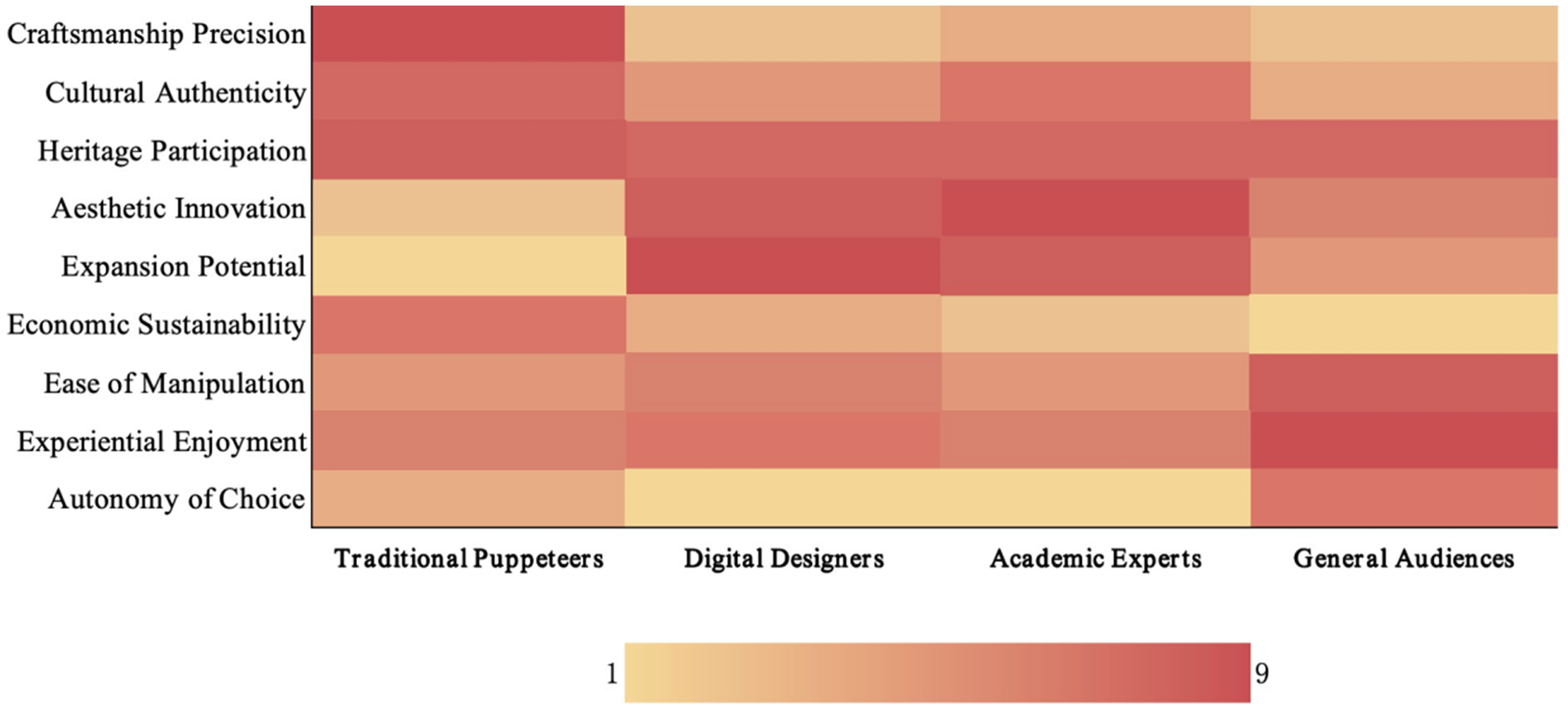
Heatmap of four stakeholder groups’ concerns about digitally mediated glove puppetry (scores based on frequency and salience of interview themes).
Media as extension: Deconstructing the “hand–puppet” relationship and reconstructing the digital body
This section draws on McLuhan's proposition that “the medium is an extension of man” to examine how digital technologies extend the traditional “hand–puppet” relationship into a composite human–machine–puppet system characterized by a new form of digital corporeality. Digital mediation not only dismantles the embodied control once rooted in manual dexterity but also reconstructs performance through multimodal interactions involving full-body movement, eye tracking, and externalized interfaces. In doing so, it addresses the study's central concerns about sustaining craftsmanship and reconfiguring cultural experience.
Interview data reveal that digitally mediated glove puppetry involves a multilayered process of deconstruction and reconstruction.
First, digital mediation disrupts the precise correspondence between hand and puppet while transforming the modalities through which bodily knowledge is acquired. Traditional manipulation relies on specialized physical training and fine motor control, as illustrated by comments such as: “You have to hold your hand up for a long time; it can’t get tired” (C3) and “When you position your index finger like this, the head becomes upright instead of tilting” (A1). By contrast, digital operation substantially simplifies or modifies these bodily requirements, enabling participants to “realize they could interact with a puppet in such a simple way” (C3).
Second, digital technology dislocates the cultural situatedness of performance, detaching manipulation from its original ritual and communal contexts: “My impression is always in front of the temple, on the stage, or occasionally on the old street” (D2) and “In the future, you can just play at home” (D2). This displacement risks eroding the improvisational dynamics integral to traditional performance: “Traditional glove puppetry includes elements of improvisation” (D1) and “The puppeteer must know how to respond on the spot” (A1). By contrast, digital environments tend to be preprogrammed and highly scripted, constraining such responsive creativity.
Third, this deconstruction extends into the economic domain, potentially disrupting the traditional value chain: “The materials themselves involve significant commerce; new technological media cannot truly address this economic dimension and may even stifle the traditional economy surrounding it” (C3).
Yet while dismantling established structures, digital mediation simultaneously reconstructs glove puppetry in innovative forms. The most immediate reconstruction lies in the creation of new corporealities and modes of embodied cognition. Participants observed: “Glove puppetry has expanded from the palm to the whole body—I feel a stronger sense of embodiment; I begin to understand this culture through my entire body” (B3) and “Manipulating the puppet with the whole body feels most intuitive” (D1). Digital technology thus fosters a multisensory, hybrid human–machine body that serves as a new vehicle for intangible cultural heritage.
Reconstruction also entails translating cultural “genes.” The symbolic esthetics of glove puppetry—such as color metaphors and archetypal character traits—are rearticulated as digital effects and concrete animations, making implicit cultural imagery both perceptible and experiential. For instance: “‘Step by step blooming flowers’ gives the female role greater femininity” (B3) and “Certain cultural elements of glove puppetry are expressed through digital technology—red for fire, others for wind—highly abstract and suggestive. Translating these abstract elements into digital visual language, such as particle effects, significantly enhances the esthetic dimension of glove puppetry” (C1).
Furthermore, digitally mediated puppetry introduces new esthetic values and opportunities for development. Digitalization rekindles emotional connections to glove puppetry: “It allows me to get very close so conveniently; it seems to awaken my old passion for glove puppetry” (C2). Digital technologies also offer experiences unattainable in traditional settings: “That sense of surprise—sudden visual effects—only possible in VR” (B2). At the same time, they signal future trajectories for heritage innovation: “Digital enhancement of the physical” (C1); “Technological intervention opens possibilities for glove puppetry to emerge in new media spaces and materialities” (C3); and “Culture finds a new path for continuity” (C3).
In sum, digital technology does not deconstruct the cultural core but rather its material substrate, while its reconstruction extends beyond performative form to encompass ecological pathways for sustaining intangible cultural heritage. By extending operational modalities, translating cultural codes, and innovating esthetic values, digital mediation opens an indispensable pathway for the survival of glove puppetry in the digital age.
From the perspective of theoretical dialogue, this process of deconstruction and reconstruction vividly demonstrates the complementarity of McLuhan and ANT. As a media form (McLuhan), digital technology, with its inherent logic of “disembodiment” and “re-mediation,” predetermines a structural challenge (deconstruction) to the traditional “hand-puppet” symbiosis and opens possibilities for new sensory extensions (reconstruction). However, the specific pathways through which this formal logic is realized—for instance, whether it leads to immersive full-body control or concentrated gaze-based interaction—are determined by the translations and negotiations within the actor-network described by ANT. Digital technologies, as actants, carrying their specific materiality and scripts, interact with human actors (artists, designers, and audiences) possessing different skills, interests, and cultural beliefs, ultimately co-constructing multiple, often tense, paradigms of the digital body. The combination of the two theories allows us to see that the transformation is neither unilaterally determined by technological form nor purely socially constructed, but rather the result of the interplay between the structural power of form and the practical negotiations within the network.
Beyond the hot–cool binary: Dual imperatives of cultural transmission and mass dissemination
This study reveals that the contemporary sustainability of glove puppetry hinges on a dual mandate: the deep transmission of cultural heritage and its broad dissemination to mass audiences. While McLuhan's theory of hot and cool media provides an insightful lens for understanding media characteristics, its binary classification—based on an inverse relationship between informational clarity and audience participation—proves inadequate for explaining contemporary digital media such as VR and motion-based interaction. These technologies often exhibit a hybrid configuration of high-definition sensory rendering and strong interactivity, thereby challenging the assumptions underpinning McLuhan's framework.
Interview data indicate that participants view distinct media forms—ranging from physical puppetry, which relies on informational gaps and imaginative engagement, to digital puppetry, which affords immersive and interactive experiences—as complementary strategies for meeting the dual imperatives of heritage transmission and popularization.
From the perspective of deep cultural transmission, the interviews highlight a pressing need for media configurations that maximize participation and contextual immersion. Such configurations require learners’ full bodily engagement, nuanced sensory perception, and embodied interaction within socially embedded contexts. This mode approximates the attributes of McLuhan's “cool media,” yet participants stress that what they seek is not mere informational completion but an embodied, situated mode of cultural learning. Respondents assert that transmission-oriented education cannot forgo hands-on practice with physical puppets: “For further learning, I would prefer working with real puppets” (D1) and “Professionalism and person-to-person interaction clarify teaching” (D2). The tactile sensitivity, interpersonal exchange, and bodily memory embedded in physical manipulation remain challenging to replicate digitally. However, this mode of transmission, which prioritizes authenticity and depth, appears less compelling for audiences lacking prior cultural knowledge: “The traditional puppets aren’t attractive” (D1) and “Few young people are interested in traditional glove puppetry” (D3). This illustrates the constraints of traditional forms in terms of dissemination effectiveness.
Conversely, at the level of mass communication and audience engagement, interviews reveal a strong preference for media configurations that offer high immersion, low entry barriers, and heightened sensory stimulation. These modes aim to capture attention quickly, spark interest, and deliver immediate cultural enjoyment through simplified interaction. As participants remarked: “The visual effects are the most engaging” (C3); “Exciting” (B2); and “It easily attracts children” (A1). Accordingly, “The traditional path is declining… new technological puppetry is thriving” (C1). Digital technologies fuse the high-definition quality of “hot media” with the interactivity of “cool media,” positioning them as gateways to cultural heritage. Several participants noted: “I was initially interested in the digital technology, then became curious about glove puppetry” (C2). Such initial encounters often serve as a prelude to deeper engagement with the cultural core, even for international audiences: “European and American audiences feel it's a completely different world… the visuals are striking” (B3). Some users expressed a willingness to transition toward heritage learning: “Experiencing virtual puppetry motivates me to learn the real craft” (D2).
Building on these findings, a design-oriented perspective highlights the necessity of consciously constructing a cross-media experiential ecology for the contemporary communication of glove puppetry. This involves not only the technical integration of diverse media but, more critically, the embedding of mechanisms for cultural translation and cognitive scaffolding within the experience design process. Designers should preserve the core vocabulary and esthetic qualities of traditional craftsmanship within digital interfaces—for instance, by incorporating parameterized models of conventional puppetry movements into virtual manipulation systems, or by embedding triggers in interactive games that stimulate deeper cultural exploration. Such strategies allow participants to transition naturally from sensory stimulation to cultural understanding. At the same time, the design of physical teaching environments and instructional tools should be optimized to connect with the interest sparked by digital media, thereby establishing an integrated experiential loop that bridges the virtual and the physical. In this way, design serves as the operational bridge that links broad dissemination with pathways for deep engagement.
These findings suggest that the contemporary evolution of glove puppetry cannot rely on a single media paradigm but instead requires a dual-track, systemic strategy: leveraging digital media for broad outreach while utilizing physical media for deep engagement. These two trajectories are not mutually exclusive; rather, they function as complementary and mutually reinforcing pathways. The critical linkage lies in ensuring that broad outreach preserves the integrity of core cultural values—“Don’t oversimplify the meaningful parts” (D3) and “Digital technology should not overshadow the essence” (B1)—in order to prevent misconceptions regarding the craft's depth, such as “Future generations might think glove puppetry is only at this level” (A1). Furthermore, the transition from outreach to deep engagement must remain viable and clearly articulated.
In sum, the sustainability of glove puppetry depends on constructing a dynamic ecosystem in which digitally mediated forms ensure broad accessibility, while traditional embodied practices safeguard deep cultural participation. Through their interplay, these complementary modalities can create a continuum from widespread attraction to profound cultural learning, thereby securing the vitality of this heritage in the digital era.
Translating and fluidifying spectator–performer identities: The participatory experience of digitally mediated glove puppetry
The incorporation of digital technologies has introduced a new paradigm in which puppeteer and spectator identities become fluid, shifting the core of the glove puppetry experience from a public-facing performance for others to an inward-focused, immersive mode of performance for oneself. This role translation not only underscores the agency of digital technology as a nonhuman actor but also reconfigures power dynamics within the performative network, directly addressing the study's central inquiry: how technologies co-construct cultural experience alongside human agents.
Interview data reveal the defining characteristics, driving forces, and cultural implications of this identity transformation.
First, digitally mediated glove puppetry enables participants to move from watching others perform to embodying the performing subject. In traditional glove puppetry, audiences adopted a passive, third-person perspective: “In the past, traditional theatre was always viewed in third person” (C1). By contrast, digital technologies grant users the ability to manipulate puppets directly—or even become the puppet itself: “Through VR, I can see from a first-person perspective and join the performance” (C1); “I became the character” (C2); and “I used to watch the master perform, but now I’m the one controlling the puppet” (B3). This immersive embodiment forms the foundation of an inward-oriented performative mode.
A key driver of this transformation lies in digital technology's ability to turn previously scarce opportunities for hands-on manipulation into readily accessible, on-demand experiences. Traditionally, close engagement with precious puppets depended on rare opportunities—“a matter of luck and timing” (C2). By contrast, digital environments provide unrestricted interaction with favored characters: “I can control the character I like and interact closely” (C2) and “I usually just watch, but VR let me experience it firsthand” (D3). This accessibility greatly amplifies the desire for participation.
Under digital mediation, the performative orientation of glove puppetry has also shifted—from pleasing the audience toward pleasing oneself. Historically, glove puppetry was audience-centered, its mirror symbolizing the spectator's gaze (A1). Traditional performers relied heavily on real-time audience feedback: “Traditional glove puppetry depends a lot on audience responses” (B2). Conversely, digitally mediated puppetry privileges a self-referential logic, driven by personal enjoyment and exploratory impulses: “I was mostly just playing for fun” (B1); “Whether others are watching doesn’t matter much” (D3); “In VR, I feel like it's my exclusive space” (C1); and “Inside VR, I have no sense of the outside world” (C3).
Furthermore, performance structures increasingly migrate from rigid codification toward gamification. Digital technologies eliminate constraints associated with the puppet's physical weight, stage boundaries, and operational conventions, granting users freedom to explore nontraditional movements and spectacular visual effects: “Playing in different ways” (B3); “Interacting with background effects” (C1); and “What is impossible in reality becomes possible in VR” (B2).
This paradigm shift is reinforced by the spatial transition from public, communal settings such as temple courtyards to highly individualized environments mediated by VR headsets or interactive screens: “It feels like entering another world, separated from reality, and that's interesting” (D3). The resulting sense of isolation intensifies the privacy and focus of self-entertainment.
Simultaneously, digital puppetry accentuates the entertainment dimension of glove puppetry. Participants frequently noted: “The gaming element adds fun” (D2). Performance rules shift from standardized heritage practice toward user-defined, goal-oriented interaction: “There's no single right answer” (B3) and “Everyone can use their imagination to achieve their desired effects” (B3).
Taken together, this identity revolution—enabled by digital mediation—marks a historic shift from a craft-centered paradigm to a participatory culture model. Spectators evolve from passive receivers to active manipulators, performers, and even embodied avatars. Motivations for performance similarly shift from audience gratification toward self-enjoyment and exploratory immersion. This inward-facing mode is characterized by first-person perspective, self-centricity, gamified interactivity, and spatial intimacy, unleashing unprecedented enthusiasm for participation and creative potential. Serving as a critical bridge between traditional art and contemporary audiences, it simultaneously accentuates and extends the entertainment essence of glove puppetry while reshaping its performative logic, spatiality, and modes of cultural engagement. By encapsulating the core of glove puppetry—its characters, narrative, and gestural esthetics—within immersive technology, game logic, and personal agency, digital puppetry enables a transformative experiential leap: from watching the stage from afar to inhabiting the world within the palm.
Discussion
The paradox of transmission and innovation: The cultural dialectics of digital translation
A comprehensive review of the preceding analysis reveals a profound cultural paradox arising from the intervention of digital technologies in glove puppetry's manipulation techniques: they operate simultaneously as forces of deconstruction and as catalysts for reconstruction. This paradox underscores the dilemmas and complexities that intangible cultural heritage faces in sustaining and transforming itself within the digital age.
On the deconstructive side, digital translation inevitably produces structural deficiencies in the transmission of “palm-based craftsmanship.” This study confirms that essential embodied knowledge in traditional manipulation—tacit, experiential, and resistant to verbalization—such as the sense of a puppet's weight or the subtle exertion of force required to shift its center of gravity, is highly susceptible to loss when translated into data and algorithms. Veteran puppeteers’ concerns about diminished precision point directly to the limitations of rendering embodied skills in digital form. Furthermore, the ritual atmosphere of temple courtyard stages and the improvized social interactions between puppeteer and audience are difficult to reproduce within the preprogrammed and individualized environment of digital interfaces. These omissions suggest that while digitalization advances innovative design and broad dissemination, it simultaneously risks attenuating the authenticity, corporeality, and social embeddedness that constitute the core dimensions of cultural practice.
Conversely, on the reconstructive side, these very omissions open up unexpected opportunities for development. Freed from the constraints of physical puppets and conventional performance settings, digital technologies generate performative vocabularies and experiential modes unattainable through traditional means. Hyperrealistic actions—such as instantaneous transformations, floral trajectories, and interactive engagement with virtual environments—expand the narrative repertoire distinctive to digitally mediated glove puppetry. The incorporation of gamification further enhances participatory motivation, acting as a catalytic mechanism for attracting younger generations. Moreover, the affordances of cloud-based platforms for cross-regional co-performance are redefining the parameters of the “performative network.” These innovations do not seek to supplant tradition but rather to establish a parallel trajectory of development. In doing so, they enable glove puppetry to function as a living cultural gene—mutating, evolving, and seeking new modes of existence within the technological milieu of the present.
Accordingly, digital technologies should be understood not merely as instruments but as mediators that catalyze dialectical cultural processes. By dismantling certain traditional forms, they expose vulnerabilities in heritage transmission, compelling critical reflection on and redefinition of cultural values at their core. Simultaneously, through reconstructing novel forms, they offer creative responses to the very crises they precipitate. Ultimately, the future of glove puppetry lies not in a binary opposition between tradition and technology but in the capacity to recognize and navigate this paradox—constructing an ecosystem where hot and cool media coexist and where deep transmission and mass dissemination evolve along dual, mutually reinforcing trajectories. Within this dynamic tension, seemingly antagonistic poles can jointly propel the cultural evolution of the form.
Media dimensions: Formal reshaping of cognition and the contemporary transformations of hot and cool media
McLuhan's insight that “the medium is the message” receives renewed validation in this study. The extension of glove puppetry through digital technologies is not merely an instrumental application but constitutes a cultural shift in cognition driven by the affordances of media forms themselves.
At the level of cognitive breadth, the expansion of media forms surpasses the physical limitations of traditional glove puppetry. Historically, the esthetics of glove puppetry were shaped by the spatial constraints of its small stage. By contrast, digital technologies reconfigure sensory scales and the interplay between virtual and physical space, transforming glove puppetry from a local ritual practice centered on “the craft of the hand” into a performative cultural symbol enacted through the “digital body,” capable of crossing media boundaries and temporal–spatial divides. Such formal reorganization opens new cognitive dimensions within the digital milieu and introduces novel esthetic experiences.
At the level of cognitive depth, media form emerges as a historical determinant of authenticity. From a diachronic perspective, the shaping force of media on cognition has been continuous throughout the media history of glove puppetry: from temple courtyard performances emphasizing embodied ritual; to the televisual era of Pili glove puppetry, where editing techniques and audiovisual effects legitimated large-scale puppet manipulation; to the contemporary application of digital technologies for virtual puppetry, with the prospect of inaugurating “VR gesture lineages” defined by technological compatibility. Each new medium generates a distinctive cognitive configuration of glove puppetry culture specific to its form. Media history thus reveals that the shaping of cognitive depth is both historical and cumulative. Authenticity, therefore, cannot be disentangled from the mediating forms that both participate in and regulate the cultural manifestations of glove puppetry within particular historical contexts.
This trajectory corroborates McLuhan's claim that the evolution of media forms preemptively reshapes cultural cognition. In this sense, “form over content” is not a value judgment but a descriptive recognition of how shifts in mediation reorient the locus of cultural attention. Such shifts reconfigure not only how glove puppetry is understood (from embodied practice to human–machine hybridity), but also its breadth (from local art to global symbol) and its depth (from historical sedimentation to future imaginaries).
However, this study also demonstrates that applying McLuhan's binary framework of hot and cool media directly to contemporary technologies such as VR presents significant limitations. VR simultaneously delivers “high-definition” visual information and “high-participation” interactivity, producing a hybrid model that destabilizes the traditional hot–cool dichotomy. This does not imply the obsolescence of the hot–cool media framework; rather, it underscores the necessity of its reinterpretation in the digital age, whereby digital technologies do not dissolve its theoretical relevance but instead render it more complex and contextually situated. Such dynamics compel a re-examination of the very nature of media temperature and its evolving role in cultural transmission. Accordingly, understanding glove puppetry across VR, motion-sensing, and cloud-based platforms requires moving beyond binary distinctions toward analyzing how media properties circulate, interweave, and are strategically configured within networks of digital technology, culture, and user practice. For glove puppetry, VR and related technologies can simultaneously provide hyperrealistic “hot” representations and, through interactive design, preserve “cool” spaces that invite audiences to fill in meaning. Thus, rather than dichotomous classification, attention should be directed to how these hybrid configurations are tactically mobilized to address the dual imperatives of heritage transmission and mass dissemination.
Finally, the pragmatic limitations of contemporary VR technologies must be acknowledged. The inconvenience and bulkiness of head-mounted devices, risks of motion sickness, high equipment costs, and spatial requirements all constrain its accessibility and sustainability for long-term use. These factors delimit its initial fields of application and target audiences. This study argues that the role of digitally mediated glove puppetry is not to displace seasoned enthusiasts from traditional stages, but to function as an experiential bridge—targeting younger generations, technology-oriented audiences, and cultural learners in museums and educational settings. Its optimal positioning lies in cultural exhibitions, educational outreach programs, and online virtual theaters, where it can lower barriers to engagement and spark curiosity. The ultimate goal, however, remains to guide audiences back toward more embodied and culturally profound experiences of physical puppetry—thus establishing a virtuous cycle in which hot and cool media evolve in parallel, along mutually reinforcing trajectories.
Actor–network dimensions: Translational power and the revolution of performance networks
From the perspective of ANT, the intervention of digital technologies constitutes a revolution of performative networks, centered on the renegotiation and redistribution of translational power. In traditional glove puppetry networks, human actors—particularly puppeteers—functioned as obligatory passage points, exercising authority in translating narrative into the puppet's gestures and movements. Nonhuman actors such as puppets and stages occupied comparatively passive positions within these networks. However, with the entry of new nonhuman actors—VR systems, motion-capture technologies, and algorithms—the structure of the network is fundamentally reconfigured. These entities, operating according to their own technical logics—data precision, computational rules, and visual-effects libraries—acquire agency in the translation process, triggering systemic shifts along three dimensions.
First, expertise and authority are dispersed, and the network of core actors becomes more diverse. The embodied knowledge of puppeteers is partially transferred to programmers, animators, and algorithm designers. The final visual presentation of the puppet is no longer determined solely by puppeteers’ hand movements but is co-shaped by the esthetic decisions of digital designers and by the computational capacities of software and hardware. Programmers, animators, and interaction designers thus emerge as new translators, entering into relations of competition, negotiation, or alliance with puppeteers.
Second, the agency of nonhuman actors is significantly amplified. Technical artifacts cease to function as passive tools and instead assume roles as cultural agents. In the digital environment, traditional puppets are reconstructed as virtual avatars; a single set of motion-capture data can animate multiple stylistically divergent digital characters. Artificial intelligence can even learn from puppeteers’ performance data, generating new motion sequences that blur the boundaries between originality and reproduction, thereby challenging embodied transmission, the uniqueness of craftsmanship, and notions of authorship.
Third, the spatial–temporal structure of performance undergoes thorough reorganization. Motion data can be transmitted across locations, edited asynchronously, and deployed translocally. The physical stage is no longer the sole site of performance; multimodal digital interfaces now operate as expanded stages. Through interactive mechanisms, audiences acquire performative agency, progressively dissolving the boundaries between performer and spectator.
The profound reconfigurations of expertise, agency, and spatiotemporality detailed above compel a theoretical refinement. While McLuhan's axiom “the medium is the message” presciently captures the formative power of digital media as a structural condition, our findings demonstrate that this “message” is not monolithic or predetermined. The ANT lens reveals that the “message”—manifested here as a decentralized, fluid, and collaborative network—is, in fact, co-shaped through myriad microlevel translations. It emerges from the negotiations between the logics of digital forms and the specific cultural actors of glove puppetry, including local traditions, artists’ embodied habits, and audience expectations. Thus, ANT does not refute McLuhan but rather operationalizes his insight, providing the microsociological foundation to understand how the medium's message is adapted and enacted within a particular sociotechnical context.
This understanding of digital mediation as a co-constructive process, in turn, brings to the fore critical ethical considerations that extend beyond the technical and experiential dimensions of the practice itself. Issues of ownership emerge when traditional gestures or performances are captured and stored as datasets—who holds the rights to these digital archives: the puppeteers, the research team, or cultural institutions? Similarly, questions of representation arise when cultural symbols are reinterpreted through digital esthetics, potentially leading to cultural dilution or misrepresentation. Engaging heritage communities in decision-making processes and establishing guidelines for data governance are essential to ensure that digital mediation respects cultural ownership, authenticity, and agency.
Ultimately, a decentralized performance network emerges in which human creativity and nonhuman technological capacities jointly constitute the pathways to the cultural sustainability of glove puppetry in the digital age. This study not only substantiates ANT's claim regarding the agency of nonhuman actors but also reveals, in greater detail, the multifaceted roles played by digital technologies in the transformation of traditional craftsmanship. Digital technologies thus function as active agents of cultural reconfiguration, whose impact extends far beyond technical innovation to touch the very core of how intangible cultural heritage exists, persists, and evolves within contemporary society.
Conclusion
This study, drawing on McLuhan's media theory and Latour's ANT, investigates how digital technologies are driving the transformation of glove puppetry from a hand-based craft into a technologically mediated cultural practice. Through cross-group interviews with traditional puppeteers, digital designers, academic experts, and general audiences, as well as an analysis of five digital mediation models developed in the Future Glove Puppetry project, this research not only illuminates divergent perceptions of technological intervention across stakeholder groups but also reveals how digital technologies—as nonhuman actors endowed with agency—reconfigure puppetry practices, cultural experiences, and performance networks.
At the theoretical level, the study extends the contemporary applicability of McLuhan's media theory, reaffirming the critical relevance of the dictum “the medium is the message” for cultural practices in the digital age. It demonstrates how media forms operate dialectically between heritage transmission and innovation. At the same time, it strengthens ANT's explanatory power in the domain of ICH digitalization, empirically showing how new nonhuman actors generate a performative network revolution that reshapes cultural practice. More significantly, by constructing a sustained dialogue between the macrolevel, form-oriented analysis of McLuhan and the microlevel, network-oriented tracing of ANT, this research offers a novel integrative framework. This framework overcomes the limitations of applying either theory in isolation, capturing simultaneously the structuring power of technological forms and the nuanced agency and negotiations within sociotechnical networks, thereby providing a more robust and holistic tool for understanding cultural transformations in the digital era.
This research also acknowledges several limitations. First, the study's scope is limited to a single cultural context—Taiwanese glove puppetry—and a relatively small sample of 12 participants (three from each stakeholder group). While this focus provides cultural depth, it inevitably constrains the generalizability of the findings. Future research should expand both the sample size and the cultural scope, conducting comparative studies across regions or even countries. Such cross-cultural engagement would allow a more comprehensive understanding of how digital mediation reshapes intangible cultural heritage in global or intercultural contexts. Second, the audience experience data are drawn from a temporary exhibition setting, which may not fully reflect sustained engagement or long-term learning outcomes. Future longitudinal studies are recommended to examine how repeated or extended exposure to digital puppetry influences cultural identity formation and heritage appreciation over time.
Despite these limitations, this study offers an innovative framework for understanding the living transmission of ICH in the digital era. It highlights the active role of media forms and nonhuman actors in sustaining cultural dynamism. The emergent performance network of glove puppetry—characterized by cultural vitality and technological inclusiveness—derives its fundamental value not from reproducing a fixed notion of “what glove puppetry is,” but from diffusing definitional authority into a continually evolving practice of cultural–technological co-creation. In doing so, it opens new possibilities for traditional arts to gain renewed vitality within the digital milieu.
Footnotes

Ethical Approval Statement
This study was approved by the Institutional Review Board (IRB) of National Yang Ming Chiao Tung University (approval no. NYCU113047BE) on June 17, 2024. All research ethics are strictly followed and conducted in the field study accordingly.
Funding
The authors disclosed receipt of the following financial support for the research, authorship, and/or publication of this article: This work was supported by the National Science and Technology Council, Taiwan (grant number NSTC 113-2423-H-A49-004).
Declaration of conflicting interests
The authors declared no potential conflicts of interest with respect to the research, authorship, and/or publication of this article.