



Abstract
Of the many new forms of synthetic media, one trend to garner especially sustained attention in the popular imagination has been the recent slew of “A.I. Films.” Despite the cinematic qualities that this moniker invokes, these media artifacts are typically short-form digital creations—short films, fanciful trailers for non-existent movies, etc.—that circulate online, share distinct aims, and, quite often, achieve considerable virality. But what of sound and music in this idiosyncratic subset of digital media, and to what extent might they also be the product of algorithmic co-creation, as the term A.I. film implies? This article investigates screen music's status as part of the most pervasive popular perceptions concerning A.I. in filmmaking, thus challenging the longstanding visual bias of much existing literature on synthetic media. It considers screen scoring in several relevant contexts concerning the ethics and aesthetics of A.I., raising issues of authorship, labor, and deceptiveness. It also brings the growing corpus of literature on A.I. from screen studies into dialogue with film music scholarship, especially the nascent debates on library music in which the soundtracks of so-called “A.I. films” are so often enmeshed. Ultimately, this article seeks to identify the dominant scoring idiom for these short-form creations and interrogate its role in consolidating their cinematic aspirations, while also questioning the more pernicious ways that certain scoring tendencies in this trend have perpetuated the obfuscation/erasure of labor by vulnerable communities of artists and composers.
Introduction
The Sound of Synthetic Media
In recent years, there have been several notable junctures in popular and scholarly discourse on generative artificial intelligence (A.I.). Typically, these moments have been the result of a novel (or perhaps concerningly sophisticated) technological development which has garnered widespread media attention and sparked fervent discussion on the ethics and aesthetics of A.I.-generated media. Foremost among these digital curios we might think of DALL·E Mini's surreal 3 × 3 polyptychs in summer of 2022, or the convincingly debonair “Balenciaga Pope” in spring of 2023, described by web culture journalist Ryan Broderick as “the first real mass-level A.I. misinformation case” (quoted in Lu, 2023; see also O’Meara & Murphy, 2023). Yet, of the many new strains of synthetic media (see Barnes & Barraclough, 2020), one trend to have garnered especially sustained attention in the popular imagination has been the recent profusion of video clips identified by their creators as “A.I. Films.” Despite the cinematic qualities that this moniker invokes, these media artifacts are typically short-form and endemically online digital creations—short films, scene-length A.I. experiments, fanciful trailers for non-existent movies, etc.—that circulate on video hosting platforms, share distinct aims, and, often, achieve considerable virality. But what of sound and music in this idiosyncratic subset of online narrative media, and to what extent are the soundtracks for these creations also the product of algorithmic co-creative processes, as the categorization favored by their creators, “A.I. films,” so clearly suggests?
In this article, I investigate screen music's status amid the “dominant imaginary” of A.I. in filmmaking (see Chow, 2020), mounting an in-depth exploration of the most widespread popular ideas concerning the production of music and sound for algorithmically generated media. I adopt the A.I. film as a central case study to interrogate the most prevalent perceptions and misapprehensions concerning algorithms, authorship, and artfulness in the case of generative A.I. in digital content creation: how is music framed and represented (or misrepresented) in these peculiar media artifacts and their paratexts? How does sound/music contribute to the dominant ideas among both their creators and audiences concerning A.I.'s perceived sophistication and its potential impact on the film industry, which has become a source of such profound anxiety for filmmakers throughout the early 2020s? By posing such questions as these, I hope to challenge the longstanding visual bias of existing literature on synthetic media: in a recent study, Gamage et al. (2022, p. 18) describe how the primary corpus of literature on synthetic media and deepfakes explores these technologies in the mode of videos. This suggests that sonic phenomena—such as voice synthesis and algorithmically generated music and/or sound—are often underemphasized or unrepresented in studies of synthetic (screen) media, despite their equivalent potential for deception and, as this study reveals, their capacity to heighten the apparent legitimacy of algorithmically generated imagery. Musical issues, then, although occasionally mentioned, are seldom centered in studies of A.I. aesthetics, particularly in discussions concerning A.I.'s potential in filmmaking. Again, this seems highly unusual, especially given how neighboring fields such as film music studies and screen sound studies have long emphasized the complementary role of sound and music in rendering audiences less critical viewing subjects (Gorbman, 1987, pp. 4–5), a quality we might logically view as essential to the illusory potential of A.I. in filmmaking. As I contend throughout this article, music often adopts a central role in misrepresenting or exaggerating the present potential of A.I. in the creation of digital content and can serve to allay impressions of its current limitations with great effectiveness. Moreover, my analyses suggest that—in many recent examples—it is library music (often alternatively referred to as stock music or production music) which is most responsible for buttressing this impression.
As well as attempting to redress the notable imbalance in the existing literature described above, this study also investigates what we might consider to be the dominant scoring idiom favored by the creators of A.I. films, examining its role in consolidating these distinctive media artifacts’ clear cinematic aspirations. 1 In doing so, I hope to highlight what this curious online phenomenon's musical identity reveals about current trends in screen scoring and the possible motivations informing the most recent wave of A.I. creations. Adopting this emphasis on musical style and filmic antecedents has been motivated, at least in part, by Patricia De Vries’ ardent call for “scholarship that relates algorithms to the broader artistic and cultural contexts in which they are embedded” (2020, p. 8), a demand which has been widely echoed across recent humanities and film studies scholarship (Chow, 2020, p. 195; O’Meara & Murphy, 2023; Beer, 2017). 2 In this respect, and following the precedent set by other scholars who have examined algorithmic processes in filmmaking, this study is thus “less concerned with the technical details of the algorithms or the systems that underlie them, but rather with ‘the meanings and implications that algorithmic systems may have’ and the socio-cultural phenomena driven by algorithmic systems” (Gillespie, 2016, p. 27; quoted in Chow, 2020, p. 195). As scholars like Lev Manovich have convincingly argued, should we move beyond technical studies and investigate the recent integration of A.I. into our day-to-day lives and device-use—what he calls “cultural A.I.” (as distinct from earlier visions of A.I. as a notional means of automating cognition)—we are quickly faced with numerous “important questions about the future of culture, aesthetics, and taste” (2018, p. 2).
Lastly, this article attempts to connect the increasingly fertile subset of screen studies research on algorithmic culture—to use the term favored by scholars such as De Vries (2020), Galloway (2006), and Striphas (2015)—with the ever-expanding body of screen music research on the use of pre-existing library music and royalty-free music in audiovisual productions (see Deaville, 2017; Durand, 2020; Huelin, 2022). As will quickly become apparent, this latter area of study directly addresses phenomena that are at the heart of recent practices in A.I. filmmaking. It thus seems surprising that this online trend's prominent reliance on library music (and not algorithmically generated music, which one might logically expect to hear) has been conspicuously absent from any discussion of this peculiar media trend until now, despite the rich potential of this branch of screen music scholarship to elucidate our understanding of the A.I. film phenomenon, its aesthetic appeal, and its potentially more pernicious ramifications. While scholars like Ravi Krishnaswami have explored the role of A.I. tools in the generation of stock assets for audiovisual productions (2024), no existing study has specifically confronted the prominent use of pre-existing music from library catalogs in A.I.-generated audiovisual content or the unique aesthetic and ethical considerations that this practice raises. I believe engaging with A.I. films in this way allows us to glean new insights that may complement and expand upon existing studies of library music, especially given how these rapid developments in A.I. technologies are, by Krishnaswami's reckoning, “poised to disrupt the functional music system, where music for media is bought and sold as a service and commodity.” Ultimately, this framing allows us to take important steps in foregrounding library music's seemingly central role in shaping the sound of synthetic media at this very specific juncture in the accelerated development of generative media practices and their adoption by digital creators, whereby the primary criterion for what constitutes an “A.I. film” seems solely reliant on the visual, rather than sonic or musical properties. If, as Chow asserts, “existing humanistic and social science research on the relationship between A.I. and cinema is particularly scant” (2020, p. 195), then studying the relationship between A.I.-generated media and film sound/music represents an area that is even more ripe for exploration.
Categorizing A.I. Films
Considerations of Style, Tone, and Motivation
Before turning to sonic/musical concerns, it is first essential to define and delimit the precise subset of audiovisual media under scrutiny by providing an overview of its most prominently shared characteristics. To reiterate, my references to “A.I. films” relate solely to the fruits of a recent and very specific online phenomenon, around which an especially active community of creators has blossomed on YouTube in particular. This trend has seen numerous digital creators using A.I. tools to generate short audiovisual creations and narrative film fragments that unambiguously strive to simulate the sights and sonorities of contemporary entertainment cinema. These self-declared A.I. films typically begin life as series of still images created using software such as OpenAI's DALL·E 2 or Midjourney, before being partially animated and stitched together using further A.I. tools (e.g., Pika Labs or RunwayML). As noted earlier, the resultant videos are typically short-form creations with an average runtime of 2–3 min and, most often, adhere to recognizable style/genre conventions or strive to simulate the grammar of specific filmmakers or franchises. Another recurring characteristic is how these videos’ framing descriptions and paratexts tend to be imbued with highly sensationalized or hyperbolic language, in ways that both celebrate the apparent sophistication of the A.I. technologies being used and project the (sometimes forceful) techno-optimism of their creators. Quite often, this tone seems poised to generate a sense of wonder and spectacle among audiences, or to encourage reactions of awe-struck disbelief that what they are seeing has seemingly been generated without human input. Perhaps unsurprisingly, there is frequently a financial motivation underpinning such sensational expressions of approval as these: many of the most well-known creators working in this idiom use their A.I. films as a means of surreptitiously advertising subscription-based Patreon pages or online courses in generative A.I., where aspiring filmmakers might pay these digital creators a regular fee to learn the secrets of their craft.
By identifying these recurring characteristics, we can thus distinguish this very specific subset of online media from other experiments in integrating A.I. tools into more traditional narrative filmmaking processes. While online media in this trend can of course come from a place of sincere creative ambition, the notable proliferation of this variety of A.I. film throughout 2023–24 in particular neatly fulfills many of the criteria for what we might categorize as a meme (Shifman, 2013): the videos are short-form, attention-grabbing, and shareable; they boast a clear and recurring formula, encouraging imitators to create and share their own contributions; and, as noted above, they often aim to furnish audiences with the tools to recreate and thus perpetuate the format, usually by way of a paid subscription. By adopting a term as generic as “A.I. films” (the most common descriptor favored by the creators themselves), I am of course aware of the risk that my object of study could be conflated with other theatrically exhibited and more conventionally cinematic offerings to have foregrounded these new technologies as part of their production workflows in recent years. Examples of such films include Another Persona (2024)—an experimental A.I.-generated reimagining of Bergman's Persona (1966) which was exclusively screened at the 2024 Göteborg Film Festival with representatives from the Ingmar Bergman Foundation in attendance, before its project files were permanently deleted—or Piotr Winiewicz's working title About A Hero: an attempt to make an entirely synthetic Werner Herzog feature film, produced with the real Herzog's blessing (as well as his firm conviction that the project is doomed to fail). 3 My focus might likewise be distinguished from other short-form projects that have been produced and exhibited throughout the past year that demonstrate a similarly measured engagement with these developing technologies and the practical/conceptual debates that surround them. Here we might think of Simon and Ieva Ball's award-winning Original Short Film (2023) or Adam Cain and Lois Macdonald's Patience VIII (2024), both of which consciously strive to center A.I. tools as part of their more conventional production workflows. 4 This latter example is especially striking on account of its integrated approach to incorporating A.I. in the creation of its score and sound design which, as will quickly become apparent, is quite atypical of the A.I. films explored in this article (the models for the film's sound design were created by Macdonald and trained on her own voice using the open-access neural network PRiSM SampleRNN).
In practical terms, these feature-length and short-form experiments may seem like the more logical sort of works to define as “A.I. films.” However, throughout my research into this very different and endemically online phenomenon, I have consciously categorized this distinct variety of short form creations using the same cinematic designation adopted by their creators, not least because the term “A.I. film” is the most common title under which they appear online, but also because of the wider ramifications of this seemingly incongruous framing. As I hope to illustrate, digital artists’ conscious invocation of cinematic properties via the term “A.I. film” often proves central to the divisive responses that these short clips sometimes seem designed to provoke and, as the following sections explore, it can equally serve to perpetuate (occasionally misleading) notions about the status of music as part of the processes of algorithmic co-creation from which the films profess to be borne.
Early Viral Examples: Generative Jacksons and A.I. Andersons
In addition to contextualizing these online A.I. creations amid the filmmaking landscape described above, it is also important to frame these uses of A.I. as part of a much longer tradition of artists and filmmakers’ playful experimentation with the latest production tools and technologies, frequently involving algorithmic or statistical processes. There is of course a long-established culture of artists harnessing algorithms as central components of their practice, often with surprising or innovative aesthetic results. Lev Manovich notes how, since the 1960s, composers, architects, and artists alike have used algorithms to create works of “wonderful aesthetic inventiveness and refinement” (2018, p. 9). However, a crucial distinction between those antecedent works described by Manovich and the online trend under discussion in this study is that many of those earlier works were conspicuously abstract and had no representational ambitions: it is perhaps unsurprising that the “more ‘loose’ and associative conventions of ‘avant-garde’ or ‘experimental’ cinema turned out be much easier to simulate than a conventional narrative film” by algorithmic means (2018, p. 10). In a crucial distinction, then, the A.I. films under discussion in this article are markedly dissimilar and instead appear to strive toward a more complete simulation of narrative-oriented Hollywood entertainment cinema, often with quite mixed results.
The decidedly representational aspirations of recent A.I. films, as distinct from earlier abstract experiments in algorithmic filmmaking, are especially evident in the first notable examples in the trend from early 2023. This period saw numerous A.I. creators uploading parodic trailers for classic films, recreated in the distinctive styles of popular auteur filmmakers: a phenomenon for which there is a well-established precedent in the earlier culture of fan mashups and remakes. The most well-known of these viral clips were undoubtedly those of Curious Refuge, a company whose A.I. trailers for The Lord of The Rings and Star Wars in the style of American filmmaker Wes Anderson collectively amassed over seven million views during their first year on YouTube (Curious Refuge, 2023b, 2023c). The success of these fanciful trailers was, of course, entirely reliant on their playful intertextual nods to Anderson's wider oeuvre and—in particular—his recurring roster of favored actors, who were fan-cast in these reimaginings by way of humorously uncanny deepfake imagery (see Figure 1). Perhaps unsurprisingly, and consistent with my earlier description of A.I. films, these videos also doubled as advertisements for the company's online courses in generative A.I., with each trailer's narration seamlessly dovetailing into spoken invitations for audiences to enroll in the company's specialist tutorials during their final moments.
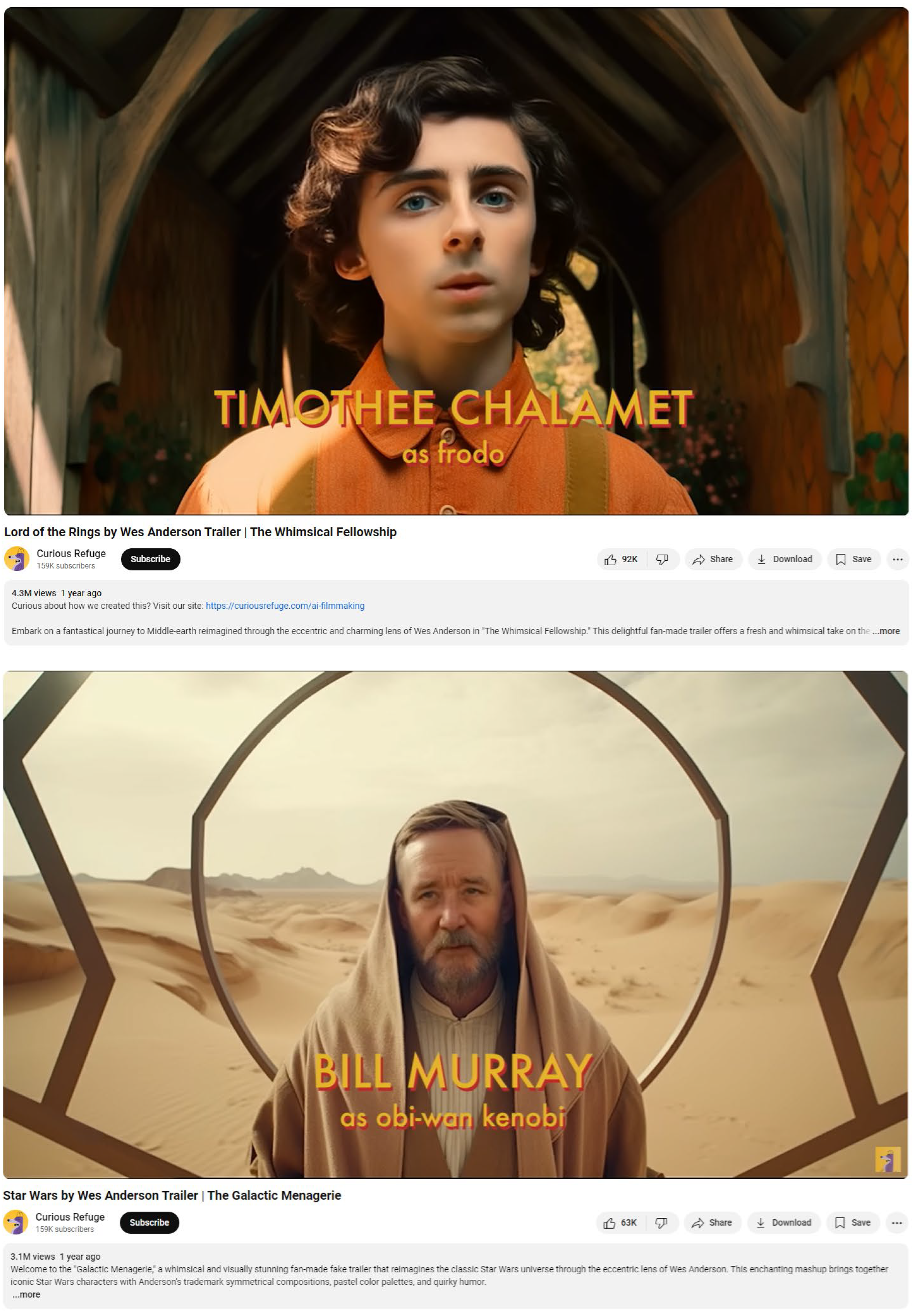
Screenshots from Curious Refuge's A.I. film trailers, which recreate scenes and characters from Lord of the Rings and Star Wars in the style of Wes Anderson.
Setting a robust precedent for much of the recent surge in A.I. films, these tongue-in-cheek trailers serve as a useful means of accounting for this trend's wider appeal, 5 as well as elucidating aspects of its limitations. In a recent interview with Anderson himself (who is both aware of and conflicted by these A.I. emulations of his oeuvre), journalist Michael Cavna accounts for these A.I. creations’ failure to fully encapsulate the creative logic of their chosen filmmakers. He vividly describes the videos as “reductive” and “flattening” renderings of the cinematic visions they strive to mimic, as well as charging imitative works such as these as being “increasingly untethered from the truth of the source material” (Cavna, 2023). Likewise, Wally Koval—founder of the well-known “Accidentally Wes Anderson” fan community—describes these A.I. videos as functioning at “the surface level of what people think Wes Anderson is,” without ever “going behind the façade with a deeper understanding of the storytelling space and underlying narratives” (quoted in Cavna, 2023). 6 Tellingly, Cavna and Koval's impassioned critiques of Curious Refuge's “A.I. Anderson” trailers are remarkably consistent with the description of A.I.'s current potential in filmmaking put forth by media theorist Lev Manovich, who has likewise accounted for generative adversarial networks’ (GANs’) effective capacity to successfully replicate well-known authorial styles, 7 yet without any consideration for the work's original artistic context (2019, p. 4). 8
The applicability of Manovich's description to imitations like Curious Refuge's Anderson trailers is clear. However, in the case of this recent surge in online A.I. films, I contend that the (sometimes crude) disjuncture between these A.I. works and the artistic intentions of their source material—irrespective of whether it is consciously noted by viewers—serves a key role in these media artefacts’ unusual aesthetic appeal. Certainly, the imperfect and uncanny qualities of these stylistic imitations evoke the attractive sense of “raw naiveté and quirkiness” that is often associated with blossoming media formats before they settle into more well-defined and easily identifiable idioms, much like that which was ascribed to the earliest forms of podcasts in the mid-2000s for example (Dearman & Galloway, 2005, p. 535). We might also attribute these videos’ widespread appeal—and indeed the allure of deepfakes more generally—to their neat consonance with “Hollywood's emergent reboot culture, filmmaking multiplications, and derivative media content” which, as Holliday argues, boast an “increasingly circular industrial logic” (2021, p. 910). Yet perhaps most importantly, because of their short-form trailer format, parodic undertones, and often less-than-perfect execution, audiences of these A.I. Andersonian simulations are rarely forced to confront any of the more challenging ramifications of the media they are consuming; that is, questions of whether these videos may potentially supplant any of the more traditional Hollywood filmmaking techniques that they (often superficially) strive to simulate. In this sense, any fears or discomfort that these trailers might otherwise elicit concerning A.I.'s potential replacement of human labor—one of the core sources of anxiety concerning algorithms, as per De Vries (2020, p. 13)—are conveniently allayed for the viewer, if not mitigated altogether: a further factor that has undoubtedly contributed to their unprecedented appeal and reach.
Deliberate Dystopias: Recurring Genre Conventions
Before turning to sonic concerns, there is one additional quality of the current wave of A.I. films that I believe merits special attention, especially given its direct connection to the divisive responses that they so often provoke: that is, their shared genre conventions. With only a handful of exceptions, the majority of A.I. films adopt unambiguously science-fiction-inspired settings, themes, and/or protagonists (Figure 2). On the one hand, this might be interpreted as a quite functional consideration. Given the notable difficulties that are sometimes experienced by current generative A.I. tools in depicting fluid human movement and expression, adopting a sci-fi setting serves as a convenient workaround on account of our easy acceptance of masked/helmeted protagonists and other strange nonhuman characters in sci-fi narratives. As Manovich (2018, p. 10) notes, “whether an algorithmic creation looks plausible or not also depends on genre conventions.” Certainly, in the case of A.I. films, the genre conventions of science fiction do much to temper the perceptibility of generative A.I.'s current limitations.
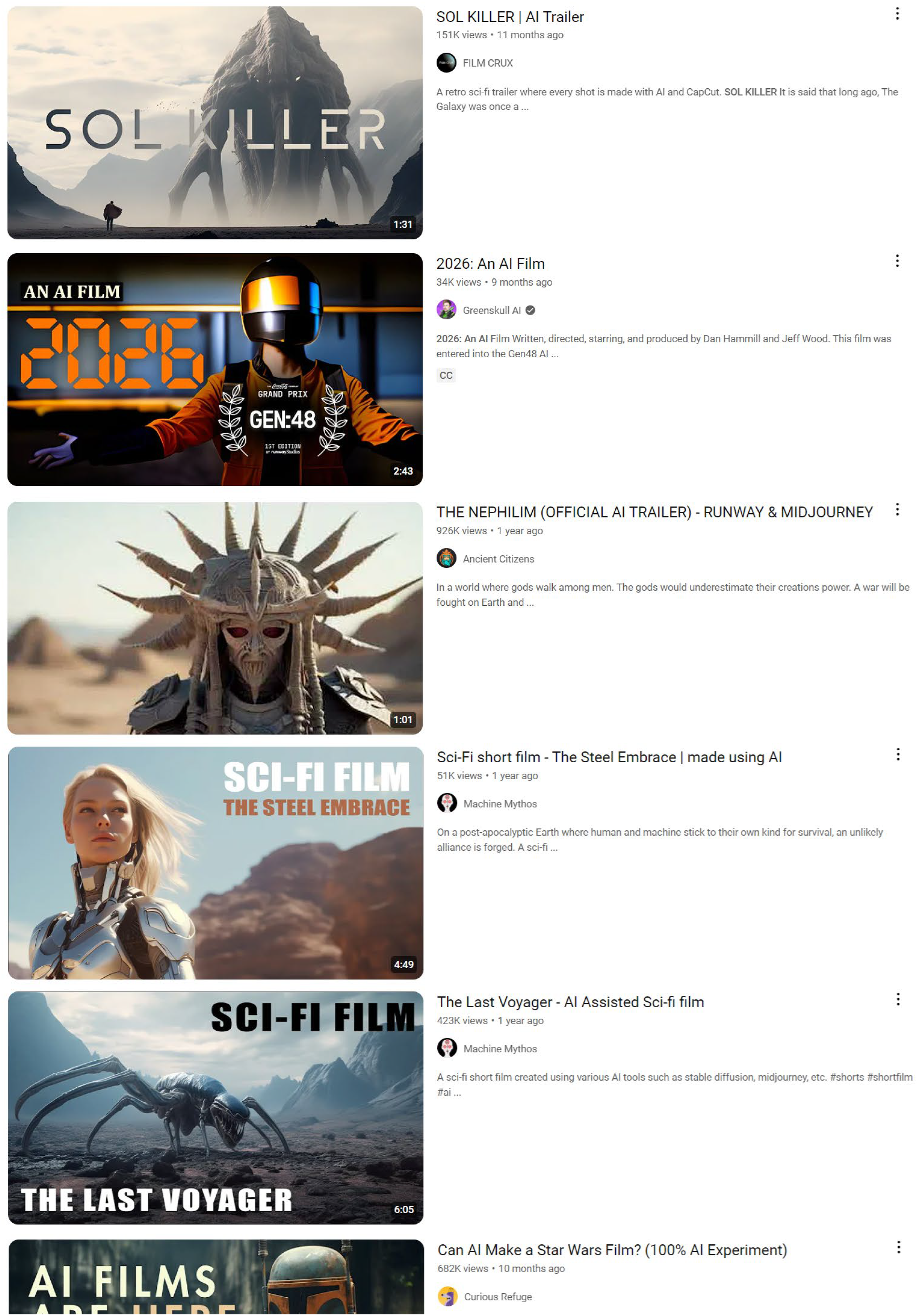
YouTube Thumbnails for an array of A.I. films and trailers, all of which conform to recognizable science-fiction conventions.
However, the genre of these creations is often more specific still. Of the abundant body of sci-fi-themed A.I. films, the overwhelming majority of examples can be further categorized as part of the dystopian, speculative, or social science fiction subgenres, with narratives that typically center around archetypal perils-of-A.I. or “machine takeover” storylines (Dihal, 2020, p. 189). In one sense, this tendency conforms with the wider tendency for twenty-first-century art and screen media to interrogate what Patricia De Vries refers to as algorithmic anxiety (2020). In her monograph of the same name, De Vries accounts for the profusion of recent artwork and exhibitions which have prioritized “imagining, representing and narrativizing aspects of […] algorithmic culture,” exploring its influence on “conceptions of self and values like freedom, transparency, autonomy, or objectivity” (2020, p. 13). This certainly sheds light on the disproportionate volume of A.I. films which present dystopian vignettes involving android takeovers, the struggles of human artists in the age of A.I., etc. 9 However, while the sort of artwork and exhibitions described by De Vries typically comprise self-reflexive meditations on the nature of our human interactions with A.I., the motivations behind A.I. films’ adherence to these genre conventions often seem quite different. In contrast with the examples explored by De Vries, these online films’ narratives—however, short or fragmented—often seem poised to provoke alarmist or fearful responses in viewers, or to cultivate divisiveness and polarized reactions concerning their reliance on A.I. This is clearly evidenced in their paratextual materials, as well as the adversarial debates they so often spark between A.I. advocates and staunch techno-pessimists. Rather than offering especially nuanced meditations on our human interactions with A.I. (as in the examples highlighted by De Vries), this recurring dystopian bent instead seems primarily designed (i) to cultivate online engagement, however, polarized, (ii) to fortify existing divisions between advocates for and detractors of the technology being used, and, quite often, (iii) to promote online tutorials in generative A.I. Of course, this may seem like a relatively unexceptional observation concerning a recent viral marketing strategy; yet, as we turn to examine these films’ framing of music and sound in the following section, it quickly becomes apparent that certain creators’ harnessing of public divisions and algorithmic anxiety to further personal interests is often intertwined with their regular overstatement of the work's reliance on generative A.I.: a practice which can bear extraordinarily negative ramifications.
To quickly summarize: the term “A.I. film,” as defined in this study, refers to any of a wide-ranging set of short-form narrative films and film fragments created using A.I. tools, popularized as part of an online trend during the early 2020s. These films are typically structured around sequences of partially animated A.I.-generated images, with the disproportionate majority of examples adhering to the genre conventions of dystopian science fiction. Most creators favor the term “A.I. film” themselves, routinely incorporating related hyperbolic language in their videos’ titles, descriptions, and other associated paratexts. Such language frequently seems designed to instill a sense of awe or wonder in the accelerated technological leaps that these A.I.-generated creations purport to represent, or to provoke incredulity or disbelief that such visually striking A/V materials could be generated without human input (thus overlooking the necessary co-creation inherent to much of generative A.I.'s current functionality in filmmaking). Many of these films therefore appear as attempts to legitimize the creative potential of the technology being employed, or to provoke fractious reactions among an already polarized body of online audiences: an interpretation reinforced by the frequency with which these films fall into technohorror or dystopian sci-fi subgenres. The A.I. film trend might also be categorized as a meme, especially given the recurring and reproducible forms that these creations adopt, as well as their often-conspicuous attempts to accrue some degree of online virality. Furthermore, many of the most successful examples of viral A.I. films double as advertisements for subscription-based courses in software such as Midjourney or DALL·E 3.
Sound and Music in A.I. Films
Synthesized Voices and Recurring Scoring Choices
As outlined above, a significant number of the current wave of online A.I. creators tangibly strive to simulate the aesthetics and sensory experience of contemporary entertainment cinema in their work and, in so doing, endeavor to assert generative A.I.'s legitimacy as an extension of (if not a replacement for) existing apparatuses in Hollywood filmmaking. In light of this, it stands to reason that sound and music should be afforded central roles both in establishing and perpetuating this impression. This section thus comprises a detailed survey of the current scoring practices in this trend based on my close analyses of the soundtracks for 31 A.I. films. Works were selected based on their titles and/or paratextual materials, in which it was required that they were clearly identified as “A.I. movies,” “short A.I. films,” “A.I. trailers,” or similar. The analyzed films were uploaded to YouTube between March 2023 and July 2024, and might thus be seen as part of the present era's sea-change in popular and scholarly discussions relating to generative A.I. in filmmaking. Moreover, in light of the ever-accelerating development of generative music tools noted earlier, the sample set observed in this article might equally be seen as snapshot of a pivotal moment of transition in the widespread adoption of A.I. tools in screen music production more generally. In each case, several details were observed in the selected films: (i) the presence/absence of music, (ii) the stylistic idiom in which the music was composed, (iii) the role of A.I. in the creation of sound/music and whether this was clearly signaled, and (iv) the category of the music, i.e. newly composed, library/royalty-free music, A.I.-generated, pre-existing tracks, or otherwise.
Firstly, perhaps the most obvious sonic quality shared by these videos is their frequent reliance on A.I. voice synthesis, usually by way of voiceover narration: whether in the form of authoritative stentorian narration, or as the implied internal monologue of an onscreen character. Again, this could easily be interpreted as a convenient workaround for these A.I. artists: just as in the case of masked/faceless protagonists in science fiction, the voiceover similarly allows A.I. creators to eschew any necessity for complex facial animation or synchronization. In theory, this may seem like an efficient way to disguise certain limitations of present-day generative A.I.'s applicability in filmmaking. However, this practice occasionally elicits the opposite effect: although voice synthesis has become increasingly inexpensive, accessible, and sophisticated in recent years, the prominent reuse of certain voice “fonts” (such as those created by companies like ElevenLabs and Speechify) can serve to unintentionally underline the artificiality of A.I. films. The synthesized narrator for Curious Refuge's parodic Lord of the Rings trailer, for example, dubbed “Adam” (ElevenLabs), can be heard across numerous other A.I. films 10 ; although often appearing in pitch-shifted or otherwise altered forms, the voice is still discernibly derived from the same recorded phonemes upon which the “Adam” voice is clearly trained (see Eidsheim, 2023, pp. 138–140). In this sense, the presence of conspicuously recurring voice fonts becomes an altogether unambiguous signifier of an audiovisual creation's synthetic nature. In much the same way that the recurrence of specific screen music can forcibly signify certain categories of TV viewing experience, “succinctly [establishing] expectations of genre, tone, and mode” (Huelin, 2022, p. 204), digital creators’ frequent recourse to easily recognizable text-to-speech A.I. voices can prove similarly unambiguous as a signifier of a given work's status as synthetic.
Beyond voice synthesis, there are similarly recurring musical practices favored by these digital creators from which I believe we can ascribe a dominant scoring idiom to the A.I. film, in its current incarnation at least. Given how these videos so often strive toward the very ambitious goal of a complete simulation of narrative-oriented Hollywood cinema, it is perhaps unsurprising that the scores for A.I. films regularly boast the cyclical cell-based structures and symphonic sonorities that have long characterized contemporary entertainment media. This scoring idiom—famously perpetuated in the screen music of Hans Zimmer, James Newton Howard, Harry Gregson-Williams, and many others—is memorably theorized by Nick Reyland in his description of so-called “corporate classicism” (2015) and incorporates many of the hybrid scoring practices that Sergi Casanelles convincingly categorizes as hyperorchestration techniques (2016; see also Buhler 2019, p. 271). Owing to an array of technological, cultural, and commercial circumstances, this recurring idiom has firmly established itself as the defining stylistic trend of twenty-first-century narrative screen music and has enjoyed an enduring presence in the scores for innumerable Hollywood films, Peak TV series, film/television trailers, and video games since the early-to-mid-2000s (Mc Glynn, 2023, p. 115).
Even a cursory survey of online videos identified as A.I. films reveals that digital creators regularly revert to this recognizable style topic as a nebulous signifier for all things “cinematic” in the age of digital media convergence. On the one hand, this idiom's ubiquity as part of this trend could be seen as an inevitable consequence of the aesthetics of the era into which the trend was born. So deep-seated is the precedent for this scoring idiom in contemporary screen media that its presence in these online creations—which so clearly aspire toward the sights and sonorities of big-budget Hollywood films—could even be interpreted as an example of overcoding, “where the music merely signifies what is already present in the visual content or other aspects of a production” (Huelin, 2022, p. 195; see also Rodman, 2009, p. 72). One must not forget just how entangled this scoring idiom is with the conventions of intensified continuity, which have figured so centrally in the aesthetics of our present era of Hollywood entertainment filmmaking (Bordwell, 2002). The music of A.I. films might thus be seen as a quite unambiguous attempt to underpin these creations’ channeling of this visual aesthetic via their reliance on an amorphous, semiotically apotheosized “Zimmeresque” quality, as well as the cultural capital of the Zimmer's film score company Remote Control Productions and their roster of composers: textbook overcoding, as per Rodman's definition. 11
On a more conceptual level, it seems similarly logical that these practices should form the basis for so many A.I. film scores: many of the recent developments in cultural A.I. described throughout this article have, throughout recent scholarship, been framed in the context of the hyperreal (e.g., Zafar, 2023). This seems like a somewhat unavoidable theoretical pairing, especially when these new technologies represent a move towards a form of Baudrillardian hyperreality in today's screen media that is quite unlike any that we have encountered before, both on an individual level for consumers/creators and across society more broadly. 12 Yet, given the challenges that A.I.-generated media pose to our more traditional approaches to cinema in film and screen studies, which often remain surprisingly indebted to mid-twentieth-century conceptions of cinematic realism (e.g., Bazin, 1960), Casanelles’ theorization of this contemporary cinematic orchestration mode without a basis in reality—a model which is in itself indebted to Baudrillardian ideas—seems especially befitting of these distinctive A.I. creations. Furthermore, at face value, it seems quite plausible that approximations of this repetitious, harmonically compressed, ostinato-based scoring idiom could indeed be achieved algorithmically. As Manovich (2018) observes, “it is logical to think that any area of cultural production which either follows explicit rules or has systematic patterns …” (and the scoring mode described by Reyland and Casanelles most certainly does) “… can be in principle automated” (p. 9). There is, of course, a long history of algorithmic composition methods being deployed throughout the history of twentieth-century music, and, in the context of recent screen scoring, A.I. composition programs such as Soundful and Dynascore have been specifically marketed to media creators (Krishnaswami, 2024). However, as the following section explores, A.I. films do not typically generate their soundtracks algorithmically. Rather, as noted at the outset of this study, these media artifacts’ sonic/musical identity is most often characterized by their extensive incorporation of pre-existing library music and royalty-free soundtrack cues. Quite often, A.I.-generated dialogue is thus the sole sonic component of “A.I. films” that we might categorize as synthetic.
Library Music and the A.I. Film Score
To provide a very general overview, library music refers to licensable digital recordings that are categorized in online catalogs, created according to commercial trends and demands, and designed for use in a wide variety of contexts (Huelin, 2022, p. 57). The existing literature on library music tends to focus on the resultant compositions’ distinctive aesthetic ramifications and style, as well as their notable implications relating to authorship and intertextuality. Notably, library music is known to provoke vastly contrasting value judgments among audiences and scholars alike: the idiom often faces decidedly negative appraisals, being regarded as “an indicator of genre, standardisation, conformity and vulgarity” (Butler, 2013, p. 171); it is routinely dismissed as a “lesser alternative” to newly commissioned music (Durand, 2020, p. 24) and is regularly seen as more likely to be incorporated in ways that bear “little relevance to the images or the narration” (Huelin, 2022, p. 55). Conversely, a case has been made for library music's status as a space for the creation of highly original and experimental work by composers, whose reputations are often safeguarded behind pseudonyms as a means of distinguishing this often-maligned endeavor from their feature-length cinematic credits (which typically enjoy far greater cultural valorization). The task also necessarily entails the composition of highly versatile material which is designed for use in a wide variety of contexts; notably, Júlia Durand has highlighted the particular diversity of audiovisual contexts where library music is found, which range from TV shows to adverts, computer games, corporate videos, and vlogs (2020, pp. 23–24).
Alongside these eclectic contexts highlighted by Durand, I believe it is now imperative that we foreground synthetic media as a further notable site of library music's use, especially when one considers library music's prominent recurrence as the dominant scoring mode for today's algorithmically generated films, as well as the strikingly similar issues relating to authorship, intertextuality, ethics, and aesthetics that are raised by both library music and A.I.-generated media. After all, the distinctive aesthetic effects that scholars like Toby Huelin have ascribed to library music and its challenging of the perceived primacy of the composer (2022, p. 3) can just as easily be attributed to the A.I. film, which is likewise characterized by a diffusion of authorship and its simulation of very specific pre-existing authorial styles. Furthermore, even in cases where A.I. music generation tools have indeed found a natural home in screen scoring practices, it is commonplace for catalogs of library music to be licensed in order to train A.I. music generation models 13 in ways that capitalize on library music's pre-existing metadata tags, track-specific descriptors of genre and emotion, and even suggestions for possible usage in screen media contexts (Krishnaswami, 2024). Thus, even scores which have been created using A.I. text-to-audio models can become enmeshed in the distinctive aesthetic and semiotic interplay inherent to library music: a dynamic which I believe is central to the perceived effectiveness of these short-form viral experiments and the divisive responses they occasionally seem sculpted to provoke.
Although somewhat self-explanatory, the rationale behind library music's seldom-acknowledged centrality in A.I. films furnishes us with a valuable set of insights into the aesthetic and conceptual commonalities between library music and A.I.-generated media, as well as elucidating key motivations that inform this viral filmmaking trend more generally. First, one must remember that the main motivations behind library music catalogs are often speed and ease of access (Durand, 2020, p. 27). This neatly squares with the impetus behind so much of A.I.'s use in filmmaking, which is typically defended on the grounds of technological solutionism (Chow, 2020, p. 196). It also speaks to the possibility that, in many cases, music and sound are secondary to the visuals in these digital creators’ pursuit of algorithmically recreating Hollywood film and television aesthetics. A second notable commonality concerns library music's regular reliance on easily identifiable musical shorthands and clichés. Quite often, library cues incorporate clichéd, reductive sonic signifiers for specific locations, time periods, or social/cultural contexts in order to facilitate quick and easy signification for the largest possible subset of listeners: whether via the music's instrumentation, harmonic/melodic qualities, timbre, production value, or the specific style in which it is composed. Prompt engineering for text-to-image generation can likewise be predicated on reductive and clichéd understandings of culture, identity, and race, a phenomenon which has led Nicola Bozzi to characterize online A.I. art as a “platformed stereotype engine” (2024). Of course, it is well acknowledged that these technologies are far from neutral entities (Noble, 2018; O’Meara & Murphy, 2023, p. 1071). At the same time, however, when we consider library music's efficacy in quickly conveying an amorphous, median idea of contemporary Hollywood film—a goal shared with the algorithmically generated visuals that it often accompanies in the case of the A.I. film—it is perhaps unsurprising that library music should find a new home in this context, serving as an important vehicle to consolidate its impression of the cinematic. This is, after all, a recurring function of library music across screen media: Huelin memorably describes how, when selecting library music for use in her television projects, director Nicola Silk would typically search for “keywords [that] usually relate to the specific musical genre she is envisaging, using words such as ‘cinematic’” (2022, p. 191). It is clear from the examples explored as part of this study that a similar approach is likely adopted by the A.I. creators involved in producing these films, who seek to imbue their works with equally “cinematic” properties, yet for whom music and sound are perhaps secondary concerns.
Yet herein lies a more troublesome consequence of this pairing of library music and A.I.-generated imagery: while we might logically interpret library music's prominent presence in A.I. films as a natural consequence of the characteristics described above (i.e., ease-of-access, speed, functional efficacy, and convenient semiotic shorthands), another notable quality of library music—and arguably all screen music—is its potent capacity to guide audiences toward a particular interpretation of an audiovisual work. In line with this, Durand convincingly describes the “decisive role” of library music in perpetuating certain screen scoring tropes for audiences, which she argues cannot be underestimated (2020, p. 42). Library music's potential to convey a certain perspective or ideal is not insignificant. While the recurring use of library music in A.I. films may seem innocuous at first, its prominent incorporation in these digital creations—paired with a frequent lack of transparency concerning the human labor involved in its creation—can prove similarly decisive, not merely in shaping expectations of musical style, but also in perpetuating the dominant (and occasionally inaccurate) ideas concerning A.I. and its apparent sophistication in contemporary screen music production: that is, sculpting the dominant imaginary of A.I. in filmmaking. This issue—the topic of my final section—invites one central question: when the primary motivation of many A.I. films is their communication of a particular message (i.e., ideas concerning the present sophistication of A.I. and its potential to displace traditional filmmaking processes) and when this message hinges upon audiences’ latent assumption that sound/music are also the product of algorithmic processes, do these films then necessarily present themselves in a way that casts ambiguity over their music's pre-existence?
Misrepresenting the Role of A.I. in Screen Music
As hinted above, there is a notable lack of clarity concerning A.I.'s role in the creation of sound and music for so many A.I. films: an ambiguity which often serves to occlude the score's original authorship or obfuscate its status as library music. Of all the A.I. films explored as part of this study, it is notable that only two examples incorporated a score that was clearly signaled as A.I.-generated. The short film “The Portal Makers” (NightmareAI, 2023) incorporates three contrasting musical cues, which, according to a note in the film’s YouTube description, were generated using the A.I. music generation tool AIVA. Likewise, the score for “How to Stay Healthy | AI Dystopian Horror” (Aze Alter, 2024) is credited to both the film's creator and the recently released A.I. music generation tool Udio. All other examples explored in this study sharply contrast with these notable outliers. In many cases, it is often never made explicitly clear that music is not the product of algorithmic processes: whether through omission, a dearth of text to adequately contextualize the extent of A.I.'s use, or, in certain cases, an implication that the project is solely the product of algorithmic production methods. For example, one short film fragment inspired by Star Wars (Curious Refuge, 2023a) boasts the ostentatious parenthetical subtitle “100% A.I. Experiment,” yet the YouTube video's description states that stock music had been used due to time constraints, notwithstanding how the music heard could “easily” have been generated using A.I. tools according to the uploader. A similar lack of clarity exists in “SOL KILLER” (FILM CRUX, 2023b). Music is atypically foregrounded in this example and is even afforded a distinct numbered chapter in a separately uploaded “Making Of” featurette (FILM CRUX, 2023a); however, it is solely in the comments section where the uploader clarifies that the music is not in fact algorithmically generated, as the specific style they wanted would have been “hard to get” using A.I. tools. More than half of the examples analyzed in this study exhibit an equivalent sense of ambiguity regarding their scores’ statuses as A.I.-generated, originally composed, or pre-existing music. Furthermore, this lack of clarity is often compounded by the recurring hyperorchestral idiom in which the chosen music is composed (which, as noted earlier, tends to exhibit cyclical, ostinato-based properties that could conceivably be misconstrued as A.I.-generated).
In all such cases—and there are many—A.I. films lack what Kyle Worrall and Catherine Flick (2022) refer to as creative signaling: the ethical practice of signaling if and when a work has been subject to algorithmic manipulation (a practice that has been legislated for in certain jurisdictions; see Holliday, 2021, p. 905). Although Worrall and Flick specifically reference the signposting of A.I.-generated or manipulated components of a work, I maintain that clearly signaling the pre-existence of creative material is, in certain contexts, just as much of a responsibility for the ethical creator. Failing to do so—or, as in the aforecited examples, implying that a work is solely the product of creative A.I., when significant aspects of it are not—can bear an array of negative consequences, ranging from the obfuscation of labor and copyright issues to the spreading of rampant misapprehensions about the current sophistication of A.I. tools. In many circumstances, truly ethical creative signaling demands both algorithmic transparency and creative attribution.
Perhaps the most vivid evidence of this is illustrated by Mad Cow Films’ A.I.-generated short “The Carnival of the Ages” (Mad Cow Films, 2023). In the year since its publication, this A.I. film amassed over 700,000 views on YouTube, making it one of the most popular early examples in this trend (Figure 3). While its creator has never outwardly suggested that the clip incorporates algorithmically generated audio, a creative statement published shortly after its release hails A.I. as “the Einstein of everything,” including music and composition: they write, in sensational terms, “you can have […] the best director, the best cinematographer, the best composer, music, lighting, everything at your disposal” (Mad Cow Films, 2023). The soundscapes heard in the film represent a notable departure from the more familiar hyperorchestral scoring idiom discussed earlier: instead, we hear a beguiling sonic bricolage resembling something closer to musique concrète, with jagged vocal fragments and heavily processed samples appearing to diegetically emanate from the various sideshows we pass in the film's titular amusement park. While one might initially assume the film's effective sound design to be the product of algorithmic composition tools, this erratic assemblage in fact pre-existed “The Carnival of the Ages” in almost exactly the form in which it appears in the film. The entire score comprises an excerpt from the 2019 track “We Are Almost There” by the British-Nigerian experimental R&B artist Klein. Reviews of this music refer to Klein's “grainy pop collages” and frequently highlight her incorporation of film excerpts, loops, samples, and vocalizations (see Ravens, 2017). “The Carnival of the Ages” thus directly imports aspects of Klein's surreal bricolage aesthetic, in ways that often seem to double as effective diegetic sound design. Crucially, Klein is never credited, notwithstanding her role in constructing this perfectly surreal Lynchian soundscape befitting of our perambulation through the film's retrofuturist Americana. Furthermore, in another curious instance of citation, a ringing bell heard at 1:07 can be identified as a sample from former KISS guitarist Ace Frehley's 2016 recording of the blues song “Bring It On Home.” While it is of course quite possible that Frehley may have simply taken this distinctive sample from the same sound effect library used by Mad Cow Films, this detail nonetheless further points to the constructedness of the sonic bricolage heard in the film, as well as the human curation that was likely involved in its creation.
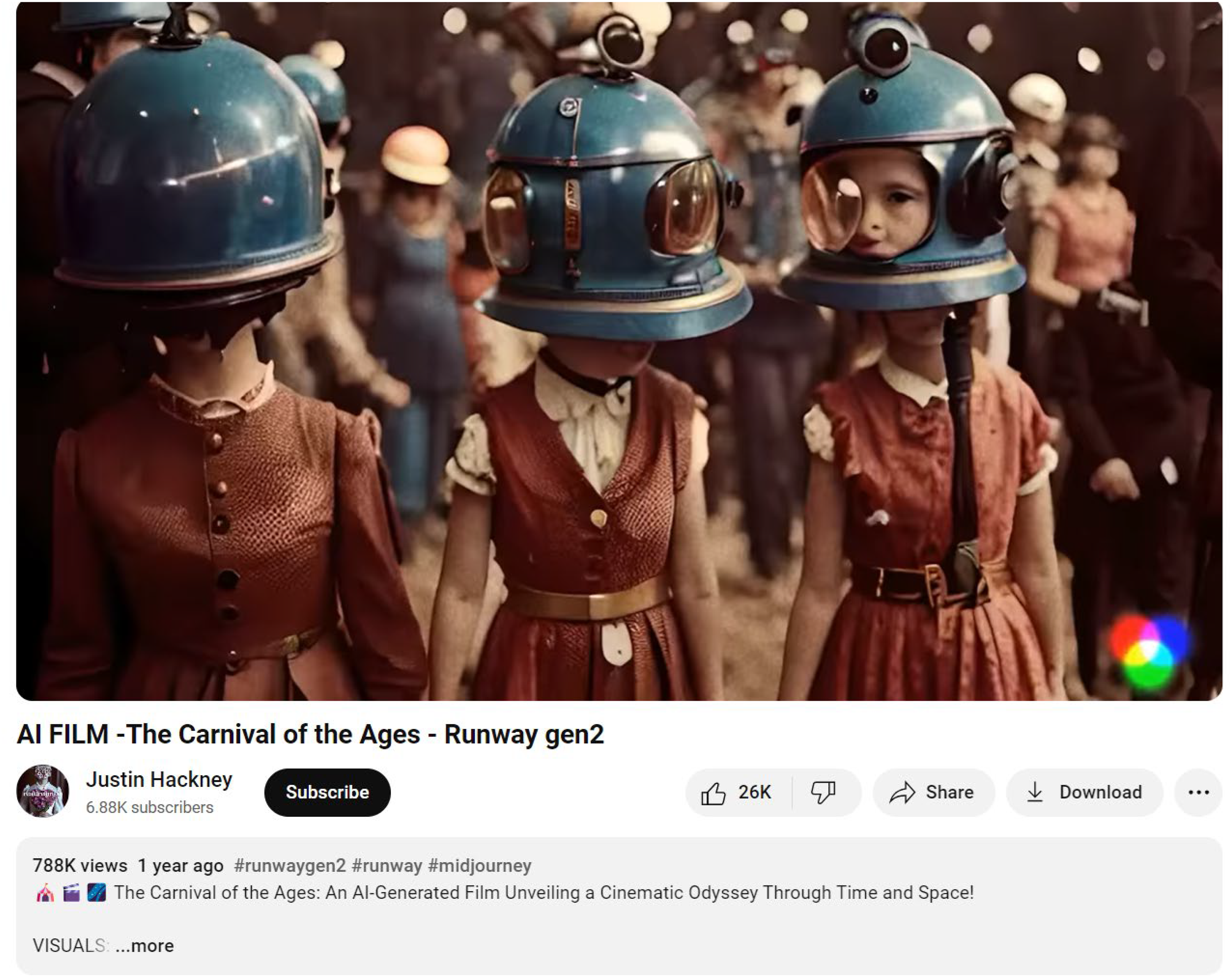
“The Carnival of the Ages,” One of the Most Popular Early Examples in the Viral A.I. Film Trend.
Conspicuous omissions and oversights such as these serve as reminders of the limited protections in current intellectual property law which, as Krishnaswami argues, are skewed in ways that neglect the rights of original creators in the case of A.I.-generated music and media (2024). This is echoed in the work of Matthew Blackmar, whose incisive appraisal of A.I. vocal deepfakes in the context of US and EU copyright law paints a stark picture of how far the fair use doctrine has veered from its original function as a legal defense for individual artists. Describing the EU's formal expansion of fair use exceptions to include data and text mining in 2019, Blackmar asserts that “where fair use once protected individuals from litigious corporations, it increasingly insulates corporations from liability for feeding on the work of individuals” (2024). This extension of fair use protections to include data mining has led Blackmar to posit, such as Krishnaswami, that the very possibility of copyright in our present age of A.I. is at stake. Beyond these pressing legal concerns, examples such as “The Carnival of the Ages” illustrate that it is not merely legislation that leaves vulnerable and marginalized artists open to exploitation, but also the present attitudes to creative attribution in “A.I. films” and the imagined reality that is so often put forth regarding the extent of A.I.'s role in their creation. As is evident across all of the works examined in this study, the A.I. film phenomenon and its lack of any strong culture of creative signaling serve as compelling evidence of the pervasive attitude toward (and disregard for) attribution among many digital media creators who have contributed to this online A.I. micro-trend.
Conclusion
The Present Moment and Possible Futures
By investigating the viral A.I. film trend, this study has explored how—in the overwhelming majority of cases—score and sound design in these creations are not the product of algorithmic composition. Rather, it is library music that serves as the dominant scoring mode, usually supplemented by synthesized voiceover narration created using services such as Elevenlabs or Speechify. Invariably, then, any valuable scholarly appraisal of these media artifacts necessitates our close engagement with the growing body of scholarship on library music, especially given the shared aesthetic and ethical concerns raised by both. Of course, as noted elsewhere in this article, one must remain mindful that the aesthetics and sensibilities of the A.I. film I have observed are representative of a very specific juncture in the development of these technologies and their ongoing adoption into filmmaking practices and digital content creation more generally. Should we contrast the limited capabilities of software such as Dynascore and Soundful (as flagged by Krishnaswami) with the renewed sophistication of more recent stable release A.I. music generation tools such as Suno A.I., one could reasonably predict that the A.I. film trend's reliance on library music may have a finite lifespan 14 and that, in the period ahead, we may see a marked decrease in the presence of pre-existing music in these creations. 15 This becomes even more apparent when one thinks of recent developments in the use of GAN models for video-to-audio generation (Bastianello, 2023, p. 21), as well as the perceived benefits of deep learning systems over existing approaches to procedural audio generation for digital media through digital signal processing: a shift which is increasingly discussed with reference to the creation of generative sound assets for narrative media such as video games (Barahona Rios & Collins, 2022). I believe it becomes all the more pressing then to survey this ephemeral moment of transition, especially when—faced with a pivotal turning point in public understanding and literacy of A.I.-generated media—current scoring practices are so often complicit in perpetuating misleading interpretations of this developing technology's figuration in these media artifacts’ creation. 16
Following on from this point, my investigation into these practices has also revealed that there is currently no strong culture of creative signaling as part of this trend, likely as a result of the commercial motivations that often underpin these creations. Many of these online A.I. creations thus seem wholly insulated from the current conversations concerning ethical uses of creative A.I. and the core values they promote (e.g., transparency, informed consent, etc.). Taking my cue from Worrall and Flick, then, I maintain that the most ethical approach to creative signaling in the case of A.I.-generated media not only involves complete transparency regarding where algorithms are used, but also with respect to the use of pre-existing material (especially where claims are made concerning the seemingly more significant extent of A.I.'s role). Ultimately, by exploring this trend, this article has highlighted the wider consequences that certain seemingly innocuous creative decisions can bear in the case of A.I.-generated music and media—from consciously downplaying and obfuscating human labor, to perpetuating damaging misapprehensions concerning the present sophistication of A.I. in filmmaking—in the hope of guiding their more ethical integration into contemporary digital media creation practices.
Ethical Statement
As this article is primarily an argumentative piece—informed solely by (i) existing literature and (ii) original textual analyses of audiovisual examples which are freely available in the public domain—no institutional ethical approval was required.
Image Permissions
All three of the images in this manuscript, Figures 1–3, comprise screenshots (created by the author) of the YouTube pages hosting the films being analyzed. Consonant with the doctrine of fair use—as set out in Section 107 of the US Copyright Act and Sage Publications’ Copyright and Fair Use guidelines—I believe all three of these images can be freely reproduced without receipt of permission from the copyright holder, given that they are (i) solely for commentary/criticism, (ii) represent a small portion (i.e., one frame) of the films in question, and (iii) do not affect the market of the original works being captured.
Footnotes
Acknowledgements
I would like to extend my most heartfelt gratitude to Dr Toby Huelin (University of Leeds), who generously shared his doctoral dissertation with me during the early stages of this research. I must also thank Professor James Buhler (UT Austin) for sharing his insights on this topic while chairing my panel at the twentieth Music and the Moving Image conference (NYU Steinhardt, May 2024), at which I presented an early version of this work.

Funding
The author disclosed receipt of the following financial support for the research, authorship, and/or publication of this article: This work was supported by the Irish Research Council (IRCLA/2022/2959).
Declaration of Conflicting Interests
The author declared no potential conflicts of interest with respect to the research, authorship, and/or publication of this article.