



Abstract
This article addresses the urgent need for a comprehensive understanding of the global media coverage of Coronavirus Disease 2019 (COVID-19) by conducting a massive-scale analysis using the Global Database of Events, Language, and Tone. With a dataset encompassing 53,967,878 news items from 4,708 online news sources across 67 countries, the study spans the entire trajectory of the pandemic from the first reported case on December 31, 2019, to September 11, 2020. The analysis aims to surpass the limitations of previous research by offering a worldwide perspective on COVID-19 media coverage over a significant timeframe. Additionally, the paper explores the intricate relationships between media portrayals and the epidemiological situations in primary countries. By examining the media's impact on public perceptions, the study contributes valuable insights to the ongoing discourse on COVID-19, addressing the limitations of prior research and emphasizing the importance of a nuanced and expansive approach to understanding the role of media in the context of global health crises.
Keywords
Introduction
Coronavirus disease 2019 (COVID-19) is an emerging infectious disease caused by a novel acute respiratory syndrome coronavirus (SARS-CoV-2; CDC, 2019). Since the first case was reported in late December 2019, it has rapidly spread globally, affecting 25 million people and causing more than 853,000 deaths by September 2020 (World Health Organization, 2020). This global pandemic has confronted the world with considerable political, economic, and public health challenges, igniting heated media, political, and scientific debate worldwide (Ippolito et al., 2020; Moon, 2020; Motta et al., 2020; Oh et al, 2020). The proliferation of news and information in the media has been unprecedented.
The media outlets have a tremendous impact on public perceptions of the disease (Singer and Endreny, 1993; Young et al., 2013). For example, researchers in the epidemiology domain have built several mathematical models showing that the media coverage of infectious diseases (e.g., SARS, MERS, H1N1) affected public norms, risk perceptions, and eventually transmission of the disease (e.g., Liu & Cui, 2008; Sun and Zhu, 2008; Tchuenche et al., 2011). It is thereby of great importance to examine the media coverage of COVID-19. Several studies have analyzed the social media content posted by Chinese government accounts (Liao et al., 2020), disease patients (Huang et al., 2020), major world leaders (Rufai & Bunce, 2020), etc. Although providing an insightful glance into the media portrayals of COVID-19, the scope was restrained to a relatively small sample on social media. To our best knowledge, there are two exceptions. One is Jung and Shin's (2020) big-data analysis of COVID-19 news reports in Korean newspapers, magazines, and broadcasts. However, this study primarily focused on domestic reports in traditional media. The other one is Cinelli and his colleagues’ massive-scale comparison of information spreading across five social media platforms (Cinelli et al., 2020). They examined the dynamics of information diffusion on a global scale but did not obtain a nuanced understanding of the post's content.
Research on the media coverage of COVID-19 so far has several limitations. First, only a few countries’ media coverage (e.g., China, the United States) was examined, and the findings relied on relatively small-scale data on social media. Such a limited scope may be subjected to inaccurate descriptions and a lack of generalizability at the global level. Moreover, although social media is a rapidly emerging source to obtain information, people still rely on the elite news media (e.g., CNN, BBC) to seek trustworthy information (Newman & Fletcher, 2017), which is worth research attention. Second, the coding categories of the media content were restricted to health-related information (e.g., disease knowledge, prevention actions). Nevertheless, the COVID-19 pandemic has posed unprecedented challenges in various arenas worldwide, such as politics, economics, education, etc. It is therefore critical to examine the connections between COVID-19 and other crises. Lastly, most previous research failed to measure the COVID-19 media coverage in ways that facilitate comparisons over time. Given the fact that the pandemic is an extremely fluid situation, it is important to track the media coverage changes along the outbreak trajectory using longitudinal analysis.
This article presents a massive-scale examination of COVID-19 media coverage with a big data analysis of the Global Database of Events, Language, and Tone (GDELT; Leetaru, 2012, 2015), which archives an exhaustive collection of available online news sources in more than 100 languages worldwide throughout 2015. In total, 53,967,878 news items from 4,708 online news sources about COVID-19 from 67 countries were analyzed in this study. Two goals are to be achieved in this study. First, we sought to provide a comprehensive picture of COVID-19-related media reports worldwide, covering a large timespan of the pandemic development (from the first case reported on December 31st, 2019 up to September 11th, 2020). Second, we investigated how media coverage is associated with the epidemiology situation in primary countries.
Interconnections between COVID-19 and other issues
Since the declaration of the COVID-19 outbreak as a global emergency on January 30 (WHO, 2020), governments worldwide have implemented various measures to mitigate the spread, from imposing strict lockdowns and travel bans at countries’ level to enforcing quarantine and face masks at individual level (Dunford et al., 2020). These interventions, along with public fear and anxiety, posed grave effects on all kinds of industries, such as manufacturing (e.g., Rapaccini et al., 2020), energy and oil (Norouzi et al., 2020), and tourism (Gössling et al., 2020). Subsequently, this economic turbulence raised many other crises, including poverty and food insecurity (Laborde et al., 2020), political instability (Sibley et al., 2020), labor market fluctuations (Coibion et al., 2020), education disruption (UNESCO, 2020), and so on. Consider social justice as an example. On March 16, the U.S. President Donald Trump called COVID-19 the Chinese virus, followed by a wave of posts on Twitter. The terms stimulated racism and discrimination against Asians, as reported by New York Times (Myers, 2020), BBC (Marcus, 2020), the Guardian (Aratani, 2020), and other main stream news media (Huang, 2020; Sha, 2020). These socioeconomic implications are being fiercely discussed, along with COVID-19, in news reports on various media outlets. From agenda-setting perspectives (McCombs and Shaw, 1972), the interweaved media coverage of COVID-19 with other issues strongly impacts public opinion.
As a third-level agenda-setting theory, the Network Agenda-Setting (NAS) Model argues that in addition to topics (first-level) and attributes (second-level), the salience of the connections among objects (e.g., news topic, public figure, etc.) can also be transferred from news media to the public (Guo & McCombs, 2011a, 2011b; Wu and Guo, 2020). This model assumes that people's cognitive representations of objects are structured in a network-like format where one node is connected to many other nodes (Kaplan, 2005). For example, people easily connect Egypt with pyramids and ancient civilization. This model further argues that media construct a network-shaped picture by bundling different objects (e.g., news topic, attribute, etc.) together, and can make this network salient in public's cognitions simultaneously (Guo & McCombs, 2011a, 2011b). Previous research testing this model showed that the connections among various issues constructed by media agendas on social media (Vargo et al., 2014) and newspapers (Cheng & Chan, 2015) can be substantially passed on to public cognitions in different cultures (e.g., Cheng, 2016; Guo et al., 2015). Informed by this model and relevant research, it is critical to examine how COVID-19 and other news topics are interwoven into media coverage.
A research question is proposed to draw a picture constructed by news media regarding COVID-19 with two follow-up research questions to make cross-country comparisons and track the media coverage evolution:
Media framing: Tone and polarization
Besides what issues were made associated with COVID-19, it is equally important to examine how COVID-19 is reported in the media. The second goal of the study is to examine the affective attributes attached to COVID-19 media coverage, as well as how these attributes are possibly associated with the incidence rate in each country. 1 We approach this question through the theoretical lens of framing (for a review, see Chong & Druckman, 2007). Framing refers to highlighting an interpretation of an event or issue by particularly focusing on some facets of the events or issues (Entman, 1993). Two dimensions of affective attributes will be assessed: media tone and polarity.
Media tone
Media tone is an essential content feature extensively studied in journalism, political communication, and media studies (McCombs et al., 1997; Sheafer, 2007). It refers to the evaluation or affection toward an issue displayed in news coverage (Cacioppo and Berntson, 1994; Sheafer, 2007). A recent sentiment analysis of COVID-19 news in 16 major U.S. newspapers showed a declining trend from slightly positive to moderately negative over time (Buckman et al., 2020). A contrastive study reported that the BBC had most of their news stories being pessimistic, while CNN and People's Daily coverage were more neutral and slightly optimistic (Mutua & Ong'ong'a, 2020). Following this line of research, we aim to map how the media coverage tone of COVID-19 evolved over time for major countries.
It was well-documented that media tone can heavily influence public opinion by creating a positive or negative image toward an object, such as public issues (e.g., economy, Sheafer, 2007; local issues, Kim et al., 2002), nations (Wanta et al., 2004), and public figures (e.g., Golan & Wanta, 2001). When it comes to infectious diseases, epidemiology researchers have built several mathematical models showing that effective media coverage 2 can delay the arrival of the infection peak, and decrease the number of infected individuals (Chang et al., 2020; Cui et al., 2008; Liu & Cui, 2008; Majee et al., 2023; Maji et al., 2022). However, to our best knowledge, no research so far has offered a more nuanced understanding of the impact of media coverage tone on the outbreak's development. We sought to fill in this gap by exploring a possible causal relationship between media coverage tone and disease incidence.
The media tone could be positive, negative, or neutral (Sheafer, 2007). Negativity bias has been a prominent phenomenon observed in various fields (e.g., psychology, Cacioppo & Berntson, 1994; political science, Lau, 1985). It describes the situation where negative information tends to capture attention far more than positive information. We operationalized the media tone in two ways: given a time frame, (a) the positive and negative affection categories computed by sentiment analysis programs, (b) the ratio of news items with a positive or negative tone in the entire news collection. Applied to journalism, news items attached with negative affections are expected to raise people's perceived importance and accessibility of the issue, whereas a positive tone may not have this effect. This notion has been proven in a political science study examining the German national election (Schoenbach & Semetko, 1992). We expect a similar effect, such that the negative attributes of COVID-19 media coverage would increase the salience of the issue in people's minds, followed by stricter protection measures and a low incidence rate. However, due to the complexities of pandemic communication, it is also likely that the incidence rate could influence media coverage. Thus, we proposed:
Media polarization
Assessing the media coverage in a positive-negative tone may oversimplify the news information at a societal level. Polarization offers another dimension for understanding the media coverage of an issue. It refers to the extent to which attitudes disperse and cluster around two contrasting positions with a few moderate views in between (DiMaggio et al., 1996). In politics, polarization is believed to have a deleterious effect on governments’ legislative and executive productivity and may cause problems like policymaking gridlock and governmental inaction (Binder, 2003; Fowler and Gollust, 2015; Jones, 2001). We believe the same effect should apply to the COVID-19 crisis, such that a polarized media environment of COVID-19 brings chaos and confusion to the public, eventually leading to noncompliance with government recommendations. The following research questions are proposed to compare the polarization level of COVID-19 media coverage across major countries as well as investigate its impact on the epidemiology situation.
Method
Data preparation
This study utilized the GDELT's Global Knowledge Graph, an open-source data set archiving the news items worldwide (Leetaru, 2012, 2015). It has been widely used in peer-reviewed academic research across various disciplines, such as political science and communication (e.g., Hammond and Weidmann, 2014; Vargo et al., 2018). Two search terms were employed to extract relevant media articles: COVID-19 and coronavirus from December 31st, 2019 (the first reported case) to September 4th, 2020. A total of 9,242,810 COVID-19-related news items from 67 countries were gathered, with 3,525,679 prelabeled themes. 3 Among them, 160 themes appeared more than 500,000 times, and 99.739% (3,516,496) of the themes appeared fewer than 100 times. These 160 top themes account for more than 99% of media reports, and were thus used to conduct the coding and network analysis. Figure 1 presents the coverage percent of each issue.
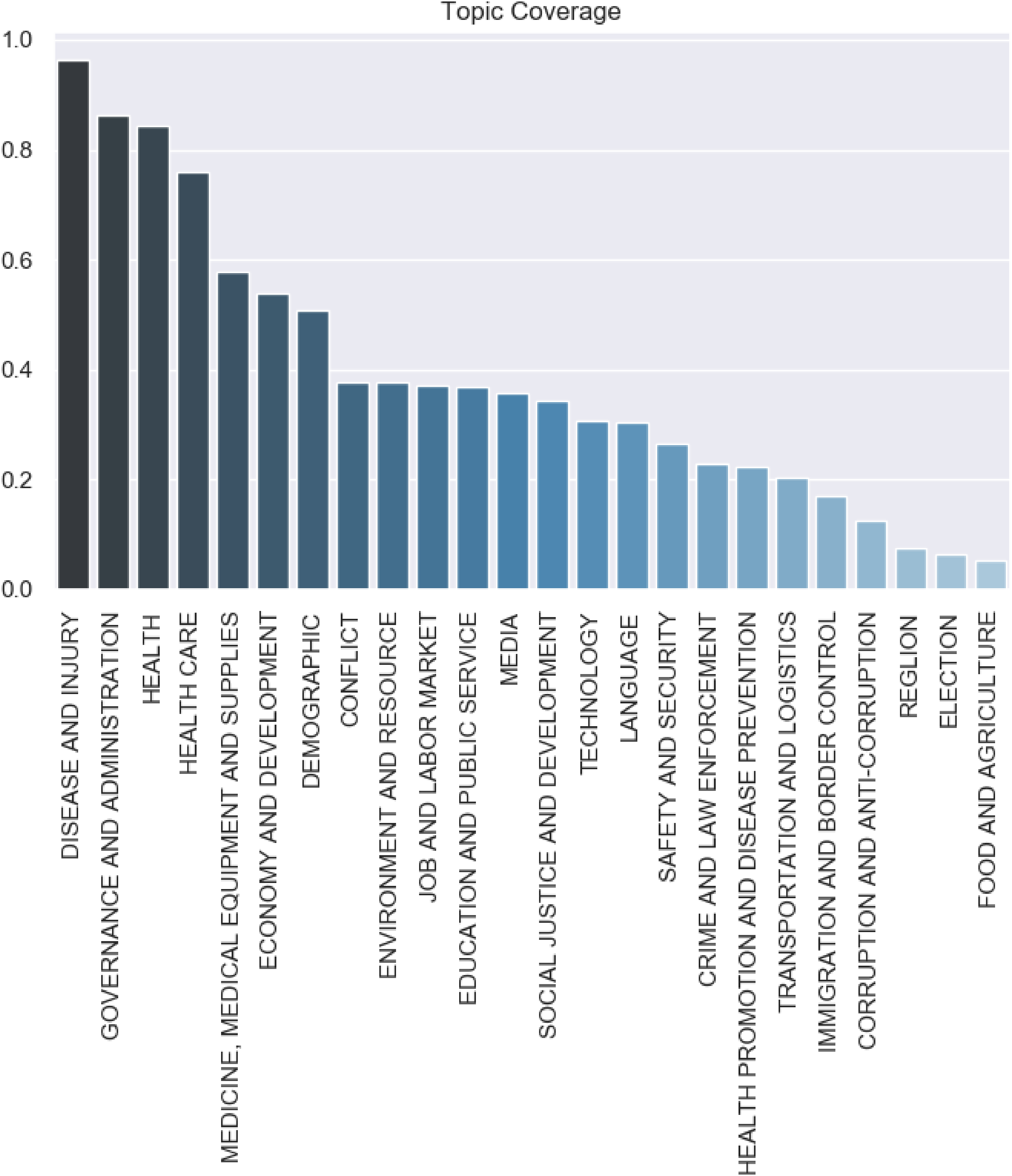
Coverage percentage of the 24 issues.
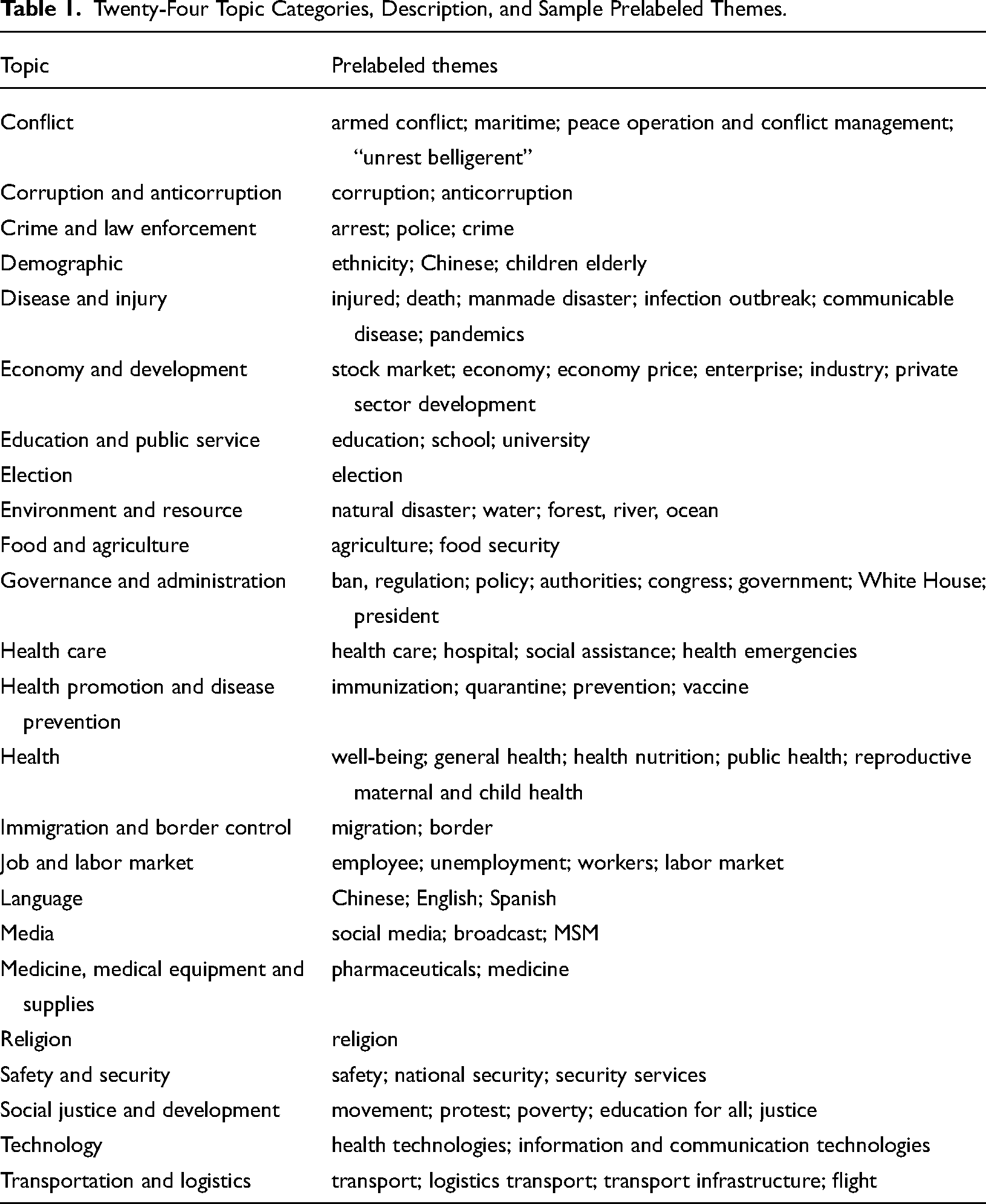
The first and fourth authors together browsed the 160 themes and created 22 distinct issue categories for COVID-19-related news. The categorization was compared with previous agenda-setting research (e.g., Guo et al., 2016) to thoroughly encompass the current issues facing the world. Then the first and fourth authors independently assigned the 160 GDELT prelabeled themes to one of the 22 issue categories, reaching an intercoder reliability of .92 (Krippendorff's α). The discrepancies were resolved after discussion. Table 1 shows the 24 issues, with examples of consisted themes. 4
Twenty-Four Topic Categories, Description, and Sample Prelabeled Themes.
Measure
Network data preparation and analysis
To make the data manageable while preserving rich information and investigating possible diachronic changes, we selected three important dates of pandemic development: (a) January 30, 2020 (declaration of global emergency by WHO), (b) the day with the highest daily increase for each country, and (c) the day with the lowest daily increase for each country. For example, the first time point for Austria is January 30, 2020, which is a fixed date for all countries. The second point is March 26 with the highest daily increase of 1,321, and the third point is June 9th with the lowest daily increase of 11 (if two or more days reported the highest or lowest daily increase, the first date is selected). In this way, the outbreak trajectory is divided into four phases: (a) before the announcement of a global emergency, (b) an upward trend to the spike, (c) a downward trend as strong evidence of effective control measures, suggesting “Sustained decline in infection rates” and (d) a rebound 5 possibly indicating a “postpeak fluctuation phase” (Fang et al., 2020).
The unit of analysis is each news item, which was analyzed for the 24 issues. The connection among issues was operationalized as the co-occurrence of two given issues in one article. Then network matrices were built to reflect the times of co-occurrence of issues in each country's media, and further divided into four phases as described above.
Figure 2 provides an example matrix, which illustrates the network issue agenda of Germany for Phase 1. Each letter represents an issue, and the number in each cell represents the connection value between the two corresponding issues. For example, the cell associated with A and B is 38, which means that A-death and B-conspiracy were mentioned 38 times in the same news items. Likewise, the cell that corresponds to control measure and medicine is 0, meaning that no news item in this country mentioned control measure and medicine in the same news item. These two issues had no connection. Notably, the matrix is symmetrical because this study does not consider the directions between issues.
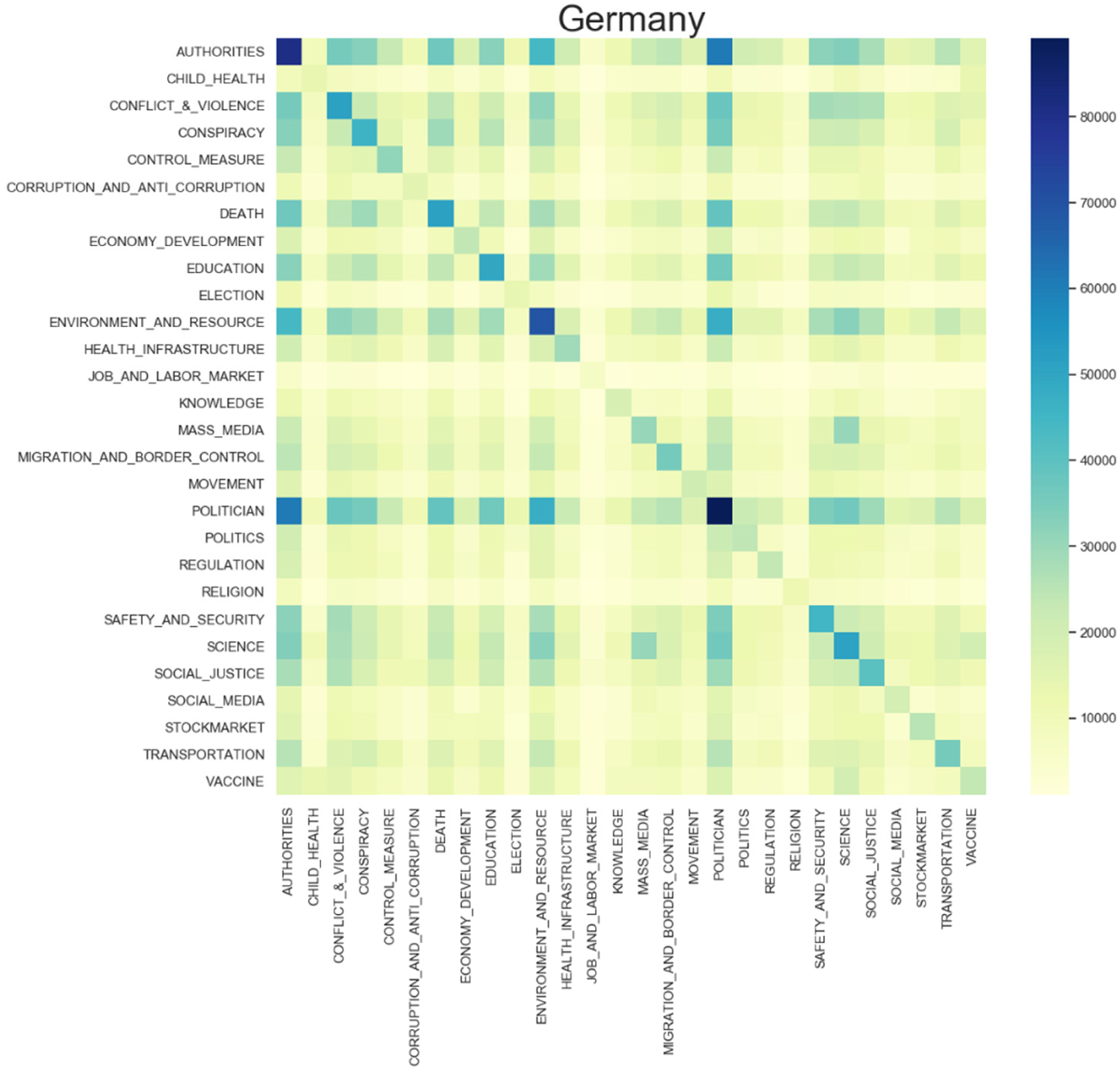
The issue matrix of Germany.
As the last step, bivariate quadratic assignment procedure (QAP) analysis was carried out to compare the networks of the different countries with UCINET for four phases, respectively (Borgatti et al., 2013). This analysis determines whether two network structures are significantly related to each other (Mantel, 1967). Unlike a traditional least-squares estimation, which is based on the assumption of independence, a QAP is a permutation-based nonparametric test that preserves the integrity of the observed structures (Krackhardt, 1987). In the bivariate QAP, we aimed to test the association between two network variables X and Y, that is, where X and Y are the observed network matrices. This analysis addresses the strength and specification of ties from one network to another and calculates a correlation coefficient (Simpson, 2001).
Media tone measure
Media tone was computed using a computerized text analysis program designed specifically to assess the tone of media content. This process involves measuring media tone through the application of linguistic polarity lexicons (Hatzivassiloglou, 1997; Turney, 2002; Wiebe, 2000). Polarity lexicons consist of extensive lists of phrases, each of which encodes a specific emotional tone. These phrases are categorized based on their sentiment, allowing for a nuanced understanding of the language used in media. Each phrase within these lexicons is assigned a value that ranges from −1 to 1, indicating its polarity as either positive or negative. Additionally, these values often include a score that reflects the intensity or magnitude of the sentiment expressed (Taboada et al., 2011; Turney, 2002; Young and Soroka, 2012).
Time series analysis
Bidirectional F-type Granger causality tests were performed to examine the mutual causal relationships between media coverage and epidemiological data of major countries (Granger, 1969; Soroka, 2002). Granger causality test is a time series modeling tool which estimates the impact of one variable on another. Variable X is said to “Granger cause” variable Y, if the present values of Y are better predicted from the past values of X and Y than solely the past values of Y (Hamilton, 1994). We tested 18 major countries’ causal relationships between media reports and daily increase number. The media coverage was measured in the dimensions of news item counts, polarity index, positive tone, negative tone, and generic affective words. Considering COVID-19's incubation time and testing turnaround lagging, we identify the optimal time lag to be 14 days. 6
Results
To answer RQ 1, Figure 1 shows that the issue of disease and injury was covered the most across all the countries, followed by issues of governance and administration, health, and health care. Each issue took up more than 80% of the coverage. Subsequently, issues of medicine, medical equipment and supplies, economy and development, and demographics occupied more than 50% of the coverage. As Table 2 shows, all the countries are strongly associated with one another (rs > 0.984). China exhibits a different pattern from all other countries (0.598 < rs < 0.742).
Correlations Between Countries’ Issue Matrices.
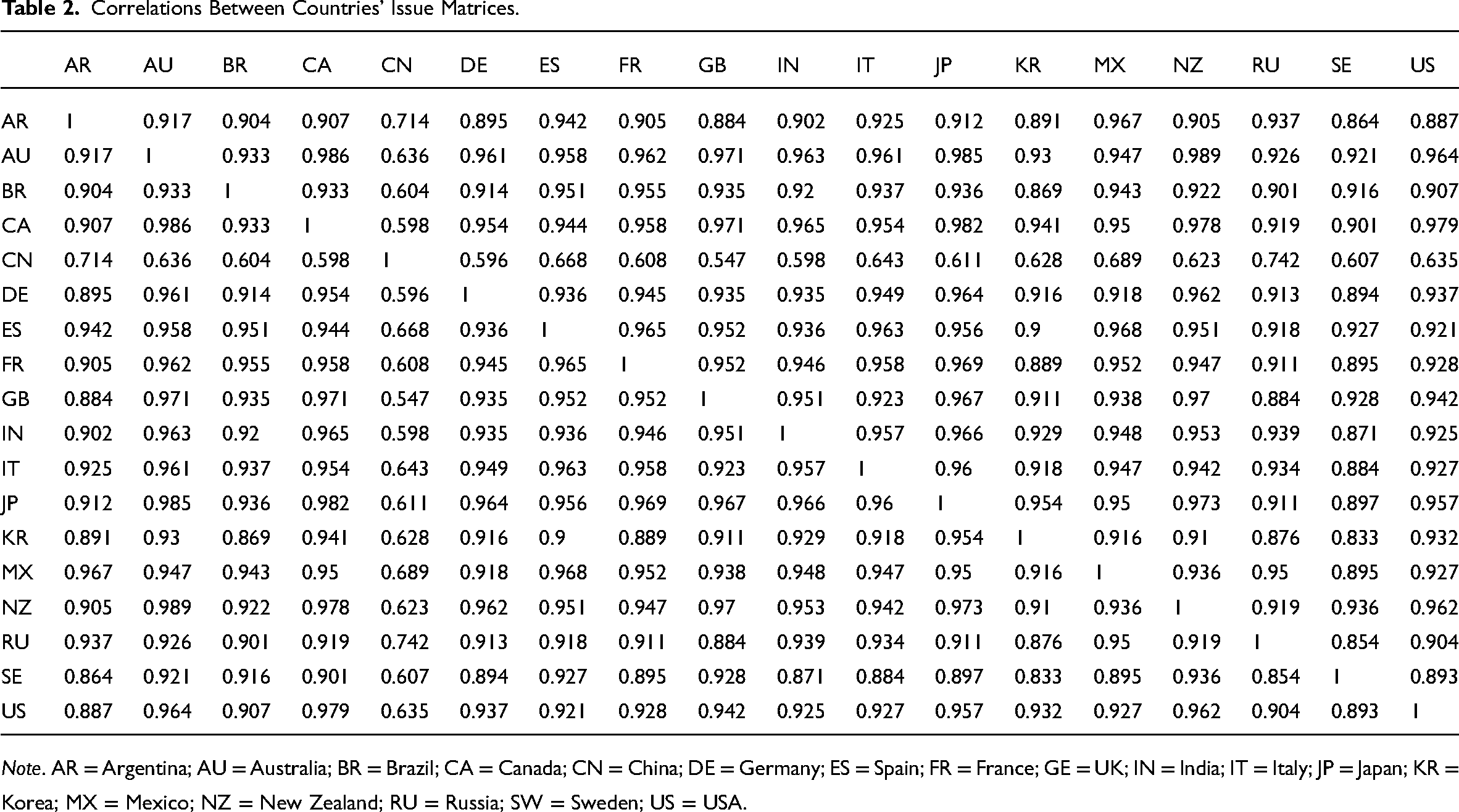
Note. AR = Argentina; AU = Australia; BR = Brazil; CA = Canada; CN = China; DE = Germany; ES = Spain; FR = France; GE = UK; IN = India; IT = Italy; JP = Japan; KR = Korea; MX = Mexico; NZ = New Zealand; RU = Russia; SW = Sweden; US = USA.
Causal relationship between media coverage and epidemiological data
To examine RQ3 and RQ4, our pairs of bidirectional Granger causality tests were performed to identify the relationship between media coverage and daily increases. The results are shown in Table 3. First, media coverage was found to affect the epidemiological data in six countries, including Australia, China, the United Kingdom, South Korea, New Zealand, and Sweden, and the reserved causal relationships were not found to be statistically significant. However, media tones and language use differentially affected the epidemiological situation in each country. In Australia, the polarity (χ2 = 1.56, df = 14, p < .10) was associated with the daily increase. The negative tone of media reports in both China (χ2 = 1.88, df = 14, p < .10) and the United Kingdom (χ2 = 1.64, df = 14, p < .10) correlated with the daily increase. In South Korea, the positive tone of media report was associated with the epidemiological data (χ2 = 1.61, df = 14, p < .10). In New Zealand, all dimensions correlated with the country's daily increase, including polarity (χ2 = 1.82, df = 14, p < .05), affective words (χ2 = 1.96, df = 14, p < .05), negative tone (χ2 = 1.95, df = 14, p < .05), and positive tone (χ2 = 1.90, df = 14, p < .05).
Granger Analysis Between Media Language Use and COVID-19 Daily New Cases.
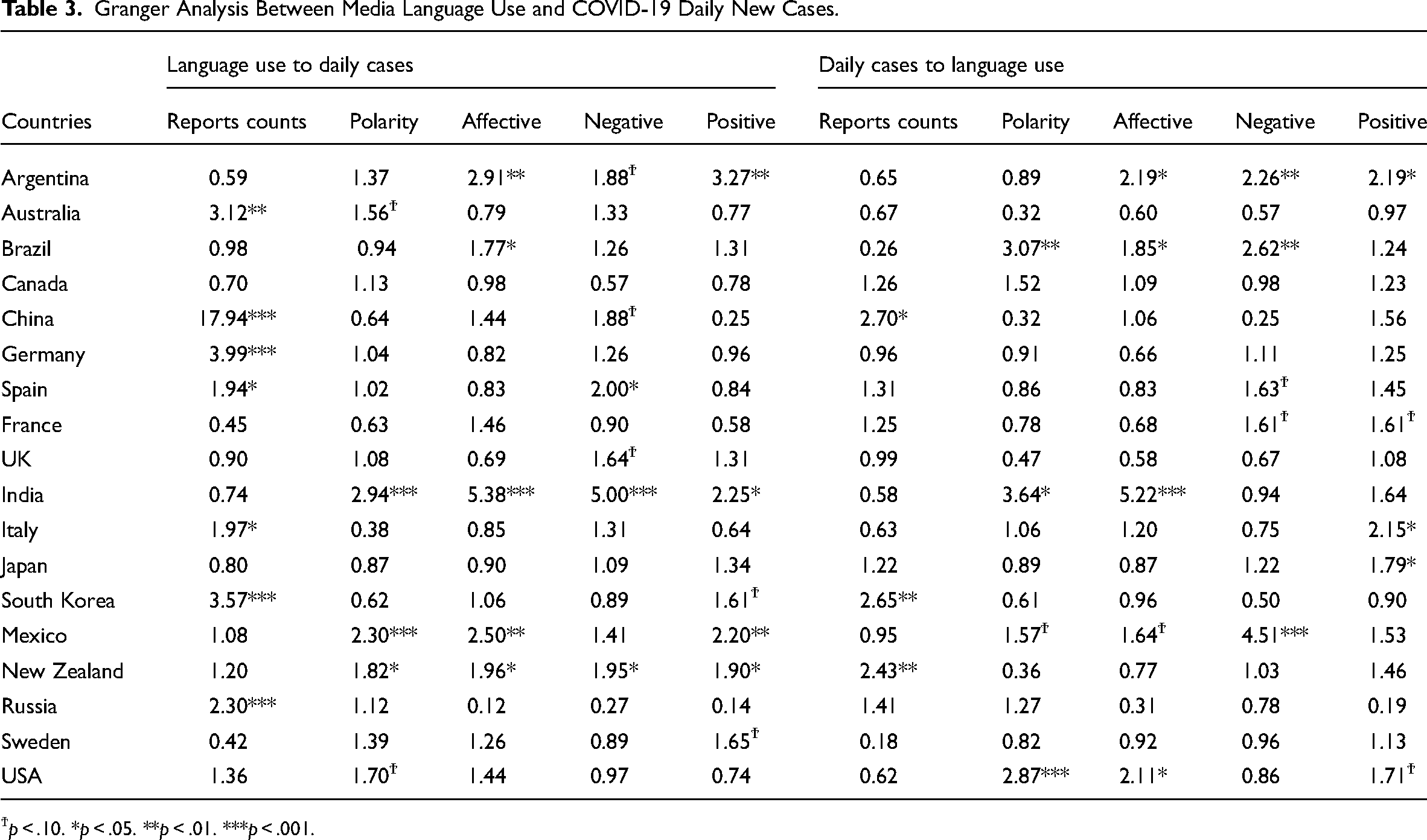
p < .10. *p < .05. **p < .01. ***p < .001.
The report counts in Germany (χ2 = 3.99, df = 14, p < .001) and Russia (χ2 = 2.30, df = 14, p < .001) was associated with the country's daily new cases. In the United Kingdom, it is the negative tone of the media report correlated with the daily increase (χ2 = 1.64, df = 14, p < .10), whereas in Sweden it is the positive tone of their media reports (χ2 = 1.65, df = 14, p < .10).
In France, Italy, and Japan, no causal relationship was found for the direction from media reports to daily increases, but the reversed relationships were significant. Specifically, the daily increase in France was associated with both positive (χ2 = 1.61, df = 14, p < .10) and negative tone (χ2 = 1.61, df = 14, p < .10) of their media reports. The daily increase in both Italy (χ2 = 2.15, df = 14, p < .05) and Japan (χ2 = 1.79, df = 14, p < .05) was associated with the positive tone of the media reports.
Both directions were found to be significant in six countries. Specifically, the emotion tone and affective words used in Argentina (χ2 > 1.79, df = 14, p < .05), Brazil (χ2 = 1.77, df = 14, p < .05), Mexico (χ2 > 2.20, df = 14, p < .05), and India (χ2 > 2.25, df = 14, p < .05) correlated with the country's daily increase. The polarity index was found to be associated with the daily increase in the United States (χ2 = 1.70, df = 14, p < .10), India (χ2 = 2.94, df = 14, p < .001), and Mexico (χ2 = 2.30, df = 14, p < .01). On the other side, the daily increase also correlated with polarity (Brazil, χ2 = 3.07, df = 14, p < .01; India, χ2 = 3.64, df = 14, p < .05; Mexico, χ2 = 1.57, df = 14, p < .10; United States, χ2 = 2.87, df = 14, p < .001), negative tone use (Argentina, χ2 = 2.26, df = 14, p < .01; Brazil, χ2 = 2.62, df = 14, p < .01; Spain, χ2 = 1.63, df = 14, p < .10; Mexico, χ2 = 4.51, df = 14, p < .001), and positive tone use (Argentina, χ2 = 2.19, df = 14, p < .05; United States, χ2 = 1.71, df = 14, p < .10). No causal relationship was found in either direction in Canada, Germany, or Russia.
Discussion
By exploiting a near-complete corpus of content from the global media, the current study adopts a big data-driven approach, and overcomes the limitations of small-scale, manual content analyses of online text. This study aims to identify country-level differences in media coverage of COVID-19 by analyzing a near-complete corpus of media reports from around the world. In addition, most research relied on manual content analysis and therefore was only able to examine news coverage from a limited number of countries, or for a short period of time. As COVID-19 is a global infectious disease, it is necessary to expand the research scope beyond countries and continents. In light of this limitation of not considering emerging media in the existing international news flow literature, and with the advent of big data computer-assisted content analyses, this study seeks to conduct a more comprehensive analysis of international news flow by including various online news sources, both traditional and emerging, from a large number of countries.
The findings from the analysis of media coverage on various issues across different countries carry significant implications. Notably, the overwhelming focus on disease and injury, followed by governance and administration, health, and health care, reflects the global media's attention to health-related concerns. This highlights the pressing nature of these issues and their pervasive impact on societies worldwide. The substantial coverage of medicine, medical equipment and supplies, economy and development, and demographics further underscores the interconnectedness of these themes with the broader discourse on health crises. The strong associations among all countries, as evidenced by correlation coefficients exceeding 0.984, suggest a shared global narrative and collective awareness regarding the prominent issues. However, the distinctive pattern observed in China, with correlation coefficients ranging between 0.598 and 0.742, indicates a unique media landscape and potentially divergent priorities within the country. This raises questions about the factors influencing media agendas and the implications of such variations for global understanding and cooperation. Exploring these differences can provide valuable insights into the shaping of public perception, policy responses, and international collaboration in addressing global challenges.
The outcomes of the bidirectional Granger causality tests, conducted to examine the relationship between media coverage and daily increases in various countries, unveil nuanced dynamics with implications for public understanding and response to the COVID-19 pandemic. The identification of Granger causality from media coverage to epidemiological data in Australia, China, the United Kingdom, South Korea, New Zealand, and Sweden underscores the influence of media narratives on the perception of health-related situations. However, the absence of statistically significant reserved causal relationships indicates a unidirectional impact of media coverage on daily increases. The differentiated effects of media tones and language use on epidemiological situations highlight the complexity of this relationship. For instance, the polarity of media reports in Australia, negative tones in China and the United Kingdom, and positive tones in South Korea were found to cause variations in daily increases. New Zealand exhibited a multifaceted influence, with dimensions such as polarity, affective words, negative tone, and positive tone all contributing to the country's daily increase. These findings emphasize the need for a nuanced understanding of the media's role in shaping public perceptions and responses, suggesting that the tone and language used can have varying impacts on the interpretation of epidemiological data.
The outcomes of the bidirectional Granger causality tests shed light on the intricate relationship between media reports and daily increases in the context of France, Italy, Japan, and several other countries. In France, Italy, and Japan, no direct causal link was identified from media reports to daily increases, but reversed relationships were significant. Notably, the daily increase in France influenced both positive and negative tones in media reports, 7 indicating a complex interplay between epidemiological trends and media narratives. Similarly, in Italy and Japan, the daily increase caused a positive tone in media reports, 8 suggesting a responsive media discourse to evolving health situations.
Conversely, in six countries, including Argentina, Brazil, Mexico, and India, significant causal relationships were observed in both directions. Emotional tone and affective words in these countries were found to influence the daily increase, illustrating the reciprocal nature of media and public health dynamics. Moreover, polarity indices played a role in causing daily increases in the United States, India, and Mexico. Simultaneously, daily increases influenced polarity, negative tone use, and positive tone use in various countries, showcasing the multifaceted impact of health data on media reporting and vice versa.
These interesting differences could be understood from the aspects of contextual factors, public health communication strategies, policy implications, and cultural dimensions. First, our findings reveal significant country-level differences in the relationship between media coverage and COVID-19 case numbers. These differences can be attributed to various contextual factors, including historical experiences with epidemics, political landscapes, and trust in institutions. For instance, in South Korea, positive media tone caused increases in case numbers. This finding aligns with Kopecka-Piech and Łódzki (2022) 's observation that positive media coverage, intended to boost morale, may have inadvertently led to reduced vigilance in following preventive measures due to a sense of complacency. This “trust paradox” (You, 2020) highlights how high institutional trust can sometimes lead to unintended consequences in crisis communication. In contrast, in countries like the United Kingdom where negative tone caused daily increases, the political context may have influenced public reception of media messages. Hartmann et al. (2021) demonstrated how political polarization in COVID-19 news coverage affected public perception and response to the pandemic. The negative tone might have exacerbated existing political divisions, leading to varied public responses and ultimately affecting case numbers. Furthermore, in countries such as France, Italy, and Japan, where we found no causal relationship from media reports to daily increases (but rather the reverse), the level of trust in institutions might be a key factor. Devine et al. (2021) found that in countries with high trust in government institutions, official communications had more impact than general media coverage on public behavior and case numbers. This could explain why media coverage in these countries seemed to follow rather than lead changes in case numbers.
Cultural dimensions also play a role in how media coverage influences public response and, consequently, case numbers. The variations we observed across countries might be partially explained by these cultural factors. For example, in collectivist cultures like China, where we found negative tone causing increases in cases, Oshitani (2020) notes that media messages emphasizing social responsibility and group harmony might be more effective in promoting preventive behaviors. Huynh (2020) found that in countries with high uncertainty avoidance, clear guidelines and expert opinions in media coverage had a stronger influence on public behavior. This might explain the strong causal relationships we found in countries like New Zealand, where all dimensions of media coverage caused changes in daily case increases. In countries with low power distance, like Sweden, where we found positive tone causing changes in case numbers, Dutta-Bergman (2004) suggests that media coverage including diverse voices and perspectives might be more influential than top-down messaging from authorities.
Theoretically, our results offer some nuanced insights into NAS Model. Firstly, our results, derived from network analysis, reveal an intricate interplay among different issues within the media's portrayal of COVID-19. This pattern of interconnectedness suggests a strong associative structure in media narratives, where prominent issues like disease and injury, governance and administration, and health and healthcare were not discussed in isolation but were intertwined within the public's cognitive schemas and information processes. These findings echo the fundamental assumption of NAS's third level, which posits that media coverage can influence the connections between different issues (Guo et al., 2012). Secondly, we explored the directionality of these connections. Our Granger causality tests indicate a bidirectional relationship between media tone and epidemiological trends in certain countries. This suggests that while media coverage can influence public behavior and health outcomes, the state of the pandemic also shapes media narratives. This reciprocal relationship supports the NAS's assertion that media effects are not unidirectional but dynamic (Su et al., 2020; Vargo & Guo, 2017). Thirdly, the tone and polarity of media coverage, as indicated by our sentiment analysis, offer insights into the affective dimensions of the NAS. A negative media tone may increase the salience of an issue, potentially leading to policy changes or public behavioral shifts. Conversely, a positive tone may reassure the public, potentially reducing perceived urgency (Vargo et al., 2014; Vargo & Guo, 2017).
From a practical perspective, our findings have important implications for public health communication strategies. In countries where negative media tone correlated with increased cases (e.g., China and the United Kingdom), we recommend a more balanced approach to reporting. Anwar et al. (2020) emphasize the importance of responsible reporting in public health communications during the COVID-19 pandemic. They suggest pairing reports on case numbers with information on effective prevention strategies and recovery rates to provide a more comprehensive picture. For countries where positive tone was associated with changes in case numbers (e.g., South Korea and Sweden), maintaining this approach while supplementing it with clear, factual information could be beneficial. Lwin et al. (2020) found that positive sentiments in social media discussions were associated with better public compliance with health measures.
Besides, our findings can inform policymakers’ communication strategies during health crises. In countries where we found strong relationships between media coverage and cases, such as the United Kingdom and Australia, Sanders et al. (2020) suggests that more frequent and transparent media briefings could ensure accurate information dissemination and build public trust. In countries with bidirectional relationships, like Argentina, Brazil, Mexico, India, and the United States, policymakers should be aware of the potential feedback loop between media coverage and case numbers. Finset et al. (2020) emphasize the importance of using multiple communication channels, including social media and community outreach programs, to reach diverse populations effectively and manage this complex dynamic.
There are several limitations should be noted. The present study is in no way exhaustive and can be extended in various ways: First, for example, to investigate the case in which there is media coverage but people ignore it (in which case the vaccination rate is unchanged despite the control). Thus, the effects of media on an outbreak of influenza with a partially effective vaccine may be complicated. While the media may encourage more people to get vaccinated, they may also trigger a vaccination panic or promote overconfidence in the ability of a vaccine to fully protect against the disease. This may have potentially disastrous consequences in the face of a new pandemic. Second, our study mainly focused on the relationship between frames and pandemic progression, informed by theory and methodology. Still, we admit that themes may significantly influence public responses, suggesting that the link between themes and incidence rates is an important avenue for future research. Third, as an exploratory study, we didn’t prove the causal relationship exist between media coverage of COVID-19 and incidence rate. Moreover, there seems to be an ecological fallacy in our study, as we posited that increased awareness of issue salience can boost public engagement with health measures, such as vaccinations and safety protocols (Chen et al., 2021; Goh et al., 2022). This collective behavioral shift may subsequently impact infection rates at the group level. Acknowledging the complexity and possible intervening variables, we propose that future research could gain a more nuanced understanding through longitudinal studies tracking individuals’ media consumption, beliefs, behaviors, and health outcomes over time. We also suggest implementing mixed-methods approaches that combine quantitative analysis of media content and case numbers with qualitative research on how individuals interpret and respond to media coverage. Lastly, this study's timeframe was focused on the early phase of the pandemic (December 31, 2019 to September 11, 2020), which we believe is crucial because it captures the initial, critical stages of the pandemic. During this period, there was rapid information evolution and high uncertainty, and the media's adaptation and communication were pivotal. However, we acknowledge that a study encompassing a more comprehensive timeframe could potentially yield broader implications. Future studies may benefit from using our findings as a comparative baseline.
Footnotes
Declaration of conflicting interests
The authors declared no potential conflicts of interest with respect to the research, authorship, and/or publication of this article.
Ethical statement
This research adheres to the principles outlined in the Declaration of Helsinki, even though it does not involve direct collection of data from human subjects. Our study utilizes big data and automated content analysis methods to analyze publicly available media reports on COVID-19. Hence, it does not require individual informed consent, as no personal data is being collected or analyzed.
Funding
The authors received no financial support for the research, authorship, and/or publication of this article.
