




Abstract
The advancement of technology has seen the growth of online news platforms where users can interact and share their views in the comments section. The comments section, therefore, has become a site for the expression of divergent views, leading to linguistic practices such as verbal attacks. This study sourced data from GhanaWeb, an online news platform that focuses on sociopolitical occurrences in Ghana, to demonstrate how users rely on insults, alongside other strategies like endorsement, irrelevancy claims, ill-wishes and unpalatable questions to create enmity with the out-group and build solidarity with the in-group. It was also found that there were cases where two participants or commenters who seem to share the same viewpoint were challenged by a third participant. This study makes a fair contribution to the emerging research on the linguistic practices on online communication platforms and highlights areas for further inquiry.
Introduction
Today, digitalisation has transformed the way news is produced, consumed and deliberated, with online news platforms serving as a major medium for public discourse, providing a space for readers to engage in debates, express opinions and interact with each other in the comments section (Boczkowski et al., 2018; Wright et al., 2020). Because online news platforms are interactive, everyone with internet access can now take part in public discourse, democratising the public realm (Toepfl & Piwoni, 2015). As more people with different viewpoints and ideas participate in online conversations, this democratisation has also increased conflicts among users (Vargo et al., 2017).
Conflicts in online discussions are not inherently negative, as they can stimulate critical thinking, promote diverse viewpoints and foster democratic debate (Barnidge, 2017). However, when a conflict devolves into personal attacks, insults, hate speech or trolling, it can undermine the quality of the discussion and deter individuals from participating (Gagliardone et al., 2015). Several factors contribute to the prevalence of verbal conflicts in online news comments. One is the pseudonymity offered by these platforms, which gives users the confidence to voice divisive views and act aggressively (Lumsden & Morgan, 2017). The divisive character of many internet debates is another factor that might intensify conflicts and deter compromise (Barberá et al., 2015). The lack of face-to-face interaction in online discussions can also lead to misunderstandings and escalate conflicts (Hmielowski et al., 2014).
In Ghana, such antagonistic verbal behaviour has been noted in political discourse on both traditional and online news media platforms (Ofori, 2015, 2017; Ofori et al., 2021; Thompson, 2019, 2020, 2021a, 2021b). On online news platforms, in particular, it has been reported that verbal attacks are used against political figures, albeit this contravenes the sociocultural norms of the people, and that some users serve as regulatory figures who enforce these norms by using both confrontational and defensive strategies. The present study argues that these verbal attacks form part of a general solidarity framework where they serve to distance the in-group (i.e., the us) from the out-group (i.e., the other).
The study focuses on political discourse on GhanaWeb, a news website developed in Finland in the early 1990s by a Ghanaian exchange student and currently ran in the Netherlands (Otu, 2021). News on GhanaWeb focuses mainly on Ghanaian sociopolitical issues, and the platform has a comments section where users can express their views under pseudonymous identities. The news often generates polarised comments (Thompson, 2019, 2020, 2021a, 2021b), demonstrating attempts by users to solidarise with certain individuals on the platform, which is then extended to specific sociopolitical ideologies and groups in Ghana. It is this solidarity that the present study focuses on. The rest of the paper first situates this research in the relevant theoretical frameworks, followed by a synthesis of previous related research, a description of the methodology, a presentation of the findings, a discussion of the findings and, finally, a conclusion.
Theoretical underpinnings
This study draws insights from an eclectic theoretical foundation, incorporating the performative theory of solidarity discourse and the theory of impoliteness, both of which are explained in this section.
The performative theory of solidarity discourse
The performative theory of solidarity discourse, developed by Alharbi (2018), provides cogent explanations for the findings of the present study. It is challenging to offer a comprehensive definition of solidarity due to its broad and difficult-to-map boundaries (Prainsack & Buyx, 2011). To address this, the present study adopts a definition by Alharbi (2018, p. 2) which conceptualises solidarity as a social practice, specifically as a discourse: Solidarity is a relational (reciprocal) term that can imply resistance, support, social cohesion, and anticipation for the future. It requires self-recognition, shared interests, goals, causes, enemies, or danger, as a common cause, ground, or interest to achieve consubstantiality, commonalities, or sameness/oneness, which in turn achieves solidarity.
According to Alharbi (2018), when considered a performative discourse, solidarity then gains the potential to perform a specific role (i.e., to solidarize people) while being constitutive (i.e., generating alignments).
As Alharbi and Rucker (2023) have noted, solidarity as a social practice has some characteristics. Specifically, solidarity arises from people's interactions within a particular context and from their deliberate and thoughtful choice, in that people, groups or communities actively choose, for particular reasons in a particular setting, to forge a bond of solidarity with one another or with other people, groups or communities. Furthermore, it entails a mutual connection or commitment that individuals knowingly have to one another on the basis of certain generally intensified similarities or interests which are constantly shaped by the demands of a particular circumstance. Consequently, over time, social factors and events may either strengthen or diminish group cohesiveness. Additionally, solidarity involves some form of support and actions that are linguistically expressed in various interpersonal contexts.
The performative theory of solidarity discourse is built on eight assumptions. First is the assumption that the discourse of solidarity entails a commissive act, as people who promote solidarity signal their willingness to commit to a common goal. In addition, depending on the context, solidarity thrives on either personal/emotional or institutional/policy support targeted at the common goal. Moreover, solidarity entails identification with a group and similarly concerns finding common grounds (e.g., interests, beliefs) with the group. Furthermore, solidarity discourse entails regrouping, as individuals put away other differences to align themselves with a common purpose. Another characteristic of solidarity discourse is its assertiveness. Here, the individual represents a reality that strengthens group unity. Also, solidarity discourse is conveyed through storytelling. Specifically, the stories are used as evidence to build arguments in line with the asserted reality and enhance group cohesiveness. Ultimately, solidarity discourse has a persuasive intent (Alharbi, 2018; Alharbi & Rucker, 2023; Wei, 2024).
Empirical work by Alharbi and Rucker (2023) identified some linguistic/discursive means of attaining solidarity. First, solidarity can be achieved by means of first person inclusive pronouns, personal and impersonal collective nouns, and spatialisation, all of which signal plurality and assimilation. Second, there is a reliance on evaluative resources to (a) praise the self or one's support, (b) to attack the out-group and (c) to praise the in-group. Third, representation is achieved by (a) signaling a strong bond between groups (i.e., intertwined representation), (b) presenting the groups as having a common enemy and (c) signaling one's standpoint in relation to topics discussed. Fourth, endorsement involves an individual verbally showing support for the ideologies of the group. Finally, storytelling is effective in attracting and engaging the audience to attain persuasion (Alharbi, 2018; Alharbi & Rucker, 2023).
In the present study, GhanaWeb is considered as a social domain of competing interests and ideologies, where participants use language to show solidarity, and this specifically aligns with the ultimate goals of this theory. Thus, the theory is appropriate to attain the objectives of the present study.
Impoliteness
As mentioned earlier, solidarity entails negative appraisal of the other or the out-group. In particular, because research has explained this negative appraisal through the lens of impoliteness, this study complements the performative theory of solidarity discourse with the theory of impoliteness, specifically its applications to interactions on multiparticipant online platforms like GhanaWeb (see Bousfield, 2007; Dobs & Blitvich, 2013; Thompson et al., 2024).
The theory of impoliteness, as used in this paper at least, originates from work by Culpeper (Culpeper, 1996, 2010, 2011; Culpeper et al., 2017), who defined impoliteness as “a negative attitude towards specific behaviors occurring in specific contexts” (Culpeper, 2011, p. 23). Culpeper (1996, p. 356) initially classified impoliteness strategies into bald on record, positive impoliteness, negative impoliteness, off-record and withhold the face-threatening act, and later revised them into 11 impoliteness formulae, as shown in Table 1.
Conventionalised impoliteness formulae.
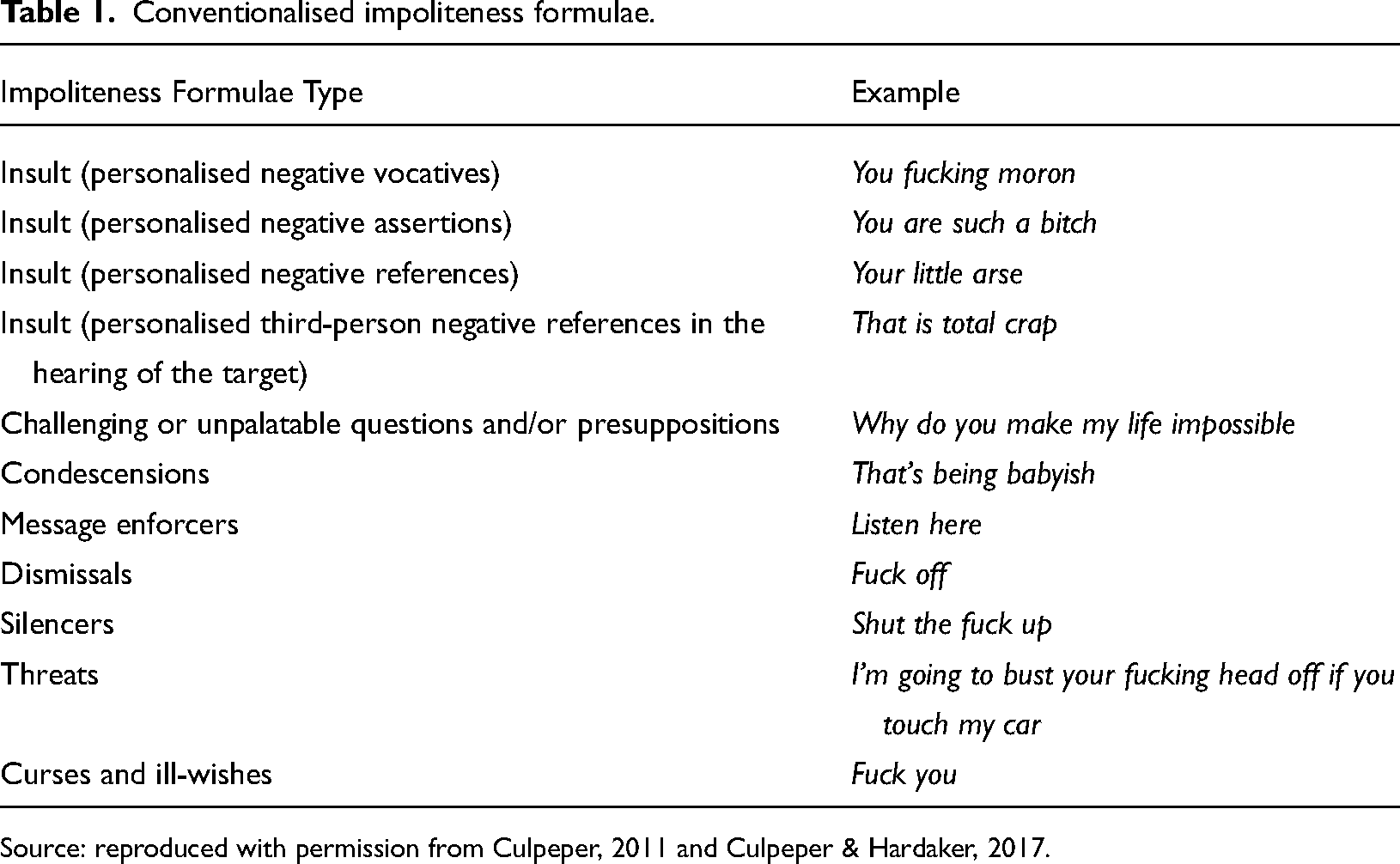
Source: reproduced with permission from Culpeper, 2011 and Culpeper & Hardaker, 2017.
As face-to-face communication is usually bidirectional, Culpeper et al. (2003) developed another model to cater for the responses that impolite acts are likely to trigger from the target. This model on responses to impoliteness specifically shows that a recipient of an impolite act may decide whether or not to respond and if they choose to respond, they may do so either defensively or offensively.
An important contribution to the theory came from work by Dobs and Blitvich (2013) on response options in polylogal communication (i.e., communication involving more than two participants). Their data of small-group interactions showed that responses to impolite acts do not always come from the attacked but also from witnesses, who may choose to either respond or not. A witness that chooses to respond has the options of reacting, corroborating opposition or denying opposition which can be achieved by proposing a compromise or countering the opposition. This is particularly important to the present study as interactions on GhanaWeb entail multiple participants sharing oppositional beliefs and attitudes. This also suggests that both the attacked and witnesses may use strategies to either corroborate or oppose views, and by so doing, attain solidarity with specific individuals or groups.
Solidarity building in the media space
This section examines the broad literature on solidarity building on the internet, looking beyond work involving the performative theory of solidarity discourse, in order to provide a solid empirical grounding for this research. Research on solidarity building and contestation online has evolved around themes such as refugees (e.g., Cinalli et al., 2021; Kreis, 2017; Smith et al., 2018; Trenz et al., 2020; Weber et al., 2024), migration (e.g., Wallaschek, 2020), politics (e.g., Zappavigna, 2011) and so on.
In research on the framing of refugees on the then Twitter, now X, it was found that certain strategies were adopted to express anti-refugee sentiments. Importantly, the analyzed tweets contained the strategies of nomination and predication. For example, negative labels such as terrorists and criminals were ascribed to the refugees and migrants. Moreover, the tweeters adopted a viewpoint of people who opposed pro-refugee policies, evident in such grammatical strategies as the passive voice, and some tweeters employed multimodal affordances to express anti-refugee views (Kreis, 2017). Although this study did not explicitly claim association with the concept of solidarity, the strategies identified were almost the same as some of the strategies in Alharbi's (2018) performative theory of solidarity discourse. For instance, negative nomination with insulting words functions to attack the other. This strategy similarly falls within the scope of the impoliteness theory (Culpeper, 1996, 2010, 2011; Culpeper et al., 2017).
Other findings from Twitter have pointed to a reduction of solidarity with refugees in 2022 as compared to 2015 (Weber et al., 2024). In addition, a research study by Wallaschek (2020) draws attention to solidarity in the discourse on the migration crisis in Europe as expressed in two leading newspapers in Germany. The study relied on a mesodiscursive framework which categorised solidarity into political, social, cultural, legal, economic, monetary and misuse dimensions, each of which was examined at local, national, international and global levels. The study discovered a preponderance of political solidarity in the crisis. Specifically, there were references to the establishment of political mechanisms for cooperative purposes. Similarly, for cultural solidarity, attention was paid to shared values. Despite the insightful findings of this study, its approach was essentially thematic, and in contrast to the present study, the linguistic strategies were not systematically analysed.
In the domain of politics, the present study relates closely with the work of Zappavigna (2011), who, relying on the concept of ambiance affiliation as conceptualised within systemic functional linguistics, analysed the meanings expressed in tweets made shortly after the declaration of Barack Obama as President of America. The study highlighted that affiliation can be strengthened by the use of graphological strategies such as repeated exclamations and capitalisation. Also, association with Obama was realised with positive evaluative lexis, particularly those related to judgement (i.e., evaluation of a person's behaviour based on some social norms) and affect (i.e., expression of feelings). This positive evaluation was given a boost by the use of hashtags which helped to connect all those who shared the propagated values.
As Zappavigna's (2011) work showed, negative appraisals were sparely used in the tweets, and when used, they tended to create an oppositional relation to views that were against Obama's victory. This finding echoes the findings of recent studies on abusive language in the media and most importantly in the online space (Chiluwa & Ifukor, 2015; Faria, 2023; Hansson et al., 2022; Thompson, 2019, 2020, 2021a, 2021b; Thompson et al., 2024). Some of these studies have considered insults as a negative evaluation of the target, focusing on issues relating to their abilities, honesty, resoluteness and aesthetic value (Faria, 2023; Hansson et al., 2022). Thompson (2020), for example, showed that by using insults, interactants in the online space are able to evaluate the activities of politicians. Thompson et al. (2024) have also shown that counter insults can serve as a means of ensuring social order in online news comments sections.
Other strategies identified include humour (Baxter, 2018), words of support and encouragement, and stories about mundane experiences (Jackson et al., 2017). These studies show that these strategies are used among people suffering from cancer and members of the lesbian, gay, bisexual, transgender and queer (LGBTQ) community. In all, these studies shed light on how individuals linguistically express their association with a particular group based on shared interests. The present study contributes to this emerging literature by focusing on Ghana, where work on solidarity in media discourse is rare, though research on impoliteness has recently gained some momentum . Adopting an eclectic lens of the performative theory of solidarity discourse and impoliteness particularly helps to offer a detailed analysis.
Methodology
Background to the data: LGBTQ in Ghana
Ghana, a sub-Saharan African country, serves as the sociocultural background for this study. In Ghana, homosexuality is frowned upon, with individuals who idenitify as such suffering various levels of homophobic attacks, including stereotyping, physical abuse, verbal abuse and expulsion from school, though there is no legislation proscribing the practice (Odoi, 2022). Furthermore, homosexuality is considered un-Ghanaian and it is believed that the practice of same-sex relations is alien to African cultural norms. As a result, the practice is linked to the degeneration of morality among the youth. Similarly, others have blamed colonialism and sex tourism for introducing this alien value to the Ghanaian society. In addition, the United Kingdom and the United States have been suspected of intending to use diplomacy and aid to promote homosexuality in Ghana (Baisley, 2015).
Religion has also been used as a basis for arguments against the acceptance of LGBTQ in Ghana (Asante, 2020; Baisley, 2015; Dery et al., 2019). For example, some people believe that males and females were created by God distinctly for a particular purpose, procreation, which can only be fulfilled if each sex organ is used for the designated purpose (Dery et al., 2019). Relatedly, homosexuality is considered evil and associated with Satan himself. Thus, it is believed, the practice of homosexuality, if not completely eliminated, would attract the displeasure of God to the nation (Nartey, 2022). Supported by religious groups, the media amplify these concerns and frame the practice as destructive to the future of the nation. In effect, seeking a large share of media attention, politicians who identify with these religious groups endorse anti-homosexual views so as to get the support of the general public (Asante, 2020; Tettey, 2016).
In Ghana, concerns have always been raised about the promotion of LGBTQ activities, and this led to the introduction of an anti-LGBTQ bill for parliamentary deliberation in 2021 (Acquah et al., 2023). After about three years of parliamentary debate, the Human Sexual Rights and Family Values Bill was finally passed unanimously on 28th February, 2024. However, a lawyer soon challenged the bill in court with the argument that the parliament did not attain a quorum when it was passed. Subsequently, Nana Asante Bediatuo, the Executive Secretary to the president, sent a letter tothe parliament, forbidding them to send the bill for presidential approval until the legal issues associated with it are clarified. Few days later, Mr Alban Bagbin, the Speaker of Parliament, also refused approvals for ministerial nominations, citing an interlocutory injunction filed at the Supreme Court by the member of parliament for South Dayi, Rockson-Nelson Etse K. Dafeamekpor (City Newsroom, 2024).
The data
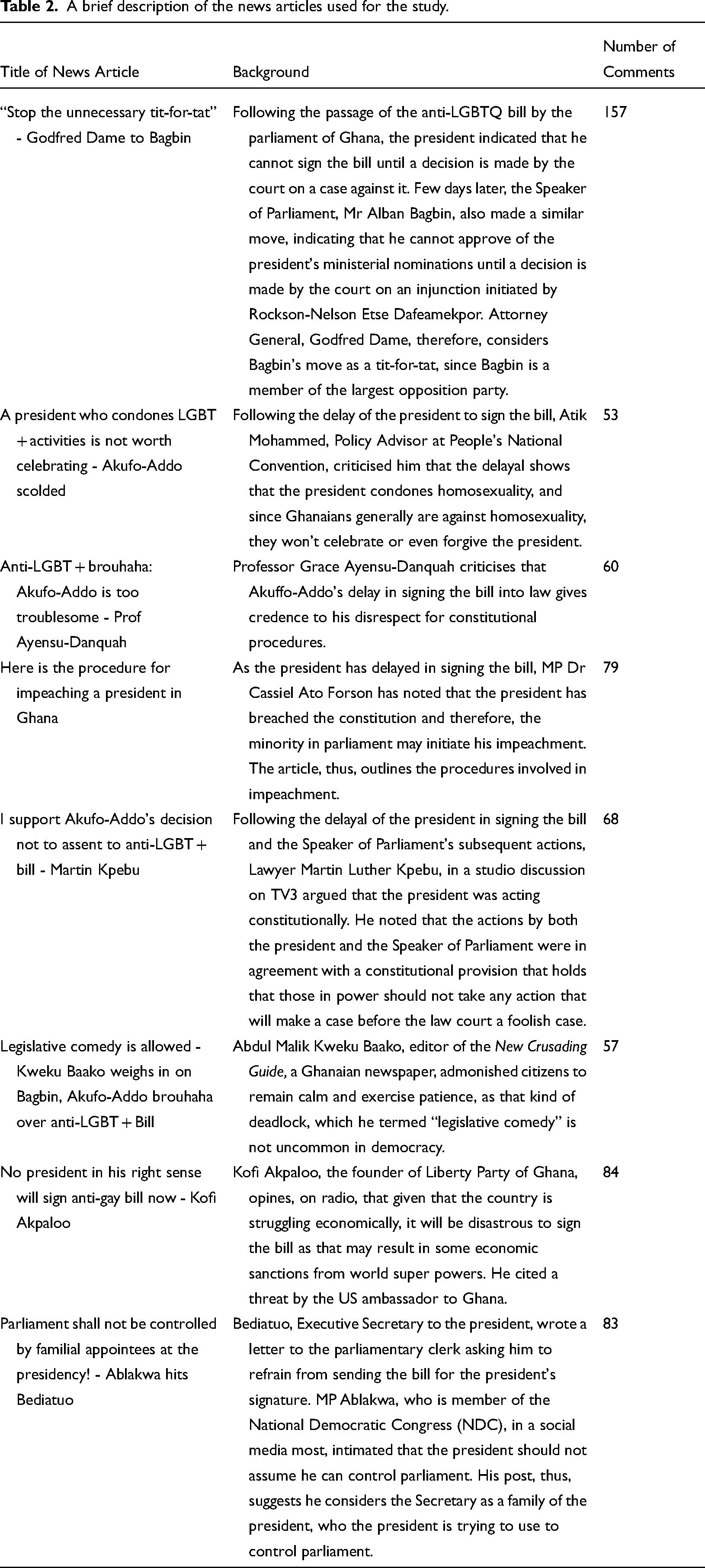
The present study relied on comments on eight news articles on the LGBTQ community, published in the first quarter of 2024 (i.e., from January to March 2024). In collecting the data, all eight articles, together with their comments, were saved in an html format into a new folder named “homosexuality” for easy identification. The choice of these articles was guided by recency and their association with the controversial anti-LGBTQ bill passed in the Ghanaian parliament, and given the qualitative orientation of the study, these articles and their associated comments were sufficient for the analysis. With the controversy about this community in Ghana (Gyasi-Gyamerah & Søgaard, 2019; Otu, 2021), news on it becomes a fruitful arena for the expression solidarity. Table 2 presents information on the news articles whose comments were used for the present study:
A brief description of the news articles used for the study.
Method of analysis
The analytical method adopted in this study was essentially discourse analysis, a text analysis method that pays attention to the context and purpose of language use (Fairclough, 2003; Gee et al., 2023). This method is, therefore, appropriate for the analysis of language use to attain solidarity in the Ghanaian online space. The analysis was inductive, repetitive and flexible, and focused on the microlevel linguistic means of achieving solidarity, drawing insights from the relevant theoretical and empirical literature (e.g., Alharbi, 2018; Alharbi & Rucker, 2023; Bou-Franch & Blitvich, 2014; Bousfield, 2007; Culpeper & Hardaker, 2017; Dobs & Blitvich, 2013). In other words, the comments for each news article were read and the discursive strategies used for solidarity building were identified, considering the strategies reported by previous studies and the unique sociocultural context of Ghana.
Labels have been assigned to the kinds of comments used in this paper. Specifically, a main comment (MC) refers to a comment that serves as a direct reply to a news article, and a reply/response comment (RC) is a comment that serves as a reply to an MC or another RC, while news headline (NH) refers to the title of the news article. These labels are chosen based on a well-accepted practice in studies of this kind to enhance comprehension of the analysis (see Thompson et al., 2024, for example). Similarly, in the extracts used in this paper, the comments are presented without any form of editing, alongside the pseudonyms of the commenters, but where the pseudonyms are unnecessarily long, their first one or two words are used in the running text to explain the extracts. Additionally the correct forms of some words or phrases are put in square brackets and inserted into the comments and where understanding is not hampered, [sic] is placed right after the incorrect expression. Finally, English translations of Ghanaian expressions are provided in square brackets where necessary.
Findings
This section presents the findings of the study. This is done under themes linked to the theoretical framework of the study.
Solidarity by attacking the other
The performative theory of solidarity discourse holds that an individual can show solidarity with the ingroup by attacking the outgroup (Alharbi & Rucker, 2023). In the present study, the verbal attacks came in various forms, including insults, claims of irrelevancy, curses, unpalatable questions and scolding.
Insults are verbal expressions aimed to produce a devalued image of a target individual or group (Culpeper, 2010). In the data analysed, insults were used to attack members of the political party, the perceived outgroup, as shown in Extracts 1 and 2 below:


In Extract 1 above, Sumsum Bofuo responds to the view of the Attorney General that the Speaker of Parliament should not engage in a tit-for-tat. Here, he verbally attacks members of the New Patriotic Party (NPP), accusing them of being criminals. The insults suggest that the NPP have destroyed the nation (i.e., nation wreckers) through their criminal activities. The full name of the NPP is changed to Narcotics Peddlers Party and National Poisoners Party. The former is a reference to some drug-related crimes that took place in the country during the presidency of John Agyekum Kufuor, which culminated in the defeat of the NPP in 2008 (Frempong, 2017). Similarly, amidst this recent LGBTQ impasse, John Kumah, the Deputy Minister of Information and member of the NPP, died and was rumoured to have been poisoned (“Watch as Ken and Bawumia “Dine” Amid Allegation of Poisoning in the NPP,” 2024). Thus, changing the name of the party to National Poisoners Party is an attempt by Sumsum Bofuo to accuse the NPP for allegedly killing the minister. In Extract 2, the Attorney General is labeled as a big animal (i.e., aboaa piiiiii). An interesting thing about these insults is how emphasis is expressed by the use of capitalisation (Extract 1) and letter repetitions (Extract 2). This shows that users of the website draw on its affordances to achieve their communicative goals of strengthening the force of their insults, thereby showing their heightened disapproval of homosexuality and distance from the out-group.
Another insult is seen in Extract 3 below, where Samuel Okudzeto Ablakwa as well as his party and the Speaker of Parliament is labelled as useless, in response to his claim that the president was trying to use some familiar faces to control the parliament:

The insult in Extract 3 above shows the dissociation of the commenter not only from the member of parliament (MP) and the Speaker of Parliament but also from their political party, the NDC. The effect is that the insult positions the commenter as a member of an outgroup of the NDC, apparently of a political party whose views and supporters are not useless.
While the insults were mostly targeted at the political figures, there were some instances where those insults attracted counter-insults, as shown in Extract 4 below:
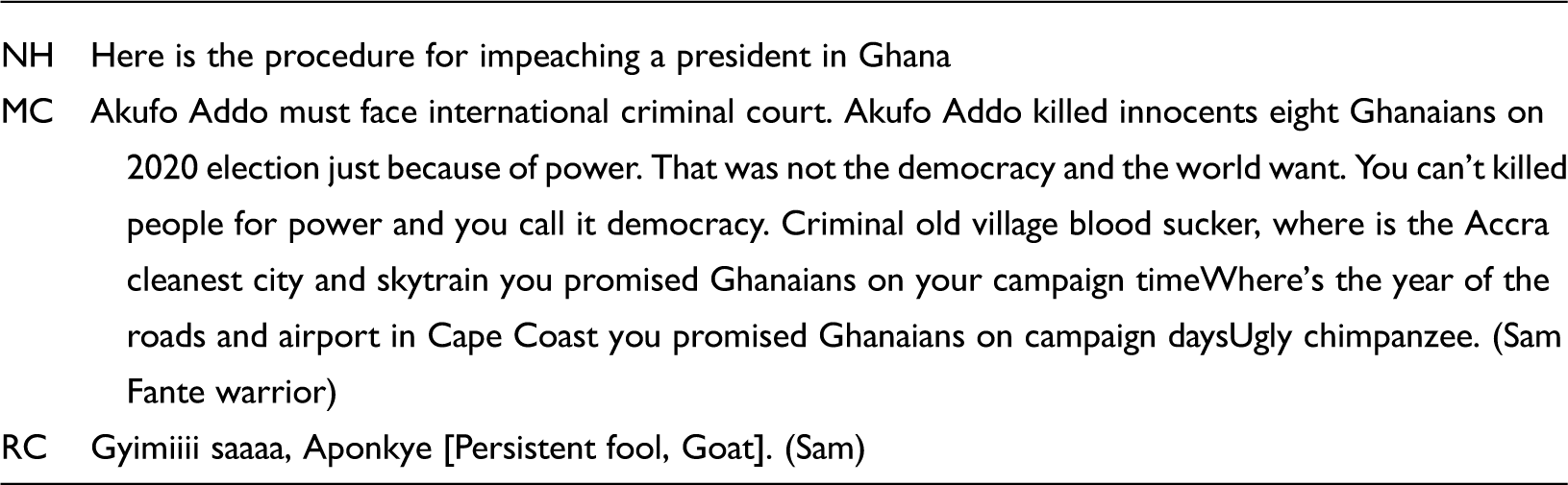
The comment from Sam Fante suggests a disappointment with the president's inactions in cases involving electoral violence as well as his failed promises. Sam Fante's comment shows his belief that in a proper democracy, a president must act to prosecute people involved in electoral violence, especially when it results in a loss of lives. Here, the reference to the president as a Criminal old village blood sucker echoes the popular Akan proverb, Panyin a ɔtena fie ma mmɔfra we nanka no, yebu nankawefoɔ a ɔka ho, which means an elderly person who remains unconcerned for children to eat a python passes for a python eater (Thompson et al., 2024). The point is that since the president has failed to prosecute the murderers, it is fair to accuse him of murder. In this instance, Sam, in his reply, labels Sam Fante as a persistent fool and a goat. This insult does not necessarily suggest that Sam is in the same political party with the president. In Ghana, it is against societal norms to insult the elderly, so the counter insult in this case may suggest an attempt by Sam to enforce societal norms on the online platform. In so doing, Sam builds solidarity with people who believe that social norms must be upheld even in the online space.
In addition to insults, irrelevancy claims, curses and unpalatable questions were used to attack the other or the out-group, as shown in Extracts 5–8 below:
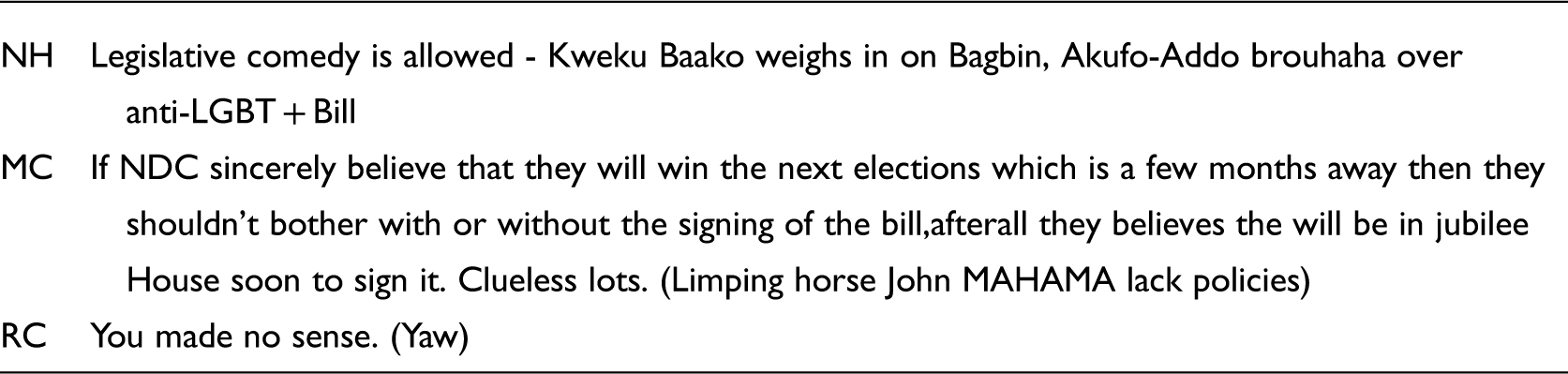



In Extract 5, Limping claims that there is no need for the NDC to push for the signing of the bill since they believe they would win the next election. This comment suggests that NDC's opposition to the bill is not necessarily in the interest of the Ghanaian populace as a whole but rather motivated by the intention to make the NPP unpopular in order to gain electoral advantage in the coming elections. Yaw replies that Limping is not making sense. Thus, Yaw dismisses this claim by labeling it as irrelevant to the ongoing discussion. Apparently, Yaw aligns with people who hold the view that issues of national interest should not be politicised; thus, the bill must be signed regardless of its implications for the general elections.
In Extract 6, the commenter, who identifies as Nonpartisan, asks God to curse the president if he passes the bill. This curse, therefore, is used to wish harm on the other (Jay, 2000). The reference to God in this instance aligns with the religious framing of homosexuality in Ghana. In Extract 7, Bambata, with the use of a question, accuses Sage of engaging in bootlicking or flattery. This question contains a metaphor and a simile. The metaphor compares the president to a dead rat whose faeces serve as the ingredients for Sage's soup. The soup itself is compared to water of life. The imagery created here is that of someone (i.e., Sage) flattering another person (i.e., the president) as though his (i.e., Sage's) life depended on it. The strategy of Bambata, therefore, helps to raise allegations against the other (Henderson et al., 2023; Lamb et al., 2018; Stevens et al., 2021). Scolding is used in Extract 8, where Frankie rebukes Akufo-Addo, the supposed problem child. In this extract, Frankie uses a strategy called infantisation (Ofori, 2015, 2017; Ofori et al., 2021) to rebuke the president, who is described as a disobedient child.
Apart from the individual strategies identified above, commenters combined strategies in attacking the other. For instance, in Extract 9 below, Anim uses a curse (i.e., God is going to punish this NPP government 10 folds), an insult (i.e., Thieves) and a dismissal (i.e., go away from us!):

Similarly, in Extract 10 below, Joy uses a dismissal (i.e., Ablakwa shut up) and an insult (i.e., thief), and receives a similar response from a coparticipant:
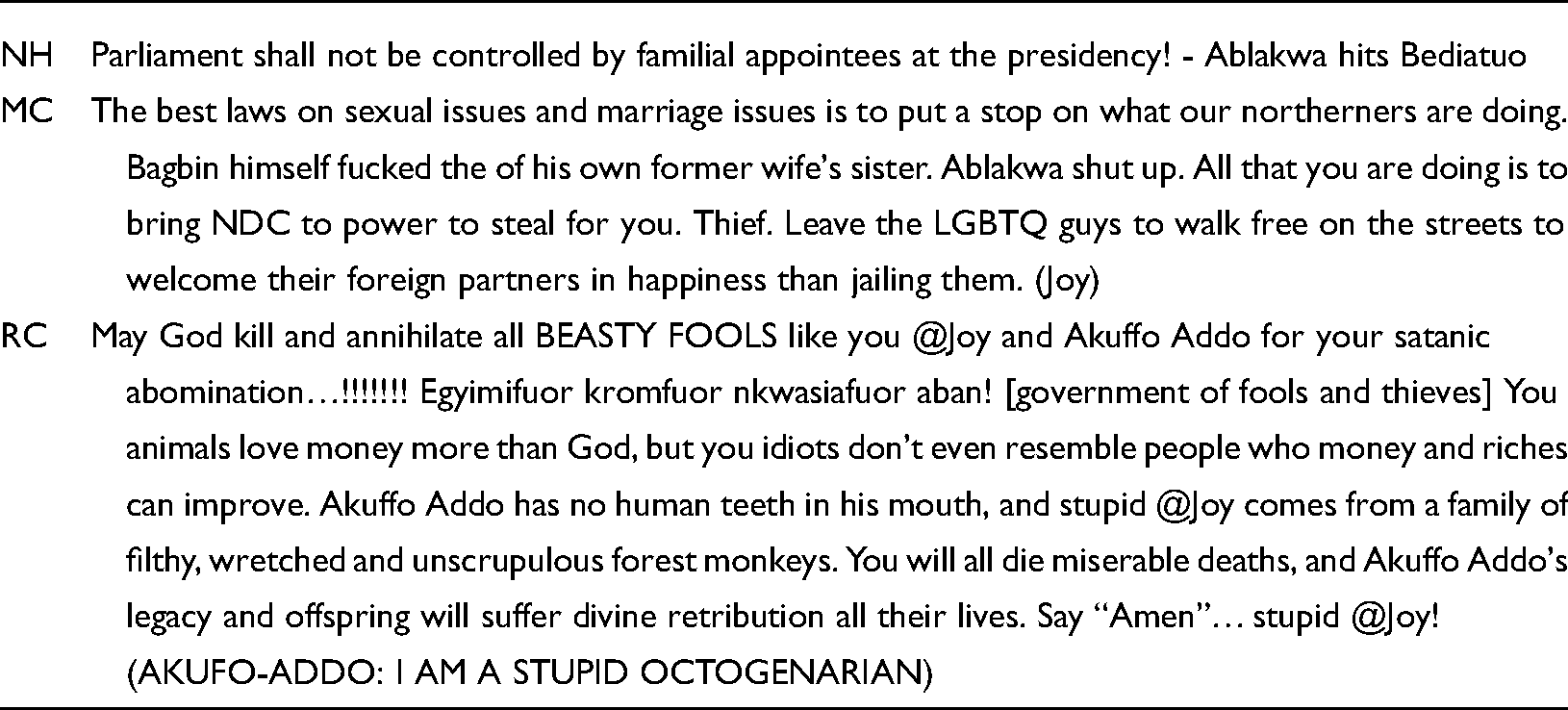
In this extract, Joy mentions, among other things, the need for homosexuals to be given freedom to meet their foreign partners. This throws light on the common assumption among Ghanaians that homosexuality is introduced by foreigners who bait their victims with pecuniary gifts (Baisley, 2015). Joy receives a reply that contains ill-wishes (i.e., May God kill and annihilate all BEASTY FOOLS like you @Joy and Akuffo Addo for your satanic abomination, You will all die miserable deaths, and Akuffo Addo's legacy and offspring will suffer divine retribution all their lives) and insults (e.g., Egyimifuor kromfuor nkwasiafuor aban!, idiot, stupid). Here too, reference to God is made in the attacking reply, highlighting the religious dimension of the delegitimisation of homosexuality in Ghana. In addition, the attack is strengthened by the use of capitalisation (e.g., BEASTY FOOLS) and repeated exclamation marks (i.e., !!!!!!!).
Solidarizing against the other through endorsement
As the LGBTQ topic generates opposing views, it is important to consider how members of the online community express support for others. This is particularly by means of endorsement. Consider Extract 11 below:
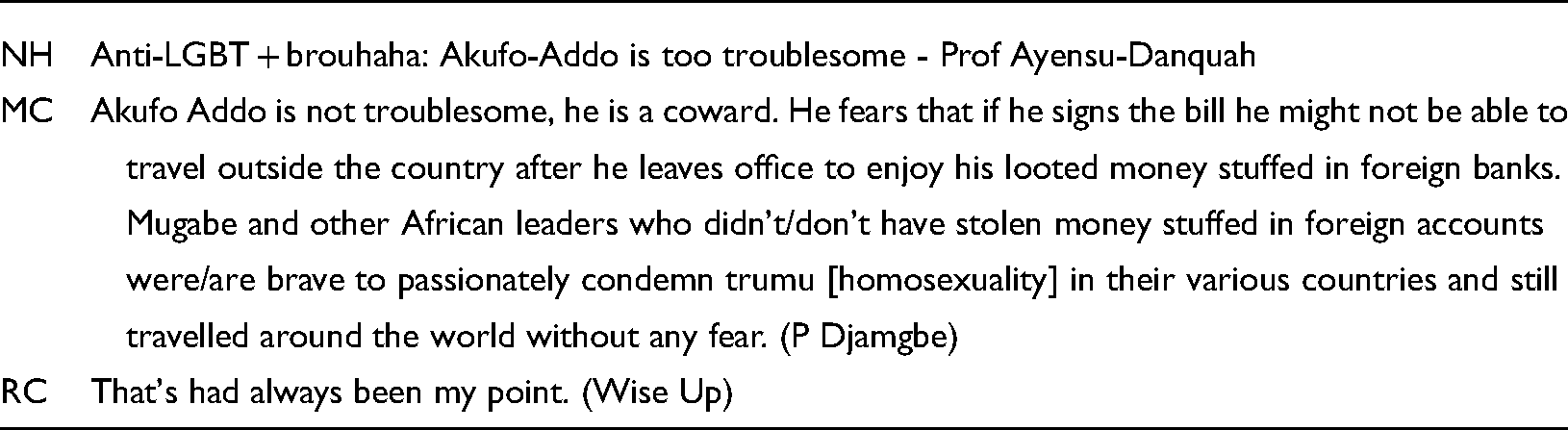
In this extract, P Djamgbe expresses that the president is a coward and explains further by citing some African leaders who, by contrast, have been bold enough to sign such bills into laws. This attack receives support from Wise Up, who intimates that he or she shares the same view. Wise Up, thus, solidarises with P Djamgbe and, by extension, with all those who hold a negative attitude towards the LGBTQ community in Ghana.
Another instance of this pattern occurred in the comments on the view of the Attorney General that tit-for-tat is not needed, as shown in Extract 12 below:

In this extract, Ustice uses an expression, S3 kukukru nu jai aa, k3k3kr3 nu su b3 jai. This alludes to a Ghanaian high life song by African Brothers International Band (1990), titled “Kukrukukru,” which mentions that one who feels people do not like him/her should reflect on his/her own character, as he/she may be showing a bad character which triggers the dislike from others. In the context of Extract 12, it suggests that Bagbin's action was triggered by a bad action from the Attorney General. In this extract, the comment by Ustice garners support from Kiki who, by the use of the adverb, Pricelely, endorses the view of Ustice in disagreement with the Attorney General. Kiki further shows his solidarity with Bagbin, which suggests that this user considers the polarized relationship between Alban Bagbin and Akufo-Addo as the source of the conflict that is carried over to the online space through the article and its associated comments. We stand with Bagbin involves self-positioning, where the individual “declared their position to show where they stood and build solidarity” (Alharbi & Rucker, 2023, p. 9).
In another instance, Oklemekuku shows his endorsement of the view of Kweku Bamako that Kweku Baako is not credible, as shown in Extract 13 below:
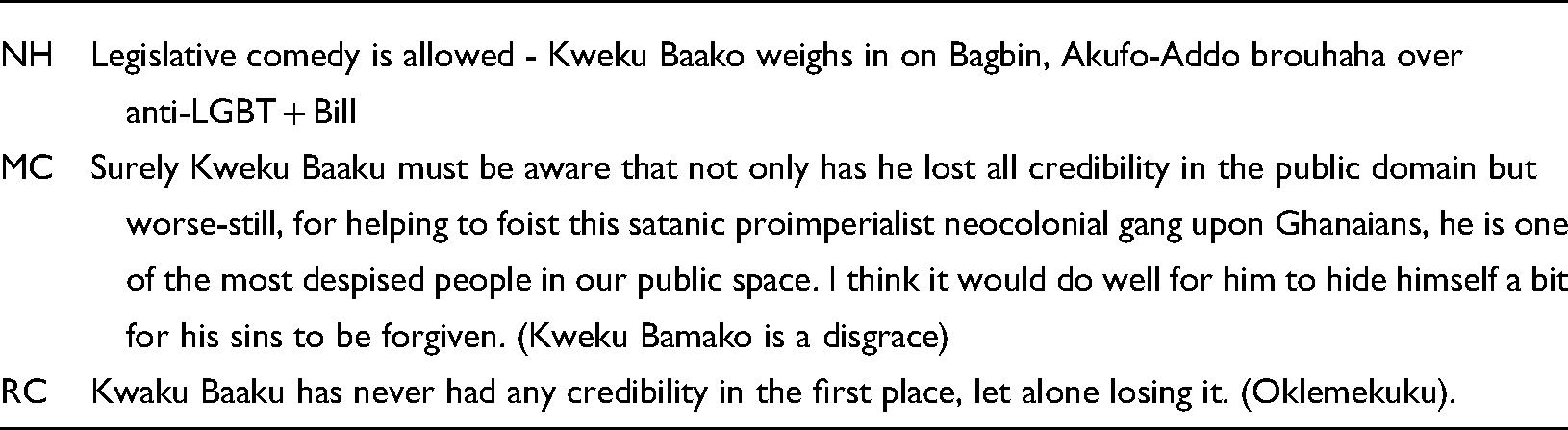
In this extract, Kweku Bamako mentions that Kweku Baaku has lost all credibility. Oklemekuku replies by saying Kwaku Baaku has never had credibility. This positions Oklemekuku as a stronger opponent of the other, in this case, Kweku Baako.
As we would see in Extract 14 below, endorsement is also achieved by showing explicit agreement with a coparticipant:
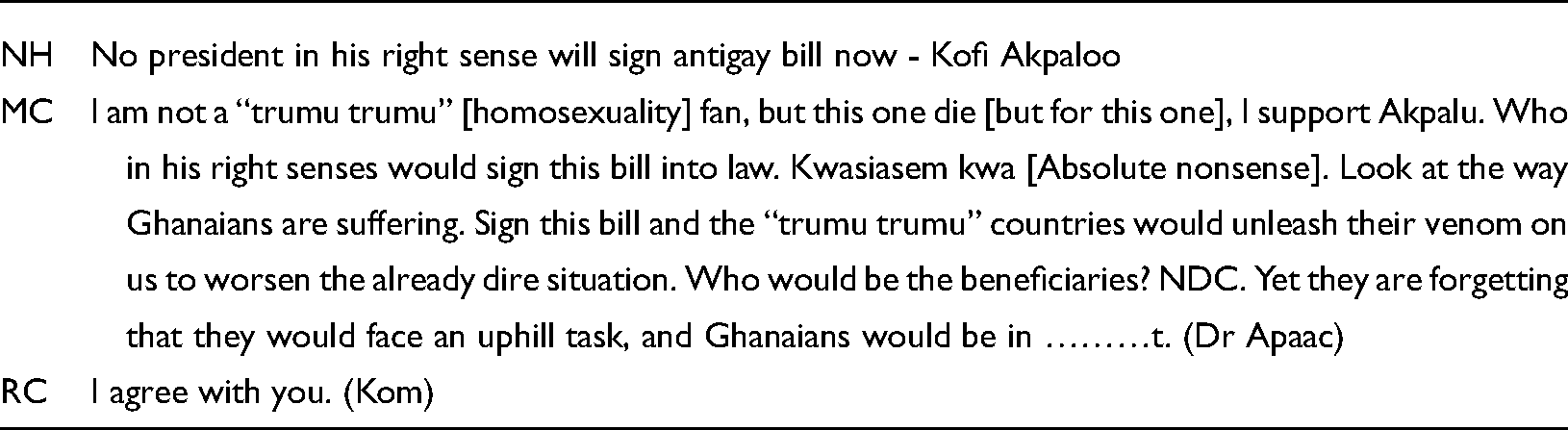
In this extract, Dr Apaac explicitly shows support for the views of Kofi Apkaloo. Kofi thinks that since the Ghanaian economy depends largely on borrowing from world economic powers that accept the LGBTQ community, it will be unwise for the president to sign the bill as that could mean an end to the economic support and intensify the economic hardship of Ghanaians. Kom, in turn, shows endorsement for this view, stating explicitly that I agree with you.
Challenging the solidarizing other
In the data, it emerged that a solidarising pair is sometimes challenged by a third commenter, who uses impoliteness formulae such as insults to attack. Consider Extract 15 below:
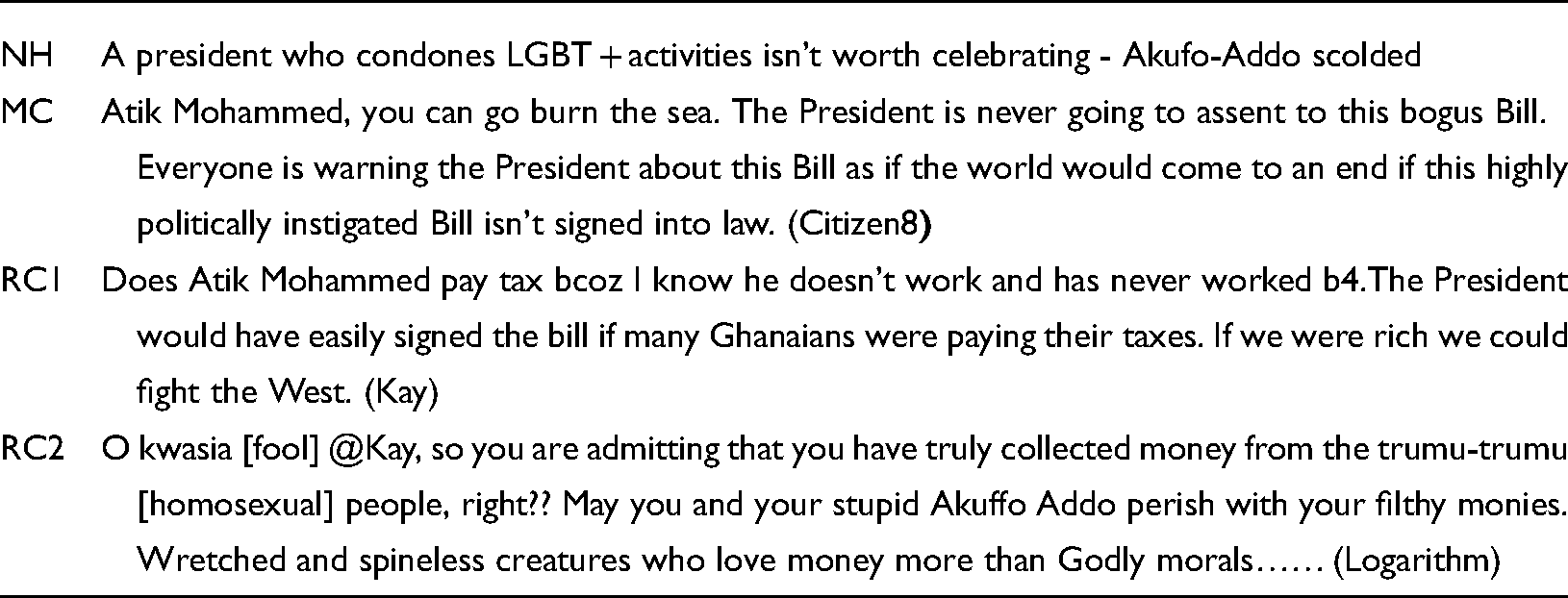
Here, the sequence begins with Citizen8's comment on the article where he attacks Atik Mohammed. He mentions the economic implications of the bill. His reply suggests an opposition between everyone, including Atik Mohammed, and the president. He gets a supportive reply from Kay, who accuses Atik Mohammed of tax evasion. Kay gets an opposing reply from Logarithm who accuses him of taking money from homosexuals and verbally attacks him and Akufo-Addo, the president. Here, the opposition created is between lovers of money and lovers of morals. Thus, by this attack, Logarithm solidarises with people who stand against homosexuality in Ghana based on the issue of morality.
Let us consider another example where Farmer challenges solidarity building of participants who identify as Attention and Joe, as shown in Extract 16 below:
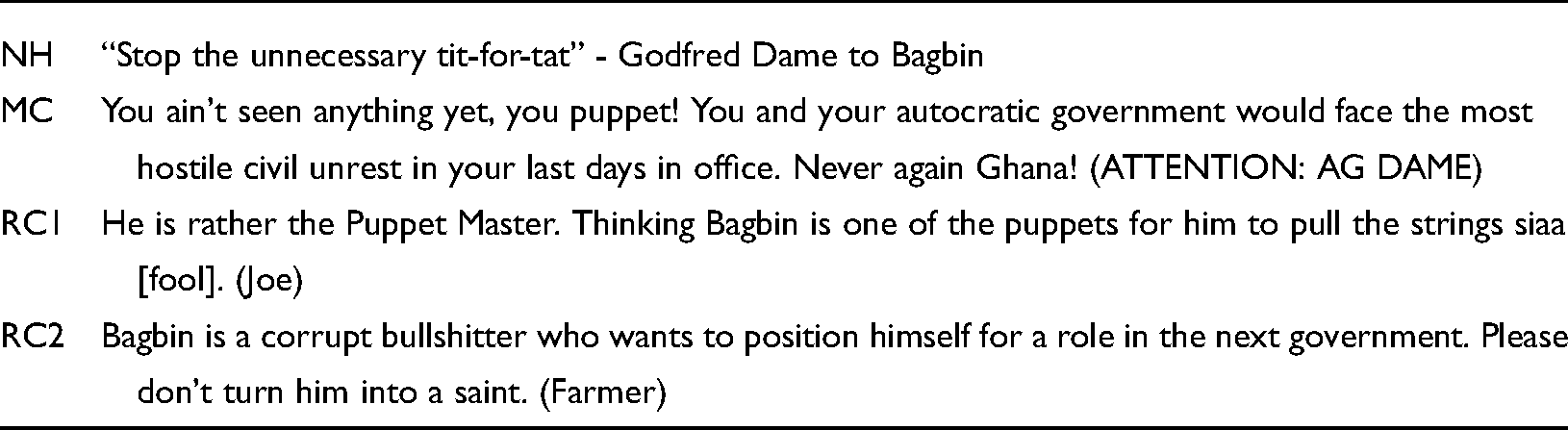
In this extract, the comment by Attention shows a disagreement with the Attorney General, who is identified as a puppet and member of an autocratic government. The commenter, therefore, creates an oppositional relationship between the autocratic government and the masses through the mention of civil unrests. This comment receives a reply from Joe, who also creates an oppositional relationship between himself and Godfred Dame, and in some way, solidarises with all those people who support the Speaker of Parliament, Mr Alban Bagbin. This emerging solidarity is challenged by Farmer, who thinks Bagbin is also corrupt and must not be projected in a positive light. Farmer's use of please shows his intention to make his contribution as a suggestion rather than an attack on the coparticipants.
Discussion
The aim of this study is to examine solidarity expressed in political discourse related to LGBTQ on GhanaWeb, a website which presents news articles on the occurrences in the sociopolitical terrain of Ghana and which has been an important source of linguistic data for recent research (Thompson, 2019, 2020, 2021a, 2021b). Grounded on the performative theory of solidarity discourse and the theory of impoliteness, this study considers verbal attack as an aspect of solidarity discourse and examines it alongside other means of expressing solidarity. In this section, the key findings of the study are discussed.
The study discovered that insults were used to evaluate or attack the out-group and align with the ingroup. The insults were not only targeted at the politicians mentioned in the news article, but also at coparticipants in the online interaction. Thus, in the study, for commenters who stand against the LGBTQ community, the out-group includes the ruling party, its supporters and all those whose comments suggest they support homosexuality in Ghana. On the other hand, people whose comments suggest they support the LGBTQ community target their attacks at the opposition party (i.e., the NDC) and its supporters as well as any other person whose opinion is against the LGBTQ. Thus, the use of verbal attacks creates oppositional identities which serve as a foundation for solidarising with people who share same views with the commenters. According to Alharbi and Rucker (2023), as political positions are transient, it may be disastrous to use this strategy to create enmity with the other while establishing solidarity. However, as GhanaWeb guarantees pseudonymity, users of this strategy do not risk identification and dire consequences (Thompson, 2019, 2020, 2021a, 2021b).
In agreement with work by Thompson (2019, 2020, 2021a, 2021b), this study found that insults that compare the target to an animal (e.g., aboa, gyimii, aponkye) were replete in the verbal attacks. This category of insults highlights an important distinction between a reasonable person and a fool—who is considered an animal—among Ghanaians. Ghanaians consider the possession or otherwise of a conscience (referred to as tiboa in Akan 1 ), which helps a person to differentiate right from wrong and act according to sociocultural norms. As tiboa is imbued into the individual through the socialization process, people who go against societal norms are considered unsocialized or, making them behave like an animal. Thus, referring to the opponents as an animal points to their lack of socialization and, thus, their lack of conscience, which makes them act unreasonably (Agyekum, 2010; Gyekye, 1995; Ofori, 2017).
Another important attacking strategy is the curse or ill-wish. Among Akans, curses are known as duabor, and they emerge out of “enmity, breakdown of love, lack of peace, conflict, anger, social avoidance, selfishness, attempt to eliminate a fellow, curse etc.” (Agyekum, 1999, p. 358). As noted by Agyekum (1999), this kind of verbal behaviour normally contains a conditional clause (as in if he refuses to sign the bill). Among Ghanaians, curses are invoked when people feel powerless and need to supplicate to a more powerful being to intervene on their behalf and ensure justice. In this study, there were instances where curses were invoked on the president and his supporters. In this case, the invokers recognised the power dynamics between them and the president, and sought justice from God (Tweneboah, 2021). The references to God highlight the religious dimension of issues relating to homosexuality in Ghana. As several studies have shown, the objection to homosexuality is predicated on religious assumptions. The view is that God created man and woman with sexual organs intended for procreation. Thus, engagement in homosexuality goes against God's will and, if not curtailed, can invite misfortune on such individuals and the nation as a whole (Asante, 2020; Dery et al., 2019).
Scolding, questioning and irrelevancy claims were also used in the data. In Ghana, scolding is normally directed at disobedient children, who are not allowed to defend themselves as it is against the cultural communicative norms to talk back at elders (Affram et al., 2020). This explains why the commenter had to compare the president to a child before scolding him as Abofrabon3 (i.e., disobedient/problem child). Further, the findings agrees with the finding of research that considers rhetorical questions as means of expressing emotions during disagreements (Cerović, 2016; Hassan, 2019; Langlotz & Locher, 2012; Tsoumou, 2023). Moreover, Muntigl and Turnbull (1998) contend that irrelevancy claims are most aggravating, for they render one's prior claim as irrelevant to any discussion. Langlotz and Locher (2012, p. 1594) support this view and further note that irrelevancy claims constitute pure opposition, limiting any further development because they attack “the social skills of making relevant claims.” In the present study, the irrelevancy claim was used to counter a comment that suggests that opposition to homosexuality was intended to give the NDC a political advantage. In this case, this strategy was used to communicate that issues of national interest should not be politicised.
In the present study, there were cases where commenters used a combination of strategies to enhance the force of the expressed emotions. Relatedly, graphological means like capitalisation, letter repetitions and punctuations help to intensify the force of the verbal attacks. This is not identified by the performative theory of solidarity discourse developed by Alharbi (2018). This suggests that in applying this theory to the online platform, it is critical to be sensitive to its affordances, as an analyses of them can help deepen our understanding of how solidarity works. Similar findings were reported by Zappavigna (2011), who used the concept of ambiance affiliation to explore the affiliative meanings in tweets made shortly after the declaration of Barack Obama as President of America.
Apart from the verbal attacks, endorsements were also used to solidarise with coparticipants. This involves signaling “support of ideologies, positions, and policies that promote the cause of a given group” (Alharbi & Rucker, 2023, p. 9). In the data analysed, this strategy was used by commenters who were against the LGBTQ. This was linguistically realised by emphatic discourse markers (e.g., precisely!), expressions of agreement (e.g., I agree with you) etc. Endorsing the views and ideologies of one group helps, on the one hand, to solidarise with that group and, on the other hand, to create enmity with the out-group. This finding agrees with the observation of Jackson et al. (2017) that people used support and encouragement strategies to show solidarity with LGBTQ people.
Finally, there were cases where two participants who seem to share the same viewpoint are challenged by a third participant. The third participant usually attacks the views of the first two participants to create enmity with them. This agrees with the findings of Dobs and Blitvich (2013) on the nature of impoliteness in multiparticipant interactions. Dobs and Blitvich noted that a witness can counter opposition as a means of associating with the in-group. The opposing views on the platform reflect the sociopolitical dialectics in the country, for instance, the NPP versus the NDC, the masses versus corrupt public officials, pro- versus anti-LGBTQ people, etc. In general, solidarity on the platform is as a result of the polarisation of views in the sociopolitical context of Ghana (Bou-Franch & Blitvich, 2014; Hutchby, 2001).
Conclusion
The thrust of this study is to consider verbal attacks, along with other discursive strategies, as means of expressing solidarity on online news platforms. Focusing on GhanaWeb, this study has shown that various kinds of insults were used to attack the out-group and align with the in-group. Apart from insults, irrelevancy claims, curses and ill-wishes, unpalatable questions etc. also served as strategies for attacking the out-group. These attacks reflect the oppositional views in the sociopolitical context of Ghana (e.g., the NPP versus the NDC, the masses versus corrupt public officials, pro- versus anti-LGBTQ people, etc.). It is interesting to note that using various linguistic means, commenters also showed solidarity by endorsing the views of coparticipants.
The contributions of this study can be considered from two perspectives. First, this study is an addition to the emerging research on verbal attacks in political discourse and on online news platforms (e.g., Ofori, 2017; Thompson, 2019, 2020, 2021a, 2021b). In Ghana, unlike previous work which considers insults as a contravention of sociopolitical norms and as a way of regulating the use of inappropriate language on GhanaWeb, the present study sees them as a way of showing solidarity. Beyond this, ways of drawing on graphology to strengthen the insults and heighten the degree of solidarity emerged from the study, and considering them in the analyses has provided a very fine-grained perspective of solidarity in the online space. Second, the study demonstrates the applicability of the performative theory of solidarity discourse to polylogal communication, particularly on the internet, and the combination of this theory and the theory of impoliteness enhanced the analysis. The study finds that counter insults could be used to establish solidarity with Ghanaians who hold the societal norms in high esteem, suggesting that norms of appropriate communication must be enforced online. This and similar strategies found by Thompson et al. (2024) can be used as a means of moderating political discourse to ensure that the online space is safe for the expression of ideas.
Despite the contributions highlighted, the study has some limitations that need acknowledgement. First, this study relies on the qualitative research approach, involving discourse analysis, and aimed at revealing deeper insights into the context-bound use of the linguistic phenomena under investigation. Thus, the findings are not intended to be generalised. In addition, the data used for this study were on a single topic, that is, the LGBTQ, and this foregrounds a further need to interpret the findings with caution, as it is not guaranteed that similar strategies will emerge in data on other sociopolitical topics and even in other countries. The importance of these limitations is that they could serve as a standpoint for further research. For example, it remains unclear whether or not these strategies occur with significantly different frequencies. This is a topic that can be explored with quantitative methods. Corpus-based discourse analysis, in particular, can be useful in this regard (Nartey & Mwinlaaru, 2019).
Footnotes
Declaration of conflicting interests
The author declared no potential conflicts of interest with respect to the research, authorship, and/or publication of this article.
Ethical statement
This study uses information that is freely available online, and to address key ethical and copyright concerns, extracts of few sentences rather than whole texts are used to substantiate arguments made. Additionally, the fact that the online interactants use pseudonyms conceals their real identities and addresses the issue of anonymity
Funding
The author received no financial support for the research, authorship, and/or publication of this article.
