



Abstract
This study examines how automation and then artificial intelligence (AI) was discussed by news workers in journalism trade publications in the 1980s and 1990s and through the 2000s and 2010s. This era saw the full computerization of the newsroom, as well as the introduction of the civilian, commercial internet and its adoption by the news and media industries. Limited use of automated and early AI tools in these fields dates back to the 1960s and 1970s, with the use of software such as spell- and grammar-checkers, as well as the first generation of word-processing tools. This included very early efforts at automated writing, such as for financial and sports news. With this complex origin story, the discourse around AI has a prehistory that deserves a deeper exploration and appreciation.
Introduction
This study examines how automation and artificial intelligence (AI) was discussed by news workers in journalism trade publications in the 1980s and 1990s and through the 2000s. This era saw the full computerization of the newsroom, as well as the introduction of the civilian internet and its adoption by the news and media industries. Limited use of AI tools—initially referred to as “automated” or “automatic” processes or machines—in these fields dates back to the 1960s and 1970s, with the use of software such as spell- and grammar-checkers, as well as the first generation of word-processing tools. This included very early efforts at automated writing, such as for financial and sports news (Mari, 2019, 2022). In other words, the discourse around AI has a prehistory that deserves a deeper exploration (Balbi et al., 2021). As a working definition, “automated” technologies predate those identified by their human creators as driven by “artificial intelligence” in a few key respects. The first is that automated technologies were (and still sometimes are) a combination of analog and digital tools (though those definitions are themselves somewhat challenging); however, automated technologies are often augmentations to existing processes and are more mechanical in nature. They have roots going back to the late 19th century and include “factory”-style tools designed to aid production. In contrast, AI or machine-learning tools are driven by software and are often more creative in nature, and occasionally supplant or attempt to replace at least some of the more mundane aspects of human labor. The latter encompass a whole range of tools and have emerged since the c. 1980s and have been centered less on the production side of news operations and have been more focused on the editorial side of the latter. But the connection between automation and AI tools is better conceived as a continuum, from production to more higher-order processes.
In this and my other related research, I am building on the work of scholars such as Megan Sapnar Ankerson and Jesse Lingel, with their research on the early civilian internet, as well as Kevin Driscoll, with his book on pre-internet, bulletin board system (BBS) culture in the 1980s (Ankerson, 2018; Driscoll, 2022; Lingel, 2020). In addition, work by Laine Nooney and Mar Hicks has pointed out the gendered nature of early internet culture, including discussions of emergent technologies such as AI and programming, in ways that also inspire this project (Hicks, 2017; Nooney, 2022). Driscoll, Nooney and Hicks in particular have drawn attention to how many current concerns have a media-historical origin that deserves consideration and context. In other words, every “new” communication tool has a media history.
When thinking about the initial wave of AI discourse, it is vital to recall that news workers were already anxious about the ways technology would impact their jobs. This phenomenon—recurring waves of optimism, followed by fear, followed by something in between the two as automated technology was deployed in newsrooms and news-production facilities (i.e., “news factories,” to borrow a term from media historian Michael Stamm)—is an old one in the world of white-collar workers and is connected to the rise of the information economy in the mid-20th century (Stamm, 2018). Within journalism, specifically, worries around the introduction of machines that could set type and pages, and later, software that could perform other tasks traditionally done by hand, such as design and more advanced layout, date back to at least the 1920s and 1930s, if not before (Örnebring, 2010). Stamm and Örnebring have both made the case the journalism's identity is at least partially centered in technology adoption and the professional and social anxieties that come from the adoption, use and meaning of creative tools. These anxieties appear in the discussion of new tools, the retirement of old ones, and the impact of tools on labor, as well as control over that labor, as will be explored below.
Literature review and theoretical framework
When thinking about how news workers framed the early introduction of automation and AI—in an era already fraught with massive changes—it is important to keep a materiality framework in mind (Bollmer, 2019). Scholars who study technological change within journalism have been influenced by this “material turn” for a generation (Mari, 2021). The “things” of journalism have come under renewed focus in the past decade or so of scholarship (Anderson & De Maeyer, 2015). It is in the material construction of sometimes abstract concepts that larger, more meta concerns can be appreciated for what they are, and in their critical contexts—in other words, media history provides important perspective and grounding—and a connection to felt reality. Without it, presentism tends to dominate conversations about how best to use “new” tools and whether or not “old” tools (and values) still have a place in today's storytelling (Peters, 2009).
This theoretical approach informs my work and this project, with its focus on the use of physical tools and “thinginess” in newsroom contexts. Researchers such as Bonnie Brennen, Brian Creech, Juliette De Maeyer, John Delva, Florence Le Cam, and Susan Keith have looked at the incorporation of technology tools in journalism spaces using this perspective (Brennen, 2001; Creech, 2017; De Maeyer & Delva, 2020; Keith, 2015; Le Cam, 2015). Rachel Moran and Nikki Usher have gone further, studying the affective impact of newsroom tools (Moran & Usher, 2021). The evolution of “users” and their needs, interests and influences on computer hardware—in the specific case of the TRS-80, an early and popular desktop computer used by news workers—has also been explored by Lindsay (2003). Digital infrastructures have hidden histories and processes that tend to be taken for granted (Parks & Starosielski, 2015). This is especially the case when considering such vast assemblages of technologies and networks such as the civilian internet and its complex development (Hesmondhalgh, 2022; McKelvey & Driscoll, 2019). It is also the case when considering the computerization of the newsroom and the adoption of software, along with hardware, by journalists (Boczkowski, 2005; Mari, 2019).
But moving beyond how other media historians have applied material, it is important to think about how the adoption of new physical tools (or at least tools that have physical effects, including those connected to AI and its various conceptions) have impacted workers’ professional identities on the ground, in specific ways. Sociologists of work, most notably Andrew Abbott, have pointed out that control over work processes is a critical part of one's professional identity (Abbott, 1988). In other words, who decides what work tools to use and when, who decides how hiring and retention is handled, matters. These decisions, in turn, determine how diagnosis, inference, and treatment come together, to borrow his well-known medical metaphor, in contestation with other occupations (such as public relations) over jurisdiction of societal challenges or problems (in this case over information critical to the functioning of a democratic society)—these all come together in materiality (Furness, 2019). A material understanding of the newsroom, news workers and news labor can help scholars understand how the journalistic occupation has been impacted by automation, before, and AI, more recently (and now). While questions of professional identity are mostly outside of the scope of this study, this material consideration can help researchers better understand the impacts of technological change on workers in an information society.
When thinking about how journalism studies scholars have applied media history to their work, it is important to remember that change and development—including the formation of attitudes and anxieties regarding technology and work—have “origin stories” that often predate current concerns. With regards to automation, automated tools, and, eventually, AI, at least as contemporary observers thought of that term, fears about their impact on work and newsroom roles and identities were in place long before the civilian internet (Mari, 2019; Schudson, 2015). Changing ideas of gender and power impact the incorporation of such tools (Alper, 2019), and how they have been deployed in white-collar workplaces (Plotnick, 2015, 2020). How journalism students have been taught about the use of computer-assisting reporting (CAR) techniques has reflected the changing values and priorities of market forces, along with cultural, political, and social pressures (Parks & Mari, 2023). National histories also influence path development so that even similar journalistic cultures have different reactions to, and incorporations of, technology tools within journalism (Conboy, 2023). Ultimately, this material sensibility when considering journalistic tool use allows for a more holistic understanding of news labor, the experiential realities of news workers, and the complex, contingent and messy nature of change within journalism and within its multiple contexts, and even the concept of the “new” itself (De Maeyer & Le Cam, 2015; Peters, 2009). Innovation and disruption within journalism are the norm, not the abnormal, and this has been the case for both its study and application (Belair-Gagnon & Steinke, 2020).
To that end, the project's guiding and iterative research questions are as follows: RQ1: How does the trade-literature discourse (and specific examples from that discourse) from the pre-internet and early internet eras around automation in journalism and news work preview, if it does, current anxieties around AI usage in journalism? RQ2: In what ways was this discourse different, or disconnected, to concerns about AI today, and how does automation preview these concerns?
It is through specific case studies and places—such as the automation of the journalistic reference library, and newsrooms themselves—that scholars can come to understand the nature of these changes (Boyles & Meisinger, 2020; Maares et al., 2023). This project seeks to trace a similar path—by examining the discourse around a specific set of technologies that have tended to be both taken-for-granted, and feared, but whose application is less certain and less impactful than first perceived, that is, automation and AI. The case study here is automation—how it was integrated into newsroom routines, but also how it was discussed by news workers while it happened, and how these same workers anticipated or predicted further changes.
Methods
Sources
As a media history, this study's sources and methods are meant to help guide archival research and not predetermine it, to help shape the search for a coherent narrative with cause and effect and not to test hypotheses in an experimental manner (Strauss & Corbin, 1998). Primary sources for this project include Editor & Publisher, the Columbia Journalism Review, Quill, and other journalistic trade publications, along with the collections held at the University of Colorado at Boulder. These sources include debates, controversies, conversations and, most importantly, a record of the emergent discourse—including best practices, the aforementioned anxieties and fears, and optimistic assessments of and around technology tools. They are not perfect sources, to be clear. Sometimes they give too much weight to those in power, as with Editor & Publisher. They may represent the point of view of experts who are not always rank-and-file in their concerns around technologies (as with Columbia Journalism Review). Or they were perhaps more concerned with career advancement and training than in specific technologies (as with Quill).
Nonetheless, taken together, they provide valuable in situ insights to media historians looking at near history and its events. They reveal privilege and occupational and power dynamics (especially with Columbia Journalism Review), group think and bandwagon-style enthusiasms (in the case of Editor & Publisher), and worries about career progression and employment (in the case of Quill). Along with textbooks, trade journals represent best-practice thinking for their eras (Parks & Mari, 2023). Sometimes the voices writing in these publications criticized how tech adoptions occurred, or raised concerns about the impact on news workers’ jobs in the newsroom, at least eventually. While some coverage of new newsroom technologies could be uncritical, some was, and in both cases it is important to see how industry conversations around automation and automated tools developed during the latter decades of the 20th century, and as they presaged today's concerns. And while I will be focusing on the United States and Canada for this project, I will also include some comparative analysis of the United Kingdom, via the inclusion of the Press Gazette, which has been interested in the introduction of AI tools for some time. A close reading of trade publications shows how news organizations and their workers routinely practiced (and arguably still practice) a form of “retro innovation,” as theorized by Ángel Arrese (2016) in his research on justifications for paywalls for online content, or Mari in the latter's history of the halting, but not hesitant, internet adoption by newsrooms in the 1990s (2022). In both cases retro innovation is “the process by which past choices are justified through the lens of the present,” in a kind of “obvious” explanation for technology adoption that presumes inevitability (Mari, 2022, p. 17). Likewise, a kind of anxiety is projected from the present to the past. One might call this a kind of retro anxiety: “we feel this way, and thus they must have, too.”
As part of a much larger set of studies, about 12,000 articles from c. 1920 through the end of the 20th century and beginning of the 21st were read from Editor & Publisher, along with a further 500 whole issues of Quill, published by the Society of Professional Journalists (formerly known as Sigma Delta Chi) and 480 issues of Columbia Journalism Review (and about 300 issues of the shorter-lived, c. 1977 to 2015, American Journalism Review). Note that this large corpus of material was read both online via the Internet Archive when available, but primarily in hard copy, in bound volumes, which allowed for contextual reading in many cases, and as part of a larger series of studies by the researcher. A special focus of this project was on the computerization and then the early internetization of newsroom spaces, so on the c. 1960s through the 1980s for the former and the c. 1990s through the 2010s, for the latter.
There were 1469 references to “automated” and 1386 references to “automation” in Editor & Publisher between 1954 and 2015. With Editor & Publisher, an especially close chronicler of technology adoption during these eras, about 45 discrete references to “artificial intelligence” were carefully examined from c. 1966 through 2014, along with 65 examples of “automated” systems and 102 examples of “automation,” which included examples of images representing both analog and digital technologies related to news production and distribution from the pre-internet era. With Quill and Columbia Journalism Review, a further 317 specific references to automation were examined closely, with the earliest, from the former, from 1932, though with the majority from after c. 2000. Finally, an additional set of more than 500 examples of “artificial intelligence” were in Columbia Journalism Review, but the vast majority (more than 450) were from after about the mid-2010s. The same applies to the UK's journalistic trade publication, the Press Gazette, which had 196 references to “artificial intelligence,” with the majority from the past decade. Generally, searching for meta terms led to more granular concepts.
Analysis
So the goal with the above was not to create an exhaustive or complete list of all references to automation and AI, but rather to find a representative set of sources that could be used to explore the meta-narratives of anxiety and foreshadowing that come with these technologies and their respective changes wrought on (or adopted by) the news industry and the latter's workers. That involved a certain narrowing of a broad capture of sources and terms, but with an overarching interest in materiality and material work conditions, and the ways that automation impacted production and AI impacted editorial processes. Hence the progression from broad to more particular terms and application, as outlined in the primary-source citations below.
Utilizing a close, comparative, iterative reading of these primary sources, the researcher deployed a qualitative, emergent historical approach as outlined above (Strauss & Corbin, 1998). This media-historical method emphasis a close reading of primary texts in their political, social, cultural and other contexts, and does not depend on variable or a quantitative content analysis. However, this approach, with a commitment to reflecting the lived experiences of news workers, seeks to represent the narrative reality of its time: in other words, informed by theory (especially materiality, as outlined above), historical scholarship can help researchers understand cause and effect, precursor phenomenon, path dependency and thus contribute to a better understanding of how change happens, especially technological change.
Findings
The first era of automation: The production side
For most of the 20th century, automation was primarily confined to the production side of news organizations. This involved the step-by-step physical manufacturing of the material product—that is, the newspaper—via printing and distribution, often by truck with the latter. In this sense, automation followed other mass-production industry trends, as Michael Stamm has pointed out: the newspaper was a factory and the news, on paper, was its product (2018). This mid-century industrial journalism deployed automation for discrete, often union-controlled (especially by the International Typographical Union) and managed jobs, including inserting advertisements and setting type, and was often compared to car manufacturing (“This is National Steel,” 1955, p. 44). Ads for the Fairchild Teletypesetter emphasized their “automatic” features, including the capacity to load paper (Fairchild Teletypesetters, 1958, p. 51; see Figure 1).
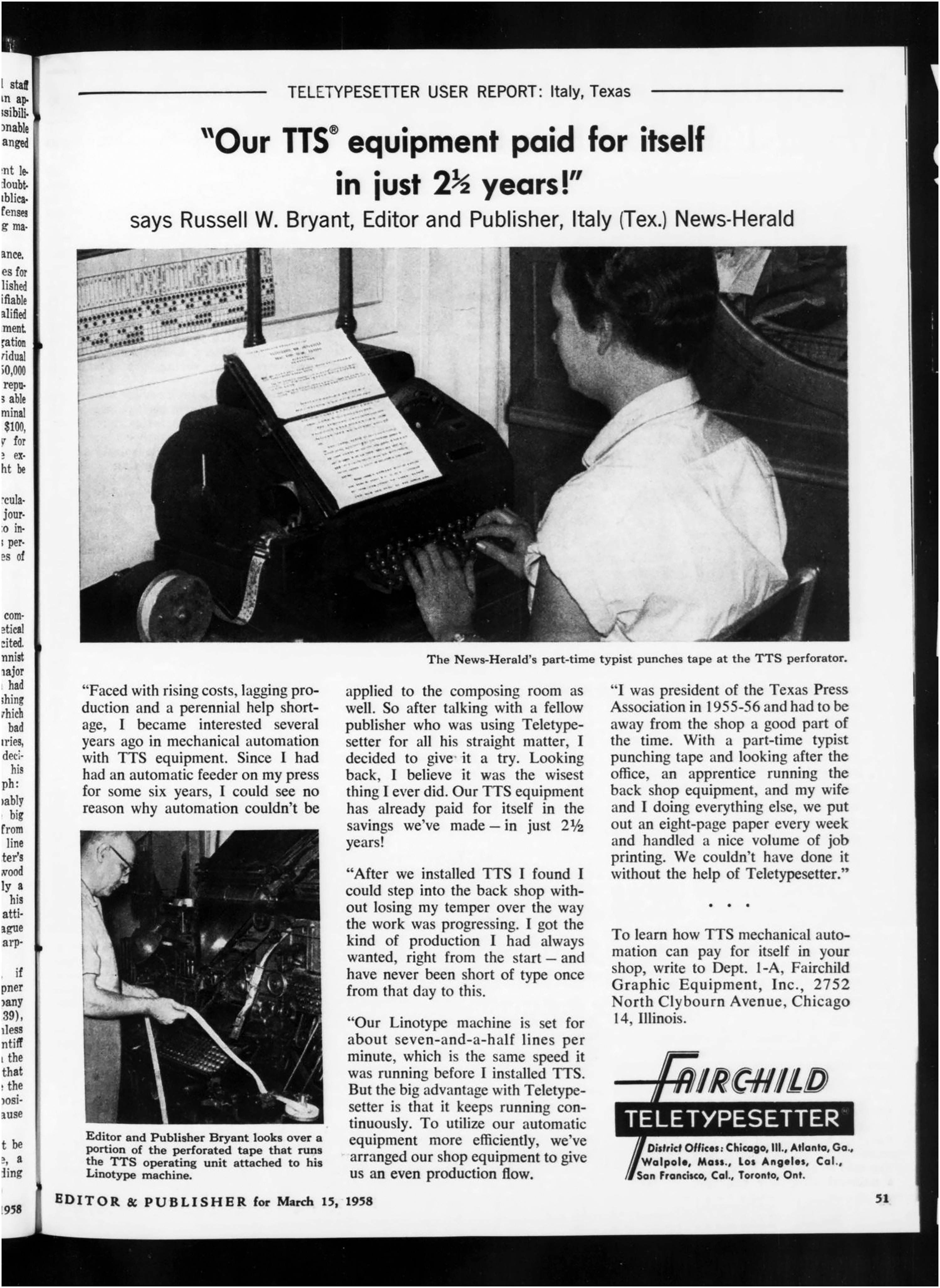
Ads for the Fairchild Teletypesetter emphasized their “automatic” features, including the capacity to load paper. 3
Similarly, ads for other teletypesetter companies highlighted automatic layout. In one such ad, the editor for a rural weekly newspaper in Thayer, Missouri, an R.H. Williams, praised the machine's capacity, including its ability to help speed production. “Our operator punches a very satisfactory tape at the rate of 300 plus lines per hour. Since she can only work part-time, we punch most of our tape in the morning, Monday through Thursday,” but that was more than sufficient. He continued: “…before we installed Teletypesetter equipment, my wife set all our type manually. TTS has relieved her a great deal, and to say the least, she's very happy with the installation” (Teletypesetter (TTS) Corporation, 1957, p. 57; see Figure 2). Note that women—including the spouses and daughters of newspaper editors and owners—were often tasked with running early automated newsroom equipment. Women were also commonly employed at larger, daily newspapers on the production side of newspapers, and later a number of women also directed the installation of the first wave of computers in newsrooms (Mari, 2022).
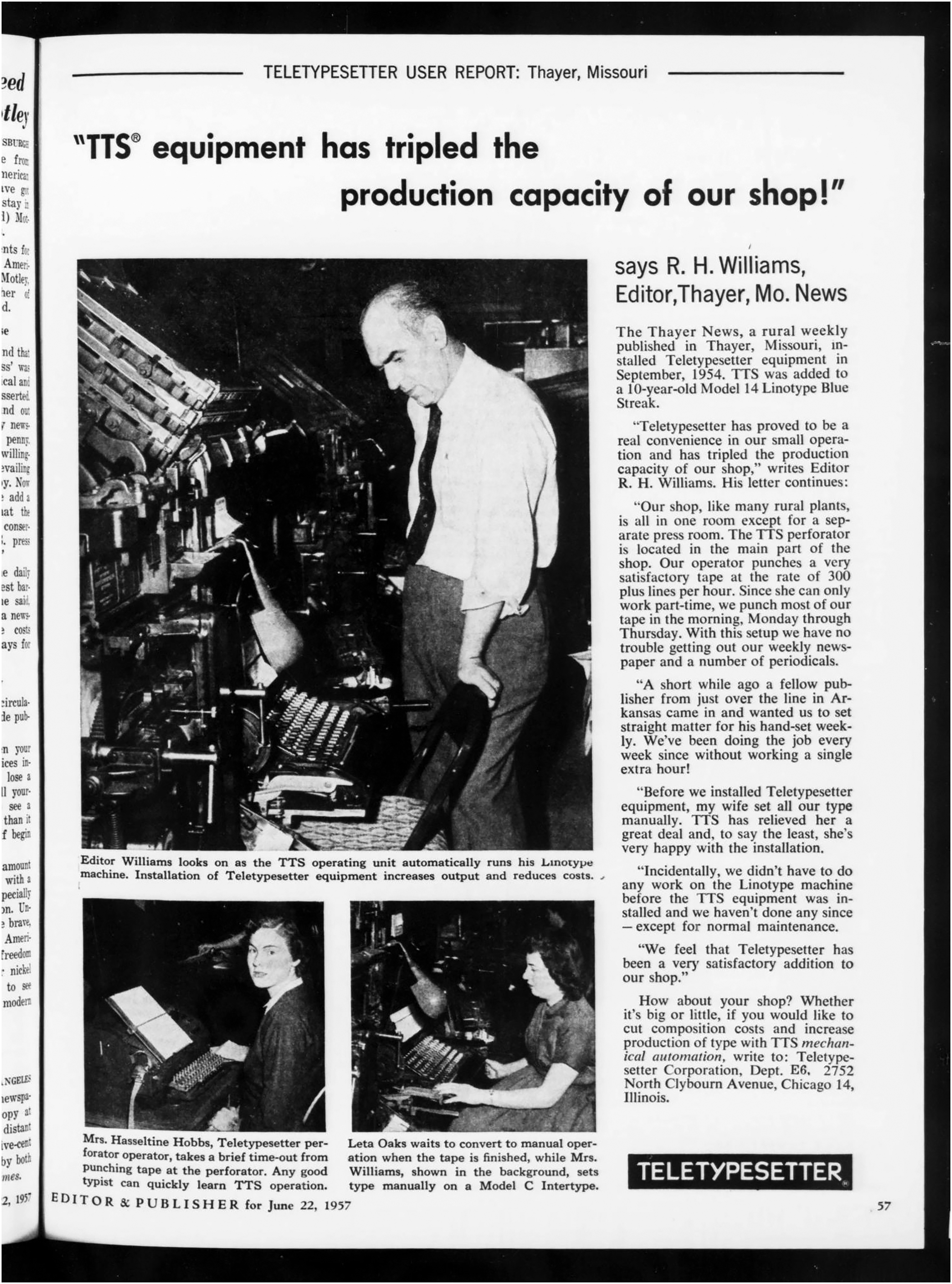
Teletypesetter (TTS) ad from 1957. 4
This held true through the 1970s, when the majority of coverage in trade publications of automated machines, techniques and other innovations focused on the literal making of the newspaper. One major exception was early layout, including basic hyphenation-and-justification (i.e., “H&J”), which used to be done by hand but was increasingly completed by early computer systems (specifically, specialized programs) by the end of the 1970s (Mari, 2019, pp. 46–47). The adoption of at first centralized and then later more decentralized computer systems was part of the long computerization of the newsroom, and the larger story of the move from mainframes to microcomputers to microprocessors (i.e., desktops; see Mari, 2019). Even organizations such as the ITU recognized the importance of automation and instituted both a training center in Colorado Springs, Colorado, and classes there as early as the mid-1950s in an attempt to head off some of the more radical impacts to their workforce (ITU, 2024). The ITU was not particularly known for its nimbleness in the face of technological change, but its training programs including software programming/coding, early computer-assisted layout, and data entry (ITU, 2024).
A story from 1970 about a microcomputer (typically the size of a phone booth, in this case a PDP-8) emphasized its ability to automate elements of the production process, specifically with the use of paper rolls in the presses of a mid-sized newspaper in Wisconsin (“Button moves paper rolls,” 1970, p. 64). Even into the 1980s, ads for newspaper-production equipment showcased automated technology, including robots that could cut and transport paper and monitor printing (“Mitsubishi announces”, 1988, p. 3).
Beginning in the 1980s, newsrooms began to adopt even smaller, more powerful computers that ran intranet and content management system (CMS) software. This resulted in automation appearing more on the editorial side of news organizations (De Maeyer, 2019). Reporters and editors alike could use their own terminals that had their own processors, instead of having to share one or two computers with dumb video-display terminals (VDTs); the result was a much more computerized workplace by the 1990s (De Maeyer & Delva, 2020; Mari, 2019).
This, in turn, set the stage of the adoption of the early commercial internet, which is outside the scope of this study but is part of the bigger conversation regarding the introduction of digital technologies during this era (Mari, 2022) and the widespread adoption of word processing by writers (Kirschenbaum, 2016). It was within this computerized and internet-adopting newsroom culture that both excitement and concern about AI first appeared.
The second era of automation: The editorial side
A story from 1990 about DragonDictate, a first-generation voice-to-text software program, mentions its unique (and automation-driven) affordances, including its recognition of a user's unique writing style, and how otherwise injured news workers could continue to work in the field as a result. Still, the system cost about $12,000 in 1990, or about $28,000 in 2024 (“Spoken word,” 1990, p. 56). Scanning was another newsroom tool that was enhanced by automation, especially with OCR (optical character recognition), though such devices were also pricey: an OCR scanner with its automated software could cost $20,000 in 1990, or $48,500 today (Gloede, 1990, p. 34). 1 The first generation of digital photo-storage systems, including that adopted at The New York Times in the early 1990s, could also use AI (described as such) to help search for and retrieve images. Previously, a human photo editor would have to track down and copy these photos manually, as had been done at National Geographic, which was moving toward digital storage of its images during this same era (Rosenberg, 1990, p. 34.).
Some of the differences between traditional automation and early AI tools began to blur in the 1980s, but there was a gradual emphasis on software for the latter and less on analog approaches. Artificial Intelligence Technologies Inc., a small research-and-development company founded in 1986, partnered with IBM in 1991 to focus on, as the name implies, initial AI use (primarily software that monitored production processes, as well as circulation and waste reduction with printing). Marvin Berlin, AIT's chairman, speculated that “AI would reappear in a form newspapers would pay for … but unlike other manufacturing industries … newspapers, even those with data processing managers, lack ‘an engineering outlook’ and a willingness to pioneer” (this is the paraphrase of the writer who interviewed Berlin, to be clear; Rosenberg, 1991, p. 33). As seen in trade-publication previews of industry technology shows, IBM was interested in possible news-organization applications for AI at this time, through partnerships with small start-up companies like AIT. It seems that this was primarily in support of other newsroom tools such as speech recognition and digital photography, however, not as an end to itself (“Booth,” 1991, p. 31; Rosenberg, 1991, p. 28). This is before newspapers felt real pressure to make more money from ad revenue—the 1990s were a moment when most publishers felt extremely comfortable, with healthy profit margins and enough revenue to plow into expensive experiments like creating web sites and giving away some, or even all, of their story content away for free (Mari, 2022).
But when it was applied to production problems, the focus was still on how to make print products such as advertising inserts even more profitable, as more than 71 billion of them were produced in 1991 alone (Garneau, 1993, p. 28). But even as forays into non-production AI applications continued, most uses of automation were connected to the making of the paper, versus the gathering and editing of news (“Planning,” 1993, p. 33). This would change slowly, gradually, and messily. Another common target of automation was mailrooms, as with The Toronto Star (“Harland Simon,” 1992, p. 24; see Figure 3). In the early 1990s, Knight Ridder experimented with automated high-school sports statistics for football, basketball, baseball, and softball with its “PrepStats” software, at newspapers in South Dakota, South Carolina, Indiana, and Pennsylvania. It was “designed to eliminate spelling and math errors from copy, cut time spent preparing cumulative statistics and provide a reporter's research database;” so not so much to write the stories, as to prepare the numbers for them, though a smaller community paper could just run the names and numbers as news shorts if needed. The paper that used it in Indiana, the News-Sentinel, reported a “big boost in sports readership when high school sports statistics were expanded [including] a 7% increase among women” (Rosenberg, 1993, p. 33).
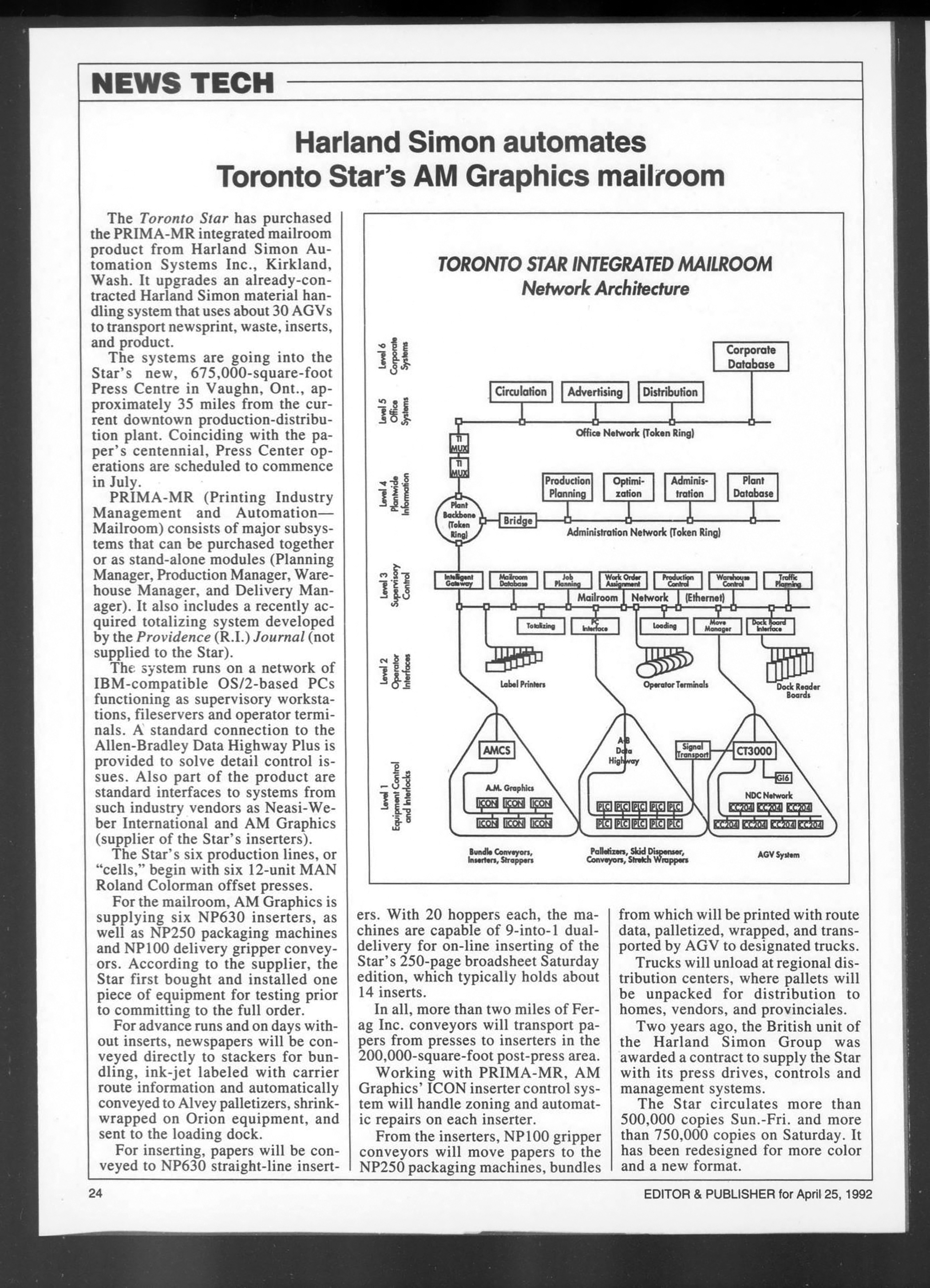
A common target of automation was mailrooms, as with The Toronto Star. 5
One observer predicted that newspapers would eventually become “information utilities” if they could just figure out how to apply AI tools to the business side of the news, that is, how to market and sell the news and the ads that went with them (Rosenberg, 1993, p. 34). As with other aspects of the journalism industry, this side of the business would drive technology change, with mixed results. Other industry watchers were skeptical. “In the ‘90s, synergy has gone the way of artificial intelligence: rarely heard and almost never seen,” noted Michael Conniff, a columnist who wrote about tech trends for Editor & Publisher. “Freelance trend-spotters have been known to sit through entire days of new media conferences without hearing the word” (Conniff, 1994, p. 31). Comparing AI hype to “synergy” fads was not exactly a compliment in the middle of the decade. Arguably it took the adoption of the internet to drive AI use and move the later beyond more advanced conceptions of automation.
A move away from “systems integration” with “legacy,” proprietary, all-in-one components purchased and installed in newsrooms in big batches (by companies such as Systems Integrators, General Motors and Raytheon), to more distributed, ad hoc, off-the-self and more decentralized desktops (still linked via an intranet and CMS) marked a shift for the potential of AI, in the late 1990s and early 2000s (Fitzgerald, 1995, p. 30). This was seen in the use of AI with early online search tools (Bowen, 1999, p. 38), and in more sophisticated software that “learned” to optimize production tasks (Fitzgerald, 1999, p. 36). AI also made its way into software used for layout and pagination, which continued to be a time- and labor-intensive task into the 2000s (Rosenberg, 2000, p. 52).
By the 2000s, there was a further shift in thinking about AI tools, one that set the stage for their more aggressive adoption and deployment in the 2010s through the present. Based on research by MIT's News in the Future project (funded by Knight-Ridder, Gannett, Times Mirror and Hearst, among other media companies, in the early 1990s), scholars such as Walter Bender connected pattern recognition to AI and called for its use in journalism. In a 1994 Columbia Journalism Review article, Bender predicted that: …The impact this technology's going to have on news in the future isn't going to manifest itself in a gadget… Rather it's going to manifest itself in an architecture. And the architecture is going to do three things. It's going to change our concept of timeliness. It's going to change our concept of convenience. And it's going to change our concept of relevancy. In order to do those three things, we need to understand the individual. (Oppenheimer, 1994, pp. 41–43)
In the era before RSS feeds, at least one company attempted to monetize custom news feeds to corporate internet users with curated emails. This product, “NewsPage Direct,” billed itself as a tool for “knowledge workers,” and for $3.95 a month a customer could access about a third of a daily intake of about 20,000 news stories organized into 2500 subcategories; for $6.95 a month, they could access the rest. That's about $8 to $14 today; the email subscription won a “Best Online News Service award from Internet World magazine (Cohen, 1996, pp. 32–33). 2 Other efforts did similar things for political news for citizen activists (Neuwirth, 1998, p. 16) and autopaying subscriptions (Stein, 1997, p. 14, 16). There was one for journalists too, for organizations such as IRE (Investigative Reporters and Editors) and the Society of Professional Journalists, along with CAR practitioners; though in this case it was a free, early listserv (Isaacs, 1995, pp. 61–64).
But one major concern that emerged by the mid-2000s was some worry about the impacts on strained journalistic workforces from automated tools—both in the labor required to maintain and use them and because they could be used to then justify reductions in the number of news workers needed to gather, produce and distribute news. “Some things can't be automated … The demands for people are even greater as news gathering gets more complex,” noted Mark Tatge, the Chicago-based Midwest bureau chief for Forbes magazine (Greenwald, 2004, pp. 22–25). Despite the adoption of internet (and AI) tools in newsrooms, “old-fashioned legwork is still the key to solid reporting,” argued Joe Mahr, an investigative journalists who worked for the Toledo Blade and was part of a team of three reporters that won a Pulitzer Prize for its journalism about Vietnam War-era atrocities committed by the U.S. Army (Greenwald, 2004, pp. 22–25). Nonetheless, automation of news content on newspaper's site had promise, it was felt (Frye, 2006, pp. 14–18). Concerns remained about information overload for news consumers through the end of the 2000s, with automation both helping and hurting the issue (Quart, 2008, pp. 14–17).
Discourse about artificial intelligence (as contemporary readers might more familiarly recognize the term) in the journalistic trade press picked up both in quantity and in the range of possibilities, from worries to hopes, in the 2010s (Mari, 2024). One 2017 piece from Columbia Journalism Review hypothesized a mostly harmonious near-future relationship between a human journalist and AI tools, in which the latter served to shift through and analyze data ranging from government documents to video captured by aerial drones (Marconi & Siegman, 2017). Nicholas Diakopoulos, a researcher who studies the real-world application of AI to journalism, thought that AI tools could help to fact check and perhaps complete some basic reporting tasks in order to assist a human journalist, with an eye toward enhancing, rather than replacing, the person in the process (Diakopoulos, 2018). In this sense, AI tools were discussed as extensions of previous waves of newsroom computerization and internet adoption. AI, sometimes also referred to by this point as “machine learning,” often in the form of specific tasks such as algorithmic curation, was just the latest in a long line of computer-assistant reporting tools, with both opportunities and excesses to be navigated (Ivancsics & Hansen, 2019). There is some truth to this, as automation helped to pioneer ideas of what AI tools, when they emerged, were capable of (and how they manifested in physical form in newsrooms via digital devices).
But the downsides of AI's nascent deployment in the 2010s, at least as discussed by journalism studies scholars and industry observers, included removing much-needed human perspectives on challenging issues, and, in some cases, enhancing the power of authoritarian states and their ability to control reporting, as in China (Ables, 2018). AI could exacerbate existing biases and the ethical pitfalls that went with them (Diakopoulos, 2016). It was (and still remains) less sophisticated than a human observer when it comes to discerning between very different kinds of content, such as videos documenting war crimes versus videos that celebrate violence (Ingram, 2019). AI was both promising and problematic, capable of aiding journalism but also circulating falsehoods, in an era already fraught with them (Stenger, 2013). The “robot journalism” of the late 2010s and early 2020s was only as good as its data, its human overseers, and the specific contexts in which it was applied; the subtext was not so much fear, as uncertainty (Willis, 2020). In this sense, AI really did—and again, still does—resemble previous technologies, at least in terms of fear about the use of such tools.
Discussion: How automation became artificial intelligence
As seen above, analog automatic/automated machines/processes and other devices (mostly for production/layout) were in the background for much of the 20th century and then more visible once digital and on the editorial side. This gradual move from more implicit to explicit automation, and from the “factory” or production side of the news to its gathering, editing, and publication, may help to explain some of the emergent anxieties regarding its use. Sometimes this anxiety took the form, somewhat ironically, of (1) unbridled enthusiasm in the 1970s and 1980s for new, automated, and later, AI-driven tools. Technology equaled helpful innovation and not loss, but enhancement—journalism was made better with such tools. This was particularly present in the coverage of automation and then AI in Editor & Publisher, and to a lesser extent, in CJR. But a corresponding theme in the 1990s and early 2000s was (2) worry about job loss, or loss of control over work, to refer back to Abbott's jurisdictional theorizing of professional identity formation and creation. This was also present in the pages of Quill and other, more news-worker oriented publications. Finally, a third theme of (3) cautious optimism, which sought to place the introduction of new tools in context and highlighted their potentials but also their pitfalls, emerged by the 2010s. All three conceptions existed in rough parallel with one another, and no one strand dominated the discourse around the use of automation and AI. And all three manifested in different ways depending on where one worked in a news organization.
To put it another way, automation was less alarming for white-collar editorial workers when it mostly impacted blue-collar production workers, but when the former were finally impacted it finally caused some of the alarm and the kinds of anxiety that scholars observe today. With regards to RQ1 (How does the trade-literature discourse (and specific examples from that discourse) from the pre-internet and early internet eras … preview current anxieties?), previous conversations regarding “automation” seem less freighted with worry and more concerned with the application of machines to questions of efficiency and cost savings. With RQ2 (In what ways was this discourse different, or disconnected…?), then, it was far less fear-based, per se., and highly dependent on the kinds of work one did and how much training one received in any new technology tool (Örnebring, 2010).
While certainly not a complete survey of the discourse surrounding AI and its antecedents, examining the above shows how discourse around them evolved. And while one might make the case that “automation” and conceptions of “automated” technologies were not, strictly speaking, directly akin to “artificial intelligence,” as news workers understood the former two terms (as machine-led or driven- processes independent from human intervention, except for initial operating instructions or updates to commands), they are roughly comparable as precedents. There is the danger in this kind of project of anachronistic back-reading of technology adoption in journalism. For again both retro innovation and retro anxiety … both motivate technology-dependent, information-society workers (in this case, news workers) in similar and different ways, with back-justifications for innovations and disruptions that make more sense in retrospect (and are far less clear in the present), and in worries that seem ubiquitous today and thus must have been present before. But that is not always the case with the latter and the former needs careful contextualization in the form of discrete media histories. To put it another way, it is messy.
That is not to say that news workers were not worried about technology tools taking their jobs or at least reducing their autonomy—they were. But they were concerned about technology in different ways than news workers and scholars in our present. Older fears were tempered by the limited capacity of tools such as AI, and because the workers themselves had more control over the adoption process (in the case of production workers, with the ITU), or their actual day-to-work was not actually impacted, at least not much and definitely not in core ways (with exceptions such as the use of the first generation of search tools, with editorial workers). A cartoon from Editor & Publisher and published in 1986 represents some of these anxieties (Doug Borgstedt, “The Fourth Estate,” Editor & Publisher, Sept. 13, 1986, 4; see Figure 4).
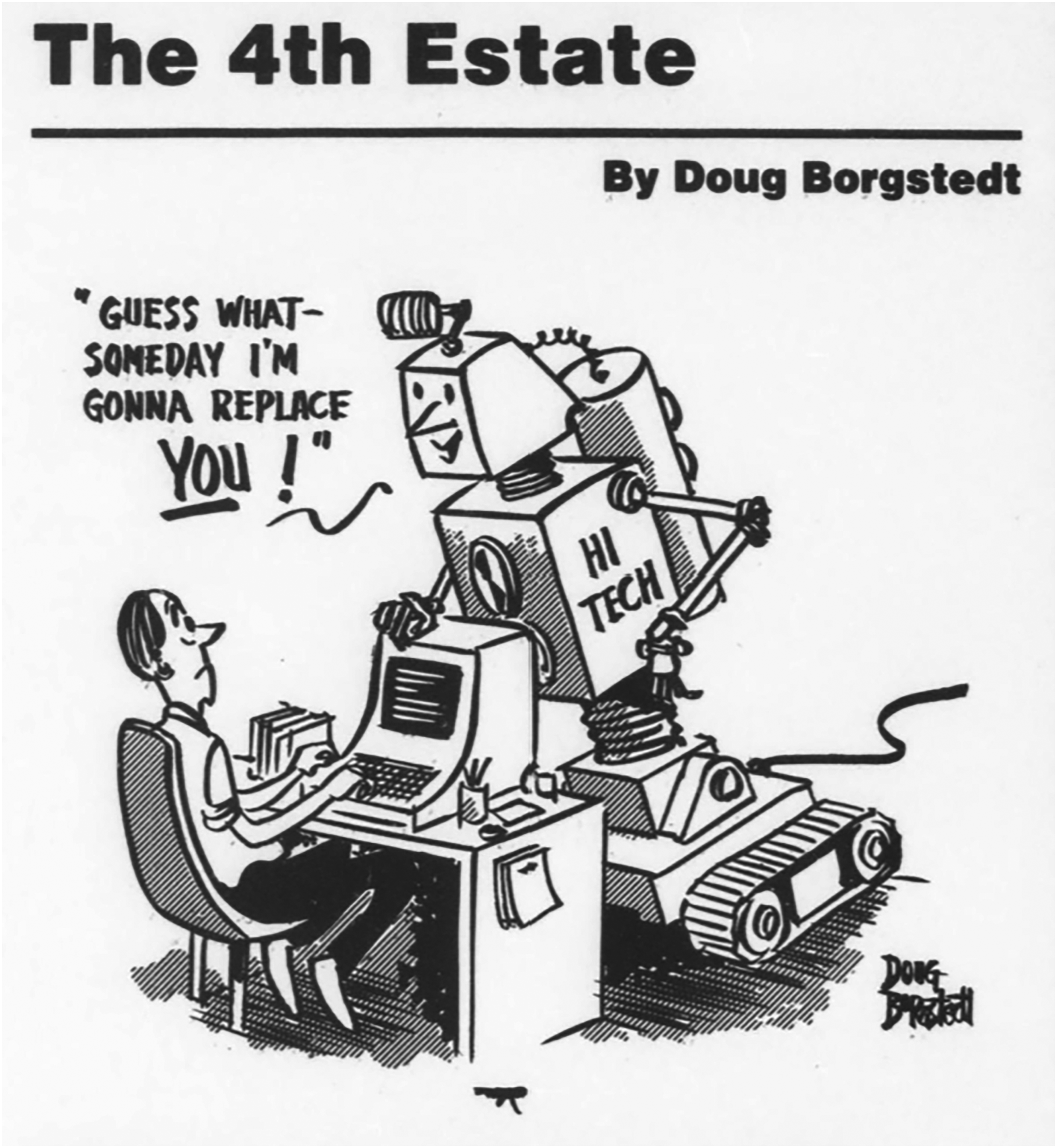
A cartoon from Editor & Publisher and published in 1986 represents some of these anxieties (Doug Borgstedt, “The Fourth Estate,” Editor & Publisher, Sept. 13, 1986, 4. 6
Conclusion
“Hi Tech” (see above) is personified in the form of an andromorphic robot that declares to a startled news worker, laboring behind a VDT, “Guess what—someday I’m gonna replace you!” cheerfully, if vaguely menacingly. It is thus important to remember that previous generations’ experiences with technology adoption were, in fact, different, but that similar concerns (control over work processes, the need for training, etc.), can be enduring. The concerns of each new generation of news worker are thus novel in many respects, but reflect similar, foundational issues.
This is the case with AI as much as any other “revolutionary” technology that claims to upend all the came before: it likely will not, at least not right away. While not a shocking discovery, it is worth consideration and consideration, especially for media studies and journalism studies scholarship. The discourse around automation and later AI in the journalistic trade literature of the past half century, especially in Editor & Publisher, Columbia Journalism Review, and Quill, show that AI anxiety, like that about many such supposedly new concepts, has a long tail of development: it has emerged from an occupational past into our present, unevenly and with its own material, and conceptual, baggage. As Balbi and his colleagues have shown in their research on this phenomenon, digital ideas often have analog roots, and media history can help to show those roots and their connections to the present (Balbi et al., 2021). A throughline for thinking about automation, and later AI tools is thus: each new generation of workers feels the weight of new tools in ways that reflect older worries, and in ways that touch on professional identity at a fundamental level. This shows up in discourse about the use of material tools, about the training (or lack thereof) in the use of these tools, and in how management implements changes to workforces and work processes. Only by considering a material approach can one appreciate how automation and then AI discourse has and had practical, day-to-day impacts on the lived experiences of news workers.
Subsequent research could and should look at country-specific AI tool discourse outside of the global north or west. Most of the scholarship on newsroom computerization has focused on the latter two areas, especially Western Europe (particularly in the UK) and North America (the U.S. and Canada). In a future study, I or another scholar could examine automation discourse in the Global South or in another part of the planet—cultural and historical factors and forces are, of course, different, in different contexts. A follow-up project could likewise examine how the manufacturers, developers, programmers, or others behind the creation of automation and later AI tools thought about the application of these tools to creative endeavors such as journalism (if they have). A series of interviews (oral histories) with these individuals could tease out motivations and perceptions in ways that enhance archival insights. The best research, of course, draws from multiple sources.
Understanding current phenomena—especially the kinds of supposedly radically (not just gradual) new technologies such as AI, demands a grounded, longitudinal perspective, which media history can help provide. As internet-history scholar David Karpf has argued, discrete examples of technology discourse can help to pin fuzzy ideas down and define “internet time” as happening in the real world with real actors and real consequences for people, both workers and consumers alike (Karpf, 2012).
If one thinks of AI as an extension of automation—as one should—and as something that has moved from the production to the editorial side of news organizations, a media-historical background can be fruitful for understanding how ideas of “newness” are founded and can flourish. AI in journalism has its own long history. I hope this project has added some initial, and insightful, historical context to the debate about the potential—and harms—around AI implementation in the media and news industries.
Footnotes
Declaration of conflicting interests
The author declared no potential conflicts of interest with respect to the research, authorship, and/or publication of this article.
Ethical statement
This study did not require institutional review board (IRB) approval as it was exempt due to its archival and historical nature. The latter method and approach was conducted in accordance with best practices in the field and following federal and other guidelines. No human subjects were used for this research.
Funding
The author received no financial support for the research, authorship, and/or publication of this article.
