



Abstract
In this study, a mixed method was used to understand metajournalistic discourse on TikTok. Using convenience sampling, 30 journalists active on TikTok were selected and all their available 3270 TikTok videos were manually content analyzed. To understand these videos, a codebook was designed in which 5 major categories were identified as follows: 1. Educational news production; 2. News sharing/live reporting; 3. Personal anecdotes & opinions; 4. Interactions with audience; and 5. Dancing & challenges. In general, metajournalistic discourse on TikTok revolve around employing educational tips, entertainment, creativity, and music to engage and interact with wider audiences. To complement the study and gain a deeper understanding of journalism practice on TikTok, 17 journalists active on TikTok were interviewed mostly by email. Using thematic analysis, four major themes emerged from the interviews including personalized content, effective algorithms, audience outreach, and TikTok as a newsroom.
Introduction
In this study, the focus is on journalism practices on TikTok because this is still a largely under-researched topic especially studies involving mixed method approaches. Before discussing the details of the study, it is important to provide some background information on TikTok and review the available studies. According to Reuters Institute's Digital News Report of 2022, “TikTok has become the fastest growing network…, reaching 40% of 18–24 s, with 15% using the platform for news. Usage is much higher in parts of Latin America, Asia, and Africa than it is in the United States or Northern Europe” (Reuters Institute, 2022, p. 11). As a mobile social media platform, TikTok originally started in China back in 2016 as “Douyin.” The app became increasingly popular in 2018 when it merged with Musical.ly, a short lip-syncing video-based app (Vázquez-Herrero et al., 2022; Zulli & Zulli, 2020). As mentioned above, there has been relatively limited academic research surrounding the rise of the ByteDance platform and journalism practices (Vázquez-Herrero et al., 2022), or it has primarily focused on its predecessors, Douyin and Musical.ly (Shutsko, 2020). Shutsko (2020) found that the number one motive to using the app was to have fun, and it was primarily popular with adolescents, which may have resulted in missing topics, such as vehicles and parenting. The standard short video times of TikTok (60 s) were found to be another possible factor for its popularity. The predominant use of the app for the younger user was an online stage, where users could perform, tell stories, and express themselves in creative ways (Shutsko, 2020). In this study, video content was categorized based on what journalists posted on TikTok and a few other journalists were later interviewed to better understand why they chose this online platform as part of their journalistic work.
Situated within the theoretical discussion of metajournalistic discourse, this study presents new insight into the use of TikTok by journalists for it does not only provide a systematic content analysis of TikTok videos but also offers an understanding of the reasons behind using TikTok and elaborates on its implications for journalism. Second, the application of metajournalistic discourse in the empirical study of TikTok is unique as previous studies have not used this theoretical framework to better understand the affordances of this specific social media site and its effect on journalism practice. Third, the mixed methodological approaches applied in this study, which involve both content analysis and interviews, directly address the conceptual components of metajournalistic discourse such as the specific topics discussed and the type of actors involved. To expand on this theory using the empirical findings of this study, I argue that it does not cover the educational and entertainment aspects. Hence, I introduce the concept of “edutainment journalism” which I consider to be a unique feature of TikTok because journalists have often become both educators and entertainers at the same time. Often time, this happens through TikTok's features of dance and music in what I call “the dancification of journalism,” adding more value and varied meanings for audiences at a time where trust in the journalism industry and consumption of mainstream news are in gradual decline. In the following section, a literature review is presented on journalists’ use of TikTok.
The Journalism of TikTok
Within the limited available research on TikTok and journalism, there have been a few important areas examined in previous studies in relation to the macro level of news organizations. This study, however, focuses on the TikTok journalists themselves, an area that remains largely under-researched. For example, concentrated on the intersectionality of TikTok and television news, Vázquez-Herrero et al.'s (2021) article explored how other media were adapting to “TikTok logic,” looking specifically at how news media was adapting to TikTok. The authors’ other research paper explored the adaptation of television programs to the new platform. Both articles researched which news organizations in their respective categories were present on TikTok and if and how these organizations have adapted to TikTok's characteristics and affordances (Vázquez-Herrero et al., 2022, 2021). The studies found that both news media and television program companies were engaging in TikTok logic by participating and promoting its unique online challenges, using the built-in visual effects, transitions, filters, and having popular songs play in the background of their videos. Both studies also found that these news organizations created behind the scenes content to show a unique, more personal look into the news making process, but neither had a clear motive behind trying to direct TikTok users toward their primary news sites. Instead, journalists focused on giving visibility to their brand (Vázquez-Herrero et al., 2022), sharing small segments, or highlighting entertainment aspects (Vázquez-Herrero et al., 2021).
One other related study investigated citizen journalism practices on TikTok (Peterson-Salahuddin, 2023), while a few other one examined Douyin, the Chinese TikTok version, in terms of fact checking techniques (Lu & Shen, 2023) as well as platform use by Chinese official news organizations (Zhao & Ye, 2023). These two latter studies, however, are limited to Douyin, and the first one is more focused on persuasive strategies rather than journalism practice or news production.
To further expand the literature and explore non-journalism research and TikTok, other studies investigated political communication on the platform. For example, Medina Serrano et al. (2020) explored who uses TikTok for political purposes and along with Vijay, and Gekker's article (2021), explores how TikTok's architecture affects political discourses. Both of these studies found that unlike other social media platforms, such as Facebook and Instagram, where you can share other people's content, TikTok features such as duets often lead users to directly participate in the political discussion instead of just sharing content. The duet feature allows users to respond to a video with a video of their own, making them content creators, something Medina Serrano et al. found to affect how political debates play out across the platform (2020).
In this regard, the sound feature, where TikTok users can employ a premade sound to lip-syncing, has led to users’ playing politics’ and becoming active participants in discussions (Medina Serrano et al., 2020; Vijay & Gekker, 2021). Shutsko's study also found that political content dispersed through the mobile app was exceptional (2020). More so, these studies found that although TikTok's political potential is vast, the infrastructure of the app has also resulted in the “realization of politics as entertainment” (Medina Serrano et al., 2020), which Vijay and Gekker (2021) argue can result in actual political actions and activism being diminished to a joke, satire, or spoof.
A few other studies focused on other aspects of TikTok's use like its governance, regulations, and social implications (Kaye et al., 2020) as well as the issues of creative work and play (Zulli & Zulli, 2020), frontline health workers (Al-Rawi & Zemenchik, 2023), mental health and well-being (Masciantonio et al., 2021), COVID-19 guidelines (Chen et al., 2021), and education (Presley et al., 2021).
As can be seen from the above review, there are no studies that empirically examined metajournalistic discourse on TikTok and none of them used automated methods to extract data in combination with manual analysis of TikTok videos combined with semi-structured interview research. In this paper, journalists on TikTok often engage their audiences on a variety of entertaining issues including serious ones like how news is made in the newsroom. I call this practice edutainment journalism which involves traditional journalistic work in terms of making and disseminating news using the technological affordances of the social media platform like its filters to create entertaining and creative content as well as audio-visual guides on how news itself is written, made, and presented to the wider TikTok audience. The educational aspects of this journalistic content mostly offer unique insights into the news making process from the journalist's perspective (see for example TikTok, 2020). Similar to the arguments made in Presley et al.'s study (2021), there is a clear entertainment value in creating serious content.
Metajournalistic Discourse via TikTok
In terms of conceptually situating journalists’ use of TikTok, the theory of metajournalistic discourse offers a suitable framework. Discourse about the news industry provides meanings of journalism to both the journalistic community and the public (Berkowitz, 2000). Carlson (2016, 2017) raised questions on the struggles of journalistic boundaries, highlighting the value of metajournalistic discourse, which includes any discourse about evaluating journalism and who belongs within its boundaries (Carlson, 2016). The term highlights discussions about proper borders and practices of journalism, which affects how journalists work and how the public perceive their product (Ofori-Parku & Botwe, 2020).
Metajournalistic discourse is essential for socially constructing journalistic authority (Zelizer, 1993), by regularly defining journalistic boundaries and accepting or discrediting specific actors and practices (Lough, 2021). Carlson (2016) also highlights that understanding how actors justify or challenge the industry “is inseparable from ways of understanding journalism” (p. 2). Thus, metajournalistic discourse presents a fitting theoretical model to study “news texts, the practices that produce them, or the conditions of their reception” (Carlson, 2016, p. 350), bridging the gap between “empirical and normative work” (Craft & Thomas, 2016, p. 4). In other words, the theory provides a clear guide to analyze how discourse about journalism is understood, executed and consumed (Carlson, 2016, p. 359). With the assumption that journalism is socially constructed based on space and time, it suggests that when scholars examine metajournalistic discourse, they should link together three main components that provide necessary contextual information: the sites where the discourse happens and the audience who perceives it, actors creating it, and the topics they discuss (Carlson, 2016, p. 14). In relation to this study, the place where the discourses occur is TikTok, which is a non-journalistic site, and the actors creating the discourse are journalists themselves who are also the content creators.
Regarding the first component, the theory refers to sites as the place where discourse is published (Ferrucci, 2019). A site is connected to its audience since a site determines “how the discourse reaches audiences and, then, how the audience interprets the message” (Ferrucci & Taylor, 2018, p. 125). Similar to how different speakers inside and outside journalism produce metajournalistic discourse, sites also include various channels (Carlson, 2018). For example, it can be traditional sites of news dissemination like a newspaper's public editor column or when reporters cover their industry (Ferrucci, 2018) and non-traditional ones like media commentary sites (Carlson, 2016) and social media websites like Twitter. Furthermore, sites intersect with the second component of the theory, as Carlson (2016) argues that “actors are often defined by where they speak'’ (p. 356). Again, TikTok in this study is the non-journalistic site where the discourses occur.
As for actors, they are producers of metajournalistic discourse who can be journalists and non-journalists (Craft & Thomas, 2016; De Maeyer & Holton, 2016). Previous metajournalistic discourse studies analyze journalistic actors by understanding how they talk about and discuss their industry (Ferrucci & Taylor, 2018; Vos & Singer, 2016). Other studies examine discussions created by non-journalists in textual spaces through Twitter and social media sharing (De Maeyer & Holton, 2016). Journalists and non-journalists together can also interact in textual spaces, highlighting the appearance of non-journalism in newspapers (Carlson, 2016). Examples include the letter-to-the-editor space (Wahl-Jorgensen, 2001) and government officials responding to the news. However, Carlson (2016) notes that current research focuses more on discourses produced by journalists (Ferrucci & Taylor, 2018). Scholars argue that journalists’ and insiders’ discourse has a broader impact on shaping the industry (Craft & Thomas, 2016; Vos & Singer, 2016) than a strategic influence by non-journalists (Lamuedra et al., 2019). In relation to this study, journalists on TikTok post videos and often interact with their audiences either through responding to their comments or making other videos.
Finally, the last dimension of this theory focuses on the topics or discourses that are divided into reactive and generative. The latter metadiscourse refers to discussions on the industry as a whole, originating from broader considerations of contemporary journalism (Carlson, 2016, p. 358). This type of discourse “surveys the field and does not focus on one specific event but rather the general norms, practices, and actions of the industry” (Ferrucci, 2019, p. 293). In this study, journalists on TikTok often engage their audiences on a variety of generative issues including how news is made in the newsroom which is related to edutainment journalism.
Metajournalistic discourse, however, does not cover the educational, creative, and/or entertainment aspects of the generative discourses which are evident today on TikTok. I argue that edutainment journalism is another aspect of generative metajournalistic discourse because journalists have become educators and creative content creators with the technological features of TikTok like its filters and varied features like music and dance. I term this new phenomenon as “the dancification of journalism” wherein dance and music elements are embedded in journalists’ generative metajournalistic discourse. This study attempts to answer the following research questions: RQ1: Based on the content analysis phase, what are the categories of metajournalistic discourse found in the videos posted by journalists on TikTok? RQ2: Based on the interviews with journalists, why and how do they use TikTok and what are the major themes that emerged?
Method
In this study, a mixed method approach was employed. Using their mobile phones, two coders selected TikTok journalists using convenience sampling, based on several hashtag searches including #TikTokjournaslits, #JournalistsofTikTok, #Journalism, #News, and #Jounrnalist. The selection of these journalists is one of the study's limitations regarding the content analysis phase, but our goal was to collect enough TikTok videos that could be manually analyzed offering adequate insight into the major content categories used by journalists. Audience engagement with the journalists’ TikTok videos was also taken into account which is calculated as the sum of video comments, shares, and play counts. Due to the quality of digital labour involved, it is important to note here that there are different types and levels of audience engagement, for commenting on a video can be considered more engaging than sharing it, while viewing a video can be considered less engaging than the other two metrics. This is similar to the observation made by Al-Rawi et al. (2023) regarding replies to tweets being more engaging than liking or retweeting them. However, I took into account all of the above three TikTok metrics by summing them up because they collectively indicate a variety of engagement with the videos, the highest being play counts. In this respect, I partly followed the studies of Yang et al. (2021) and Toff and Mathews (2021) in which audience engagement is measured on Facebook by calculating the overall number emoji reactions, comments, and shares. Using a TypeScript program, 3270 TikTok videos were automatedly downloaded on May 24, 2021. These videos, which received 653,511 comments, 1,367,747 shares, and 502,652,062 play counts, were posted by 30 journalists representing all the available posts that were not deleted from the social media platform.
As for the codebook, two coders deductively used previous research on journalists’ use of social media to identify the main categories of posts, as indicated above. Although past articles have discussed how journalists use social media, few analyzed the exact content that was being shared. On a broader scale, Canter (2015) sorted journalist posts into the umbrella categories Traditional, Informal, Personal, Sharing: Colleagues, Sharing: External, Interactive: Colleague and Interactive: External (2015). But in a deeper delve deeper into what journalist post on their social media, a categorized breakdown on the post's themes were analyzed in studies from both Brems et al. (2016) and (Al-Rawi, 2020). The common categorize these studies observed were: Opinion, critique, interpretation; Sharing news; Breaking news or live reporting; Self-promotion; Promoting other individual journalists; Arguing or debating with others; Request for non-journalistic input; Request for journalistic input; Giving general advice or helping someone; Acknowledgment; Sharing personal information; Correcting an error; Reflecting on journalism practice; and Other. In addition to these themes, Al-Rawi included the category humor in his study on celebrity journalists’ social media posts (2020).
After a few rounds of deliberation and discussion, two coders identified five main categories by relying on previous research and by examining a sample data of TikTok videos. The main categories are listed as follows: (1) Educational news production/tutorials/tips; (2) News sharing/live reporting; (3) Personal anecdotes & opinions; (4) Interactions with audience; and (5) Dancing & challenges. Three coders examined 372 videos representing over 10% of the total sample and the agreement was acceptable using Krippendorff's alpha α≥0.826.
After finalizing our content analysis stage of the study, we wanted to further understand why and how journalists use the online platform especially that content analysis cannot delve deeper into the reasons and implications of using TikTok. Hence, we decided to conduct interviews with journalists that could complement our insight into metajournalistic discourse on TikTok. Regarding this second phase of the study, we found over 70 journalists who are active on TikTok and were contacted by email and/or via their social media sites in late 2021. However, journalism educators, community, citizen, and non-English journalists were excluded from the study, and journalists who deleted or made their TikTok accounts private were not contacted. Using convenience sampling, 17 journalists (2 men and 15 women) accepted to participate in the study which received an ethics clearance from the authors’ university. The respondents, who are a mix of early and mid-career journalists, are based in the US, UK, Canada, and New Zealand. Based on the journalists’ preference, most of the interviews were conducted by email (n = 14) with a few on Zoom (n = 3), and the latter lasted between 30 to 60 min. The questions revolved around the implications of using TikTok for journalists, the algorithmic features of the platform, and how it is different from other social media outlets like Facebook or Twitter regarding journalistic work. To analyze the responses, Thematic Analysis was used to inductively identify the major themes discussed by the journalists (Charmaz & Belgrave, 2012). After interviewing about 15 journalists by email and Zoom, we reached the saturation level (Guest et al., 2006) as we started receiving similar responses and common themes. As a result, we stopped inviting more journalists to be involved in the study.
Results and Discussion
This study focuses on content analyzing journalists’ video content on TikTok and further eliciting their insights on the implications of using this platform by employing interviews. To answer the first research question on the categories found in the journalists’ metajournalistic discourse, the results show that personal anecdotes and opinions category was the most dominant one that is used by journalists (55.6%), receiving (41.2%) of audience engagement (See Table 1). This finding closely aligns with the literature review presented above (Bossio & Sacco, 2017; Brems et al., 2016; Tandoc et al., 2019), for posts referencing the personal lives and opinions of journalists remain vital for audience engagement especially on a platform like TikTok. I argue here that this category, which is not directly related to news making, is part of social media discourses around educational, creative, and entertainment aspects.
The major Categories of TikTok Videos Posted by Journalists and Audience Engagement.
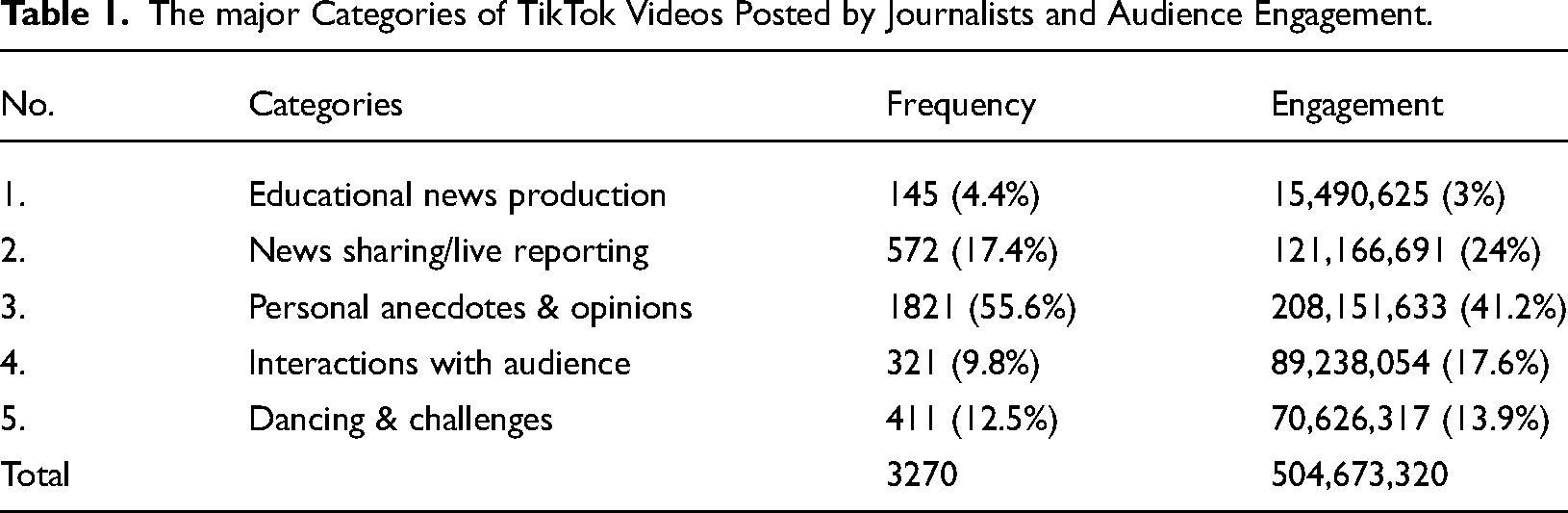
The second top category is related to news sharing and/or live reporting which got (17.4%) and (24%) for audience engagement. Though this is the traditional role of journalists, it is not the most prominent on TikTok, probably because TikTok is not considered the main venue for breaking and sharing current news despite the creative features that are often used in making the videos.
As for the third category, it is related to dancing and challenges (12.5%) which received (13.9%) in audience engagement. In fact, music studies discuss the term dancification which often refers to the rhythmic patterns and alignment of movements in association with the played music (Soriano & Clemente, 2010; Wang et al., 2020). Similarly, we can find an aspect of dancification in journalism on TikTok wherein dance and music elements are embedded in journalists’ discourses, allowing wider audiences to engage and interact with this appealing new content. Here, the journalist is personalized and humanized and would often “show work behind the scenes in a casual and musical atmosphere that seems appropriate for the TikTok audience” (Vázquez-Herrero et al., 2022, p. 1729).
In terms of the use of music tunes, the content analysis results show that 1401 videos contained music tunes, constituting 42.8% of all the videos (Table 2). The tunes also include one called “Breaking News” (https://sf16-ies-music-sg.tiktokcdn.com/obj/tiktok-obj/db817bc56696115544860f710b780ecd.m4a). In one of the interviews conducted, a female journalist mentioned the following about the significance of dancing challenges: I think it's actually like a fun juxtaposition of news. Personalities are often seen as so stiff, so serious, delivering death and destruction. And so the duration of when you see us during our broadcast is very like, you know, prim proper sitting up straight. … But when you break out of that out of the broadcast, it's like seeing a dog walk on its two legs. For some people, like they don't, they don't really see us as real people. And so I would say, like with TikTok, music and dancing, it's like personalizing the journalists and making them more real. … So a lot of people have been using the music and dance and whatnot to kind of say, like, we're fun. We're real people, too. It's kind of like, if you would see the president say, you always see them in very serious settings, you know, they're at Congress and whatnot. … They're just very like, you know, this archetype, this cookie mold of a person. And then if you saw them dancing to mambo number five, it would probably make you like them a little bit more.
The Most Used Tunes Associated with TikTok Videos Posted by Journalists.
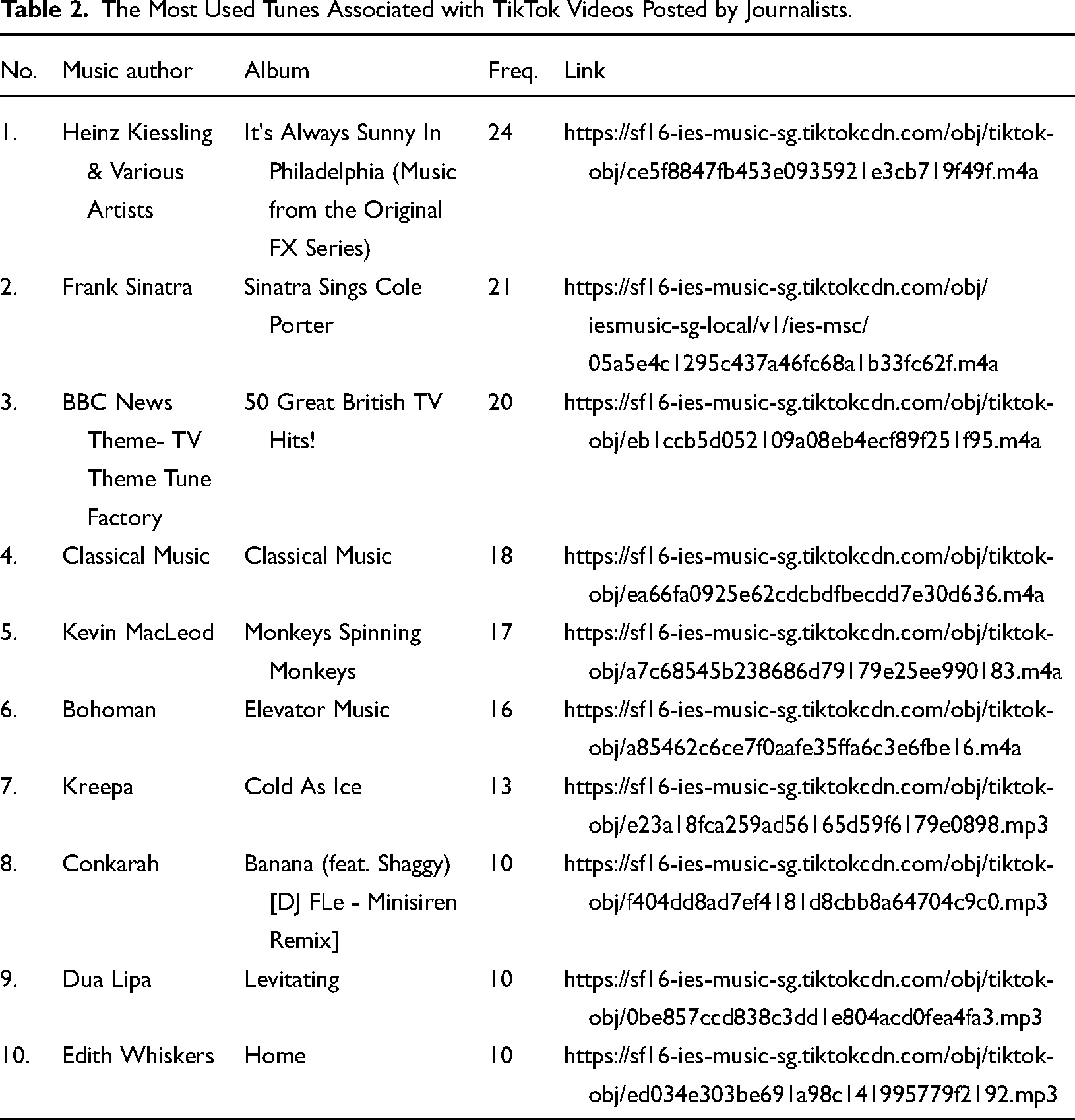
Another journalist who reports weather news largely agrees with the above characterization of TikTok, stressing that “using music is a fun, [offering] additional benefit as well. For example, on a stormy day, I could use the song “Riders on the Storm” by The Doors for added impact of the day's weather. TikTok gives you a platform to approach news in a video first, video centric platform. No other platform can do that. Furthermore, you can blend video with text, graphics and filters to enhance the certain parts of the piece as you'd wish.” Interestingly, this was not a major issue discussed by the journalists during the interviews. A third journalist mentioned how the platform encourages creativity since “content is heavily influenced by trends, music and viral sounds which makes creators on the app heavily focused on how they can combine important information and their journalism work with those popular trends”.
Regarding the fourth category, it is related to journalists’ direct interactions with their audience (9.8%) which received slightly higher percentage in terms of audience engagement (17.6%) than the previous category. Contrary to the journalists’ expectations, these interactions seem to be enhancing the engagement despite their challenges and risks such as receiving trolling messages and uncivil comments, as will be explained below.
Finally, the category that got the least attention by journalists is related to educational news production such as news making tips (4.4%), receiving the lowest audience engagement (3%), too. As stated above, this category is related to educational journalism; for example, journalists often elaborate on the way news is fact checked, collected and/or presented in the broadcast newsroom, offering educational as well as entertaining insider knowledge of the news making process.
To answer the second research question, this study interviewed 17 journalists who are active on TikTok to understand how and why journalists use TikTok including the dissemination of news on this platform. The goal is to gain insight into metajournalistic discourse on TikTok by examining how the platform is used and is different from other social media sites. There are four major themes that are emerged from the interviews:
Personalized content
There is a general consensus among the participants that one of the key differences between TikTok and other social media platforms is how the content can become more personable. One of the main objectives of personalized content is enhancing audience engagement. For example, one journalist stated how TikTok can be “more inspiring than other social media sites as it encourages users to be creative”, while another one mentioned the following: Whether that is in your personal or career life … I'm talking about my professional journalism, but in the personal side I am right now training for a half marathon, so I'm taking people on that journey with me. And it's important that we do that because I feel like it, it shows that journalists are humans and it shows that, apart from the fact that we work a regular job we also deal with personal stuff … just like we are humans beyond the content that we put out there in the news that we tell people.
Another journalist confirmed the need to highlight one's personal life in the posted videos, saying: “I don't post too many news stories on the platform, instead I've found the most success with behind-the-scenes videos showing my life as a journalist” because it personalizes the journalists. Similarly, another respondent revealed that “TikTok … seems to be more personal; users connect with videos that have a human element to them- unlike Twitter which is usually text-specific, or Facebook, which has a bad algorithm for news.” Multiple participants have echoed this sentiment, finding that younger audiences are attracted to shorter, personal videos compared to more traditional long-form news content. Another journalist agreed, stating that TikTok videos are “a lot more relatable and feel more personal.” Interestingly, one participant mentioned how TikTok combines features found in several other social media sites into one, stating: “I'm on Twitter and I can type short form typing, right? But that's not my face. That's not my voice. It's not my mannerisms. It's not my personality. Instagram is just a picture, which is a static image that doesn't. But TikTok is all a bit combined. And in short form, which is completely my wheelhouse.”
However, several participants noted that the differences between TikTok and other platforms might stem from how they are used. While platforms like Facebook and Twitter are good for sharing longer, more traditional types of news, the visual nature of TikTok allows for a wider range of topical videos that can enhance engagement. In this respect, another participant summed up the personal appeal of TikTok, saying: “By feeling that they know me and where it's a little bit more personal and fun … for many people I am one of the first journalists they’ve ever engaged with in a personal way and I think that builds an element of trust…”
Effective algorithms
Another major theme highlighted by the journalists is how TikTok offers numerous features due to its effective algorithms that allow news to easily go viral. Multiple participants discussed the benefits of the platform's algorithms to introduce their content to new audiences. One respondent, for example, compared TikTok's feeds to the feeds on Instagram and Facebook, describing the latter as being extremely catered to the user's preferences and who they are following. In contrast, TikTok offers two different feeds, with one showing the user content from the accounts they follow and the other showing a mix of content determined by the algorithm. This differentiation, the respondent thinks, makes it easier for people to begin creating creative content and gain a large audience. Another journalist has also found that the two feeds on TikTok aid her in increasing her audience because, as she describes it, the algorithms “put a video in front of a stranger's eyes and the more interaction it gets, the more people will see it.” This, in turn, gives users the greatest chance to go viral, echoing the sentiments of multiple other participants. A third participant has also benefitted from the feed created by the algorithm on TikTok. By including hashtags on videos that he posts, the algorithm will show similar videos. He uses this as a way “to see what people are really talking about in [his] area and see videos from other parts of Southeast Louisiana, even without geotagging.” This also aids him in finding local accounts that he can then use as sources from different stories.
Participants have also indicated that TikTok's algorithms are useful in identifying current popular culture trends. One respondent, who is a freelancer and has worked for various online publications, indicated that the process of understanding trends should not only be limited to TikTok but should be understood in terms of its ability to be translated across multiple platforms. This is because each platform offers journalists access to different audiences. However, in particular, TikTok is known for its recreation of trends, which is why understanding current trends and the aesthetics associated with them is a vital component for creating relatable content and potentially going viral online.
Another reporter has found that the increased engagement she has with her TikTok audiences may be due to how the platform itself functions. She stated, for instance, that while her engagement with immediate followers tended to be similar across other platforms like Twitter, it is “faster to engage with a larger audience on TikTok due to the algorithm.”
Some of the other advantages of TikTok's algorithms are how they can help journalists find news stories. This can come from members of the community posting or through connections made on the platform. For example, one respondent was able to use the platform's algorithm while reporting on Hurricane Ida to find videos of the storm, the damage and the aftermath. He explained that by using TikTok, there was no need to search out the photos through geolocation on other platforms as they were being brought directly to him. He also stated that he could use the platform to connect with TikTok creators directly impacted by the storm and do a follow-up story with them. This story was unique to this journalist's TV station, and it increased his TikTok influencer's profile.
For the sake of comparisons, one female journalist posted the same video to both TikTok and Instagram, and she found that her TikTok video got millions of views while the Instagram video's views were still in the tens of thousands. Due to TikTok's algorithms, the respondent found it easier for her to engage with her followers than on other platforms, and she credits this to TikTok pushing the most liked comments on her videos to the top of the list, making it easier for her to read and respond to them.
On the other hand, other participants indicated that TikTok's algorithms are not as straightforward as other social media platforms. Going viral is exceptionally simple once one gains traction, but it remains unclear how exactly one can go viral on the platform when there are no specific formulae. One participant indicated, for instance, that the number of followers a user has on TikTok does not guarantee that a video will be successful as it may not reach the followers’ pages.
Audience outreach
Most respondents found that TikTok is helpful in expanding audience outreach, and audiences tend to be younger and more engaged. Due to the growing prominence of TikTok amongst younger consumers, its value for spreading information is becoming vital. One respondent mentioned that she has had her content pushed out to a broader range of viewers, allowing her to connect with audiences she would not usually reach. These different people include “a younger audience, those outside of [her] viewing area, or people that do not watch news through a normal TV setup.” Another participant indicated that one of the benefits of using TikTok is that it increases trust between viewers and creators, though this trust is likely to be more meaningful if it is solely one individual conveying the information to the audience, as impersonal organizations are less likely to be trusted in this media landscape. In her experience, the followers she gets on TikTok are more inclined to seek her out on other platforms and follow those possibly due to the issue of trust. She finds this unique “because [her] Twitter, Instagram, or Facebook following stays on those apps and [she] does not see a lot of cross-over of followers on the other apps.” This may be due to the younger demographic on the platform that may use social media more frequently.
As stated above, personalized content seems to be an important feature of TikTok which ultimately helps in broadening the journalists’ audience outreach. One respondent, for example, elaborated as follows: As far as my professional social media goes and the content I produce, I’ve had Twitter for 12 years and a professional Instagram page for six. Neither have more than 6-thousand followers. I had good engagement on my Facebook “like” page, but it was mostly negative comments, so I deleted that page several years ago. But since May [2021], I’ve garnered more than 30-thousand followers on TikTok. I post different types of content on all three social media outlets I use. My Tweets are focused almost entirely on local news, but in contrast, my TikTok is more “behind the scenes” news things intended for a much broader audience. I think when you open up the scope of your content like that, it will naturally appeal to more people.
Indeed, the reference to “behind the scenes” videos is related to educational journalism that is discussed above. Several participants also indicated that the increased levels of engagement on TikTok might stem from how the platform itself functions. One journalist believes that “the fact that videos without ads that instantly play tends to engage the viewer more, regardless of what platform they are on.” This, combined with the shorter videos that communicate information quickly, appeals to her audiences’ shortened attention spans and keeps them engaged. Another respondent, in contrast, believes that her increased engagement with audiences is due to her geographical location. According to her, this is likely due to more people using TikTok than the other platforms in her area, increasing her overall engagement.
Many other respondents believe that TikTok followers are much more engaged than those on other social media sites due to the visual nature of the platform. This video-centric characteristic has made users more comfortable with commenting on and liking videos, thereby increasing their connectivity and online interactions with each other. This point was supported by other participants, who found that the highly visual nature of the platform is what contributes to the high level of engagement on TikTok, mostly because TikTok is more demanding of users’ attention and focus. Another participant discussed using TikTok to create creative content for his audiences. In January 2021, he began doing a morning TikTok show, where he shares three new pieces of information which he “usually sets to the tune of some fun songs as a way to help people have a bright and informed start to their day.” These shows are then shared across different social media platforms like Instagram to amplify his content to a wider audience.
Tiktok as a newsroom
Based on the responses, TikTok seems to have some technological features that have empowered some journalists to be more creative. Because the video is short, less text-heavy than other social media sites, and visually appealing, it typically attracts younger audiences because of its relevance to their lives. One journalist mentioned how TikTok “videos have to be quick and engaging and very visual to attract audiences which allows me to get creative.” Once again, this theme is directly related to edutainment.
Many respondents believe that the primary difference between TikTok and other platforms is that it allows videos to be blended with graphics, filters, and text according to the underlying message in each post. They also indicated that TikTok is easier to use than a few other platforms despite all of the above added features, for it offers various AI technologies, green screen, video filters, as well as text/photo/video editing capabilities. As one journalist clarified: “I don't have to be on a network news show. You know, I can do it from my house. And whenever you want. I mean, and I use all the same tools I would use if I was sitting in a newsroom in a building for another company.”
TikTok also differs from other social media platforms in that users have sixty seconds to convey their message in a succinct and visually appealing manner. One female journalist indicated that, on Instagram, she feels pressured to convey her professionalism through wearing specific makeup and clothing but, on TikTok, she does not have to concern herself with how she looks like because the message and information “value that you're providing” are more important. Another journalist echoes this sentiment and has found that “videos have to be quick and engaging and very visual to attract audiences which allows [her] to get creative.” In addition, having the chance to experiment with other types of content makes the app more lighthearted and fun for her.
Similar to other social media sites, TikTok facilities getting story ideas and keeping abreast of current trends, as one journalist clarified: “Some followers have also reached out to me on TikTok with possible story ideas so it's a great way to connect with people from all walks of life.” According to several participants, the connectivity between journalists and their followers manifests by having the followers recommend stories to be reported through the platform. Another journalist confirmed the following is happening on TikTok: “a lot of people have entrusted me with story ideas or information that allow me to do better journalism.” Another journalist has found that her audience has begun to ask her to make videos on specific topics that they would like to learn more about. This ability to easily make videos on specific topics comes from what she described as an increased closeness between her and the followers. Unlike television news, she can directly engage with her audiences on a more intimate level.
These features make TikTok an important platform because it gives users the ability to create online content through the use of various online tools. One male journalist mentioned that TikTok is effective in transmitting information to his audience through the use of a hashtag and other identifiable features on the platform, which he brands as #suitcast. He explains that TikTok has granted him access to a variety of tools that allow him to better communicate with the audience and, by extension, reach more users. Other participants stated that these online tools are not only used for aesthetic purposes, such as in the case of Instagram, but they can be adjusted to better disseminate news, which is a vital component of TikTok.
Finally and though this was not a recurrent theme found in the interview responses, a few participants have had negative experiences with the platform. One female respondent, for example, and her co-host use the platform's Live feature to engage with the audience following their show and recap what is discussed and answer questions in a behind-the-scenes format during these lives. However, with these live videos and other types of content, there has been a lot of trolling activity by users posting negative comments which can range from critiques of the journalist's physical appearance to malicious accusations about her professionalism. After looking into the accounts that post these negative comments, the journalist has found that “a lot of them make their careers on TikTok by commenting outrageous things so creators will post a response, and they'll get more follows.” Another female journalist confirmed the above claim by highlighting the two sides of TikTok use, stating: “Yes, there's so much engagement on there, but it comes with the con of letting in a large amount of criticism and hateful comments. That is also something unique to TikTok, but I try my best to stay positive and make content that's informative and fun.” In relation to negative videos and comments on TikTok, the former journalist observed that they “don't really stay up too long” unlike the case of Facebook where they “have a longer shelf life.” While these negative experiences are unique to a few respondents, it does highlight some of the downsides that journalists can experience when using TikTok for their work.
Conclusion
To examine metajournalistic discourse on TikTok, the paper explores some of the pillars of this theory such as the non-journalistic site, TikTok, and the generative components of the topics. The findings from the content analysis phase reveal that personal anecdotes and opinions are the most recurrent categories followed by news sharing and/or live reporting, dancing and challenges, direct interactions with their audiences, and educational news production. I argue that these educational, creative, and entertainment practices make journalists educators and creative content creators at the same time. Regarding the latter aspect, journalists are making use of the technological features of TikTok like its filters, audio-video production features, and use of music tunes. On TikTok, many journalists are transforming their metajournalistic discourse into appealing cultural productions often involving edutainment elements like interesting tutorials, reports, and personal testimonials embedded in music and dance.
Regarding the interviews, the majority of participants found that TikTok has been a beneficial addition to their journalistic work, with multiple respondents saying that it adds an integral element of fun and entertainment. Many journalists who use the platform to reach out to younger audiences have found that they can be less serious than when they are engaging with their usual audiences through the newscast or other social media sites. A few respondents attributed the increased engagement on TikTok to the fact that there is a younger demographic compared to other online platforms. This demographic also tends to engage more with the accounts they follow, which could be why personable content does extremely well on TikTok. Combining this demographic with effective TikTok algorithms often create very engaging videos.
In general, journalists on TikTok have become creative content creators, educators, entertainers, news makers, and video editors. There is also consensus that the platform helps journalists reach a broader audience, especially those who do not often watch television news. This aspect highlights the relevance and importance of metajournalistic discourse in attracting younger people's attention to the journalism industry. Additionally, TikTok has made it easier for participants to find news stories and create new types of creative content for their audiences. The above factors make TikTok a desired platform for some journalists and creative content creators, who can enhance their audience outreach through the higher rate of interactions via likes, comments, shares, and other methods of participation. While most of the participants find TikTok to be useful, there are a few respondents who revealed some of the drawbacks of the platform like the pervasive issue of gendered trolling of journalists.
Though the study mostly highlighted the various aspects of using TikTok by journalists, the main broader implication is that news organizations and specifically journalists have been largely struggling to maintain and potentially grow their news audiences. This occurs at a time when there is a growing mistrust in the news media industry. For example, the findings of a Gallup poll conducted in June 2022 confirmed that the majority of Americans are continuing to lose their confidence and trust in the news of mainstream media such as newspapers and television news. In 2022, only 11% of Americans have some degree of confidence in mainstream television news, and only 16% of U.S. adults have sufficient trust in mainstream newspapers. While 51% of Americans expressed a high level of confidence in mainstream newspapers in 1979 and 39% of U.S. adults had a higher level of confidence in newspapers in 1973 and 1990, about 46% of Americans expressed very little confidence in mainstream media in 2022 (Brenan, 2022). Hence, there seems to be an urgent need to use non-journalistic sites such as TikTok to keep the audiences informed partly via entertaining content. In comparison to older and more mainstream social media sites like Facebook, Instagram, and Twitter, TikTok is a rapidly emerging and to a certain extent functions as a unique social media site, as stressed by the majority of journalists interviewed in this study. However, news organizations as well as journalists seem to be still experimenting with its varied and updated features and affordances in our evolving information ecosystem. There is no doubt that this adds extra work, effort, and mostly unpaid labour that journalists have to shoulder. For independent journalists, TikTok could offer them a potential source of income, yet only if they can have a sizable and engaging audience. In general, there are currently many uncertainties in the journalism industry, and most news organizations are actively competing for more views and shares.
This study is limited in several ways. The TikTok videos, for example, were analyzed using purposive sampling procedure based on what two researchers found using certain English language hashtags on their mobile phones. Indeed, TikTok algorithms played a role in identifying these journalists; hence, other studies need to focus on using other criteria like gender, non-English languages, nationality, age, type of journalistic work, and other hashtag searches. Future studies can also focus on investigating TikTok video production techniques that are used by news organizations, taking a cross-national comparative perspective. Another under-researched area is related to surveying TikTok news audiences to better understand the appeals of consuming news on this platform. Finally, case studies involving TikTok news coverage of thematic issues like trolling, climate change, the refugee crisis as well as episodic events like the war in Ukraine are still important to be systematically explored.
Footnotes
Acknowledgments
I would like to thank the following research assistants from Simon Fraser University for their help in conducting this study: Mina Einifar, Breanna Blackwell, and Abdulrahman Fakida.
Declaration of conflicting interests
The author declared no potential conflicts of interest with respect to the research, authorship, and/or publication of this article.
Ethical statement
This study was approved by Simon Fraser University's Research Ethics Board (No. #30000399). Participation in the study was voluntary and informed consent was obtained from the participants. Journalists’ names or personal details that could identify the participants were not disclosed in the paper.
Funding
The author received no financial support for the research, authorship, and/or publication of this article.
