



Abstract
The aim of this investigation was to explore U.S. Americans’ mask attitude and their public deliberation processes on Reddit during the COVID-19 pandemic. With the assistance of “Key Features of Deliberative Conversation and Discussion” variables developed by Gastil and Black, the current project used content analysis method to analyze 524 Reddit posts on mask-wearing issues during two time periods of 2020 (February–March and July). The results showed that Reddit users’ attitude changed over time and there was a significant association between user attitude and most analytical and social deliberation process except for creating information base. The above results were generally supported when different time periods were considered. The present study also revealed that at the time of great uncertainty, users demonstrated a “deficit mode,” which results from expertise knowledge deficits and calls for expert enhancement in information dissemination and problem-solving. Besides the positive correlation between public attitude and policy agenda, there was a general lack of interest in social factors, thus harming the quality of online public deliberation processes. Limitations and implications were discussed.
The seriousness of the COVID-19 pandemic and the use of masks have been publicly deliberated since the virus first emerged. As COVID-19 is a pandemic and has the potential to put everyone's life at risk, the individual's need for orientation is high because they are experiencing both a high level of relevance and a high level of uncertainty. However, health organizations and governments have constantly changed their policies on public safety including mask-wearing guidelines. For example, national and international health organizations suggested that masks were unnecessary except for those that were sick in early 2020 (Rodriguez, 2020) and then required masks to be worn on public transportation in early 2021 (Laris, 2021). The policy inconsistency and the long-standing belief in conspiracies may have contributed to the public's rejection of information from expert authorities (Van der Linden, Roozenbeek & Compton, 2020). Meanwhile, the American right of citizens accompanied and accelerated such discussions and made them hotly contested. For example, the objections to mask-wearing resulted in the halting of a meeting called by county commissioners in Wyoming (Hughes, 2020).
In times of crisis, it is important to examine the quality of public deliberation on social media. On the one hand, it is believed that the public tend to express their opinions more online than face to face, therefore are likely to achieve a more genuine level of public deliberation (Ho & McLeod, 2008). On the other hand, scholars fear that the unique features of the internet such as anonymity might easily lead to uncivil and hostile conversations such as flaming and accusations (Dahlberg, 2001; Mutz, 2006). In line with previous literature on online public deliberation, it is logical to explore how the public discusses mask-wearing, an urgent, highly relevant, yet controversial issue, on popular online forums such as Reddit. It is equally important to assess the genuine level of such online public deliberation by examining whether the public provides and exchanges information with reason and emotion on social media. Therefore, it is the aim of this study to explore U.S. American public sentiment regarding mask wearing, specifically their mask attitude and their public deliberation processes on Reddit during the COVID-19 pandemic.
Literature
Public deliberation
Public deliberation has its roots in models of the public sphere and political thinking on rational political decision-making. A normative political platform that promotes rational, egalitarian, and interpersonal deliberation space is deemed a prerequisite to an effective public deliberation process (Habemas, 1962, 1993). For Habermas, the public sphere is a discursive space in which citizens discuss matters of mutual interests and where possible reach a common judgment. The basic belief underpinning the public sphere theory is that political action is decided by the public. Democratic governance rests on the ability and opportunity for citizens to engage in well-informed deliberation. These Habermasian notions form theoretical pillars within which modern deliberative democratic theories are situated (Dutwin, 2002).
Discussions on quality or genuine public deliberation have largely evolved around knowledge, power, and competence. Leighninger (2012) asserted that the era of expert governance has been overtaken by an era of grassroots people taking charge of their own affairs. Pondering about public participation and epistemology, Healy (2009) argued that the nature of tensions and disconnects between lay and expert knowledge as an epistemic factor has become a significant issue in participatory democracy. Healy asserted that while most deliberative efforts adopt the Habermesian assumption in framing their activities, the notion that deliberative processes should be free and egalitarian, the common problem with most approaches is that trust deficit and asymmetries of power usually impede the deliberative process. Experts get caught in what Healy (2009) calls a “deficit mode”, the belief that lack of public participation is a result of knowledge deficits and should be resolved by expert-mediated enhancements in information dissemination. However, it is evident that sometimes the public tend to reject information from expert authorities out of distrust (Smith & Graham, 2019; Van der Linden et al., 2020).
The quality of public deliberation often involves the production of a variety of perspectives and the presence of equality. In other words, we need to examine whether the public uses both proper reason and appropriate emotions when jointly coming up to a rightful decision. de Tocqueville (1945) pointed out that genuine public deliberation should be free of dysfunctional social-psychological processes and possible coercion from the majority. In a case study of the Public Dialogue Consortium (PDC), Spano (2006) argued that dialogic qualities include: (a) an emphasis on listening as much as speaking; (b) the free and honest expression of views and opinions; (c) the ability to seriously consider other people's views and opinions regardless of differences; and (d) a focus on mutual understanding and coordination without aiming at winning an argument. Mansbridge, Hartz-Karp, Amengual, and Gastil (2006) also suggested that both facilitators and participants often use participation satisfaction and group productivity as criteria to evaluate the group deliberation processes.
To focus on the dynamics of actual discursive practices during deliberative processes, Gastil and Black (2008) suggested looking at the two main aspects of deliberative processes, which are: (a) the analytic process which allows participants to operate from a shared information base and (b) the social process that is based on the nature of social interaction prevailing during deliberation. Specifically, Gastil and Black (2008) proposed that the analytical processes should include variables such as creating information base, prioritizing key values, identifying solutions, weighing solutions, and making decisions; and that the social processes include speaking opportunities, mutual comprehension, consideration, and respect. While the former process affords participants a point of reference for well-informed decisions and solution identification, a well-developed social process provides participants equal and adequate speaking opportunities that can be regarded as a demonstration of mutual comprehension and appreciation of views of other participants. The framework has been previously adapted as the content analysis codebook to assess the facilitating process of the Australian Citizens’ Parliament (Li, Ziwoya, Black & Hartz-Karp, 2013).
Online communication provides a platform for democracy, public deliberation, and interaction between users (Collins & Nerlich, 2015). Research on online public deliberation has generally explored the various arenas of political communication (e.g., Hyunseo, Kim & Huh, 2014), health communication (e.g., Davis, 2019; Shen & Zhou, 2021), online deliberation quality (e.g., Manosevitch, Steinfeld & Lev-On, 2014), information reading and sharing (Kang, Lee, You & Lee, 2013), and story-telling (Black, 2009), etc. For example, Shi (2018) has suggested that online deliberation exists in the form of online political talk or online political broadcasting; the distinguishing factor being that political broadcasting is accessible by an audience that is anonymous in nature and undefined in size. In addition, Shi (2018) summarized that online deliberation is uniquely characterized by (a) written channel, (b) asynchronicity, (c) anonymity, and (d) lack of social cues. This type of online deliberation can be found in the comments following social media posts.
COVID-19 and mask controversy
COVID-19 is a disease caused by a novel coronavirus (Centers for Disease Control and Prevention). The CDC has suggested that most people experience mild symptoms, but it has been known to cause severe illness or death in older adults and people with underlying health conditions. On March 13, 2020, President Trump declared a National Emergency because the virus had become a pandemic. During this time international health organizations suggested that the need for masks outside of healthcare settings was unnecessary (Rodriguez, 2020). On April 9, 2020, the United States government issued guidance urging people to wear masks in public places, with the CDC providing guidance on how to make homemade masks. On July 9, 2020, the World Health Organization claimed that the virus can be spread by asymptomatic carriers and that the virus was airborne. Two days later President Trump wore a mask for the first time while visiting the Walter Reed hospital. As COVID-19 is a pandemic and has the potential to put everyone's life in risk, the individual's need for orientation is high because they are experiencing both a high level of relevance and a high level of uncertainty.
The inconsistency in mask-wearing guidelines can be troublesome since there has been a long-standing belief in government/expert conspiracies. For example, the anti-vaccination agenda is very popular on social media (Kata, 2012; Smith & Graham, 2019), especially at the COVID crisis (Lobato, Powell, Padilla & Holbrook, 2020; Van der Linden et al., 2020). The inconsistent policy could further contribute to the public's rejection of information from expert authorities (Van der Linden et al., 2020) and furthered the mask debate. This is the first study to explore whether public sentiment regarding mask-wearing followed the agendas set by health agencies, the federal government, and the media. For this purpose, we would like to propose our first research question: RQ1: Is there an association between user mask attitude and time of post?
As online public deliberation continues gaining its popularity nowadays, it is very important to pay attention to its quality and communication processes. Ho and McLeod's study (2008) suggested that online anonymity encourages more communicative and lively discussions as well as speaking opportunities of the minority opinion-holders. However, researchers also fear anonymity can easily cause uncivil and hostile communication (Dahlberg, 2001; Mutz, 2006). It is a meaningful endeavor to investigate whether quality deliberation happened in terms of both analytical and social processes when the public anonymously discussed mask-wearing to express and disseminate the “rightful” attitude(s) on a public forum. Therefore, our second research question posits: RQ2: Is there an association between user mask attitude and deliberation process?
Method
Sampling
The second author collected online conversations about mask-wearing via Reddit. Reddit is a popular American social media site that facilitates public deliberations on many issues. It is home to 52 million daily users (Patel, 2020). A 2020 survey suggests that over 90% of its users are between the ages of 18 and 49, 80% of them have completed at least some college, over 50% of them are white, and 67% of them are male (Shearer & Mitchell, 2021). The site uses “upvotes” and “downvotes” to rank users’ posts and comments. The voting system can be used to sort posts and comments so that users can quickly locate content that is deemed more relevant by the other members of the community. Additionally, these votes contribute to each individual user's “karma,” with “upvotes” adding to their “karma,” and “downvotes” subtracting. The site also has another feature, a user's “Cake Day,” which refers to the day that a user registered their account with Reddit. Considering the popularity and nature of Reddit, we opted to choose it to explore people's attitudes and deliberation processes.
Using the relevance-sampling method (Krippendorf, 2004), the second author collected data with “mask” as the keyword. We opted to collect the data from two windows: February 22 to March 8 and July 5 to July 19. Informed by agenda-setting theory (McCombs & Shaw, 1972), those two time periods were selected based on two factors: the time progression into the pandemic and comparatively enough sample posts. One important assumption of agenda-setting theory is that there is a time lag between media exposure and public reaction (Brosius & Kepplinger, 1990; Stone & McCombs, 1981). Even though the first COVID-19-related death in the United States was reported on February 2, we could not collect enough samples until about 20 days later. The first window February 22 to March 8 was chosen for that particular reason. However, for the choice of the second window, we were influenced by Gilardi, Gessler, Kubli, and Muller's study (2022) that there might be a mutual influence among the traditional media agenda, the social media agenda of parties, and the social media agenda of politicians. Considering the fact that in July of 2020, most people saw the seriousness of the pandemic and there were more than abundant discussions on Reddit, we decided that we can use July 12 when Trump wore a mask in public for the first time as the midpoint for the second window for data collection; therefore it being July 5 to July 19. We propose that those two time windows exactly marked the public's initial and more mature attitudes toward mask-wearing.
Pusshift's Reddit search application programming interface (API) was used to locate the top posts that included “mask” in the title. The first author selected the top 10 posts for each time period based on the highest number of upvotes. Posts that included the word “mask” but were not related to COVID-19 were not included. After identifying the top 10 posts, the comments were sorted using Reddit's “Top” function. The comments were then expanded to include all replies. The page was then searched using the word “mask” and the first 29 comments were collected. If the post included fewer than 29 comments including the word “mask,” the second author collected all the responses. As the data were collected, he carefully read each response and removed comments that only included the word “mask” in a hyperlink, as well as comments from users that self-disclosed that they were not from the United States. In the end, we collected 20 conversations and 524 posts (February 22–March 8: 234 posts, 44.66%; July 7–July 19: 290 posts, 55.34%).
Demographics of users
The current dataset consists of 458 users contributing to 524 posts in 20 conversations. Twenty-six posts were generated by users whose accounts were deleted at some point after the post was created. These posts are all identified as “[deleted]” on Reddit; as their accounts were deleted it is not possible to gather the demographic information that is associated with the accounts or determine if the posts were made by unique users. Additionally, some of the accounts were suspended for violating Reddit's content policy and their associated demographic information is unavailable as well. The majority of the users only posted once within the dataset with the exception of a few users that contributed multiple times to the conversations. Of these users, the greatest contribution was five times. The users’ average registration dates is July 16, 2016 (min: 12/24/2005; max: 07/09/2020; 50 missing cases). The users’ average karma is 52,014 (min: 3; max: 925,817; 49 missing cases).
Unit of analysis
We chose each response post as our unit of analysis; therefore, 524 units were identified. We argue that each comment can serve as a meaningful unit for our analysis since each time a person made the effort to talk, there should be a task value or a social purpose.
Coding scheme construction
We conducted content analysis to analyze the 524 units. The coding scheme is comprised of two parts. The first part included an assessment of each unit's attitude toward mask-wearing: pro-mask, anti-mask, or neutral. We were able to code each unit's attitude after examining its words, tune, context (units prior to and/or after), etc.
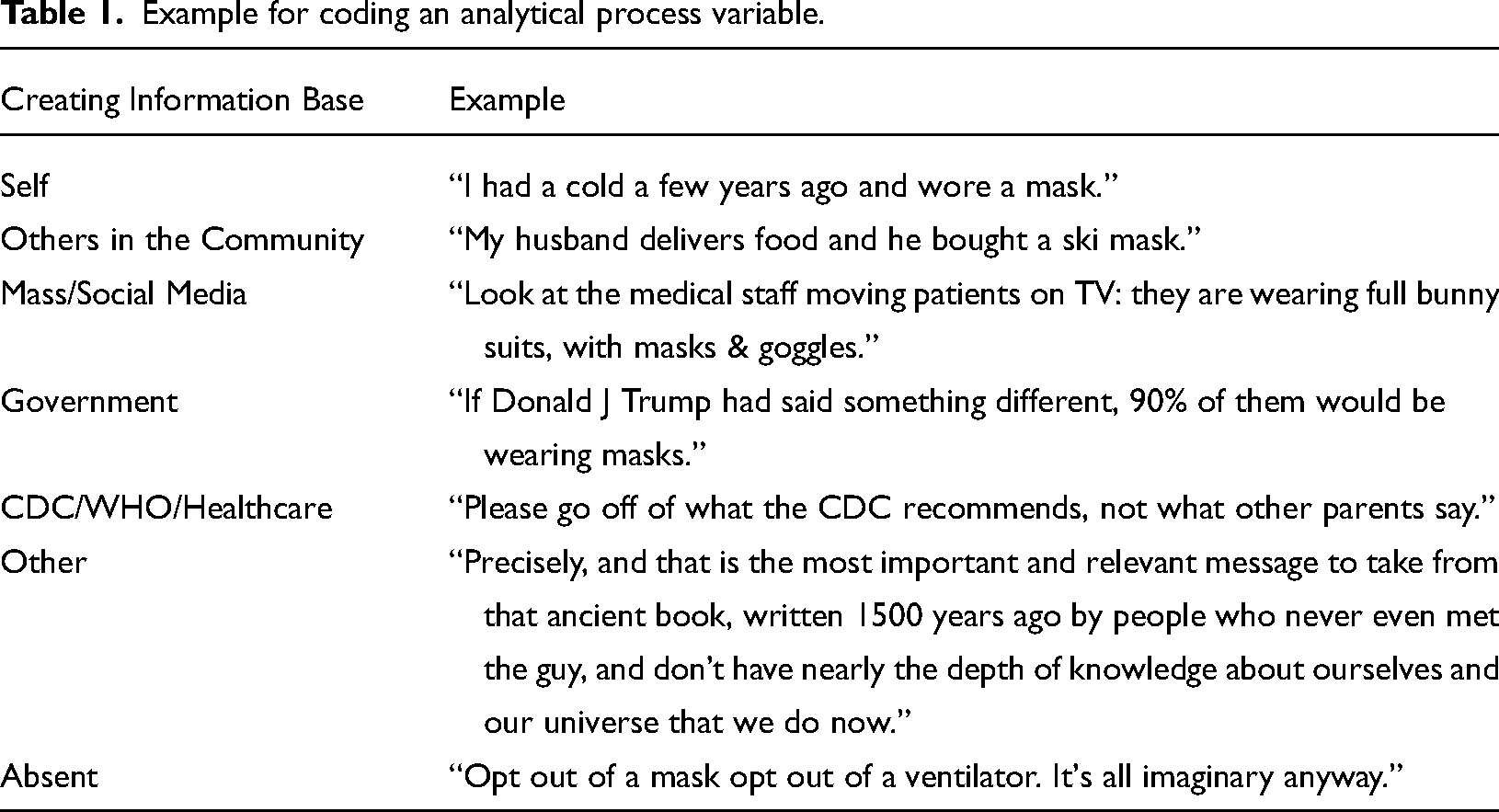
The second of the coding scheme was adapted from the “Key Features of Deliberative Conversation and Discussion” variables developed by Gastil and Black (2008). The “Key Features” has two major variables: analytic process and social process. The analytic process variable includes five sub-variables: (a) creating information base (anything that a user posted to acquaint others with the target issue, for example, they may discuss their personal and emotional experiences with mask-wearing, etc.), (b) prioritizing key values (anything that user posted to show the values related with the targeted issue, for example, the government's values, the user's values, etc.), (c) identifying solutions (e.g., brainstorming, identifying the government solutions, medical expert's solutions, user's solutions, etc.), (d) weighing solutions (discussing which solution should be prioritized and emphasized the trade-offs, for example, realizing the pros and cons of the user(s)’ solution(s), etc.), and (e) making decisions (the user updated opinions of what the participants of the post had discussed or identified the solution that best addressed the problem. It may or may not be the joint decision. The decision might be generated from other sources). We coded most of the analytical process variables by seven categories: self, other people in the community, mass/social media, government, CDC/WHO/healthcare, other, and absent except for the variable of “weighing solutions,” which has two categories: absent and present. Those categories were developed through a non-linear process during our initial coding. Every time we came across a new category in coding the posts, we would add the category and reexamine the rest of the posts for its presence.
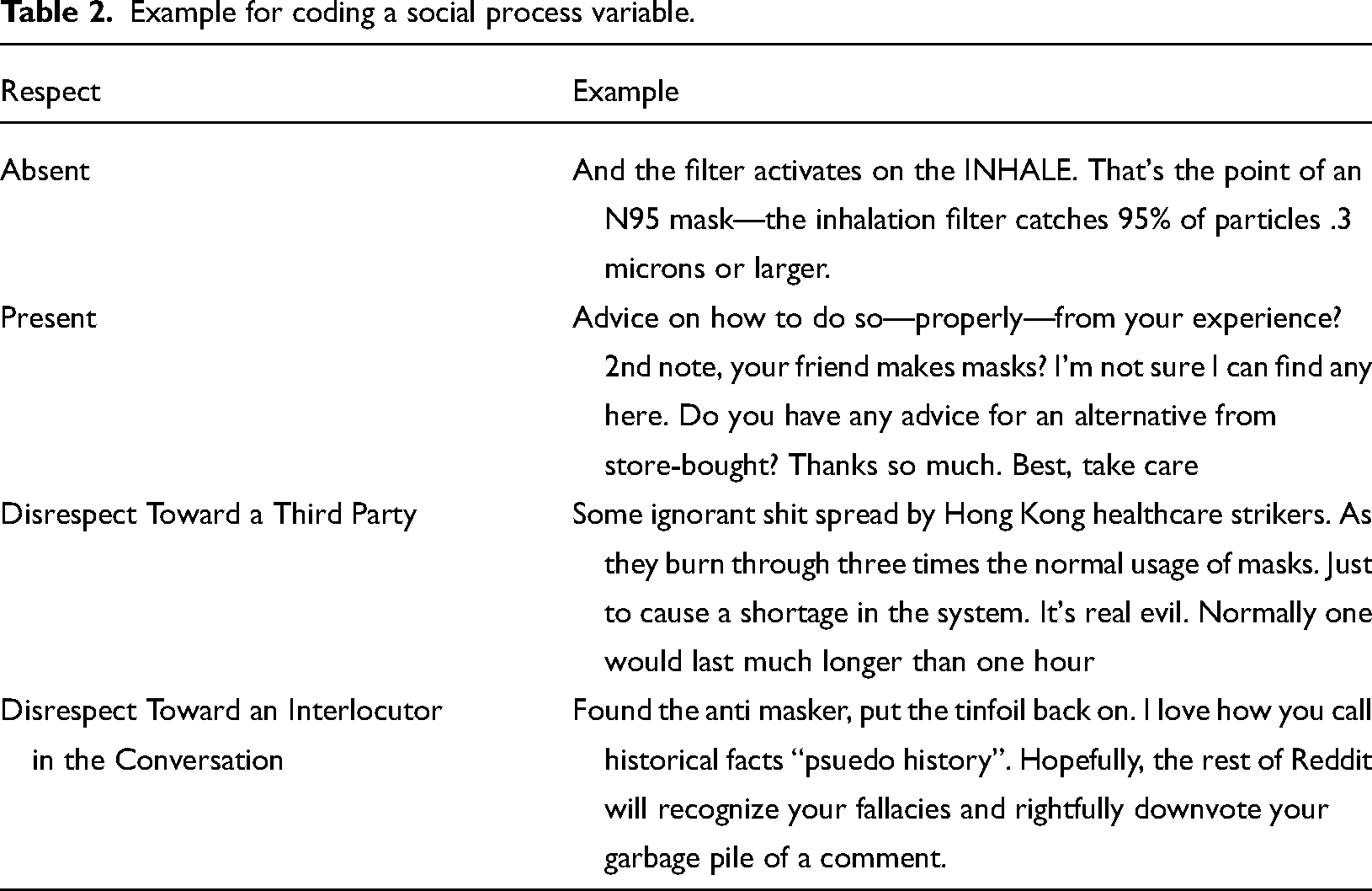
The social process variable includes 4 sub-variables: (a) speaking opportunities (the user created speaking opportunities for other participants of the post, the user encouraged the other participants to speak, ensuring more talkative participants do not dominate the discussion, helping minority opinion-holders have their opinions heard, etc.), (b) mutual comprehension (the user tried to make sure the participants understood each other. S/he asked the participants to use plain language, ensured that participants can articulate general technical points, and asked for clarification when confused), (c) consideration (the user showed that s/he listened carefully to other participants, especially when s/he disagreed. S/he encouraged, appreciated, and took seriously arguments from the participants’ use of rhetoric such as humor, wordplay, images, and figures of speech, storytelling, and different cultural heritages), and (d) respect (The user treated other participants respectfully. S/he might greet them, presumed that the participants are qualified, honest, and well-intentioned, showed respect for different views, and acknowledged their unique experience and perspective). For the social process variables, we mainly used two categories: present and absent. Considering the nature of the online conversation in an anonymous community (Dahlberg, 2001; Mutz, 2006), we opted to have more categories for consideration (absent, present, and present with counter-argument) and respect (absent, present, disrespect toward a third party, and disrespect toward an interlocutor in the conversation). Examples are provided to typify our coding of both the analytic and social process variable (see Tables 1 and 2).
Example for coding an analytical process variable.
Example for coding a social process variable.
Coder training and coding
We randomly chose 3 conversations from July (outside the dataset used by this current study) to discuss the code book, interpretations of each variable as well as the categories, and conducted actual coding. After the coder training, we decided that it was the best for both authors to code all units. Therefore, inter-coder reliability was unnecessary. We coded each unit independently, and then met to thoroughly discuss each unit when there were cases of coding inconsistencies. We were able to generate total agreement on our coding of all units.
Results
Research question 1 queried whether users’ mask attitude is associated with time of their posts. Crosstabs showed that the time of the post and user attitude are significantly associated: χ2 = 77.331, df = 2, p < .001. During February–March, users holding a neutral attitude (n = 113, 48.29%) comprised nearly half of the sample, closely followed by pro-mask users (n = 99, 42.31%), and anti-mask users (n = 22, 9.40%). However, in July, a vast majority of users demonstrated a pro-mask attitude (n = 229, 78.97.31%), leaving a comparatively much smaller sample of neutral (n = 57, 19.66%) and anti-mask users (n = 4, 1.38%).
Research question 2 asked for any association between users’ mask attitude and their deliberation processes. Crosstabs indicated an overall significant association in the whole data between attitude and the following analytical and social deliberation process (prioritizing key values: χ2 = 48.786, df = 12, p < .001; identifying solutions: χ2 = 99.286, df = 10, p < .001; weighing solutions: χ2 = 18.667, df = 2, p < .001; making decisions: χ2 = 96.674.468, df = 10, p < .001; speaking opportunities: χ2 = 8.871, df = 2, p < .05; mutual comprehension: χ2 = 55.523, df = 2, p < .001; considerations: χ2 = 17.243, df = 4, p < .01; and respect: χ2 = 15.048, df = 6, p < .05). However, no association was found between attitude and creating information base: χ2 = 16.347, df = 12, p > .05.
When time was added as a layer in crosstabs to detect any significant association between attitude and the social/analytic process across different timelines, we found a consistent association between attitude and the following variables across time: prioritizing key values (February–March: χ2 = 23.463, df = 8, p < .01; July: χ2 = 28.396, df = 12, p< .01), identifying solutions (February–March: χ2 = 105.223, df = 10, p < .001; July: χ2 = 27.599, df = 10, p < .01), weighing solutions (February–March: χ2 = 10.323, df = 2, p < .01; July: χ2 = 9.867, df = 2, p < .01), making decisions (February–March: χ2 = 105.223, df = 10, p < .001; July: χ2 = 25.895, df = 10, p < .01), mutual comprehension (February–March: χ2 = 40.127, df = 2, p < .001; July: χ2 = 8.503, df = 2, p < .05), and respect (February–March: χ2 = 20.520, df = 6, p < .01; July: χ2 = 22.107, df = 6, p < .01). Corresponding to the finding in the overall data, no association was found between attitude and creating information base (February–March: χ2 = 13.060, df = 8, p > .05; July: χ2 = 11.381, df = 12, p > .05). However, during February–March, there was no association between attitude and speaking opportunities (χ2 = 2.015, df = 2, p > .05); while in July, there was a significant association between the two variables: χ2 = 9.961, df = 2, p < .01). Contrarily, attitude was significantly associated with considerations in February–March (χ2 = 28.252, df = 4, p < .001), but not in July: χ2 = 3.613, df = 4, p > .05.
To investigate further details in the association, we also calculated the frequencies of each category in the five variables in the analytical process and listed the top two categories since they comprised the dominant majorities of the percentage (see Table 3). The categories “self” and “media/social media” were consistently among the top two categories for anti-maskers, neutral maskers, and pro-maskers across two time periods in four variables “creating information base,” “prioritizing key values,” “identifying solutions,” and “making decisions.” Meanwhile, “absent” emerged as a leading category in three variables “identifying solutions,” “weighing solutions,” and “making decisions.”
Mask attitude and analytical process variables (frequencies and percentages).
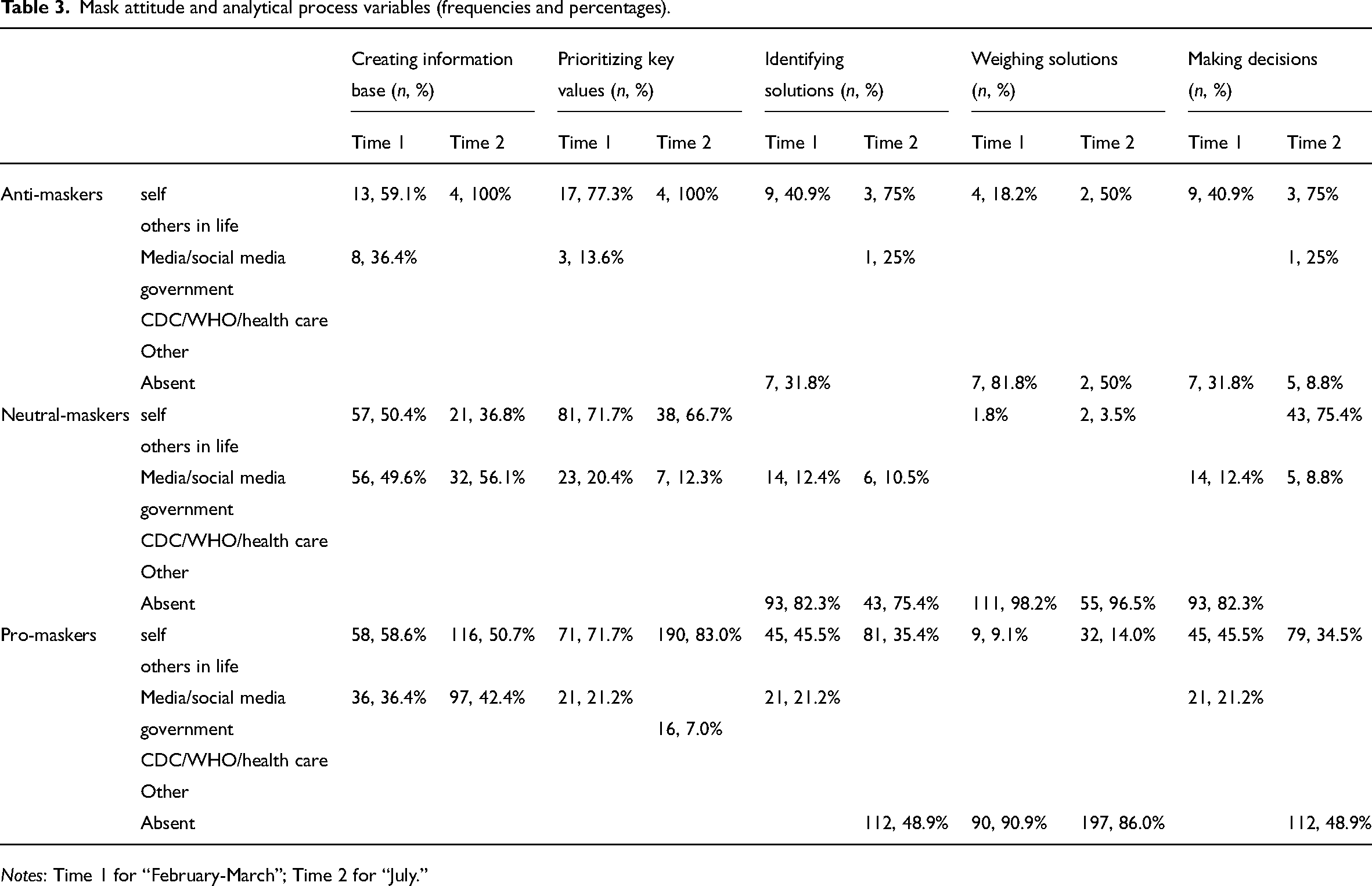
Notes: Time 1 for “February-March”; Time 2 for “July.”
In terms of social process across two time periods (see Table 4), most users did not indicate special attention to creating “speaking opportunities” and showed a moderate interest in accomplishing “mutual apprehension.” For “consideration,” both anti-maskers and pro-maskers demonstrated their consideration of others’ opinions; however, negative/aggressive consideration existed for pro-maskers across time, for anti-maskers during February–March, and for neutral-maskers in July. For the variable “respect,” even though categories “disrespect toward a third party” and “disrespect toward the current interlocutor” existed in all user groups, those comprised a much larger proportion in pro-maskers’ and neutral-maskers’ posts. Using constant comparative method (Glaser & Strauss, 1967), we went through all the posts that were coded as showing “disrespect toward a third party” and “disrespect toward the current interlocutor.” Three themes emerged: cursing, threatening, and name-calling. Four-lettered words and acronyms (e.g., TDS) were typical for language filler cursing. In addition, users also stressed threats such as “death,” “losing a job” to curse the third/other party. In terms of name-calling, users used labels such as “anti-maskers,” “cultist,” “nomaskbitchitis,” “Karen,” “morons,” “lady,” “idiots,” “dimwits,” etc. for stigmatization.
Mask Attitude and Social Process Variables (Frequencies and Percentages).
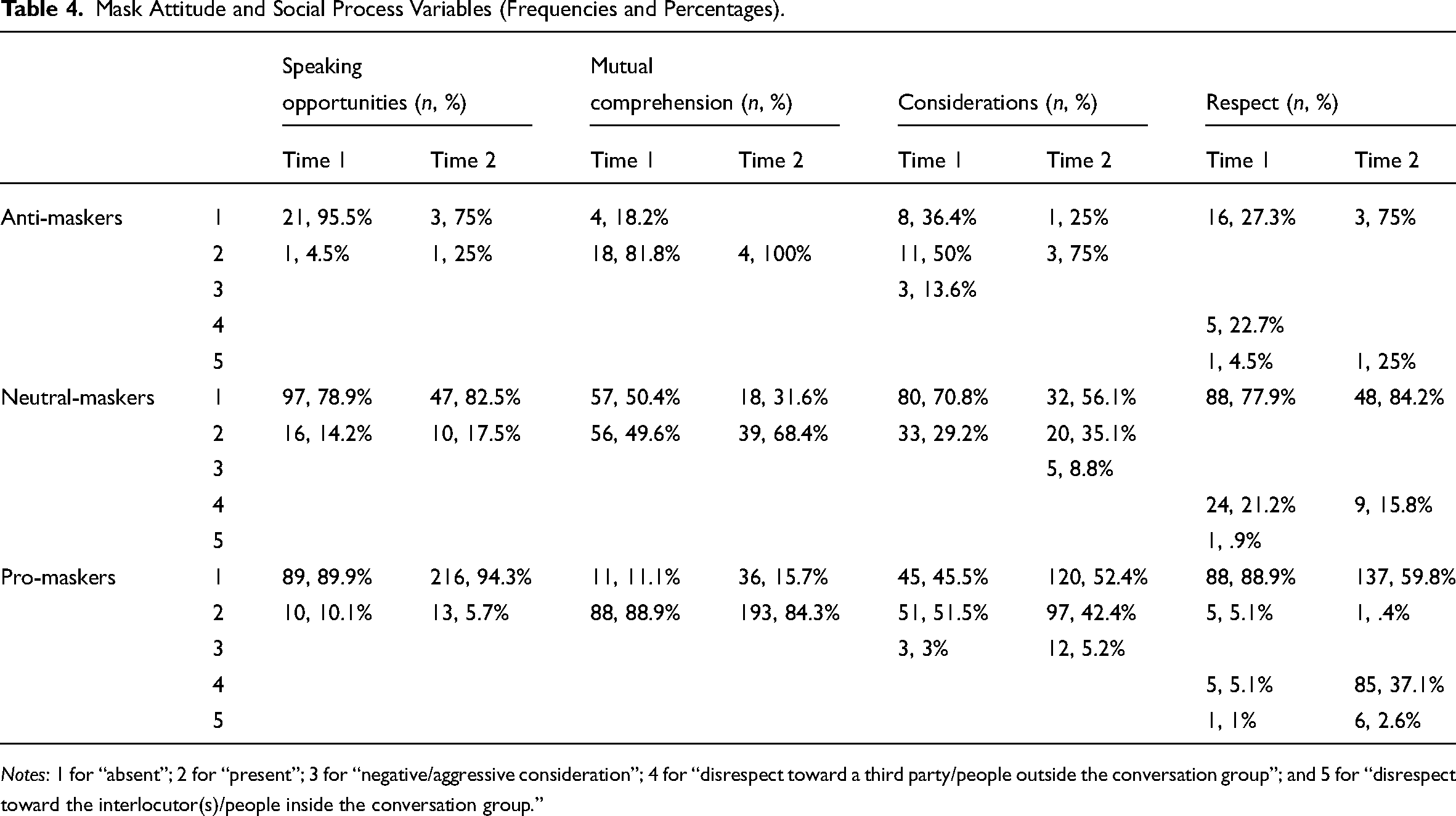
Notes: 1 for “absent”; 2 for “present”; 3 for “negative/aggressive consideration”; 4 for “disrespect toward a third party/people outside the conversation group”; and 5 for “disrespect toward the interlocutor(s)/people inside the conversation group.”
Discussion
The aim of this current investigation was to explore user mask attitudes (anti-making, neutral masking, and pro-masking) during different time periods and their public deliberation processes on Reddit. The results showed that Reddit users’ attitude changed over time and there was a significant association between user attitude and most analytical and social deliberation process except for creating information base. The above results were generally supported when different time periods were considered. However, even during February–March, there was no association between attitude and speaking opportunities; while in July, there was a significant association between the two variables. Judging from the number of posts across three attitude groups and the percentage of absence of speaking opportunities, it seems that the users generally did not provide or offer speaking opportunities to other participants throughout the two time frames. However, the lack of speaking opportunities was made more salient due to the vast majority of such posts holding a pro-mask attitude. Contrarily, user attitude was significantly associated with considerations in February–March, but not in July. Considering the overall significant association between attitude and considerations in the whole dataset, pro-maskers appeared to be consistent with dominating deliberations with a lack of consideration or with the presence of aggressive/negative communication. However, in the February–March frame, neutral-maskers demonstrated more lack of consideration in their posts.
The present study suggested a positive correlation between the policy agenda setting and public agenda that the public in general relied on policy agenda actors such as politicians and medical experts as their basis of information and proper behaviors. It also revealed that at the time of great uncertainty, such as at the beginning of the COVID crisis, users demonstrated a “deficit mode,” which results from expertise knowledge deficits and calls for expert enhancement in information dissemination and problem-solving (Healy, 2009). Specifically in public deliberation of the mask issue, Reddit users based/obtained information from, prioritized their values on, identifying solutions from, and making decisions based on self-experience and media/social media coverage. In terms of the trio problem-solving variables (“identifying solutions,” “weighing solutions,” and “making decisions”), the category “absent” took the lead. Users focused their conversations on providing information and prioritizing certain values, majorly missing the problem-solving components in their posts.
The findings also revealed a general lack of interest in social factors of the public deliberation processes. Quality of online public deliberation was thus compromised. Contrary to de Tocqueville's conception of genuine public deliberation (1945), majority of users, despite their different stances in terms of mask wearing, did not make efforts for creating “speaking opportunities,” or showing “consideration” and “respect.” Very interesting, pro-maskers, as the majority group, predominantly created ways to show their disrespect toward a third party or the interlocutor(s) who appeared to be an anti-masker (the minority) in the conversation. The three themes (cursing, making threats, and name-calling) showcased the limits of users’ free expression with online anonymity (Shi, 2018), confirmed the presence of aggressive and hostile communication on social media (Dahlberg, 2001; Mutz, 2006), and coercion to the minority group(s).
When the general public faces an urgent and vital matter (mask-wearing or not) during a time of great uncertainty, they have a greater need for orientation and sense-making. The fact that “Media/social media” are consistently among the top two categories for anti-maskers, neutral maskers, and pro-maskers across two time periods in four analytical variables “creating information base,” “prioritizing key values,” “identifying solutions,” and “making decisions” revealed the online users’ heavy reliance and valuing of media coverage in their lived experiences and public deliberation. Even though the current study did not differentiate mass media and social media, through coding, we have found that majority of users’ posts prioritized the importance of social media such as Facebook, Twitter, online communities, etc.
Despite these findings, some limitations and directions for future studies deserve discussion. First, we had a comparatively small sample. Due to the time constraints, we were only able to co-code 20 conversations and 524 posts. Considering some users dominated some conversations and were included multiple times in our data, the sample might represent a biased attitude and public deliberation process. We propose a future study including more conversations and more time periods to have a more inclusive and representative sample data. Second, the posts were generated due to their popularity and were not presented in their natural and coherent order when we coded them, causing a great lack of context and incongruency of the conversation as well as sense-making. We urge future studies to investigate naturally occurring conversations to guarantee a fuller understanding of the online posts. Third, we had rough categories for each variable and there was a lack of details to differentiate various constructs. For example, we put mass media and social media in the same category while in fact, they are conceptually very different. Future research needs to address those concepts when constructing categories. Last, this quantitative study stressed statistical significance, frequencies, and percentages. Details such as narrative and different ways of agenda substantiating were missing. While reading and coding various variables, we were always amazed by the amount and quality of the narrative, figure of speech, rhetorical questions, etc. We feel a qualitative study is much needed to do further investigations in those interesting details and texts.
This body of work was an exploration into the functions that social media and public deliberation serve in the development of personal agendas. The public's need for orientation to resolve levels of uncertainty in matters that are beyond their individual comprehension often results in the pursuit of outside sources. In this case, we were able to determine that those sources were more often than not social media as opposed to government and health organizations. For good or bad, the democratizing effect of new media sources seems to have produced a larger public sphere wherein public deliberation can take place. It appears that the personal agendas of the individuals included in our dataset did follow the public agenda set by the government and health organizations. It is particularly interesting to note that the personal agendas of those in the public sphere were ahead of the public agenda that would be set in the coming months.
