




Abstract
Culturally sensitive practices when working with young children with disabilities and their families are key to producing socially valid goals. In this article, we provide teachers with guidelines on how to best support Muslim families who have children with extensive support needs. Islam is the second-largest religion in the world, yet many non-Muslims might not be familiar with the religious practices of Muslim families. Thus, we provide an overview of the five pillars of Islam and suggest adaptations that may be required. Practitioners are encouraged to use the “LAFF don’t CRY” active listening strategy when working with families from diverse backgrounds. Additional resources to foster religious diversity are presented.
Mrs. Collins teaches a multi-grade level classroom for students with extensive support needs (ESN) at a local public elementary school. In recent years, her city became a refugee resettlement city, which has increased the number of students from diverse cultural, racial, and ethnic backgrounds in her classroom. One of her students, Omar, and his family identify as Muslim and have recently emigrated from Syria. Omar is a 7-year-old boy with a diagnosis of autism and intellectual disabilities. Omar enjoys spending time with his family. He has two older brothers with whom he enjoys watching and playing soccer. His mom mentioned he enjoys cooking and helping her in the kitchen. His dad has also reported they like to spend time together tending the family garden. He is very social but has trouble communicating verbally, learning new tasks, and independently maintaining his personal hygiene. Omar has been using an augmentative and alternative communication (AAC) device at school for the past 6 months, which has helped him flourish.
“It is important to recognize religion as part of an individual’s intersectionality as it is intertwined with personal and family culture, thus affecting norms, values, and practices that drive daily functioning. Given the relationships between educators of students with ESN and their families, increasing the understanding of religious issues and taking a culturally responsive strengths-based approach to their education is essential to the successful inclusion of their students and collaborations between practitioners, students, and their families.”
Mrs. Collins and the rest of the Individualized Education Plan (IEP) team are trying their best to support Omar in the classroom but are unsure about how to communicate with Omar’s parents so they can integrate his IEP communication and daily living goals to their family values, norms, and priorities. Mrs. Collins still feels there is a cultural barrier she has not been able to cross. Mrs. Collins knows that including her students’ families is key to their generalization of skills at home, as well as creating goals that are socially valid for the student and the family. She is curious about the religious and cultural elements of Omar’s life and wonders what else they could be doing to craft more socially significant goals. Thankfully, given the influx of students from diverse religious backgrounds, her district schedules a series of professional development opportunities on religious diversity. Mrs. Collins attends the one about Islam to learn more.
There are over 1.9 billion Muslims (i.e., followers of Islam) worldwide, making it the second largest religion on Earth and the third-largest religion in the United States. Despite the widespread practice of Islam, misinformation about Islam practices is still prevalent (Lewandowsky & Yesilada, 2021). For example, the Pew Research Center (2017) reports that 41% of American adults believe that Islam encourages more violence than other religions. In addition, they state that 35% of these individuals also shared the belief that there is widespread extremism among American Muslims. Researchers have also found that Islam is typically presented in a more negative light than other religious groups (Jaspal & Cinnirella, 2010), and it is often associated with terms such as forced marriage and terrorism (Dolliver & Kearns, 2019; Lewandowsky & Yesilada, 2021) all factors contributing to the misinformation. In practitioner preparation programs, religious diversity is a topic that is often neglected (Abraham, 2020; Subedi, 2006). Moreover, religion is also often excluded from the conversation when discussing diversity, but, as with other aspects of diversity, it has an impact on how we provide services and the goals we set for individuals with disabilities (Lee, 2011).
In many families, religion and culture and deeply intertwined. Culture is defined as a set of customary beliefs, social forms, and material traits of a racial, religious, or social group (Merriam-Webster, n.d.-a). However, religion is defined as an institutionalized system of religious attitudes, beliefs, and practices (Merriam-Webster, n.d.-b). Religion is a significant identity marker, especially for those who live in a country where their faith is considered a minority, like Islam in Western countries (Rizzo et al., 2020). It is important to recognize religion as part of an individual’s intersectionality as it is intertwined with personal and family culture, thus affecting norms, values, and practices that drive daily functioning. The intersection of family values, norms, practices, and activities can be difficult to balance for individuals with ESN. This population is defined as students who typically require support across multiple settings and are provided services under the autism spectrum disorders, intellectual, and/or multiple disabilities categories. Students with ESN are also more likely to receive instruction under their state’s alternate curriculum standards (Raley et al., 2020; Taub et al., 2017).
Individuals with ESN often have limited social and communication opportunities provided to them, which can be a cause and a consequence of them being fully included and accepted in their congregations (Carter, 2022). These barriers have a cascading effect, particularly for young children with ESN, as the opportunities they have to fully engage in everyday family activities are significantly reduced. Given the relationships between educators of students with ESN and their families, increasing the understanding of religious issues and taking a culturally responsive strengths-based approach to their education is essential to the successful inclusion of their students and collaborations between practitioners, students, and their families. Thus, we suggest these professionals understand the basic tenets of Islam and some of the different implications these may have in the students’ lives.
In this article, we provide a summary of Islam, views on disability in the Islamic faith, and an overview of its practices (i.e., Five Pillars of Islam). Furthermore, we will provide information on how professionals can best support Muslim students with extensive needs.
Positionality
The first author identifies as an Indian and Latina cis-woman and immigrant to the United States. Her life experiences have been shaped by her growing up in the country of Panama, as the granddaughter of very observant Sunni-Muslim Indian immigrants, in a community where religion, culture, and family traditions are deeply intertwined. Her professional experience includes working as a teacher’s assistant at a daycare located in a Florida college town, and as the lead teacher of a self-contained classroom for students with ESN in a suburban school district in the southern part of the United States. Her lived experiences with Islamophobia as a student and, more recently, as a Muslim educator and professor made her realize the benefits of culturally responsive practices for all students. Thus, she proposes that viewing religion as a dimension of diversity will help us better support students with ESN as we could craft more socially valid and generalizable goals. She currently works as an assistant professor of special education in the Northeast. Her research interest focuses on culturally responsive evidence-based practices with a focus on supporting caregivers of individuals with extensive support needs.
The second author identifies as an Indonesian Muslim cis-woman. She was born and spent most of her life in Indonesia where majority of the population is Sunni-Muslim. Her background is special education, and she has worked with children and adults with different disabilities in various settings in the United States. Her motivation to write this article came from experiencing how her colleagues’ curiosity about her religion was often accompanied by hesitation as they were nervous about offending Muslims. From these experiences, she realized the importance of providing professionals with tools that they can use to approach topics that may be seen as sensitive to enhance culturally responsive practices. She is currently a doctoral candidate in human development and family studies as she pursues her interests in supporting families of individuals with disabilities through evidence-based and culturally responsive practices, as well as training and development for those working with children with disabilities.
Islam and Its Pillars
There are three main branches of Islam: Sunni, Shia, and Sufi. Sunni Muslims comprise the overwhelming majority, with 87% to 90% of Muslims identifying as such (Pew Research Center, 2009). Islam is practiced in every continent; however, over 80% of Muslims live in Asia, the Middle East, and North Africa. Muslims follow the word of Allah as described in their holy book, the Quran (also spelled Qur’an and Koran). According to Muslim tradition, the Quran was revealed to the prophet, Muhammed, over 600 years after Jesus (also considered one of the prophets in Islam) walked the Earth. The Quran was gradually revealed over a period spanning 23 years. All practicing Sunni Muslims must abide by the same five pillars: faith, prayer, charity, fasting, and pilgrimage.
However, Muslims are not a monolith. Faith is typically interpreted and experienced differently based on the subdivision of Islam the family follows. Furthermore, we frequently encounter differences in cultural traditions related to the family’s country of origin, socioeconomic status, and the significance of religion in their everyday life (i.e., how religious the person is). Muslims may also identify as members of diverse cultural or ethnic groups based on their background. For instance, Muslims from Nigeria may identify as Black and Muslim, while Muslims from Argentina could identify as Latinx and Muslim. From a solely religious point of view, there are no significant differences among Sunni Muslims. The differences we observe are often a mix of cultural, socioeconomic, racial, and ethnic factors. Thus, educators working with Muslim families of young children with ESN should be aware and reflect on how the families’ intersecting identities will impact the provision of services.
Just as Christianity has the Ten Commandments and Judaism has the Seven Laws of Noah, Islam has The Five Pillars of Islam (Bukhari 1:17). These pillars are the fundamental practices all Muslims must follow. Practitioner recommendations will be provided for each pillar below.
Pillar 1: Faith (Shahada in Arabic)
Allah is the Arabic word for God. Muslims believe there is “no god but God (Allah) and Muhammad is the Messenger of God.” This belief and its recitation are the requirements for a person to become Muslim (“The Qur’an,” 2001, 2:163; 3:17; 16:51; 112:1; 5:15). In many families, this phrase is repeated often as a way to attest and confirm their faith. The goal of a practicing Muslim’s life is to live a pious and complete life to gain access to paradise in the afterlife.
In practice, AAC could also be used for individuals of all ages who have trouble communicating. For example, Mrs. Collins could teach Omar’s brothers how to use his AAC device so that they can program the Shahada and other related vocabulary. Similarly, augmented text (where the person can point to the words), or pre-recorded buttons could be used as low-tech forms of AAC for individuals who don’t have access to high tech devices.
Pillar 2: Prayer (Salat in Arabic)
The second pillar of Islam is prayer, or Salat in Arabic. Muslims are required to complete five prayers a day at specific times of the day (e.g., before sunrise, before sunset, after sunset; “The Qur’an,” 2001, 11:114; 50:39; 30:17-18). Only individuals who have gone through puberty are required to complete the daily prayers. For individuals with disabilities, prayers are only mandatory if a person can cognitively understand the purpose and focus on the prayer (Basyouni, 2019). However, it is recommended parents start teaching their children about prayers in early childhood so that it becomes a habit as they grow older. Each prayer ritual has a set of guidelines, recitations, movements, and postures (i.e., yoga-like poses), that the reciter should follow. As part of the prayer ritual, Muslims need to complete an ablution (i.e., cleaning of the body) or wudhu (“The Qur’an,” 2001, 5:6). This ablution includes several different steps that are also completed in a systematic manner. Cleanliness of the body, mind, and home is part of the core beliefs of Muslims. Caregivers of individuals with disabilities may request a focus on personal hygiene due to this belief.
For professionals working with this population, if one of the goals is for the child to practice ablution, visual supports can be developed to engage the child in good hygiene practices at home, while visual supports such as visual schedules and task analyses could provide more independence to students who want to engage in daily prayers at home. In addition, there are already many accommodations available for individuals with physical disabilities. For instance, they can pray while lying in bed or sitting in a chair if they are unable to perform the different postures. Those who have trouble memorizing the recitation can participate by following the movements while the leader of the prayer recites the readings or by having a recitation book/ an app that recites for them as they do the physical movements.
Pillar 3: Charity (Zakat in Arabic)
Muslims are required to donate to charity a fixed portion of their income every lunar year (“The Qur’an,” 2001, 2:177). For individuals living in poverty or below a certain income threshold, these donations are not mandatory, and they are eligible to be on the receiving end. This pillar of Islam is meant for Muslims to help the local and global community.
To ensure the inclusion of students with ESN in the practice of donating to charity, consider creating accessible service opportunities within the educational setting. Professionals can collaborate with local organizations or establish on-campus initiatives that cater to their student’s various abilities. To foster independence and, working to the student’s strengths, students can get involved in alternative methods of contribution, such as volunteer work, fundraising events, or educational campaigns that allow them, regardless of ability, to actively participate in supporting the community. In addition, professionals can encourage discussions and awareness sessions about diverse ways of giving and the impact it creates, fostering an inclusive understanding of this important pillar of Islam.
Pillar 4: Fasting during Ramadan (Sawm in Arabic)
Ramadan is the holiest month for Muslims that falls in the ninth month of the Islamic calendar. During Ramadan, Muslims fast every day from sunrise to sunset for 30 days (“The Qur’an,” 2001, 2:183-185). These fasts require the person to abstain from any food and water for the duration of the fast. Islam is one of the world religions that follows a lunar calendar. Thus, Ramadan does not fall in the same month each year. Typically, the start of Ramadan moves back 10 days each year (i.e., if it starts on August 20 this year, it will start around August 10 next year). Ramadan culminates with the celebration of Eid al-Fitr or “the festival of breaking fast.” Called Eid for short, Muslims celebrate it by visiting relatives, eating meals together, and sharing gifts.
Only individuals who have gone through puberty are required to fast during Ramadhan. Similar to prayers, individuals with different disabilities (including gastrointestinal issues, diabetes, and ESN who may not be able to abstain from eating and drinking) are exempt from fasting. Teachers can support Muslim students with ESN so they can increase their religious participation during Ramadhan. The teacher may incorporate cultural and religious elements such as special foods or books during Ramadan and Eid, which typically do not fall during the winter, when many Western holidays are celebrated. Family members could also be invited to share their traditions and food with the class. Furthermore, phrases like “Eid Mubarak” (e.g., traditional Eid greeting meaning blessed or happy Eid) can also be programmed into the child’s AAC device. Even if typically, they do not pray at school, during Ramadan, some students without disabilities often request time to complete the prayers that fall during the school day. This option may also be offered to students with ESN. Although, we acknowledge this can be harder to implement in some settings due to guidelines related to the celebration of religious holidays in public schools.
Pillar 5: Pilgrimage to Mecca (Hajj in Arabic)
The city of Mecca, in Saudi Arabia, is the holiest place for practicing Muslims. All Muslims who can afford it, are required to complete the pilgrimage to Mecca at least once in their lifetime (“The Qur’an,” 2001, 2:196). As with fasting and prayer, the pilgrimage to Mecca is only required for physically and financially capable individuals.
To ensure the inclusion of students with ESN in understanding and engaging with the pilgrimage to Mecca, professionals can facilitate discussions and educational sessions that teach the historical context and significance of this journey. Furthermore, teachers can prepare students who may be going on the pilgrimage by incorporating lessons about airplane rides, traveling to different countries, and the history and customs of different countries, including Saudi Arabia. Professionals working with caregivers could provide them with suggestions such as exploring alternative forms of participation (e.g., virtual pilgrimages and interactive multimedia experiences) that bring to life the essence of this sacred journey.
Disability in Islam
Besides covering the basics of the Islamic faith, the professional development workshop presenters talked about the views of disability in Islam, which Mrs. Collins found thought-provoking. She was surprised to find that religious teachings can shape how families in certain communities understand and accept their child’s disability. She starts thinking about Omar and his family. Since he enjoys spending time with them, some of the religious activities and events she has learned about would be great opportunities for him to develop his social and communication skills. Practicing hygiene skills would also be essential for him to engage in prayer. Ms. Collins also makes a mental note to ask Omar’s parents about when Ramadan falls this year and the type of activities the family engages in.
Throughout history, disability has often viewed as the result of a curse and a burden (Miles, 2002). It is generally agreed upon by Muslims that the Prophet Muhammad was welcoming of people with disabilities and set an example to others of how they should be treated (Suleiman, 2014, 2018). The Quran and the Hadiths (i.e., supporting texts akin to the Gospels in the Bible) mention several instances of the prophet being kind and supportive to those with physical, mental, and ESN and encouraging inclusion by talking about the Islamic benefits of visiting those who have a disability or are ill (Suleiman, 2014, 2018). These texts discuss how people with disabilities and their caretakers should be accommodated, and in some cases are exempt, from various religious obligations. It is also mentioned that disabled individuals and their caretakers will receive many rewards in the afterlife (Suleiman, 2014, 2018). Finally, these texts explain that a person with the most extensive needs (e.g., anyone who has challenges understanding the repercussions of their actions) will be considered “sinless” and will have a guaranteed place in Jannah (i.e., heaven; Suleiman, 2014, 2018).
Despite these positive views in the Quran, cultural factors often influence the views of disability. Muslim members of the disability community report being pitied and stigmatized (Csányi, 2022; Husain, 2019) by members of their Islamic community. They have denounced a lack of support in local mosques as a barrier to full inclusion in their religious community (Husain, 2019). Citing that individuals with disabilities and their families are exempted from attending religious services in person, members of the disability community report being excluded from religious events (Husain, 2019). These exceptions and accommodations may be the reason why mosques have been slow to implement changes to make their buildings more accessible community (Husain, 2019). This exclusion can compound the feeling of isolation felt by Muslim individuals with disabilities and families of individuals with ESN (Husain, 2019; Jegatheesan, 2005).
Nevertheless, other Muslim families use the framework of religion to raise their children with disabilities. In a study by Jegatheesan (2005), the author described three families who regarded their children with ESN as “gifts from Allah” given to them as Allah knew they would be responsible and loving parents. These children were mostly included in their family’s lives, including going to the mosque and participating in big events with extended family members.
Using Active Listening to Facilitate Inclusive Practices
After presenting an introduction to the main tenants of Islam the presenter asked the audience what other questions they had about Islam and Muslims. One teacher, an early interventionist working in a home setting, asked if it was required of her to wear a head covering at the family’s home. The presenter explained that religious Muslim women typically wear a hair covering called the hijab to maintain modesty and to ease their process during prayers and that although it is an obligation to wear the hijab, it is a personal choice that women, depending on their spiritual stand, choose to do. Once a woman decides to start covering her hair, they often only take their hijab off in the presence of close male family members and groups compromised solely of women, especially those whom they trust. In some communities, it is customary to have young women wear hijabs as an opportunity for them to understand how it feels to wear the head covering. The presenter also explained that Muslims believe in freedom of religion and do not expect non-Muslims to follow the same dress code (e.g., cover their hair or dress modestly) unless they are visiting a religious site. However, if, for any given reason, the professional feels the need to dress modestly, pants or jeans and a tunic shirt, a long skirt, or a maxi dress would be appropriate.
Next, a male teacher raised his hand. He was used to having frequent conversations with all of his student’s parents, but did not know if it was inappropriate to call or email one of his student’s mothers with daily updates. The presenter then went on to explain that in some Muslim cultures, individuals from the opposite sex refrain from close contact unless they are considered close family (i.e., fathers, brothers, and uncles). Their definitions of close contact can range from eye contact for more than 3 seconds, shaking hands, and hugging, and boundaries will vary based on each person’s comfort levels and religious stance. The presenter suggested the teacher inquiry about the family dynamic and ask what the mother would be comfortable with, and if asynchronous or other forms of communication would be preferred.
In the religious diversity professional development, the speakers present different strategies practitioners working with students with ESN could implement to support their Muslim students and their families. These strategies include active listening, fostering religious diversity in the classroom, and caregiver supports.
Active Listening
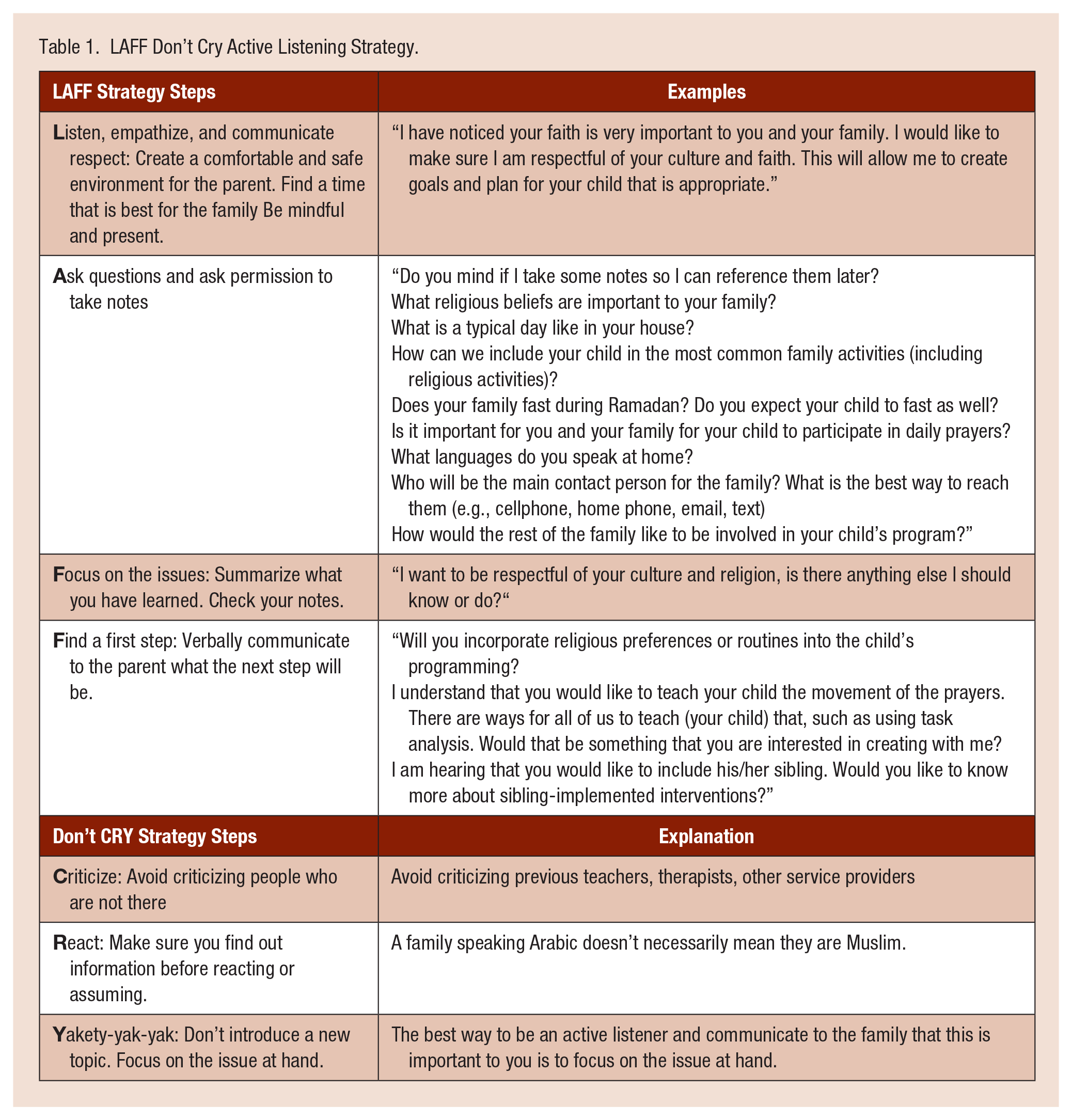
There are different aspects of communication that can enhance and support the communication between caregivers and education professionals. One strategy that incorporates several of these critical components is active listening (Spataro & Bloch, 2018). This set of strategies prompts professionals to use nonverbal and verbal communication to convey to the caregiver that they are engaged, attentive, and that their message is valued and important. With active listening, professionals ask questions about the caregivers’ beliefs, feelings, and paraphrase the message to ensure mutual understanding (Vostal et al., 2021; Weger et al., 2010). Active listening can be used to set the foundation of a reciprocal meeting, get families involved, and communicate about topics that may be daunting to discuss, such as religious diversity, in an open and respectful way. One strategy that professionals can use during meetings with caregivers to engage and collect information is called “LAFF Don’t Cry” (McNaughton & Vostal, 2010). Caregivers expressed that they perceive those who used LAFF don’t CRY strategy as more effective communicators than those who do not (McNaughton et al., 2008; Thistle & McNaughton, 2015; Vostal et al., 2021).
Using active listening strategies, teachers and early interventionists could gauge the types of religious and cultural practices the family engages in and thus jointly decide how to incorporate these strategies in the classroom best. It should be noted that some caregivers may choose not to discuss sensitive topics or will refrain from giving their opinion due to a cultural view emphasizing respect for authority figures, such as doctors and teachers. In other words, culturally, it may be considered respectful to be a passive listener and follow the professional’s instructions without complaint rather than providing information. In such cases, it may be appropriate to explain the service delivery model being used (i.e., student-centered and family-centered) so the family is aware of the importance of their input.
Fostering Religious Diversity in the Classroom
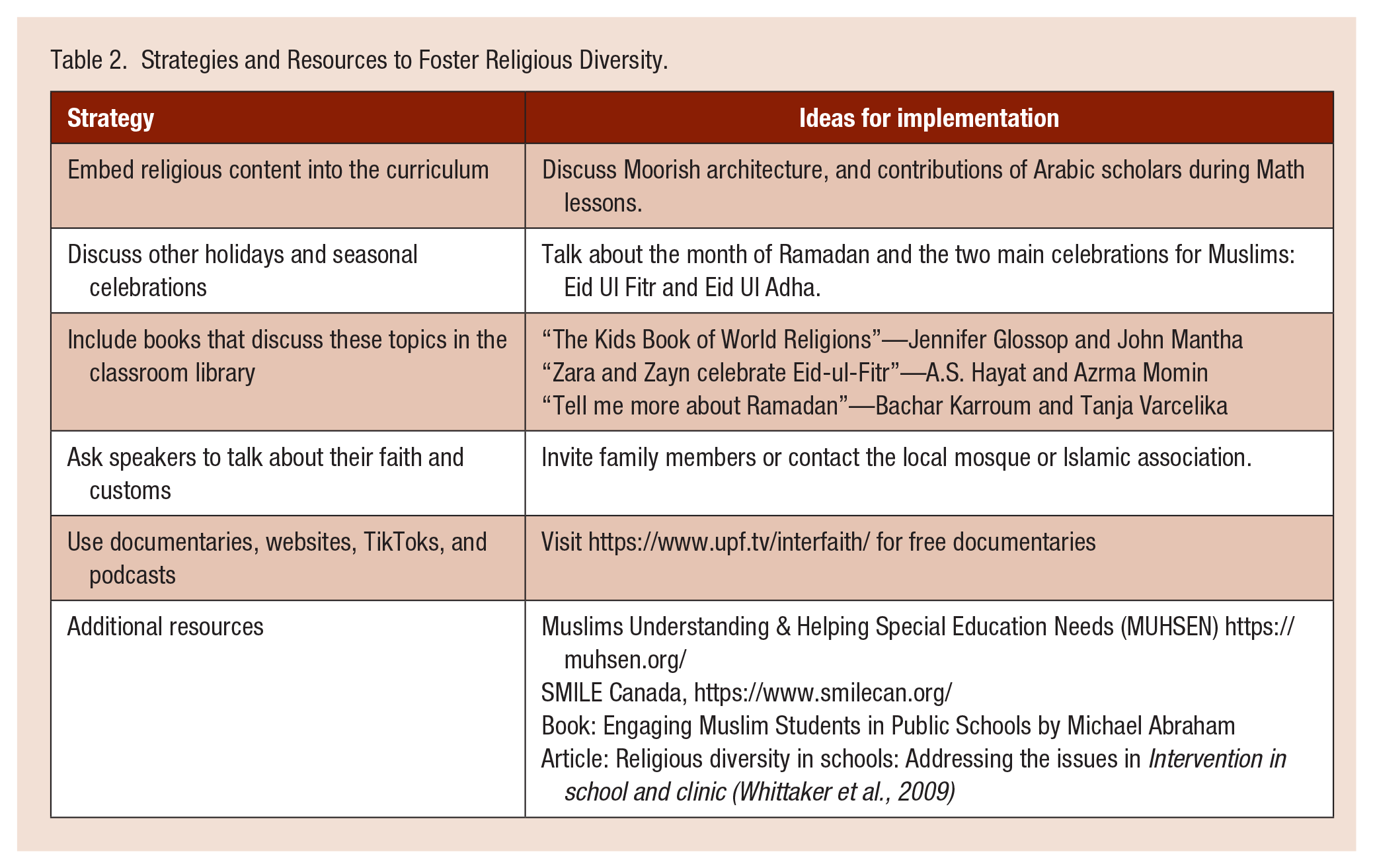
Teachers of students with ESN can also incorporate the student’s racial, ethnic, and religious backgrounds into classroom activities. When discussing other topics, religious diversity could be infused by including representation in pictures that may be more common and inviting for the student. For example, a woman with a hijab and a lab coat representing a doctor on the student’s communication board/ on a communication board that everyone can use, or a man with a beard when providing an example of a biologist during a science class. Inviting caregivers to participate in these activities can also promote valuable collaborations between the school and home (Whittaker et al., 2009). As a general suggestion, representation should emphasize the strengths and contributions of diverse individuals and communities. More suggestions are provided in Table 1.
LAFF Don’t Cry Active Listening Strategy.
Caregiver Supports
Considering the nature of religious traditions, we advise educators to collaborate with caregivers and propose caregiver-led interventions to support the student’s participation in the family’s routine religious and social events. Parent or caregiver-implemented interventions have been proven to be an effective intervention for various ESN populations (Amsbary & AFIRM Team, 2017; Germansky et al., 2020). These approaches foster a positive relationship between professionals and caregivers as well as capitalize on positive familiar relationships, which in turn, can support the family’s vision and goals for their child in and outside of educational settings.
Professionals can provide two types of resources to caregivers. The first is knowledge-focused (Bearss et al., 2015). This type of support includes providing caregivers with resources and information about the child’s diagnosis. The second type is more involved and includes the parent actively implementing interventions aimed at skill and behavior building (Bearss et al., 2015). Both types of supports could help caregivers embed their socio-cultural identities into interventions and better advocate for their child’s needs within their communities while also allowing them to connect with other families from similar backgrounds, which is often difficult for them (Perepa, 2019), due to socio-cultural and logistic factors, but highly valuable. By offering resources, professionals can empower families and increase family functioning that fits with their norms and values.
Discuss the Role of Extended Family Members
When implementing these interventions, it is important to consider that extended family members are also often also a key support system for Muslim families. Although not part of the Islamic tradition, it is culturally not uncommon for immigrants to live with their extended family (e.g., aunts and uncles, grandparents). They may also support the family and care for the person with disabilities. In other cases, they may live close by for frequent visits or to ensure availability during emergencies. Therefore, it may be beneficial to ask parents and extended family members about their role and what kind of support that might be helpful for them. For example, if the child’s grandmother is one of the main caregivers, it would be ideal to invite her to discussions related to creating and supporting the child’s goals.
Discuss the Role of Siblings
Similarly, siblings have an important role in the family system. It is not uncommon for older siblings to support their parents by providing care for their brothers and sisters from an early age, such as playing with them while their parents are doing housework. Subsequently, they may be expected to support their disabled siblings as they reach adulthood (Sage & Jegatheesan, 2010). It would be beneficial for practitioners to ask the family about the level of sibling involvement in the programming (e.g., should goals and supports include the sibling?). The discussion could include the benefits of including siblings and the different considerations that they will need to evaluate (see Beffel et al., 2021; Ferraioli et al., 2012).
Conclusion
Mrs. Collins decides to use these strategies with Omar and his family at the next parent–teacher conference night. She uses the questions outlined in Table 2 to share and gather information from the family. Using these strategies, Mrs. Collins learns that the family was not aware that school personnel were able to help Omar with life skills. After discussing different opportunities, Mrs. Collins was able to identify that both Omar and his parents would like him to be more independent with his hygiene, as it is a very important value for the family. Using visual supports to help Omar join the discussion, they also identify several events and opportunities in the religious community Omar could participate in if he has his AAC programmed with the correct vocabulary, which she coordinates with the speech and language pathologist. In addition, she asked the parents about their willingness to implement some parent-implemented interventions, which they said would like to learn more about. Using active listening and providing concrete suggestions to the family, Mrs. Collins feels she now has a better understanding of the needs of the family and how to best support Omar.
Strategies and Resources to Foster Religious Diversity.
Religious diversity is a topic that is often excluded in conversations about diversity. For individuals with severe disabilities and their families, acknowledging their religion can be a gateway to a fuller social life. We recommend having group discussions at schools and clinics to reflect on our preconceived notions and biases. Furthermore, if possible, we encourage practitioner to work with places of worship, as described in Carter (2022) to make sure they are inclusive and supportive of observers with severe disabilities and their families.
This article is not meant to be a rule book for practitioners, rather, it is aimed as a tool to provide basic knowledge about disability views in Islam, common practices observed by Muslims, and initial strategies to facilitate conversations regarding this topic and leverage the strengths of their students from diverse cultural, ethnic, and religious backgrounds and their families. Religion is only one aspect of diversity, and other considerations, such as cultural context, socioeconomic status, and personal level of faith, affect our clients’ lives. In the end, we hope you will use the information and inclusive practices presented in this article as general guidelines to start the conversation.
Footnotes
Acknowledgements
The authors thank Ms. Aziza Patel, Dr. Kristen Buonomo, Dr. Jordan Lukins, and Dr. Asma Ahmed for their valuable feedback.
Author Note
Both identity-first and person-first language will be used to honor the preferences of members of the Autistic and Disabled communities.
Conflict of Interest
The author(s) declared no potential conflicts of interest with respect to the research, authorship, and/or publication of this article.
Funding
The author(s) received no financial support for the research, authorship, and/or publication of this article.
