




Abstract
Many educators learn about people with disabilities without learning from them. This article describes the value of inviting people with disabilities, including individuals with extensive support needs (ESN), to share their experiences and knowledge with others. In this article, we describe how to create a Self-Advocate Guest Presenter Series to provide opportunities for individuals with disabilities to tell their stories. In addition, this article includes ideas to support educators in using what they learned from the presenters within their classrooms and advocacy.
Pre- and in-service practitioners working in special education and disability-related fields spend countless hours, through coursework and professional development, learning how to teach and support individuals with disabilities (see Council for Exceptional Children’s Practice-Based Standards; Berlinghoff & McLaughlin, 2022). Strikingly, many of these sessions are led by individuals without disabilities and exclude the perspectives, experiences, and desires of self-advocates (Ladau, 2021; Vandercook et al., 1989; Van der Klift & Kunc, 2013). Shogren et al. (2019) define self-advocates as individuals with disabilities who share their wants, needs, and goals with others. When teacher preparation courses and in-service professional development are not led by self-advocates, practitioners learn about individuals with disabilities without learning from their lived experiences. Van der Klift and Kunc (2013) express concern that individuals with disabilities are often not given the opportunity to advocate for themselves and encourage practitioners to “trust experience over expertise” (p. 8) when making personal, educational, and policy decisions regarding individuals with disabilities. Emily Ladau (2021), a disability rights activist, similarly urges individuals to amplify the perspectives of those in the disability community, stating, “So please, don’t speak for us, about us, or over us. Speak to us and with us” (p. 144).
“People form concepts about disability throughout their lives, which inform their thoughts, communication, and actions; therefore, exposure to ideas alone is likely not enough to shift habitual ableist patterns.”
Individuals with experience working, learning, and socializing with peers with extensive support needs (ESN), including individuals with intellectual and developmental disabilities (IDD) and multiple disabilities, report having positive perceptions about people with disabilities. This is true for K–12 students, college students, and adult siblings of individuals with disabilities. For example, Biggs and Snodgrass (2020) interviewed 16 elementary school students who had friends with ESN, finding that the children described their friends by identifying their unique traits and strengths, and not by perceived deficits related to disability. Recent studies (see Athamanah et al., 2020; Gilson et al., 2020; Lee & Taylor, 2022; Travers et al., 2020) have found that college students without IDD who attended institutions of higher education with inclusive postsecondary education (IPSE) programs reported an increase in disability awareness and valuing the perspectives of people with IDD (see https://thinkcollege.net/ for information on IPSE opportunities). Similarly, adults who described spending time with their siblings with IDD characterized their relationship as positive (Lemoine & Schneider, 2022) and could identify their sibling’s strengths (Carter et al., 2020).
Contact alone does not necessarily result in positive attitudes or actions toward individuals with disabilities. Many practitioners enter teacher preparation programs and school buildings with preconceived views about disability and the capacity of students with ESN (Bialka et al., 2019; Strimel et al., 2023). This is compounded by the fact that the Disability Rights Movement is not typically taught in schools, making people unaware of disability advocates’ fight for access, opportunities, and inclusion (Ladau, 2021; Office of Disability Employment Policy, 2009). As a result of a lack of knowledge and ableist views, some practitioners perceive disability as an individual problem that needs fixing (Ruppar et al., 2023). Administrators with deficit-based narratives about students with ESN often described expert special education teachers as caregivers, primarily responsible for managing behaviors and keeping students with disabilities safe (Roberts et al., 2018). This deficit mindset can impact where students with ESN receive instruction (Olson & Roberts, 2020) and the types of skills identified as important to teach (Ruppar et al., 2023). In addition, practitioners who view disability through deficits may prioritize teaching skills to students with ESN that focus on remediation (Carter et al., 2020) rather than developing their strengths and gifts.
As new practitioners move from their preparation programs to K–12 schools, they can take an active role in the Disability Rights Movement and work to disrupt inequitable practices (Danforth, 2017). To counteract ableism, pre- and in-service practitioners must learn strategies for challenging deficit-based views of disability (Olson & Roberts, 2020) and developing individualized education programs based on student strengths (Elder et al., 2018). Practitioners with a strengths-based view of students with ESN are more able to navigate challenges as they arise (Ruppar et al., 2015) and express positive beliefs about including and supporting students with disabilities within the general education classroom (Kwon et al., 2017; McHatton & Parker, 2013). These findings indicate there is a need for pre- and in-service practitioners to confront their biases and develop a strengths-based approach to working with individuals with ESN.
Learning From Individuals With Disabilities
Many disability activists stress the importance of amplifying the perspectives of individuals with disabilities (see Hughes, 2023; Ladau, 2021; Ruppar et al., 2023; Zepp et al., 2022). One way to facilitate learning from individuals with disabilities is by inviting self-advocates to guest present in university classrooms, school professional development sessions, and community centers. Event organizers should invite presenters who represent diverse viewpoints, backgrounds, and intersecting identities. Guest presenting offers a myriad of benefits to both the attendees and presenters. Findings from prior research indicate that guest presenters can help college students make connections between what they learned in their classes and the professional world (Craig et al., 2020) and encourage deeper thinking by focusing on application (Robinson & Kakela, 2006). In addition, both college students (Ji et al., 2021; Metrejean et al., 2002) and professors (Zou et al., 2019) find guest presenters to be valuable additions to a university classroom. Guest presenting can also benefit those brought in to share their expertise. Hughes (2023) interviewed nine self-advocates after they presented to college students on disability topics of their choosing. The presenters stated they often felt misunderstood by people without disabilities and found presenting offered an opportunity to dispel misconceptions. Furthermore, the presenters reported enjoying making new connections, sharing their stories, and meeting their professional goals.
Self-Advocate Guest Presenter Series
Below, we share our structure for developing a Self-Advocate Guest Presenter Series to learn from the expertise and experiences of individuals with disabilities. We implemented the series at two mid-sized public institutions in the midwestern United States to align with the instruction we provided in our special education courses. In sharing the structure of our presenter series, we hope to provide a useful model for individuals involved in teacher preparation, those interested in promoting inclusive schooling, or anybody who may be looking to organize community events. The Self-Advocate Guest Presenter Series includes five stages: (a) value, (b) prepare, (c) engage, (d) reflect, and (e) apply learning.
Value
Our first goal was to develop a presenter series that values the expertise of individuals with disabilities who are interested in sharing their stories and knowledge with others. Presenting should be a choice, and not an expectation, for those who are interested in teaching others about disability (Hughes, 2023). Each semester, we invite one national keynote presenter, followed by two local self-advocates from our community. We chose to invite three people because college students participating in one study (Ji et al., 2021) identified three as the optimal number of guest presenters, stating that it allowed them to hear from a diverse group of people with a range of views and backgrounds. Because disability is not a monolith (Annamma et al., 2013; Frederick & Shifrer, 2019), we recommend inviting individuals who represent a range of backgrounds and intersecting identities (e.g., race, gender, sexuality, religion). Learning from a diverse group of presenters is essential to understanding the heterogeneity in the lived experience of individuals with disabilities. The presenters in Hughes’s (2023) study similarly stated that it was important for attendees to learn from multiple presenters as it ensured they would not overgeneralize or misunderstand the experiences of one self-advocate as representing the beliefs of all individuals with disabilities.
Furthermore, we value our presenters’ expertise by providing them with monetary compensation. Planning and executing a presentation takes work, and individuals doing this work should be paid (Ladau, 2021). To pay presenters, however, funding is required. We received funding through internal institutional grants. Schools and community groups that do not have the funds may benefit from forming partnerships with advocacy organizations or applying for a small community grant. State-run advocacy organizations, like the Michigan Developmental Disabilities Council, offer monetary compensation and planning support to assist individuals with IDD in sharing their experiences with others. In addition, faculty in special education departments may be interested in partnering with their local K–12 schools to co-sponsor a presenter series.
Prepare
To ensure the Self-Advocate Guest Presenter Series is beneficial for both presenters and attendees, we identified four steps to prepare for each presentation:
Meet with the presenter: Organizers should meet with each presenter to share the purpose of the series, identify their area of interest or expertise (e.g., self-determination, integrated employment, inclusive education, sexuality education), and discuss next steps. Meetings can occur in person or virtually. Some presenters may seek additional support (e.g., from series organizers, advocacy organizations, trusted friends) in developing their presentations, while others may prefer to plan independently. In addition, organizers should ask presenters to identify two to three resources for attendees to read, watch, or listen to before their presentation.
Secure the venue: If funding and space are available, we recommend conducting the series in a formal and accessible venue with food, reliable technology, and seating that allows for interaction between attendees. During each planning meeting, we ask our presenters about their environmental needs and preferences and adjust accordingly. In addition, we collaborate with our technical support team to ensure the room’s technology can smoothly integrate our presenters’ presentation formats.
Learn about the presenter through pre-work: About a week before each presentation, we ask our attendees to engage with the resources provided by the presenter. The purpose of this pre-work is to get to know the presenter and their area of expertise (Ji et al., 2021). After examining the resources, we ask attendees to reflect on the content by using a Thinking Routine developed by Harvard’s Project Zero (President and Fellows of Harvard College & Harvard Graduate School of Education, 2022) called Connect, Extend, Challenge (see https://pz.harvard.edu/sites/default/files/Connect%20Extend%20Challenge_2.pdf). The Thinking Routine provides guiding questions that encourage attendees to determine the key ideas and main concepts of the material.
Ask questions: After completing the pre-work, we ask our attendees to submit three questions for the presenter. Not only does this prepare attendees for the presentation, but it also allows the organizer to identify common themes. Before each presentation, we read through the questions, sort them into categories, and share a few examples with our presenter. This is especially helpful for presenters who prefer prep time to process and respond to questions.
Engage
Throughout each presentation, organizers should implement evidence-based learning strategies to optimize engagement for attendees. We begin each presentation by introducing the presenter, sharing a few words about their background and accomplishments, and addressing the expectations for the presentation. Researchers recommend starting with three to five positively stated norms (State et al., 2022). The four norms we use in our presenter series are (a) go device-free (for in-person attendees), (b) turn camera on (for Zoom attendees), (c) take notes, and (d) be a learner.
To encourage active engagement throughout the lecture, we offer attendees a structured approach to make connections, extend their learning, and question what they hear (see Figure 1). When attendees participate in person, we hand out paper copies of the note-taking sheet because research indicates individuals learn best when they write notes without the use of technology (Mueller & Oppenheimer, 2014). Given that writing notes by hand may not always be possible or preferred, especially for attendees participating over a videoconferencing system, we also provide a digital option. In prior research, college students reported preferring guest presenters who offer opportunities to ask and answer questions (Merle & Craig, 2017; Wolfe, 2006). Therefore, after the presentation, we recommend providing time and space for attendees to create and share questions within a small group. Then, during a Q&A, attendees can either ask their questions aloud to the presenter or capture their questions on a sticky note for the organizer to read aloud.
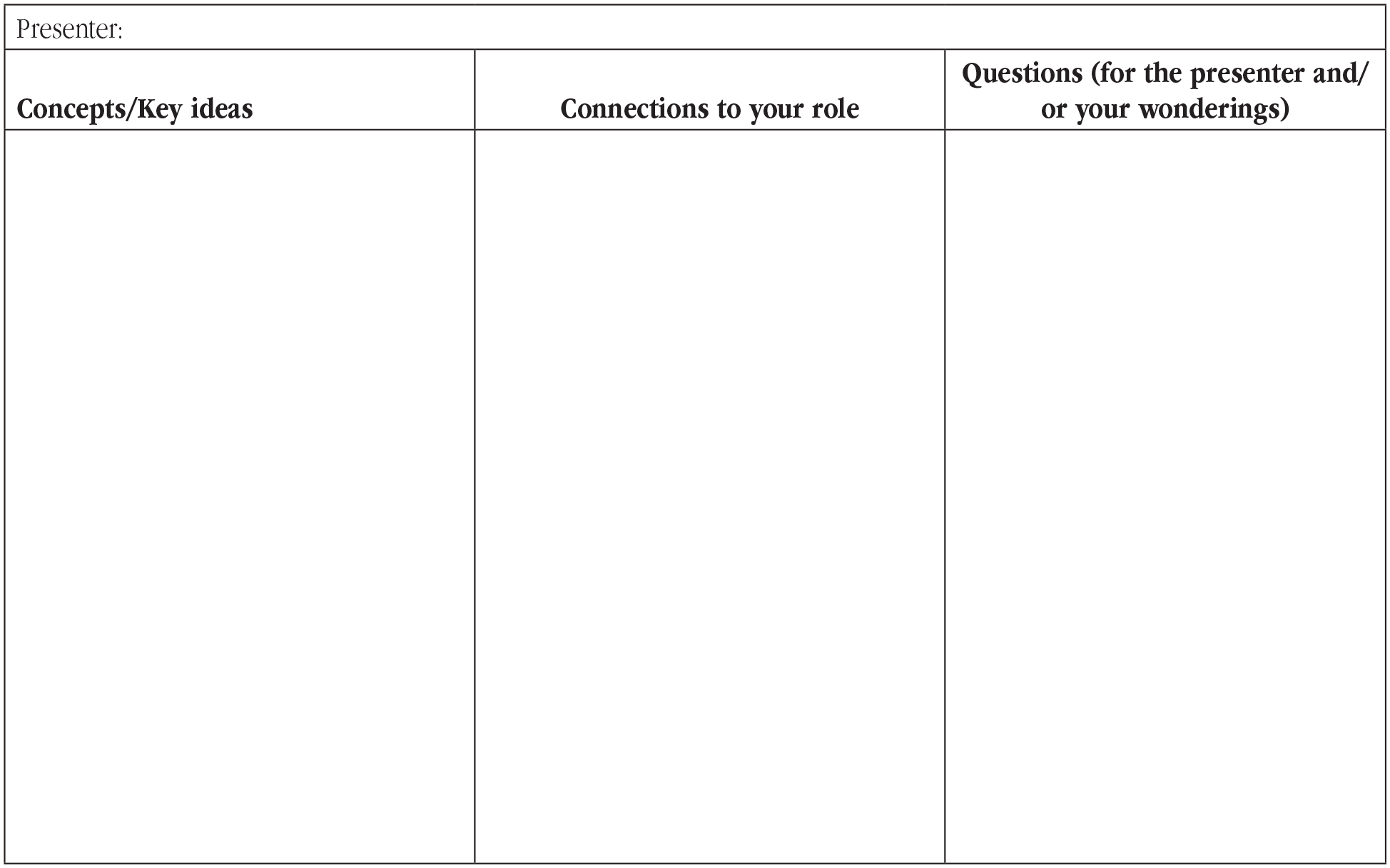
Note-Taking Sheet.
Reflect
After each presentation and Q&A, we provide attendees with time for reflection and discussion. The notes taken by attendees can serve as a memory aid, reminding them of their thoughts and connections during each presentation (Mariage et al., 2022). Immediately after the presentation, we recommend providing attendees with anywhere from 1 to 3 minutes to reread, add, and highlight ideas from their note-taking sheet (Figure 1). Then, we suggest providing time in small groups for attendees to share their reflections. Because each attendee will layer their own thoughts and reactions from the presentation onto their existing schema (Rumelhart & Norman, 1976), group work encourages participants to construct new meanings (Vygotsky, 1978). To provide structure for this peer discourse, we selected a Take Note Routine from Harvard’s Project Zero (see https://pz.harvard.edu/sites/default/files/Take%20Note.pdf). Structured conversations such as these can provide a safe environment for attendees to practice communicating new ideas and language, further encouraging them to explore different ways of thinking about disability.
Multiple opportunities to work with the same ideas over time deepen learning (Chen & Yang, 2020). Therefore, we advise organizers to continue unpacking themes and attendee reactions after the presentation has ended. During this time (e.g., future classes, team meetings), attendees once again revisit their note-taking sheet silently and then share the ideas that now resonate for them with a partner. These steps build toward a whole-group discussion for attendees to communicate their own ideas and make sense of the perceptions of others.
Apply
People form concepts about disability throughout their lives, which inform their thoughts, communication, and actions; therefore, exposure to ideas alone is likely not enough to shift habitual ableist patterns (Annamma et al., 2013; Causey et al., 2000; Vosniadou & Brewer, 1987). After each presentation has commenced, we guide attendees to try out new frameworks in the form of experiential, actionable steps with support from peers and organizers. To build toward concrete, attendee-created action steps, our students use their note-taking sheet during the presentation to make connections between their lives and what they learned from each presenter. Then, as an exit slip (see Figure 2), students turn their learning into actionable steps by creating a concrete plan. For example, some of our students made plans to shift their language, collaborate with other practitioners, and incorporate transition-related skills in their classrooms. This process provides an opportunity for attendees to experience how shifting schemas influence change.
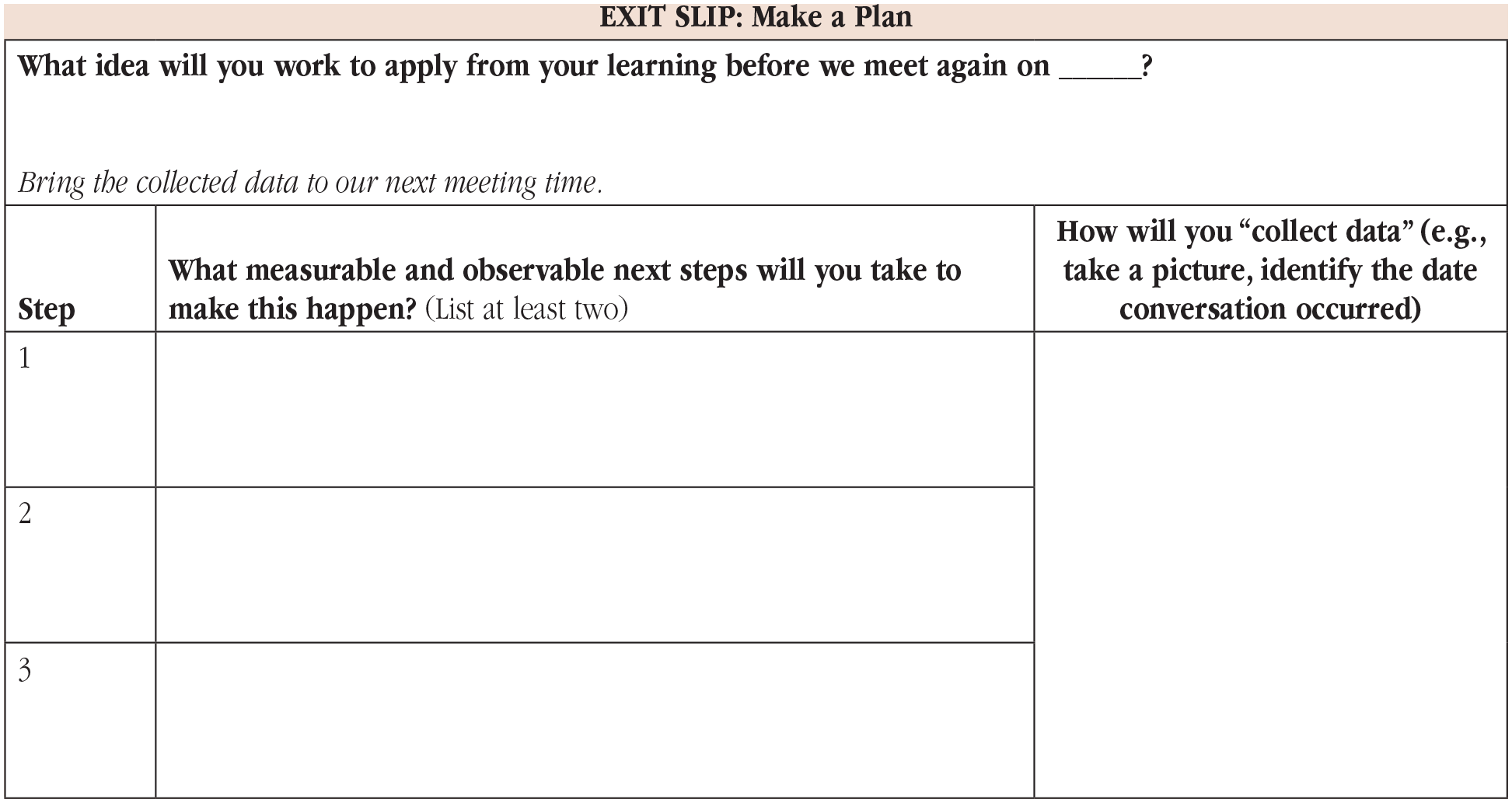
Exit Slip to Make Actionable Plans.
Continuing to revise the action plans they developed at the end of each presentation offers attendees an opportunity to leverage learning. Therefore, we ask the following questions to reflect on previous action plans.
Were you able to take your action steps? How did it go? If not, what got in the way?
Given this experience, what did you learn about designing and implementing action plans?
To wrap up, attendees work together to provide one another an additional nudge to move from the initial experience with the presenter to application in their community.
Conclusion and Implications
Currently, the opportunity to learn from individuals with disabilities is lacking across contexts, including teacher preparation programs, in-service professional development, and community learning events (Bialka et al., 2019; Van der Klift & Kunc, 2013). A Self-Advocate Guest Presenter Series can address and challenge the incoming ableist assumptions of pre- and in-service practitioners by intentionally creating spaces to learn from, and not just about, individuals with disabilities. Self-advocates who participate in a presenter series can benefit by sharing their stories with others, actively challenging ableism, receiving compensation for their expertise, and forming partnerships that could potentially lead to future collaboration and job opportunities. Presentations alone are not enough to shift perspectives and support anti-ableist actions. Therefore, it is essential for organizers to thoughtfully carve out time and develop a structure for individuals to make meaningful connections between the concepts and ideas that arise in the presenter series and their everyday lives. As individuals in various roles (e.g., pre- and in-service practitioners, administrators, paraprofessionals) take action, they can ultimately improve the experiences of individuals with ESN. For example, a series could impact a range of pre-service practitioners’ beliefs about what education can and should look like for individuals with ESN. As practitioners enter K–12 schools, they can apply what they have learned, challenge inequitable practices, and perhaps even impact how and where students with ESN access their education.
Footnotes
Conflict of Interest
The author(s) declared no potential conflicts of interest with respect to the research, authorship, and/or publication of this article.
Funding
The author(s) received no financial support for the research, authorship, and/or publication of this article.