




Abstract
The period in which young adults transition from high school is accompanied with complexities they need to navigate, such as further education and training, independent living, developing their career, and achieving meaningful employment. All of these set the stage for a successful and independent life. The significance of this transition is paramount; however, in research and practice, we continue to see poor outcomes for students with disabilities, especially those with the most significant support needs. Transition planning, mandated by the Individuals with Disabilities Education Act, must begin no later than a child turning 16. Some states mandate transition activities to start as early as 14, but should we consider an even earlier age? Within this paper, we discuss the need for changes within policy and practice to begin transition activities during children’s early education years.
Keywords
Postschool outcomes for students with significant support needs tend to be poorer than those for students with less-intensive support needs (e.g., learning disabilities, physical disabilities, or language disorders; Newman, 2011). Students with significant support needs are less likely to enroll in postsecondary education and training programs, live independently, and are less likely to be competitively employed (Avellone et al., 2021; Lee & Taylor, 2022; Newman et al., 2011; Winsor et al., 2021). Overall, these students often face greater challenges in achieving their postschool goals and may require more specialized support to do so. This emphasizes the need for effective interventions and supports to help students with significant support needs achieve their postschool goals and aspirations.
“predictors fit naturally into children’s early education experiences and should be emphasized throughout a child’s education, rather than waiting until children reach the arbitrary “transition-age.””
Legislation and research have focused on services and supports to enhance transition outcomes for students with disabilities, and in turn, those with the most significant support needs. Regarding legislation, the Individuals with Disabilities Education Act (IDEA, 2004) mandates that students who qualify for special education services must have age-appropriate transition planning goals and objectives added to their Individualized Education Program no later than their 16th birthday. Some states have even chosen to initiate transition planning as early as 14 years of age (Suk et al., 2020). Nevertheless, despite legislative intent, students continue to experience unsatisfactory postschool outcomes in these aforementioned areas. Regarding research, educational practices continue to be identified that support and contribute to more positive postschool outcomes for students with the most significant support needs (e.g., Carter et al., 2012).
Recently, Mazzotti and colleagues (2021) conducted a systematic literature review to identify further evidence to support practices that predict positive postschool outcomes for students with disabilities, which also support students with the most significant support needs. Notable predictors of success include, but are not limited to, career and technical education, inclusion in the general education setting, paid employment/work experience, parent expectations, and instruction in self-determination and self-advocacy (Mazzotti et al., 2021). Understanding these predictors is crucial for practitioners to effectively support students with significant support needs in their transition from high school.
Legislation and research findings indicate the imperative need to better prepare students with disabilities for their lives after high school. Despite years of effort, these students continue to suffer profound negative outcomes. One solution would be implementing strategies that have proven to enhance outcomes at an earlier age. It is well known that several educational practices predict positive postschool outcomes, which naturally align with early education practices for children with disabilities. Hence, there could be avenues in which these activities, beginning earlier in a student’s educational career, could further improve outcomes for students with significant support needs after high school. This article provides a rationale for beginning transition planning in early childhood and describes implications for practice and policy.
The Case for Earlier Transition Planning
In this section, we propose three reasons that transition planning should begin in early childhood. First, many states have already lowered the transition-age, which has led to positive outcomes for students with disabilities. Second, the law already emphasizes the need to prioritize children’s post high school outcomes in early childhood, given the impact of intervening early. Finally, the predictors that have been identified as leading to positive post high school outcomes for students with disabilities naturally align with the priorities and practices in early childhood and therefore can easily be implemented with young children.
Lower Transition Planning Age
More than half of the states and U.S. territories mandate transition planning to begin before the federal age requirement (Suk et al., 2020). Specifically, Suk et al. found that of the 56 U.S. states and territories they examined, 27 started transition planning at age 16, 25 began at age 14, two began at age 13, one began at age 15, and one began at age 12. Notably, researchers have found that adults with disabilities who lived in states that began transition planning before age 16 were more likely to be employed than individuals from states where the transition process begins at 16 (Cimera et al., 2013, 2014). These findings indicate that there is strong support for reducing the required transition planning age and that by doing so, adults with disabilities will have better outcomes.
Impact of Early Childhood
Years of research have found that children’s early experiences influence the skills they will have as they get older (Center on the Developing Child, 2007). In fact, given that early childhood is a critical period of development, IDEA extended special education services to very young children (birth to 3-years-old) under Part C of the law (i.e., the early intervention program; IDEA, 2004). While many goals of the Part C early intervention program indirectly relate to children’s future skills and function, one goal closely aligns with transition planning. It states that Part C services are needed “to maximize the potential for individuals with disabilities to live independently in society” (p. 99). In addition, Part C requires that early intervention professionals work with families and school districts to prepare children for the transition from home-based services to school-based-services when children enter preschool. Given that the law emphasizes children’s future during their first intervention experiences, we argue that policymakers and practitioners need practical ways to prepare children for their life after school throughout children’s childhood.
Predictors Naturally Fit into Early Education
As noted previously, researchers have identified predictors of success for adults with disabilities. Many of these predictors fit naturally into children’s early education experiences and should be emphasized throughout a child’s education, rather than waiting until children reach the arbitrary “transition-age.” In Table 1, we outline four transition-related educational opportunities that children with disabilities can receive beginning in early childhood: experiential learning, self-determination, meaningful inclusion, and caregiver engagement.
Early Education Opportunities Aligned With Postschool Predictors of Success.
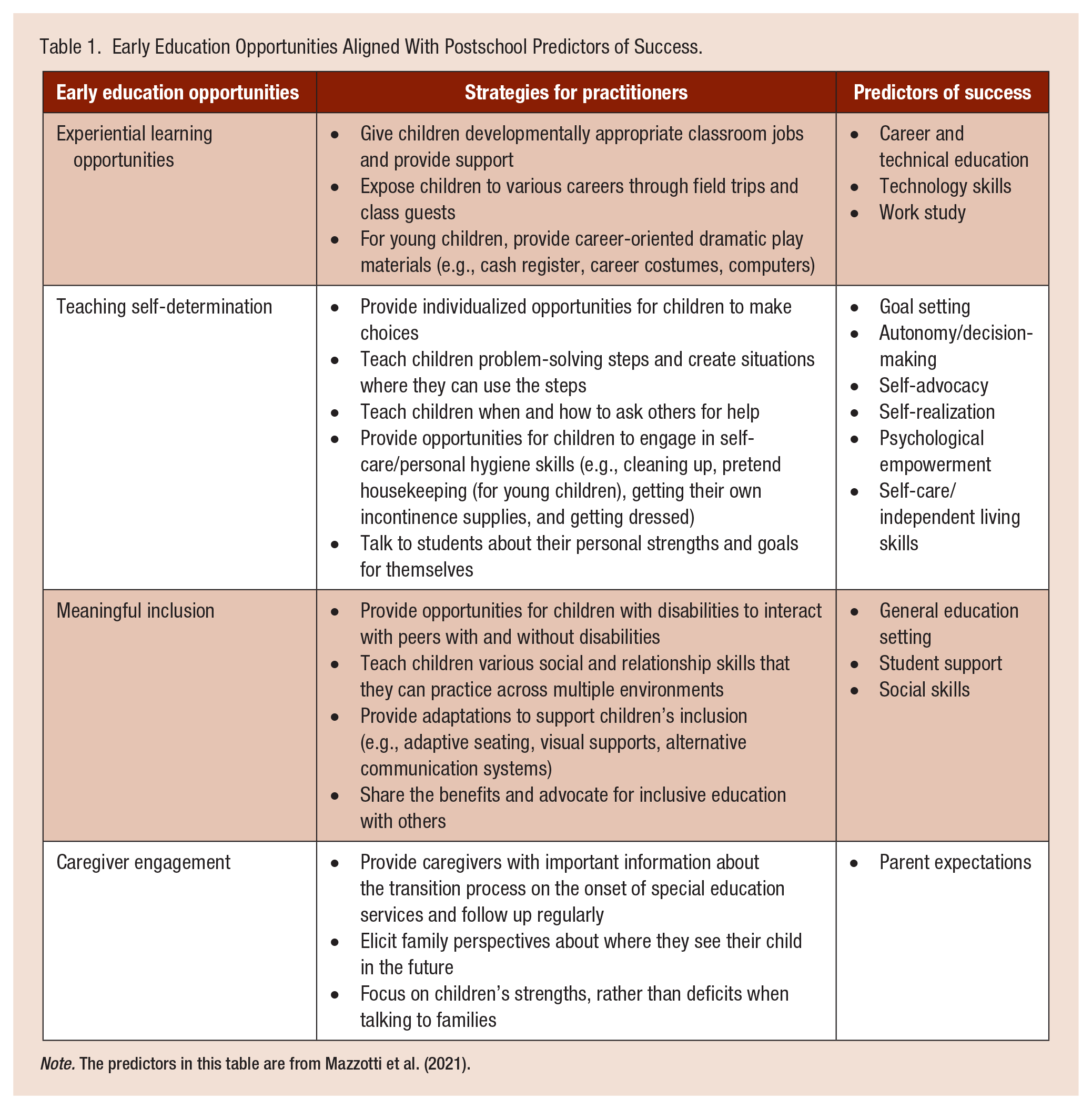
Note. The predictors in this table are from Mazzotti et al. (2021).
Beginning with experiential learning, children learn through rich, hands-on experiences (Friedman et al., 2021), which aligns with predictors such as career and technical education, technology skills, and work study. Experiential learning allows children to gain first-hand experience with topics (e.g., work, college, community engagement), which will influence their trajectory later. In Table 1, we listed three strategies that practitioners can use to provide students with experiential learning opportunities focused on career exploration and independent living skills. These activities should be developmentally appropriate for each child’s ability, while also maintaining high expectations and honoring children’s strengths and preferences. For example, students with more significant support needs should not be assigned an “easy” classroom job, but rather, should be able to choose their job and receive scaffolding to increase their independence.
Second, self-determination is an individual’s ability to have agency in their own life by accomplishing tasks such as making choices, identifying and advocating for their interests and needs, and progressing toward individually set goals (Erwin et al., 2009), which clearly aligns with predictors of postschool success such as goal setting, autonomy, and self-advocacy (Mazzotti et al., 2021). There is a significant amount of literature in early childhood that emphasizes young children’s self-determination skills, beginning as early as infancy (Erwin et al., 2009). We provide five strategies that practitioners can use to enhance young children’s self-determination skills in Table 1. It is important for practitioners to acknowledge that all children have strengths and contribute to the classroom, which in turn, helps children identify their own strengths, which is a crucial skill for person-centered planning later.
In regard to meaningful inclusion, two of the leading national organizations for early childhood education, the Division for Early Childhood and the National Association for the Education of Young Children (2009) state there are three tenets of inclusion: access, participation, and supports. These tenets emphasize not only that children should be included in physical settings with their peers but also should be able to meaningfully participate with their peers and receive systems-level supports that promote their inclusion. The three tenets directly align with postschool predictors such as inclusion in general education, social skills, and student supports. When children are included in general education classrooms beginning early, they are more likely to develop social skills that are necessary for their future success (Odom et al., 2004). Inclusive education is imperative for overcoming poor postschool outcomes for students with disabilities and should be prioritized throughout a child’s education. In Table 1, we list four ideas that practitioners can use to promote meaningful inclusion for children. Importantly, practitioners should remember that inclusion is not just a place in the general education classroom. It requires intentional planning and action to ensure each student has what they need to be successful, including responding to multiple intersecting identities that affect children such as race, culture, and poverty.
Finally, caregiver engagement is a key feature of early childhood education that tends to decrease as children get older (Murray et al., 2015). Families show engagement in their children’s education in a variety of ways, such as sharing their goals and priorities for their children, helping their children learn in a variety of contexts, advocating for their children’s needs, and engaging in ongoing communication with teachers and other professionals. Caregiver engagement aligns with the postschool predictor of parent expectations for their children. When caregivers have high expectations for their children and the educational institutions that serve them, their children will have better outcomes. In Table 1, we offer three strategies for practitioners that focus on family engagement. Noteworthy, all families engage in their children’s education in different ways, and it is important for practitioners to be responsive to different types of engagement and family preferences. For example, practitioners can offer families a choice about how they want to communicate (e.g., text, email, call, and notebook) and provide information in ways that meet families learning preferences (e.g., handouts, verbal explanation, and videos). In addition, it is crucial to have a strengths-based and progress-focused lens when talking to families about their children with disabilities, especially those with the most significant support needs.
Implications for Policy
Poor outcomes across the areas of independent living, postsecondary education and training, and employment provide the urgent need for policy changes. In the next reauthorization of IDEA, we encourage federal policymakers to follow the lead of states who have lowered the age of transition planning (Suk et al., 2020). Recognizing the continuum of special education services from early education through adulthood, policymakers should keep in mind that the goal of IDEA is to successfully prepare students with disabilities for a successful and independent future. Therefore, transition planning should be mandated to start at the onset of a child receiving early intervention (Part C) or school-based special education services (Part B). Policies should directly link the practices done in early education to the services and supports that need to be provided during a student’s transition, ensuring a seamless and uninterrupted transition process. When transition practices are embedded early and consistently, there is a higher likelihood of students with disabilities reaching higher impact transition milestones (e.g., paid work, college acceptance, involvement in an inclusive community activity) before they graduate.
Implications for Practice
Regardless of policy changes, practitioners working with children with disabilities can be intentional in preparing students for their transition to adulthood beginning in early childhood. One practice that practitioners can implement is collaboration with a variety of professionals across grade-levels. For example, we know that early childhood often provides opportunities for experiential learning, self-determination skills, meaningful inclusion, and family engagement. Nonetheless, these practices seem to stop and then start again during the arbitrary “transition-age.” By collaborating with practitioners in older grades, early childhood practitioners can share the benefits of these experiences, and how they prepare children for their future. As another example, the practitioners who typically begin the process of transition planning with children at ages 14 to 16 can share strategies with practitioners in younger grades to help get children ready. Practitioners can initiate these collaborative relationships by emailing questions to others, inviting them to the classroom to consult, or asking them to attend the child’s Individualized Family Service Plan (0–3 years) or Individualized Education Program (3–21 years) meetings. This collaboration will not only positively impact children, but also their caregivers to begin preparing for their child’s transition.
Another way that practitioners can help prepare children for the transition process earlier is by intentionally tracking transition-related milestones. For example, beginning in the early intervention program, practitioners and families can reflect on how they are addressing children’s future planning and intentionally develop action plans that focus on children’s future. Some of these actions may include helping families get on a waitlist for disability services the child will need when they are older, getting children assistive technology that will help children access and participate in environments, and providing opportunities for children to make developmentally appropriate choices (see Table 1 for additional strategies). In addition, practitioners can track children’s transition-related milestones using a checklist that goes with the child as they age, which would help promote a continuity of services and offer practitioners practical ways they can support children’s transition.
Conclusion
In this article, we provided a rationale for beginning transition planning in early childhood and described implications for practice and policy. Overall, students with significant support needs often face greater challenges in achieving their postschool goals and may require more specialized support to do so. This emphasizes the need for effective interventions and supports to start earlier in these students’ educational journey to better enhance their transition outcomes. By starting transition planning early and gradually building the necessary skills, students have more time to develop their strengths, address challenges, and acquire the skills needed to succeed in their future. Given the statewide trends related to transition-planning and the impact and priorities of early childhood, we believe there is a strong case to lower the transition age at the federal level to begin when children enter the early intervention or special education system. Policymakers, school administrators, and practitioners alike have a responsibility to help prepare children with disabilities for their futures, which will in turn, create more opportunities and success for adults with disabilities.
Footnotes
Conflict of Interest
The author(s) declared no potential conflicts of interest with respect to the research, authorship, and/or publication of this article.
Funding
The author(s) disclosed receipt of the following financial support for the research, authorship, and/or publication of this article: This work was supported in part by two grants from the Office of Special Education Programs, U.S. Department of Education: Early Childhood Intervention Doctoral Consortium (ECiDC) (grant no. H325H190004) and Secondary Curriculum that leads to Outcomes and Research in Employment (SCORE3) (grant no. H325D180077).
