



Abstract
This article explores how students and institutional actors in cross-section of Northern and Southern European conservatories navigate the growing dominance of the entrepreneurial mindset within higher music education. Rather than framing this engagement in binary terms of acceptance or resistance, the study highlights the subtle, affective, and discursive tactics through which individuals negotiate institutional expectations through irony, strategic fluency, reframing, and hesitation. Drawing on critical discourse analysis and informed by theories of neoliberal subject formation, performativity, institutional temporality, and affective labour, the article interprets these micro-practices as forms of both conformity and quiet resistance. Focusing on conservatory settings, the analysis attends to the frictions between policy-driven discourses of entrepreneurial subjectivity and the slower, recursive rhythms of artistic learning. It shows how institutional scripts are not simply internalised but tactically performed, rearticulated, or quietly unsettled in everyday language. By situating these negotiations within broader debates on the marketisation of higher education, this study contributes to a deeper understanding of how music students’ identities are shaped, strained, and contested in the discursive margins of institutional speech. In doing so, it invites further reflection on what kinds of subjectivities music institutions are cultivating, and at what cost.
Keywords
Introduction: Frictions of becoming in artistic higher education
Over the past two decades, higher education has undergone what some scholars have increasingly described as an entrepreneurial turn – a shift in discourse and institutional practice that reconfigures education around ideals of innovation, venture creation, and self-enterprise (Bridgstock, 2013; Olssen and Peters, 2005; Sadler, 2021; Shore, 2017). This transformation is not merely curricular, but part of the broader neoliberalisation of higher education – a process through which universities are increasingly governed by market logics, performance metrics, and an emphasis on individual responsibility and employability (Ball, 2012; Brown, 2015; Davies and Bansel, 2007; Shore and Wright, 2011). Under this paradigm, students are no longer primarily conceived as learners or citizens-in-formation, but as entrepreneurial subjects: self-managing agents responsible for maximising their own human capital (Bröckling, 2016; Rose, 1999). While this trend has touched nearly all disciplines, its impact on arts and creative education is especially complex. In domains historically shaped by values of aesthetic process, critical inquiry, and collective experimentation, the rise of entrepreneurial discourse introduces new normative expectations, pedagogical logics, and temporal rhythms that reshape how students and educators imagine their work and more importantly, themselves.
This shift is not incidental. It reflects a broader structural alignment between higher education systems and neoliberal governance rationalities, in which employability, adaptability, and market relevance have come to dominate policy discourse and curriculum design (Ball, 2012; Brown, 2015). Across Europe, these rationalities have been amplified by cultural industries agendas that frame culture as a driver of innovation, economic growth, and urban regeneration. Higher education institutions (HEIs), including conservatories, are increasingly expected to reorient their missions, not only to cultivate students’ artistic capacities, but to produce entrepreneurial graduates equipped to navigate precarious labour markets and contribute to the cultural industries (Comunian et al., 2011; Ellmeier, 2003; O’Connor, 2016).
Within this framework, cultural practices have increasingly been repositioned as industries to be managed, evaluated, and monetised, with greater emphasis placed on their economic contribution than on their aesthetic, critical, or social dimensions (Menger, 2006; Yúdice, 2003).
This reframing has far-reaching implications. As argued by O’Connor (2023), the creative economy discourse reduces culture to a form of managed economic activity, abstracting it from the uncertain, processual, and often non-instrumental nature of artistic work. Within conservatories, this discourse reshapes not only what students are taught, but who they are encouraged to become. The ideal graduate is no longer solely an artist or musician, but a self-managing cultural entrepreneur – flexible, networked, and fluent in the language of strategic value creation entrepreneurial subject innovation (Pyykkönen and Stavrum, 2018; Shore and Wright, 2011). What is at stake in this transformation is not only the function of artistic education, but also the kinds of subjectivities that are legitimised and valued within it. Entrepreneurship has thus become more than a skillset; it is now framed as an ethical orientation and a form of desirable personhood.
Within this context, the entrepreneurial mindset has been integrated into the artistic curricula through – among others – modules, incubator initiatives, learning outcomes, and graduate profiles. Though often with limited formal credit weight, their influence is registered in how employability, value, and adaptability are framed within institutional discourse. While early scholarship often highlighted the need to equip artistic students with tools to navigate precarious cultural labour markets (Bridgstock, 2013; Essig, 2015), more recent critiques have turned attention to how these tools function discursively, what they teach and how they shape the subjectivities of those who participate (Gu, 2022, Lazzarato, 2011). As conservatories adopt the language of creativity as capital and risk as opportunity, the principles of what counts as artistic learning, value, or success are redefined.
Yet this transformation is neither linear nor uniformly internalised. As shown in previous research and echoed in this study, students and staff engage with these discourses in uneven, situated ways. What emerges is not straightforward compliance or rejection, but a field of negotiation marked by ambivalence, adjustment, and alternative ways of engagement in which individuals partially align with, selectively adopt, or resist the entrepreneurial ethos. These forms of engagement rarely take the shape of open confrontation. More often, they surface in quieter ways, through irony, pauses, reframing, or subtle shifts in how things are said. These moments may seem minor, even ambivalent, but they often mark a deeper discomfort or distance from the dominant narrative. Rather than treating them as marginal or incidental, this article understands them as part of how institutional discourse is actually lived, navigated, stretched, and at times, gently unsettled.
The study adopts a critical discourse analytic lens, informed by post-structural and affect theory, and treats discourse not as a neutral reflection of institutional practice but as a terrain where subjectivity is negotiated and sometimes contested. It focuses on the small, often unnoticed ways in which students and educators navigate entrepreneurial discourse, not just as isolated reactions, but as cultural expressions that reveal deeper tensions within the everyday life of artistic HEIs. Rather than framing these responses in terms of acceptance or resistance, the article looks at how people speak with and around the scripts they are given. Drawing on critical discourse analysis and informed by theories of neoliberal subject formation, performativity, affective labour, and institutional temporality this article examines how institutional discourse is taken up in practice. It attends to the everyday negotiations through which students and educators engage with dominant expectations, not by fully endorsing or rejecting them, but by adjusting, repurposing, or questioning them in subtle and affectively charged ways. In doing so, it addresses the following guiding questions: How is entrepreneurial subjectivity shaped and contested in artistic HEIs? What rhetorical, affective, and temporal strategies emerge in response to institutional expectations? What do these everyday responses reveal about the deeper tensions between neoliberal frameworks and the values of artistic education?
The hope is that what follows is not a binary account of acceptance versus rejection, but a reading of how entrepreneurial discourse is lived, spoken, and sometimes quietly reworked in the margins of institutional practice. By focusing on everyday language use, narrative framing, and rhetorics, this analysis contributes to wider conversations about how subjectivities are shaped and contested in the neoliberal university, and how even in moments of apparent students’ alignment with the dominant neoliberal narrative, other trajectories remain possible. It also offers a reminder that institutional power often does not operate through overt control, but through affect, rhythm, and slow influence on students’ identity, and that resistance, too, can reside in the quiet turn of phrase, sarcastic joke, a deliberate pause, or the refusal to speak fluently in the terms one is expected to master.
Building upon de Certeau's (1984) distinction between strategies and tactics, this article interprets student narratives as micro-acts of resistance and conformity that reflect both acquiescence and quiet dissent. These acts are not necessarily oppositional in a traditional sense; rather, they operate within dominant discourses, often reproducing their terms while subtly displacing their meanings. In doing so, students enact what Davies and Bansel (2007) describe as the ‘paradox of subjectivity’ in neoliberal education – a condition in which ‘we are both produced by discourse and capable of producing ourselves differently within discourse’ (p. 254).
In sum, by undertaking a critical discourse analysis of student and leadership narratives, this article aims to re-read the entrepreneurial mindset not as a neutral set of skills or useful addition to the artistic curriculum, but as a discursive regime that governs not only what students are taught but who they are expected to become. The findings contribute to a growing body of literature critiquing the marketisation of higher education (Brown, 2015; Shore and Wright, 2011), while also offering a more granular account of how individuals make sense of and act within these discursive terrains.
Theoretical framework: Neoliberal subjectivity, temporalities, and everyday discursive tactics in artistic higher education
As education systems increasingly align themselves with labour market logics, students are encouraged to become not just skilled professionals, but enterprising selves, strategically attuned to opportunity, capable of managing risk, and responsible for their own employability. In the arts, where creative autonomy, uncertainty, and slow experimental processes have traditionally been central to pedagogical and professional identities, this shift introduces new tensions, new temporalities, and new expectations of selfhood.
This reconfiguration of the learner is underpinned by a broader neoliberal rationality, in which education becomes a means of governance, and students are interpellated into a normative framework of self-entrepreneurship. As Wendy Brown (2015) and Aihwa Ong (2006) have argued, neoliberalism cannot be seen solely as market deregulation; it operates through the internalisation of certain moral principles, a form of subjectification that deems autonomy and adaptability as personal virtues. In this view, the ideal student is a project manager of the self, tasked with increasing their market value through self-investment and entrepreneurial disposition (Bröckling, 2016; Davies and Bansel, 2007; Rose and Miller, 1992). Michel Foucault's (2008) lectures on The Birth of Biopolitics trace this phenomenon to the expansion of economic rationality into all spheres of life, where individuals are tasked and expected to govern themselves as micro-enterprises. This logic extends into education, where students are trained not just in skills but in a particular mode of being, a mode that normalises precarity, celebrates risk, and frames self-reliance as an ethical imperative (Ranczakowska and Kuznetsova-Bogdanovitsh, 2025).
Entrepreneurial subjectivity and affective labour
In artistic higher education, this framework introduces particular tensions (Bridgstock, 2005; Throsby, 2007). Traditionally, artistic identity has been associated with ambiguity, aesthetic process, and forms of value that resist immediate quantification – qualities that are often at odds with the performative fluency and strategic coherence demanded by entrepreneurial education. As Dewey (1934) argued, the value of art lies not in its utility or external outcomes, but in the experiential and processual nature of creation. More recently, scholars such as Ellmeier (2003); Bridgstock (2013); Throsby (2005) have shown how attempts to align creative practice with economic rationality can displace core values within arts education, leading to a redefinition of what counts as artistic work.
Yet, as Siivonen and Brunila (2014) have shown, students rarely adopt these discourses because someone explicitly tells them to. Instead, they learn to speak in its terms through everyday exposure: course descriptions that frame creativity as marketable output, assignments that ask them to pitch rather than reflect, or career workshops that emphasise the articulation of their marketable value. In particular, recent work has shown how these processes unfold in artistic HEIs as students navigate institutional scripts, communities of practice, and conflicting imperatives of personal development and strategic self-performance (Kuznetsova-Bogdanovitsh and Ranczakowska, 2025). The entrepreneurial self, therefore, is not simply taught; it is spoken into being, reiterated across learning outcomes, assessment rubrics, career narratives and professional context.
This process however is not only discursive, but also deeply emotional and embodied. As Lauren Berlant (2011) and Sara Ahmed (2012) have shown, institutions shape not just how people think, but how they feel and what they come to see as possible, valuable, or legitimate. Performing the entrepreneurial self often involves a background labour of confidence, composure, and forward-facing optimism: emotional work that can mask doubt, fatigue, or ambivalence. As Berlant's concept of ‘cruel optimism’ (p. 6) suggests, the promise of autonomy, creative freedom, and self-made success is often tightly linked to structures that make those very things difficult to achieve. In this sense, producing the entrepreneurial subject also produces emotional tension, as students work to appear aligned with values that may not fully reflect their own. This emotional labour is one of the less visible costs of the neoliberal turn in universities, a quiet, ongoing effort to remain legible within systems that often overlook the complexity, vulnerability, and uncertainty at the heart of creative learning.
Institutional temporality and subject formation
A further layer of tension emerges in relation to institutional temporality, the pace, sequencing, and rhythm embedded in pedagogical structures. Aligned with audit cultures (Shore and Wright, 1999) HEIs increasingly operate through accelerated temporalities, structured around short cycles of delivery, performance, and measurable impact (Adam, 2004; Sharma, 2014). These tempos are often at odds with the nonlinear, iterative, and affectively charged artistic learning, which unfold through cycles of uncertainty, slow development, and emergent transformation. Hence, the entrepreneurial mindset emerges also as a temporal ideal promoting urgency, forward motion, and constant productivity.
These pedagogical structures function as governing mechanisms of subject formation. They shape how students come to see themselves, how they measure progress, and what they learn to value. This aligns with Bröckling's (2016) concept of the ‘entrepreneurial self’, a subject whose very sense of agency is configured through economic rationality and institutional principles. To perform fluently in this regime is to inhabit a tempo that may not belong to one's learning but is required by the institutional frame. Therefore, resistance is not always expressed through speech or direct action, but through an alternative inhabitation of time itself: moments of hesitation, refusal to rush, or the slow crafting of work that resists premature legibility.
Discursive tactics: Navigating institutional scripts
To understand how individuals negotiate these pressures, this study draws on Michel de Certeau's (1984) distinction between strategies and tactics – a framework for understanding how everyday actors operate within dominant systems without fully internalising them. Strategies are the organising logics of institutions, the official plans, categories, decisions, and discourses through which power is enacted. Tactics, by contrast, are improvised manoeuvers ‘the art of the weak’ (de Certeau, 1984: 37) enacted not through open confrontation but through adaptation, holding back or shifting meaning.
Such tactics can manifest in narrative tone, rhetorical hesitation, ironic compliance, or selective self-presentation – subtle forms of resistance that allow students and staff to maintain partial distance from institutional principles while appearing to conform. These are not grand gestures of rebellion, but small acts of negotiation, expressions of ambivalence, friction, or alternative valuation that suggest the presence of counter-narrative within institutional life.
These insights resonate with a growing body of scholarship that critiques the increasing submission of creative education under managerial logics. Scholars such as Gauntlett (2018), O’Connor (2016), and Comunian and Gilmore (2015) have emphasised the tension between creative autonomy and market imperatives in contemporary cultural work. This study extends such critiques by demonstrating how these tensions manifest not only in institutional policies, but in the micropolitics of everyday discourse, the subtle negotiations of identity, affect, and institutional language that shape students’ sense of self and professional becoming.
Methodology
In this article, I approach discourse not as a neutral framework for ideas, but as a site where subjectivities are shaped through institutional logics, emotional dynamics, and the temporal structures of HEI. Methodologically, the analysis is situated within a qualitative, critical-interpretive framework, informed by anthropological approaches to discourse as social and institutional practice. I focus on how discourses of the entrepreneurial mindset are articulated, how language creates subjects, how normative expectations are embedded in institutional speech, and how emotionality and temporality operate within discursive formations. My own positionality informs this perspective: I write from within the institution, having moved across roles as student, educator, and administrator, and now reflecting on these trajectories as a researcher. This proximity does not provide analytical detachment but rather enables my situated and reflexive perspective: one shaped by both familiarity with, and critical distance from, the institutional dynamics under examination. It is from this embedded standpoint that I interpret discourse, attentive to the ways in which institutional scripts are inhabited, negotiated, and contested.
My primary interest lies in exploring the language and narrative structures through which students and institutional actors make sense of entrepreneurial education and negotiate its implications for artistic identity, learning, and professional development.
In total, the study draws on 35 interviews and seven focus groups across seven conservatories in Europe including institutions in Denmark, the Netherlands, Estonia, Finland, Norway, Sweden, and Spain. The selected institutions reflect variation in cultural policy environments, and involvement in EU-funded projects (e.g. Erasmus+, Creative Europe) focusing on entrepreneurship in music education. Each institution had offered entrepreneurship-related courses for at least a decade and employed designated staff in this area. Each institution is also a member of either ActinArt network focusing on development of entrepreneurial mindset in artistic HEI or the Association Européenne des Conservatoires. The analysis includes voices from students at various stages of study (undergraduate, postgraduate, doctoral), recent alumni, educators, and institutional leaders. Rather than constructing fixed categories of respondents, I focused on the textured quality of language: how discourse circulates, hesitates, fractures, or solidifies across different institutional and cultural settings, and how these patterns reflect shifting relationships to entrepreneurial discourse. The aim was not to pursue representativeness in any statistical sense, but to trace how educational subjectivities are spoken, felt, and tactically navigated in everyday institutional life.
The research is grounded in critical discourse analysis, informed by the understanding that language is not a neutral medium but a site where power, ideology, and identity are continually negotiated (Fairclough, 1995). This approach enables close attention to how discourse both reflects and constructs social realities, particularly within institutions shaped by broader economic and political pressures. The analysis draws on theoretical work on neoliberal subject formation, institutional temporality and affective labour (e.g. Ball, 2012; Bröckling, 2016; Davies and Bansel, 2007). This orientation is particularly relevant within the field of cultural management, where dominant research frameworks often remain managerialist in tone, framing entrepreneurship in terms of skills acquisition, efficiency and economic output. A critical-discursive approach instead highlights the ideological and affective dimensions of entrepreneurial discourse, showing how it operates at the level of subjectivity and institutional practice. From this perspective, the entrepreneurial mindset is approached not merely as a pedagogical tool, but as a discursive formation with ideological effects that privileges certain ways of speaking, being, and imagining the future, while marginalising others.
My analytical process involved iterative reading, coding, and thematic clustering, with a particular focus on moments of tension, irony, ambiguity, and narrative divergence from institutional scripts. I examined how participants positioned themselves in relation to dominant entrepreneurial discourse: how they repeated, redefined, resisted, or recontextualised its key terms and how emotional undercurrents such as frustration, ambivalence, or reluctant alignment entered their speech. The analysis followed an abductive logic, moving between empirical material and theory to refine interpretive categories. Themes were not predetermined but emerged through a recursive process that prioritised affective nuance, rhetorical shifts, and discursive contradiction.
The aim of this approach is not to arrive at general conclusions, but to deepen understanding of the discursive micropolitics at play in HEI, a space where questions of autonomy, identity, and value often collide with institutional imperatives for adaptability, coherence, and market-readiness. I treat complexity, contradiction, and hesitation not as analytical obstacles, but as meaningful data, signals of how subjectivities are negotiated and performed within the constraints and possibilities of contemporary higher education. Excerpts presented in the findings section were selected not for their frequency but for their capacity to illuminate the affective and rhetorical complexity through which entrepreneurial discourse is engaged, tactically reworked, or quietly unsettled.
Results
The analysis revealed a range of discursive patterns that illuminate how students and institutional actors grapple with the entrepreneurial mindset as a dominant framing of learning and professional development in European conservatories. These patterns do not align neatly with either enthusiastic endorsement or open resistance. Instead, they often emerge in ambivalent, layered, and subtly negotiated forms, reflecting the complex interplay between institutional discourse, artistic identity, and individual agency.
Rather than approaching resistance as opposition, this analysis draws attention to the quieter micropolitics of discourse such as the rhetorical moves, hesitations, reframings, and emotional undertones through which individuals position themselves in relation to institutional expectations. In this sense, resistance is not always a refusal, nor is conformity always a sign of acceptance. These micro-acts often take place within the language itself, signalling discomfort, adaptation, or quiet subversion through tone, metaphor, and discursive framing.
Thematic strands that identified in the inductive analysis are as follows:
Ambivalence as discursive resistance Conformity wrapped in empowerment language Irony, reframing, and quiet subversion Entrepreneurial identity as burden or mask
Each theme represents an overlapping mode of engagement with entrepreneurial discourse, offering a textured view of how subjectivities are formed, challenged, and manoeuvered within artistic HEIs. The thematic analysis is organised around four recurrent discursive patterns drawn from participants’ narratives. While presented separately for clarity, these modes often intersect, since strategic fluency can coexist with ironic detachment, and empowerment language may be undercut by emotional ambivalence. The themes should be read not as fixed categories but as interwoven responses to institutional expectations. In the discussion section, each theme is unpacked with illustrative excerpts and interpreted through critical discourse analysis.
Figure 1 presents additional selection of representative excerpts clustered into these four patterns. Rather than treating entrepreneurial discourse as uniformly accepted or rejected, the data reveal ironic, ambivalent, appropriative, and burden-laden engagements. These excerpts demonstrate how students and staff navigate, negotiate, and sometimes quietly contest the institutional logic of the entrepreneurial mindset.
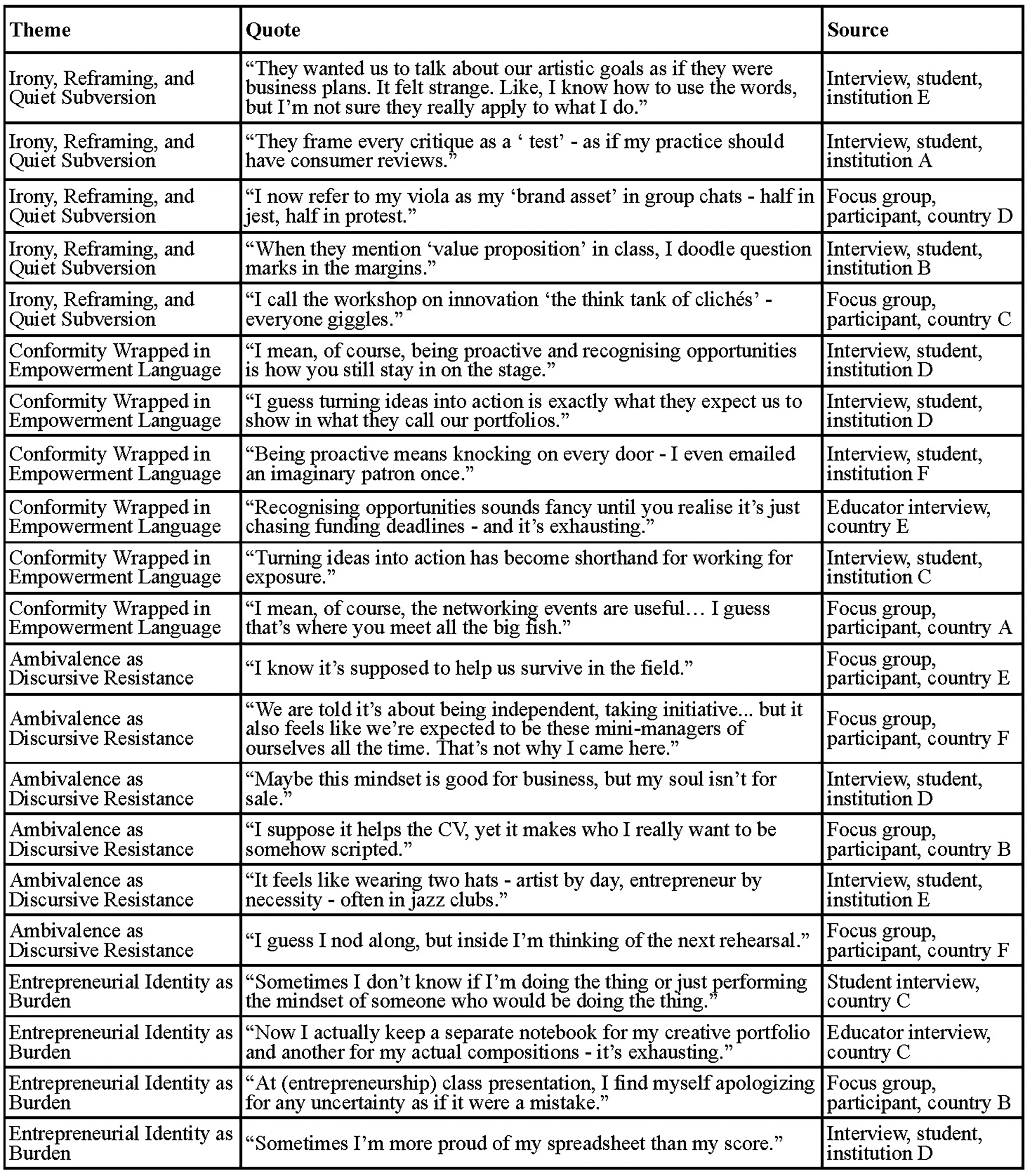
Additional quotes from the data collection.
Discussion
Theme 1: Ambivalence as discursive resistance
What emerges with striking consistency in participants’ narratives is not outright rejection of the entrepreneurial mindset, but a more elusive, often difficult-to-name sense of ambivalence, a hesitation that sits between obligation and disidentification, between internalisation and discomfort. The entrepreneurial discourse does not appear here as something simply resisted or embraced, but as something unsettling, something that disrupts more than it defines. It appears as a language learned reluctantly, often spoken with borrowed words and translated back into the participants’ own dictionary of artistic practice.
This ambivalence surfaces not in refusals, but in half-sentences, in pauses, in the careful qualifiers that surround statements like ‘I guess it's important to be proactive nowadays’ or ‘I know it's supposed to help us survive in the field’. In such a way we can sense a friction, not always articulated, but felt. It is the friction of being hailed into a subject position that does not quite fit, and yet cannot be simply declined. This emotional tension recalls Bourdieu and Passeron's notion of symbolic violence, the subtle imposition of cultural norms that appear neutral or empowering but serve to legitimize dominant values while marginalising others (Bourdieu and Passeron, 1977: 5). The entrepreneurial mindset is offered here as a tool for agency, yet it often lands as an alien form, misaligned with the tacit values that shape artistic self-understanding. A student reflects: We are told it's about being independent, taking initiative … but it also feels like we’re expected to be these mini-managers of ourselves all the time. That's not why I came here.
In such moments, we witness what Veena Das (2007: 7) might call ‘the ordinary register of resistance’, a mode of living with and around dominant structures without necessarily confronting them head-on. The ambivalence is a mode of engagement that neither fully internalises nor simply rejects, but rather inhabits the discourse with unease, shaping it from within through hesitancy, irony, or avoidance.
Even when participants acknowledge the practical relevance of entrepreneurial skills, this recognition is frequently wrapped in qualifiers: ‘I suppose it's useful’, or ‘Maybe we need it, but…’. These small phrases, the hesitations, qualifiers, and side comments are not accidental; they serve as subtle ways of questioning or reshaping institutional narratives without openly opposing them. One educator noted: I try to integrate some of the entrepreneurial elements into my teaching, but always in a way that doesn’t feel forced. Many students are skeptical, and rightly so.
What emerges in these narratives, then, is not disengagement, but a kind of affective balancing act of holding together contradictory subject positions that are difficult to resolve. The artist as entrepreneur, the creator as project manager, the student as self-branded agent: these are frictional identities, formed through hesitation, selective uptake, and partial refusals.
Ambivalence, in this sense, is not indecision or passivity. It is a situated response to institutional expectations in a form of an embodied tactic for navigating the demand to become a particular kind of subject. It is a slow-moving form of resistance: quiet, nonconfrontational, and yet deeply significant. Precisely because it doesn’t disrupt the flow, it endures, and in that endurance, it speaks.
Theme 2: Conformity wrapped in empowerment language
If the first theme revealed friction, this second pattern captures a different and perhaps more subtle mode of alignment with the institutional discourse of entrepreneurship: one that rises from a strategic adaptation to its rhetorical force. Here, conformity emerges not as mechanical compliance, but as a performance of fluency in a language of empowerment, a way of speaking in expected terms while still negotiating one's own position beneath the surface.
What stands out in many of the narratives is how fluency in entrepreneurial vocabulary becomes a form of institutional navigation. Participants often repeat phrases such as ‘being proactive’, ‘recognising opportunities’, or ‘turning ideas into action’,not necessarily as expressions of deeply held values, but as tokens, borrowed from the surrounding institutional rhetoric. These utterances carry a certain quality, they sound right, even if they feel, at times, hollow or dislocated from lived practice.
As one student noted, almost casually: Yes, we’re encouraged to have this entrepreneurial mindset, to take initiative, to find solutions. I mean, of course, it's useful … I guess that's what you need in this field.
Some students take up this role with ease; others do so with hesitation or irony, aware of the gap between their inner orientation and the persona they are expected to project. Yet both responses operate within a system that values visibility over vulnerability, coherence over uncertainty. What may appear as confident self-narration is, at times, a protective performance that secures access to opportunity while obscuring the emotional and epistemic costs of such alignment. I know it's all about being resilient and adaptable. I’ve learned to talk about my work that way now. It helps when applying for grants.
There are moments, however, where the tension beneath the polished surface becomes visible. A student describes how entrepreneurial training workshops left her feeling conflicted: They wanted us to talk about our artistic goals as if they were business plans. It felt strange. Like, I know how to use the words, but I’m not sure they really apply to what I do.
Indeed, what may appear as confidence or adaptation may, in fact, conceal deeper forms of vulnerability. Several participants describe a sense of internal contradiction: learning to speak the entrepreneurial language not because it resonates, but because it is what one needs to succeed, to be recognised, to survive. You start to think in these terms – value, impact, audience – even if your work doesn’t come from there. It creeps in.
In this theme, then, we see not resistance but a compliance sprinkled with dissonance,a fluency that allows students to navigate institutional terrain, but often leaves them wondering what has been lost in translation.
Theme 3: Irony, reframing, and quiet subversion
Beyond ambivalence and strategic conformity, some narratives carry another tone altogether: a quieter, sharper undercurrent of irony, reframing, and the subtle repurposing of institutional language. These are not the loud gestures of defiance, but soft and deliberate shifts, the small ways students and staff bend, twist, or lightly undermine the dominant discourse, even while outwardly engaging with it.
Irony, in these cases, becomes a discursive tactic, not only a rhetorical flourish, but a way of holding distance, of marking disidentification without confrontation. A kind of double speech emerges, where one speaks the expected language, but with a knowing edge. One student remarked: We’re constantly told to develop our ‘brand’ as artists. I’ve started saying it with air quotes now – like, ‘Oh yes, I’m just working on my personal brand’. People laugh, but we all know it's what they want us to say.
This kind of discursive play again brings to mind Scott's notion of hidden transcripts (1990), the informal and subversive narratives that operate just beneath the official ones. While students may perform entrepreneurial scripts in formal settings, they often critique or parody them in more intimate spaces, such as peer conversations, shared jokes, or offhand remarks in class.
One educator described a moment when a student presented a project using all the right buzzwords: ‘sustainability’, ‘creative leadership’, ‘value creation’, only to end the presentation with a tongue-in-cheek comment: ‘Well, now that I’ve ticked all the boxes, let me tell you what I really want to do’. The room laughed. But the gesture said more than the words, it marked a boundary, a refusal to let the institutional frame entirely capture the practice.
Such moments may seem minor, but they are telling. They suggest that while the entrepreneurial mindset has become a dominant framework, it is not always internalised as intended. Instead, it is sometimes inhabited strategically, spoken through, and then pushed aside. Students learn to navigate the language, but also to reframe it and to adapt its terms to their own values, or to gently mock its excesses.
One student explained: We’ve started calling some of the courses ‘Get your shit together’ – it's half affectionate, half critique. We know what the courses are trying to do, but we also know what they leave out.
These practices might be easy to overlook as they don’t interrupt or protest, they don’t take institutional form. But they matter. They reflect a mode of cultural navigation, where individuals learn not only to survive within dominant systems but to find room for irony, critique, and humour as part of that survival. They are part of what Michel de Certeau (1984: xix) called ‘tactics’ – acts that operate within and against dominant structures, not by direct opposition, but by misusing, repurposing, or stretching them just far enough to make space for something else.
Importantly, these tactics do not negate the institutional project entirely. They do not refuse entrepreneurial education outright. But they suggest that the discourse does not land unchallenged and that there is a quiet friction always at play. The entrepreneurial mindset may dominate the formal curriculum, but students’ narrative creativity, their capacity to bend, parody, or reframe becomes its own kind of counter-curriculum.
These subtle acts of subversion: jokes, reframings, repurposed phrases – are not insignificant. They are small cracks in the surface of conformity, moments where alternative meanings seep through. And in that seepage lies the possibility for something else: not resistance in the traditional sense, but a slow pushing out of taken-for-granted terms, a gradual reshaping of the language from within.
Theme 4: Entrepreneurial identity as burden
Among the many layers of discourse that shape how students and staff speak about the entrepreneurial mindset, one of the more quietly revealing is the sense of wearing a mask, a temporary identity adopted not for personal alignment, but for navigational purposes. For some, the entrepreneurial persona becomes something they feel they must put on in order to move through institutional and professional spaces. It is not necessarily who they are, but who they are expected to be,or at least how they are expected to appear.
A student phrased it simply: Sometimes it feels like I’m performing a version of myself – the ‘enterprising artist’ version. But I don’t always recognise that person.
Another student explained: I’ve learned how to frame things, how to speak in a way that sounds confident, innovative, strategic. But honestly, sometimes I just feel tired of it. Like I’m always translating myself.
It's not just students who carry this dissonance. Some staff spoke in similar tones, acknowledging the value of preparing students for complex futures but also questioning the cost of internalising a discourse that often displaces the slower, less marketable aspects of artistic development.
One educator put it bluntly: We’re trying to make students future-proof, but we rarely stop to ask at what cost? What kind of exhaustion are we normalising when we teach them to always perform at this level of productivity?
What emerges, then, is not simply tension between artist and entrepreneur, but between being and appearing. The entrepreneurial mindset is often presented, and in many cases rightly so, as a means of supporting individual agency. However, it can also create pressure to continuously perform that agency, to appear enterprising, even when one feels lost, ambivalent, or creatively adrift. Sometimes I don’t know if I’m doing the thing or just performing the mindset of someone who would be doing the thing.
To speak of this burden is not to deny the usefulness of entrepreneurial skills or the realities of professional life in the arts. But it does ask us to take seriously the
The entrepreneurial mindset, then, is not just a pedagogical tool. It is a form, one that individuals must learn to wear, negotiate, or resist, and sometimes, simply endure. What this analysis suggests is that beneath the language of opportunity lies a more complicated emotional landscape, one in which empowerment and exhaustion are often entangled, and where the demand to perform a certain kind of self becomes, in itself, a quiet strain.
Neoliberal subjectivity and the entrepreneurial turn
The findings of this study can be further understood by situating them within broader critical accounts of neoliberal subject formation in higher education. As Bröckling (2016) suggests, the ‘entrepreneurial self’ emerges not only as a pedagogical ideal but as a normative subject, shaped through the internalisation of economic rationalities and logics of self-management. Within this discursive framework, education increasingly becomes a space oriented towards calculated self-optimisation rather than open-ended exploration. The entrepreneurial mindset, in this context, is not limited to learning how to act entrepreneurially, but also involves becoming a subject who thinks, feels, and narrates oneself in entrepreneurial terms.
This redefinition of personhood does not occur solely through overt policy changes. Brown (2015) characterises it as a ‘stealth revolution’, in which the language and values of democracy are gradually displaced by those of the market. Within this shift, political and educational life becomes increasingly concerned with individual competition, self-investment, and measurable outcomes. In artistic higher education, this transformation has distinctive implications. It can displace modes of learning that are slower, more uncertain, and less easily captured by institutional metrics. Students are thus increasingly positioned not only as learners or creative practitioners, but as self-managing micro-enterprises. They are expected to adapt to precarious labour conditions while also presenting themselves as consistently productive, coherent, and forward-moving.
Importantly, this process of subject formation is not purely cognitive or ideological, it also operates through emotion and temporality. Scholars such as Ong (2006) and Davies and Bansel (2007) note that neoliberal governance shapes what individuals are encouraged to desire, fear, and pursue, as well as how time is structured and felt. Within conservatoires, the demand for acceleration, planning, and visible outcomes often clashes with the non-linear temporality of creative work. Students may be expected to articulate clear goals before their artistic direction has fully formed, or to present confident narratives of coherence even as their practice remains in flux. This temporal compression can produce forms of dissonance that are not always explicitly voiced, but are felt across students’ accounts of pressure and performance.
Within this context, the figure of the entrepreneurial subject carries a dual resonance. It is presented as a promise of autonomy and relevance, yet for some, it can also function as a subtle demand to be strategic, self-managing, and visibly successful. While the entrepreneurial mindset is often framed as empowering, students also describe moments of ambivalence and misalignment. Their responses suggest not outright rejection, but a more complex navigation: reframing institutional language, parodying its tone, or quietly stepping outside its expectations.
Viewed through the lens of neoliberal subject formation, entrepreneurial education can be understood not only as a pedagogical framework, but as a broader discourse that shapes students’ ways of thinking, feeling, and becoming. This does not diminish the potential value of entrepreneurial competencies, particularly in increasingly precarious creative sectors. However, it does invite more critical attention to the forms of subjectivity being cultivated, the values that are prioritised, and the pressures that may remain invisible in formal curriculum design.
Implications and further considerations
This study has explored how the entrepreneurial mindset, as discourse in artistic higher education, is not merely taken up or pushed back against – but continuously negotiated, repurposed, and, at times, quietly unsettled. Through a close analysis of everyday speech, rhetorical tactics, and narrative positioning, it has shown that students and staff do not engage with institutional expectations as passive recipients or resistant outsiders. Rather, they occupy a terrain marked by ambivalence, irony, strategic compliance, and subtle refusal – tactics that are deeply affective, relational, and often hidden in plain sight.
What emerges is a more nuanced picture of how entrepreneurial subjectivity is lived: not as a simple internalisation of market logic, but as a site of friction between who one is asked to become and what one still hopes to hold onto. This friction is not incidental. It is the very ground on which identity is shaped under neoliberal conditions, where students learn to speak fluently in a language they did not choose, perform coherence while still in formation, and carry the emotional weight of institutional ideals that are often misaligned with the values of artistic practice.
By tracing the everyday negotiations through which entrepreneurial discourse is inhabited, this article contributes to an ongoing rethinking of how subjectivities are made, felt, and managed in higher education. It builds on a body of work that challenges the dominance of individualism, productivity, and strategic legibility, and instead foregrounds the messy, contingent, and affectively charged work of becoming. In doing so, it highlights a recurring tension at the heart of arts education today: between the desire for creative autonomy and the institutional demand for continuous visibility, marketability, and performative fluency.
This research invites educators and institutions to pause and listen more closely, not just to what is said in course handbooks and strategy documents, but to what is whispered between lines, held in silence, or spoken ironically in studio critiques and staff meetings. These are not marginal expressions; they are critical indicators of how discourse lands, and where it strains. They reveal a need for spaces where students and educators can reflect on, rather than simply perform, the identities they are expected to embody.
But such listening must be accompanied by a deeper institutional reflection: not just on the skills students are expected to acquire, but on the kinds of people they are being trained to become. What subjectivities are being cultivated in the name of employability, resilience, and innovation? What values do these institutional scripts carry, and which ones do they displace? What kind of world do these graduates step into, and what futures are they being prepared to build, challenge, or imagine otherwise?
Conclusion: Friction, fluency, and the politics of becoming
This article has explored how students and institutional actors in arts universities engage with the discourse of the entrepreneurial mindset – not merely by accepting or rejecting it, but by inhabiting its language in ways that are often contradictory, ambivalent, or quietly subversive. The analysis has drawn attention to the micropolitics of discourse, where resistance and conformity are not fixed positions, but relational movements, shaped by context, affect, and institutional rhythms.
This study is situated within a post structural discourse analytic approach that highlights subjectivity as fluid and contested. Rather than portraying entrepreneurial education as inherently liberating or oppressive, the narratives discussed here complicate such binaries. They reveal how individuals move between different modes: adapting to institutional expectations while subtly rearticulating them, performing fluency while signalling critique, internalising entrepreneurial vocabularies while simultaneously repurposing them for their own ends. The entrepreneurial mindset, in this view, is not a static framework but a discursive landscape, one that is continually negotiated, reframed, and, at times, quietly contested.
This study has several limitations. It draws on a non-representative sample from a specific group of European conservatories that have actively integrated entrepreneurship education into their programmes. As such, the findings may not reflect experiences in institutions where entrepreneurial discourse is less developed or more contested. The analysis is qualitative and interpretive; it does not aim for generalisability or statistical inference. Moreover, the focus on discourse and affective positioning means that curriculum structure, credit weighting, and formal policy mechanisms were not systematically analysed. Finally, the researcher's embedded position within the conservatory field, while offering contextual insight, also shapes the interpretive lens through which the material is read.
In situating its findings within broader conversations on neoliberal subjectivity in higher education, this study echoes and extends a growing body of work that critiques the increasing normalisation of market logic in the arts and humanities. The idea of the self-managing, opportunity-seeking, strategically networked subject, increasingly central to institutional principles is not without its frictions. As the narratives show, such subject positions often sit uneasily with the lived experiences, values, and temporalities of artistic learning.
Yet what also emerges is not only resistance, but a form of slow, situated negotiation, a kind of cultural translation work that students and educators perform in order to maintain their creative identities within systems that increasingly speak in managerial and productivity terms. These negotiations are not always visible in policy discourse or curriculum documents, but they are deeply present in the everyday language and affective undercurrents of learning.
Importantly, the findings suggest that it is not the presence of entrepreneurial discourse itself that generates tension, but rather the form it takes, its framing, its affective tone, and the subjectivities it privileges. When entrepreneurial education becomes a script to perform rather than a space to reflect and question, it risks reinforcing the very exclusions it claims to resolve. The challenge, then, is not simply to ‘include’ entrepreneurship in artistic HEI, but to critically address how it is framed, who it serves, and what it demands of those who must inhabit its terms.
Footnotes
Acknowledgements
The author would like to thank the students and educators from participating institutions for sharing their insights, and acknowledges the intellectual support of the ActinArt and b.creative networks, which provided a stimulating context for the development of these ideas.
Ethical considerations
This research was conducted in accordance with the procedure of Tallinn University Ethics Committee. Based on institutional regulations, the study did not require formal ethics review.
Consent to participate
Informed consent was obtained from all participants prior to data collection.
Author contributions
Anna Maria Ranczakowska is the sole author and was responsible for the conception, data collection, analysis, and writing of this article.
Funding
The author received no financial support for the research, authorship, and/or publication of this article.
Declaration of conflicting interests
The author declared no potential conflicts of interest with respect to the research, authorship, and/or publication of this article.
Data availability statement
The anonymized interview and focus group data referenced in this article are available from the author upon reasonable request and in compliance with participant confidentiality.
