




Abstract
Some people report attending to their feelings and valuing them, whereas others do not. Such individual differences, in attention to emotion, could alter the extent to which thoughts are related to feelings. In the present research, 180 participants completed a novel stream of consciousness paradigm in which they were asked to report on thoughts and feelings that occurred during 12 blank intervals. Thoughts related to relationships and good things in life were linked to pleasant feelings and thoughts related to problems in life and uncertainties were linked to unpleasant feelings. These thought-feeling relationships were more pronounced at higher, relative to lower, levels of attention to emotion. Cross-level interactions tended not to be significant when emotional awareness was represented by emotional clarity, suggesting that attention and clarity function differently. The results link attention to emotion, in particular, to a type of experiential openness that may benefit self-regulation.
Feelings (e.g., of pleasure and displeasure) are thought to provide direct information concerning personal preferences (Clore & Tamir, 2002) and they should, under many circumstances, guide decision-making (Bechara, 2004). In this connection, individual differences in attention to emotion should be consequential because some individuals report attending to and valuing their feelings, whereas others claim to ignore or disregard their feelings (Boden & Thompson, 2017). The present research pursues the possibility that attending to feelings more regularly should result in feelings that are more reflective of current circumstances (a signature of emotional intelligence: Robinson et al., 2024), including the momentary thoughts that one has (e.g., concerning good things in one’s life or problems). To investigate within-person thought-feeling connectivity, a novel stream of consciousness paradigm was created. The primary hypotheses were that (a) momentary feelings would shift in accordance with momentary thoughts and that (b) within-person covariations between thoughts and feelings would be stronger at higher, relative to lower, levels of attention to emotion. Such results would provide a new understanding of the thought-feeling relationship and its modulation by attention to emotion.
Theoretical Background
In his theory of mental health, Carl Rogers (1963) suggested that the psychologically healthy person is fully open to, and curious about, their momentary feelings. In this theory, momentary feelings inform the individual concerning authentic values and preferences, producing important insights that can be used to make decisions concerning one’s life. This perspective on feelings accords with functional perspectives on emotion (Keltner & Gross, 1999) and with theories of self-regulation that give feelings a central role in decision-making (Bechara, 2004) and goal pursuit (Carver & Scheier, 1998). Even in the self-regulation of mental processes, it has been argued, momentary feelings of pleasure and displeasure play critical roles in self-governance (Inzlicht et al., 2015).
From these perspectives and others, individual differences in attention to emotion are theoretically important. Some individuals attend to their emotions and regard them as valuable; others, by contrast, claim not to attend to their emotions nor regard them as valuable (Gasper & Clore, 2000). Attention to emotion is thought to be a core skill involved in emotional awareness, mood awareness, and emotional intelligence (Boden & Thompson, 2017). It is a core skill because attending to emotions should, theoretically, set the stage for other forms of emotion-related expertise such as an ability to label one’s feelings or to have clarity concerning them (Park et al., 2022). Even so, attention to emotion exhibits only moderate correlations with other emotional expertise constructs, suggesting that this set of individual differences cannot be equated with other forms of emotion-related expertise (Park et al., 2022). From the present perspectives, attention to emotion would seem to overlap with what Rogers (1963) emphasized in his theory of mental health – namely, always being open to feelings and their changes by circumstances and time.
Despite the benefits that are theorized to follow from attending to one’s feelings (e.g., Epstein, 2003), there appears to be no straightforward link between attention to emotion and well-being (Lischetzke et al., 2012). Indeed, in some cases, such as when one is prone to depression, attending to feelings can exacerbate such symptoms (Thayer et al., 2003). In bifactor models, too, attention to emotion sometimes displays a negative relationship with outcomes such as life satisfaction (Blasco-Belled et al., 2020). In response to results of this type, it may be useful to recognize that the function of feelings may be behavioral rather than hedonic (Nesse & Ellsworth, 2009; Watson, 2000). In this connection, attending to emotions would be valuable in sensitizing the individual to both problems and opportunities, resulting in different courses of action depending on one’s current state (Cacioppo & Berntson, 1999). Because one’s current state will vary from positive to negative, the net result would be no straightforward relationship between attention to emotion and well-being (Larsen & Diener, 1987).
In terms of affective states, the primary signature of attention to emotion is likely to be a dynamic one, with affective states linked to current conditions to a greater extent at higher levels of attention to emotion (Robinson et al., 2023). Being open to their feelings, and to the events and circumstances that should elicit them (Keltner & Gross, 1999), high attention individuals would likely experience more intense reactions when concurrent events or circumstances are emotionally significant. Such reactions would sometimes be pleasant and sometimes unpleasant, resulting in no net hedonic benefit when collapsing across events or circumstances. In support of this perspective, research has linked attention to emotion to affect intensity (Huang et al., 2013; Thompson et al., 2009), which is thought to encompass the intensity of both pleasant and unpleasant reactions (Larsen & Diener, 1987). Relatedly, Robinson et al. (in press) found that high attention individuals displayed stronger affective reactions to both appetitive and aversive images in a dynamic reactivity task.
The Present Study
Emotional reactivity is typically conceptualized in terms of reactivity to external events, such as an encounter with a snake or sexual relations with one’s partner (Watson, 2000). Even in such cases, most theories contend that it is the thoughts concerning the events, and not the events themselves, that trigger the affective reactions that occur (Moors et al., 2013). This is an important point because it allows for different individuals to react differently to the same events, providing a scaffolding for understanding personality-emotion relationships (Kuppens & Tong, 2010). When individuals are engaged with the environment, though, it can be difficult to distinguish reactions to thoughts from reactions to events, creating difficulties in studying thought-feeling relationships in a precise, event-unconfounded manner (Kuppens et al., 2022).
Important to the present work, thoughts and events can be disentangled by taking advantage of the fact that people have thoughts, and in some ways particularly important thoughts, when they are not doing anything (Menon, 2023). Such thoughts are linked to the default mode brain network, which becomes particularly active at rest (Raichle, 2015), and they play important roles in the creation of a narrative self (Menon, 2023), in social cognition (Schilbach et al., 2008), and as a basis for goal planning and pursuit (Klinger et al., 2018). Spontaneous thoughts change quickly (Mildner & Tamir, 2019) and they cannot be fully controlled (Irving, 2016), but they also tend to return to the goals and concerns of the self (Mildner & Tamir, 2024), so much so that they could provide key insights into the processes that generate, or at least reflect, personality (Singer, 1993). In the present research, we sought to capitalize on a novel mind-wandering method to understand how variations in emotional awareness, defined in terms of the two separable dimensions of attention to emotion and emotional clarity (Boden & Thompson, 2017), are reflected in the sorts of thoughts and feelings that one has when nothing much is happening.
The particulars of our stream of consciousness assessment include the following. Participants were not asked to “do” anything aside from observe and report on their mental activities. In this sense, we did not pit spontaneous mental activity against an effortful task to perform, and spontaneous mental activity under such circumstances would not, in any obvious way, reflect deficits in executive control (Smallwood & Andrews-Hanna, 2013). Instead, the conditions of the paradigm were such that intentional forms of mind-wandering (Seli et al., 2016), as might occur in everyday mentation (Klinger et al., 2018; Singer, 1993), would be encouraged. Another innovation was to structure the laboratory paradigm such that it mimicked an experience-sampling protocol, with repeated probe intervals and a common set of questions that could be used to study within-person changes across time (Conner et al., 2009). Rather than asking about events and behaviors, as is common in daily diary studies, though, the laboratory paradigm focused solely on naturally occurring thoughts and feelings.
Thoughts come in various shapes and forms (e.g., Ruby et al., 2013), but we sought to focus the paradigm on thought “content”, defined in terms of thinking about, or not thinking about, certain topics (Smallwood & Andrews-Hanna, 2013). And we focused on topics that might reasonably be expected to influence momentary feeling states. Positive topics consisted of relationships, which tend to benefit well-being (Helliwell & Aknin, 2018), and “good things in life”, broadly considered (Emmons & McCullough, 2003). Negative topics consisted of problems, which are thought to give rise to negative affect (Carver & Scheier, 1998), and uncertainties, which have been implicated in several anxiety disorders (Carlton, 2016). On the basis of the mind-wandering literature, it is reasonable to expect that people often think about relationships, good things in life, problems in life, and uncertainties (Gross et al., 2025; Klinger et al., 2018; Menon, 2023; Song & Wang, 2012), rendering these topic categories useful ones to focus on.
To capture momentary feeling states, we focused on core affect rather than emotional states, which are not particularly frequent (Watson, 2000), or mood states, which are sometimes long-lasting (Watson, 2000). Core affect, in contrast to emotional states or mood states, is thought to be continuously present and continuously varying (Russell, 2005), thus comprising a stream (an affect stream) that could change as quickly as spontaneous thoughts do (Mildner & Tamir, 2019). We focused specifically on the pleasantness dimension of core affect, which is thought to be closely linked to evaluation-related processes (Barrett, 2006) and momentary appraisals (Kuppens et al., 2012), and which could therefore vary in accordance with thoughts deemed to be primarily positive or negative.
The relationship between thoughts and feelings has been a perennial topic of interest (e.g., Anderson, 1934; Lazarus, 1982; Pessoa, 2008) and yet it is difficult to identify a dominant perspective in this area. As an example, Heavey et al. (2017) concluded that conscious thoughts rarely contain feelings, suggesting a fairly clean dissociation between thoughts and feelings (also see Ickes & Cheng, 2011). Others, however, have contended that the distinction between thoughts and feelings is a somewhat artificial one, given that similar brain networks appear to be implicated in the generation of both thoughts and feelings (Oosterwijk et al., 2012). Intermediate positions (e.g., Fox et al., 2018) can also be identified. Our position is that thoughts and feelings are distinct (Pham et al., 2001), but thoughts can influence feelings (Kuppens et al., 2012). The present study, which carefully tracks thoughts and feelings over time, should be capable of speaking to this interface.
Of more importance, it is our contention that attention to emotion should alter the strength of the relationship between thoughts and feelings. Part of valuing feelings, which is an important component of attention to emotion (Robinson et al., 2021), should involve valuing feelings as sources of information (Clore et al., 2001). This informational value would be served to the extent that one allowed one’s feelings to represent a large scope of influences, such as the thoughts that one has or the current state of one’s goal prospects (Moors et al., 2013). By contrast, feelings among individuals who do not value their feelings would likely reflect a more limited set of influences (e.g., biological ones: Craig, 2002). Essentially, by infusing feelings with psychological meaning, feelings would eventually become more attuned to psychological meaning. On the basis of these considerations, we hypothesized that thought-feeling relationships would be stronger at higher (versus lower) levels of attention to emotion, as reflected in cross-level interactions.
Attention to emotion is often contrasted with emotional clarity (Boden & Thompson, 2017) and we believe that these individual differences operate differently (Robinson et al., 2021). In specific terms, attention to emotion should be more closely related to the reflective value of feelings (e.g., feeling pleasant when thinking about positive topics and feeling unpleasant when thinking about negative topics). Emotional clarity (which indexes the meta-perception that one perceives their own emotions clearly: Boden & Thompson, 2017), by contrast, may be more closely related to perceived self-efficacy in the feeling realm, which, like self-esteem, would result in feeling states that are, on average, more pleasant (Szczygieł & Mikolajczak, 2017). In other words, within-subject relationships between thoughts and feelings should be moderated by attention to emotion more frequently, but emotional clarity may result in more frequent main effects (e.g., thinking about good things more frequently or feeling more pleasant, on average).
In summary, we performed a single sufficiently powered stream of consciousness experiment to investigate main effects and interactions involving thought content, feelings, and individual differences in emotional awareness. We hypothesized that thoughts and feelings would vary together within individuals, but that thought-feeling covariation would be more pronounced at higher levels of attention to emotion. Variations in emotional clarity should function differently, being linked to average states of feeling or thinking that are more positive.
Method
Transparency and Openness
Materials and code for this project are available at OSF: https://osf.io/k9tyj/?view_only=f07b0751089f4befbfcb7e55f04feb7e (Authors, 2026). Pre-registration did not occur. The present research focuses on individual differences in emotional awareness, though Big Five personality trait measures were also administered. For the sake of transparency, we note that results involving the Big Five traits of personality (e.g., high neuroticism individuals tending to think about problems and uncertainties more frequently) will be reported in other papers. The emotional awareness variables that are currently focused on do not correlate highly with the Big Five trait dimensions. In our study, for example, attention to emotion correlated at .19, .35, −.03, .35, and .08 with extraversion, agreeableness, conscientiousness, neuroticism, and openness to experience, respectively. Correlations between emotional clarity and the Big Five dimensions were .18, .14, .16, −.32, and .11. We will not control for the Big Five traits in the current research, both because the emotional awareness variables cannot be considered to be Big Five trait measures and because we are interested in zero-order relationships involving the emotional awareness variables. Under such circumstances, controlling for Big Five personality traits would lead to misleading results (Hoyle et al., 2023).
Sample Size Planning
Multilevel modeling designs are powerful, but rules of thumb, based on simulation evidence, are typically followed in planning sample size (Nezlek, 2012). We sought sufficient power to detect medium-sized relationships for all classes of multilevel models and a sample size of 180 should meet this goal. By Figure 1 of Scherbaum and Ferreter (2009), such a sample size is estimated to be linked to .90 power to detect level 1 (within-person) relationships. By Table 6 of Arend and Schäfer (2019), such a sample size should provide .80 power to detect level 2 (between-person) relationships. And by Figure 6 of Mathieu et al. (2012), such a sample size should provide .80 power to detect cross-level interactions. Estimated means for cross-level interactions involving attention to emotion: relationships (Top Left Panel), good things (Top Right Panel), problems (Bottom Left Panel), and uncertainties (Bottom Right Panel)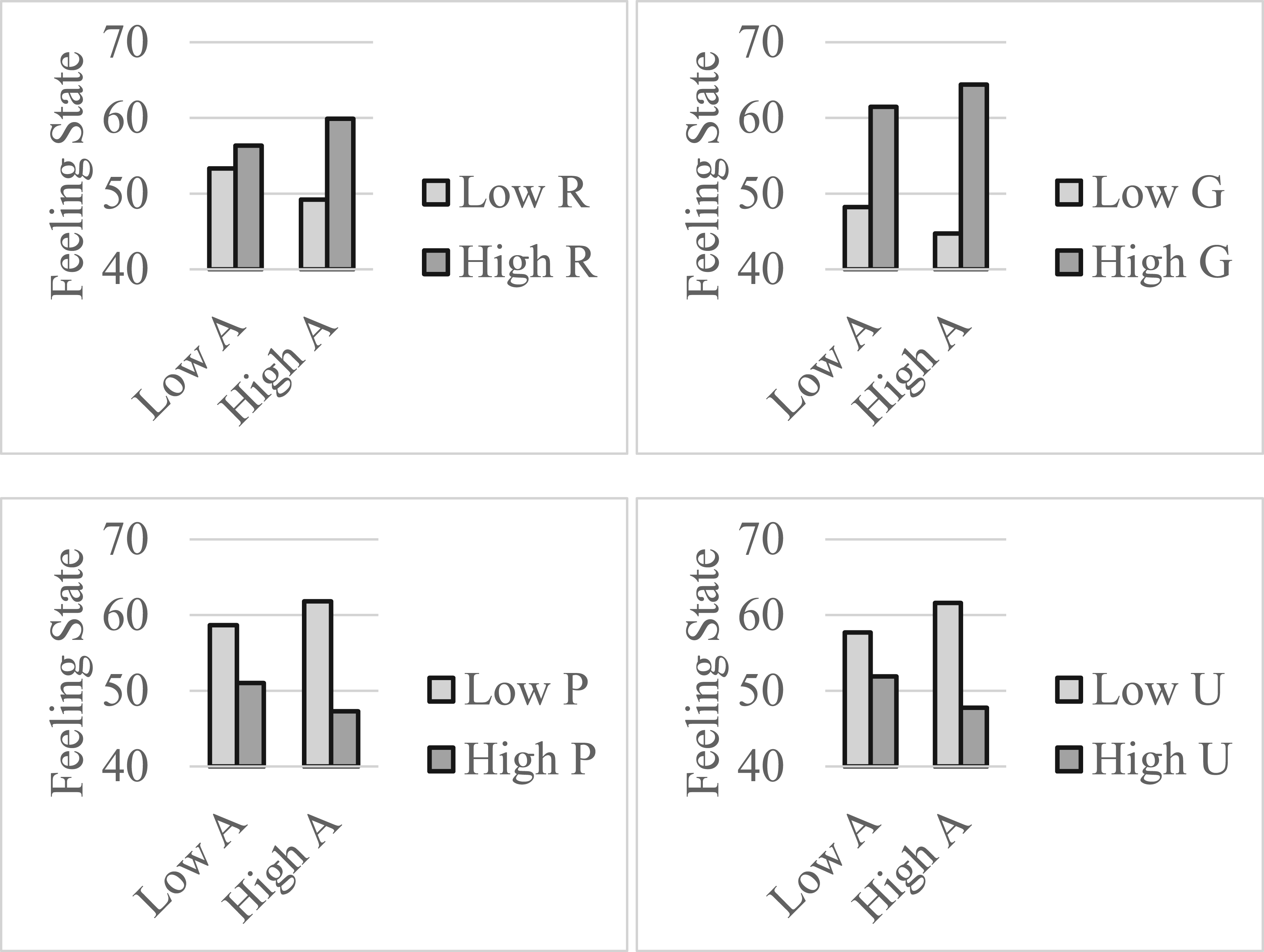
Recruitment and General Procedures
Undergraduate students taking psychology classes were eligible to sign up for a “personality and emotion” study using SONA software. After signing up, participants showed up to a psychology laboratory in groups of 6 or fewer. After receiving general instructions and signing consent forms, participants were assigned to individual computer rooms in which they completed the tasks described below. The individual computer rooms are uniform (4 feet by 6 feet, painted light brown, medium lighting) and plain (e.g., no windows, no decorations). Each room had a chair, a computer shelf, a monitor on the computer shelf, and a hard drive on the floor. Thus, conditions for the study were standardized and bereft of distraction.
One month of running time resulted in a sample size of 180 (55.00% female; 81.67% White; M age = 19.09), with 2 other individuals failing to complete the study. Thoughts and feelings were assessed in a stream of consciousness paradigm, following which individuals completed emotional awareness measures.
Emotional Awareness Assessment
Individuals are thought to differ in the extent to which they attend to their feelings and in the extent to which they judge their feelings to be clear (Boden & Thompson, 2017). These components of emotional awareness were assessed with the relevant subscales of the Trait Meta-Mood Scale (TMMS: Salovey et al., 1995), which has been validated in many studies (Boden & Thompson, 2017; Fernández-Berrocal & Extremera, 2008). In a MediaLab program, participants were asked whether they agreed or disagreed (1 = strongly disagree; 5 = strongly agree) with 13 statements assessing attention to emotion (e.g., “feelings give direction to life”, “I often think about my feelings”) and 11 statements assessing emotional clarity (e.g., “I am rarely confused about how I feel”). Individual difference scores were computed by averaging across items (attention to emotion: M = 3.79; SD = .54; α = .78; emotional clarity: M = 3.11; SD = .69; α = .82), with attention and clarity correlating at .17 [.03, .31], p = .019. For follow-up purposes, residual attention and clarity scores were also computed.
Thoughts, Feelings, and Their Connection
A PsychoPy program was created to assess variations in thought content and feeling across time. Thought content has been estimated to shift at least 4.3 times a minute (Mildner & Tamir, 2019) and core affective state (e.g., feelings of pleasure or displeasure) is thought to change at a similar rate (Russell, 2005). Thus, repeatedly sampling thoughts and feelings, during a 15-min interval, was deemed a useful way of characterizing dynamic operations related to the stream of consciousness.
Participants were told that we were interested in shifts in thoughts and feelings across time. They were also told that they would often be doing nothing during the study, aside from having thoughts and feelings and monitoring these occurrences so that they could be reported on. During blank intervals, participants were asked to let their minds move freely and naturally, centering on certain topics (e.g., classes, family) or shifting from topic to topic if that is what their minds wanted to do. After each blank interval, participants would report on what they were thinking about and feeling during a particular interval.
The experiment consisted of 12 blank intervals, 4 of which were 30 seconds long, 4 of which were 45 seconds, and 4 of which were 60 seconds. Durations were randomly assigned to trial number such that the duration of each interval could not be predicted and thought flow would be facilitated. During blank intervals, light gray text on a black screen indicated that “This is the “do nothing” interval. Just monitor your thoughts and feelings”. Following each blank interval, we asked participants to answer a series of 8 questions, 5 of which are pertinent to hypotheses (other questions asked about thoughts concerning the self, goals, and perceptions of mind-wandering).
Questions, which were presented in a yellow font color, were randomly ordered at the trial level. Thoughts pertaining to RELATIONSHIPS (“During the last blank interval, to what extent were you thinking about your relationships (including friends and family)?”) and GOOD THINGS in life (“…to what extent were you thinking about good things in your life?”) were expected to result in pleasant affective states and thoughts pertaining to PROBLEMS (“…to what extent were you thinking about problems in your life?”) and UNCERTAINTIES (“…to what extent were you thinking about uncertainties in your life?”) were expected to result in unpleasant affective states. These thought content questions were answered by clicking a position along a 101-point slider that was anchored by “0% of the time” to the left and “100% of the time” to the right. At the trial level, averages tended to hover around 40%, with a considerable degree of variation around this central tendency (RELATIONSHIPS: M = 43.23; SD = 35.83; GOOD THINGS: M = 42.18; SD = 31.97; PROBLEMS: M = 37.74; SD = 32.60; UNCERTAINTIES: M = 36.46; SD = 32.25).
Participants also reported on how pleasant their feelings had been during each blank interval (“During the last blank interval, to what extent were your feelings pleasant or unpleasant?”). A 101-point slider was also used for this question and this slider was anchored by “very unpleasant” to the left and “very pleasant” to the right. On the average trial, feeling states were relatively neutral, but feeling states also varied considerably across trials (M = 54.71; SD = 24.45). Thus, both thoughts and feelings varied in a dynamic manner.
Analysis Strategy
Multilevel models (trials nested in participants) were used to examine questions concerning thought-feeling relationships, main effects for the emotional awareness traits, and potential cross-level interactions (Nezlek, 2007). A first set of models focused on the question of whether feeling states responded to changes in thought content (level 1 models). A second set of analyses examined whether the emotional awareness variables (attention and clarity) predicted averages, or intercepts, for the thought and feeling measures (level 2 models). Of critical importance, we then examined whether within-subject slopes linking thoughts to feelings varied as a function of emotional awareness (cross-level models).
Results
Were Thoughts Linked to Feelings?
A stream of consciousness will almost necessarily vary in what it thinks about (Mildner & Tamir, 2019). A foundational question was whether changes in thought topics (e.g., thinking about relationships to a greater extent during a particular trial) would be linked to changes in feeling state. To speak to this question, we performed within-subject, or level 1, multilevel models (MLMs) using SAS PROC MIXED (Singer, 1998), with changes in a thought category predicting changes in feeling state. Thought categories were person z-scored (Irvin et al., 2023) and intercepts and slopes were allowed to vary at random (Heisig & Schaeffer, 2019). The feeling state outcome retained its original units, but a second set of models were performed on a z-scored feeling state variable, resulting in a standardized b that can be considered a measure of effect size (Lorah, 2018). To further understand effect sizes, we will report estimated means (+/− 1 SD with respect to analysis predictors: Aiken & West, 1991), even for non-significant results.
When participants thought about relationships more frequently, their feelings were more pleasant, b = 3.419 [2.284, 4.553], t = 5.91, p < .001, standardized b = .140 (−1 SD: 51.31; +1 SD: 58.08). Similarly, when individuals thought about good things in their lives more frequently, they felt better, b = 8.220 [6.996, 9.443], t = 13.18, p < .001, standardized b = .338 (−1 SD: 46.58; +1 SD: 62.81). By contrast, thinking about problems in life, b = −5.538 [-6.953, −4.123], t = −7.68, p < .001, standardized b = −.227 (−1 SD: 60.21; +1 SD: 49.18), as well as uncertainties, b = −4.881 [-6.215, −3.546], t = −7.17, p < .001, standardized b = −.200 (−1 SD: 59.59; +1 SD: 49.88), was linked to comparatively unpleasant feeling states. Normatively, and in the context of a sensitive design, thoughts and feelings were systematically related to each other.
Were There Main Effects Related to Emotional Awareness?
Covariance parameter estimates indicated that intercepts for the thought and feeling variables differed across participants, ps < .001, justifying level 2 analyses. On the basis of prior results, one might expect higher levels of emotional clarity, but not attention to emotion, to be linked to average feeling states that are more pleasant (Gohm & Clore, 2002). Whether the pertinent individual differences matter for thought content is unknown. To speak to potential relationships of this type, we performed level 2 multilevel models, also using SAS PROC MIXED (Singer, 1998). For these analyses, emotional awareness predictors were z-scored and intercepts were allowed to vary at random.
Potential Main Effects Involving Emotional Awareness Predictors
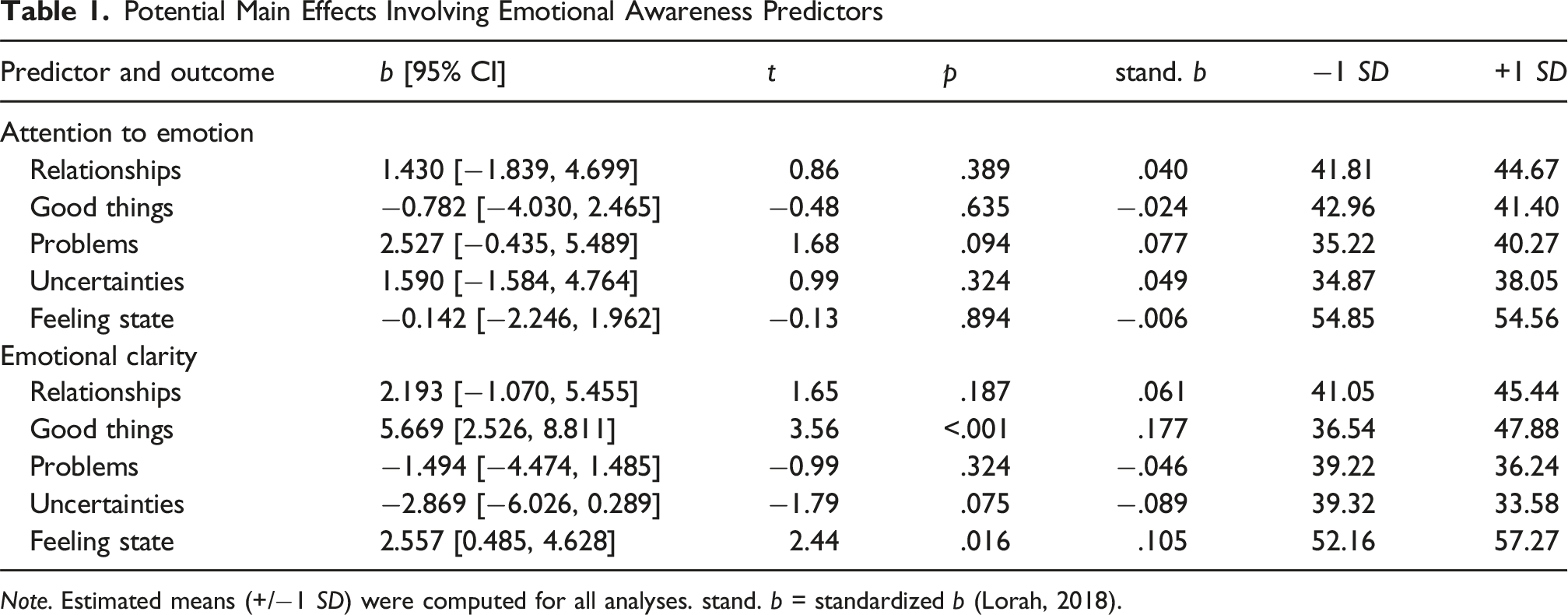
Note. Estimated means (+/−1 SD) were computed for all analyses. stand. b = standardized b (Lorah, 2018).
Did Thought-Feeling Relationships Vary by Emotional Awareness?
Thought-Feeling Relationships as a Function of Emotional Awareness (Cross-Level Models)

As displayed in Table 2, all thought-feeling relationships varied by attention to emotion, as indicated by significant cross-level interactions. For example, the positive slope linking relationship thoughts to pleasant feelings became more positive at higher levels of attention to emotion. This conclusion was reinforced with simple slope analyses (also displayed in Table 2), which resulted in standardized bs of .062 and .219 at low (−1 SD) versus high (+1 SD) levels of the attention predictor. The other attention to emotion interactions, which were all significant, exhibited a parallel form. For example, the negative slope linking problems to unpleasant feelings became more negative at higher levels of attention to emotion, with simple slopes analyses producing standardized bs of −.157 and −.298 at low versus high levels of the attention to emotion continuum.
Estimated means (+/−1 SD) for the attention-related cross-level interactions are displayed in Figure 1. In each case (relationships: top left panel; good things: top right panel; problems: bottom left panel; uncertainties: bottom right panel), the connection between variations in thought frequencies (across trials) and feeling states was stronger at higher levels of attention to emotion (right bars within a figure) than at lower levels of attention to emotion (left bars within a figure). For example, estimated feeling state means were 49.22 and 59.90 when high attention individuals did versus did not think about relationships. The comparable figures were 53.34 and 56.35 among low attention individuals.
As indicated in Table 2 and Figure 2, cross-level interactions involving emotional clarity were inconsistent. This point can be bolstered by re-running the cross-level analyses with residual attention and clarity scores. Interactions with residual attention scores were found with respect to thoughts about relationships, p = .003, standardized b = .129, good things, p = .020, standardized b = .112, problems, p = .023, standardized b = −.126, and uncertainties, p = .003, standardized b = −.157. By comparison, interactions with residual clarity scores were found with respect to thoughts about relationships, p = .023, standardized b = .079, but not good things, p = .166, standardized b = .052, problems, p = .603, standardized b = −.023, or uncertainties, p = .733, standardized b = .014. The processes involved in attention to emotion are therefore distinct from those involved in emotional clarity. Estimated means for cross-level interactions involving emotional clarity: relationships (Top Left Panel), good things (Top Right Panel), problems (Bottom Left Panel), and uncertainties (Bottom Right Panel)
Discussion
We conducted one adequately powered experiment to examine several questions concerning thoughts, feelings, and the thought-feeling relationship. When given no concurrent task to perform, people thought about their relationships, the good things in their lives, the problems in their lives, and uncertainties with a moderate degree of frequency. The mind tended to favor the positive topics relative to the negative ones, but such differences were slight. Consistent with an emergent perspective suggesting that the hedonic consequences of mind-wandering are likely to vary in accordance with topics that are thought about (Nyklíček et al., 2021; Smallwood & Andrews-Hanna, 2013; Welz et al., 2018), thoughts pertaining to relationships and good things in life gave rise to feeling states that were more pleasant and thoughts pertaining to problems and uncertainties gave rise to feeling states that were less pleasant. Of particular theoretical importance, and as will be discussed below, these thought-feeling relationships were moderated by attention to emotion such that all thought categories influenced feeling states to a greater extent at higher levels of attention to emotion.
Implications, Limitations, and Future Directions
Mind-wandering is typically examined under conditions in which individuals are asked to perform a cognitive task (e.g., a sustained attention task) and mind-wandering under such conditions may often reflect deficits in executive control (McVay & Kane, 2010). An innovation of the current method, we think, is that participants were given no task to perform aside from monitoring their thoughts and feelings. Such conditions should encourage mind-wandering and they may better capture spontaneous forms of thought that are not “off-task” in any shape or form. There is increased interest in such forms of mind-wandering, which may be more purposeful (Irving, 2016), intentional (Seli et al., 2016), and freely moving (Mills et al., 2018) than would be the case if mind-wandering was pitted against another task to perform. Indeed, the conditions of the current study would seem well-suited to investigate what the mind naturally does when nothing much is happening.
Other innovations included the following. We focused squarely on thought content rather than other dimensions of mind-wandering such as its temporal focus. We sampled thought content frequently, with the supposition that thought content would vary across time in a manner consistent with the stream of consciousness construct (Singer, 1975). And we assessed feeling states in terms of the core affect dimension of pleasantness, given that variations in core affect, relative to mood states or emotions, are thought to flux and flow in a nearly continuous manner (Russell, 2005). Such innovations provided a unique platform for understanding whether variations in thought content are reflected in variations in feeling. The results of the study suggested that thought streams and feeling streams, for the average person, do not flow independently of each other, but cannot be viewed as the same stream either. Rather, there are points of contact between the streams that allows them to influence each other, for some people more than others.
Thoughts and feelings are informative in different ways. Thoughts have content and specificity to them (Ickes & Cheng, 2011), often simulating events, conditions of the world, or actions that one might perform (Barsalou, 2008). Feelings have much less specificity to them (Russell, 2005), but they inform the individual that something of value – that is, something that matters to the self – is at stake (Clore & Tamir, 2002). When thoughts are paired with feelings, they become more powerful in motivating the individual to do something that could change the relationship between the self and its environment (Furtak, 2018). Viewed from this perspective, allowing thoughts and feelings to speak to each other should give thoughts some motivational power that they might otherwise lack (Furtak, 2018). Attending to and valuing feelings, which defines an individual difference dimension termed attention to emotion (Boden & Thompson, 2017; Salovey et al., 1995), is likely to render feelings more sensitive to a wide variety of influences, thoughts included. We were able to provide novel evidence for these ideas, in that thought-feeling relationships were stronger at higher levels of attention to emotion. For the most part, such moderating effects did not occur as a function of emotional clarity, which was, instead, linked to main effects for one thought category (good things in life) and feeling states that tended to be more pleasant.
When feelings react to thoughts of both positive (e.g., thoughts about relationships) and negative (e.g., thoughts about problems in life) types, well-being will not necessarily be increased because well-being can be defined in terms of the net difference between pleasant and unpleasant feelings (Larsen & Diener, 1987). Along these lines, attention to emotion was not predictive of average levels of pleasantness during the stream of consciousness task. But, high attention individuals had feelings that were more attuned to current thoughts. Because high attention individuals also appear to react more strongly to both appetitive and aversive external events (Robinson et al., 2021), attention to emotion appears to promote emotional flexibility, defined in terms of feeling states that quickly vary in accordance with the valence of current conditions (Beshai et al., 2018; Waugh et al., 2011). Emotional flexibility, in turn, is thought to promote psychological flexibility (Beshai et al., 2018), which is marked by context-appropriate reactions and behavioral choices that more fully reflect one’s values (Kashdan & Rottenberg, 2010). Thus, at least one important theory of mental health contends that emotional reactivity is functional when it is context-appropriate and linked to decision-making choices.
Feelings are often linked to apt behavioral choices, as research on patients with damage to the ventromedial prefrontal cortex makes clear (Naqvi et al., 2006). On this point, Epstein (2003) suggests that the experiential system (that linked to feelings) encourages people to pursue courses of action that will be health-promoting while discouraging them from pursuing courses of action that will be dangerous or harmful (also see Nesse & Ellsworth, 2009; Watson, 2000). Robinson et al. (2021) provided support for such theorizing by showing that stronger feelings were linked to behavioral choices that would render it more likely that one’s future self would experience a greater proportion of positive to negative events. In other words, feelings seem to govern approach-avoidance processes that are, on average, beneficial to the individual (Elliot, 2006; Epstein, 2003). Rogers (1963) similarly suggested that when feelings are well-attuned to current conditions, the person would spontaneously act in ways that are health-promoting. In summary, the attention to emotion construct seems to align itself with the psychological flexibility construct (Harris, 2006; Hayes, 2002), such that further research concerning this attention-flexibility interface can be recommended.
Speaking to future directions, personality is conceptualized in terms of individual differences in thoughts, feelings, and behaviors (Bleidorn et al., 2019), but it is arguable that we know considerably more about how personality variables relate to feelings and behaviors relative to thoughts (Smillie, 2013). This is unfortunate because feelings and behaviors are likely to follow from thoughts under many circumstances (Cantor, 1990), as documented by literatures focused on appraisal-emotion relationships (Moors et al., 2013) and the functions of conscious thought (Baumeister et al., 2011). Singer (1993) advocated for research on the “private” features of personality, as reflected in spontaneous thoughts, daydreams, and mental simulations of the future (also see Klinger, 2013; McClelland, 1980) and, with the emergence of mind-wandering as a serious topic of study in cognitive science (Callard et al., 2013), it would seem timely to conduct more research on the personality-thought interface.
In the spirit of encouraging further research on the personality-thought interface, we note that preliminary results from our lab have linked the Big Five personality trait of agreeableness to the frequency with which individuals spontaneously think about their relationships. Preliminary results have also linked the Big Five trait of neuroticism to the frequency with which individuals spontaneously think about problems in their lives and uncertainties, suggesting operations of an avoidance motivation system even in the absence of concurrent negative events to react to (Klein & Robinson, 2019). Additional studies of this type might be capable of defining each of the Big Five trait dimensions, and possibly other trait-related dimensions (e.g., self-esteem), in terms of corresponding dimensions of spontaneous thought. Such “mind maps” could then be explored for their potential value in understanding intervention effects or personality change processes (Bleidorn et al., 2019). As an example, Barlow and colleagues (e.g., Ametaj et al., 2015) have suggested that mental health interventions might profitably attempt to reduce trait-related variations in neuroticism rather than alleviating particular symptoms, with the premise that reductions of this type are likely to have far-ranging consequences (Lahey, 2009). Such interventions could be paired with assessments of the present type, with the prediction that successful interventions should reduce spontaneous thoughts related to problems and uncertainties (Carleton, 2016).
Considerations related to sample should be discussed. In the United States, where the research took place, approximately 70% of high school graduates enter tertiary education systems (e.g., college) and the university at which the research took place admits approximately 95% of applicants. The sample is therefore not a highly selective one, particularly given that the participant pool draws from General Education classes, with General Education requirements pertinent to all students at the university. Nonetheless, and as Arnett (2016) points out, many high school graduates, and especially those from lower SES backgrounds, attend two-year colleges rather than four-year colleges or universities. Ultimately, then, the present sample is only somewhat representative of the larger population of emerging adults (i.e., 18–29 years old: Arnett, 2016).
Given the nature of the current sample, it would be valuable to explore whether similar results could be found among older individuals. An important line of theorizing suggests that younger and older adults have different priorities, with younger adults tending to focus on instrumental goals and older adults focusing to a greater extent on social and emotional goals (Carstensen, 2021). In support of Socioemotional Selectivity Theory (Carstensen, 2021), some studies have found that older individuals either prioritize positive stimuli and experiences and/or disattend to negative stimuli or experiences (for a review, see Ready et al., 2006). Such motivation-related processes could, quite reasonably, be linked to age differences in spontaneous thought frequencies and/or their impact on emotional states. A study of the present type that compares older to younger adults would thus be an excellent direction for future research.
As a final discussion piece, we suggest that people are often sitting in rooms having thoughts. From this perspective, our laboratory setting is quite representative of much of waking life (e.g., when sitting in one’s home). Of course, people are typically not in laboratory settings and sampling thoughts and feelings in non-laboratory contexts is valuable as well (Conner et al., 2009). Linz et al. (2021) found that there was a good degree of correspondence between what people thought about in laboratory and non-laboratory contexts, but mind-wandering processes can sometimes be different across contexts (Kane et al., 2017). Even so, we consider our laboratory setting to be a valuable one in capturing spontaneous thoughts in a controlled manner, which may not be possible in non-laboratory experience-sampling protocols (Kuppens et al., 2022).
Conclusions
A new stream of consciousness paradigm was created to examine whether thoughts and feelings converge, diverge, or operate independently. When feelings are defined in terms of the core affect dimension of pleasantness, they are responsive to thought content, but more so for some individuals than others. Thought-feeling convergence is higher among individuals who attend to their feelings and concordance of this type is likely to support both emotional and psychological flexibility.
Footnotes
Author Note
Dr. Cristian Zanon was the handling editor.
Acknowledgements
Not applicable.

Author Contributions
Michael D. Robinson: Conceptualization; Investigation; Methodology; Project administration; Supervision; and Writing – original draft
Hamidreza Fereidouni: Data curation; Formal analysis; Project administration; and Writing – review & editing
Muhammad R. Asad: Data curation; Methodology; Software; and Writing – review & editing
Roberta L. Irvin: Data curation; Formal analysis; Investigation; Software; and Writing – review & editing.
Funding
The authors disclosed receipt of the following financial support for the research, authorship, and/or publication of this article: Dr. Irvin was supported by the Boston University Rheumatology Research Training (BURRT) T32 Program [NIH T32 AR080623].
Declaration of Conflicting Interests
The authors declared no potential conflicts of interest with respect to the research, authorship, and/or publication of this article.
Data Availability Statement
The data and materials for this manuscript are accessible at: https://osf.io/k9tyj/?view_only=f07b0751089f4befbfcb7e55f04feb7e (Authors, 2026).