



Abstract
Impulsivity influences behavioral tendencies and can contribute to dysfunction both in everyday life and in psychopathology. A common measure of impulsivity is the Barratt Impulsiveness Scale (BIS), a widely-used self-report questionnaire currently in its 11th version (BIS-11). In this validation study, we integrated several German translations into a unified version and evaluated its factor structure as well as its construct and criterion validity. The original factor structure of motor, attentional and non-planning impulsivity was not supported in our data, as factor analyses yielded poor model fit. Nonetheless, the validity of the BIS-11 sum score was supported by associations with other impulsivity-related questionnaires (UPPS Impulsive Behavior Scale, Brief Self-Control Scale) and differentiation from unrelated constructs (UPPS sensation seeking, trait anxiety). We found no links between BIS-11 scores and behavioral performance in response inhibition and automaticity tasks. Crucially, higher BIS-11 scores predicted participants’ dependability, as indexed by missed study appointments, thus linking the questionnaire to everyday behavior. In sum, although we could not reliably detect the BIS-11’s factor structure in our data, our findings support its use as a valid overall measure of impulsivity that relates meaningfully to everyday functioning.
Introduction
The concept of impulsivity and its associations to human behavior is a topic of interest both in psychological research and outside the research community. One widely accepted definition describes impulsivity as a “predisposition toward rapid, unplanned actions to internal or external stimuli without regard to the negative consequences of these actions to the impulsive individual or to others” (Moeller et al., 2001). As this definition highlights, impulsivity is linked to decision-making, and has been associated to potentially harmful behaviors such as aggression, delinquency, substance use, gambling, risky sexual behavior, as well as excessive shopping and eating (Huang et al., 2024; Sharma et al., 2014). Impulsivity has been shown to predict psychopathology (Fields et al., 2021; Friedman et al., 2019) and suicidality (Moore et al., 2022), influence the course of substance use disorders (Kozak et al., 2019; Kräplin et al., 2020), and is a key characteristic of various mental disorders, including borderline personality disorder (American Psychiatric Association, 2013).
Despite the widespread use of impulsivity as a construct, there is significant disagreement about what precisely impulsivity entails. Which components of impulsivity are examined differs greatly depending on how it is operationalized, e.g., the specific task or questionnaire. Common self-report scales capture different combinations of impulsivity domains, including cognitive factors, inhibition, risk-taking and affective responses (Carver & White, 1994; Lynam et al., 2006; Patton et al., 1995). The Barratt Impulsiveness Scale (BIS) was originally developed to distinguish impulsivity from anxiety (Barratt, 1959), as well as from impulsivity-related constructs such as sensation seeking, extraversion, and risk tolerance (Barratt, 1985). The current version (BIS-11; Patton et al., 1995) consists of 30 items, with a principal component analysis on data from 733 participants identifying three higher-order factors: attentional impulsiveness (i.e., difficulty to focus on a given task), motor impulsiveness (i.e., acting without forethought) and non-planning impulsiveness (i.e., lack of forward planning). However, while the BIS-11 is frequently used to assess impulsivity, researchers often rely on the good psychometric properties of the BIS-11 sum score (Stanford et al., 2009), as its factor structure has been criticized (Reise et al., 2013; Steinberg et al., 2013; Vasconcelos et al., 2012).
Our study aimed to validate a German version of the BIS-11, developed by our research group, that unified several existing German translations, across several general population samples. We investigated whether our questionnaire reflects the factor structure proposed by Patton (attentional, motor and non-planning impulsivity; Patton et al., 1995) using exploratory and confirmatory factor analysis. Subsequently, to establish construct validity, we compared the BIS-11 with another well-established impulsivity questionnaire, the UPPS (Whiteside et al., 2005), which distinguishes between four dimensions of impulsivity. We assumed positive correlations between the BIS-11 sum score and the subscales urgency, lack of premeditation and lack of perseverance. As the BIS-11 was developed to be distinct from sensation seeking, we expected no association with the UPPS subscale sensation seeking. Additionally, we tested the association to trait self-control, which describes the ability to resist immediate impulses and refrain from initially appealing but undesired behavior (Tangney et al., 2004). Given that impulsivity and trait self-control are negatively correlated and often considered opposing constructs (Duckworth & Kern, 2011; Evenden, 1999), we expected a negative association between the BIS-11 and the Brief Self-Control Scale (Tangney et al., 2004). Furthermore, as early versions of the BIS aimed to distinguish impulsivity and anxiety, we used the trait scale of the State-Trait Inventory for Cognitive and Somatic Anxiety (Ree et al., 2008) to test the BIS-11’s discriminant validity against anxiety. Another common approach in investigating self-reported impulsivity is through behavioral paradigms, often assessing inhibitory control. These investigations mostly focus on response inhibition, i.e., withholding a prepotent response (Stevens et al., 2007) or automaticity, i.e., acting with reduced intent due to learned stimulus-response contingencies (Flaudias & Llorca, 2014). However, findings on the association between laboratory tasks, especially regarding response inhibition, and self-reported impulsivity have been inconsistent (Aichert et al., 2012; Bernoster et al., 2019; Perales et al., 2009; Sach et al., 2018; Torres et al., 2013; Weidacker et al., 2015), and some researchers suggest a dissociation between the two (Cyders & Coskunpinar, 2011; Sharma et al., 2014). We examined the link between the BIS-11 and performance in a Go/Nogo, a Stop-Signal and a Stroop task, expecting a negative association between BIS-11 scores and behavioral task performance. Based on their conceptual overlap, we investigated potential links between behavioral performance and the motor impulsivity scale as well as the BIS-11 sum score.
A crucial aspect of questionnaire evaluation is criterion validity, which assesses whether the measure corresponds with external criteria beyond the test situation (Piedmont, 2014). Based on the associations between impulsivity, psychopathology, and delinquency, the BIS is often validated in patient or delinquent populations (Stanford et al., 2009; Steinberg et al., 2013), while studies in the general population are scarce. As a result, criterion validity based on clinical status or aggressive behavior may not be easily transferable. Here, we propose using missed appointments to participate in a study as a practical, daily-life measure of impulsivity. Short-notice cancellation or failure to attend appointments has previously been linked to impulsivity (Müller et al., 2021) and likely reflects bad planning or choosing a more appealing alternative while ignoring potential negative consequences. In a novel approach, we assessed criterion validity via the association between BIS-11 scores and the number of appointments missed due to cancellation or no-show (except for illness-related reasons).
Methods
Participants
Sample Characteristics

Note. Mental disorder: number of participants reporting a lifetime or acute diagnosis of a mental disorder other than the respective exclusion criteria.
Procedure
We used data from three different samples to validate our version of the BIS-11. All self-report questionnaires were completed via the online platform LimeSurvey (LimeSurvey GmbH, n.d.).
Sample 1
An exploratory factor analysis of the BIS-11 was conducted using data from Sample 1, collected online as part of a validation study for the German adaptation of the Creature of Habit Scale (Ersche et al., 2017; Overmeyer et al., 2020).
Sample 2
We used data from Sample 2 to conduct a confirmatory factor analysis and investigate the associations between the BIS-11, other self-report questionnaires, and behavioral response inhibition and automaticity tasks. Participants took part in a research project on cognitive control functions related to impulsivity and compulsivity (https://osf.io/ywnze/). During the first lab session, they completed a computerized neuropsychological test battery (Wolff, Krönke, & Goschke, 2016; Wolff, Krönke, Venz, et al., 2016) via Matlab 2010a (The MathWorks Inc, 2010). The test battery contained nine executive functioning tasks, including a Stroop task assessing automaticity. In a second laboratory session, participants then underwent electroencephalographic (EEG) assessment of cognitive control. We used the behavioral performance from a Go/Nogo and a Stop-signal task as indices of response inhibition. All EEG tasks were presented via Presentation® software (version 19.0, Neurobehavioral Systems, Inc., Berkeley, CA, www.neurobs.com).
Sample 3
In Sample 3, we investigated the association between BIS-11 scores and missed study appointments. Data originates from a project investigating cognitive control functions, impulsivity and compulsivity (https://osf.io/bjpc8/). Participation consisted of a lab session including an EEG task battery and self-report questionnaires.
Measures
BIS-11
As outlined above, the BIS-11 captures impulsivity through its attentional, motor and non-planning components. These subscales are composed of 30 self-report items measuring impulsive behavior on a rating scale ranging from 1 (“almost never”) to 4 (“almost always”).
The BIS-11 has been translated into German several times, making it difficult to compare the different versions. Besides the official translation of the BIS-11 by Preuss et al. (2008), unpublished versions have been created by different research groups. Hartmann et al. (2011) published a version of the BIS-11 to be used for adolescents (translated from Italian; Fossati et al., 2002). Further, the BIS-15 constitutes a short (15 items) version of the questionnaire (Meule et al., 2011). Using mainly a subset of the German items from Preuss et al., Meule et al. could confirm the three-factor structure of the BIS-15 as proposed by Spinelli (2004). The version of the BIS-11 used in this paper was developed by native German speakers and combined questions from these previous German translations and new translations of specific items from the original English BIS-11 (Patton et al., 1995). The final version is provided in Supplement 2.
Additional Questionnaires
UPPS Impulsive Behavior Scale
Internal Consistency of the BIS-11 and Additional Questionnaires

Note. α = Cronbach’s alpha, ω = McDonald’s omega. Sum score = BIS-11 sum score. Non-planning = non-planning impulsiveness subscale, motor = motor impulsiveness subscale, attentional = attentional impulsiveness subscale. UPPS = UPPS Impulsive Behavior Scale. BSCS = Brief Self-Control Scale sum score. STICSA trait = State-Trait Inventory for Cognitive and Somatic Anxiety trait subscale score.
Brief Self Control Scale
Trait self-control was assessed using the Brief Self Control Scale (Bertrams & Dickhäuser, 2009; Tangney et al., 2004), a 13-item self-report measure in which participants rate the extent to which various behavioral tendencies apply to them on a 5-point scale (1: “completely inaccurate” to 5: “completely accurate”). The Brief Self Control Scale showed good internal reliability (Cronbach’s alpha = .81 and McDonald’s omega = .84) in our data.
State-Trait Inventory for Cognitive and Somatic Anxiety
The State-Trait Inventory for Cognitive and Somatic Anxiety (STICSA; Overmeyer & Endrass, 2023; Ree et al., 2008) is a self-report measure that distinguishes cognitive and somatic symptoms of anxiety. The 42 items, with responses ranging from 1 to 4, are divided into state and trait scales, both with strong reliability. For our analyses, we employed the trait scale, which assesses the frequency of anxiety symptoms experienced by individuals and showed good internal reliability in our sample (Cronbach’s alpha = .85 and McDonald’s omega = .87).
Behavioral Paradigms
We examined the relationship between participants’ impulsivity as indexed by BIS-11 scores and their performance in tasks assessing automatic behavior (Counting-Stroop task) and response inhibition (Go/Nogo and Stop-Signal tasks).
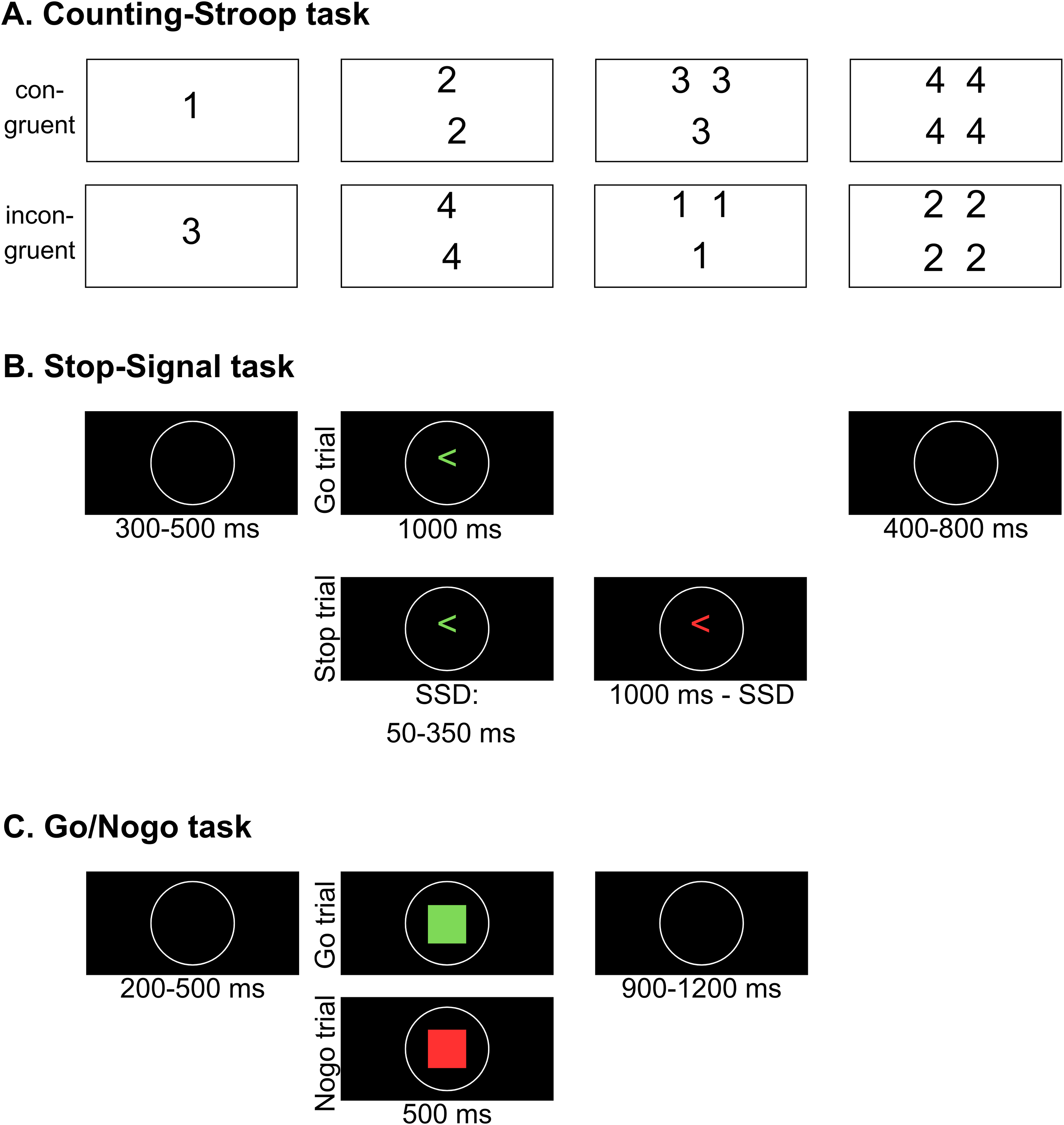
Counting-Stroop Task
In Stroop tasks, participants are required to respond to one stimulus modality while ignoring another more salient modality that typically elicits a more automatic response (Stroop, 1935). We used a modified version of the task based on Bush et al. (1998). On each trial, participants viewed a stimulus consisting of one to four identical digits (1-4). The digit count and identity were either congruent (1, 22, 333, 4444) or incongruent (111, 2222, 3, 44). Participants were instructed to report the number of digits via key press, ignoring the identity of the digits. The task comprised of 160 trials (50% congruent), where one of eight possible stimulus sets (see Figure 1(A)) was shown for 1,000 ms, followed by an inter-trial-interval with a fixation cross for 750 ms. To assess task performance, we determined the individual inverse efficiency scores (IES; Townsend & Ashby, 1978) for congruent vs. incongruent trials, which integrates response speed (mean reaction time for correct trials; RT) and accuracy (proportion of correct responses): Behavioral tasks. Note. (A) Stimulus sets for the Counting-Stroop task, with congruent (top) and incongruent (bottom) stimuli. (B) Exemplary trials of the Stop-Signal task. Participants were instructed to respond to the Go stimulus (green arrow, second column) but stop their initiated response if it is followed by a Stop stimulus (red arrow, third column in the bottom row). (C) Exemplary trials of the Go/Nogo task. Participants were instructed to respond to the Go stimulus (green square, second column in the top row), but withhold their response to the Nogo stimulus (red square, bottom row)
Higher DeltaIES scores indicate increased behavioral automaticity, reflecting reduced inhibitory control.
Stop-Signal Task
The Stop-Signal-Task (Aron & Poldrack, 2006; Logan, 1994) measures the ability to stop an already initiated response. Participants were instructed to respond as fast as possible to the Go stimulus (a green arrow pointing left or right) by pressing the corresponding key. In 25 % of the trials the arrow turned red shortly after onset, signaling participants to withhold their response (Stop signal; see Figure 1(B)). Initial Stop signal delays (SSD; 100, 150, 200 and 250 ms) were evenly distributed across trials and dynamically adjusted in 50 ms steps based on performance: shortened after successful and lengthened after failed inhibition, targeting a stopping success rate of around 50%. The task continued until participants completed two blocks with a stopping performance between 40% and 60% (valid blocks) or a maximum of four blocks. Each block consisted of 128 trials, with an inter-trial-interval of 400-800 ms. Only valid task blocks were included in the analyses. Participants were excluded if they did not complete at least two valid blocks (n = 5) or due to task recording issues (n = 3), resulting in a final sample of N = 244 participants. Task performance was conceptualized as a race between Go and Stop processes, with the outcome measured by Stop signal reaction time (SSRT). SSRT was calculated by subtracting the mean SSD from the mean reaction time in Go trials (Verbruggen & Logan, 2009). Higher SSRT scores reflect slower and thus poorer response inhibition.
Go/Nogo Task
In the Go/Nogo task (Enriquez-Geppert et al., 2010) participants were instructed to respond as fast and as accurately as possible to a Go stimulus (a green square) and withhold their response to a Nogo stimulus (a red square; see Figure 1(C)). Both stimuli were presented inside a white circle on a black background for up to 500 ms, followed by a variable inter-stimulus interval of 900-1,200 ms (jittered randomly in 50 ms; M = 1,050 ms). The task consisted of 192 Go (75%) and 64 Nogo trials (25%). Data was analyzed from N = 250 participants (after participant exclusion due to poor task compliance [multiple responses; n = 1] and task recording issues [n = 1]. Task performance was assessed with participants’ RT in Go trials and the percentage of correct responses in Nogo trials (Nogo accuracy).
Missed Study Appointments
Missed study appointment were used to assess criterion validity by linking participants’ BIS-11 scores to their everyday behavior and (un-)dependability. In Sample 3, we documented cancellations of appointments and no-shows to partake in a neurocognitive study at the lab, which included financial compensation. Data includes participants who then rescheduled their appointment and eventually completed the study. We distinguished between illness-related and non-illness-related reasons; Only non-illness-related cancellations and no-shows were included in our analyses, resulting in a binary variable (missed appointment = 1; no missed appointment = 0). This applied to ten participants who missed a study appointment at the lab for non-illness-related reasons.
Data Analysis
All analyses were carried out in R, version 4.4.3 (R Core Team, 2023). We first assessed the internal reliability of the BIS-11 using McDonald’s omega (McDonald, 2013) and Cronbach’s alpha (Cronbach, 1951) and conducted an item analysis in Sample 1 using the R packages psych (version 2.4.12) and sjPlot (version 2.8.17; Lüdecke, 2024; Revelle, 2024). Outliers were identified in all samples but retained to preserve analytical power. To explore the dimensionality of the BIS-11, we performed exploratory factor analysis (EFA) with oblique rotation (Promax) and Maximum-Likelihood-Estimation on the data from Sample 1, again using psych (Revelle, 2024). Due to the non-normality of the data, as indicated by Mardia’s test (Mardia, 1970) in MVN (version 5.9; Korkmaz et al., 2014), we used a polychoric correlation matrix (Holgado–Tello et al., 2010). The number of factors or components was determined with minimum average partial procedure, parallel analysis for component extraction, optimal coordinates, acceleration factor (nFactors version 2.4.4.1; Raiche & Magis, 2010) and comparison data (RGenData version 1.0; Ruscio, 2018). These techniques were chosen for their high accuracy rates (Ruscio & Roche, 2012). The final factor solution was chosen based on item loadings >.30, minimal cross-loadings, and having at least three items per factor (Costello & Osborne, 2019; Fabrigar et al., 1999). The factorial structure was then validated via confirmatory factor analysis on Sample 2 data, using diagonally weighted least squares for ordinal data (Li, 2016) in lavaan (version 0.6-19; Rosseel, 2012).
Construct validity was evaluated through correlations between the BIS-11 sum score and other self-report questionnaires in Sample 2. We employed impulsivity-related questionnaires (UPPS urgency, lack of premeditation and lack of perseverance scales as well as the Brief-Self-Control Scale (BSCS; Tangney et al., 2004; Whiteside & Lynam, 2001) to measure the BIS-11’s utility in capturing impulsivity. UPPS sensation seeking and the State-Trait Inventory for Cognitive and Somatic Anxiety (STICSA; Ree et al., 2008) were employed to differentiate the BIS-11 from unrelated constructs (sensation seeking and trait anxiety). We further investigated the associations between self-report and behavioral measures of impulsivity: BIS-11 sum scores and motor impulsivity scores, i.e., scores for the respective factor derived by EFA, were correlated with performance in the Stroop, Go/Nogo and Stop-Signal tasks. All relationships were calculated as Pearson correlations using the package stats. We additionally calculated Kendall’s tau (Kendall, 1938) to account for non-normality of the data indicated by Shapiro-Wilk tests (Shapiro & Wilk, 1965; see Supplement 5).
To assess criterion validity, we conducted a logistic regression on the number of missed appointments in relation to the BIS-11 sum score in Sample 3 (using stats; R Core Team, 2023), with further investigation using Odds Ratio (Bland & Altman, 2000).
Results
Internal Reliability
First, we examined the distribution of the BIS-11 items and its sum score, calculating item difficulty and discrimination in Sample 1 (see Supplemental Table S3.1). Although items 3, 4 and 23 yielded item discriminations near zero, their removal would have resulted in only marginally improved Cronbach’s alpha scores and was therefore not performed. Cronbach’s alpha and McDonald’s omega revealed acceptable (alpha = .77, omega = .81) to good (alpha = .88, omega = .91) internal consistency of the BIS-11 sum score in all three samples (see Table 2). We further calculated internal consistency of the BIS-11 subscales as proposed by Patton et al. (1995), which revealed acceptable scores only in Sample 3 (see Table 2). The mean BIS-11 sum score ranged between 60 and 62, which is considered to be average (Stanford et al., 2009).
Factorial Validity
Exploratory Factor Analysis
Promax-Rotated Standardized EFA Loadings for the Three-Factor Solution
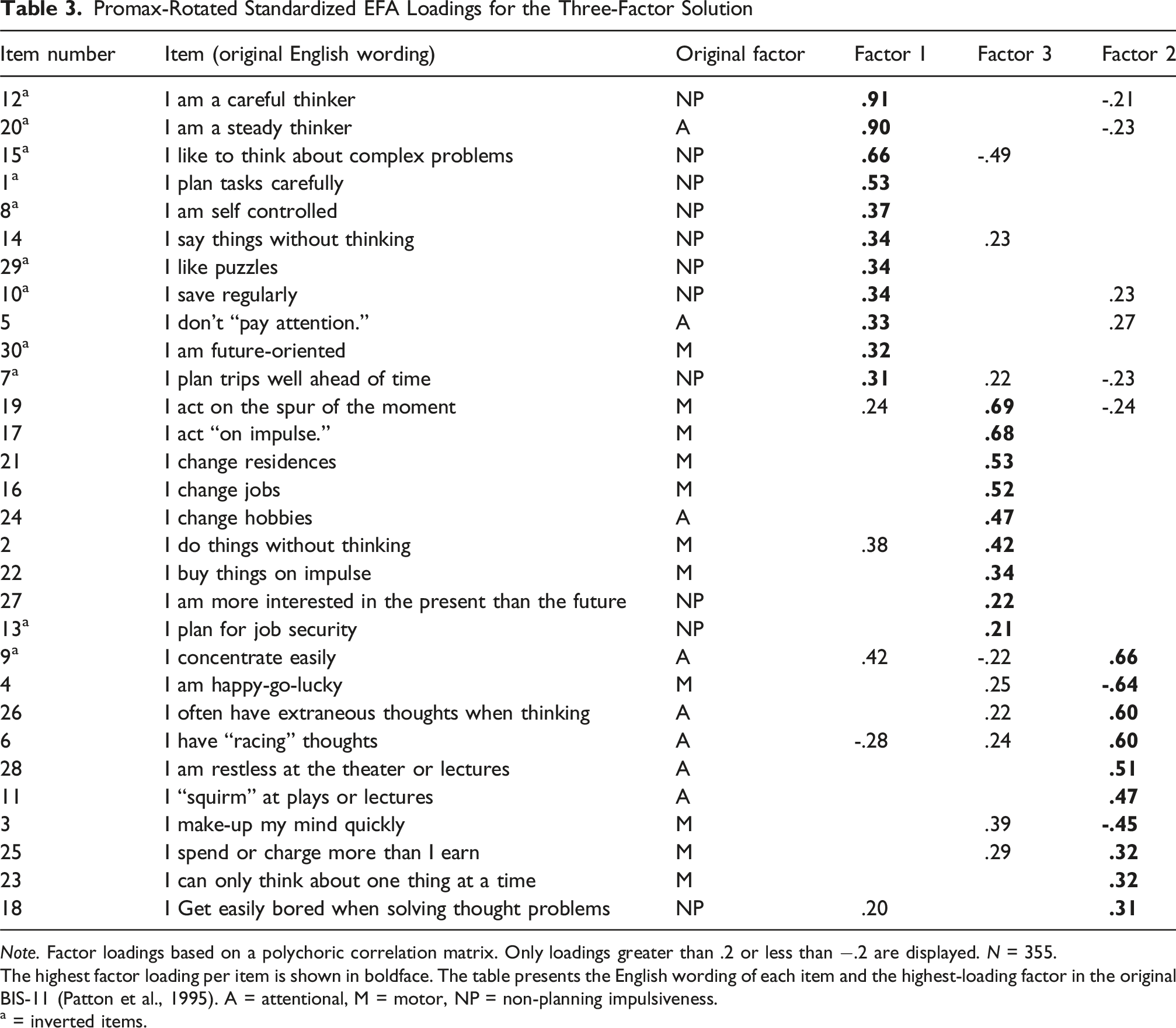
Note. Factor loadings based on a polychoric correlation matrix. Only loadings greater than .2 or less than −.2 are displayed. N = 355.
The highest factor loading per item is shown in boldface. The table presents the English wording of each item and the highest-loading factor in the original BIS-11 (Patton et al., 1995). A = attentional, M = motor, NP = non-planning impulsiveness.
a = inverted items.

Path diagram for the BIS-11 confirmatory factor analysis on Sample 2, based on the factor structure from the current exploratory factor analysis.
Confirmatory Factor Analysis
Model fit indices for the current three-factor-model derived from EFA ranged from acceptable for Root Mean Square Error of Approximation (RMSEArobust = .07) and Chi-square test (X2 (402) = 835, p < .001) to insufficient for Comparative Fit Index (CFIrobust = .85) and Tucker Lewis Index (TLIrobust = .84). Standardized factor loadings for the BIS-11 reached significance for all but two items (4 and 23). However, only 10 out of 30 items showed satisfactory factor loadings of λ > .50 (Kahn, 2006). These well-performing items were mainly distributed across the motor and non-planning impulsivity factors, supporting these dimensions in CFA, while the attentional impulsivity factor remained questionable (see Figure 2 for factor loadings).
Further analyses revealed a similarly poor model fit for the original three-factor model proposed by Patton et al. (1995; see Supplemental Table S3.5 for factor loadings), with RMSEArobust = .08, CFIrobust = .83, TLIrobust = .82 and (X2 (402) = 821.10, p < .001). Therefore, neither the factor structure from the current EFA nor the original three-factor model of the BIS-11 could be confirmed. Lastly, we tested a model with only one latent factor. CFA did not yield improved model fit over the three-factor models (RMSEArobust = .08, CFIrobust = .83, TLIrobust = .82 and X2 (405) = 881, p < .001; see Supplemental Table 3.6 for factor loadings of the one-factor model).
Given the unsatisfactory results of CFA in our version of the BIS-11, we further explored a possible short form of the questionnaire, based on the BIS-15 as proposed by Meule et al. (2011), which is detailed in Supplement 4.
Construct Validity
Associations with Other Questionnaires
Pearson Correlations of Self-Report Questionnaires in Sample 2

Note. BIS-11 = BIS-11 sum score. UPPS-u = UPPS urgency subscale. UPPS-pr = UPPS lack of premeditation subscale. UPPS-pe = UPPS lack of perseverance subscale. UPPS-ss = UPPS sensation seeking subscale. BSCS = Brief Self-Control Scale. STICSA = Trait subscale of the State-Trait Inventory for Cognitive and Somatic Anxiety.
N = 252. *p < .05. **p < .01.
Associations with Behavioral Inhibitory Task Performance
Pearson Correlations of BIS-11 Scores With Inhibitory Performance Parameters

Note. BIS-11 motor impulsivity = sum score of the motor impulsivity factor derived from exploratory factor analysis of the BIS-11.
aN = 252.
bN = 250.
cN = 244.
Criterion Validity: Missed Study Appointments
In a binomial logistic regression analysis, BIS-11 scores significantly predicted whether a study appointment at the lab was missed. The analysis revealed an odds ratio (OR) of 1.16 (95% confidence interval [1.07, 1.30], p = .002), indicating that for each additional point on the BIS-11, the odds of missing an appointment increased by 16%.
Discussion
This study aimed to validate a German translation of the BIS-11 as a self-report measure of impulsivity across multiple general population samples, examining its internal reliability, factorial structure, and construct validity via other self-report measures. Additionally, we explored its association with behavioral inhibitory task performance and behavior relevant for daily life (missed appointments). While the BIS-11 showed strong internal consistency, we could not confirm the factor structure proposed by Patton et al. (1995). Construct validity of the BIS-11 appears to be given: Its sum score showed moderate positive correlations with UPPS subscales urgency, lack of premeditation and lack of perseverance and negative associations with self-control on the BSCS, while correlations with the UPPS scale sensation seeking and trait anxiety on the STICSA were small. However, we observed a dissociation between self-reported impulsivity and performance on cognitive inhibition tasks. The BIS-11 sum score significantly predicted participants’ missed appointments to partake in a study.
Factor Structure
The exploratory and confirmatory factor analyses did not confirm the original three-factor structure of attentional, motor and non-planning impulsivity proposed by Patton et al. (1995). Instead, the alternative three-factor model with adjusted item distribution showed better, but still suboptimal model fit. Specifically, the attentional impulsivity factor appeared less robust, with several items displaying cross-loadings and low factor loadings. This fits the ambiguity in the development of the BIS as detailed by Stanford et al. (2009), where an assumed cognitive factor of impulsivity could not be defined and later resulted in the attentional impulsivity scale. Despite the relatively small sample sizes used for the factor analyses, our results indicate that we could not detect a three-factor model of impulsivity in our data. These findings are consistent with previous reports that have not observed the factor structure of the BIS-11 (Reise et al., 2013; Steinberg et al., 2013; Vasconcelos et al., 2012).
Validity and Reliability
The BIS-11, especially its sum score, is one of the most-widely used self-report measures in impulsivity research (Stanford et al., 2009). The BIS-11 sum score demonstrated good internal consistency across all samples, suggesting that the overall measure is reliable. In contrast, questionnaires such as the UPPS can be employed to focus on individual facets of impulsivity (Whiteside et al., 2005) but give only limited information on impulsivity as a superordinate trait. Our findings on the factorial structure of the BIS-11 in our data correspond with those of Huang et al. (2024). The authors, after analyzing a multitude of self-report and behavioral measures, propose impulsivity to be a unidimensional construct with a small number of related constructs (sensation seeking, punishment and reward sensitivity and cognitive behavioral factors). The BIS-11 sum score might thus reflect such a “general factor” of impulsivity.
The construct validity of the BIS-11 sum score as a measure of impulsivity was further supported with related impulsivity measures, such as the UPPS urgency, lack of premeditation, and lack of perseverance scales. Small positive correlations were observed between the BIS-11 and trait anxiety as well as UPPS sensation seeking. As expected, we found a negative link between the BIS-11 and the BSCS, which aligns with the conceptualization of impulsivity and self-control as opposing constructs (Duckworth & Kern, 2011; Evenden, 1999). Trait self-control likely involves, amongst others, conscientiousness and planning to avoid temptation (Gao et al., 2021; Milyavskaya et al., 2021), both of which interfere with the quick, unplanned or not well considered action tendencies that characterize impulsivity.
The expected link between self-reported impulsivity and behavior was not observed for the laboratory tasks. BIS-11 scores were not significantly associated with performance on the Go/Nogo, Stop-Signal, or Counting-Stroop tasks, indicating a dissociation between self-reported impulsivity and behavioral response inhibition and automaticity. This finding is consistent with meta-analyses revealing little to no correlation between self-reported impulsivity and cognitive tasks (Cyders & Coskunpinar, 2011; Sharma et al., 2014), despite both being commonly used as operationalizations of impulsivity. One proposed explanation is that self-report measures capture broader, trait-like action tendencies, whereas cognitive control tasks assess momentary, micro-level processes (Sharma et al., 2014). Hedge et al. (2018) further highlight the reliability paradox: Cognitive behavioral tasks are optimized to minimize between-subjects variability to detect within-subject effects, which limits their utility for capturing individual differences, in contrast to self-report scales, which rely on such variability. The lack of convergence between these approaches calls for further research to clarify which facets of impulsivity each method captures and whether they reflect distinct dimensions of impulsive behavior.
One of the key strengths of our study was the demonstration of criterion validity through the association between BIS-11 sum scores and daily-life dependability, measured by non-illness related missed study appointments at the lab, which may relate to core characteristics of impulsivity (Moeller et al., 2001). The significant positive relationship between higher impulsivity scores and increased likelihood of missing appointments to participate in a study provides external validation of the BIS-11 as a measure of everyday impulsive behavior. Here, potentially poor planning, resulting in competing activities, could be due to a lack of forethought. A person’s dependability in terms of appointments presumably applies not only to their participation in a study but also other aspects of their life. Missing appointments to engage in more appealing activities likely involves disregard for potential negative consequences, such as inconveniencies for the other involved parties, negative effects on their relationship, the individual’s reputation or missed opportunities. The BIS-11 is thus linked to our participants’ impulsivity-related behavioral tendencies. Crucially, this is the first time, to our knowledge, that self-reported impulsivity has been associated with a very simple but direct measure of participants’ everyday behavior. More precisely, we were able to capture an externally observable action. Although it needs replication, this assessment appears to give useful insights without the detour of self-report, possibly avoiding social desirability. This is especially important in the context of impulsivity, as participants may under-report typically impulsive behaviors such as substance use and risky behaviors when asked directly in a questionnaire.
Limitations and Conclusion
Limitations of this validation study include the relatively small and homogeneous samples for factor analyses (Tabachnik & Fidell, 2012). Larger and more diverse samples may help clarify the generalizability of these findings across different populations. Additionally, one could question several items’ utility due to their discrimination scores near zero and low factor loadings in the CFA (λ < .20; 3, 4, and 23). Further, several items loaded on all three factors in the EFA (6, 7, 9, 19), questioning their use for differentiating different aspects of impulsivity. Both the three-as well as the one-factor solution showed poor model fit. However, the sum score remains supported by its relation to other self-report measures. While we demonstrated strong criterion validity through missed appointments, additional behaviors in participants’ daily life should be examined to strengthen its ecological validity.
In conclusion, this study provides a comprehensive evaluation of a German version of the BIS-11, demonstrating that the sum score has satisfactory reliability and validity, as indexed by its associations to other related constructs as well as an external measure of participants’ behavior. The BIS-11 remains a valuable tool for assessing impulsivity, but further refinement and investigation into its subscales and external correlates are needed.
Supplemental Material
Supplemental Material - Self-Reported Impulsivity Predicts Missed Study Appointments: Validating a German Adaptation of the BIS-11
Supplemental Material for Self-Reported Impulsivity Predicts Missed Study Appointments: Validating a German Adaptation of the BIS-11 by Kerstin Dück, Rebecca Overmeyer, Lena Eger, Tanja Endrass in Personality Science.
Footnotes
Acknowledgments
We express our gratitude to Dr. Diana Armbruster for her insight on the experimental design of this study.
Ethical Considerations
This analysis used data from three different projects. All were approved by the ethics committee at the University Hospital Carl Gustav Carus, TUD (EK 310082018, EK 372092017 and EK 161042019).
Consent to Participate
All participants gave written informed consent to participate.
Consent for Publication
Not applicable.
Author Contributions
Kerstin Dück: Conceptualization, Data Curation, Formal Analysis, Methodology, Resources, Software, Validation, Visualization, Writing – Original Draft.
Rebecca Overmeyer: Conceptualization, Data Curation, Formal Analysis, Funding Acquisition, Investigation, Methodology, Project Administration, Software, Supervision, Validation, Writing – Review & Editing.
Lena Eger: Conceptualization, Data Curation, Formal Analysis, Writing – Original Draft.
Tanja Endrass: Conceptualization, Funding Acquisition, Methodology, Project Administration, Resources, Software, Supervision, Validation, Writing – Review & Editing.
Funding
The authors disclosed receipt of the following financial support for the research, authorship, and/or publication of this article: This work was funded by the Deutsche Forschungsgemeinschaft (DFG, German Research Foundation), grant number SFB 940, project C6 (awarded to Tanja Endrass), and a grant awarded to Rebecca Overmeyer (MK201903, centralized funds of the Faculty of Psychology, Technische Universität Dresden).
Declaration of Conflicting Interests
The authors declared no potential conflicts of interest with respect to the research, authorship, and/or publication of this article.
Transparency,Openness,and Reproducibility
This study was not preregistered. Our analyses on the factorial structure and validity of the BIS-11 are thus exploratory. The R code and datasets are available under https://osf.io/6vzk4/. As detailed in the participants section, data from Sample 1 was also used in a validation study of the Creature of Habit Scale (Ersche et al., 2017; Overmeyer et al., 2020), while data for Samples 2 and 3 stems from research projects on the electrophysiological basis of cognitive functions (https://osf.io/ywnze/ and  ).
).
Supplemental Material
Supplemental material for this article is available online.
Notes
Not applicable.
References
Supplementary Material
Please find the following supplemental material available below.
For Open Access articles published under a Creative Commons License, all supplemental material carries the same license as the article it is associated with.
For non-Open Access articles published, all supplemental material carries a non-exclusive license, and permission requests for re-use of supplemental material or any part of supplemental material shall be sent directly to the copyright owner as specified in the copyright notice associated with the article.
