




Abstract
Using Beck’s cognitive model of emotional disorders as a foundation, and existing models of how reinforcement sensitivity theory of personality, and biased cognitions for negative and threatening social information contribute to social anxiety, a process model of social anxiety was proposed in the study. In this model, reinforcement sensitivity personality dimensions, negative social self-beliefs, fear of negative evaluation, and self-verbalization during performance in social settings were viewed as contributing in sequence to social anxiety. To test this model, the study used hierarchical regression to examine the incremental validity for these predictions in the order just mentioned. Three hundred and four adults (101 males, 203 females) completed measures on behavioral inhibition and approach, maladaptive cognitive beliefs, fear and distress related to negative evaluation from others, negative and positive self-statements, and social anxiety. The findings indicated that at each step, the variables entered provided additional variance for the prediction of social anxiety above and beyond the preceding variables. These findings were interpreted as supportive of our process model of social anxiety.
Keywords
The Diagnostic and Statistical Manual (Fifth Edition [DSM- 5]; American Psychiatry Association [APA], 2013) defines social anxiety as a disorder characterized by a marked fear or anxiety about one or more social situations in which the individual is exposed to possible scrutiny by others. According to the DSM-5, for this disorder, the fear or anxiety shown is disproportionate to the actual threat, and the individual either avoids the social situations or endures them with intense fear and/or anxiety. Among other factors, the development and maintenance of social anxiety has been linked to personality dimensions (Kaplan et al., 2015; Kimbrel, 2008, 2012; McNaughton & Gray, 2000), and biased cognitions for negative and threatening social information (Claus et al., 2023; Clark & Wells, 1995; Kuckertz & Amir, 2014; Liu et al., 2017). Based on the extant literature, and using Beck’s cognitive model of emotional disorder as a foundation, a process model of social anxiety is proposed. In this model, reinforcement sensitivity personality dimensions, negative social self-beliefs, fear of negative evaluation, and self-verbalization during performance in social settings were viewed as contributing in sequence to social anxiety. The current study used hierarchical regression analysis to examine the applicability of this model in a group of adults.
Reinforcement Sensitivity Theory of Personality and Social Anxiety
Social anxiety has been linked to reinforcement sensitivity theory of personality (RST; Gray, 1982; McNaughton & Gray, 2000; McNaughton & Corr, 2004). RST has the behavioral inhibition system (BIS) and the behavioral approach system (BAS) as core dimensions. The BIS is sensitive to punishment, frustrative non-reward, and novelty oriented, with its activation leading to anxiety and avoidance responses. Conversely, the BAS is sensitive to reward and non-punishment, with its activation leading to positive emotions and approach behaviors. McNaughton and Gray (2000) linked heightened BIS sensitivity to social anxiety, for which there is ample empirical support (e.g., Kimbrel et al., 2016; Kramer & Rodriguez, 2018; Ly & Gomez, 2014). There are also data showing association between higher BIS sensitivity and bias for negative and threatening social information (Gomez & Gomez, 2002; Noguchi et al., 2006).
Corr (2002) proposed the joint subsystems hypothesis that suggests that under certain situations, the BIS and BAS will apply opposite effects on behavior. As such, BAS sensitivity can be linked negatively with social anxiety. Indeed, studies have shown that both the BIS and the BAS have positive and negative associations, respectively with social anxiety (Kimbrel et al., 2012; Ly & Gomez, 2014). Thus, the joint subsystems hypothesis can be considered to be applicable to social anxiety. Also of relevance, Kimbrel (2008) proposed an integrated model of social anxiety, in which the BIS is considered as the basis of the negatively biased social cognitions and social anxiety, with low BAS increasing the effect of the BIS on social anxiety. Empirical support for this integrated model has been forthcoming (Gomez et al., 2020).
Cognitive Models of Social Anxiety
To date, several cognitive models of social anxiety have been proposed (Clark & Wells, 1995; Hofmann, 2007; see also Heimberg et al., 2014; Leigh & Clark, 2018; Modini & Abbott, 2016; Wong et al., 2014). According to Clark and Well’s model (1995; see also Wells, 2007; Ghasemi et al., 2024; Wong et al., 2014) when a person with social anxiety enters a potentially social anxiety provoking situation, pre-existing dysfunctional social beliefs about himself/herself activate distorted negative thoughts, such as fear of negative evaluation by others. Although these are highly exaggerated, they are perceived as true and accurate by the individual. Consequently, the individual responds with excessive anxiety (recognized as social anxiety), and/or avoidance. Relatedly, a psychological maintenance model of social anxiety was proposed by Hofmann (2007; see also Hofmann, 2025; Hofmann et al., 2014). This model argued that when in socially provoking situations, individuals prone to social anxiety tend to focus their attention on their own anxiety, view themselves negatively as a social object, overestimate the negative outcomes of their social behavior, and underestimate their capacity to control their emotional response and their social skills to deal effectively with the social situation. To avoid social mishaps, they utilize maladaptive coping strategies, such as avoidance and safety behaviors.
There is sufficient evidence supporting cognitive models of social anxiety (Hodson et al., 2008; Morrison & Heimberg, 2013; Schultz & Heimberg, 2008). Furthermore, there are now data consistent with predictions from cognitive models showing that social anxiety is associated with dysfunctional social beliefs (Gros & Sarver, 2014; McCarthy & Morina, 2020), fear of negative evaluation (Carleton et al., 2007; Li et al., 2023; Wong & Moulds, 2011; Zhang et al., 2022), and negative cognitive self-evaluation during social performance (Glass et al., 1982; Gomez et al., 2022; Hofmann & DiBartolo, 2000; Lin & Fan, 2023; Muris et al., 2005). In addition, the negative view of the self and fear of negative evaluation precipitate an individual’s negative self-referent cognitions that often includes negative self-statements about one’s ability (“I’m not good enough,” or “I cannot do this”) to handle adaptively the potential social anxiety provoking situations (Castagna et al., 2019; Makkar & Grisham, 2011; Moree, 2010; Ng & Abbott, 2016), thereby increasing social anxiety even further (Heimberg & Barlow, 1991; Heimberg & Becker, 2002; Hope et al., 2010).
In summary, social anxiety can be viewed as being influenced by biased and maladaptive cognitive schemas and beliefs, and negative thoughts and evaluations about one’s social behaviors, and self-statements (generally negative) about one’s ability. In this respect, a relevant question is what constitutes the underlying processes underpinning the influence of these negative social cognitive factors? Considering that cognitive models of social anxiety have emanated from Beck’s cognitive models of depression and anxiety (Hope et al., 2010), it can be speculated that Beck’s cognitive models of depression and anxiety (Hope et al., 2010) can be extrapolated to explain the underlying processes underpinning the influence of these negative social cognitive factors.
According to Beck’s model, emotional disturbances (like depression and anxiety) begin with the development of negative cognitive structures or ‘schemata’, which are stored bodies of knowledge that affect the encoding, comprehension, and retrieval of information. Developing via interactions between an individual’s vulnerabilities (that could include disposition factors, like personality) and environment events, activation of the schemata would, in turn, activate negative automatic thoughts and other negative cognitions. In turn, these lead to a negative view of the self, the world, and their own future (negative cognitive triad), and then to emotional disturbances such as depression and anxiety. When these steps and processes are applied to social anxiety, it could mean that negative cognitive social ‘schemata’ that are developed via interactions between an individual’s personality (in particular behavior inhibition) and environment events, activate the schemata that, in turn, activates negative automatic thoughts and other negative social cognitions. In turn, this leads to excessive social anxiety. Past events in social settings that would have caused intense fear and anxiety would have contributed to the development of social anxiety schemas that are characterized by negative self-referential beliefs about one’s ability to perform or interact adaptively (negative social comparison and ineptness) in social settings and events perceived to be threatening.
The steps and processes, and the key variables involved in our “process” model of social anxiety, and how the behavioral inhibition and approach personality dimensions are involved in this model are shown in Supplemental Figure S1. As shown, in this process model, an individual’s latent schemas related to social interaction and performance (i.e., internally stored representations of beliefs based on past experiences in social setting and events) are activated by interaction between environmental events (threatening social anxiety settings) and dispositional reinforcement sensitivity personality traits. In this respect, the behavioral inhibition system, and to a lesser degree, the behavioral approach system are activated. When schemas are activated, they automatically influence how information is processed (encoded, organized, retrieved). This generally involves fear of negative evaluation and interpretation of the social event in ways that confer vulnerability for social anxiety through negative self-evaluation of one’s social behavior. When engaging with the feared social situation directly, the individual self-evaluates and verbalizes his/her social behavior in negative terms. This would usually include negative self-statements of their performance, thereby resulting in intense social anxiety and fear and avoidance responses.
Study Aims
The aim of the current study was to examine the applicability of our proposed process model of social anxiety. Corresponding to our proposed process model of social anxiety, the current study examined the incremental validity (in sequence) of the RST personality dimensions, dysfunctional core self-beliefs, distorted social cognitions, and self-verbalization during performance in the prediction of social anxiety. As the RST dimensions are well established personality constructs, and as dysfunctional social self-beliefs, and fear of negative evaluation are general and not situation specific (Alden & Wallace, 1995), the incremental validity models were examined with measures developed for use at the individual differences (or trait) level. This is appropriate as despite been viewed in categorical terms by DSM-5, empirical findings support a dimensional view of social anxiety, i.e., lying along a spectrum from low to high (Boyers et al., 2017; Ruscio, 2010). Considering that an examination of the proposed model can contribute to a more comprehensive understanding of the relative contributions to social anxiety by some of the well-established personality and negative social cognitions, the study can be expected to provide valuable information that could have important implications for the etiology and treatment of social anxiety.
Based on past studies, we predicted that social anxiety will be associated positively with behavioral inhibition, dysfunctional social beliefs (both social comparison and ineptness), fear of negative evaluation, and negative self-statements during social performance; and it will be associated negatively with the behavioral approach, and positive self-statements during performance. Based on our process model of social anxiety, it was predicted that dysfunctional social self-beliefs would predict social anxiety over and above the RST personality dimensions; fear of negative evaluation would predict social anxiety over and above the dysfunctional social self-beliefs and the RST personality dimensions; and negative self-verbalization during performance would predict social anxiety over and above fear of negative evaluation, dysfunctional core self-beliefs, and the RST personality dimensions.
Method
Participants and Procedure
The study was conducted in 2014. The Federation University of Australia approved the study and the recruitment of participants (ethics approval number A14-058). To generate the sample, the study was advertised electronically on social media platforms, and via flyers posted at the university campus and various locations such as athletic carnivals. Participants were recruited from the general community either directly or online via Survey Monkey. All potential participants were provided with a plain language information statement informing them about the study. This statement also indicated that completing and returning questionnaires indicated that they understood the nature of the research and freely consented to participate. Participants recruited directly were provided with envelopes containing a set of questionnaires, which were to be returned directly to research assistants or via prepaid reply envelopes. Those completing the measures online were instructed to submit the completed questionnaires online on completion. Participants from the Federation University of Australia psychology participant pool (N = 32%) received research participation credit, but other participants did not receive any incentives. Overall, 51% of respondents completed the survey online, and 49% directly via hard copies.
The initial sample comprised 364 adults (age range = 18 years to 65 years), recruited from the general Australian community and the psychology participant pool of the Federation University. SPSS version 22 was used to examine missing values. With reference to the total or summary scores, all variables had one or more missing values. The percentage of missing values ranged from 1.4% for positive self-statement to 2.2% for fear of negative evaluation. In all, there was 178 missing values, and this constituted 5.43% of the total scores (178/3,276 summary scores). Inspection of the missing value patterns indicated no evidence of monotonicity, and missing data were primarily at random. Considering these, the present study utilized listwise deletion to remove participants if they had one or more missing values. This removed 60 individuals, resulting in the final study sample size of 304 participants (males = 101, females = 203).
Careless responding was identified using Mahalanobis distances (Huang & Wang, 2021) and the “longstring” method (Meade & Craig, 2012; Ward & Meade, 2023). They were conducted using the applications developed by Aybek and Gulleroglu (2021), and the R package “careless” (Yentes & Wilhelm, 2023), respectively.
Supplemental Table 1 shows the frequencies, percentages, and means, and standard deviation scores of the background characteristics of the participants. The mean age (SD) for all participants was 33.94 years (SD = 12.21 years), men and women 33.73 years (SD = 11.70 years) and 34.04 years (SD = 11.49 years), respectively. These ages did not differ significantly, t (df = 302) = 0.21, ns. Also, many participants had achieved secondary or university education, were employed, and in some sort of relationship.
Measures
All participants provided information on demographic information including age, gender, education, employment, and relationship status, and completed several dispositional self-report questionnaires covering personality, bias social cognitions, and social anxiety. The questionnaires administered are described below.
The Behavioral Inhibition System/Behavioral Activation System (BIS/BAS; Carver & White, 1994)
The BIS/BAS was used for measuring the behavioral inhibition (BIS; tendency for experiencing negative affect and behavioral inhibition in the presence of potential punishment or threat) and behavioral approach (BAS; tendency to experience positive affect and behavioral approach in the presence of rewards) personality dimensions. Each item is rated on a 4-point scale; (1 = very false for me to 4 = very true for me), with higher scores indicating higher sensitivities. In the current study, the Cronbach’s α values for the BIS and BAS were both .79.
Social Thoughts and Beliefs Scale (STABS; Turner et al., 2003)
The STABS was used for measuring maladaptive cognitive beliefs of social comparison (SC; maladaptive cognitions related to comparing oneself to others to better understand one’s status) and social ineptness (SI; maladaptive cognitions related to the inability to interact with others in a smooth and appropriate way). Each item is rated on a 5-point scale (1 = never characteristic) to 5 = always characteristic), with higher scores indicating more maladaptive beliefs, In the current study, the Cronbach’s α values for the SC and SI were .84 and .88, respectively.
Brief Fear of Negative Evaluation Scale – II (BFNE-II; Carleton et al., 2006)
The BFNE-II was used for measuring fear and distress related to negative evaluation from others (FNE). Each item is rated on a 5-point scale (0 = not at all characteristic of me to 4 = extremely characteristic of me), with higher scores indicating more negative evaluation. In the current study, the Cronbach’s α value for the BFNE-II was .97.
Self-Statements During Public Speaking Scale (SSPS; Hofmann & DiBartolo, 2000)
The SSPS was used for measuring one’s use of negative self-statements (SSPS-N; negative self-statements during public speaking), and positive self-statements (SSPS-P; positive self-statements during public speaking) during performance. Each item is rated on a 6-point scale (0 = totally disagree to 5 = fully agree), with higher scores indicating more self-statements. In the current study, the Cronbach’s α values for the SSPS-N and SSPS-P were .88 and .85, respectively.
Social Phobia Scale (SPS; Mattick & Clarke, 1998)
The SPS was used for measuring social anxiety (SA). Each item is rated on a 5-point scale (0 = not at all characteristic of me to 4 = extremely characteristic of me), with higher scores indicating more anxiety. In the current study, the Cronbach’s α value for SA was .91.
The Federation University of Australia approved the study and the recruitment of participants (ethics approval number A14-058). To generate the sample, the study was advertised electronically on social media platforms, and via flyers posted at the university campus and various locations such as athletic carnivals. Participants were recruited from the general community either directly or online via Survey Monkey. All potential participants were provided with a plain language information statement informing them about the study. This statement also indicated that completing and returning questionnaires indicated that they understood the nature of the research and freely consented to participate. Participants recruited directly were provided with envelopes containing a set of questionnaires, which were to be returned directly to research assistants or via prepaid reply envelopes. Those completing the measures online were instructed to submit the completed questionnaires online on completion. Participants from the Federation University psychology participant pool received research participation credit, but other participants did not receive any incentives. Overall, 51% of respondents completed the survey online, and 49% directly via hard copies.
Data Analysis
Initially, an a priori power analysis was conducted using G*Power version 3.1.9.7 (Faul et al., 2007) to determine the minimum sample size required to test the study hypothesis. Results indicated the required sample size to achieve 80% power for detecting a medium effect, at a significance criterion of α = .05, was N = 114 for the final step in the hierarchical regression analysis (when all predictors would have been entered), used for testing incremental validity. Thus, our sample size of N = 304 was more than adequate to test the incremental validity at each step.
Initially, the intercorrelations among all the study variables were examined. The effect sizes for the correlations were examined using Cohen (1992) guidelines for correlation effect sizes: values of 0.10, 0.30, and 0.50 are small, medium, and large effect sizes, respectively. Skew and kurtosis coefficients and evidence of multicollinearity [variance inflation factor (VIF)] was examined. It has been suggested that data can be considered as normal if skewness is between −2 to +2 and kurtosis between −7 to +7 (Hair et al., 2010). A general rule is that the VIF should not exceed 10 (Belsley, 1980).
Following the abovementioned analyses, the incremental validity for the predictions of social anxiety was examined using the hierarchical regression analysis module in SPSS version 22. Hierarchical regression analysis is appropriate in this respect as it will show how much incremental additional variance in a dependent variable can be explained by a new predictor, after controlling for the effects of existing predictors (Hunsley & Meyer, 2003). Applied to the aims of our study, it will show if adding a new variable (say negative self-statements) to an existing model (say that includes variables for behavioral inhibition and activations, social comparison, and fear of negative evaluation) would significantly add to the prediction of the dependent variable (social anxiety).
It is known from the existing evidence that among adults, women report more social anxiety than men, and younger age groups (up to the age of 24 years) show greater sex differences in social anxiety (Caballo et al., 2008). Therefore, age and sex were entered as the first step in our hierarchical regression analysis as covariates, prior to the personality and cognitive variables (step 1). In this analysis, both the RST personality dimensions (behavioral inhibition and behavioral approach from the BIS/BAS) were entered in step 2; maladaptive beliefs of the social self (social comparison and social ineptness from the STABS) were entered in step 3; negative self-evaluation (the total score for the BFNE-II) was entered in step 4; and use of negative and positive self-statements during performance from the SSPSP were entered in step 5. In this approach, the R2 change for one step to the next step and the corresponding F-statistics are examined for significance. A significant F is indicative that the predictor (or block of predictors) in that step has incremental validity above and beyond the predictor (or block of predictors) entered in the previous step(s).
Results
Mean (SD) of Study Variables for the Sample Examined
Means and Standard Deviations, and Intercorrelations of All the Study Variables (N = 304)
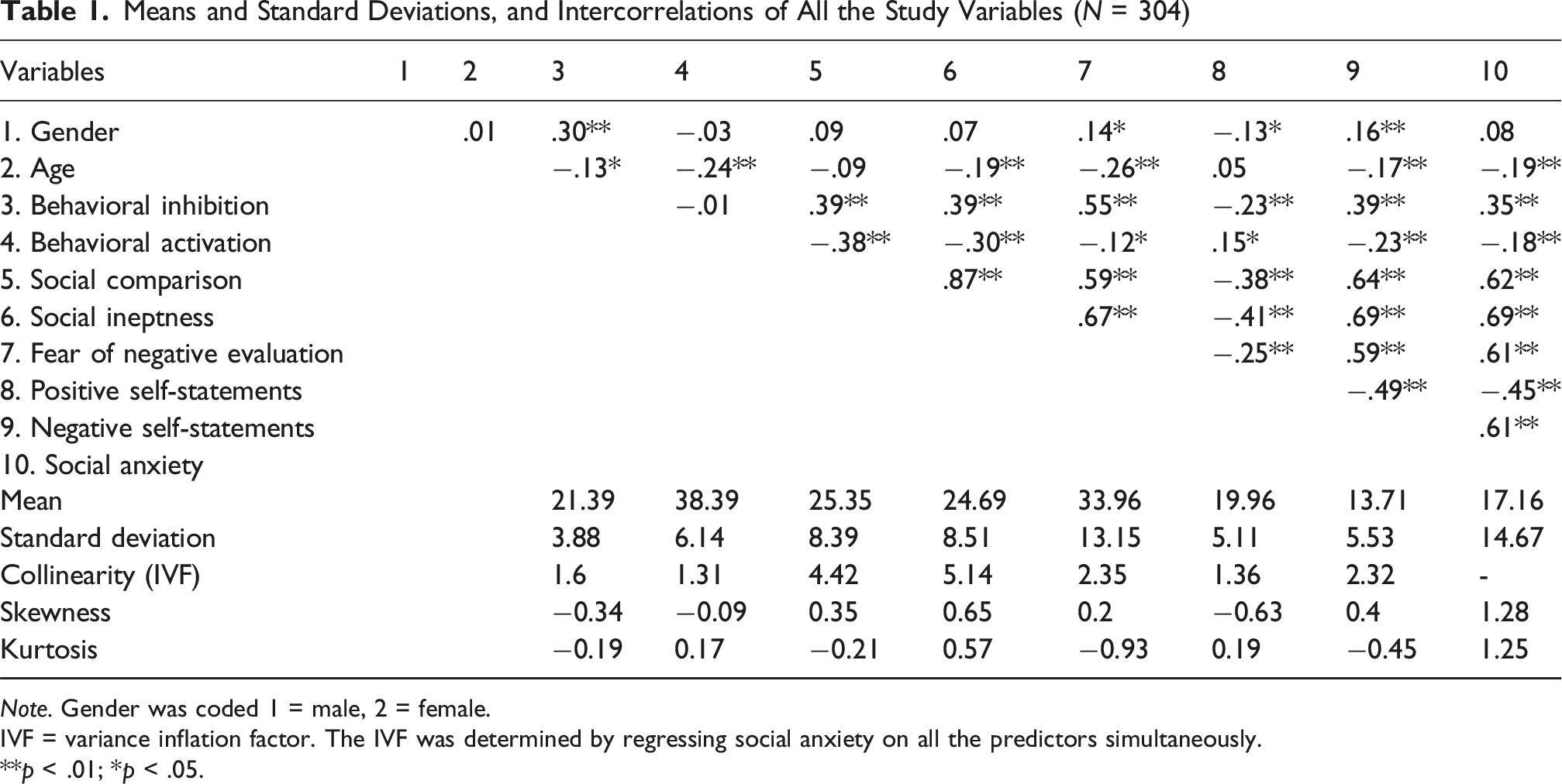
Note. Gender was coded 1 = male, 2 = female.
IVF = variance inflation factor. The IVF was determined by regressing social anxiety on all the predictors simultaneously.
**p < .01; *p < .05.
Careless and Inattentive Responding
Our findings for Mahalanobis distance revealed no evidence of multivariate outliers, and the longstring method showed no individuals with a pattern of 10 or more identical consecutive answers. Therefore, we decided there was no evidence of careless and inattentive responding for this group and thus included all 304 in our study.
Characteristics of all Study Variables
Table 1 also includes the variance inflation factor (IVF) used to examine evidence of multicollinearity. As shown, skew and kurtosis coefficients for all variables, were within acceptable limits (skewness between −2 to +2, and kurtosis between −7 to +7). Thus, we assessed normality for all variables. Regression diagnostics indicated the presence of outliers but because the IVF values ranged from 1.122 to 5.140, we concluded there was no evidence of multicollinearity (i.e., <10).
Intercorrelations of Study Variables
Table 1 shows the intercorrelations among all the study variables. Behavioral inhibition and behavioral approach were not significantly correlated. Social comparison and social ineptness were correlated significantly with a large effect size. Fear of negative evaluation was correlated significantly and positively with large effect sizes with behavioral inhibition, social comparison and social ineptness, fear of negative evaluation, negative self-statements, and social anxiety, and significantly and negatively with small effect sizes with behavioral approach, and positive self-statements. Both positive and negative self-statements were correlated positively with behavioral inhibition (medium effect sizes), social comparison and social ineptness (large effect sizes), fear of negative evaluation (large effect size), negative self-statements (large effect sizes), and social anxiety (large effect size). They were associated negatively with behavior approach (small effect sizes), with each other (medium effect size). Social anxiety was associated positively with behavioral inhibition, social comparison, social ineptness, fear of negative evaluation, and negative self-statement; and significantly and negatively with age, behavioral approach, and positive self-statements.
Incremental Validity for the Prediction of Social Anxiety by Personality Dimensions Followed by Cognitive Variables
Hierarchical Multiple Regression Testing the Incremental Validity for the Prediction of Social Anxiety by (in Sequence) Gender and Age, RST Personality Domains, Bias Cognition/Beliefs, Dysfunctional Thoughts and Self-Talk
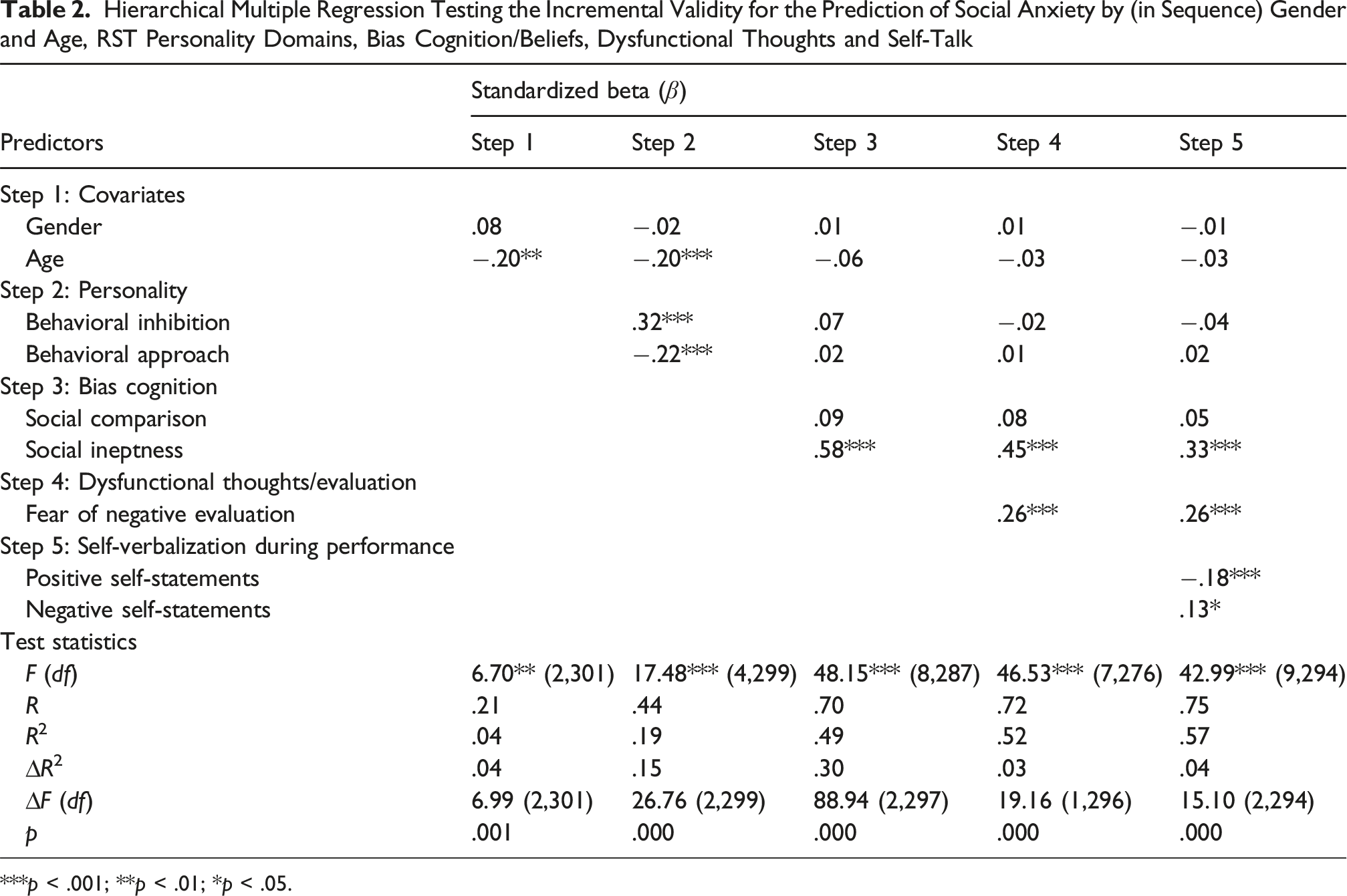
***p < .001; **p < .01; *p < .05.
Discussion
In summary, the correlation findings showed that fear of negative evaluation was correlated positively with behavioral inhibition, social comparison and social ineptness, negative self-statements, and social anxiety; and negatively with behavioral approach, and positive self-statements. Both positive and negative self-statements were correlated positively with behavioral inhibition, social comparison and social ineptness, fear of negative evaluation, and social anxiety. They were associated negatively with behavior approach, and with each other. Behavioral inhibition and behavioral approach were not significantly correlated. Social comparison and social ineptness were correlated positively. Also, social anxiety was associated positively with behavioral inhibition, social comparison, social ineptness, fear of negative evaluation, and negative self-statement.
The correlation findings were as predicted and are generally consistent with existing findings. Previous studies have also revealed that social anxiety is associated positively with behavioral inhibition (Kimbrel et al., 2016; Kramer & Rodriguez, 2018; Ly & Gomez, 2014), dysfunctional social beliefs, such as social comparison and ineptness (Gomez et al., 2022; Gros & Sarver, 2014; Kimbrel et al., 2012; McCarthy & Morina, 2020; Wong & Moulds, 2011), fear of negative evaluation (Carleton et al., 2007; Li et al., 2023; Mattick & Clarke, 1998; Van der Molen et al., 2014; Wong & Moulds, 2011; Zhang et al., 2023), and negative self-statements during performance (Glass et al., 1982; Glass & Arnkoff, 1994; Gomez et al., 2022; Hofmann & DiBartolo, 2000; Lin & Fan, 2023). Additionally, existing data also show that social anxiety is associated negatively with the behavioral approach (Kimbrel et al., 2016; Kramer & Rodriguez, 2018; Ly & Gomez, 2014), and positive self-statements during performance (Gomez et al., 2022; Lin & Fan, 2023). There are also data showing the negative association between social anxiety and age (Caballo et al., 2008). However, unlike previous research showing more social anxiety among women (Caballo et al., 2008), we found no such association between gender and social anxiety.
The hierarchical regression analysis that examined the incremental validity (in sequence) of the RST personality dimensions, dysfunctional core self-beliefs, distorted social cognitions, and the self-verbalization during performance variables in the prediction of social anxiety showed that both the RST (BIS and BAS) dimensions predicted social anxiety, positively and negatively, respectively. When the dysfunctional self-beliefs variables (social comparison and social ineptness) were entered in the next step, social ineptness (but not social comparison) provided positive and significant incremental variance for the prediction of social anxiety above and beyond the RST dimensions. The RST dimensions were no longer significant predictors at this step. When fear of negative evaluation was entered in the next step, it provided positive and significant incremental variance for the prediction of social anxiety, above and beyond dysfunctional self-beliefs and the RST dimensions. At this step, social ineptness also contributed significantly. When the negative and positive self-statements during performance variables were entered in the next step, they provided positive and negative incremental variance, respectively, for the prediction of social anxiety, above and beyond fear of negative evaluation, dysfunctional self-beliefs, and the RST dimensions. There were also significant positive predictions by social ineptness and fear of negative evaluation, but not the RST dimensions and social comparison. Overall, therefore, apart from the finding that social comparison did not provide significant incremental variance for the prediction of social anxiety above and beyond the RST dimensions, all other findings were consistent with predictions from the process model of social anxiety.
Taken together, our incremental validity findings showed that while the BIS and BAS are associated with social anxiety, these personality dimensions add no variance to the prediction of social anxiety when cognitive variables (at least the ones in the present study) are considered. Among the cognitive variables, social ineptness continued to be important predictor of social anxiety, even when fear of negative evaluation and self-statements during performance were taken into consideration. Despite this, fear of negative evaluation was also a significant positive predictor when social ineptness and social comparison were entered. Furthermore, negative self-statements during performance was also a significant positive predictor of social anxiety, even when social ineptness and fear of negative evaluation were considered.
Given that in our hierarchical regression analysis, we entered our personality and cognitive variables in steps corresponding to the different stages of the proposed process model of social anxiety, and as the different cognitive variables at the different steps provided additional variance for the prediction of social anxiety over and above the preceding variables, it can be speculated that our findings are generally consistent with associations reflected in our proposed process model of social anxiety. Overall, therefore, there was good support for our process model of social anxiety. However, we stress strongly that as we used cross-sectional data, this interpretation should not be viewed in terms of a temporal or causal change of events, but more in terms of atemporal associations reflected in the proposed process model of social anxiety.
The association for the BIS with social anxiety is consistent with the RST model of social anxiety that has linked BIS sensitivity/activation with social anxiety (McNaughton & Gray, 2000). Additionally, taken together, the positive association for the BIS with social anxiety, and the negative association for the BAS with social anxiety is supportive of Corr’s (2002) joint subsystems hypothesis that proposes, under certain situations, the BIS and BAS will exert opposite effects on behavior. Considering these findings, it can be speculated that social anxiety is associated with high sensitivity to punishment, frustrative non-reward and novelty, and high anxiety and avoidance responses; and low sensitivity to reward and non-punishment, positive emotions, and approach behaviors. It should also be noted that our correlation findings for the RST dimensions showing positive associations for the BIS with negative beliefs (social comparison and social ineptness) and fear of negative evaluation is also consistent with Kimbrel’s (2008) integrated model of social anxiety. This model proposes that the BIS is associated with negatively biased social cognitions.
The positive association with negative self-statements during performance indicates that social anxiety is associated with negative self-statements during performance. The positive association with social ineptness beliefs indicate that social anxiety is associated with maladaptive cognitions related to the inability to interact with others in a smooth and appropriate way. Relatedly, given the step at which social comparison was entered into the hierarchical regression analysis model, the absence of an association between social comparison beliefs and social anxiety indicates that when the BIS and BAS are also taken into consideration, social anxiety is not associated uniquely with maladaptive cognitions related to comparing oneself to others to better understand one’s social performance status. However this must be viewed cautiously as social comparison was high correlated with social ineptness that showed incremental validity. The finding of a positive association for social anxiety with fear of negative evaluation indicates that social anxiety is associated with fear and distress related to negative evaluations from others. These associations are consistent with cognitive models of social anxiety (see Clark & Wells, 1995; Heimberg & Becker, 2002; Hofmann, 2007), and virtually all our predictions based on our process model of social anxiety.
Our process model of social anxiety was developed from Beck’s cognitive model for emotional disturbance (Hope et al., 2010). Considering our findings, this model suggest that when an individual faces a fear-provoking social situation, the BIS, and to a lesser degree the BAS, are activated, and this in turn activates pre-existing negative self-beliefs about one social behavior, in particular social ineptness. These then trigger bias negative automatic thoughts, such as fear of negative evaluation. Following this, when directly engaging with the feared social situation, the individual would verbalize his/her social behavior performance in negative terms, such as repeating negative self-statements of their performance. These are followed by intense fear and anxiety emotions, and potentially avoidance behavior that is recognized as social anxiety. In concluding, as our process model was developed from Beck’s cognitive models of depression and anxiety (Hope et al., 2010), our model provides the foundation for a theoretical basis for the use of Beck’s cognitive behavior therapy model for treating social anxiety, for which there is now ample support (Heimberg, 2002; Hofmann, 2005; Liu et al., 2017; Mayo-Wilson et al., 2014; Rodebaugh et al., 2004; Scaini et al., 2016).
Limitations
Although the current study delivered valuable new information on the associations of social anxiety with RST personality dimensions and negative social cognitions, the findings and interpretations need to be considered with several limitations in mind. First, social anxiety is highly comorbid with other psychopathologies, such as major depression and alcohol use disorder (Koyuncu et al., 2019). Not controlling for this in the present study may have confounded the findings. Second, as all participants in the current study were from the general community and not selected randomly, our findings may be confounded and limited in terms of generalization, including their application to those with clinical levels of social anxiety. Related to this limitation, the means scores for all the variables in the study were within the average range or below. Third, as all data used were collected using self-rating questionnaires, it is possible that the ratings were confounded by common method variance. Fourth, we cannot be certain as to whether our findings will be replicated with other measures of social anxiety, cognitions, and personality or if data were obtained via clinical interview. Fifth, our findings were obtained from a single study, and therefore, replication is essential. Sixth, we did not adjust for multiple comparisons, thereby controlling the possibility of Type 1 error. Seventh, and most importantly, although we have interpreted support for our proposed process model of social anxiety, it should be noted that as we used cross-sectional data, this interpretation should not be viewed in terms of a temporal or causal change of events, but more in terms of temporal associations reflected in our proposed process model of social anxiety. Eighth, in terms of cognitive variables our proposal process model is limited, as a wider range of cognitive variables than what was included have been linked to social anxiety. Including focus attention to one’s own anxiety, view of oneself negatively as a social object, overestimate the negative consequences of one’s social behavior, and underestimate one’s ability to control one’s emotional response, and one’s social skills to deal effectively with the social situation (Hofmann, 2007). Given these limitations, further research addressing the limitations and omissions noted is necessary for a more comprehensive understanding of the incremental contribution of cognitive variables to social anxiety. Nevertheless, despite the limitations mentioned, the findings of this study can be expected to contribute significantly to theory and clinical practice regarding the role of personality and cognitions in social anxiety among adults.
Supplemental Material
Supplemental Material - Incremental Validity for the Prediction of Social Anxiety by Personality Dimensions and Negative Social Cognitions: Testing a Process Model of Social Anxiety
Supplemental Material for Incremental Validity for the Prediction of Social Anxiety by Personality Dimensions and Negative Social Cognitions: Testing a Process Model of Social Anxiety by Rapson Gomez and Stephen Houghton in Personality Science
Supplemental Material
Supplemental Material - Incremental Validity for the Prediction of Social Anxiety by Personality Dimensions and Negative Social Cognitions: Testing a Process Model of Social Anxiety
Supplemental Material for Incremental Validity for the Prediction of Social Anxiety by Personality Dimensions and Negative Social Cognitions: Testing a Process Model of Social Anxiety by Rapson Gomez and Stephen Houghton in Personality Science
Footnotes
Acknowledgements
We are indebted to the participants who were involved in this research.
Author Contributions
Funding
The authors received no financial support for the research, authorship, and/or publication of this article.
Declaration of Conflicting Interests
The authors declared no potential conflicts of interest with respect to the research, authorship, and/or publication of this article.
Data Availability Statement
The study materials, data and analysis scripts used for this article can be accessed via the first author at
Disclosure Statement
Not applicable.
Supplemental Material
Supplemental material for this article is available online.
References
Supplementary Material
Please find the following supplemental material available below.
For Open Access articles published under a Creative Commons License, all supplemental material carries the same license as the article it is associated with.
For non-Open Access articles published, all supplemental material carries a non-exclusive license, and permission requests for re-use of supplemental material or any part of supplemental material shall be sent directly to the copyright owner as specified in the copyright notice associated with the article.
