




Abstract
In the current work, the relations between trait emotional intelligence (EI) and the three dark triad (DT) traits of narcissism, Machiavellianism, and psychopathy were further examined. Previous meta-analytic work has revealed significant but small correlations between trait EI and each of the DT traits. Here, latent profile analysis (LPA) was used to go beyond correlation analyses by identifying subgroups of individuals with similar profiles across trait EI and the DT. A total of N = 1026 male (23%) and female (77%) undergraduates participated in the study. Five profiles were identified, the largest one of which manifested intermediate levels of both trait EI and all three DT traits. Of the two profiles with low DT trait levels, one was accompanied by very high EI with the individuals in the other reporting relatively much lower levels of EI. Of the two profiles with high DT trait levels, one was accompanied by very low EI with the individuals in the other reporting relatively much higher levels of EI. Importantly, this latter profile was also characterized by lower of levels of benevolency (i.e., prosociality and positive mood management) and higher levels of malevolency (i.e., antisociality and negative mood management) towards others. Such results highlight the presence of a potential dark side to EI.
Keywords
Trait emotional intelligence (EI) is defined as a set of dispositional characteristics, marked by domains related to the self-perception of one’s and other’s emotions and includes beliefs and behaviours in the processing, regulation, and expression of emotional states assessed on self-report measures (Petrides et al., 2007). Although related, it may be differentiated from ability EI which utilizes performance-based tests for its measurement (Petrides, 2011). Broadly speaking, high trait EI can be beneficial to enhancing both favourable psychological outcomes within individuals (i.e., intrapersonally) and successful social interactions between individuals (i.e., interpersonally; Davis & Nichols, 2018). Studies typically show that EI has positive relationships with well-being (Schutte et al., 2002) and both occupational and academic success (Lopes et al., 2006; Perera & DiGiacomo, 2013). It also correlates positively with benevolent personality traits (such as prosociality; Gallitto & Leth-Steensen, 2019) and negatively to more malevolent personality traits (such as psychopathy; Gómez-Leal et al., 2018).
Recent theorizing and work in EI, however, has considered the possibility that high EI could also be related to disadvantageous intrapersonal outcomes and interpersonal interactions (i.e., a “dark” side; Davis & Nichols, 2018). For instance, Côté et al. (2011) demonstrated that higher emotional regulation serves to enhance the relation between individuals’ moral identity and their prosocial behavior (the “Dr Jekyll” of such regulation) but also between their level of Machiavelliansim and interpersonal deviance engagement (the “Dr Hyde” of such regulation). One interpersonal aspect that has received some attention by researchers interested in the potential dark side of EI is the extent to which individuals feel that they can manage the emotions of others, in both prosocial and non-prosocial manners (Austin et al., 2014; Nagler et al., 2014). In general, higher trait EI is positively related to prosocial emotion management and negatively to non-prosocial emotional management (Austin et al., 2014). However, these relationships were also shown to be moderated by co-occurring levels of Agreeableness such that the relation between EI and non-prosocial emotion management was actually positive for those with low levels of Agreeableness. Such results indeed suggest that high EI individuals have the capability for self-serving and manipulative behaviour (Austin et al., 2014). Moreover, it has also been suggested that those who exhibit high trait EI can be prone to selfishness and are susceptible to using deception to both attain extrinsic goals and exert manipulation within interpersonal interactions (Kilduff et al., 2010).
In this vein, a growing body of research has revealed the nature of the links that EI has with the composite Dark Triad (DT) personality typology that includes narcissism, Machiavellianism, and psychopathy (Austin et al., 2014; Davis & Nichols, 2016; Miao et al., 2019; Michels & Schulze, 2021; Nagler et al., 2014; Szabó & Bereczkei, 2017). These three socially aversive traits were originally grouped together conceptually by Paulhaus and Williams (2002) and a number of possible core constructs (e.g., callousness) have since been proposed to explain the overlapping variance that they share (Michels & Schulze, 2021). Individuals scoring higher on the trio of traits constituting the DT have a greater tendency to actively engage in maladaptive and antisocial behaviours such as cheating, plagiarism, and other counterproductive behaviours (Jonanson et al., 2017). Prior meta-analytic research (Miao et al., 2019; Michels & Schulze, 2021) on the relation between DT traits and EI has demonstrated the presence of a weak overall positive correlation between global trait EI and narcissistic tendencies (that was significant in Michels & Schulze, 2021), and significant overall negative correlations of global trait EI with both Machiavellianism and psychopathy. As concluded by Miao et al. (2019), the latter two results do not actually support the notion of a dark side to EI (at least in terms of the “total” overall relations between EI and those two latter dark traits).
Narcissism is characterized by an inflated sense of self-worth, entitlement, and control (Morf & Rhodewalt, 2001). The fact that it is often shown to be positively related to trait EI is consistent with research demonstrating that individuals who score high on such measures may have an inflated perception of themselves which leads them to believe that they are overly empathetic and pleasant human beings (Siegling et al., 2014). Furthermore, the relationship between trait EI and narcissism coincides with a recent study that explored the maladaptive aspects of EI, revealing the tendency of high scoring EI individuals to demonstrate behaviours in line with grandiose narcissism such as self-assertiveness and domineering over others (Zajenkowski et al., 2018). Hence, negative constructs such as narcissism may sometimes not demonstrate a negative correlation with EI despite their seemingly malevolent underpinnings (Zajenkowski et al., 2018).
The trait of Machiavellianism is characterized by self-serving behaviour, agency as well as the exploitation of others to reach personal goals (Bakan, 1966). In Austin et al. (2007), Machiavellianism was indeed negatively correlated with global trait EI as well as the interpersonal subcomponent of trait EI, thereby suggesting that those who score high on Machiavellianism tend to also report poorer emotion-related interpersonal abilities. In this same study, however, Machiavellianism was found to be positively related to a measure of emotional manipulation. Hence the latter finding suggests that emotionally manipulative tendencies may indeed be circumscribed within Machiavellianism although the proper execution of these actions may be highly situational and depend on other factors such as environmental constraints for them to be implemented successfully (Austin et al., 2007). Subsequent work by O’Connor and Athota (2013) served to further qualify the relation between global trait EI and Machiavellianism by showing that it was mediated by Agreeableness (which was positively related to trait EI and negatively to Machiavellianism). These authors also showed that for a facet of EI referred to as emotional competence, its relation with Machiavellianism was moderated by Agreeableness (actually becoming positive for lower levels of Agreeableness).
Psychopathy is generally characterized by callous, antagonistic tendencies in conjunction with impulsive and antisocial outward behaviours (Sharpe et al., 2023). Interestingly, in a prior study assessing convicts (individuals with demonstrably higher levels of trait psychopathy), psychopathy was shown to be positively related to trait EI after controlling for overall intelligence (Copestake et al., 2013; see also Pham et al., 2010). More generally, though, psychopathic personality is characterized by emotional callousness and shallowness as well as excessive implusiveness and hostile tendencies (Lishner et al., 2011) and has been shown to be negatively related to trait EI (Gómez-Leal et al., 2018; especially for samples of university students with proportionately more females).
Prosociality
Prosocial behavior is characterized by elements of selflessness, cooperation, helping, and comforting for the purpose of benefitting others (Batson & Powell, 2003). Overall, the existing research appears to suggest that prosocial trajectories and their emotional, cognitive, and behavioural underpinnings may be constituents of a wider motivational process associated with certain personality typologies (Habashi et al., 2016). In this vein, recent studies have explored the link between personality and prosocial behaviours, such as the one by Wertag and Bratko (2019) that revealed that the set of HEXACO traits explained 31% of the variance of self-reported prosocial tendencies, whereas DT personality traits (specifically Machiavellianism and psychopathy in a negative manner) accounted for an additional 5% of the variance. Current research surrounding the relationship between trait EI and prosocial behavior in adults is scarce, however, and most studies that link the two constructs are centred on early childhood experiences and socialization (e.g., Maroveli et al., 2009). However, a positive relation between trait EI and self-reported prosocial behavior for a very large sample of adolescents from a national longitudinal survey was reported in recent work by Gallitto and Leth-Steensen (2019).
Antisocial behaviors
Strong positive associations between psychopathic trait levels and a measure of student antisociality were observed for both males and females by Visser et al. (2010) who also found moderate negative correlations of ability EI with antisociality. Of relevance to the current work, while exploring relationships between trait psychopathy, EI, criminality, and illicit behaviours in a sample of male undergraduates, Fix and Fix (2015) found that those scoring high in psychopathy demonstrated decreased interpersonal skills, and that the trait was a strong predictor of illicit and antisocial behaviours (i.e., violent, drug, and property offences). Those authors proposed that “successful” psychopathy involves both a predisposition to antisocial/deviant behaviours and manipulativeness in conjunction with an intact ability to regulate social responses to fine-tune behaviours (Fix & Fix, 2015). Moreover, a study exploring the relationship between self-report trait EI and psychopathy in a male clinical sample found a significant correlation between the clarity subscale of trait EI (i.e., making sense of ones’ feelings) and several antisocial and impulsive facets of psychopathy (i.e., self-centred impulsivity). Thus, it may be that psychopathic individuals who demonstrate greater emotional self-perception ratings (a characteristic of higher trait EI) are more likely to engage in antisocial behaviours associated with selfish gain (Copestake et al., 2013).
Managing the emotions of others
One important aspect of interpersonal relationships, that is also regarded as a being key component of EI, is the extent to which people tend to employ interpersonal-related strategies directed towards the managing the emotions of others. Importantly, such emotion management can either be prosocial in nature, by serving to enhance the emotional state of others, or non-prosocial in nature, by serving to worsen the emotional state of others. Recent work by Austin et al. (2018), was focused on a set of subscales measuring both the self-reported frequency of usage of a set of both prosocial (i.e., Enhance and Divert) and non-prosocial (Worsen and Inauthentic) emotion management strategies. In the course of validating short forms of these subscales, positive relations between EI and the two prosocial subscales and also between the DT traits and the two non-prosocial subscales were observed.
The current study
One recent analytical trend has been to supplement the variable-centered approach that focusses on total relationships between variables with a person-centered approach, such as latent-profile analysis (LPA), that focusses on the potential existence of clusters or classes of individuals. The primary concept behind LPA is the generation of unique configurations of latent profiles underlying distinct trends of values corresponding to a series of continuous indicators of interest (Spurk et al., 2020) that allows for the classification of individuals with similar traits into subpopulations. Groups of individuals sharing common personality characteristics are assigned profiles that provides a great deal of descriptive specificity compared to classic variable-centred approaches such as regression or correlation (Howard & Hoffman, 2018). Furthermore, utilizing classification patterns obtained from LPA modelling is regarded as a conceptually and methodologically sound method with respect to the construction and incorporation of typologies from data (Costa et al., 2002).
Hence, the key objective of this present work is to use LPA to determine whether subgroups of individuals can be revealed based on their EI and DT traits. Such an approach was advocated by Davis and Nichols (2016) and would provide a more nuanced examination of the relation between EI and the DT traits. Namely, according to Miao et al.'s (2019) recent meta-analysis, the aggregated correlations between trait EI and narcissism, Machiavellianism, and psychopathy were .05, −.27, −.16 (see their Table 1). Hence, given the low to moderately-low size of these correlations, it is not the case that everyone high (or low) in trait EI will have corresponding levels of DT traits. For instance, it is possible that there exists a smaller set of individuals who are high (or low) on both trait EI and the DT traits. Such groups might then manifest interesting and revealing novel relations with other variables that are key to the study of EI, the DT, and the potential dark side of EI.
Therefore, the second objective was to evaluate the relationship of the resulting EI and DT trait profiles to aspects of prosociality, antisocial behaviour, and interpersonal mood management. Namely, personality profiles characterized by low EI and high DT traits would be expected to relate positively to more antisocial behaviour as well as to more non-prosocial mood management of others, whereas profiles characterized by high EI and low DT traits would be expected to relate positively to prosociality and the enhanced use of prosocial mood management strategies. Of key relevance to the issue of a dark side to EI would be the existence of a profile of individuals with both high trait EI and high levels of DT traits who report darker levels of both prosociality and antisocial behavior but, especially, heightened tendencies towards more manipulative non-prosocial interpersonal mood management (i.e., given the presence of both enhanced malevolency and emotional efficacy in such individuals). Indeed, the potentially manipulative nature of such “dark EI” individuals could be regarded as one of the main impetuses for attempting to determine if there is indeed a dark side to EI. That is “the assumption that some individuals might be predisposed to a strategic use of their own and others’ emotions, functional to manipulating or ingratiating others to derive personal gains” (Fino et al., 2023, p. 2). Importantly, this assumption can be directly examined in the current work given the inclusion of Austin et al.’s (2018) interpersonal mood management measures.
Hence, the current study has the potential to provide insights into the dark side of EI. In this vein, it should help to elucidate some of the positive and negative connotations behind the presence of specific constellations of EI and DT traits and their underlying behavioural manifestations. Nonetheless, it is important to note that there has been some other analogous LPA work that has recently been performed, some of which could be regarded as being consistent with the current findings (Heym et al., 2023) and some of which as being inconsistent (Fino et al., 2023; Rico-Bordera et al., 2024). A full discussion of that work and its relevance to the current work will be provided after the current LPA results have been reported.
Methods
Sample and procedure
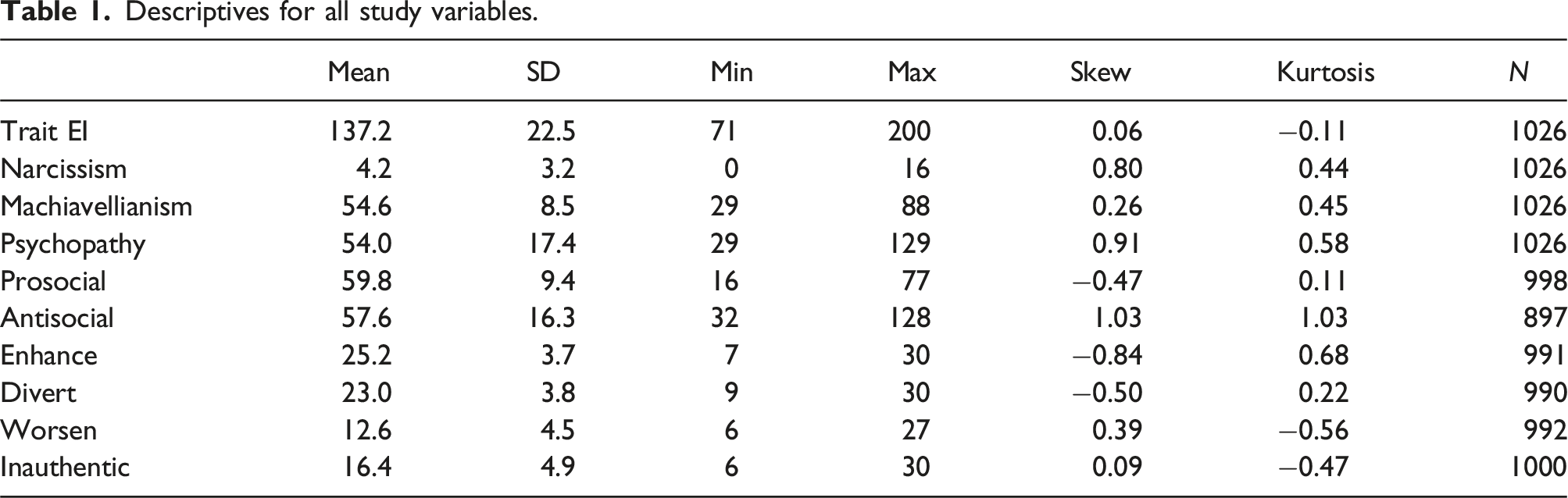
The sample was initially composed of 1198 undergraduate students at a university in Canada. In exchange for their participation, the students received credit towards a psychology course. Response data for the measures indicated below were collected on-line through Qualtrics. All participants provided their informed consent online at the start of the data collection and were shown an on-line debriefing sheet upon finishing. One-hundred and fifty-three cases were subsequently dropped from the original data set for not having any responses to the items in at least one of the indicator scales (e.g., trait EI, narcissism, Machiavellianism, or psychopathy; 64 of which did not respond to any of the items, 9 of which did not respond to any of the dark triad items, 47 of which did not respond to any of the Machiavellianism and psychopathy items, and 33 of which did not respond to any of the psychopathy items) with 7 additional participants dropped for missing more than 50% of the responses to the items in at least one of those four scales. As well, 12 cases not reporting as either male or female were dropped. Upon removal, the remaining number of cases to be analyzed was 1026 (23% male, Mage = 20.3 years, SDage = 4.19 years with 97% of the sample being less than 30 years of age). Of these remaining data, 81 item responses were missing for trait EI, with 14, 27, and 80 items missing for narcissism, Machiavellianism, and psychopathy, respectively. These missing responses were imputed for each measure separately using the EM procedure in Missing Values in SPSS version 28 (and, subsequently, rounded to the nearest integer).
Data analysis plan
LPA is a statistical method that identifies unmeasured latent subpopulations within a given population based on multiple indicator variables. This method assumes that people can be classified into different categories based on their personal or environmental attributes. Researchers have been using person-centred approaches for data mining in different fields including psychological research. LPA represents an advancement of cluster analysis (i.e., a technique based on mapping data into homogenous classes without possessing any a priori knowledge of their grouping).
Individuals typically manifest a consistent set of traits across various situations, thereby influencing how they interact with others and the world at large. In this vein, LPA attempts to group those individuals who possess similar trait profiles. This procedure statistically derives classes that are both maximally homogenous within classes and heterogenous between classes. As observed in the study by Merz and Roesch (2011), these classes are a ramification of response patterns associated with the observable variables. In the context of traits, LPA is an effective tool to model complex relationships between the dimensions of personality.
The four personality dimensions used here as the trait indicators upon which to derive such latent profiles were trait EI, narcissism, Machiavellianism, and psychopathy. Models with as few as two profiles to as many as seven profiles were fit. To model the variance-covariance structure within each profile, models with increasingly relaxed equality constraints were applied as prescribed by Pastor et al. (2007) using the Mplus code provided by those authors in their Appendix A. First, models with equal indicator variances across profiles and no covariances between indictors within each profile (i.e., the full local independence model) were fit. Then models with covariances added that remained constant across classes were fit, followed by models that allowed the variances to differ across the classes, and finally models that also allowed the covariances to differ across the classes.
The optimal number of latent profiles and within-profile variance-covariance structure was determined based on goodness of fit indices. The Akaike information criterion (AIC; Akaike, 1974), Bayesian information criterion (BIC; Schwartz, 1978), and the sample size adjusted BIC (SSA-BIC; Sclove, 1987) were used to determine the individual fit of the models. Specifically, better model fits are indicated by smaller values. Moreover, the Lo–Mendell–Rubin Likelihood Ratio Test (LMR-LRT; Lo et al., 2001) was also used to make comparisons between numerically adjacent class solution with significant LMR p-values indicating that model fit improves from that for one less class. Although not specifically used to determine the optimal number of latent profiles, values of the entropy statistic are also provided. Entropy values range from 0 (worst) to 1 (best), are related to the separation of the classes in the multidimensional space of the indicators, and can be used to compare the classification utility across models. Although there is no set criterion value that can be used to determine a “useful” level of classification (Pastor et al., 2007), according to Clark (2010) an entropy value of .8 could be regarded as high, .6 as moderate, and .4 as low.
Analysis of Variance (ANOVA) was then used to assess differences between different profiles on the outcomes of interest, namely prosociality, antisocial behaviour, and interpersonal mood management. Besides the inherent ease of interpretation of ANOVA results and no concerns regarding a lack of power with 1026 cases, the presence of missing values on the outcome variables rendered the data set somewhat non-amenable to the use of other potential approaches.
Measures
Trait emotional intelligence
The Trait Emotional Intelligence Questionnaire short form (TEIQue-SF; Petrides & Furnham, 2006) was used in this study to measure global trait EI. It consists of 30 items (e.g., “On the whole, I am a highly motivated person”, “I can deal effectively with people”) rated on a seven-point Likert-type response scale which ranges from 1 (completely disagree) to 7 (completely agree). Participants’ global trait EI total score was calculated by adding up individual items scores and ranged from 30 to 210, with higher scores indicating higher global EI. In a previous study by Cooper and Petrides (2010), the TEIQue-SF achieved high reliability in a university and community sample of men and women (i.e., internal consistencies of .89 and .88, respectively). In the current sample, α = .88 for the TEIQue-SF.
Grandiose narcissism
The Narcissistic Personality Inventory-16 (NPI-16; Ames et al., 2006) was used to measure subclinical narcissism (i.e., pervasive grandiose narcissism). This short measure consists of 16 items, with each item containing the option of a narcissism-consistent response and narcissism-inconsistent response, with the former statement in each pair representing higher narcissism (e.g., “I like to be the center of attention”). The total NPI-16 score for each participant was computed as the sum of 16 items. The total score ranged from 0 to 16, with higher scores indicating higher narcissistic tendencies. Prior research has shown that the NPI-16 indicates an overall good discriminant and convergent validity as well as reliability (Gentile et al., 2013), with a Cronbach’s alpha of .72 and mean inter-item correlation of .13 (Ames et al., 2006). In the current sample, α = .75 for the NPI-16.
Machiavellianism
The MACH-IV is a 20-item self-report questionnaire that represents a single factor assessment (i.e., unidimensional) regarding Machiavellian inclinations (i.e., “The best way to handle people is to tell them what they want to hear”). Each item is rated on a five-point Likert-like scale ranging from 1 (strongly disagree) to 5 (strongly agree). The MACH-IV total score ranges from 20 to 100, with higher scores indicating higher Machiavellian inclinations. The initial study administered the Mach-IV to various samples and demonstrated good initial reliability (α = .79; Christie & Geis, 1970). In the current sample, α = .65 for the MACH-IV.
Psychopathy
The Self-Report Psychopathy Scale-Short Form (SRP-SF) is a four-factor measure of psychopathic tendencies consisting of traits such as pathological lying and deception and glibness/superficial charm (Hare, 1985). The SRP-SF is composed of 29 items (e.g., “I rarely follow the rules”, “I was convicted of a serious crime”) which are representative of the four components of the empirical construct of psychopathy: Interpersonal, affective, lifestyle, and antisocial. The scale uses a Likert-type format with responses ranging from 1 (strongly disagree) to 5 (strongly agree). The global psychopathy score for the SRP-SF ranges from 29 to 145, with higher scores indicating higher psychopathic tendencies. The SRP-SF has been shown good/acceptable internal consistency across all four facets in a community sample of 500 participants in total (α = .69–.76; Mahmut et al., 2011). In the current sample, α = .92 for the full SRP-SF.
Prosociality
The Prosocial Scale for Adults (PSA; Caprara et al., 2005) is a self-report, unidimensional scale for adolescents that measures prosocial behaviour irrespective of specific social contextual factors and motives and evaluates personal tendencies to behave in ways that facilitate positive interpersonal interactions (Marti-Vilar et al., 2020). The PSA includes 16 items (e.g., “I am pleased to help my friends/colleagues in their activities”) rated on a five-point Likert scale with response options ranging from 1 (never/rarely) to 5 (always/almost always). The total score for the PSA scale ranges from 16 to 80, with higher scores indicating a higher prosocial tendency. The measure has shown to have excellent reliability in a large (n = 2574) sample of Italian adults (α = .91), with a mean item-total correlation of 0.59 suggesting an acceptable correspondence between the items and the overall scale (Caprara et al., 2005). In the current sample, α = .90 for the PSA.
Antisocial behavior
The Subtypes of Antisocial Behavior Questionnaire (STAB; Burt & Donnellan, 2009). was used for the assessment of antisocial behaviour including physical aggression, social aggression, rule-breaking, and norm violation as well as uniquely predicting momentary or situational acting-out behaviours which may occur in an individual’s day-to-day life (Burt & Donnellan, 2010). Moreover, the STAB has been shown to predict instances of acting-out behaviours within the public domain reliably and validly, which suggests that it may be of particular use in measuring differences in antisocial behaviour on the sub-scale level (Burt & Donnellan, 2009). Overall, the measure consists of 32 items and three subscales, those being physical aggression (“Felt better after hitting”), rule-breaking (“Failed to pay debts”), and social aggression (“Made negative comments about other’s appearance”), all of which have been shown to have very good internal consistency reliabilities (α = .82–.86; Burt & Donnellan, 2010). Each of the items was assessed on a five-point Likert scale ranging from 1 (never) to 5 (nearly all the time) and measured the frequency of antisocial behaviours within the past year. The total score for the STAB scale ranges from 32 to 160, with higher scores indicating a higher antisocial behavior. In the current sample, α = .93 for the full STAB.
Managing emotions of others
The Managing Emotions of Others Scale Short-Form (MEOS-SF; Austin et al., 2018) is composed of 30 items rated on a five-point Likert scale ranging from 1 (strongly disagree) to 5 (strongly agree) and is used to assess various aspects of the interpersonal emotional management, including prosocial-related tendencies and strategic manipulation. The four core subscales of the MEOS-SF include: (1) Enhance, which measures one’s tendencies to reassure and motivate others (e.g., “If someone is feeling anxious, I try to calm them down by talking with them”); (2) Divert, which measures the degree to which humour is used to augment mood (e.g., “I sometimes use humour to try to live another person’s mood”); (3) Worsen, which assesses one’s criticism and negatively-charged actions towards others (e.g., “I use criticism to make others feel that they should work harder”); and (4) Inauthentic, which includes flattery and gussying behaviours towards others (e.g., “I sometimes sulk to get someone to change their behaviour”). The MEOS-SF subscale scores indicated satisfactory internal reliability in a large sample of men and women taken from combined archival data (Austin et al., 2014; Austin & O’Donnell, 2013; Austin & Vahle, 2016), with omega coefficients ranging from .79 to .87. In the current sample, αs = .87, .79, .74, and .78 for the above four subscales, respectively. Note that although the explicit decision was made in this research to examine the other scales at the global level in order to keep the final interpretation of the results manageable, given the distinct conceptual nature of each of the four MEOS subscales, these were analyzed as four separate outcomes.
Transparency, openness, and reproducibility
The current work was not pre-registered. Given that it is attempting to uncover the subtypes involving EI and the three DT traits, the current work could indeed be regarded as being exploratory in nature. The final sample of N = 1026 is larger than the largest sample size examined in the simulation work of Tein et al. (2013) which is the seminal work addressing the issue of power in LPA modeling. The use of an undergraduate sample is consistent with previous work involving DT traits and EI (Austin et al., 2014; Côté et al., 2011; Nagler et al., 2014; Szabó & Bereczkei, 2017). Four other measures that were collected but not utilized in the following analyses were the Ten-Item Personality Inventory (TIPI; Gosling et al., 2003), the Social Desirability Scale-17 (SDS-17; Stöber, 2001), the Assessing Emotions Scale (AES; Schutte et al., 2009), and the Prosocial Tendencies Measure (PTM; Carlo & Randall; 2002). The data that support the findings of this study and corresponding analysis scripts are openly available at https://osf.io/v4qwb/?view_only=fc4d46f67b264d95844c972a37a81e44.
Results
Descriptives and correlations
Descriptives for all study variables.
Correlations between all study variables.

Note. All rs > .07 are significant at p < .05.
Latent profile analysis
Model fit indices.
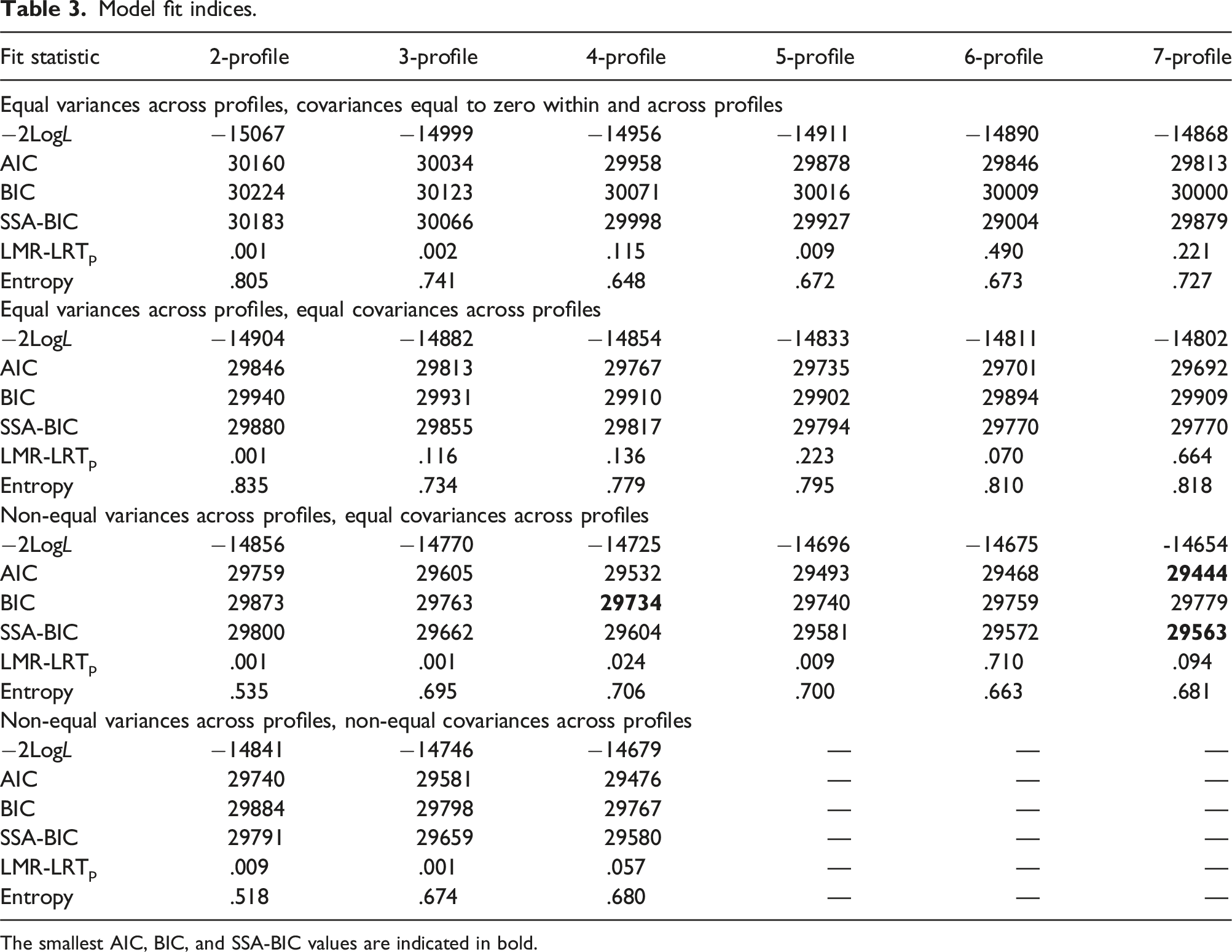
The smallest AIC, BIC, and SSA-BIC values are indicated in bold.
Profiles of mean (SD in parentheses) scores for each indicator variables.


Profile plots of the means of the standardized scores for each indicator.
Gender makeup (in percent) of the five EI-DT profiles.

Outcome variables
Mean (SD in parentheses) scores across the profiles for each outcome variable.
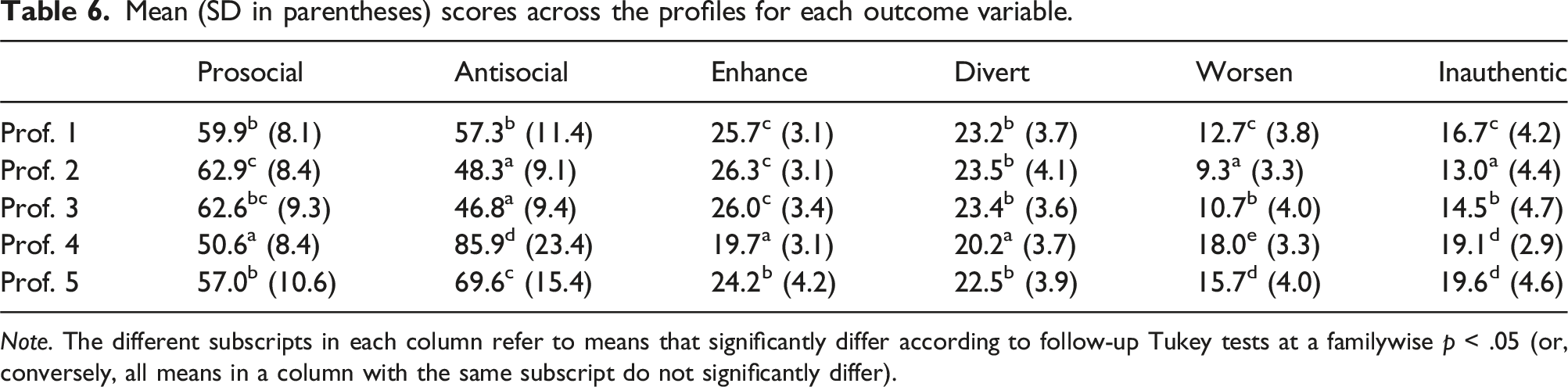
Note. The different subscripts in each column refer to means that significantly differ according to follow-up Tukey tests at a familywise p < .05 (or, conversely, all means in a column with the same subscript do not significantly differ).
In Table 6, the Dark Profile 4 is indeed the most malevolent with respect to the outcome variables having, by far, the lowest prosociality and highest antisociality along with the lowest mean scores on the two prosocial emotion-management subscales (i.e., Enhance and Divert) and very high mean scores on the two non-prosocial emotion-management subscales (i.e., Worsen and Inauthentic). In this vein, the second-lowest mean prosociality score and second-highest mean antisociality score were associated with the Dark EI Profile 5 (albeit quite a bit higher and lower, respectively, than those for Profile 4). With respect to the two prosocial emotion-management subscales, the second-lowest mean scores for each can be found in Profile 5 (although, again, they were still quite a bit higher than those for Profile 4). Most importantly, though, is the fact that the second-highest score for the Worsen emotion-management subscale was found in Profile 5 along with a mean score for the Inauthentic emotion-management subscale that was on par with (and, even, a touch higher than) that for Profile 4. Note such a pattern of results for the outcome variables in Profile 5 is exactly what would have been expected for a profile with higher levels of both trait EI and DT traits.
On the other hand, the Benign and Light Profiles 2 and 3 were almost equally benevolent with respect to the outcome variables having the highest mean prosociality scores and the lowest mean antisociality scores along with the highest mean scores on both the Enhance and Divert subscales and the lowest mean scores for the Worsen and Inauthentic subscales. Nonetheless, it can be noted that mean scores on the two non-prosocial Worsen and Inauthentic emotion management subscales were actually significantly lower for the Benign Profile 2 than for the higher EI and more narcissistic Light Profile 3. Regarding the Intermediate Profile 1, their mean scores on all of the outcome variables fell about halfway between those for the Dark EI Profile 5 and the Light Profile 3 with the exception of the two prosocial emotion-management Enhance and Divert subscales for which scores in Profile 1 were as high as those for Profiles 2 and 3.
Discussion
The present study explores the intricacies associated with darker and lighter aspects of personality within an undergraduate, non-clinical sample. The findings obtained from the LPA performed here demonstrated distinct clustering of trait EI and DT traits within a configuration of five latent profiles that were labelled Intermediate, Benign, Light, Dark, and Dark EI, respectively. As such, these five profiles essentially represent the following combinations of trait EI and DT trait levels: average/average, below-average/low, high/low, low/high, and above-average/high, respectively).
The first trait profile obtained here (i.e., Intermediate) is characterized by average levels for all traits and outcome variables with the exception of the levels of the two prosocially orientated Enhance and Divert emotion-management strategies which were comparable to the two most benevolent profiles. This profile, which contained 40% of the sample participants, represent the typical modal personality type with respect to the variables studied here. That is, not too benevolent and not too malevolent. Nonetheless, it seems that the use of prosocial emotion management of others may represent a general tendency for most non-malevolent individuals. The gender makeup of this profile was mostly female but at a level that was comparable to the overall gender makeup of the sample.
The second trait profile (i.e., Benign) represents individuals with somewhat lower trait EI coupled with the lowest levels of all three DT traits. Interestingly, they are the least likely to employ the two non-prosocially orientated emotion-management strategies. As such, they tend to be quite benevolent which then likely affords them some survival capabilities by allowing them to mostly “fly under the radar” societally. On the other hand, their inherent benevolent nature and lower emotional understanding of their own selves and others could also render them more easily exploited by those with malevolent tendencies. The gender makeup of this profile was mostly female.
The third trait profile (i.e., Light) denoted by the highest levels of trait EI and low DT trait levels, except for narcissism, exemplifies a highly benevolent and emotionally intelligent trait profile. Based on principles of trait EI theory (Petrides, 2010), individuals falling into this category should benefit greatly from having such a profile with respect to both their interactions with others as well as in their general life outcomes. Importantly, even though both Machiavellianism and psychopathy levels were quite low for this profile, the fact that intermediate levels of narcissism were reported by those individuals represents somewhat of a dissociation between the three DT traits in this particular profile. Such a dissociation indicates that moderate levels of narcissism can indeed go together with high EI which is consistent with the small positive relations between trait EI and narcissism that have been observed. In fact, narcissistic individuals can often be quite prosocial and altruistic in order to help maintain their grandiose view of themselves (Rico-Boderea et al., 2024). They can also sometimes be quite optimistic, likeable, and popular individuals (Rico-Boderea et al., 2024). The gender makeup of this profile was also mostly female.
The fourth trait profile (i.e., Dark) denoted by very low trait EI and high levels of all DT traits, is objectively the most malevolent of all the profiles. The low levels of EI in this profile indicates that such individuals have a shallow emotional repertoire and diminished understanding of the emotional aspects of the self and other. Hence, such a profile might then be most likely to be associated with the “unsuccessful” psychopathy that often can result in incarceration (c.f., Fix & Fix, 2015). The gender makeup of this profile was 38% male even though males made up only a quarter of the overall sample. Certainly, if the sample had been more evenly split overall between males and females, a supermajority of males would have been expected in such a profile. Nonetheless, it should be clear from these results that it would not exclusively be made up of males and that there is indeed a sizable proportion of malevolent, non-empathetic females.
The fifth trait profile (i.e., Dark EI) is characterized by comparably higher trait EI and high levels of all three DT traits. In this vein, this typology is akin to that of the Dark profile by manifesting higher malevolent tendencies while also being much higher in trait EI. The finding of high levels of narcissism in this profile also certainly contributes to the small positive correlation between these two traits (which is then somewhat counteracted by the high narcissism and very low EI in Profile 4). The very high level of Machiavellianism associated with this profile is consistent with the notion that dark EI individuals are indeed more manipulative (which is also supported by their higher usage of non-prosocial emotional management strategies). Indeed, such a typology might then be most likely to be associated with “successful” psychopathy (c.f., Fix & Fix, 2015) given that such individuals have a better emotional understanding of the self and others (along with a greater potential to demonstrate emotional control) while also being motivated towards the exploitation of others. The gender makeup of this profile was about 42% male.
Note that the main issue of concern in the present work was whether a mixture of a high trait EI and high DT typology could be revealed. In this vein, the latter Dark EI Profile 5 did indicate that higher levels of trait EI in individuals can indeed coexist with high levels of DT traits (with the size of this profile, at n = 187, not being that small). Moreover, this profile is associated with less prosociality and more antisociality than would be expected for individuals with comparable levels of trait EI. As well, it is also associated with lower levels of positive emotion-management tendencies and higher levels of negative emotion-management tendencies, especially with respect to the use of inauthentic emotion management strategies with others. Hence, as was conjectured here, the individuals within such a profile tend to engage in higher levels of interpersonal emotion-related manipulation.
Recent analogous LPA findings
The current work could be regarded as being consistent with that of Heym et al. (2021) who performed an LPA with the three DT traits and five cognitive and affective empathy related variables. They purported to uncover a four-profile solution with one of the profiles labelled as a “Dark Empath” profile given the presence of the second highest levels of empathy along with levels of DT traits that were comparable to a “traditional” high DT and low empathy profile. Although empathy is not synonymous with EI, it has been regarded by some as a core component of EI (Miao et al., 2019).
On the other hand, the results of the current study are not at all consistent with the LPA profiles obtained recently by Fino et al. (2023) which were essentially replicated by Rico-Bodera et al. (2024). As a representative example of this work, an LPA ran by Rico-Bodera et al. (2024; Study 1 with N = 1241 university students in Spain) that involved the three DT traits and the four trait EI subscales resulted in those authors reporting the presence of a three-profile solution. In this solution, Profile 1 was characterized by very low narcissism, low Machiavellianism and psychopathy along with low to very low trait EI subscale levels (somewhat analogous to the Benign profile in the current work). Profile 2 was characterized by average level narcissism, low Machiavellianism and psychopathy along with high trait EI subscale levels (analogous to the Light profile in the current work). Profile 3 was characterized by very high levels of all three DT traits along with mostly below average trait EI subscale levels. Importantly, as in Fino et al. (2023) and Rico-Bordera et al.’s Study 2, they concluded that the presence of a dark EI (i.e., high DT and high EI) profile was not supported.
With respect to the differences between those LPA results and the current ones, besides the differences in the location of the samples, there were a number of key differences in the manner in which the analyses were performed. Namely, in Rico-Bodera et al.’s (2024) Study 1, the short DT measure was used instead of the full DT measures, all four EI subscales were used as indicators instead of a composite trait EI measure, and potential violations of local independence in the LPA model fitting were not considered. Importantly, all of these can potentially have dramatic impacts on the model fit and, hence, the decision regarding the optimal number of profiles to retain.
Regarding such decisions, one potentially troubling aspect of Rico-Borderas et al.’s (2024) work was not considering the possibility that there might indeed be four profiles instead of three. Namely, given the BIC elbow plot, the consideration of solutions with classes less than 5% of the sample, and the inconsistency in the LRT results in their Table 2, it could easily have been argued that a four-profile solution would have been just as reasonable in their Study 1. Indeed, even though standard LPA practice invariably prescribes the consideration of a number of determiners of goodness of fit in order to decide upon the optimal number of profiles to retain, the oftentimes apparent arbitrariness of this decision remains a glaring drawback of such person-centered approaches. This problem is especially relevant to situations in which the results of such analyses are then regarded as providing either pivotable support or refutation of a major theoretical viewpoint. With respect to Rico-Bodera et al.’s (2024; and also Fino et al.’s, 2023) solution, given the potential for arbitrariness in the decision to keep three profiles (and the subsequent theoretical ramifications that decision had), the onus should certainly have been on them to ensure that a dark-EI profile suddenly wouldn’t have been present in the corresponding four- or, even, five-profile solution. This point is especially important with respect to the presence or not of dark EI individuals given that a three-profile solution does not provide much of an opportunity for a high EI, high DT profile to emerge.
Limitations on generality
One potential limitation of the current study was the use of a mostly female, undergraduate sample (albeit a large one), hence, potentially limiting the generalizability of the results to the general population. However, a case could be made that the study of social-emotional constructs within a population such as this, which is fairly homogeneous in many ways, might actually be preferred because it limits the possibility for demographic variability (i.e., age, occupation, etc.,) to contribute to spurious relationships between study variables (for an in-depth discussion of this point, see Lishner et al., 2011). Nonetheless, a replication of this work within a population that is more equally distributed by gender would likely indeed be warranted. A second potential limitation is the use of self-reports given the possible contamination of the relationships found here by shared method variance (i.e., making responding seem more related across scales than is actually the case). However, note that the distinct qualitative differentiation between the obtained profiles somewhat mitigates concern over such a possibility.
Conclusion
It has been conjectured in the past that those with higher levels of EI might not always be characterized by a constellation of concomitant prosocial personality traits that then leads them to be more benevolent individuals, but that there might also exist a dark side to EI characterized by a tendency towards higher levels of more negatively valenced personality traits that could then result in a set of individuals who are highly skilled emotional manipulators. Using LPAs that allow for the modeling of within-profile variance and covariance structures, the current work adds to the literature by revealing that just such a profile might indeed exist. Moreover, the individuals within that profile did indeed report being more antisocial and more likely to use negative emotion-management strategies (and were more likely, but not exclusively, to be male). Although the extent to which such individuals may indeed be successful negative emotional manipulators as well as the nature of the social roles that such individuals might excel in cannot be addressed by the current work, such issues would be prime candidates for future research.
Supplemental Material
Supplemental Material - Emotional intelligence and the dark triad personality traits: A latent profile analysis
Supplemental Material for Emotional intelligence and the dark triad personality traits: A latent profile analysis by Elena Gallitto, Alexis I. Serghanuk and Craig Leth-Steensen in Personality Science
Footnotes
Author note
Not applicable.
Ethical statement
Acknowledgements
This research was not pre-registered. An earlier version of this research was reported in the undergraduate Honours Thesis of Alexis I. Serghanuk.
Author contributions
Declaration of conflicting interests
The author(s) declared no potential conflicts of interest with respect to the research, authorship, and/or publication of this article.
Funding
The author(s) received no financial support for the research, authorship, and/or publication of this article.

Data Accessibility Statement
Supplemental Material
Supplemental material for this article is available online. Depending on the article type, these usually include a Transparency Checklist, a Transparent Peer Review File, and optional materials from the authors.
Notes
Not applicable.
References
Supplementary Material
Please find the following supplemental material available below.
For Open Access articles published under a Creative Commons License, all supplemental material carries the same license as the article it is associated with.
For non-Open Access articles published, all supplemental material carries a non-exclusive license, and permission requests for re-use of supplemental material or any part of supplemental material shall be sent directly to the copyright owner as specified in the copyright notice associated with the article.
