




Abstract
Voice pitch is a salient acoustic cue that individuals use to make inferences about other’s personality. We examined how valid acoustic parameters such as mean fundamental frequency (i.e., voice pitch), variability in fundamental frequency and their dynamic changes function as indicators of dispositional extraversion in a naturalistic group discussion. We used audio data from a large-scale laboratory group study, in which unacquainted individuals interacted with each other (N = 448 with 5615 audio segments). Results suggest no compelling evidence that extraversion is associated with a lowered mean fundamental frequency (MF0), or dynamic changes in MF0 during a naturalistic interaction. If associations of extraversion with MF0 exist in naturalistic group settings, they are likely too small to be perceivable. However, in our group context, pitch variability was associated with extraversion and paralinguistic behaviour other than voice pitch, such as loudness, seems to be indicative of extraversion as well, suggesting that some paralinguistic variables may indeed signal a speaker’s levels of extraversion.
• No compelling evidence that mean voice pitch is associated with extraversion in naturalistic group interactions • Dynamic changes in voice pitch are also not significantly associated with extraversion • If existent, effects are likely too small to be perceivable • Variability of voice pitch is associated with extraversion • Loudness of the voice seems indicative of extraversionKey insights
Introduction
Humans routinely form impressions on people they meet (Funder & West, 1993). Personality judgements are established within seconds, and allow for valid inferences of target personality (Borkenau & Liebler, 1992). Among the broad domains of personality described by the Five Factor Model of personality, extraversion in particular is a highly perceivable trait that is easier to assess via behavioural cues compared to other personality traits (Breil et al., 2021). This is also the case when specifically considering voice-related behaviour: meta-analytic analyses by Breil et al. (2021) showed that extraverted individuals have voices that are rated as more expressive, fluent, pleasant, confident, and louder. Additionally, extraverted individuals have a higher speech rate and talk more as compared to more introverted individuals (Hartung & Renner, 2010; Lippa, 1998; Toles et al., 2021). However, evidence on voice pitch (i.e., how high or deep a voice sounds), both as an indicator of extraversion and cue for extraversion perceptions, is inconclusive (reviewed in Breil et al., 2021).
As early as (Allport & Cantril, 1934) argued that paralinguistic characteristics of the human voice convey personality. Accordingly, speakers are thought to express their emotions and even enduring personality traits via their voice, beyond the verbal content. Nevertheless, research on the links between an individual’s personality, and their voice pitch still remains scarce. Voice pitch is generally measured as fundamental frequency (F0) and is objectively quantifiable. Higher frequencies are perceived as a higher and lower frequencies as a deeper voice. F0 is produced via vibration of the vocal folds, which modulates the airflow through the glottis, an opening between vocal folds. F0 is determined by a multitude of interdependent components such as the length and thickness of vocal folds, as well as their tension and stiffness (Zhang, 2016). Further, voice pitch is highly sexually dimorphic, with men showing longer and thicker vocal cords compared to women (Titze, 2000), resulting in lower pitched voice in men (in fact, sex differences in voice pitch are about 5 SDs, Puts et al., 2012). It has been suggested that this difference evolved through intrasexual competition as an honest signal of formidability: Male individuals experienced greater selection pressure to secure resources and establish social standing, and being able to assess formidability indirectly via voice pitch allows to establish status hierarchies without costly physical fights. Voice pitch differences would thus have evolved to make social qualities of group members quickly assessable (Aung & Puts, 2020). According to Aung et al. (2023), this would be especially beneficial in large groups where knowledge on individual’s status might be lacking. In humans, lower voice pitch is also associated with perceptions of social dominance (Aung & Puts, 2020) and leadership (Klofstad et al., 2012). In a recent registered report on associations of speaker’s personality and acoustic parameters in a large sample (total N = 2217), Stern et al. (2021) reported that lower mean F0 (MF0) was associated with higher self-reported dominance and extraversion, as well as more unrestricted sociosexual orientation, supporting that voice pitch is used to communicate social qualities of the speaker. However, this study, as well as most previous studies, examined associations of personality with baseline voice recordings from reading out loud standardized texts (Schild et al., 2021), or through spontaneous speech in monologues (Lippa, 1998). Toles et al. (2021) investigated voice pitch in daily life (N = 47) and Hartung and Renner (2011) in naturalistic dyadic conversation (N = 182), but both reported null results for extraversion predicting voice pitch. This is despite the fact that social interaction provides an individual with better opportunities to express their personality via their voice as a social communication tool.
Voice pitch in social contexts
Human voice pitch is highly modular and for vast parts under voluntary control (Pisanski et al., 2016). Evidence suggests that the ability for vocal modulation is not only used to produce speech, but that individuals modulate their voice depending on the social context of the interaction they are engaging in (reviewed in Hughes & Puts, 2021; Karthikeyan & Puts, 2023). For example, individuals raise their voice pitch when talking to someone they perceive to be of higher status (Leongómez et al., 2017) or lower their voice when trying to appear more dominant (Fraccaro et al., 2013). This vocal modulation does not only occur across, but also within social contexts. In a study by Cheng et al. (2016), downward modulation of MF0 during a social interaction was associated with social dominance, suggesting that individual differences might be implicated in changes of voice pitch during social interaction in form of within-situation modulation. In turn, within the course of a social interaction, vocal modulation in terms of MF0 change should increase F0 variation across the interaction. Variation in F0 might therefore be a more informative summary characteristic of voice pitch. However, compared to MF0, research on pitch variability is scarce. Most evidence regarding pitch variability in human interaction stems from research on infant-directed speech. This research focusses on the structural aspects of speech and identifies pitch variability as characteristic for speaking with infants (Fernald, 1992). Considering adult-directed speech, greater pitch variability is associated with perceptions of emotions such as anger, fear, and happiness (Breitenstein et al., 2001), lower physical dominance (Hodges-Simeon et al., 2010), and higher cooperativeness (Knowles & Little, 2016). Furthermore, ratings of having an expressive, non-monotonic voice during social interactions are associated with lower neuroticism and higher extraversion (Breil et al., 2021; Hirschmüller et al., 2013). Taken together, these studies suggest an affiliative function of pitch variability that might be associated with the more affiliative components of extraversion. Still, it remains unclear whether pitch variability is, indeed, a valid indicator for extraversion and other personality variables.
Does pitch make for an extraverted voice?
Existing evidence suggests that most personality correlates of voice pitch are situated within the domain of extraversion and its aspects (DeYoung et al., 2007): self-reported extraversion, as well as dominance, are associated with lower MF0 when reading standardized text passages (Schild et al., 2020; Stern et al., 2021). Further, changes in MF0, specifically a downward modulation, during social interaction are associated with social dominance (Cheng et al., 2016), which is closely related to assertiveness, the agentic aspect of extraversion (Cheng et al., 2010). Likewise, the aspect enthusiasm describes the tendency to express positive emotions. Expressing positive emotions is also associated with greater pitch variability (Breitenstein et al., 2010). As an individual’s voice conveys their personality, a social interaction should allow for ample opportunities to express one’s personality. However, it remains unclear whether these findings actually transfer to naturalistic social interactions.
The current study
The aim of the current study is to investigate whether (a) mean voice pitch, (b) voice pitch variability, and (c) dynamic changes in voice pitch are valid indicators of trait extraversion during a naturalistic interaction. To this end, we collected individual voice recordings from group discussions. Individuals partaking in the study were unacquainted to ensure that relationship specific changes in vocal behaviour were controlled for.
Based on previous evidence on associations of extraversion, in particular its assertive aspect, and paralinguistic behaviour, we assume that during a social interaction, higher self- and informant reported extraversion predicts (H1a) lower MF0. Additionally, we assume that higher self- and informant reported extraversion predicts (H1b) higher overall pitch variability, defined as larger standard deviation of fundamental frequency (SDF0), and (H1c) a larger coefficient of variation (CVF0). CVF0 accounts for the dependency of SDF0 on MF0 (Pisanski et al., 2018), as higher MF0 results in higher SDF0. Additionally, based on evidence regarding within-context modulation by Cheng et al. (2016), we assumed that higher extraversion (H2) and higher assertiveness (H2a) predict downward MF0 change during a social interaction. Exploratorily, we also investigate whether extraversion predicts systematic changes in variability (SDF0 and CVF0) over the interaction. Further, we explored the associations of assertiveness and enthusiasm with these acoustic parameters and their dynamic change. We exploratorily investigate loudness and its variability across the interaction as a second acoustic parameter, as previous rating studies show associations of extraversion with louder voices (reviewed in Breil et al., 2021). Loudness can be objectively quantified, though this requires more standardization during recording. Finally, we investigate associations of acoustic parameters with constructs closely linked to extraversion, dominance and positive affect as further robustness checks.
Methods
Data collection procedures were approved by the local ethics committee (proposal no. 309) and preregistered as part of a larger project (https://osf.io/qd348). Hypotheses and planed analyses for the current study were preregistered (https://osf.io/ew2z4). Analysis code, data, as well as further supplemental material is available online (https://osf.io/m36zf/). Participants signed their informed consent form at the beginning of the study.
Recruitment and participants
Participants were recruited using flyer, social media, word of mouth and a local participant database. After completion of the study, participants received a monetary compensation or course credit. In total, N = 471 participants filled out a pre-session online personality questionnaire, and n = 451 participants attended the laboratory session in 91 groups. Out of these participants, n = 450 completed the study. 1 All participants reported to fit inclusion criteria unrelated to the current project. 2 Due to these inclusion criteria, we collected information on both gender identity and biological sex, the latter defined via gender assigned at birth and sexual differentiation during puberty. A total of n = 3 subjects identified as neither male nor female. No participant was taking prescriptive sex hormones at the time of the study. The MF0 of these non-binary individuals was within the sample distribution of their self-reported biological sex. The study was conducted in Germany and all participants reported to be fluent in German. Additionally, n = 2 participants were excluded due to insufficient speech, resulting in a final sample size for analyses of N = 448 (64.9% female, 88.9% students, 79.4% heterosexual, and 42.8% in a committed relationship). We collected no information on whether participants were diagnosed with a voice disorder. We therefore conducted additional vocal analyses. Based on Buckley et al. (2023) and Murton et al. (2020) breathiness and hoarseness of voice in our sample can be considered non-pathological (S1). On average, participants spoke for 2 min during the ten-minute interaction (M = 120.66 s, SD = 55.36 s).
We collected N = 778 informant reports on personality via an online survey for n = 414 participants. Informants were mostly friends (57.6%), family members (21.7%) or romantic partners (18.1%). Average length of acquaintance was M(SD) = 20.7 (3.07) years for family members, and M(SD) = 5.73 (4.96) years for friends and romantic partners.
Power analysis
We preregistered a sample size of N = 450 in 75–90 groups based on the funding provided for the project. For the current project, we therefore conducted a priori power analyses to estimate (a) whether we would be sufficiently powered to test an effect of the same magnitude as reported by Stern et al. (2021, β = −.23 association between mean voice pitch and self-reported trait extraversion) and (b) the smallest effect size we are able to detect given we reach our recruitment goal. With a given N = 450 and a power of 0.809, this smallest effect size is r = |.13|. Details for the power analyses are available in the preregistration (https://osf.io/ew2z4) and analysis code (https://osf.io/m36zf/).
Procedure
We conducted an observational laboratory group study, coupled with online self- and informant-reports of personality. Prior to the laboratory session, online questionnaires were collected using the survey framework formr (Arslan et al., 2020). After scheduling a laboratory session, participants received an individual link that included detailed study information and the consent forms, personality questionnaires, and a link to forward to at least two acquaintances for informant reports of personality. Up to seven participants of the same gender were invited to each laboratory session. A session took place when at least four participants showed up and reported zero-acquaintance. In cases where acquaintance was reported, one of the participants in question was asked to leave and was arranged for a different laboratory session to ensure an interaction at zero-acquaintance. When less than four participants showed up or too many participants reported acquaintance, the laboratory session was rescheduled. Participants first completed individual tasks and questionnaires unrelated to the current study. Before the group interaction, participants were equipped with a headset and informed about the group task, a moral dilemma for which they had to rank protagonists according to the perceived morality of their behaviour. The moral dilemma is a slightly modified version of the one used by Niemeyer et al. (2022). Participants had first created rankings individually and later discussed them as a group. After announcing the start of the recording, participants had 10 min to collaboratively create one ranking for the entire group. No experimenter was in the room during the group discussion, but participants were aware that they were recorded on video and audio. Participants were seated in a circle 1.5 m apart from each other. Recordings were stopped once time ran out, regardless of whether the group completed the task. Participants were then granted up to 3 min to complete the task. The interaction was followed by further questionnaires unrelated to the current study. Experimenters and participants were blind to the hypotheses at the time of data collection.
Measures and extraction procedure
Extraversion
Extraversion was measured as self- and informant-reports using the German version of the Big Five Aspects Scale (DeYoung et al., 2007; German version by ; Mussel & Russel, 2022), with a total of 20 items on 7-point Likert scales (α = .86 for both self-and informant reports). It includes assertiveness as a subscale (10 items, α = .83 for self-reports and α = .82 for informant reports). For both extraversion and its aspect assertiveness, we averaged the self-report and average informant-reports. In case no informant report was available for a participant (7.6%), analyses were carried out using only self-reported traits.
Extraction of vocal parameters
Speech during the social interaction was recorded individually using Sennheiser ME 3 Headset Microphones with a sample rate of 48 kHz. Microphones were not calibrated. The cardioid pick-up pattern of the microphone as well as the physical distance between participants reduced background noise and speech contamination of other participants in the individual audio files. Microphones were equipped with foam windscreens to lessen the impact of plosives and were situated off-axis due to the headset. After data collection, audio files were manually checked for background noise and crosstalk. Silence, acute noise as well as non-verbal vocalizations (affirmations and laughter) were removed from recordings using Audacity version 3.2.3.
Voice pitch extraction
We extracted voice pitch as F0 using the python batch analyses scripts by Feinberg (2018) and manually for a subsample using PRAAT version 6.4.05 (Boersma & Weenink, 2022). The script was applied twice: once for files that included all speech during the entire interaction and once after segmenting speech into files with a duration of 10 s, resulting in 5620 observations of 10 s speech segments. Of these speech segments, 5615 were used for subsequent analyses, excluding the speech segments of the dropout participant. MF0 and SDF0 were extracted, the CVF0 was calculated dividing SDF0 by MF0. As extracting F0 using larger audio files is more prone to errors, we compared F0 extracted for the entire interaction with the mean of F0 measures of the segmented audio and manually extracted a small subsample (n = 53) of audio files manually to judge measurement error. Comparing F0 extracted for the entire interaction with averages of F0 measures from segmented audio, there was no significant difference in means for MF0 (t[447] = −1.12, p = .264, d = −0.05). However, there was a significant difference for extracted values of SDF0 (t[447] = 15.66, p < .001, d = 0.74). SDF0 in the segmented audio average for the entire duration of the interaction is larger than SDF0 of the entire interaction by 1.97 Hz. As we consider this difference an artifact of the extraction due to differing file lengths analysed, this difference did not influence our analyses.
Loudness extraction
The extraction of loudness was not preregistered but was feasible due to the headsets standardizing distance of the mouth to microphone. We extracted the root mean square (RMS) of amplitude, a measure of sound intensity, in decibel as well as estimates of loudness in sone units via Soundgen (Anikin, 2019) as mean amplitude, and mean, median and standard deviation of loudness in the statistics software R (version 4.3.1; R Core Team, 2023). Additionally, we extracted approximations of loudness via Opensmile (Eyben et al., 2010) in python (version 3.10.9; Van Rossum & Drake, 2009) and calculated mean, median, maximum and standard deviation of loudness in R. All measures were highly correlated (Table S2). As the distribution of all variables showed audio-channel dependent peaks due to small audio-channel dependent Gain level differences, we centered variables on the audio-channel specific means. To reduce the number of analyses, we ran models only for the parameters extracted via Soundgen, as values extracted via Opensmile showed substantial correlations (r > .80) with at least one parameter extracted via Soundgen, with RMS showing the highest correlations with other measures of loudness extracted via Opensmile, followed by mean loudness and then standard deviation of loudness (see Table S2).
Variables for robustness checks
Dominance
Dominance was measured as a self-report using the Interpersonal Adjective List (Jacobs & Scholl, 2005) with a total of 8 items on an 8-point Likert scale (α = .86) as part of the online questionnaire. An example item is “I am dominant”. Items were averaged.
Positive affect
Positive affect was measured using the Positive and Negative Affect Schedule (Watson & Clark, 1999) within the first half hour of arriving at the laboratory during the laboratory session. General positive affect (α = .79) was measured using nine items, self-assurance (α = .75) was measured using six items and joviality (α = .90) was measured using eight items. All items were measured on a 5-point Likert scale. Items were averaged.
Transformation
We unfortunately failed to preregister planned data transformations for this project, but did so in another project preregistrations for the same data (https://osf.io/54ekr), which we also applied here. To account for possible group differences, trait variables were group-centred. To account for gender differences in both mean and variability of fundamental frequency (Knowles & Little, 2016; Cheng et al., 2016, Supplemental material Table S2), and to also retain the original scale in hertz, we centred the acoustic parameters based on gender-specific mean.
Results
Analyses were conducted using the statistics software R (version 4.3.1; R Core Team, 2023). We used the following packages: tidyverse (Wickham et al., 2019), tidylog (Elbers, 2020), psych (Revelle, 2024), Hmisc (Harrel, 2023), lme4 (Bates et al., 2015), lmerTest (Kuznetsova et al., 2017), sjPlot (Lüdecke, 2023), ggeffects (Lüdecke, 2018), effectsize (Ben-Shachar et al., 2020) and bayestestR (Makowski et al., 2019).
Descriptive statistics
Descriptive statistics of raw variables.
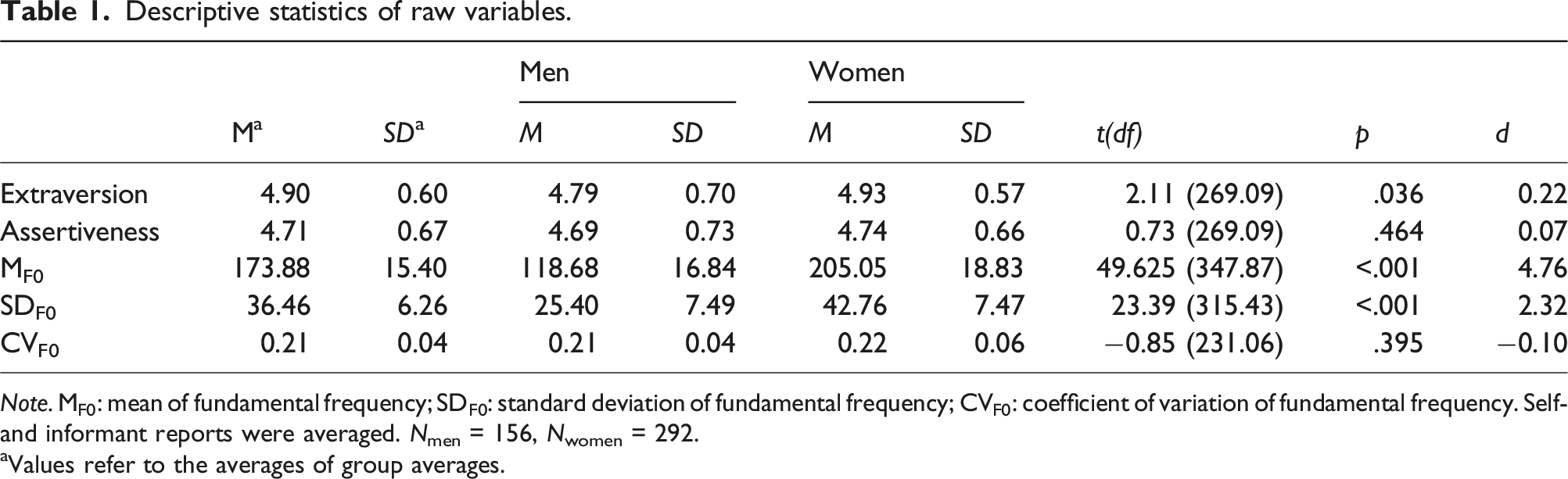
Note. MF0: mean of fundamental frequency; SDF0: standard deviation of fundamental frequency; CVF0: coefficient of variation of fundamental frequency. Self- and informant reports were averaged. Nmen = 156, Nwomen = 292.
aValues refer to the averages of group averages.
Main analyses
For all analyses, we calculated multilevel regression models. Analyses for Hypotheses H1a to H1c included extraversion as the predictor, a random intercept for groups and a random slope for group-mean of extraversion. Due to the group-mean centering of extraversion, reported associations for extraversion reflect within-group differences of individuals. For analyses testing Hypotheses H2, H2a, and the exploratory analyses, segment number as a time variable, extraversion, and its interaction term were the predictors. We modelled the random intercepts for groups and participants and added the segment number, extraversion, their interaction as well as group mean for extraversion as random slopes (Barr et al., 2013). Gender and the group mean for extraversion, reflecting between group differences, were added as control variables to all analyses. In case of non-convergence for the main analyses, we first removed the control variable gender from the model as gender-specific centering already accounts for the gender difference. Next, we removed the random slope for the group-mean of extraversion and the random intercept for group. If the model still did not converge, we removed the random effect for the interaction term. Statistical assumptions were checked for all preregistered models.
Acoustic parameters during the interaction
Multilevel regression analyses of acoustic parameters of the unsegmented recordings as a function of extraversion.

Note. MF0: mean of fundamental frequency; SDF0: standard deviation of fundamental frequency; CVF0: coefficient of variation of fundamental frequency.

Two one-sided tests of practical equivalence for mean (a), standard deviation (b) and coefficient of variation (c) fundamental frequency. Note. F0 = Fundamental Frequency. (a) Was calculated based on raw values, upper and lower bounds were set to |4.31| as the just noticeable difference in hertz, (b) and (c) based on standardized values with upper and lower bounds set to |.10|. 90% CIs were computed.
Modulation of acoustic parameters during interaction
Multilevel regression analyses of acoustic parameters of the segmented recordings as a function of extraversion or assertiveness.
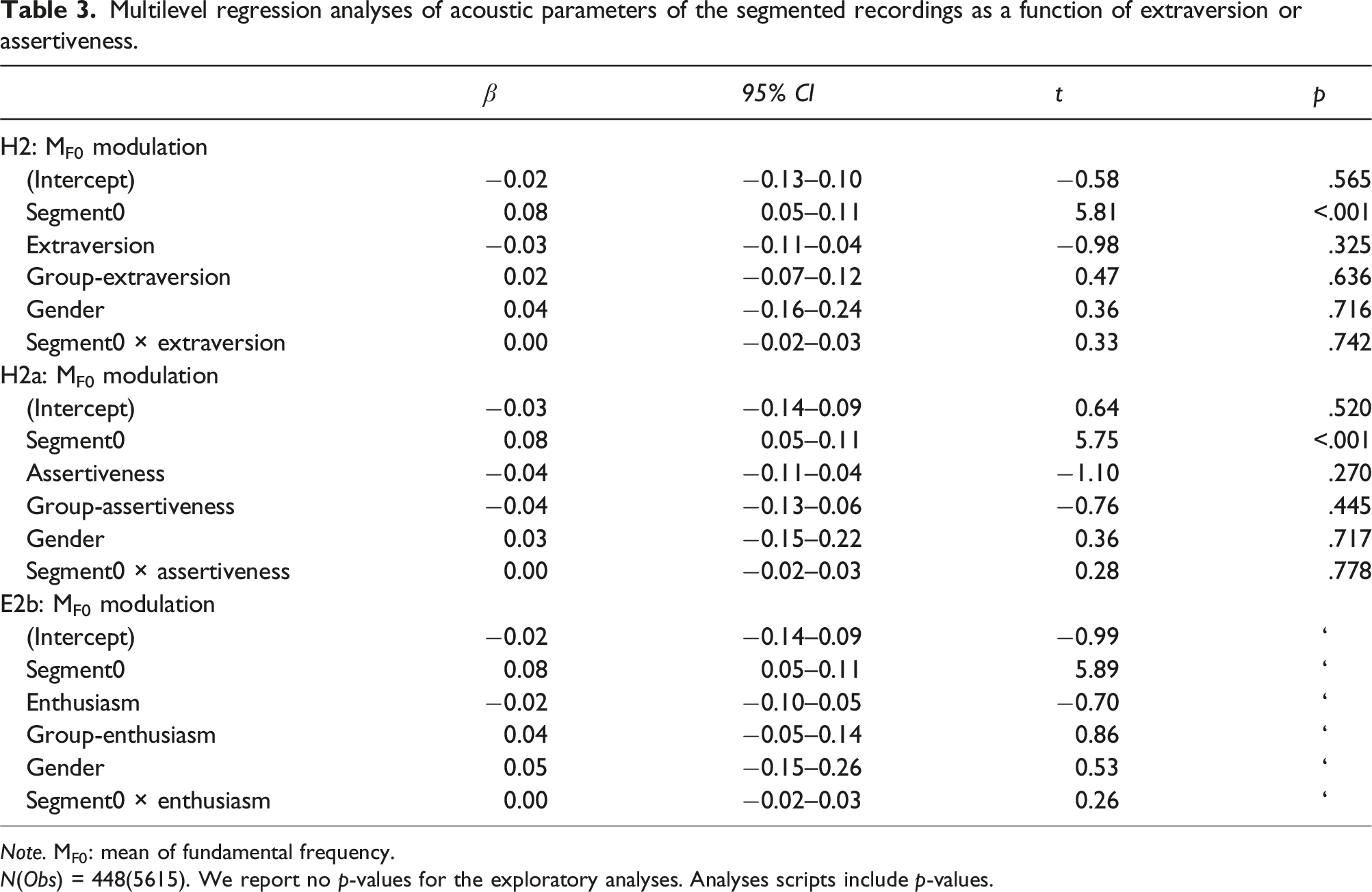
Note. MF0: mean of fundamental frequency.
N(Obs) = 448(5615). We report no p-values for the exploratory analyses. Analyses scripts include p-values.

Two one-sided tests of practical equivalence for extraversion and assertiveness predicting changes in mean fundamental frequency. Note. F0: fundamental frequency. (H2) and (H2a) were tested based on raw values, upper and lower bounds were set to |3.81| as the minimal just noticeable difference in hertz. 90% CIs were computed.
Exploratory analyses
Exploratory analyses for enthusiasm and assertiveness predicting acoustic parameters.

Note. MF0: mean of fundamental frequency; SDF0: standard deviation of fundamental frequency; CVF0: coefficient of variation of fundamental frequency.
N = 448. We report no p-values for the exploratory analyses. Analyses scripts include p-values.
Exploratory robustness checks – investigating alternative explanations
As robustness checks regarding statistical choices, we calculated the following models: we tested whether our results were robust when using self-reported extraversion rather than an average of self- and other-reported extraversion (Table S4), using grand-mean centred extraversion (Table S5), or z-standardized (Table S6) and raw values (Table S7) for MF0, SDF0 and CVF0. We conducted gender-separated analyses to account for the uneven gender distribution of our sample (Tables S8-S9). Further, we categorized extraversion into low, average and high extraversion levels based on differences from grand mean, with values smaller than 1SD from the grand mean categorized as low and values larger than 1SD from the grand mean as high, and compared individuals with average levels of extraversion with higher and lower levels (Table S10). Lastly, we compared only high versus low levels of extraversion (Table S11). Additionally, we tested whether our results were robust when excluding outliers in speech-length, defined as bigger than 2SD from grand mean (Table S12), extracting acoustic parameters in longer segments of 20 s (Table S13) or in shorter segments of 5 s (Table S14). None of these analyses changed our conclusions. Contrast analyses with categorized extraversion levels indicated that especially individuals with low extraversion show less variability in their speech compared to both individuals with average and high extraversion. Stern et al. (2021) reported larger effect sizes for associations of F0 with dominance as compared to extraversion, so we repeated analyses with dominance as a predictor. Dominance was neither associated with MF0, SDF0, CVF0, nor their modulation (Table S15). According to Breitenstein et al. (2010), pitch variability is associated with emotions such as happiness. To this end, we also tested whether positive affect is associated with MF0, SDF0, CVF0 or their modulation. Again, neither general positive affect, self-assurance nor joviality were associated with MF0 and CVF0. Only joviality was associated with SDF0 (Tables S16–S18).
As increasing subglottal pressure, which is necessary for louder voices, is one factor that leads to increases in MF0 (Gramming et al., 1988; Zhang, 2016), we computed models with loudness as a control variable (Table S19). Adding loudness to the model as a control variable did not change our conclusion, suggesting that loudness is unlikely to have masked the association of voice pitch and extraversion. According to rating studies (reviewed in Breil et al., 2021), extraversion is associated with loudness. We therefore tested associations of extraversion with acoustic measurements of loudness (Tables S20-S21). Dependent on the operationalization of loudness, extraversion was associated with loudness and its modulation, with standardized coefficient effect sizes ranging from .07 to .09, and larger confidence intervals compared to analyses testing voice pitch (see Table S1 for descriptive statistics).
Discussion
Extraversion is a very perceivable personality trait (Breil et al., 2021). Previous studies suggested that acoustic characteristics related to voice pitch are valid cues of extraversion, and particularly dominance, which is both empirically and theoretically closely related to the agentic extraverted aspect assertiveness. In this study, we investigated whether acoustic parameters such as MF0, SDF0, CVF0, as well as their dynamic changes, are valid indicators of extraversion during a group interaction. To this end, we used data from a large-scale laboratory group study that included recordings of participants during a group task, and measured extraversion via both self- and informant-reports. We found no compelling evidence that either MF0 or dynamic changes in MF0 are associated with trait extraversion or assertiveness. Even if associations existed, our results suggest they would likely be too small to be perceivable. These null results were unlikely due to statistical choices such as transformation of variables or due to sample characteristics such as the gender distribution and participants’ levels of extraversion. These null results also generalized to the related constructs enthusiasm, dominance, and positive affect. However, extraversion was indeed associated with pitch variability measured as SDF0 and CVF0. Though we were unable to answer whether these associations are perceivable, coefficient sizes are large enough to be substantial, though small. Results also only partially generalized to related constructs, namely the joviality facet of positive affect which was positive associated with only SDF0. Neither dominance nor general positive affect or self-assurance was associated with either SDF0 or CVF0. Pitch variability is indeed a valid indicator of a speaker’s level of extraversion.
Extraverted paralinguistic behaviour in group interaction
Especially during social interactions, extraverted individuals have opportunities to display extraverted behaviour. However, our results suggest that evidence on associations of MF0 and extraversion based on reading standardized texts does not generalize to group discussions. We suggest that the extraverted voice, at least in terms of MF0, is not ubiquitous but may be context-dependent. In a neutral or highly standardized context, extraverted individuals display a lower MF0 to express extraversion. In a group task, extraverted individuals might rather display a louder voice: to assert oneself in a group, one has to be heard. Likewise, showing enthusiasm entails being boisterous and loud.
According to meta-analytic evidence from rating studies, loudness is among the behaviours that show the greatest associations with speaker extraversion (Breil et al., 2021). We suggest that this translates to acoustic parameters: in information-rich social environments such as groups, loudness might be a more salient acoustic parameter associated with extraversion compared to F0. Associations of the latter might in return be too small to be perceivable, as our results suggest. In line with this assumption, Anikin et al. (2024) discuss a loudness-frequency trade-off based on physiological constraints in sound production. In simplified terms, many of the physiological parameters that make one’s voice louder can also increase F0, e.g., increased subglottal pressure and vocal effort, lowered jaw to open the mouth and decreased vocal tract length as a consequence (Titze, 2000). These constraints supposedly make it more difficult to maintain low pitch with increasing loudness. Both increased loudness and lower F0 convey an individual’s threat potential (Anikin et al., 2024; Aung & Puts, 2020). However, due to the loudness-frequency trade-off, individuals should strategically adopt either mechanism to convey formidability. The choice of mechanisms might be situation-specific and relevant in contexts other than threat vocalizations. In the current study, the noisy group interaction environment may necessitate extraverted individuals being louder to assert themselves. Thus, they might be unable to maintain a low pitch. This can explain the lack of generalization of the association of extraversion and voice pitch from prior studies. Exploratory analyses we conducted are consistent with this trade-off when considering speaker extraversion, but confirmatory tests are required to corroborate whether a loudness-frequency trade-off applies for expression of extraversion during group interaction.
F0 variability in group interactions
In highly standardized rating studies, extraversion is associated with having a more variable and expressive voice (Breil et al., 2021). We reported evidence that this is also the case when considering the acoustic parameters SDF0 and CVF0 measuring variability in voice pitch and their association with extraversion. Exploratory analyses suggest that the tendency to express positive emotions is associated with pitch variability, rather than the tendency to experience positive emotions, as trait positive affect was only inconsistently associated with pitch variability. Thus, pitch variability may operate as a form of expressive behaviour, though it remains unclear whether extraverted individuals are also more likely to accurately express their felt state positive affect in terms of pitch variability. Defined by Sabatelli and Rubin (1986), the latter is a vital component of emotional expressivity and evolutionary accounts of emotional expressivity argue that expressive behaviour contributes to social communication and coordination, making expressive behaviour adaptive (Buck, 1984). Other forms of emotional expressivity are also associated with extraversion (Kavanagh et al., 2024; Riggio & Riggio, 2002), illustrating that expressive behaviour is indeed indicative of extraversion. While our results indicate that this might also be the case for acoustic parameters of paraverbal behaviour, Toles et al. (2021) did not replicate associations of extraversion and SDF0 for healthy female singers during ambulatory assessment (N = 47). Like prior discussed associations of MF0 with extraversion, reported associations of pitch variability might thus be context-specific to affiliative contexts in which social coordination is necessary in accordance to its adaptive function.
Cross-context modulation in group interaction
Prior evidence shows that individuals modulate their voice pitch based on the context they are engaged it (e.g., Hughes & Puts, 2021). A simple alternative explanation for our results is that extraverted individuals modulate their voice pitch based on the contextual cues. To that end, extraverted individuals might modulate their MF0 upwards when faced with a social interaction that requires sociability and assertiveness. This might especially be the case when the situation is neither related to status, i.e., speaking to individuals with noticeable differences in status (Leongómez et al., 2017) or related to mating, i.e., speaking to potential romantic partners (reviewed in Karthikeyan & Puts, 2023) but more affiliative in nature. If extraversion is associated with a lower MF0 in neutral contexts, an upwards modulation or increased pitch variability in affiliative situations can explain our reported results.
The human voice in naturalistic interactions
Compared to standardized voice recordings, it is also possible that extraversion is not associated with paralinguistic behaviour as measured by acoustic characteristics during naturalistic interactions, or that these associations are too small to be noteworthy when considering only one singular acoustic feature of paralinguistic behaviour. Paralinguistic behaviour measured via acoustic parameters consists of a multitude of features, both temporal and spectral. F0, and especially MF0, as well as loudness are just few of these temporal features, though MF0 receives the most attention in psychological studies. If the goal is to identify indicators of dispositional personality in speech, a more holistic approach that considers this multitude of features might be more appropriate. For example, Toles et al. (2021) report associations of extraversion with lower voice quality even in healthy singers during ambulatory assessment, which might in turn affect other acoustic measures. Generally, extraversion is associated with paralinguistic behaviour such as speech rate, speech flow and speech-ratio (Breil et al., 2021). Considering the physiological interdependence in sound production and paralinguistic behaviour more broadly would better encapsulate the reality in which speech occurs and expresses personality.
Limitations and strengths
Extraversion is reliably associated with being talkative (Breil et al., 2021) which is also the case in our study: extraverted individuals spent more time talking during the interaction as compared to more introverted individuals. The verbal content of speech might also differ greatly. By segmenting our audio into same-length smaller audio files with a duration of 10 s, we standardized length of analysed audio and were able to average out purely phonetic effects of speech on voice pitch. The latter would have affected the short utterances of introverted individuals the most. However, it is still possible that the verbal content or duration of speech influenced F0. Results that MF0 increases with increased speech duration support this, though this association would be too small to lead to perceivable differences.
Standardizing the length of analysed audio segments to test changes in F0 made it likely that we artificially split the audio of individuals mid-sentence. Thus, we cannot distinguish between variation that occurs during or between utterances. This would be no problem if one considers speech as a continuous flow of utterances, but a conversation naturally includes pauses and speech turns that our extraction procedure was not sensitive to. Instead, a better approach might be to segment and analyse the data according to naturally occurring pauses and utterances despite the consequences of uneven utterance length and phonetic effects. While our extraction approach is unlikely to affect the measurement of individual differences in MF0 (Pisanski et al., 2021), this proposed alternative approach would improve investigations of pitch variability in particular (Benders et al., 2021).
As previously discussed, pitch variability, and even MF0, might be associated with personality-related states or affect. Additionally, high arousal vocalizations such as laughter should be associated with higher pitch variability. We did not measure personality-related states and decided to remove laughter from the audio files to focus on associations of trait extraversion on speech. We are therefore unable to answer whether pitch variability truly expresses emotions.
Despite these limitations, there are multiple strengths to highlight: our study includes a very large sample compared to prior studies. We collected standardized recordings for each participant with little environmental noise that made it possible to examine multiple acoustic parameters. This included loudness of voice, which is otherwise difficult to measure in naturalistic interaction due to confounding of distance to microphone with loudness of voice. We carefully ensured our reported null-results with robustness checks for statistical assumptions and related constructs. We calculated two one-sided tests, utilizing perception-based and empirically derived thresholds for assumed equivalence which allows more confident conclusions.
Conclusion
Our study finds no compelling evidence that extraversion is associated with lower MF0 in naturalistic group discussions among unacquainted individuals, contrasting evidence of studies in more controlled settings. If an association exists, it would likely be too small to be perceivable. However, extraversion was significantly associated with higher pitch variability. We therefore question whether mean voice pitch makes for an extraverted voice in social interactions, and whether associations would be perceivable in natural day-to-day situations. Instead, a holistic approach considering pitch, variations in pitch, loudness and voice qualities should shed light to understand how the human voice communicates speaker personality in daily life.
Supplemental Material
Supplemental Material - Does pitch make for an extraverted voice? Associations of voice pitch and extraversion in group interactions
Supplemental Material for Does pitch make for an extraverted voice? Associations of voice pitch and extraversion in group interactions by Sabine Ostermann, Julia Stern and Lars Penke in Personality Science
Footnotes
Author note
Not applicable.
Acknowledgements
We thank our research assistants and students that worked in this project: Emily Dills, Lennart Geiges, Fenja Klotz, Kenard Lehners, Kim Ossenkopp, Baldur Phillipp, Niclas Quade, Matthias Schneider and Marieke Titzmann for their help in study coding and testing, data collection and literature research.
Author contributions
Declaration of conflicting interests
The author(s) declared no potential conflicts of interest with respect to the research, authorship, and/or publication of this article.
Funding
The author(s) disclosed receipt of the following financial support for the research, authorship, and/or publication of this article: This work was supported by the Deutsche Forschungsgemeinschaft (DFG, German Research Foundation), Project Number: 254142454/GRK 2070.
Data Accessibility Statement
All materials for this project are accessible on the Open Science Framework, including the project preregistration (https://osf.io/ew2z4), project material (https://osf.io/g3yjk/), analysis scripts and data ( ).
).
Supplemental Material
Supplemental material for this article is available online. Depending on the article type, these usually include a Transparency Checklist, a Transparent Peer Review File, and optional materials from the authors.
Notes
References
Supplementary Material
Please find the following supplemental material available below.
For Open Access articles published under a Creative Commons License, all supplemental material carries the same license as the article it is associated with.
For non-Open Access articles published, all supplemental material carries a non-exclusive license, and permission requests for re-use of supplemental material or any part of supplemental material shall be sent directly to the copyright owner as specified in the copyright notice associated with the article.
