




Abstract
The aim of this research was to explore the concept of virtual personality. Traditional personality models were developed based on characteristics of the real (or offline) world. Given the evidence suggesting that people may behave differently in virtual environments, it is important to explore whether there is a virtual way of being: a virtual personality. To address this objective, three consecutive studies were conducted using various samples of Spanish-speaking adults from the general population. In Study 1, a list of adjectives that people reported using to describe how they and others are in virtual environments was developed. In Study 2, the list was psychometrically analyzed to generate both a theoretical model and a measurement instrument. A three-factor/traits model was obtained: authenticity, cautiousness, and agreeableness and sociability. The virtual personality model was named ACAS. In Study 3, its associations with normal traits and its predictive power over internet related behaviors were analyzed. ACAS’ traits are related to normal personality traits but do not constitute the same construct and present incremental validity when predicting internet related behaviors. This virtual personality model constitutes an initial approach and should be studied in greater depth in other samples and in longitudinal studies that analyze its temporal stability.
The rise of virtual environments, the internet, and social networks has fundamentally transformed the way we communicate, work, interact, and spend our leisure time. This shift has blurred the lines between online and offline life, even prompting the concept of ‘hybrid beings’ (Lin et al., 2018; Šimůnková, 2019). Despite this scenario, current personality assessment methods (e.g., Ashton & Lee, 2005; de la Iglesia & Castro Solano, 2024; John & Srivastava, 1999) primarily focus on ‘real world' behavior and neglect the digital aspects that shape most lives today. While personality traits are considered relatively stable across contexts (e.g., Allport & Odbert, 1936; Costa & McCrae, 1992; Digman, 1990; Funder, 2001; Goldberg, 1990; John et al., 2008), researchers have highlighted the importance of considering frame-of-reference effects when measuring and studying personality (Mischel & Shoda, 1995; Sheldon et al., 1997). How a test item or question is phrased (e.g., referring to work vs. home, or family vs. colleagues vs. friends, or not specifying anything) may derive in distorted responses, potentially leading to a ‘hidden-frame’ effect where individuals answer based on an unintended context due to this lack of specificity (Robie et al., 2017; Schulze et al., 2021).
When attempting to examine the possible associations between personality traits and behaviors in digital environments, research in cyberpsychology (e.g., Huang, 2019; Liu & Campbell, 2017; Lupano Perugini & Castro Solano, 2022; Marciano et al., 2020; Stover et al., 2023) typically relies on models such as the Big Five (Costa & McCrae, 1985; John & Srivastava, 1999). In these studies, personality measures are not specific to virtual environments. However, the way people are in virtual environments does not necessarily align with the way people are in the ‘real world’. In virtual spaces, interaction dynamics and self-presentation may differ, potentially leading to differences in cognitions, emotions, and behaviors that may not align with what occurs in ‘real life’ (de la Iglesia & Castro Solano, 2024; Joinson & Paine, 2009; McFarland & Ployhart, 2015). It is thus possible that some individuals exhibit different personality traits in virtual spaces compared to physical spaces, and/or that behaviors in the virtual environment group in personality traits dimensions that do not replicate the factorial structures of traditional models.
Given this scenario, it is important to study whether there is a variation in personality in virtual environments, both in terms of its presentation (is the dimensionality the same?) and its comparison with traditional measures of personality in offline environments (is there a discrepancy in how traits are presented in both contexts?). If variation is found, should this be reflected in differentiated personality assessment instruments? Bunker and Kwan (2021) suggest that non-specific personality assessments may fall short in explaining and/or predicting psychological aspects or behaviors within digitized contexts.
Virtual versus “real-world” personality
To date, there has been limited research that has examined whether there are differences in personality traits in offline and digitized contexts. Blumer and Döring (2012), for example, attempted to verify whether the Big Five traits were similar when assessed in offline and online contexts. They found that participants obtained significantly lower scores on all traits in the online context, indicating that this difference in contexts (online vs. offline) affects the expression of personality. In the same line of research, Taber and Whittaker (2018, 2020) also compared Big Five’s traits in the offline context and three social networks (Facebook, Snapchat, and Instagram). Results were similar: participants obtained lower scores on the social media measure of traits. On the other hand, Bunker and Kwan (2021) analyzed the dimensionality (using confirmatory factor analysis) of the Big Five comparing both contexts (“physical world” vs. “social media”). They found that the five-factor structure was replicated in both contexts and that the scores of the digital context measures were lower. In addition, the measures between both contexts had moderate to strong associations. The moderate to high intercorrelations of traits between the two contexts suggest that the offline and social media Big Five are similar, but they are not the same. Additionally, the online context measures were better predictors of online behaviors (time of internet use, reasons for use).
Data-driven lexical approach to the study of virtual personality
The aforementioned research measured personality in virtual contexts by administering the Big Five Inventory- 2 (Soto & John, 2017) twice: the traditional version and one specific to the virtual context (“internet,” “social network”). Given that the FFM (Costa & McCrae, 1985; John & Srivastava, 1999) emerged from a lexical data-driven approach, we propose replicating this methodology to analyze the dimensionality of personality in virtual environments. Data-driven lexical approaches are commonly used in individual differences studies. In accordance with this framework, if an individual attribute is vital for effective social and practical engagement, people will communicate about it and consequently develop a term to describe it (Goldberg, 1981). When it comes to judging other individuals, the ability to quickly determine to what extent people have certain general attributes (i.e., factors) is useful in anticipating future interactions and behaviors (McAdams, 1995). Within this lexical hypothesis, a few basic but important replicable factors are selected, instead of a long list of idiosyncratic attributes with little chance of replication. This view agrees with several recent studies on personality (cf., Ashton & Lee, 2005; De Raad et al., 2010; Saucier, 2009) Psycholexical studies utilize data-driven methodologies to derive conclusions, such as factorial structures, from data analysis, aiming to ensure generalizability and replicability across different populations (Chow, 2002). Data-driven approaches rely on empirical data to guide the development and refinement of assessment tools and models. Unlike theory-driven methods, which are based on pre-existing theoretical frameworks, data-driven approaches prioritize evidence obtained from actual observations and statistical analyses. This ensures that the assessments are grounded in real-world data and accurately reflect personality traits and behaviors. Here, our goal was to identify a personality trait model derived from the analysis of adjectives used by individuals within virtual contexts to describe themselves and others. Based on this background, we hypothesized that a personality model specifically designed for the virtual context would possess greater ecological validity and predictive power of variables related to the virtual context.
The present study
This research comprises three studies that aim to explore the concept of virtual personality. Study 1 aimed to generate a comprehensive list of adjectives commonly used to describe oneself and others in virtual environments. To achieve this, we collected phrases that individuals typically use to describe themselves and others in these settings. From these phrases, adjectives were extracted and compiled into a word corpus. The goal of converting phrases into simple adjectives was to create a shorter, more manageable list that accurately represents personality traits in virtual environments. Study 2 utilized this list of adjectives to perform psychometric analyses. The objective was to construct a parsimonious model of the fundamental factors of personality traits frequently observed in virtual environments from the perspective of laypeople. This study was conducted in two phases: the first involved exploratory factor analysis to examine how the adjectives grouped based on participant responses. Adjectives with low factor loadings or cross-loadings were eliminated. Subsequently, confirmatory factor analysis was used to validate the identified factors. Study 3 focused on evaluating the predictive power of the resulting model for variables related to internet use. Given that this model was developed specifically to assess personality in virtual environments, it was anticipated that it would significantly outperform the predictive power of the Big Five Model. The virtual personality model was hypothesized to have incremental validity over the traditional personality model (e.g., Big Five Model) that referred to the “real world”.
Procedure for all studies
Data were collected using snowball sampling in the general population of Argentina in 2023. Participation was anonymous and voluntary. The main inclusion criteria was that participants were of legal age (18 years old or older). Surveys were administered online using SurveyMonkey. On the survey’s first page, participant consent was requested, ensuring the anonymity of data and its exclusive use for research purposes. After learning about the research objectives, participants provided their free and informed consent. They were informed that they could withdraw from participation at any time and would not be required to provide any explanation and that they would not be penalized for doing so. The research followed the international ethical guidelines (APA and NC3R) and those of the National Council of Scientific and Technical Research (CONICET) for ethical conduct in the Social Sciences and Humanities (Resolution No. 2857, 2006), and it has the approval of the corresponding ethics committees (RESCS-2020-345-E-UBA-REC). Data sets and instructions for analyses are available at https://osf.io/wr9xc/files/osfstorage.
Study 1
Development of an adjective list for virtual personality
The objective of Study 1 was to produce a list of attributes related to personality characteristics that are generally exhibited in virtual environments. Therefore, first, a corpus was developed, and then a limited number of attributes (adjectives) were selected to create a shorter and more manageable list of characteristics.
While dictionaries have traditionally served as a starting point for data-driven lexical studies, an alternative approach was employed in this study. This approach involved creating a corpus of words derived from terms spontaneously generated by laypersons in virtual environments. Utilizing such a corpus to develop a list of characteristics offers the advantage that the items included represent popular and dynamic language, and we assume these words are frequently used to describe others in virtual settings. Secondly, in generating a refined list of psychological characteristics, statistical and syntactic criteria (i.e., superficial or structural) were favored over semantic judgments made by judges or experts. This was done to exclude any theoretical influence from an academic standpoint, with the aim of achieving replication across different populations (Castro Solano & Cosentino, 2019). This methodology was used to develop inductive models of positive and negative traits in other studies (Cosentino & Castro Solano, 2017, 2025).
Method
Participants
Sample A was composed of 496 individuals (52.82% woman). Their mean age was 40.6 years old (SD = 14.8, range 18–80). Sixty-eight percent of the participants were either currently pursuing or had completed their university studies, while the remaining 32% had completed secondary education. All participants resided in Buenos Aires, Argentina, and were Spanish-speaking.
Materials and procedure
Participants were asked to describe themselves and someone else in virtual environments. In both cases open-response paragraphs were used. Instructions for self-description were: “In the virtual world, people are sometimes similar and sometimes different from how they are in the offline world. We ask you to describe in a brief paragraph how you are in the virtual world. Think about how you generally behave in the virtual environments you use (WhatsApp, Telegram, Instagram, Twitter, Facebook, Twitch, Reddit, Discord, websites in general, or others)”. Following their self-description, participants were asked to describe someone else also thinking about how they are in the virtual world and providing a brief paragraph. Instructions for describing someone else were: “Now, in another brief paragraph, describe how someone you know behaves in virtual environments:”
A content analysis was conducted using participants’ responses through the Quanteda package in R. First, each of the provided texts underwent preprocessing. The sentences were tokenized into individual words or units of meaning. Punctuation marks, numbers, and special characters (e.g., @, ¡!!, Q, #, etc.,) were then removed. Following this, stopwords—words with minimal semantic significance, such as articles, pronouns, and prepositions—were eliminated. Both lemmatization and stemming were employed to process the text. Lemmatization was applied first to reduce the tokens to their base form or ‘lemma’ (e.g., kind, kindly, kindness = kind). Stemming was subsequently used to further reduce the words to their root form (e.g., authentic, authenticity = authentic). With the resulting tokens, the frequencies of the most common words were calculated. These tokens were then analyzed by two judges, and adjectives related to psychological individual differences were extracted. Idiosyncratic terms with a frequency of 1 were excluded from the list.
Results
A total of 10,280 words were collected from the participants’ self-descriptions and 7815 words from the descriptions of someone else. On average, each participant produced 16 words in their self-descriptions and 13 words in the descriptions of someone else’s. After the tokenization process, these words were reduced to 441 tokens. Low-frequency terms (e.g., abyecto/abject, errático /erratic, sarcástico/sarcastic) and non-adjective words were removed. Among the most frequent non-adjective words were red/net, virtual/virtual, and vida/life, while the least frequent included privacidad/privacy, comportamiento/behavior, and situación/situation. The result was a list of 40 adjectives corresponding to the first question (What are you like in virtual environments?) and a list of 6 adjectives corresponding to the second question (What are others like in virtual environments?). These items formed the basis for the instrument that would be used in the subsequent study. The complete list of adjectives from this phase is included in Appendix 1.
Discussion for study 1
The aim of this study was to extract personality characteristics (adjectives) from self-descriptions and descriptions of others in virtual environments. Analysis of these descriptions led to the identification of 46 adjectives reflecting individual differences in virtual personality. Most of these adjectives align with descriptors of the FFM. Specifically, the identified adjectives are primarily associated with extraversion (e.g., active, cheerful), introversion (e.g., reserved, withdrawn), neuroticism or emotional stability (e.g., balanced, anxious), and a dimension related to authenticity and sincerity (e.g., authentic, genuine) versus superficiality (e.g., superficial, frivolous). This latter dimension could partially be integrated into the agreeableness factor.
Specifically, regarding agreeableness, only two relevant adjectives were identified (e.g., kind, pleasant), and no adjectives associated with conscientiousness were found. The absence of adjectives related to conscientiousness in online environments may relate to the fact that virtual environments usually have fewer constraints than offline settings, facilitate more spontaneous and less planned interactions. Additionally, these online contexts often exhibit negative behaviors such as cyberbullying, cybercrime, harassment, and risky behaviors (Baccarella et al., 2018; Tsai et al., 2017), suggesting that irresponsible behavior may be more prevalent on social media platforms. It seems that in these contexts, users do not adhere to the norms commonly observed in the offline world. This may explain why conscientiousness and agreeableness were less prominent in self-descriptions provided by users. In this sense, Bunker and Kwan (2021), observed significantly lower conscientiousness scores in online contexts compared to offline ones and suggested that this may reflect a difference in the manifestation of conscientiousness in online environments, rather than an absence of the trait itself.
Study 2
Development of a personality traits’ model in virtual environments
Study 2 aimed at constructing a parsimonious model of the cardinal or fundamental factors of frequently observed personality traits in virtual environments from the laypeople’s perspective. It was important that the model obtained was simple and clean. For this, a two-phase method was used.
Method
Phase 1: Factor exploration
Participants
A convenience sample was used for model exploration (Sample B). It consisted of 577 participants (56.32% woman) with a mean age of 34.3 years old (SD = 12.6; range 18–80). Sixty-eight percent of the participants were either currently pursuing or had completed their university studies, while the remaining 32% had completed secondary education. All participants resided in Buenos Aires, Argentina, and were Spanish-speaking.
Materials and procedure
The list of 46 adjectives obtained from Study 1 was used. Participants had to read each adjective and respond using a Likert scale of frequency that ranged from 1 (never) to 7 (always) to indicate the degree to which each of the adjectives described how they are in the virtual world. Instructions were: “Below you will find a series of adjectives that people can use to describe themselves in the virtual world. The virtual world refers to any digital context, including social networks (e.g., Instagram, Facebook, Twitter), online communities (e.g., Discord, Reddit), streaming/video platforms (e.g., Twitch, YouTube), browsers (e.g., Google, Brave), virtual realities (e.g., video games), use of personal technology (computer, cellphone), etc. Indicate the degree to which these adjectives describe you when you are in virtual environments.”
The aim of Phase 1 was to select clearly defined factors by means of an Exploratory Factor Analysis (EFA). As an initial step, descriptive statistics (mean, standard deviation, skewness, kurtosis) were estimated for each item. Then, the univariate normality of the items was checked. Items with skewness and kurtosis values below 2 were retained. To assess the multivariate normality of the data, we used the MVN package (version 5.7, Korkmaz et al., 2014) in the R statistical computing environment (version 4.3.3, R Core Team, 2024). To determine the number of factors to extract, we used the FACTOR software (version 10.4.01, Lorenzo-Seva & Ferrando, 2013) and a parallel analysis based on the minimum rank factor analysis (Timmerman & Lorenzo-Seva, 2011). Also, eigenvalues prior to rotation were assessed. Factor rotation was oblique (direct oblimin) since personality dimensions tend to correlate with each other (Lloret-Segura et al., 2014). Due to the ordinal nature of the items the polychoric covariance matrix was used (Freiberg Hoffmann et al., 2013; Muthén & Kaplan, 1985). Factors were selected following the suggestions of Comrey and Lee (1992): each factor (a) should comprise at least 4 items with “good” factor loadings (>.55), and (b) at least one item should have a “very good” factor loading, (>.63).
Results
After assessing items’ descriptive statistics, two items (fake and aggressive) were dropped. The data were multivariately non-normal according to the Henze-Zirkler multivariate normality test (HZ = 1.01, p < .001). Sample size was adequate for the number of variables included in the analysis (KMO = .89; Bartlett’s Test of Sphericity: X2 = 8790, 406 df, p < .0001). Parallel analysis based on the minimum rank factor analysis suggested that three factors should be retained. Prior to rotation, the eigenvalues were as follows: 3.48, 2.84, and 2.66. The explained variance was 52.9% (Factor 1 = 20.5%, Factor 2 = 16.7%, Factor 3 = 15.7%). Factors were rotated to improve their interpretation. The factor structure was refined through an iterative process, ensuring that all retained items met the established criteria in terms of factor loadings and theoretical interpretability. As a result, a three-factor structure of 17 elements (adjectives) was obtained (Appendix B). Dimensions were labeled as: Authenticity (e.g., sincere, real, transparent, authentic, self-confident, direct); Cautiousness (e.g., reserved, guarded, cautious, conservative, discreet, introverted); and Agreeableness/Sociability (e.g., pleasant, funny, friendly, sociable, fun).
Phase 2: Model refinement
Participants
A separate convenience sample (Sample C), distinct from that of Phase 1, was used for model refinement. It consisted of 384 participants (51.04% woman) with a mean age of 35.5 years (SD = 12.5; range 18–80). Seventy-two percent of these participants were either currently pursuing or had completed their university studies, while the remaining 28% had completed secondary education. All participants resided in Buenos Aires, Argentina, and were Spanish-speaking.
Materials and procedure
The list of 17 adjectives from Phase 1 was used. Format response and instructions were the same. Phase 2 aimed at developing a refined version of the three-factor model obtained in Phase 1. For this, structural equation modeling was framed in an exploratory mode (Byrne, 2010). Fit indexes assessed included the Comparative Fit Index (CFI), the Standardized Root Mean Square Residual (SRMR), and the Root Mean Square Error of Approximation (RMSEA). Fit to the data was reached if cut-off values were close to and above .95 for CFI, close to and below .08 for SRMR, and below .07 for RMSEA (with the upper limit of the confidence interval <.08; Hooper et al., 2008; Hu & Bentler, 1999; Steiger, 2007). The refined model had to meet three characteristics: (a) good model fit to the data determined by the three fit indexes, (b) omega reliability for each factor ≥.80, and (c) few items per factor but at least four (Costello & Osborne, 2005; Kenny, 1979; Pett et al., 2003; Tabachnick & Fidell, 2013). The R package lavaan was used for the structural equation modeling analyses (version 0.5-23.1097, Rosseel, 2012) and model estimation was robust diagonally weighted least squares (DWLS robust).
Results
Fit indexes obtained for the 17-element model were: χ2(116) = 210.79, p < .01, CFI = .91, SRMR = .067, RMSEA = .077 (90% confidence interval = .072–.083). To improve model fit, modification indices were analyzed. A cross-loading between the indicators “friendly” and “sociable” was detected and the model was re-specified by removing the adjective “sociable”. The final model had 16 adjectives and it’s fit was as follows: χ2(116) = 494, p < .01, CFI = 0.96, SRMR = .072, RMSEA = .065 (90% confidence interval = .059–.071). The model showed a good fit and met all the expected criteria. Cronbach’s alphas for each dimension were adequate (Authenticity = .87, Cautiousness = .83, and Agreeableness/Sociability = .84); similar values were obtained when estimating McDonald’s omega coefficients (Authenticity = .87, Cautiousness = .84, and Agreeableness/Sociability = .85). Model was named ACAS (which is an acronym of the factors’ names) and the measured was named ACASI (or IACAS in Spanish) where “I” refers to Inventory. The complete measure may be seen in Appendix C. Descriptive statistics for the three factors are: Authenticity, M = 5.24, SD = 1.22, Cautiousness, M = 4.33, SD = 1.26, and Agreeableness/Sociability, M = 4.68, SD = 1.19.
Discussion for study 2
The study results provide evidence of a robust fit of the final model to the data, supported by the calculated fit indices. Despite having a limited number of items per factor, the reliability coefficients were excellent (> .80), reflecting strong internal consistency. Regarding the adjectives “friendly” and “sociable,” both terms exhibit high semantic similarity in Spanish and, as the data suggest, were significantly correlated. The removal of one of these items resulted in a notable improvement in model fit, underscoring the importance of refining items to optimize model adequacy.
Study 3
Incremental validity of the ACAS model for predicting internet related variables
Study 3 aimed to study the predictive power of the ACAS model in predicting variables related to internet use. Since the ACAS model was developed to assess personality exclusively in virtual environments, it was expected that it would significantly outperform the predictive power of a non-specific personality model (Big Five Model). That is, it was hypothesized that the ACAS model would show significant incremental validity over the normal personality traits model when predicting internet related variables.
Method
Participants
Sample used was Sample 2 from Study 2 (Sample C).
Materials
Four psychometric tests were administered in the following order: ACAS Inventory, Big Five Inventory, Generalized Problematic Internet Use Scale 2 and Motives to Use Internet. ACAS Inventory. The ACASI is the 16-item measurement developed in Phase 2 of Study 2. It assesses the three cardinal traits of personality in virtual contexts: authenticity, cautiousness, and agreeableness/sociability. Psychometric properties, response format and instructions were described in Study 2. Big Five Inventory (BFI; John et al., 1991, Argentine adaptation, Castro Solano & Casullo, 2001). This measure was used to assess the normal personality traits of the FFM: extraversion, agreeableness, conscientiousness, neuroticism, and openness. Traits are measured by 44 elements which are answered using a 5-point Likert scale that ranges from 1 (completely disagree) to 5 (completely agree). Instructions for this test are: “Here is a list of characteristics that are usually used to describe people. Indicate to what extent each phrase adequately describes you. If you completely agree with the statement, choose STRONGLY AGREE. If you completely disagree with the statement, choose STRONGLY DISAGREE. If you neither AGREE nor DISAGREE, choose the corresponding option. Remember that you have intermediate options.” It was locally studied to test its psychometric properties with satisfactory results (Castro Solano & Casullo, 2001). Regarding internal consistency in this sample, all omegas values were acceptable (alphas in brackets): .61 [.75] for extraversion, .73 [.79] for neuroticism, .71 [.72] for agreeableness, .80 [.84] for conscientiousness, and .82 [.80] for openness to experience. Generalized Problematic Internet Use Scale 2 (GPIUS-; Caplan, 2010, argentine adaptation Stover et al., 2023). The scale consists of 15 items using an 8-point Likert response format, grouped into five dimensions: preference for online interaction, mood regulation, negative outcomes, compulsive use, and cognitive preoccupation, with three items representing each dimension. Additionally, a score for deficient regulation can be obtained by summing the scores for compulsive use and cognitive preoccupation. The scale enables the calculation of either an overall score for generalized problematic Internet use by summing all 15 items or separate scores for each dimension. The adaptation for the Argentine population has good evidence of construct validity and reliability (Stover et al., 2023). In this sample, the omegas (alphas in brackets) were .85 [.85] for online interaction, .803 [.81] for mood regulation, .82 [.83] for negative outcomes, .87 [.87] for deficient regulation, .84 [.85] for compulsive use, and .83 [.83] for cognitive preoccupation. Motives for Social Media Use (Lupano Perugini & Castro Solano, 2021). This scale was used to assess the different reasons why people use the internet, which are maintenance of personal relationships, entertainment and exhibitionism, and seeking company. This 28-item instrument is answered using a 5-point Likert scale that ranges from 1 (strongly disagree) to 7 (strongly agree). In this sample, the omegas (alphas in brackets) were .73 [.75] for maintenance of personal relationships and seeking information, .81 [.82] for entertainment and exhibitionism, and .91 [.92] for seeking company.
Procedure
First, associations between the variables of the ACAS model, normal personality traits, problematic internet use, and motives to use the internet were tested by product-moment Pearson correlation. Afterwards, a series of hierarchical multiple regression analyses were conducted in which the different dimensions of problematic Internet use and the three motives for internet use (maintenance of interpersonal relationships and information seeking, entertainment and exhibitionism, and seeking company) were the criterion variable. The first block included normal personality traits as predictors, and in the second block, the three dimensions of the ACAS were added. Multicollinearity tests were calculated for all models, yielding satisfactory indices. Tolerance values were close to 1, and the variance inflation factor values were less than 2, indicating that multicollinearity did not affect the models. The Durbin-Watson statistic was also calculated to test for the absence of autocorrelation in the residuals (prediction errors). Values close to 2 were obtained, indicating the absence of autocorrelation in the sample (Hair et al., 2010). SPSS Statistics v 29.0.1.0 was used for all analyses.
Results
Associations between the ACAS’ traits, normal personality traits and variables related to internet use.

Note. ns statistically non-significant. . * p < .05. **p < .01. Values in bold correspond to large effect sizes, and values in bold italic correspond to medium effect sizes (Funder & Ozer, 2019).
Multiple hierarchical regression for problematic internet use.
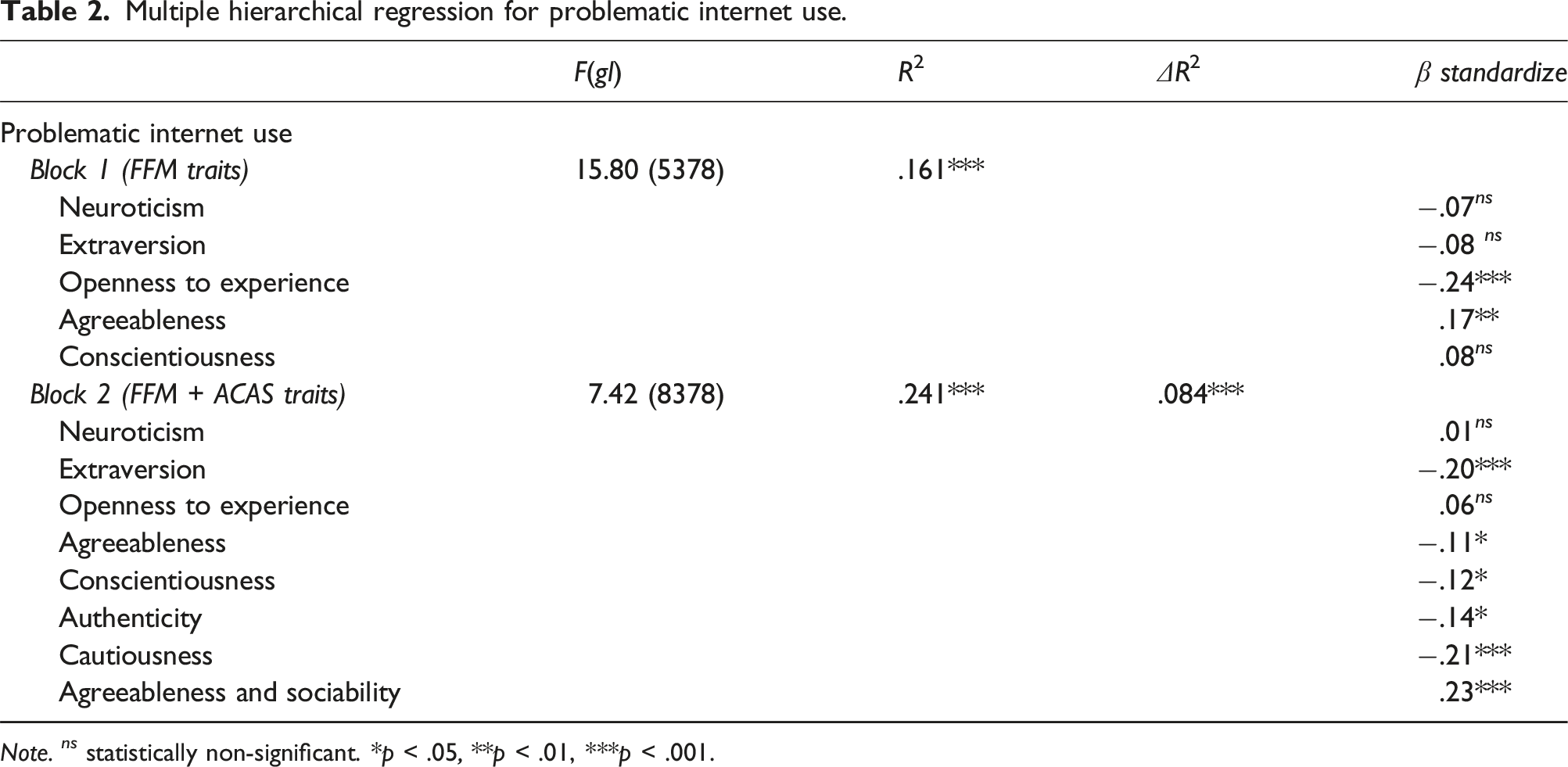
Note. ns statistically non-significant. * p < .05, **p < .01, *** p < .001.
Multiple hierarchical regression for the subscales of problematic internet use.

Note. ns statistically non-significant. * p < .05, **p < .01, *** p < .001.
Multiple hierarchical regressions for motives to use the internet.

Note. ns statistically non-significant. * p < .05, **p < .01, *** p < .001.
Since we did not control for social desirability in any way, we were unable to statistically account for this factor, which may have distorted the obtained results. As an alternative, results using ipsatized scores are available as Supplemental Materials. As it may be seen, differences were found in approximately 30% of the associations, but not in any of the model statistics of the multiple hierarchical linear regressions, and in some of the regression coefficients.
Discussion for study 3
As for the associations, the findings suggest that ACAS’ traits are related to normal personality traits and are also associated with internet-related outcomes, such as problematic internet use and motives for internet use. It should be noted that most correlations are within the weak range of interpretation. Regarding regression analyses, virtual personality significantly enhanced the explained variance in internet behavior compared to FFM traits, demonstrating its incremental validity. These findings suggest that the traits included in the virtual personality model seem relevant to understand online behavior. It should be noted that the inclusion of ACAS’ traits not only significantly increases explained variance, but also introduces changes in the significance of FFM traits when Block 1 and Block 2 are compared. This could be due to ACAS’ traits complementing or partially replacing FFM traits’ elements. For example, cautiousness association to conscientiousness and agreeableness and sociability association to extraversion may strengthen the role of those FFM traits in the regression models tested.
General discussion
This research adopted an inductive approach with high ecological validity to generate data-driven personality specific to the virtual world. Background research on this topic had either used the traditional measures of personality traits that were not specific to the virtual world vicissitudes (e.g., Marciano et al., 2020) or had attempted to adapt these measures to the virtual world in a light weighted manner (e.g., instructions being “Now think of the online world” and elements of the measure remain the same; Bunker & Kwan, 2021). Given that what occurs in virtual environments may not reflect what occurs in the offline world (McFarland & Ployhart, 2015) and the “way of being” may differ between these scenarios it was important to study whether personality traits specific to virtual environments. Using the traditional personality models, such as the FFM, in a very different context for which it was designed could lead to some personality characteristics being either overrepresented and/or some specific virtual world characteristics being underrepresented. This knowledge gap could be reflected in two main questions: “What is the dimensionality of the expression of personality in virtual environments?” and “Are there differences between personality traits of the “real world” and personality traits of virtual environments?”.
Is there a virtual personality?
To begin with, in Study 1 we used a data-driven lexical approach and obtained an extended list of adjectives that described how people are in virtual environments. This list was further analyzed in Study 2 where it was refined and shortened. As a result, a three-factor model of virtual personality was obtained. The first dimension was named Authenticity and it reflected how someone is sincere, real, transparent, authentic, self-assured, and direct. The second factor was named Cautiousness and its adjectives were reserved, guarded, cautious, conservative, discreet, and introverted. The third dimension was named Agreeableness/Sociability and its characteristics were likable, funny, fun, friendly and pleasant. The model was named ACAS.
So, in the virtual world these seem to be the main dimensions that describe how people are and how they perceive other people to be. Therefore, an assessment of virtual personality would be complete if it describes: (1) the degree in which the individual is true to his/her way of generally being in a virtual environment and is honest and transparent about his/her intentions; (2) the degree in which he/she is cautious in the things he/she does in the virtual world, what he/she shares with others and if he/she takes safety measures when in virtual environments; and, finally, (3) the degree to which he/she seeks others to interact in those virtual scenarios and is kind and fun in those interactions.
It is interesting to notice that no adjectives that reflected negative personality traits (e.g., neuroticism) were obtained by this approach. The adjectives described by participants in the initial study (e.g., superficial, fake, frivolous, anxious) did not hold in subsequent analyses. This finding is consistent with the study by Bunker and Kwan (2021), and it is possible that those who perceive themselves with negative characteristics, given the high degree of social desirability in virtual and online contexts, tend to underreport these negative characteristics (van Dijck, 2013).
Are virtual and offline personalities the same?
To test if personality traits in virtual and offline environments were related, we studied the association between ACAS’ and FFM’s traits. On one hand, authenticity was significantly and positively related to conscientiousness, extraversion, agreeableness, and openness to experience. The highest association was with conscientiousness possible reflecting the sense of responsibility and reliability in presenting oneself in a true manner even in virtual environments. On the other hand, the association with neuroticism was negative. Individuals with high neuroticism seem to be less authentic in virtual environments. Or interpreting it the other way: individuals which are less authentic in virtual environments seem to be high in neuroticism. It is possible that, for these people, these environments enable a fantasy scenario in which real world characteristics are precluded and one may “live” another way of being that does not accurately reflect offline personality.
Regarding cautiousness, this trait was significantly related to all FFM’s traits except agreeableness. Those who are cautious in virtual environments are less extroverted, less neurotic, less open to experience and more conscientious. Here, extraversion was the trait with the highest association. This may be because “introverted” is one of the adjectives that compose this trait and cautiousness may reflect a tendency to underexpose oneself in virtual environments due to fear or to lack of motivation to do so. This trait was also positively related to conscientiousness which may reflect a “think before you act” predisposition.
Finally, Agreeableness/Sociability was significantly related to all traits except conscientiousness. Individuals who are friendly in virtual environments are also high in extraversion, agreeableness, and openness to experience. All these results could easily be interpreted as reflecting someone who in virtual environments express their willingness for interacting with others in a kind manner, a high curiosity and interest for new experiences and meeting new people. Also, this trait had a negative association with neuroticism. It seems that individuals high on neuroticism are not social or friendly in virtual environments. This may be due to lack of social skills, a tendency to feeling tense, awkward, or fearing exposure to online social interactions.
In general, it was observed that offline and virtual personality traits are significantly related. However, the absolute numbers of the associations indicate that virtual personality traits and “real world” traits are not the same constructs.
Does virtual personality predict internet related behavior?
To begin with, product-moment Pearson associations were studied to see the relation of ACAS’s traits and internet related behavior. In general, most associations were within the weak range of interpretation but statistically significant. In the case of Authenticity, the trait was positively related to the motive for using the internet, maintaining interpersonal relationships and seeking information, and negatively related to entertainment and exhibitionism and seeking company. These findings are further supported by research by McKenna et al. (2002), who concluded that internet users who were sincere in their online self-presentation were more likely to develop lasting online social relationships that translated into their offline lives. Similarly, Grieve and Watkinson (2016) noted that authentic self-presentation on Facebook was associated with better social connection and lower perceived stress. This trait was also negatively related to problematic internet use. Given the precedent of Bunker and Kwan (2021) research that verified that online users scored relatively low on the trait of consciousness it may be interpreted that a similar pattern emerges with authenticity and problematic internet use is most common in individuals low on this trait.
Regarding the trait of Cautiousness it was found to be negatively related to all three motives to use the internet and to problematic internet use. Given that this trait seems to address a reluctance and conservative and conscious approach to the virtual world it appears that individuals that are highly cautious have low motive to use the internet and low problematic internet use. This finding relates to those reported regarding the lower use of the internet in individuals’ high consciousness (Blackwell et al., 2017; Castro Solano & Lupano Perugini, 2019; Roos & Kazemi, 2021).
The Agreeable/Sociability trait was positively related to maintenance of interpersonal relationships and information seeking and entertainment and exhibitionism. No association was found with seeking company and with problematic internet use. This finding is consistent with previous studies where it was found that agreeable, extraverted individuals with low levels of isolation also had as their main motive for Internet use to stay in contact with others and seek information (e.g., Horzum, 2016; Kircaburun et al., 2018; Lupano Perugini & Castro Solano, 2021; Mancinelli et al., 2019). Moreover, this result aligns with the rich get richer hypothesis since previous empirical studies have shown that individuals who are agreeable and extraverted offline tend to be agreeable and extraverted in online contexts as well (Cheng et al., 2019; Gil de Zúñiga et al., 2017). These traits were also related to mood regulation, which somehow indicates that individuals who score high in this trait tend to use this technology not only to stay in touch with others but also as a strategy for emotion regulation by preferring online activities.
Finally, several multiple hierarchical regressions were calculated to test if the ACAS’ traits may predict internet related behavior and to study if there were differences in power prediction compared to FFM’s traits. In all cases it was observed that virtual personality significantly increased explained variance and had, therefore, incremental validity over internet related behavior. That is, virtual personality was a key factor when attempting to explain how people behave online and addressing personality traits in this specific manner increased the ability to explain online behavior.
Limitations and future research
This research does not go without limitations. Firstly, sampling was not randomized, and design was cross-sectional. This characteristics impact on lower sample representativity of the general population and impedes us from concluding any causal relationships between the variables under study. It should be noted that we did not collect information regarding the socio-demographic characteristics of the “other person” described in Study 1. Therefore, we were unable to describe age, gender, relation to the respondent and other characteristics that may be relevant to the study.
The virtual personality test and the normal offline personality test had different instructions, different likert scales and were presented in different pages. However, carryover effects from one to the other cannot be completely discarded (Yousfi & Böhme, 2012). Also, the ACASI measure developed cannot be compared with exactitude to the background research presented since it is new and will require further research to attempt to replicate its dimensionality and the results observed here. Additionally, it must be noted that this study was conducted in Spanish-speaking Argentinean population which constitutes a limitation in terms of ecological validity since the adjectives obtained were derived from a single culture and language. Future research may address these limitations and may approach the study of virtual personality by means of a theory-driven methodology, in other languages and cultures. Also, the study of these traits’ stability would be a necessary step to take in future research. Appendix A and B include the two lists of adjectives used to assess virtual personality: the original list of 46 items, prior to conducting exploratory factor analyses on the local population and based on the content analysis of phrases participants use to describe themselves and others in virtual contexts, and the final list of 16 adjectives after psychometric refinement in the local population, which is the focus of this article.
Conclusions
In conclusion, our data-driven lexical approach has yielded a virtual personality model that appears to be both related to and distinct from traditional personality traits. Furthermore, this model demonstrates promising predictive power regarding internet-related behaviors. However, given the exploratory nature of this study, we caution against overgeneralizing these findings. Further research is needed to validate and refine this virtual personality model, particularly in larger and more diverse samples. This model offers a novel perspective on the expression of personality in virtual environments and could potentially serve as a valuable tool for studying personality expression in these contexts.
Supplemental Material
Supplemental Material - Is there a virtual personality? A psycholexical informed exploratory study of personality traits in virtual environments in Spanish-speaking population
Supplemental Material for Is there a virtual personality? A psycholexical informed exploratory study of personality traits in virtual environments in Spanish-speaking population by Alejandro Castro Solano and Guadalupe de la Iglesia in Personality Science
Footnotes
Author note
This paper is part of a project that explores the expression of personality in virtual environments.
Acknowledgements
The authors used ChatGPT for editing purposes.
Author contributions
Declaration of conflicting interests
The author(s) declared the following potential conflicts of interest with respect to the research, authorship, and/or publication of this article: Guadalupe de la Iglesia is an associated professionals of the Association of Video Game Developers of Argentina (ADVA).
Funding
The author(s) disclosed receipt of the following financial support for the research, authorship, and/or publication of this article: This work was carried out with the support of an UBACyT grant 20020190100045BA “Perfil psicológico del usuario de Internet y de las redes sociales. Análisis de las características de personalidad positivas y negativas desde un enfoque psicoléxico y variables psicológicas mediadoras”.
Open science statements
Preregistration statement: This research was exploratory and not preregistered.
Sampling statement: We describe the demographic composition of our sample(s).
Open material statement: We provide information regarding all procedures and measures used in this study in the manuscript.
Open data statement: The data and scripts that support the findings of this study are available at  .
.
Reproducible script statement: The scripts that support the findings of this study are available from the corresponding author upon reasonable request.
Transformation and non-standard scoring statement: We describe any data transformations.
Co-variates statement: We provide a rationale for including covariates and tested models with and without the covariates.
Effects statement: We report basic descriptive statistics, effect sizes, exact p-values, and 95% confidence (credible) intervals. Alternatively, we explain why this is not possible or why alternative statistics are appropriate.
Ethical statement
Supplemental material
Notes
Not applicable.
References
Supplementary Material
Please find the following supplemental material available below.
For Open Access articles published under a Creative Commons License, all supplemental material carries the same license as the article it is associated with.
For non-Open Access articles published, all supplemental material carries a non-exclusive license, and permission requests for re-use of supplemental material or any part of supplemental material shall be sent directly to the copyright owner as specified in the copyright notice associated with the article.
