




Abstract
Creative ideas are publicly desired and highly praised. In contrast, a growing body of research indicates that humans are implicitly biased against creative solutions. On the one hand, this counterintuitive finding might be due to negative prejudice against the label “creative”. On the other hand, this bias might be a result of deeper-rooted associations between situational features and appropriate behavior in the given context, thus favoring the emergence of tried-and-tested instead of creative solutions. In a preregistered experiment, I unraveled these two possible reasons for implicit anti-creativity biases. Participants (N = 156 adults) were prompted to select either a traditional or a creative use for an item by moving their mouse cursor to a corresponding target area. For one group, items were existing everyday objects. For the other group, items were fictitious terms for which no pre-experimental associations should exist. For the existing objects group, but not for the fictitious objects group, movements toward creative options were significantly slower and more torn towards the opposing option compared to traditional selections. I conclude that implicit aversion against creative ideas rests on cognitively deeply rooted associations between situational features and specific actions instead of on a mere bias against the “creative” label.
Keywords
Creative ideas are usually deemed as highly socially desirable (Hennessey & Amabile, 2010). In contrast with this assumption, original approaches often face hasty rejection in organizational settings (Staw, 1995) and most people prefer feasible over more original solutions (Faure et al., 2004; Rietzschel et al., 2010; Zhu et al., 2017). Similarly, while officially creativity and originality are key characteristic of outstanding research (Simonton, 2004), grant proposals, which are characterized by enhanced originality were found to receive more negative evaluations (even when controlling for their quality; Boudrea et al., 2016). At closer inspection, humans thus might be implicitly biased against original ideas (Mueller et al., 2012). This anti-creativity bias is particularly evident in so-called action-dynamics paradigms: When choosing between a traditional and a more creative alternative (e.g., how to use an object), people are torn toward the traditional option, even when selecting the more creative one eventually (Reis, Foerster, et al., 2024). This effect can also be found when creative options are self-generated (Reis & Kunde, 2024) and when the more creative alternative bears a particularly positive valence (Reis et al., 2024b).
Why such bias emerges, however, is yet to be explored. For one, over their lifetime, humans might form certain associations between situational characteristics (e.g., objects) and corresponding behavior (e.g., how to use the object). As evident in so-called functional fixedness problems, humans thus struggle to deviate from the standard use of a certain item, even if this deviation is essential for solving the given problem (Adamson, 1952; Duncker, 1945). Along the same lines, merely processing an item, has been found to activate the common use for the given object (Tucker & Ellis, 2004) and deviating from this initial tendency (i.e., acting creatively), in turn, may require additional cognitive effort.
On the other side, simply the label “creative” might already trigger an unconscious bias against the respective solution. Creative options, per definition, are novel and compared to an established approach thus bear increased uncertainty regarding their feasibility and quality (Amabile, 1996). This uncertainty is evident by an increased variance in judgements of the value of novel compared to traditional ideas (Johnson & Proudfoot, 2024). Whether an actor is willing to accept this uncertainty seems to depend on individual characteristics. For instance, creative achievements were found to be positively correlated with social risk-taking and negatively correlated with the fear of unfavorable evaluations (Bonetto et al., 2020). Along the same lines, emotional states which are characterized by a high-uncertainty appraisal (e.g., fear) were found to enhance implicit biases against creativity (Lee et al., 2017). Next to characteristics of the individual also the situational context plays an important role. For instance, consumers have a stronger preference for more novel (i.e., more uncertain) products when a potential malfunction of the product comes with less severe consequences (Campbell & Goodstein, 2001). To sum it up, creative ideas promise great benefits but at the same time they come with enhanced risk and uncertainty (the “paradox of creativity”, p. 2, Bonetto et al., 2021).
In line with such reasoning, in situations of increased uncertainty, the mere term “creative” (and also related phrases like “novel” or “original”) have been found to cause implicit rejection (Mueller et al., 2012). A similar effect was obtained in research on rule violation: That is, simply labelling a behavior as rule-violating was found to bias the corresponding behavior toward the rule-compliant alternative (Pfister et al., 2016; Reis & Pfister, 2022).
Within the present research, I aim to disentangle these two possible explanations for anti-creativity biases in a preregistered experiment. Building on recent work (Reis, Foerster, et al., 2024), I tracked hand movements while participants had to select either a creative or a traditional use for a given item. Analyzing corresponding movement trajectories allows to explore implicit attraction toward or against creative options. To be more precise, if movements toward the creative option are significantly more curved toward the traditional option than vice versa, this might indicate an implicit anti creativity bias. (Song & Nakayama, 2009; Spivey et al., 2005).
For half of the participants (“existing objects group”), items were regular, familiar objects (e.g., “spoon”). In contrast, for the other half of the participants (“fictitious objects group”), I generated imaginary items (e.g., “Driftron”), and simply labelled presented uses as either traditional or creative. I hypothesized that implicit biases against creative options are driven by deeper rooted factors instead of rather superficial biases against the label “creative”. Thus, such an implicit bias against creative options should only emerge when items are known objects (existing objects group), but it should be absent for made-up terms (fictitious objects group). I preregistered my hypotheses, experimental design and analysis plan before data collection had started (https://osf.io/ctk7q). The underlying data and the analysis script can be found on the OSF (https://osf.io/u32y9).
Method
Participants and design
An a-priori power analysis resulted in a required sample size of 156 participants (78 individuals per group; d = 0.40, 1-β = 80%, α = .05, one-sided testing; calculated with the power.t.test function in the statistics package of R, version 4.1.1). As preregistered, I excluded datasets of participants with less than ten valid trials per item use condition after exclusions (n = 2; see Data analysis section) and replaced corresponding datasets with new ones. Participants were recruited via the local university’s subject pool (Sona; compensation via course credit) and via Prolific (financial compensation of 3£; self-reported gender identity: 47 males, 103 females, 4 non-binaries, 2 prefer not to say; age: M = 27.2 years, SD = 10.3 years; 24 different nationalities; most common: Germany, n = 69, and South Africa, n = 35). As the entire study was conducted in English, sufficient knowledge of the English language was required for participation. All participants provided written informed consent and were debriefed about the study purpose at the end of the experiment. The experiment was conducted in accordance with the Declaration of Helsinki and the ethical guidelines set by the American Psychological Association. The study protocol was approved by the local ethics committee. A 2 (object kind: existing vs. fictitious objects; between subject) × 2 (object use: creative vs. traditional; within subject) design was employed. Group membership was balanced over participants to ensure equally large groups.
Materials and procedure
For the existing objects group, I used 12 items from the validated item pool of Reis, Foerster, et al. (2024). However, in contrast to this previous study, respective items were presented as text instead of as images. For the fictitious objects group, I generated 12 imaginary items, which also exclusively were shown as text. Importantly, creative and traditional uses were identical for both groups and I balanced over participants whether a certain use was labelled as creative or traditional for the fictitious object group. Items for each condition are presented in Table S1 in the supplement.
The experimental procedure was adapted from Reis et al., (2024a; Experiment 2). I programmed the study with lab.js (Henninger et al., 2022) and tracked participants mouse movements via the plugin mousetrap (Kieslich & Henninger, 2017). The study was programmed against a reference screen size of 800 × 600 px and scaled to match the individual display resolution of each participant.
At the start of each block, I presented participants the items and respective uses for the following block (see Figure S1 in the supplement). The experiment proceeded automatically after 90 seconds. Including this phase was necessary so participants in the fictitious objects group could learn for each object which use is classified as creative and which use is classified as traditional. To keep both conditions as similar to each other as possible, I also included this phase for the existing objects group.
Figure 1 shows the trial procedure. First, participants’ mouse cursor positions were centred by asking them to click on a small black square in the middle of the screen. In each trial, participants were prompted to select either the creative or the traditional use for a given item. To that means, I presented a bold, uppercase letter within the home area (60 px × 60 px) in the lower center of the screen (“T” for traditional use, “C” for creative use). The respective item was shown in the upper center of the screen (140 px × 30 px); and to the right and left of the item I showed two target areas with possible uses for the given object (bounding boxes: 230 px × 30 px). I randomized for each trial which use (creative or traditional) was shown at which location. To start each trial, participants had to click on the home area first, which made the item and both uses appear. Participants were instructed to select the prompted use as fast as possible. I measured the time from target item onset until the mouse cursor had left the home area (Initiation Time, IT) and the time from leaving the home area until approaching the center of one of both target areas to less than 20 px (Movement Time, MT). Furthermore, I sampled x- and y-coordinates of the respective mouse cursor movements and the next trial commenced directly after clicking on one of both target areas. Trial procedure. Note. To start each trial, participants had to click on a small black square in the middle of the screen. Afterwards, they should click on the home area in the lower center of the screen to make the item and both uses appear. The bold letter in the home area indicated which use should be selected in the given trial (“T” for traditional use, “C” for creative use). As soon as the item and both uses had appeared participants had to select the respective option as fast as possible.
To check whether participants really had learned which use is creative and which is traditional, I asked them to indicate respective uses for all items at the end of each block. Overall, there were 4 blocks with 30 trials each (15 traditional, 15 creative) and each block featured 3 new items (10 trials per item per block).
Data analysis
All trajectories were scaled to a uniform display resolution (distance from each target area and the center of the home area was 100 x-units (xu) on the x-axis and 200 xu on the y-axis). Moreover, left-going movements were mirrored to the right and trajectories were time-normalized from movement onset to reaching the target area to 101 points by linear interpolation. In addition, the last coordinate of the movement after time normalization was appended to account for varying dwell times in the target area. For each trial, I calculated the signed area between this time-normalized trajectory and a straight line from start- to endpoint of the movement (Area Under the Curve, AUC; in xu2).
As preregistered, I excluded trials in which participants did not follow the presented prompt (i.e., should select the creative task but opted for the traditional one and vice versa). I also excluded trials in which IT, MT or AUC deviated more than 2.5 SD from their respective cell mean and trials for which less than three datapoints were collected. Experimental blocks for which not all item-use associations were correctly memorized also were excluded from the analysis. In total, 13.32% of all trials had to be excluded.
I calculated a split-plot ANOVA for IT, MT and AUC, using object use (traditional vs. creative) as a within-subjects factor and object kind (existing vs. fictitious) as a between-subjects factor. Significant interaction effects were followed by one-sided t-tests. For error rates (the number of trials in which the respondent incorrectly chose the traditional option instead of the creative option or vice versa), I calculated a one-sided t-test, comparing this measure between both object kind groups. The latter analysis was calculated before exclusion of any trials as otherwise there would be no error trials.
As an exploratory analysis which was not preregistered, I investigated the temporal development of potential effects. Therefore, I calculated another ANOVA for IT, MT and AUC, using block half (first vs. second) as an additional factor next to object use (traditional vs. creative) and object kind (existing vs. fictitious).
Results
Figure 2(a) shows the experimental setup and averaged trajectories for each condition. ITs were significantly larger for the fictitious compared to the existing objects group (see Figure 2(b)), F(1, 154) = 7.71, p = .006, ηp2 = .05, but there was neither an effect of object use, nor an interaction of both factors, Fs < 1. MTs were not affected by object kind (see Figure 2(c)), F < 1, but significantly larger for creative compared to traditional trials, F(1, 154) = 10.90, p = .001, ηp2 = .07. Object kind and object use interacted significantly, F(1, 154) = 6.35, p = .013, ηp2 = .04. That is, for the existing objects group, MTs were significantly larger for creative compared to traditional trials, t(77) = 4.60, p < .001, dz = 0.52, while no such effect emerged for the fictitious objects group, t < 1. AUCs were significantly larger for the existing compared to the fictitious objects group, F(1, 154) = 6.60, p = .011, ηp2 = .04, and significantly larger for creative compared to traditional trials, F(1, 154) = 15.53, p < .001, ηp2 = .09. Also there was an interaction of both factors, F(1, 154) = 11.54, p = .001, ηp2 = .07. Similar to MTs, in the existing objects group, AUCs were significantly larger for creative compared to traditional trials, t(77) = 5.29, p < .001, dz = 0.60, but no such effect emerged in the fictitious objects group, t < 1. Put differently, in the existing but not in the fictitious objects group, trajectories were torn towards the traditional option, even when opting for the more creative alternative (see Figure 2(a)). Error rates were not significantly larger for the existing (M = 4.86, SD = 7.91) compared to the fictitious object group (M = 8.16, SD = 14.76), t(156) = 1.75, p = .959, d = 0.28. Main results and experimental setup. Note. (a) Averaged trajectories for each condition. “Creative use” trials are shown in red and “traditional use” trials are shown in grey. Left going trajectories indicate trials of the existing objects group and right going trajectories indicate trials of the fictitious objects group. Thin lines show average trajectories for each individual participant and item use condition. (b) Average initiation time for both item use conditions and experimental groups. Error bars represent standard errors of the paired differences, calculated separately for each experimental group (Pfister & Janczyk, 2013). (c) Average movement time for both item use conditions and experimental groups. Error bars represent standard errors of the paired differences, calculated separately for each experimental group (Pfister & Janczyk, 2013).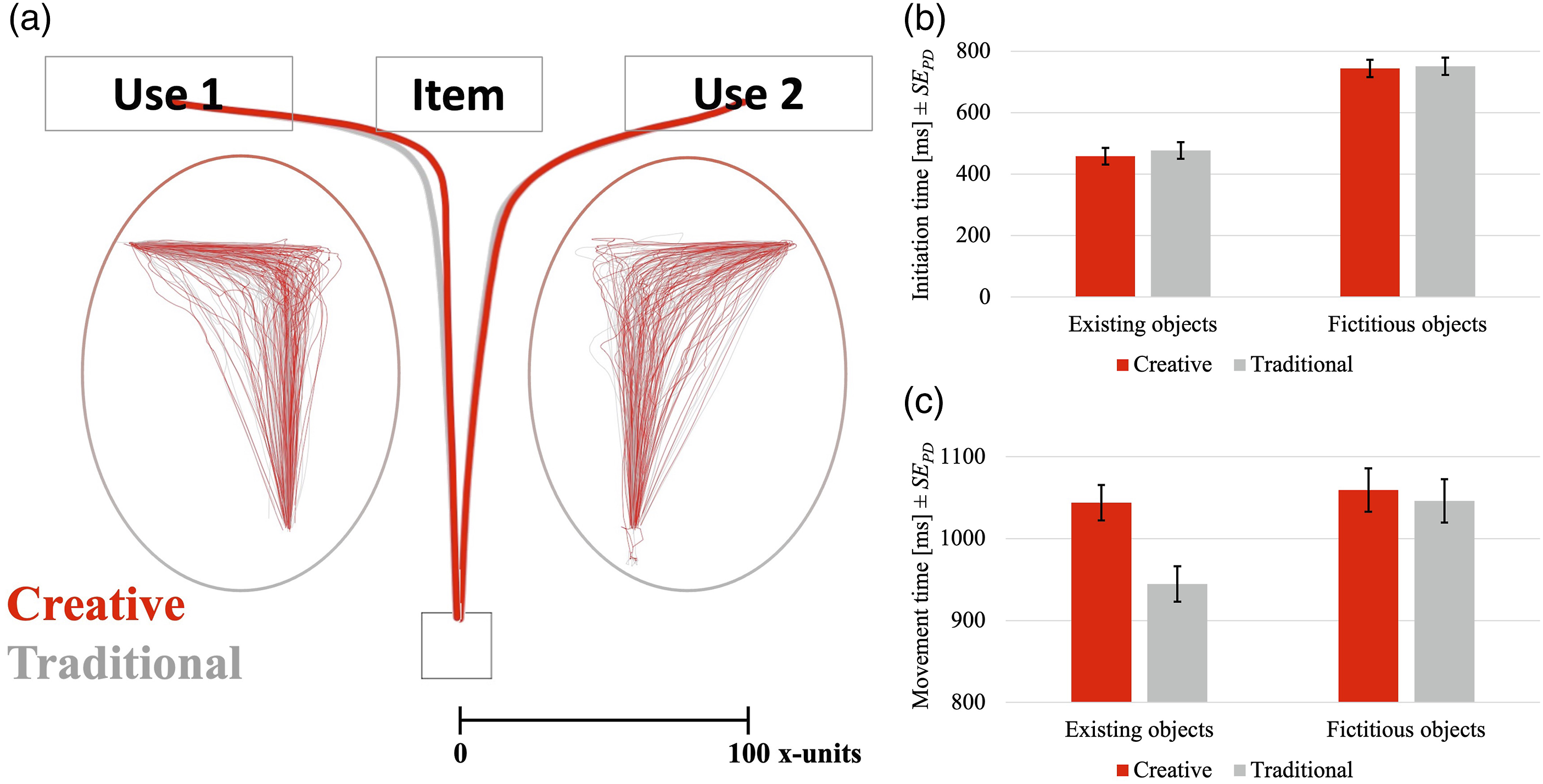
Exploratory analyses did neither reveal an interaction of block half and object use, Fs ≤ 3.34, ps ≥ .070, ηp2s ≤ .02, nor of block half and object kind, Fs ≤ 3.62, ps ≥ .059, ηp2s ≤ .02. Also, there was no three-way interaction of all factors for any measure, Fs < 1.
Discussion
Prior research indicates an implicit anti-creativity bias (Mueller et al., 2010; Reis, Foerster et al., 2024). Here, I investigate whether simply labelling an option as “creative” is sufficient to cause such unconscious rejection. Participants were prompted to select either the traditional or a more creative use for a given object by moving their mouse cursor to a corresponding target area. Objects, presented in written form, were either regular, everyday items (e.g., “Spoon”; existing objects group) or fictitious, made-up terms (e.g., “Driftron”; fictitious objects group). For the fictitious objects group, available options, thus were simply labelled as creative or traditional. If just labelling an idea as creative already elicits negative associations with the respective option, an implicit anti-creativity bias should emerge for both conditions. However, in line with my hypothesis, temporal and spatial characteristics of participants’ mouse cursor movements indicated an implicit anti-creativity bias only for the existing but not for the fictitious objects group. This finding favours the assumption that implicit biases against creative solutions rest on deeper rooted factors (e.g., learned associations between items and uses) instead of negative implicit attitudes toward the label “creative”. This outcome is worrisome news regarding the question on how to mitigate biases against creativity. While labels could be adapted easily, changing associations which are learned over a lifetime represents a far greater challenge (see also Ouellette & Wood, 1998). In line with such reasoning, implicit biases against creative solutions have been found to be stable over time, even after repeatedly encountering a more creative alternative (Reis & Kunde, 2024).
At the same time, it is important to mention, that learned associations do not have to be the sole factor driving implicit biases against creativity. While the present results indicate that the mere label “creative” is not sufficient to create such bias, other factors may also play an important role. In particular, uncertainty regarding the practicability of a creative idea (which of course is somehow related to established associations between situational characteristics and certain actions), is likely to drive implicit biases against creativity (Keith et al., 2024; Mueller et al., 2012). Moreover, there may also be situations in which even the bare term “creative” is perceived as negative. In the present setup, participants’ selections had no direct consequences. Yet, in situations which are characterized by increased uncertainty, the inherent additional uncertainty that comes with the “creative” label might in fact lead to aversion (see also Goncalo et al., 2015; Mueller et al., 2012). For instance, in organizations which are currently facing an economically difficult situation, the announcement of a “creative solution” by the company’s management may rather trigger associations of layoffs or inconvenient change within the workforce (see Staw, 1995). Thus, the exact context and in particular the situations’ level of uncertainty may determine individuals’ attitudes toward creativity.
Another factor, which could have contributed to the present results, is that the target objects served as a prime for participants’ choice behavior. That is, fictious objects might have primed the selection of more creative options while the opposite effect might have occurred for existing objects. Such a priming effect could, thus, explain why there was a bias against creative options in the existing objects condition. Yet, this alternative explanation could not explain why there was no difference between creative and traditional selections in the fictious objects condition.
In contrast to prior research which presented items as images (Reis et al., 2024, 2024b; Reis & Kunde, 2024), items in the present study were presented in written form. This difference can be crucial as pictorial stimuli were found to create more pronounced functional fixedness effects compared to text-based stimuli (Chrysikou et al., 2016). As there was still a significant bias against creative options in the existing objects condition of the present experiment, this lends further support to the assumption that humans strongly favor tried-and-tested solutions over creative ones (e.g., Reis et al., 2024a; Rietzschel et al., 2010). Whether the stimulus modality of the provided responses may affect implicit biases toward or against these options, however, is subject to future research.
The present results further point towards a crucial difference between creative behavior and rule violation. While simply labelling an action as rule-violating has been found to bias behavior towards rule-compliance (Pfister et al., 2016), just labelling an action as creative did not have a similar effect in the present study. Even though both behaviours constitute a deviation from a given norm (Gozli, 2019), their cognitive and motivational underpinnings thus might differ in crucial aspects. Whereas traditions form over numerous repetitions and long periods of time, rules often are set from one moment to the next. Moreover, even in the worst case, deviations from traditions are usually only considered as inappropriate (e.g., wearing casual clothes for a formal event). In contrast, breaking a formal rule, in particular official laws, can immediately lead to severe consequences like imprisonment. Thus, the label “rule violation” might be rooted more deeply within the human mind compared to the label “creative” and in turn might more directly trigger counter-steering behavior (i.e., behaving rule compliant or traditional, respectively). In accordance with this discrepancy, research on the relation of creativity and various instances of rule-breaking (e.g., dishonesty) yielded highly inconsistent results (Reis et al., 2023; Ścigala et al., 2022).
To conclude, implicit biases against creativity cannot merely be explained by negative attitudes toward the “creative” label. Instead, they seem to be driven by deeper rooted factors, like learned associations between situational characteristics and suitable behavior in the given context.
Supplemental Material
Supplemental Material - The lure of tradition: Just a bias against the “creative” label?
Supplemental Material for The lure of tradition: Just a bias against the “creative” label? by Moritz Reis in Personality Science
Footnotes
Author note
Dr Carolyn MacCann was the handling editor.
Acknowledgements
I thank Christine Sapia for insightful comments on the study design and her help with creating the stimuli.
Author contributions
Declaration of conflicting interests
The author(s) declared no potential conflicts of interest with respect to the research, authorship, and/or publication of this article.
Funding
The author(s) disclosed receipt of the following financial support for the research, authorship, and/or publication of this article: This research was supported by the Faculty of Humanities of the University of Wuerzburg.

Data Accessibility Statement
Supplemental material
Supplemental material for this article is available online. Depending on the article type, these usually include a Transparency Checklist, a Transparent Peer Review File, and optional materials from the authors.
Notes
Not applicable.
References
Supplementary Material
Please find the following supplemental material available below.
For Open Access articles published under a Creative Commons License, all supplemental material carries the same license as the article it is associated with.
For non-Open Access articles published, all supplemental material carries a non-exclusive license, and permission requests for re-use of supplemental material or any part of supplemental material shall be sent directly to the copyright owner as specified in the copyright notice associated with the article.
