




Abstract
Although dispositional awe, the tendency to feel awe in daily life, has been regarded as a stable trait-like construct, surprisingly few studies have examined its longitudinal stability. This study aimed to investigate the long-term stability in dispositional awe during emerging adulthood via a trait-state-occasion model. We conducted a longitudinal survey at four timepoints with four-month intervals in a Japanese sample (N = 237; mean age at Time 1 = 25.43 years, sd = 3.17, range: 18–29 years, 169 women). Results from the trait-state-occasion model revealed that 70%–79% and 22%–28% of the variance in dispositional awe were accounted for by the stable trait and occasion-residual factors, respectively. This suggested that dispositional awe might be a stable trait, such as the Big Five personality traits. Our study has both theoretical and methodological contributions to research on awe as we provide empirical evidence for conceptualizing awe proneness as a stable trait.
Introduction
People often feel awe in response to vast stimuli that transcend their existing cognitive frameworks, such as beautiful landscape, people who are morally exemplary, great art or music, and spiritual experiences (Bai et al., 2017; Keltner & Haidt, 2003). Such awe-inducing experiences can evoke feelings of diminished self-interests, which, in turn, can influence an individual’s attitudes and behaviors (Bai et al., 2017; Piff et al., 2015; Stellar et al., 2018; for a review, see Perlin & Li, 2020). Research on awe can be divided into two types: research on state-awe—the momentary psychological states of feeling awe—and research on dispositional awe—the tendency to experience awe-inducing events in a daily life (e.g., Bai et al., 2017; Piff et al., 2015; Stellar et al., 2018; for a review, see Jiang et al., 2024). Furthermore, studies on personality psychology have mainly focused on individuals differences in dispositional awe and highlighted its importance in relation to other psychological variables; for example, awe-prone people tend to have higher levels of open-mindedness (Shiota et al., 2006), prosocial tendencies (Guan et al., 2019; Luo et al., 2023; Ma et al., 2024; Piff et al., 2015), epistemic curiosity (Anderson et al., 2020; Güsewell & Ruch, 2012; Zhang et al., 2023), and creativity (Zhang et al., 2024). Although these studies have treated dispositional awe as a trait-like construct, the stability in dispositional awe remains unclear. This may be owing to limited longitudinal studies on dispositional awe. Even exceptional longitudinal studies have not systematically investigated the conceptualization of awe proneness as a stable trait (Luo et al., 2023; Ma et al., 2024; Zhao et al., 2023). Recent studies have revealed that emotional traits could vary from relatively unstable (e.g., boredom; Gana et al., 2019) to fairly stable (e.g., anxiety and anger; Lance et al., 2021). Therefore, we applied a trait-state-occasion (TSO) model, a popular statistical approach for assessing long-term stability in psychological variables (Cole et al., 2005), to longitudinal data and investigated the longitudinal stability in dispositional awe.
Many previous studies revealed a relatively strong positive association between dispositional awe and openness to experience (e.g., r = .50, Anderson et al., 2020; r = .17–.38, Nakayama et al., 2020; r = .49, Shiota et al., 2006). Studies also revealed that dispositional awe was positively associated with facets of openness to experience, such as aesthetic sensitivity (Williams et al., 2023), curiosity (Anderson et al., 2020; Güsewell & Ruch, 2012; Zhang et al., 2023), and creativity (Zhang et al., 2024). Given the associations of dispositional awe with domain- and facet-levels of openness to experience, dispositional awe may be also a stable trait-like construct like openness to experience (Wagner et al., 2019; Wu, 2021).
The most widely used method for examining the stability of psychological variables is longitudinal surveys. Although previous longitudinal studies on dispositional awe have not specifically focused on its stability, they have reported relatively strong correlations between measurement timepoints (i.e., test-retest reliability coefficients) (Luo et al., 2023; Ma et al., 2024; Zhao et al., 2023). Ma et al. (2024) measured Chinese adolescents’ dispositional awe at two timepoints with a six-month interval and revealed that the test-retest correlation was .48. Zhao et al. (2023) measured dispositional awe among Chinese adults at two timepoints with a three-month interval and revealed a strong test-retest correlation (r = .75). In addition, Luo et al. (2023) measured college students’ dispositional awe at three timepoint with fifteen-days intervals and revealed that the test-retest correlations ranged from .54–.66. These high test-retest correlation coefficients suggest the longitudinal stability of dispositional awe.
Although test-retest reliability has been used to assess the stability of a psychological construct (De Fruyt et al., 2006), it has a few limitations (Wang et al., 2024; Wu, 2016). Simple test-retest correlations can underestimate the true correlations due to measurement errors, and low test-retest correlations do not necessarily indicate low stability (Wang et al., 2024). Additionally, test-retest correlations can capture not only stable trait components but also unstable and situation-specific factors shared across two timepoints; therefore, test-retest correlations do not directly reflect the stable trait component. Furthermore, test-retest correlations provide little information about the processes underlying the stability or change (Wu, 2016). Hence, we used a TSO model, a statistical model that could resolve these limitations (Cole et al., 2005), to investigate the stability in dispositional awe.
The TSO model is a statistical approach that mathematically decomposes latent factors extracted from observed variables ( Trait-state-occasion model for dispositional awe. Note. For clarity, residual correlations (
Overview
This study aimed to investigate the longitudinal stability in dispositional awe via a TSO model
1
. We assessed dispositional awe using the Dispositional Positive Emotion Scale (Shiota et al., 2006), which has been translated into various languages, including German (Güsewell & Ruch, 2012), Chinese (Guan et al., 2018), Persian and Polish (Razavi et al., 2016), Italian (Chirico et al., 2021) and Japanese (Nomura et al., 2022; Sugawara et al., 2020), and has been used widely in previous studies (e.g., Anderson et al., 2020; Guan et al., 2019; Ma et al., 2024; Nakayama et al., 2020; Piff et al., 2015; Razavi et al., 2016; Zhang et al., 2023, 2024). We collected longitudinal data at four timepoint with four-month intervals from people aged 18–29 years, an age range similar to those reported in previous studies on awe (e.g., Chirico et al., 2018; Luo et al., 2023; Piff et al., 2015; Zhang et al., 2024). Based on the previous studies that demonstrated a strong positive correlation with openness domain and facets (e.g., Shiota et al., 2006) and high levels of the test-retest reliability (Luo et al., 2023; Ma et al., 2024; Zhao et al., 2023), we hypothesized that dispositional awe would be a stable trait. Hence, we predicted that a stable trait factor (
Research on personality and individual differences has regarded dispositional awe as a trait-like construct and has revealed its relationships with various psychological variables such as openness domain and facets, without empirically investigating its longitudinal stability. Our study can theoretically contribute to research on dispositional awe by confirming its construct validity in terms of the longitudinal stability.
Method
Participants and procedure
Japanese native speakers aged 18–29 years at the first measurement timepoint were recruited via a research company. Participants initially looked at the recruitment information on the company’s Web site and completed our survey at the first timepoint. At each subsequent timepoint (i.e., second, third, and fourth timepoints), only participants who had completed all prior surveys and passed the attention checks were invited to participate. The final sample participating in all four timepoints comprised 237 emerging adults (mean age at Time 1 = 25.43 years, sd = 3.17, range: 18–29 years, 169 women). We collected sample according to a previous study demonstrating that the TSO model behaves well with sample sized of 200 (Cole et al., 2005). This study was approved by the Ethical Review Board of the Kyoto University.
This survey was conducted online via the Qualtrics software. Participants completed questionnaire measures related to demographic data (age and gender) and dispositional awe 2 . In the questionnaire, the attention check item “Please be sure select ‘strongly agree’ to this item” was included. Participants who failed to correctly respond were excluded. Items used in this survey were the same across all the four measurement timepoints.
Materials
Dispositional awe was assessed via the awe subscale of the Japanese version (Nomura et al., 2022) of the Dispositional Positive Emotion Scale (Shiota et al., 2006). Participants rated their agreement for the following statements, on a 7-point Likert scale ranged from 1 (strongly disagree) to 7 (strongly agree): “I often feel awe,” “I see beauty all around me,” “I feel wonder almost every day,” “I often look for patterns in the objects around me,” “I have many opportunities to see the beauty of nature,” and “I seek out experiences that challenge my understanding of the world.” Cronbach’s α coefficients ranged from .80–.83 across the measurement timepoints. Total scores were calculated by averaging the ratings across the items.
Data analysis
All data analyses were conducted via R version 4.3.2 (R Core Team, 2023). First, we computed the means, standard deviations, Cronbach’s αs, and correlation coefficients. Subsequently, we conducted a TSO model to examine how dispositional awe was longitudinal stable via the “sem” function from the lavaan package (Rosseel, 2012). In the TSO model (see Figure 1), a latent state factor (
Results
Means, standard deviations (SD), Cronbach’s Alpha coefficients, and correlations.
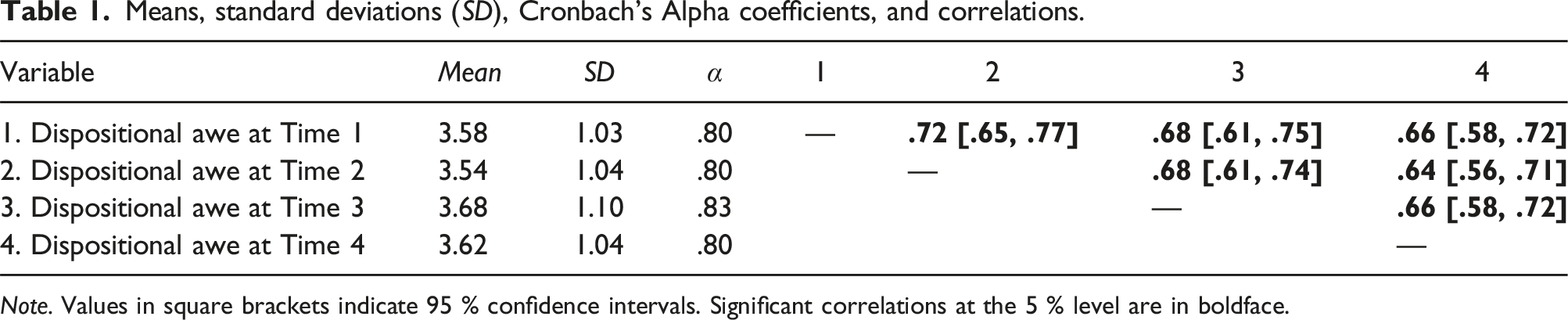
Note. Values in square brackets indicate 95 % confidence intervals. Significant correlations at the 5 % level are in boldface.
Proportion of variance explained by model components.

Note. Significant variance and autoregressive coefficient at the 5 % level are in boldface.
Discussion
This longitudinal study aimed to investigate the stability in dispositional awe. The TSO model was applied to longitudinal data collected from Japanese emerging adults across four waves over a period of a year. Results showed that the stable trait factor and occasion-residual factors accounted for 70%–79% and 22%–28% of the variances of latent dispositional awe factors, respectively.
Results revealed that the stable trait factor accounted for a substantial amount of the variances of the latent dispositional awe factors. Consistent with our hypothesis, a stability range of 70%–80% suggested that dispositional awe might be a stable trait, such as openness to experience (Wagner et al., 2019; Wu, 2021) and some emotional traits (Erz & Rentzsch, 2024; Lance et al., 2021; Olatunji et al., 2020). Previous studies investigating the stability of the Big Five personality using the TSO model revealed that the proportions of the stable trait variance for openness to experience during emerging adulthood felled within the ranged of approximately 50%–75% (Wagner et al., 2019; Wu, 2021). Our results suggest that the longitudinal stability of dispositional awe may be equal to (perhaps greater than) that of openness to experience among emerging adulthood. Given that dispositional awe is relatively strongly associated with openness to experience (Anderson et al., 2020; Nakayama et al., 2020; Shiota et al., 2006), in the future research, it is interesting to investigate how the stable trait component of dispositional awe is associated with that of openness to experience. Interestingly, previous studies on emotional traits using the TSO model also revealed that boredom (17%–35%; Gana et al., 2019) and nostalgia (37%–43%; Wang et al., 2024) were less stable, while disgust (68%–82%; Olatunji et al., 2020), envy (76.2%–80.1%; Erz & Rentzsch, 2024), anger (81%), and anxiety (84%; Lance et al., 2021) were more stable. Our results suggest that dispositional awe may be relatively stable compared with other emotional traits. However, the age of the samples and measurement intervals were various across previous studies; therefore, the stability in the previous studies might differ not only across emotions but also across age and measurement intervals. In the present study, we collected data from individuals aged 18–29 years, in the line with previous studies on dispositional awe that primarily sampled emerging adults (e.g., Chirico et al., 2018; Luo et al., 2023; Piff et al., 2015; Zhang et al., 2024). In Japanese primary and secondary education, fostering a feeling of awe towards various objects, such as nature, living things, and art works, is an educational goal (Ministry of Education, Culture, Sports, Science and Technology, 2017). Hence, dispositional awe may change dramatically during childhood or adolescence at least in a Japanese sample. In the future research, it may be worthwhile to investigate the stability in dispositional awe among other age groups with shorter or longer measurement intervals to gain a deeper understanding of its developmental changes in dispositional awe.
By revealing the longitudinal stability of dispositional awe, our study can theoretically contribute to research on personality science. Previous research on personality and individual differences has theoretically distinguished dispositional awe from state-awe; however, studies have not empirically examined the stability of dispositional awe as a trait-like construct. If dispositional awe was not a stable trait, the construct called dispositional awe might be state-like rather than trait-like, raising questions about the existing findings on dispositional awe. Moreover, previous studies have reported the similarity of the effects of dispositional awe and state-awe on some psychological constructs. For example, research on dispositional awe revealed that individuals with high dispositional awe exhibited prosocial tendencies, while research on state-awe revealed that individuals could temporarily show higher levels of prosocial attitudes and behaviors immediately following their awe experience (Guan et al., 2019; Piff et al., 2015). Research on dispositional awe also revealed that awe-prone people tended to have more curiosity (Anderson et al., 2020; Güsewell & Ruch, 2012; Zhang et al., 2023) and engage in more creative activities in daily life (Zhang et al., 2024). Furthermore, research on state-awe revealed that individuals could also temporarily demonstrate higher levels of epistemic curiosity (McPhtres, 2019; Sawada & Nomura, 2024; Zhang et al., 2023) and creative thinking just after feeling awe (Chirico et al., 2018). If dispositional awe was a state-like construct rather than a trait-like construct, therefore, these findings on dispositional awe might reflect the relationship between state-awe and other variables. By showing that dispositional awe is indeed a trait-like construct, our study can deny such possibility and provide the validation for previous research on dispositional awe, thus making theoretical contributions to awe research.
Our study also has methodological contributions. We measured dispositional awe via the awe subscale of the Dispositional Positive Emotion Scale (Shiota et al., 2006), the most commonly used awe questionnaire. Although a previous study revealed a certain level of test-retest correlation of dispositional awe (Ma et al., 2024), raw test-retest correlation may not fully capture the longitudinal stability. Our findings suggest that this scale can be a reliable tool to measure dispositional awe.
Strengths, limitations, and future directions
The present study is the first to systematically elucidate the longitudinal stability of dispositional awe. Previous studies have revealed high test-retest correlations in two-wave or three-wave longitudinal data (Luo et al., 2023; Ma et al., 2024; Zhao et al., 2023). Adapting the TSO model to the four-wave longitudinal data, our study expands these previous findings in terms of the latent state-trait theory (Steyer et al., 2015). On the other hand, this study has some limitations and also suggests several directions for future research. First, our sample may lack the representativeness due to non-random sampling, which limits the generalizability of our findings. Second, we collected data from individuals aged 18–29 years, in the line with previous study that primarily sampled emerging adults. In Japanese primary and secondary education, fostering a feeling of awe towards various objects, such as nature, living things, and art works, is an educational goal (Ministry of Education, Culture, Sports, Science and Technology, 2017). Hence, dispositional awe may change dramatically during childhood or adolescence at least in a Japanese sample. Relatedly, a recent intervention study reported that an intervention designed to elicit experiences of awe during walking had positive effects on the mental health of healthy older adults (Sturm et al., 2022). Some older adults participating in such programs for their health may also be more susceptible to changes in dispositional awe. Therefore, investigating the stability in dispositional awe among other age groups to gain a deeper understanding of its developmental changes in dispositional awe would be worthwhile. Third, although we used a Japanese sample, dispositional awe can vary across country and region (Razavi et al., 2016). For example, North Americans tended to report higher levels of dispositional awe compared with Japanese people (Nakayama et al., 2020). Hence, whether the same result can be replicated via a sample from other countries should be investigated. Fourth, our study revealed the stability of dispositional awe, but psychological mechanism underlying its stability remains unclear. Future research needs to investigate the factors (e.g., environmental or genetic factors) influence the stability of dispositional awe. Finally, our aim was to examine the longitudinal stability in dispositional awe; thus, we did not focus on other psychological variables that might predict changes (i.e., occasion components). Our results revealed that 22%–28% of the variances of latent dispositional awe factors could be accounted for by the occasion factors, and that the autoregressive effects of the occasion factor were insignificant. While these results suggest that the factors influencing occasion-specific and slow-changing components might vary across measurement timepoints, further research should investigate the time-varying factors that can predict such occasion component to uncover the psychological process underlying the change of dispositional awe.
Conclusion
In summary, this study applied the TSO model to longitudinal data and demonstrated that dispositional awe during emerging adulthood would be a stable trait. Our study provides empirical evidence for the conceptualization of awe proneness as a stable trait, contributing both theoretically and methodologically to research on awe.
Supplemental Material
Supplemental Material - Longitudinal stability in dispositional awe during emerging adulthood: A trait-state-occasion model
Supplemental Material for Longitudinal stability in dispositional awe during emerging adulthood: A trait-state-occasion model by Kazuki Sawada and Michio Nomura in Personality Science
Footnotes
Author Note
This study was approved by the local institutional board (CPE-526), and all participants provided written informed consent prior to participation. The study was performed in accordance with the Declaration of Helsinki.
Acknowledgments
Not applicable.
Author contributions
Declaration of conflicting interests
The author(s) declared no potential conflicts of interest with respect to the research, authorship, and/or publication of this article.
Funding
The author(s) disclosed receipt of the following financial support for the research, authorship, and/or publication of this article: This work was supported by the Japan Society for the Promotion of Science grant (Grant Number: 22H01103, 22KJ1734, and 23K22374).

Supplemental material
Supplemental material for this article is available online.
Notes
References
Supplementary Material
Please find the following supplemental material available below.
For Open Access articles published under a Creative Commons License, all supplemental material carries the same license as the article it is associated with.
For non-Open Access articles published, all supplemental material carries a non-exclusive license, and permission requests for re-use of supplemental material or any part of supplemental material shall be sent directly to the copyright owner as specified in the copyright notice associated with the article.
