




Abstract
Despite the common belief that Chinese individuals are industrious and determined high achievers, in cross-cultural studies they consistently rate themselves lower on conscientiousness than their Western counterparts. In bilingual studies, Chinese–English individuals rate their conscientiousness lower than that of U.S. individuals, regardless of whether they respond to a questionnaire in Chinese or in English, but their self-rating is higher when they respond in Chinese than when they respond in English. I posit that the anchoring-and-adjustment heuristic might offer a mechanism to explain personality assessment in this context: individuals initially estimate their conscientiousness level based on a cultural ideal, then adjust this estimate according to the context suggested by the test language. Contrary to the cultural ideal of high-conscientiousness (high-C anchor), Chinese subjects rate themselves low on conscientiousness in both Chinese and English, a contrasting effect (rating adjusted away from an anchor). However, the version of the questionnaire in Chinese, which is associated with a high-C anchor in Chinese communities, might lead individuals to rate themselves higher on conscientiousness, an assimilation effect (rating adjusted toward an anchor), than the version in English, which is associated with a lower level of conscientiousness (low-C anchor). Future research is needed to test this innovative idea and enable new insights into cross-cultural comparisons of personality.
“Working hard helps; hanging around kills” – Old Chinese saying.
Intuitive judgments about individuals from specific cultures are common. For instance, the term “hardworking” frequently comes to mind regarding Chinese individuals. Chinese students are perceived as more academically conscientious than American students, and many comparative studies have shown high academic performance and study motivation among Chinese students (Stevenson & Lee, 1996; see also Ruble & Zhang, 2013). Therefore, it is unsurprising that Chinese people are perceived as among the most hardworking and conscientious in the world. In a study of the national characteristics of people from 49 cultures, Chinese individuals from Beijing and Hong Kong were perceived to have higher conscientiousness (C) than their U.S. counterparts (Terranciano et al., 2005). Those with high-C are described as “purposeful, strong-willed, and determined … high C scorers are scrupulous, punctual, and reliable” (McCrae & Costa, 2010, pp. 20–21). Digman and Takemoto-Chock (1981) referred to this trait as the “will to achieve.”
Cross-cultural personality studies have recruited participants from different cultures to complete questionnaires in their native language. The resulting scores have been used to characterize the personality traits of those cultures (e.g., McCrae, Terracciano, & 78 Members of the Personality Profiles of Cultures Project, 2005; McCrae, Terracciano, & Personality Profiles of Cultures Project, 2005). Counterintuitive findings have emerged from these studies. Despite Hispanic cultures being associated with warmth and friendliness, self-reported agreeableness among Hispanics was lower than that among non-Hispanics (Ramírez-Esparza et al., 2008). Similarly, although Mexican culture is noted for its sociability, Mexicans self-reported lower levels of extraversion than U.S. individuals (Ramírez-Esparza et al., 2009). In both self- and peer-reports of personality, Chinese individuals consistently scored lower on C than U.S. individuals (McCrae, 2001; McCrae et al., 1996, 1998, 2005b; Yik et al., 2023b), and Asian Americans scored lower on C than European Americans (Eap et al., 2008; see also McCrae et al., 1998). These results seem to imply that Chinese individuals are less conscientious than commonly believed. Is this really so? In this article, I focus on the C paradox, which is broadly defined as the phenomenon wherein Chinese individuals rate themselves as lower on C than their U.S. counterparts, despite almost always being perceived as having high-C. In particular, I discuss the possible confounding factors that have been proposed to explain the low-C scores in Chinese samples and introduce the anchoring-and-adjustment heuristic as an alternative explanation for the C paradox.
Empirical illustration of the C paradox
To graphically illustrate the C paradox, I relied on the NEO Personality Inventory 3 (NEO-PI-3; McCrae & Costa, 2010) data reported by Yik et al. (2023b; Dataset 3). The data from 403 Hong Kong Chinese (HKC) subjects (222 women; Mage = 20) were plotted against the U.S. adult norms (McCrae & Costa, 2010). Figure 1(a) shows this profile. As North American norms were used, the U.S. subjects were expected to show a flat profile at a T score of 50. Using the same dataset, the NEO Five-Factor Inventory-3 (NEO-FFI-3; McCrae & Costa, 2010) scores were generated and plotted in Figure 1(b). In both profiles, the Chinese subjects rated themselves lower on C than their U.S. counterparts. Personality profiles of Chinese samples. Note. (a) presents the mean NEO-PI-3 profile of 403 HKC individuals (Yik et al., 2023b). (b) presents the NEO-FFI-3 profile of the same 403 individuals (Yik et al., 2023b). (c) presents the NEO-FFI profile of 272 HKC individuals (Yik et al., 2023a). (d) presents the NEO-FFI profile of 220 Beijing individuals (Yik et al., 2023a). In all figures, the personality scores were standardized according to U.S. norms (McCrae & Costa, 2010). The profile form is reproduced from the NEO Personality Inventory-3 by Paul T. Costa, Jr., PhD and Robert R. McCrae, PhD, with special permission of the publisher (Psychological Assessment Resources, Inc., Lutz, FL). Copyright 1978, 1985, 1989, 1991, 1992, 2010 by Psychological Assessment Resources, Inc. (PAR). Further reproduction is prohibited without the permission of PAR.
To provide further support for the C paradox, I relied on additional datasets extracted from the 33-sample study of Yik et al. (2023a), which used the NEO Five-Factor Inventory (NEO-FFI; Costa & McCrae, 1992); these datasets comprised 220 participants from Beijing (131 women; Mage = 21), 272 from Hong Kong (117 women; Mage = 21), and 264 from the U.S. (139 women; Mage = 21). First, the data from the two Chinese samples were plotted against the U.S. adult norms. Figures 1(c) and (d) show the profiles, which again demonstrate that the Chinese subjects rated themselves as less conscientious than their U.S. counterparts. Next, independent samples t-tests revealed that (a) the Beijing sample had a significantly lower C score than the U.S. sample, t(482) = −6.708, p < .001; and (b) the HKC sample also had a significantly lower C score than the U.S. sample, t(534) = −7.082, p < .001. No significant difference was found in the C scores between the two Chinese samples. Taken together, these results provided empirical support for the C paradox observed in Figure 1(a) and (b).
To further complicate the C paradox, past research has shown that Chinese participants rate themselves higher on C when responding in Chinese than responding in English (e.g., McCrae et al., 1998). Using data from 299 bilingual HKC participants who completed the Chinese and English versions of NEO-FFI in Yik et al. (2023b; Dataset 2), 1 I tested the difference in factor means between the Chinese and English language versions using the strict invariance model in which the factor means were set to 0 in the Chinese version and freely estimated in the English version. I found that conscientiousness had a lower mean (−.21, SE = .04, Z = −5.77, p < .001) in the English version than in the Chinese version, indicating that the bilingual participants rated themselves as higher in C when responding in Chinese than when responding in English. These findings are in contrast to those of Chen et al. (2014), who reported that bilingual respondents rated themselves as higher in C when responding in English than in Chinese. I suspect that these differences might be due to the dependent measures. While my focus was on C, a factor that encompasses the six facets of competence, order, dutifulness, achievement striving, self-discipline, and deliberation, Chen et al. focused on competence/self-efficacy, an evaluative component of C.
How has the C paradox been explained?
Accurately interpreting cross-cultural comparisons of personality presents unique challenges for personality psychologists. How has the C paradox been demystified in past research?
Cultures have distinct ways of expressing individual differences. The same behavior may convey different meanings in different cultures, and different behaviors may convey the same meaning in different cultures. C encompasses the attributes of being orderly, industrious, and responsible. However, what constitutes a high-C behavior may vary between cultures. For instance, studying for 3 hours a night may be considered very hardworking among U.S. individuals but below average among Chinese individuals. Despite potential cultural differences in behaviors expressing these traits, extensive cross-cultural data suggest that the five-factor model—neuroticism (N), extraversion (E), openness to experience (O), agreeableness (A), and conscientiousness (C)—represents the “dimensions of enduring dispositions that somehow find [comparable] expression in every culture” (McCrae, 2001, p. 842; cf. Ashton & Lee, 2008). In a lexical analysis of Chinese personality terms, Zhou et al. (2009) identified the conscientiousness/diligence factor, which can be defined as diligent, meticulous, hardworking, and assiduous, lending further support to the comparability of C between the English and Chinese contexts. Therefore, low-C scores among Chinese subjects may not necessarily result from cultural differences in behaviors used to define C.
Most cross-cultural studies rely on a mono-cultural, mono-lingual design, implying that the Chinese and U.S. samples differ not only in cultural background but also in translation. Translation may alter the intensity of items compared with the original English (see McCrae et al., 1996). For instance, “I sometimes feel sad” may be translated as “I often feel very down.” The translation may be interpreted as a sign of depression, which can be a taboo in Chinese culture. In fact, Chinese subjects may prefer to say that their hearts ache when they are sad (Yik, 2010; Yik & Chen, 2023). However, the NEO scale translations were found to be valid across cultures (McCrae & Costa, 2010). Specifically, Yik et al. (2023b) found that HKC bilingual respondents had lower C scores in both languages, lending further support to the equivalence of the Chinese and English versions of the NEO scales (see also McCrae et al., 1998), and implying that the low C scores among Chinese individuals are unlikely to stem from translation issues.
Response style is the systematic tendency of respondents to answer questionnaire items according to criteria other than the specific item content (Paulhus, 1991). Cultural differences in response style have been proposed as a major bias in cross-cultural comparisons (Cheung & Rensvold, 2000; see also Zolopa et al., 2023). Chen and Stevenson (1995) found that Chinese and Japanese students were more likely to use the midpoint of a scale than were U.S. students. He and van de Vijver (2013) also noted this midpoint preference among non-Western immigrants to the Netherlands (cf. Mõttus et al., 2012). Harzing (2006) reported a negative correlation between individualism and midpoint responding. Collectively, these findings suggest that East Asians’ preference for using the midpoint option rather than extreme response options may account for Chinese individuals’ low self-ratings on C, although extreme responding would affect variance rather than mean scores, which are our focus.
According to a Confucian proverb, “haughtiness invites loss whereas modesty brings benefits.” This reflects the special premium that Chinese culture places on modesty. Throughout their upbringing, Chinese individuals are immersed in this important Confucian concept. In a meta-analysis, Heine and Hamamura (2007) found that East Asians were less prone to self-enhancement than Westerners. Yik et al. (1998) found that only 39% of Chinese participants demonstrated self-enhancement on C, compared with 54% of U.S. participants. Specifically, the Chinese participants demonstrated self-effacement on C-related traits such as helpfulness, application, intellect, and restraint. Similarly, Kim et al. (2010) found that Chinese individuals were less likely to self-evaluate favorably in public than were European Americans. The emphasis on interdependence and harmony in Chinese culture has placed enormous pressure on Chinese individuals to view themselves as subordinates to a web of social relationships, which is maintained through modesty (Kurman, 2001, 2003; Markus & Kitayama, 2010).
Modesty is a powerful social norm in Chinese communities. When Chinese individuals are asked to rate their C, a very socially desirable trait in Chinese culture, they are often too modest to rate themselves highly. Notably, in several Chinese NEO datasets, Chinese individuals did not score highly on modesty yet their scores on C were low compared with U.S. norms (Yik et al., 2023b; see also McCrae et al., 1996, 1998). Furthermore, if modesty significantly affects personality ratings, the Chinese–English bilingual respondents should have rated themselves lower on C when responding in Chinese than when responding in English, assuming that the test language activates a cultural mindset of modesty (Oyserman, 2011). However, the results seem to imply that low C scores may not be directly associated with modesty in their self-assessments of personality.
Anchoring and adjustment in personality assessment
Although numerous explanatory factors were discussed in past research, most did not seem to satisfactorily account for the C paradox. I now turn to exploring personality assessment as a social judgment process in which individuals engage in adjustment from different anchors as an alternative way to explain the C paradox (see also Yik et al., 2019).
Individuals navigating the world of questionnaires must estimate uncertain quantities, such as their industriousness, using a rating scale of 1 (not at all) to 5 (very). One strategy for doing this, using Tversky and Kahneman’s (1974) anchoring-and-adjustment heuristic, is to start with an accessible value based on the context and adjust away from this value to arrive at an acceptable value. In other words, when individuals assess how hardworking they are, they may compare themselves with an ideal person in their society (an anchor) and adjust their self-assessment accordingly.
In forming a personality rating, two comparison effects in social judgments are key (Bless & Schwarz, 2010). The contrast effect describes how one’s judgment is adjusted away from an anchor, resulting in a negative relationship between the judgment and the anchor. For instance, individuals may perceive themselves as more competent among less competent people than among capable people (i.e., the “big fish, little pond” effect; see Marsh & Parker, 1984). In contrast, the assimilation effect describes how people adjust their judgment toward an anchor, resulting in a positive relationship between the judgment and the anchor. For instance, individuals who admit that they are happy with their relationship tend to report being happy with their life in general (i.e., the part-whole question sequence; see Schwarz et al., 1991). I propose that when individuals self-report their personality, both phenomena might be observed in personality ratings.
Contrast with the cultural ideal
When individuals assess their own personality, they choose a referent (anchor) to aid the assessment process. The selection of a referent can be goal-directed—for instance, it may be chosen for self-improvement (Collins, 1996; Head & Bruchmann, 2019). Asian people are known to be motivated by self-criticism, tending to view themselves as below average so that they can work hard to compensate for their perceived deficits (Heine et al., 2001). As such, Chinese individuals may choose a highly conscientious referent, such as an ideal Chinese figure (see also McCrae et al., 1998), to foster self-improvement by working harder and being more responsible. By adopting such an ideal figure as their referent (anchor 1 in Figure 2), the Chinese subjects assessed themselves lower on C. In other words, they used the cultural ideal as an “anchor” from which they adjusted their C level, resulting in a lower C profile in both languages than observed in U.S. norms, illustrating the contrast effect. Personality assessment as a process of anchoring and adjustment.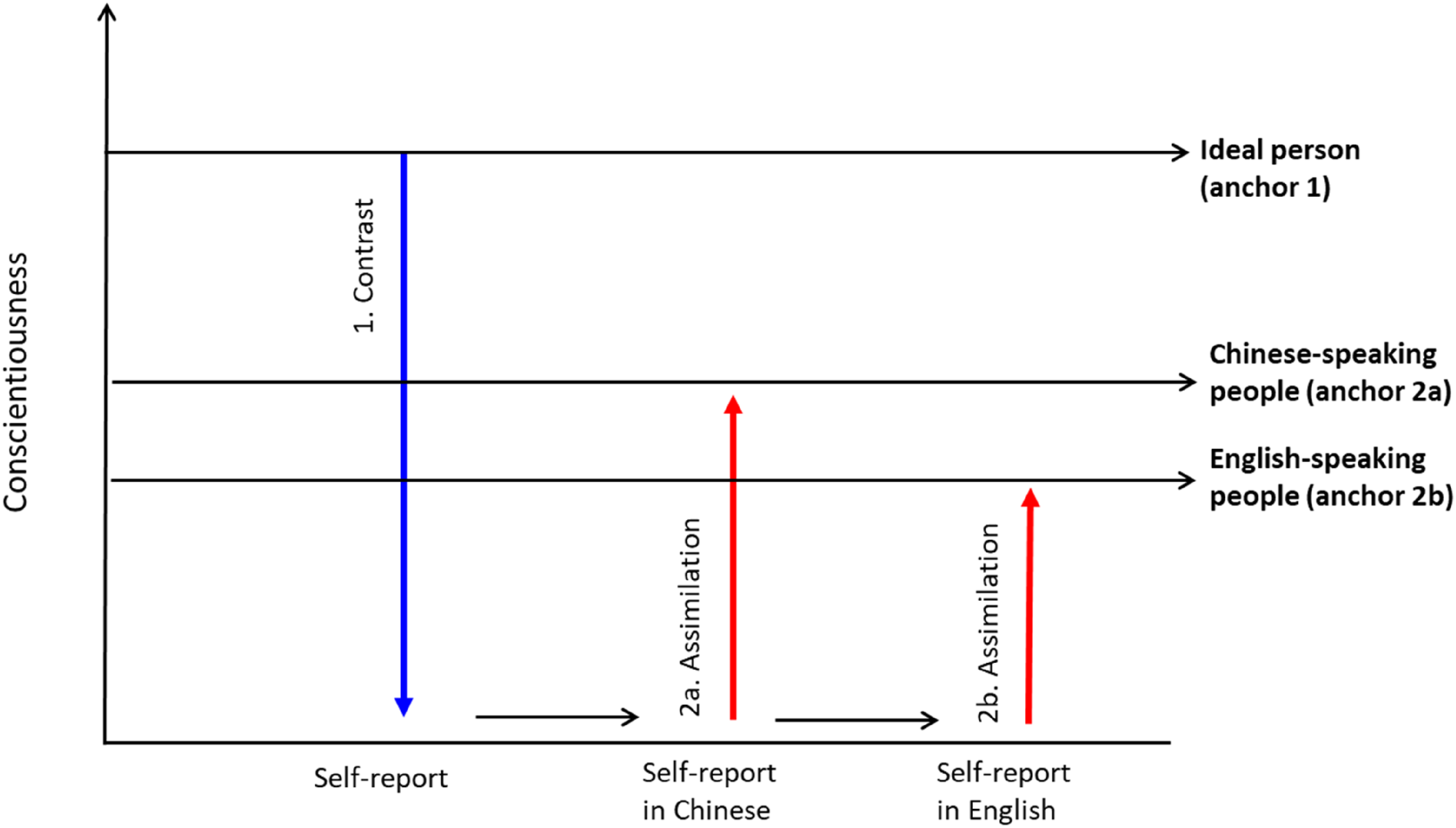
Assimilation to languages
Social comparison theory states that individuals seek to understand themselves through comparison with similar others (Festinger, 1954). Individuals tend to choose similar others as their referent (anchor). For instance, university students may choose their classmates or roommates as their anchor to assess their personality. Peng et al. (1997) observed that individuals from different cultural groups use different referents to complete self-report measures. Chinese individuals may evaluate themselves by comparing themselves with Chinese peers of a similar age and the same gender, while U.S. individuals may do the same with American peers.
Language exerts a powerful effect on perception (Sapir, 1992). A given language consists of not only its linguistic properties but also the attached social and psychological meanings. Language is also a communication tool for transmitting ideas, thoughts, and opinions within a culture. Hence language and culture are closely intertwined in cross-cultural studies of personality.
For instance, when personality questionnaires are translated from English into Chinese, they may elicit cross-cultural accommodation, supporting the five-factor structure in the Chinese version of the NEO scales. The concept of cultural frame switching (Hong et al., 1997) suggests that bicultural individuals adapt their values and attributes according to the cultural context to which they are exposed. Similarly, Lee et al. (2010) proposed the concept of cultural priming effects, positing that cultural icons activate cultural mindsets, leading individuals to align their values and behaviors with the primed culture. Heine et al. (2002) proposed the reference group effect, pointing to the possibility that Likert scales, which are widely used in cross-cultural research, may encourage individuals to evaluate themselves against implicit standards afforded by their own culture. Collectively, these theories suggest that the test language used in a cross-cultural study acts as an anchor to which individuals assimilate their personality assessment (Lee et al., 2010).
Support for such assimilation effects comes from three samples of Spanish–English bilinguals living in the U.S. and Mexico, where Ramírez-Esparza et al. (2006) found that bilinguals reported lower C when responding in Spanish than when responding in English (see also Rosselli et al., 2017). 2 Chinese–English bilinguals self-rated higher on C when responding in Chinese than when responding in English (Yik et al., 2023b; cf. Chen et al., 2014). However, this assimilation effect was less evident among German–Spanish bilinguals (Veltkamp et al., 2013).
Anchoring and adjustment by Chinese–English bilinguals
The anchoring-and-adjustment heuristic offers a possible explanation of the C paradox. When the Chinese–English bilinguals surveyed by Yik et al. (2023b) completed their C-ratings in both languages, they might have set the ideal Chinese figure as their first anchor and adjusted their ratings away from this ideal figure, leading to low self-assessed C-ratings. The test language might then have served as a second anchor, providing a comparison group for further adjustment: when completing the questionnaire in Chinese, the participants might have compared themselves against the Chinese-speaking individuals in their society (anchor 2a in Figure 2), resulting in higher C-ratings showing an assimilation effect towards the “high-C prototype.” Conversely, when completing the questionnaire in English, they might have compared themselves against the English-speaking individuals (anchor 2b in Figure 2), resulting in lower C-ratings showing an assimilation effect towards the “low-C prototype.” Of special note is that I offer the anchoring-and-adjustment heuristic as a post-hoc explanation to account for the pattern of results reported in Yik et al. (2023b; see also McCrae et al., 1998). Further empirical research is much needed to test the mechanism underlying the outcomes of personality assessment.
General discussion
Chinese individuals rate themselves as less conscientious than their U.S. counterparts, despite the common belief that they are hardworking and diligent. Notably, Chinese respondents self-report higher C scores when responding in Chinese than when responding in English (see Yik et al., 2023b). This low-C profile among Chinese respondents can be attributed to cultural differences in expressed behaviors, translation, and cultural frame switching, among other factors. In this paper, I suggest that the anchoring-and-adjustment heuristic is an important mechanism that can explain the observed personality assessment patterns.
Future research directions
Although the concept of applying Tversky and Kahneman’s (1974) anchoring-and-adjustment heuristic to personality assessment is not novel, its application to explaining the C paradox observed in Chinese samples is innovative. This hypothesis is based on a series of assumptions about the perceptions of different comparison groups in Chinese communities. My expectation that members of the Chinese-speaking community would be perceived as having higher C than members of the English-speaking community needs to be tested, although a study of national characters lends preliminary support for this assumption (see Terracciano et al., 2005). An important next step would be to gauge the personality profiles of the different anchors proposed in Figure 2: (a) an ideal person, (b) Chinese-speaking individuals, and (c) English-speaking individuals in Chinese communities. I anticipate that the ideal person would be perceived as highest in C, followed by Chinese-speaking individuals, and then English-speaking individuals.
To explain the finding of Yik et al. (2023b) that the Chinese–English bilinguals reported higher C when responding to the Chinese questionnaire than to the English questionnaire, I propose that the language differences in C might be accounted for by the anchors that were freely generated by the respondents in each language condition (e.g., Chinese-speaking individuals when the test language is Chinese). Before concluding that the anchoring mechanism is responsible for the language difference in C, it is essential to test whether there is an anchoring effect at all. If the anchoring mechanism is the underlying cause of the language difference in C, this difference can be expected to be significantly reduced if the variations in the anchor are removed. To this end, a sample of bilinguals will be recruited to report their C in both English and Chinese while taking Chinese-speaking individuals as the reference (anchor). Because the same “anchor” will be then provided in both language conditions, the variations in anchors will be reduced or even eliminated. As such, the language difference in the C scores should be greatly reduced in comparison with the results of Yik et al. (2023b), in which the subjects generated their own anchor in each language condition.
Conclusion
To better understand the human psyche, mapping the personalities of cultures holds enormous appeal. Recent research has used two methods to do this. One method relies on identifying each culture’s characteristics, defined as the perceived personality traits that characterize members of that culture (Peabody, 1985). The other method uses aggregate personality scores to describe each culture (McCrae, Terracciano, & Personality Profiles of Cultures Project, 2005). Intuitively, the findings of both methods should be very similar, if not identical. However, although Chinese individuals are perceived as hardworking and diligent, their self- and observer-reports conflict with national stereotypes. How valid are cross-cultural comparisons of aggregate personality scores, especially when the comparisons rely on different language versions?
Efforts to produce equivalent language versions of a personality test are commendable (see McCrae & Costa, 2010), but the effects of the test language may be more complex than anticipated. The test language not only facilitates communication but may also serve as an anchor (i.e., reference group or cultural mindset), thus influencing personality assessment and cross-cultural comparisons of personality. In this paper, I suggest the anchoring-and-adjustment heuristic as a viable process for understanding personality assessment in general, and specifically the C paradox reported in data from Chinese samples. Future research is needed to test this idea and yield new insights to inform cross-cultural studies of personality.
Footnotes
Acknowledgements
I profusely thank Jeff McCrae for documenting the C paradox among the Chinese in our 1996 paper. I also thank Felity Kwok, Ellick Wong, Winnie Yang, and Poppy Zhu for their help in preparing this article.
Declaration of conflicting interests
The author(s) declared no potential conflicts of interest with respect to the research, authorship, and/or publication of this article.
Funding
The author(s) received no financial support for the research, authorship, and/or publication of this article.
Notes
References
Supplementary Material
Please find the following supplemental material available below.
For Open Access articles published under a Creative Commons License, all supplemental material carries the same license as the article it is associated with.
For non-Open Access articles published, all supplemental material carries a non-exclusive license, and permission requests for re-use of supplemental material or any part of supplemental material shall be sent directly to the copyright owner as specified in the copyright notice associated with the article.
