




Abstract
This eye tracking study tested the hypothesis that narcissists’ visual attention is motivated, focusing on two fundamental social motives: status and affiliation. We measured participants’ full narcissism spectrum (narcissistic agency, antagonism, and neuroticism) via self-reports. We measured visual attention to status and affiliation images via eye-tracking in the lab. We hypothesized that narcissistic agency would relate to increased attention to status, and that narcissistic antagonism would relate to increased attention to status and decreased attention to affiliation. We formulated no hypotheses regarding narcissistic neuroticism. Results showed that only agentic narcissism was related to increased attention toward status. The three forms of narcissism were unrelated to attention to affiliation. These findings suggest that agentic narcissists’ attention is driven by an underlying status motive. More broadly, findings are consistent with the notion that visual attention expresses and maintains people’s personality traits via satisfying trait-congruent motives.
Introduction
Narcissism is characterized by a sense of inflated self-importance and entitlement to special privileges and treatment (Krizan & Herlache, 2018). It comprises distinct agentic (encompassing grandiosity, assertiveness, sense of superiority), antagonistic (encompassing aggressiveness, exploitativeness, arrogance), and neurotic (encompassing shyness, distrust, shame) manifestations (Crowe et al., 2019). Recent theory (Grapsas et al., 2020; Mahadevan et al., 2016; Zeigler-Hill, McCabe, et al., 2018) and empirical evidence (Grapsas et al., 2022; Mahadevan & Jordan, 2022) suggest that a strong motive for social status (i.e., desire for prominence, respect, and social influence) possibly underpins all three manifestations of narcissism, and that a weak motive for affiliation (i.e., desire to create strong interpersonal bonds) underpins narcissistic antagonism. In this experimental eye tracking study, we investigated whether these motive dynamics are reflected in narcissists’ 1 visual attention toward images of status and affiliation.
Personality and motivated visual attention
Personality traits are relatively enduring patterns of how people think, feel, and act. Integrative and evolutionary personality theories propose that individual differences in personality traits arise from individual differences in underlying motives (i.e., higher-order, trans-situational goals) that serve survival and reproductive fitness (Geukes et al., 2017; Hogan & Sherman, 2020; Jonason et al., 2010; Wrzus & Roberts, 2017): Across development, individual differences in motive strength are assumed to generate increasingly consistent individual differences in how people think, feel, and act to pursue their motives. These differences reflect personality trait levels. Thus, people are theorized to differ from each other in their personality traits partly because their motives differ.
Like personality traits, visual attention is motivated. Research corroborates the notion that attention has evolved as a motivational system that serves reproductive fitness and survival (Lev-Ari et al., 2022). Visual attention helps retrieve information important for motive fulfillment from the environment and is thus directed at and fixated on motive-relevant cues. For example, the stronger people’s status motive is, the longer they tend to look at faces of possible subordinates and competitors (Schultheiss & Hale, 2007; Terburg et al., 2011). Similarly, a strong affiliation motive goes along with the pronounced tendency to look longer at affiliative content and joyous faces (Dufner et al., 2023; Moore et al., 2014; Schultheiss & Hale, 2007). Thus, people selectively focus on visual content that is congruent with their motives.
Perhaps due to their shared evolutionary roots and motivational function, individual differences in personality traits and visual attention are interlinked (Jonason & Sherman, 2020). Individual differences in personality traits are not only linked to individual differences in how people attend to visual content (e.g., how many times people fixate on any visual cue; Rauthmann et al., 2012), but also to the type of visual content. For example, neurotic people, who are vigilant to threats, tend to look longer at the eyes of fearful faces compared to emotionally stable people (Perlman et al., 2009). Similarly, pessimists tend to look longer at images of health threat compared to optimists (Isaacowitz, 2005). And non-avoidantly attached women, who seek interpersonal closeness, tend to look longer at affiliative content compared to avoidantly attached women (Moore et al., 2014). Thus, people tend to selectively look at visual content that is congruent with their personality traits and the motives that underlie these traits.
Visual attention in narcissism
What may capture the visual attention of narcissists (i.e., individuals with relatively high levels of narcissism)? The answer likely lies in narcissists’ social motives. Recent theory and research (Grapsas et al., 2020; Jonason & Zeigler-Hill, 2018; Mahadevan et al., 2016; Zeigler-Hill, McCabe, et al., 2018) suggest that grandiose (i.e., agentic and antagonistic) narcissism is underlain by a strong motive for social status. According to the Status Pursuit in Narcissism model (SPIN; Grapsas et al., 2020), narcissists’ strong status motive is theorized to guide their attention toward status cues in their social environments. For example, grandiose narcissists may selectively attend to displays of others’ subordinance, attention, and admiration, because these displays constitute relational cues of status conferral (Anderson et al., 2015). Grandiose narcissists may also selectively attend to displays of wealth, luxury, and professional success, because these displays constitute tangible cues of status attainment (Anderson et al., 2015; Cisek et al., 2014). Attending to such cues can help status pursuit, because these cues can inform status perceptions of self and others and guide appraisals regarding how to pursue status within a certain environment (Grapsas et al., 2020). Indirectly corroborating this idea, agentic narcissists appear particularly fast at processing status-relevant information (for a review, see Jones, 2018), and both agentic and antagonistic narcissists are highly affectively reactive to cues of status (Grapsas et al., 2022; but see Dufner et al., 2023). Although there is no prior theory or empirical work on this issue, indirect empirical evidence suggests that neurotic narcissists may similarly selectively attend to status cues because they also exhibit a strong status motive (Mahadevan & Jordan, 2022). For these reasons, we hypothesized that both agentic and antagonistic narcissists would manifest a high degree of attention to status, and explored whether neurotic narcissists would, too.
The SPIN model posits that narcissists’ status motive can overshadow other motives, such as their affiliation motive (Grapsas et al., 2020). The way narcissists pursue status may therefore elucidate individual differences in narcissists’ motive for, and attention to cues of, affiliation. Agentic and antagonistic narcissism represent different strategies of status pursuit (Grapsas et al., 2020). Agentic narcissists pursue status primarily through self-promotion. Because affiliative relations can generate a network of potential admirers in the service of status pursuit, narcissists may even superficially report a strong desire for affiliation (Mahadevan & Jordan, 2022). Corroborating this idea, agentic narcissists are somewhat more motivated to be affiliative (Mahadevan & Jordan, 2022; Zeigler-Hill et al., 2018), but not more behaviorally affiliative or affectively reactive to cues of affiliation (Grapsas et al., 2022), than non-narcissists are. There was thus no reason for us to expect a substantial link between agentic narcissism and attention to affiliation.
By contrast, antagonistic narcissists pursue status through other-derogation and conflict (Back et al., 2013; Grapsas et al., 2022). Although they want to be socially included (Mahadevan & Jordan, 2022; Zeigler-Hill, McCabe, et al., 2018) and are sensitive to interpersonal frustrations (Grapsas et al., 2022), they do not want to reciprocate affiliation: they set more hostile interpersonal goals (Grove et al., 2019), engage in more aggressive behaviors (Back et al., 2013), and respond with less positive affect to cues of affiliation (Dufner et al., 2023; Grapsas et al., 2022), compared to non-narcissists. For these reasons, we hypothesized that antagonistic narcissists would neglect cues of affiliation, showing a lower degree of attention to affiliation than non-narcissists would.
Neurotic narcissists share antagonistic narcissists’ sensitivity to interpersonal frustrations (Crowe et al., 2019; Rogoza et al., 2022). Unlike them, however, neurotic narcissists are primarily reactively hostile (Krizan & Johar, 2015), and are theorized to generally withdraw from status pursuit out of fear of failure (Back, 2018; Mahadevan & Jordan, 2022). Consistent with the possibility that such withdrawal is tied to a sense of ostracism, neurotic narcissists claim that they strongly want affiliation (Mahadevan & Jordan, 2022). For this reason, they could be either as much, or more attentive to cues of affiliation than non-narcissists. To investigate these possibilities, we formed no hypothesis but explored how neurotic narcissists would attend to cues of affiliation.
The present study
The present experimental study is the first to investigate narcissists’ visual attention orientation toward cues of social status and affiliation. We measured participants’ full spectrum of narcissism, covering its agentic (admiration), antagonistic (rivalry), and neurotic (vulnerability) manifestations via self-reports. We measured in the lab participants’ visual attention toward images of social status (vs. control images) and affiliation (vs. control images) directly, via eye tracking—an unobtrusive method that tracks eye movements and gaze fixation (i.e., time that eyes remain still and focused). We operationalized attention orientation as the relative time of fixation on the motive images. We hypothesized that narcissistic agency and narcissistic antagonism would relate to increased attention toward status and explored the relation of narcissistic neuroticism with attention toward status. We further hypothesized that narcissistic antagonism would relate to decreased attention toward affiliation and explored the relation of narcissistic neuroticism with attention toward affiliation.
Method
Transparency, openness, and reproducibility
We report how we determined our sample size, all data exclusions (if any), all manipulations, and all measures in the study. We did not preregister our study, hypotheses, or analyses. Data, code for analyses are provided at https://osf.io/5wcga. Data collection took place as part of a larger research project entitled “LeiCo”, approved by the Ethics Review Board of the German Psychological Society (DGPs). Here, we only present the measures relevant to our research questions. A codebook including the LeiCo study design and full list of measures is also available https://osf.io/5wcga. We cannot openly share the images we used due to royalty constraints, but we openly share highly similar royalty-free ones in Figure 1 and at https://osf.io/5wcga. Example pairs of motive images and their matched control images. Note. Due to copyright issues, the images in the figure are not the ones we used, but highly similar, royalty-free ones.
A list of articles using the LeiCo dataset is found in the Supplement (Table S1). Prior research using the narcissism and attention orientation data (Dufner et al., 2023) has not examined the association between narcissism and attention orientation. Thus, the results pertaining to our research question have not been published before.
Participants
Participants were 256 adults (78% female, 21% male, 2% did not specify gender), primarily university students (79%), aged 18 to 35 (M = 24.60, SD = 4.38). We recruited participants through university notice boards, flyers, and social networks. We excluded psychology students because they could be potentially familiar with the measures. Upon completing the study, participants were debriefed and financially reimbursed with 70 Euros.
The sample size was determined by the available financial resources. A post-hoc power analysis with the R pwr package (Version 1.3-0; Champely, 2020) suggested that, for n = 243 (analyses between narcissism and attention orientation), we had 80% power to detect correlations of r ≥ .18 (α = .05, two-tailed)—an effect size smaller than the average r = .21 reported in personality and social psychology (Richard et al., 2003).
Procedure and measures
Narcissism
We measured narcissism via online questionnaires before the lab sessions. To measure the agentic and antagonistic dimensions of grandiose narcissism separately, we used the Narcissistic Admiration and Rivalry Questionnaire (NARQ; Back et al., 2013). The NARQ measures, with nine items each, agentic narcissism (narcissistic admiration) and antagonistic narcissism (narcissistic rivalry). Items are rated on a 6-point scale (1 = do not agree at all, to 6 = agree completely). We averaged responses separately for agentic and antagonistic narcissism.
To validate our grandiose narcissism results, we also used the Narcissistic Personality Inventory (NPI; Raskin & Hall, 1979), which predominantly taps agentic grandiose narcissism (and less strongly, also antagonistic narcissism; Back et al., 2013). The NPI consists of 40 pairs of statements. Each pair contains one narcissistic versus one non-narcissistic statement. Due to a programming error, we administered 39 pairs of statements, omitting the first. Participants chose the statement that best described them. We used the ratio of endorsed narcissistic statements as the total score. As a supplementary approach, we computed the “leadership/authority”, “grandiose exhibitionism”, and “entitlement/exploitativeness” subscales, identified in an exploratory factor analysis of the NPI (Ackerman et al., 2011). Analyses with these subscales are found in the Supplement Table S2.
To measure neurotic narcissism, we used the Hypersensitive Narcissism Scale (HSNS, Hendin & Cheek, 1997). The HSNS measures neurotic narcissism with 10 items, rated on a 5-point scale (1 = very uncharacteristic or untrue, strongly disagree, to 5 = very characteristic or true, strongly agree). We averaged responses for the total score.
Attention orientation
We measured attention orientation in the lab using a remote eye tracker. This apparatus tracks eye movements using the pupil center corneal reflection method: A subtle infrared light illuminates the eyes, creating reflections indicative of gaze orientation and fixation time.
To portray status, we selected 25 images that displayed scenes of social influence, success, and prestige (e.g., royals waving at a crowd from their balcony). To portray affiliation, we selected 25 images that displayed positive affiliative interactions between friends, families, or couples (e.g., a family playing outdoors). We paired each motive image with a unique control image (examples in Figure 1). We paired motive images with control images instead of with each other to strengthen the interpretability of our findings. For example, a positive correlation of agentic narcissism with status orientation when pairing status with affiliation images could be owed to increased attention to status, decreased attention to affiliation, or both. However, our procedure allows inferring that this correlation is owed to increased attention to status. To make motive and control images more visually similar, we matched them based on color palette, and if possible, on theme (e.g., an affiliation image portraying friends hugging on a couch was paired with a control image portraying only a couch). All but two motive images portrayed people (two status images portrayed only status objects: money bills, and a mansion), whereas control images did not portray people.
Participants sat 60–80 cm from the computer screen, where the eye tracker was attached. We first calibrated the device, then assessed participants’ attention orientation. Participants viewed 50 pairs of images (25 motive-control image pairs per motive domain) that were presented for 5 seconds each. The motive image of each pair was randomly located left or right.
Although 250 participants attended the eye tracking session, we excluded eye tracking data from six participants. For one of them, data transfer was erroneous, whereas the remaining five had unusually high amounts of missing eye tracking data (>15% missing data). Thus, we retained eye tracking data for 244 participants.
To index attention orientation per pair of images, we used the relative time of fixation on the motive image. We first computed the total time a participant fixated on both images. Then, we computed the proportion of this time that was spent viewing only the motive image. Per motive domain, we averaged these ratios to create the total attention orientation index.
Results
Descriptive statistics, reliability coefficients, and intercorrelations of variables.
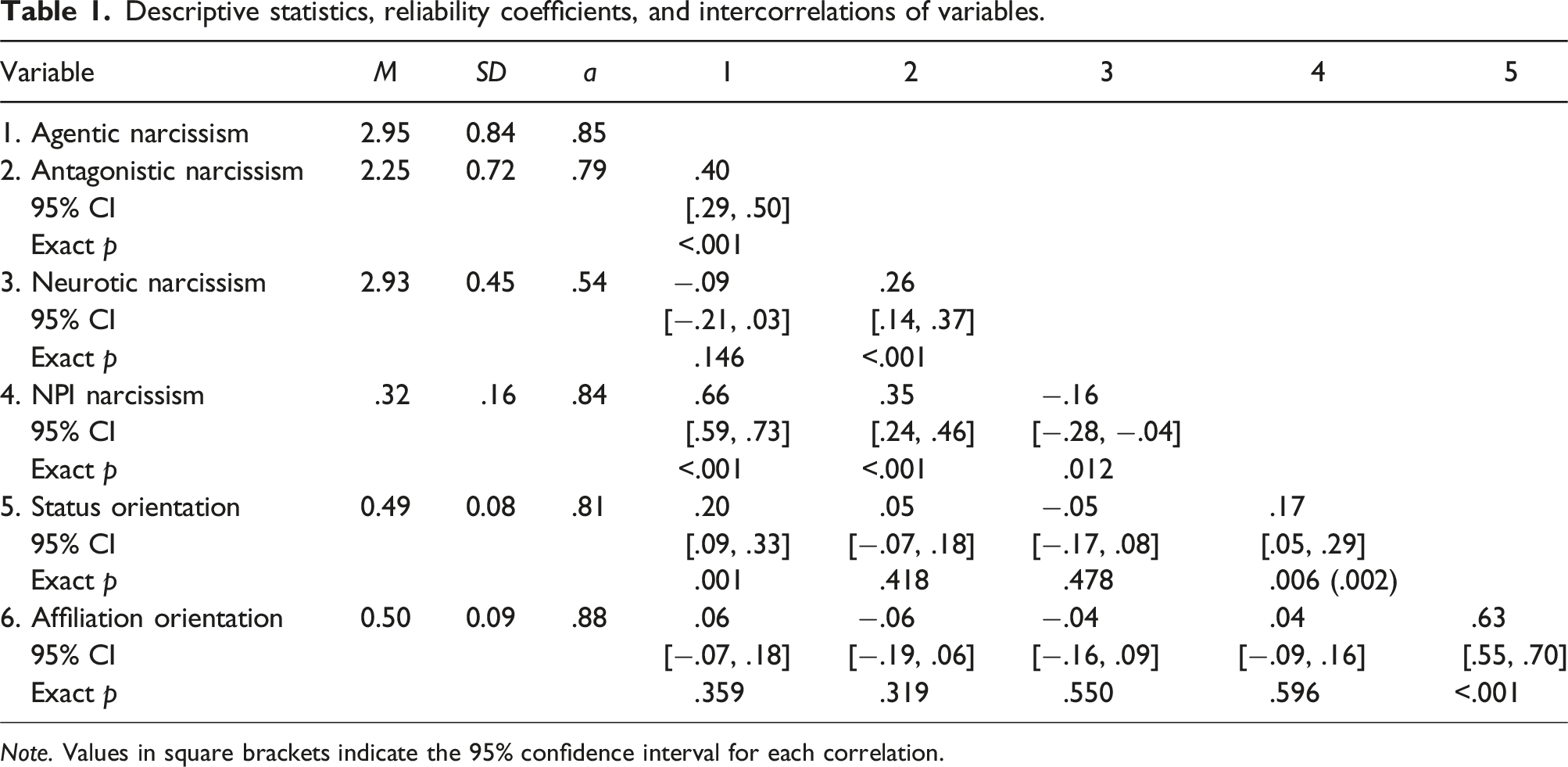
Note. Values in square brackets indicate the 95% confidence interval for each correlation.
Preliminary analyses
Narcissism indices
We examined the internal consistencies of and intercorrelations between narcissism indices. The reliability of the NARQ subscales and the NPI were good, however the reliability of the HSNS was poor. Removing any single item did not increase the reliability of the HSNS above the conventional threshold of α = .60, so we retained all HSNS items in analyses.
Agentic narcissism was positively related to antagonistic narcissism, but not significantly related to neurotic narcissism. Antagonistic narcissism was positively related to neurotic narcissism. NPI narcissism was, like agentic narcissism, positively related to antagonistic narcissism. It was also significantly negatively related to neurotic narcissism. These results are consistent with prior research (Crowe et al., 2019; Rogoza et al., 2022).
Attention orientation indices
We examined the internal consistency, descriptive statistics, and intercorrelation of attention indices. Both indices were highly internally consistent (alphas ≥.81). Scores for both indices were approximately normally distributed (attention to status skewness = −0.57, kurtosis = 0.93; attention to affiliation skewness = −0.23, kurtosis = 0.42). Mean scores indicated that, on average, participants spent approximately the same amount of time looking at motive and at control images.
Attention to status was highly positively related to attention to affiliation. Thus, participants who were more drawn to status than to control images were also more likely to be drawn to affiliation than to control images. This finding suggests a rather strong method factor, in the sense that individuals differed in their tendency to focus on motive versus control images.
Primary analyses
We examined the correlations between narcissism and attention indices. Agentic narcissism was modestly-to moderately significantly positively related to attention to status images. However, antagonistic and neurotic narcissism were not. Agentic, antagonistic, and neurotic narcissism were all not significantly related to attention to affiliation. Associations of NPI narcissism resembled those of agentic narcissism in direction, magnitude, and statistical significance levels.
Robustness analyses
First, as males are on average more narcissistic and status-driven than females (Jonason & Zeigler-Hill, 2018), we considered the alternative explanation that results might be driven by gender differences and explored whether gender moderates the relation between narcissism and attention. We found that agentic and NPI narcissism, antagonistic narcissism, and attention to status were significantly higher in males (Table S3). More importantly, the associations between narcissism and attention that we found in primary analyses held when gender was controlled for, and none of the narcissism by gender interactions were statistically significant (Table S4).
Second, we tested the specificity of associations between narcissism and attention. Primary analyses suggested strong individual differences in attention to motive versus control images. To control for these differences and further isolate motive-specific attention tendencies, we repeated primary analyses with partial indices of attention: We first regressed each attention index on the other and then used the regression residuals as the partial indices that we correlated with narcissism indices (Table S2). Third, we tested associations of narcissism with raw fixation indices toward motive images (i.e., the average time in milliseconds that participants spent fixating on motive images; Table S2). Fourth, we controlled for the shared variance of narcissism indices in predicting attention, regressing each type of attention orientation on agentic, antagonistic, and neurotic narcissism simultaneously (Table S4). Across robustness analyses, results of primary analyses were robust: all significant effects remained significant, and no non-significant effect became significant.
Discussion
The present study is the first experimental investigation of narcissists’ visual attention tendencies. Drawing from the motive dynamics described in the SPIN model (Grapsas et al., 2020), we examined narcissists’ visual attention towards images portraying the fulfillment of two fundamental social motives: social status and affiliation. Using measures of attention orientation that proved highly reliable, we found that only agentic narcissists oriented their visual attention to portrayals of status. This effect was modest-to-moderate in size, which is typical in personality and social psychology (Richard et al., 2003). We did not find a marked profile of visual attention towards portrayals of status or affiliation for antagonistic and neurotic narcissists (although our results pertaining to neurotic narcissism may be less interpretable due to the poor reliability of our measure). Together, these findings suggest that agentic narcissism tends to be characterized by socially motivated visual attention processes. More broadly, these findings demonstrate that visual attention is partly guided by personality and motivation.
Implications for narcissism theory
Narcissists’ visual attention
Although narcissists across the whole narcissism spectrum report a desire for status (Mahadevan & Jordan, 2022), our findings show that not all are especially drawn to its visual portrayals. Consistent with the SPIN model, agentic narcissists strongly fixated on status cues. Informing further the SPIN model, antagonistic and neurotic narcissists did not. Why so? A possibility is that visual portrayals of status primarily inform the self-promotional, extraverted style of status pursuit that characterizes agentic narcissists. This interpretation resonates with the proposition that a history of successful status pursuit via self-promotion (Grapsas et al., 2020) may generate agentic narcissists’ documented affective responsiveness to status gains (Dufner et al., 2023; Grapsas et al., 2022; Mota et al., 2022; Zeigler-Hill, Vrabel, et al., 2018). Although antagonistic narcissists are also theorized to be vigilant to status cues due to a strong status motive, our findings point to the possibility that their vigilance is not strong toward cues of status attainment, but to those of status threat and loss (Grapsas et al., 2020). Antagonistic narcissism is theorized to be a self-protective narcissistic strategy of status pursuit that is employed when status is threatened or lost (Back et al., 2013; Grapsas et al., 2020). Indeed, antagonistic narcissists manifest pronounced insecurity and dislike toward status loss (Grapsas et al., 2022; Mota et al., 2022; Zeigler-Hill & Vonk, 2022). Neurotic narcissists may share such sensitivity to cues of status threat or loss. Neurotic narcissism is theorized to develop through repeated failures to attain status (Back, 2018), which is also congruent with neurotic narcissists’ perception that they have a low status (Mahadevan & Jordan, 2022). Together, our findings suggest that visual portrayals of status gain are especially captivating only for those narcissists who wish to visually display their own status to others (i.e., agentic ones).
Our findings also showed that narcissists across the narcissism spectrum were neither especially drawn nor averse to portrayals of affiliation. Although this pattern was expected for agentic narcissists and theoretically plausible for neurotic ones, it was unexpected for antagonistic ones, whom we hypothesized to visually neglect portrayals of affiliation. It should be noted that affiliation and status cues share a relational, social motivational orientation. Attesting to this, we found a high correlation between attention to status and affiliation, suggestive of individual differences in attention to social images, and in concordance with prior research on the relation between these motives (e.g., Neel et al., 2016). Yet, even when we controlled for these individual differences, we did not find evidence that antagonistic narcissists are visually averse to affiliation: though the direction of this relation was negative, as we hypothesized, the effect size was small and statistically non-significant. Together, these findings do not suggest that narcissists differ from non-narcissists in their degree of attention to visual portrayals of affiliation.
Did these findings emerge because motive images were more attention-grabbing for some individuals (who prefer seeing pictures with more content over pictures with less content) or because they showed people (whereas the control pictures did not)? This seems unlikely. In either case, results for attention to status and affiliation would have been identical and the partial analyses in the robustness checks would have yielded non-significant results. Instead, participants paid different degrees of attention to status and affiliation images based on their agentic narcissism levels and gender in a direction consistent with theory and research (e.g., Grapsas et al., 2020; Jonason & Zeigler-Hill, 2018), and all findings remained significant when analyses were based on the partial indices. Thus, findings seem driven by true differences in participants’ underlying motives.
Narcissists’ situation perception
By unraveling narcissists’ visual attention tendencies, our study also has implications for how agentic narcissists perceive the world and situations they are in. Selective attention is of key relevance for situation perception and appraisal. Research has shown that agentic narcissists perceive everyday situations as opportunities to showcase their intellect, to deceive, and to socialize (Jonason & Sherman, 2020). Our findings resonate with the idea that such situation perceptions are partly formed through a visual focus on status cues, inclining agentic narcissists to interpret situations as fields for status competition (e.g., through intellectual self-enhancement and self-promotion; Zajenkowski & Dufner, 2020). Such a process would be consistent with the theoretical postulation that narcissistic vigilance toward opportunities for status attainment leads to situation appraisals that favor agentic status-seeking behaviors (Grapsas et al., 2020). Thus, our findings set the groundwork to understand how visual attention may generate cognitive and behavioral aspects of agentic narcissism. A task for future research will be to directly test these notions and uncover relevant processes for antagonistic and neurotic narcissism.
Implications for personality theory
Of the five human senses, vision is perhaps the most valued. Most people prioritize the processing of visual cues over those from the other senses (Hecht & Reiner, 2009), and would rather lose any of their other senses instead (Scott et al., 2016). Our study adds another layer as to why people greatly value their vision. Vision helps orient attention towards targets of personal relevance: those that resonate with what people want (i.e., their motives) and who people are (i.e., their personality traits). Through showcasing that agentic narcissists’ visual attention is driven by underlying motives, our study supports personality theories which propose that trait-relevant physiological processes have a motivational function (Geukes et al., 2017; Hogan & Sherman, 2020; Wrzus & Roberts, 2017). We thus offer an empirical account of why people’s personality traits are linked to the content of their attention. Attention orientation can be construed as a personality trait component that directs people to stimuli which help satisfy the motives that underly their personality traits. Motive satisfaction, in turn, may positively reinforce attention orientation, thus maintaining (this component of) personality traits. Lending further support to research showcasing that perceptual systems and personality traits have common evolutionary origins and motivational function (Jonason et al., 2010; Jonason & Sherman, 2020; Jonason & Zeigler-Hill, 2018), our findings are hence consistent with the possibility that visual attention expresses and maintains the stability of personality traits by helping satisfy trait-congruent underlying motives.
Strengths, limitations, and future research
Our study has several strengths. First, we measured visual attention directly, which enhanced the validity of our findings. Second, our measures were reliable (except for neurotic narcissism, discussed below), which bolstered the consistency of our findings. This is especially noteworthy for the attention orientation indices. Third, our sample size provided sufficient statistical power for detecting small-to-medium sized effects. Finally, our measures were comprehensive (i.e., covered all three manifestations of narcissism and the “big two” of social motives). This strengthened the relevance of our findings for contemporary narcissism theory and research.
Our study also has limitations, which should be addressed in future studies. First, our sample was comprised primarily of female university students, which may limit the generalizability of our findings. Future research should test our findings in community samples with more equal gender distribution and across different developmental periods, as narcissists’ sensitivity to status cues surfaces early in development (Grapsas et al., 2021). Future research that aims to probe interactions between narcissism and gender would likely also require larger samples (Gelman et al., 2020).
Second, considering the low internal consistency of our neurotic narcissism scale, it is hard to firmly interpret the null associations between neurotic narcissism and the attention indices. We cannot rule out the possibility that these null associations are attributable to low reliability. Future research will need to re-investigate the issue with a more reliable measure.
Third, our motive-relevant stimuli were designed to only portray motive-satisfying experiences—instances of high status and affiliation. We did not present stimuli portraying motive-frustrating experiences, such as images of low or unsuccessful pursuit of status (e.g., defeat in a competition) or affiliation (e.g., rejection from a group). Given antagonistic and vulnerable narcissists’ sensitivity to such stimuli, their absence from our study may well have driven the null associations we found for antagonistic and vulnerable narcissism with attention indices. Investigating this may hence be a priority for research on the visual attention profiles of antagonistic and vulnerable narcissists. Furthermore, understanding how narcissists orient their attention toward displays of low status and affiliation can generate knowledge about why agentic narcissists may be more approach-oriented (e.g., do they largely neglect status-threatening information?), and why antagonistic and neurotic ones may be more avoidance-oriented (e.g., do they largely focus on status- and affiliation-threatening information?) in their goal pursuit (Foster & Trimm, 2008; Miles et al., 2019; Subramanian et al., 2022).
Fourth, we cannot be sure that all participants perceived the high-status stimuli as status-satisfying. Although measuring reactions to high affiliation may be straightforward because it usually involves symmetrically positive experiences, measuring reactions to high status poses challenges: High-status people have asymmetrically high visibility, privileges, and influence compared to their audiences. Since participants were observers of high-status portrayals, some participants may have identified with the audiences rather than with the high-status individuals, thus perceiving high-status images as frustrating (cf. Schultheiss & Hale, 2007). Although we selected status stimuli aimed to minimize this possibility (e.g., images taken from the perspective of the high-status individual), future studies can address this possibility directly, for example by personalizing stimuli (e.g., superimposing participants’ own image in the high-status images).
Fifth, we studied visual attention in a computerized lab task, yet social reality is arguably more complex. Future research can study narcissists’ visual attention in daily life and face-to-face interpersonal transactions. Besides testing our results in more externally valid settings, such research can examine how narcissists’ visual attention unfolds from moment to moment, shifting between people with diverse degrees of status. Such research can also examine how attention relates to narcissists’ situation appraisals and subsequent behavior. For example, according to the SPIN model, fixating on a high-status competitor could signal a status threat, generate appraisals that self-promotion may be unsuccessful, and consequently lead to rivalrous behavior (Grapsas et al., 2020). Thus, studying visual attention in context can inform theory on the person-environment transactions that generate narcissistic appraisals and behavior as they naturally occur.
Future research can also probe the malleability of narcissists’ attention. Is it feasible to nudge agentic narcissists to shift their attention away from status cues? If so, how does this affect how they interpret the world, the situations they are in, and their interpersonal behavior? Future research that investigates these questions may offer tools to scale down socially disruptive narcissistic behaviors, such as rigid self-promotion and boasting.
Finally, future research should broaden the study of visual attention to other fundamental motives and personality traits. Narcissism belongs to a network of so-called dark traits that express the adversarial aspects of human nature (Moshagen et al., 2018). Dark traits are theorized to have evolved through a fast life history strategy, which is aimed at finding mating partners quickly by sacrificing safety and mutuality in favor of risk-taking and selfishness (Jonason et al., 2010). Empirical findings from self-report studies confirm these motivational proclivities in dark traits (Jonason et al., 2010; Jonason & Zeigler-Hill, 2018). A natural next step would be to examine the similarities, differences, and priorities in visual attention that are associated with these traits.
Conclusion
Lay wisdom holds that the eyes are the windows to the soul. If so, then our direct look into the soul of agentic narcissists uncovered a world of subordinates, admirers, and wealth—while the soul of antagonistic and neurotic narcissists remained to us relatively elusive. These findings suggest that what people tend to look at is often integrally connected to who they are.
• We examined visual attention in narcissistic agency, antagonism, and neuroticism. • We captured attention toward status and affiliation images via eye-tracking. • Narcissistic agency was associated with heightened attention to status.Key insights
Supplemental Material
Supplemental Material - Eyes on the prize: Narcissism and visual attention to status and affiliation
Supplemental Material for Eyes on the prize: Narcissism and visual attention to status and affiliation by Stathis Grapsas, Foteini Spantidaki Kyriazi and Michael Dufner in Personality Science
Supplemental Material
Supplemental Material - Eyes on the prize: Narcissism and visual attention to status and affiliation
Supplemental Material for Eyes on the prize: Narcissism and visual attention to status and affiliation by Stathis Grapsas, Foteini Spantidaki Kyriazi and Michael Dufner in Personality Science
Footnotes
Author note
Ryne Sherman was the handling editor. Peter K. Jonason and Virgil Zeigler-Hill reviewed this article. Data collection took place as part of a larger research project entitled “LeiCo”, approved by the Ethics Review Board of the German Psychological Society (DGPs). No other previously published versions of this manuscript exist in part or in whole.
Acknowledgements
We would like to thank Franziska Wieg and Livia Kraft for their central role in data collection. We thank Erik Noftle for feedback on an earlier version on this paper.
Author contributions
Declaration of conflicting interests
The author(s) declared no potential conflicts of interest with respect to the research, authorship, and/or publication of this article.
Funding
The author(s) disclosed receipt of the following financial support for the research, authorship, and/or publication of this article: Data collection was funded by a German Research Foundation (DFG) grant awarded to Michael Dufner (DU1641/3-1).
ORCID iD
Not applicable.
Data accessibility statement

Supplemental material
Supplemental material for this article is available online. Depending on the article type, these usually include a Transparency Checklist, a Transparent Peer Review File, and optional materials from the authors.
Note
References
Supplementary Material
Please find the following supplemental material available below.
For Open Access articles published under a Creative Commons License, all supplemental material carries the same license as the article it is associated with.
For non-Open Access articles published, all supplemental material carries a non-exclusive license, and permission requests for re-use of supplemental material or any part of supplemental material shall be sent directly to the copyright owner as specified in the copyright notice associated with the article.
