



Abstract
Background:
In skeletally immature patients, medial patellofemoral ligament (MPFL) reconstruction must consider the femoral physis while also trying to reproduce the ligament as anatomically as possible. There is currently no gold-standard surgical approach.
Indications:
Previous surgical techniques for MPFL reconstruction in skeletally immature patients have described methods to avoid the physis, but it is difficult to accomplish this and still place the tunnel at Shottle’s point. The technique described in this video allows the surgeon to find Shottle’s point while still placing a tunnel that is all-epiphyseal.
Technique Description:
Following MPFL attachment to the patella, the guide pin is placed at Schottle’s point under fluoroscopic guidance, and the scope is placed facing the posterior cruciate ligament (PCL) footprint. With the knee at 90° of flexion or greater, the guide pin is passed through the femoral condyle, aiming directly at the scope such that the pin enters the notch through the PCL footprint. The pin can then be passed anteriorly through the knee and the anterolateral soft tissues without endangering the lateral femoral condyle or the patellar tendon. A blind-ended tunnel is then drilled through the epiphysis to the level of the cortex making up the PCL footprint. Care is taken to ensure appropriate graft length such that the graft does not “bottom out” in the tunnel. The graft is passed into the tunnel and secured with an interference screw while the knee is in 45° to 60° of flexion.
Results:
Expected outcomes for this all-epiphyseal MPFL reconstruction are very good. Patients begin physical therapy immediately after surgery and are allowed full weightbearing and full range of motion without a brace.
Discussion/Conclusion:
The MPFL attachment is very near the medial femoral physis. Due to the undulating physis, placing the start of the femoral tunnel at the femoral MPFL attachment point requires that the tunnel trajectory be directed toward the center of the knee. The technique described in this video allows for all-epiphyseal femoral tunnel drilling with a starting point at the MPFL femoral attachment, allowing the graft to be placed as anatomically as possible.
Patient Consent Disclosure Statement:
The author(s) attests that consent has been obtained from any patient(s) appearing in this publication. If the individual may be identifiable, the author(s) has included a statement of release or other written form of approval from the patient(s) with this submission for publication.
This is a visual representation of the abstract.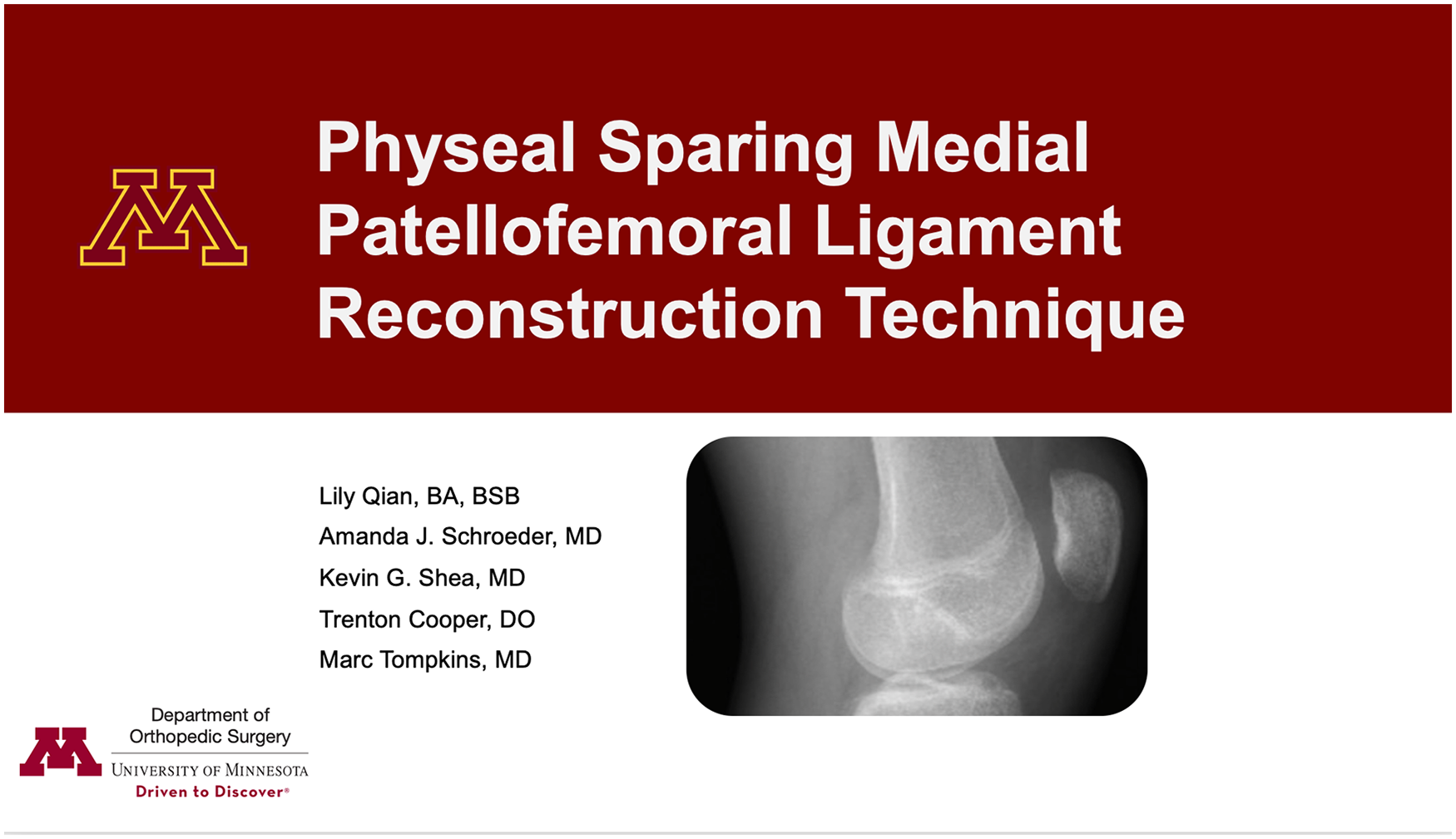
Keywords
Video Transcript
This presentation and associated video will describe a technique for physeal-sparing medial patellofemoral ligament (MPFL) reconstruction. The authors have no disclosures relevant to this presentation. We will cover all of these aspects during the overall presentation.
Background
By way of background, it is known that MPFL reconstruction is a critical treatment option for patellar instability. However, there is no current gold-standard surgical approach for skeletally immature patients. This is in part because the placement of the femoral tunnel at the femoral MPFL attachment point requires that the tunnel trajectory be directed toward the center of the knee because of the undulating physes.3,4 The technique described in this video allows for all epiphyseal femoral tunnel drilling with a starting point at the MPFL femoral attachment, which should allow for the graft to be placed as anatomically as possible.1,5,6
Indications
The patient is an 11-year-old girl with recurrent patellar instability. There was a prior episode of instability 6 months before while the patient was playing volleyball during an awkward landing. There was a recent episode while the patient was playing basketball during a cutting movement. On examination, there are 3 quadrants of lateral translation with a soft endpoint, positive patellar apprehension, and tight lateral retinaculum. There is a negative J sign and no hypermobility. Indications for surgery include patellar instability with osteochondral injury, recurrent patellar instability, and failed conservative management. There are no absolute contraindications for this technique. However, typically, the technique is not necessary in skeletally mature patients.
Preoperative planning includes physical examination as well as imaging review of radiograph and magnetic resonance imaging, particularly evaluation for patella alta and trochlear dysplasia. Typically, we are not treating those in very skeletally immature patients, but it is important to understand the bony risk factors to counsel the family. For patient positioning, they are placed supine on a radiolucent operating room table to allow for intraoperative imaging. Feet are at the end of the bed, and the patient is on the edge of the table on the operative side. Typically, the arms are out at 90° to allow access to the table.
Technique Description
In the interest of time, this video will start after the MPFL has already been attached to the patella.
Once the guide pin has been placed at Schottle’s point, the femoral condyle is palpated, and the scope is placed so that it faces the posterior cruciate ligament (PCL) footprint. The guide pin then is directed at the scope, such that it passes through the epiphysis of the medial femoral condyle and then is passed out through the skin just past the arthroscope. It should be noted that if this can be done with the knee at 90° of flexion or greater, this will help facilitate the passage of the pin through the notch without endangering the lateral femoral condyle. Once the pin has been passed, it is overdrilled with an appropriately sized reamer. The goal of the reaming is to ream through the entire medial femoral condyle without coming out into the notch with the reamer so the cortex at the base of the PCL footprint is carefully palpated with the reamer. Before advancement of the beath pin, a guide pin for the interference screw is advanced next to the pin. It allows easier passage of the guide pin.
Attention is then turned to the tunneling through the appropriate layer of the medial retinaculum. The superficial-most layer is identified at the point where the MPFL was previously attached to the patella. This is what is being held with the pickups here. The Schnidt is then placed just deep to this and tunneled consecutively with several passes down to the insertion point at Schottle’s point. Notice that when the Schnidt is being passed, initially it is facing out away from the knee, and then it is advanced to match the curve of the condyle. Once it is down to the pin at Schottle’s point, it can be turned outward and advanced through the skin such that it can then be used to retrieve a shuttle stitch. The shuttle stitch is then passed, and this is used to advance the leading sutures of the MPFL graft on the patella through the retinaculum tunnel. As the sutures are passed, care is taken to ensure that only sutures are being passed, and the graft is being maintained such that the ends of the graft can be carefully directed as the first portion of the graft through the tunnel.
Since there are 2 limbs of the graft, one limb that is the smallest is marked such that this can be the second one passed into the femoral tunnel. The suture ends for both graft limbs are then passed into the eyelet of the beath pin such that they can be passed into the tunnel. This is done while maintaining the guide pin for the interference screw to be sure that that is not falling out. Notice that as the beath pin is being advanced, the suture limbs are once again carefully maintained such that the ends of the graft can be directed into the femoral tunnel. The 2 graft limbs are then separated such that they can be passed one at a time with the largest of the 2 limbs, in terms of the size of the end, being passed first. Notice that as the graft limb is being advanced, the suture is being wrapped around an instrument such that the leading edge of the graft will be the first portion of the graft to enter the tunnel, and it will be parallel with the tunnel trajectory. This helps to facilitate easier passage and a better feel that the graft has advanced into the tunnel. This is then repeated with the second graft limb. Note that the sutures marked for that graft, which is the smaller of the two, are identified, and then the graft is also passed into the femoral tunnel.
With the knee at roughly 60° of flexion, the interference screw is advanced. It should be noted that it takes a little bit for the interference screw to get through the soft tissue, so it takes a couple times of advancing and feeling that it has started to engage. Once it has engaged, the length of the screw is marked on the screwdriver over a distance from the skin, which you expect to advance the screw into the femoral condyle. In this case, the screw is 20 mm in length, so 20 mm is marked on the screwdriver.
Once the graft has been secured, the graft is then evaluated at the patella to ensure that the limbs of the graft are under tension. The retinacular layers are then identified, both medially and laterally to the incision, such that they can then be incorporated into a repair. With tension on the suture, a No. 11 blade is advanced, and the absorbable suture is cut right adjacent to the PCL, leaving suture that should dissolve over time and have minimal passage through the PCL. In this case, fixation to the patella was achieved with 2 suture anchors and then sewing of the graft to the medial side of the patella. This leaves suture limbs that are available to help facilitate closure. A large bite of both medial and lateral retinaculum is achieved with 1 limb on each side. This also helps to facilitate backup fixation of the graft because effectively, the graft will be sewn into the retinaculum even if the fixation on the patella were to fail. This also allows imbrication of the medial retinaculum at the level of the patellar attachment of the graft. A knot is tied, and the same process is repeated for the second anchor.
In the case of this patient, a lateral retinaculum lengthening is also performed to allow for appropriate medial to lateral balance. The patella is then evaluated to ensure there is appropriate movement in both directions.
Next, the scope is reintroduced, and the patella is evaluated throughout a range of motion and felt to be tracking well. Final intraoperative and postoperative images demonstrate the femoral tunnel to be in an appropriate position in the epiphysis.
Results and Discussion
There are many tips to avoid complications. This includes making sure that a true lateral radiograph is obtained during surgery to properly identify the location for graft placement. The surgeon needs to ensure that the graft length is appropriate to avoid bottoming out in a blind-ended femoral tunnel. The graft should be fixed with the knee with at least 45° of flexion to ensure that the patella is seated in the trochlea. We typically do this without a guide and just aim directly for the arthroscope. However, it is possible to use a guide for placing the femoral tunnel. If possible, avoid drilling through the cortical bone at the base of the PCL. The tunnel length is typically between 20 and 30 mm. Patients begin physical therapy immediately after surgery. They are allowed full weightbearing and full range of motion, and they do not receive a brace. This is the overall approach based on weeks and phases of care. Patients undergo a formal functional test with physical therapy when the physical therapist believes they are ready. This is before they return to their desired sport. This is typically performed in the 6- to 9-month postoperative period but again depends on how the patient is doing with physical therapy. We counsel our patients that most are able to return to unrestricted activity within 1 year but that physical therapy is a critical portion of the recovery process. 2 All epiphyseal femoral tunnel drilling with a starting point at the MPFL femoral attachment is possible and should allow for the graft to be placed as anatomically as possible while still protecting the physes. This particular technique has not been studied with clinical patient-reported outcomes to date, but the observed clinical outcomes are good and commensurate with the adult technique. It should be noted that patients who have concomitant bony risk factors do have a higher risk for further instability. Thank you very much for the opportunity to present this technique for physeal-sparing MPFL reconstruction.
Footnotes
Submitted April 17, 2024; accepted October 18, 2024.
One or more of the authors has declared the following potential conflict of interest or source of funding: A.J.S. received support from Arthrex and Zimmer Biomet for conferences and educational meetings. AOSSM checks author disclosures against the Open Payments Database (OPD). AOSSM has not conducted an independent investigation on the OPD and disclaims any liability or responsibility relating thereto.
