



Abstract
Background:
Lateral meniscal oblique radial tears (LMORTs) are the most common type of lateral meniscal tears and occur concomitantly with anterior cruciate ligament (ACL) tears in up to 12% of cases. Four types of LMORTs have been classified in the literature based on proximity to the meniscal root and extent of the tear. Type 1 and 2 LMORTs represent partial and complete posterior root tears less than 10 mm from the root insertion. Type 3 and 4 LMORTs are partial and complete posterior radial meniscus tears greater than 10 mm from the root insertion.
Indications:
Type 3 and 4 LMORTs can and should be addressed with an all-inside side-to-side repair at the time of ACL reconstruction. LMORTs that are not repaired at the time of ACL reconstruction can contribute to persistent instability and meniscal extrusion.
Technique Description:
Diagnostic arthroscopy is performed to evaluate the posterior aspects of both the medial and lateral meniscus. The medial leaflet is commonly flipped into the notch and scarred to ACL remnant. After identifying and isolating the medial leaflet, an arthroscopic suture passer is used to pass a suture from inferior to superior through the medial leaflet. A second suture is passed from inferior to superior through the lateral leaflet. This is used to shuttle the suture pass through the medial leaflet to the bottom of the meniscus, where it can be tied in a horizontal mattress fashion. The sutures are tied down with aide of an arthroscopic knot pusher. A second set of sutures is passed and used to shuttle a second suture that would be tied posterior to the first suture, again in a horizontal mattress fashion. This allows reduction of the fragments in apposition across the tear. Postoperatively, patients are allowed range of motion from 0° to 90° and to toe touch weightbearing for the first 4 weeks. Patients are advanced to weightbearing as tolerated at 5 weeks. Typical return to sport ranges from 6 to 9 months postoperatively.
Results:
Results have been published for 2-year outcomes of type 3 and 4 LMORT repairs and have demonstrated persistent improved patient-reported outcomes as well as healing rates that are greater than 80% and in some series approach nearly 100%.
Discussion/Conclusion:
Arthroscopic all-inside side-to-side surgical repair is a durable and reliable treatment option for patients presenting for ACL reconstruction with concomitant type 3 or 4 LMORT.
Patient Consent Disclosure Statement:
The author(s) attests that consent has been obtained from any patient(s) appearing in this publication. If the individual may be identifiable, the author(s) has included a statement of release or other written form of approval from the patient(s) with this submission for publication.
This is a visual representation of the abstract.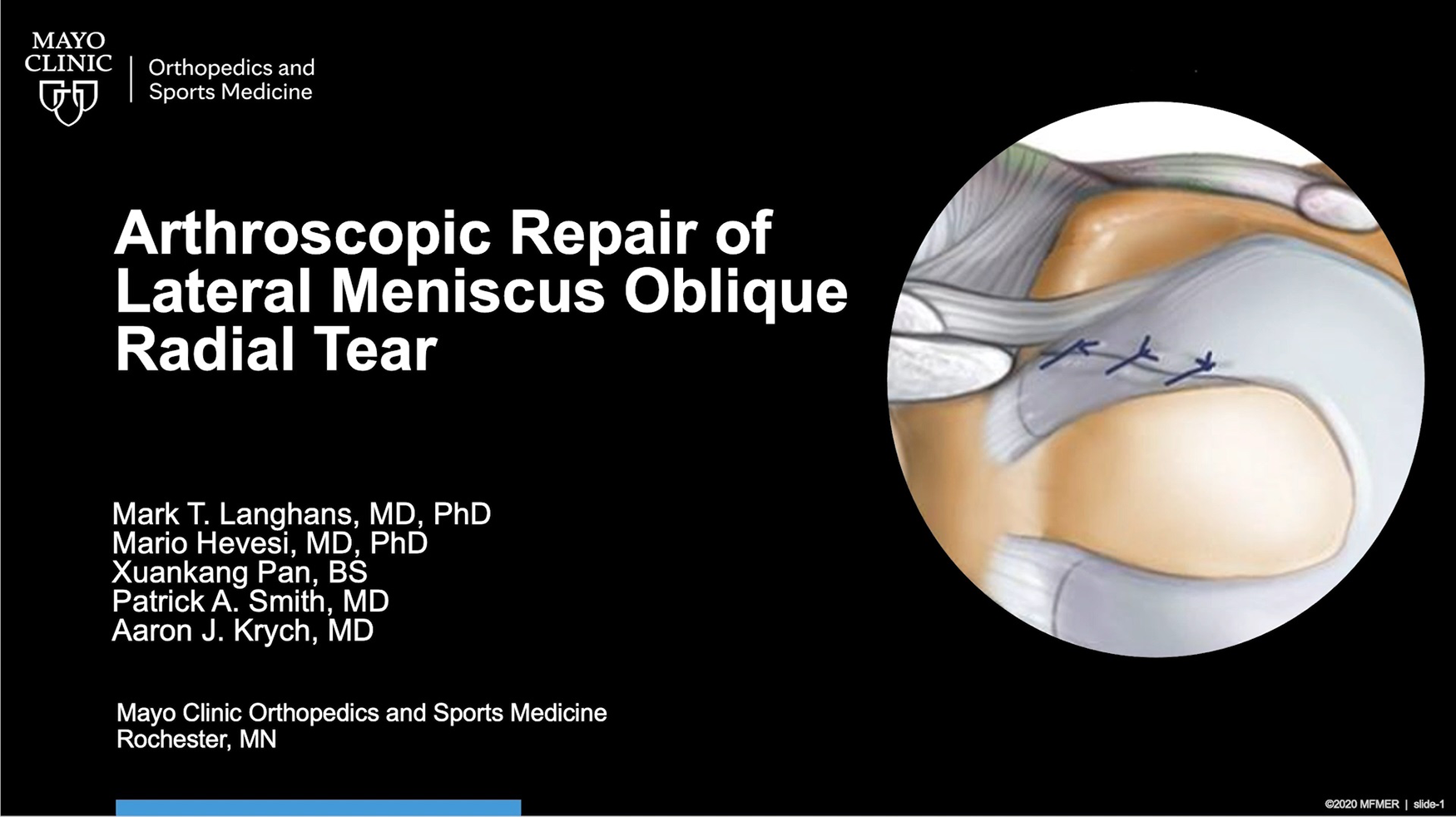
Keywords
Video Transcript
In this video, we will demonstrate our preferred technique for arthroscopic side-to-side, all-inside repair of a lateral meniscus oblique radial tear (LMORT). As an overview, we will present some background literature on LMORTs, provide a case presentation, demonstrate the surgical technique, and then discuss tips and tricks, postoperative management, return-to-sport guidelines, and patient outcomes.
LMORTs have been reported in up to 12% of anterior cruciate ligament (ACL) tears and represent the most common type of associated lateral meniscus tear. 3 There are 4 types of tears that have been described in the literature. Type 1 and type 2 LMORTs are less than 10 millimeters from the root and represent root tears, while type 3 and type 4 LMORTs are characterized by being more than 10 millimeters from the root insertion with a reparable portion on the medial side. 3 Biomechanical studies of type 3 and type 4 LMORTs have demonstrated worsening anterior translation, rotatory instability, and meniscal extrusion in ACL-deficient knees when compared to knees with an intact lateral meniscus.5,6 In addition, instability and meniscal extrusion persisted following ACL reconstruction if an associated LMORT was not repaired at the same time. 6 Results have been published for 2-year outcomes of LMORT type 3 and type 4 repairs and have demonstrated persistent improved patient-reported outcomes as well as healing rates that are greater than 80% and in some series approach nearly 100%.4,7,9
This presentation demonstrates an arthroscopic all-inside side-to-side repair of a type 4 LMORT. This patient is a 20-year-old male college football player. He has no past medical or surgical history. He was running a postroute in practice when he planted and felt a pop in his knee with immediate swelling of knee. He hopes to play in his next football season. On physical examination, he presents with an antalgic gait and an effusion of the knee. His skin is intact, and there are no surgical scars. On presentation, he was approximately 1 week out from injury and was noted to have a range of motion 10° short of full extension to about 100° of flexion. Stability testing of the knee was notable for a positive anterior drawer test and a Lachman 2B with no appreciable endpoint. He was stable to varus and valgus stress at both 0° and 30°.
Four radiograph views of the knee demonstrated no acute fractures and no acute obvious osseus abnormality. Long leg films demonstrated normal alignment. Shown here are images from a magnetic resonance imaging (MRI) of the right knee. These are T2-weighted sagittal cuts of the right knee. The first image demonstrates disruption of the ACL as well as an effusion. The second image demonstrates bone bruising on the lateral femoral condyle as well as the lateral tibial plateau characteristic of a pivot shift associated with an ACL injury. This sagittal cut demonstrates disruption of the posterior horn of the meniscus in an oblique fashion with associated bone marrow edema underneath. The coronal cuts further demonstrate that this disruption is lateral to the insertion of the root.
Lateral meniscus oblique radial tears occur in conjunction with ACL disruption as a consequence of the pivot shift that occurs during the time of the injury. Thus, timing for surgery is typically dictated by the timing for reconstruction of the ACL. Per protocol, our patient is sent to physical therapy to regain motion in the injured knee and to help decrease the effusion prior to surgery. In this interim, he is maintained in a hinged knee brace that helps to protect the meniscus from further damage, as well as given crutches and ordered only to bear weight as tolerated.
The required equipment for this operation is a standard ACL reconstruction kit that includes guides for both tibia and femur tunnel drilling. In addition, we recommend the use of a cannula for help with suture management during the meniscus repair, as well as an arthroscopic suture passer for help passing sutures in the posterior aspect of the knee. The implants that are used for side-to-side all-inside repair are typically nonresorbable suture tapes. We use anywhere from 2 to 4 tapes, depending on the size of the tear and the quality of the tissue. The positioning is standard positioning, which is supine with a lateral post and a foot holder to help position the leg for both arthroscopy and ACL reconstruction.
Prior to beginning the arthroscopy portion of the procedure, we harvest our graft of choice, taking care to ensure that we have a watertight closure of the capsule prior to proceeding with the arthroscopic portion to aid in visualization. We then perform a standard diagnostic arthroscopy, taking care to evaluate carefully the posterior aspects of both the medial and lateral meniscus. We find that performing a modified Gillquist maneuver is often very helpful to evaluate the posterior aspects of the meniscus. We see well-demonstrated here the LMORT type 4 tear, a complete radial transection of the posterior aspect of the lateral meniscus. Notably, this fragment is flipped up into the notch and can be easily confused with the fibers of the torn ACL. After establishing a cannula for suture passing and rasping each side of the tear, we begin our repair. An arthroscopic suture passer is then used to pass a suture from inferior to superior through the medial leaflet. Similarly, a second suture is passed from inferior to superior through the lateral leaflet. This is used to shuttle the suture pass through the medial leaflet to the bottom of the meniscus, where it can be tied in a horizontal mattress fashion. The sutures are then tied down with aid of an arthroscopic knot pusher. Care is taken not to over-reduce the fragments. In a similar fashion, a second set of sutures is passed and used to shuttle a second suture that would be tied posterior to the first suture, again in a horizontal mattress fashion. This allows reduction of the fragments and apposition across the tear. Probing demonstrates that the repair has good hold of the tissue on both sides, and it is stable. If the fragments are over-reduced, one trick is to cycle the knee. This helps to compress the meniscus and allow the sutures to settle out into positions of adequate tension.
Next, we will review a few tips and tricks that can be helpful with this technique. One thing to recognize is that LMORTs commonly have a medial kickstand fragment that can be displaced into the notch and scarred into place. It is easily confused with the fibers of the ACL. Thus, we consider addressing the meniscus, specifically looking for LMORTs, prior to beginning our ACL preparation. In knees that are especially tight, bringing the suture passer inverted into the notch and then rolling laterally underneath the meniscus can be helpful to get the suture passer into the correct position. We also would suggest using a passing suture to avoid having to use the suture passer inverted. A ripstop stitch in questionable meniscus tissue can be helpful to prevent pull through of the sutures. Cycling the knee can help to reduce fragments into position after sutures are tied if the fragments are over-reduced.
They are allowed to range 0° to 90° for the first 4 weeks and are given crutches and made touch weightbearing. At 4 weeks, they can begin to increase their range of motion and progress to a partial weightbearing status. If they are doing well at this point, we will advance them to weightbearing as tolerated and range of motion as tolerated at 5 weeks. We can discontinue use of the knee brace at week 6. We avoid loading of the knee and flexion, jogging or sport activity until at least 12 weeks postoperative. Typical return to sport is anywhere from 6 to 9 months postoperative.4,8
Several studies have reported excellent rates of return to play in patients who have undergone an ACL reconstruction with an all-inside meniscus repair of the lateral meniscus. Also of note, Akada et al 1 and others performed a retrospective cohort study of 426 patients who underwent ACL reconstruction, comparing those with intact menisci versus those who underwent partial meniscectomy. They noted a significant decreased rate of return to sport with any involvement of the lateral meniscus. In one of the longer follow-up studies, Logan et al 4 reported a case series of 42 elite athletes undergoing 45 meniscus repairs. They had a minimum 5-year follow-up, and they reported an 81% rate of return to support for patients, most at a similar level.
There have been a few series that have reported the outcomes of LMORT repairs. Recently, Jeon et al 2 reported a case series of 97 patients who had an ACL tear as well as an LMORT, predominantly type 3 and 4. They had a minimum 2-year follow-up and showed that patient-reported outcome scores improved from preoperative to postoperative and that among those undergoing second-look arthroscopy, 80% demonstrated complete healing. Similarly, Therrien et al 7 performed a comparative cohort study working with 50 patients with isolated ACL reconstruction versus 50 patients with ACL reconstruction, plus repair of a type 3 or 4 LMORT. They had a minimum 2-year follow-up and noted no significant difference in patient-reported outcomes between these 2 cohorts. Tsujii et al 9 reported a series of 41 patients who underwent ACL was side-to-side, inside out, or all-inside repair of radial flap tears of the posterior lateral meniscus versus isolated ACL reconstruction with a minimum 2 year follow up. In this series, 27 of 30 patients had some healing at second-look arthroscopy of their meniscus. And finally, Zhuo et al 10 reported a case series of 29 patients who underwent side-to-side repair of a radial posterior lateral meniscus tear. In their series, 28 of 29 patients had meniscus healing on MRI, and all patients showed at least some healing of their meniscus at second-look arthroscopy. They reported improved patient-reported outcomes versus preoperative and no failures at final follow-up.
Footnotes
Submitted August 29, 2023; accepted October 20, 2023.
One or more of the authors has declared the following potential conflict of interest or source of funding: M.H. is a paid consultant for DJO—Enovis, Moximed, and Vericel; receives publishing royalties, financial, or material support from Elsevier; and is on the editorial or governing board for Journal of Cartilage and Joint Preservation. P.A.S. is a board or committee member for American Orthopaedic Society for Sports Medicine (AOSSM) and Arthroscopy Association of North America (AANA); is on the editorial or governing board for Journal of Knee Surgery; has stock or stock options in Spinal Simplicity; and receives intellectual property royalties and research support from, is a paid consultant for, and paid presenter or speaker for Arthrex. A.J.K. receives research support from Aesculap/B. Braun; receives intellectual property royalties from and is a paid consultant for Arthrex; is on the editorial or governing board for American Journal of Sports Medicine and Springer; and is a board or committee member for AANA and International Cartilage Repair Society. The AOSSM checks author disclosures against the Open Payments Database (OPD). The AOSSM has not conducted an independent investigation on the OPD and disclaims any liability or responsibility relating thereto.
