



Abstract
Background:
Posteromedial meniscal root tears occur when the meniscal root detaches from the tibial plateau, which limits the native functionality of the meniscus, alters tibiofemoral contact forces, and can progress to meniscal extrusion. Untreated meniscal root tears with meniscal extrusion have been associated with significant articular cartilage loss and accelerated progression of osteoarthritis. Recent biomechanical evidence suggests restoring the contact area with the use of a peripheral stabilization suture at the posteromedial aspect of the tibial plateau.
Indications:
Meniscal root repair with a peripheral stabilization suture is indicated by clinical and radiographic evidence of complete detachment of the posteromedial meniscus root with significant meniscal extrusion outside the joint.
Technique Description:
This technique uses 2 tunnels for the meniscal root repair as well as a single additional transtibial tunnel for the peripheral stabilization suture. The described technique demonstrates a peripheral release along the meniscocapsular junction to allow the meniscus to be reapproximated to its anatomical attachment site. This is followed by transtibial tunnel preparation to allow suture passage for the meniscal root repair and an additional transtibial tunnel is created for the peripheral stabilization suture. After stabilization of the extruded meniscus, the suture is tied down over a cortical fixation device on the anteromedial tibia.
Results:
Significant improvement has been reported by clinical studies after the transtibial pullout repair method; however, structural outcomes have shown conflicting results. Kaplan et al reported patients treated with transtibial suture pullout technique with 2 locking cinch sutures had improved clinical outcomes, but increased extrusion of the medial meniscus compared with the preoperative state, whereas Kim et al reported a decrease in meniscal extrusion following pullout suture repair technique.
Discussion:
Posteromedial meniscus root repair using a peripheral stabilization suture is an effective surgical technique to restore the contact pressures of the knee and limit the amount of meniscal extrusion. This allows for appropriate correction of hoop stress to prevent further cartilage loss and progression of osteoarthritis.
Patient Consent Disclosure Statement:
The author(s) attests that consent has been obtained from any patient(s) appearing in this publication. If the individual may be identifiable, the author(s) has included a statement of release or other written form of approval from the patient(s) with this submission for publication.
This is a visual representation of the abstract.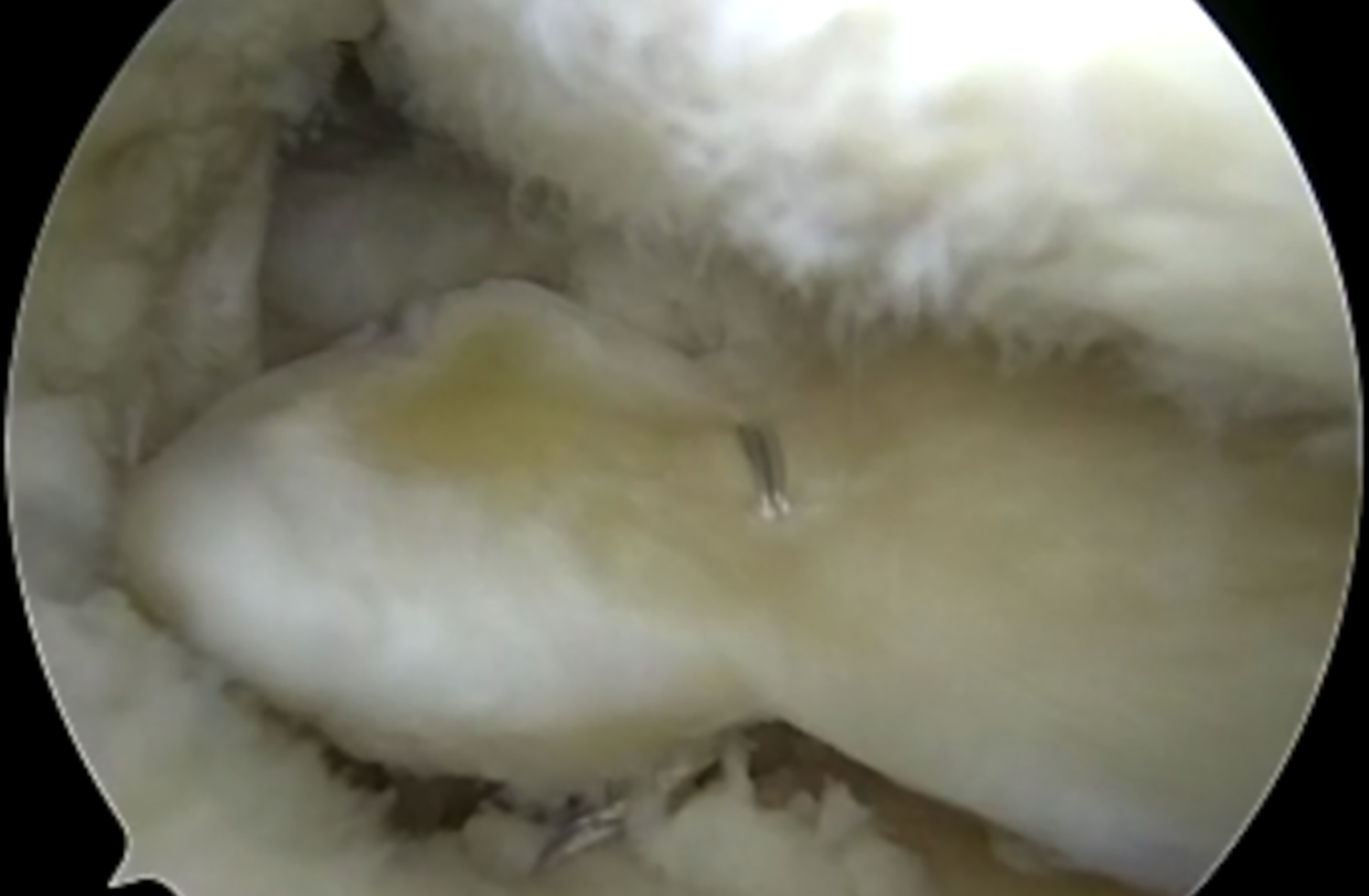
Video Transcript
This is a video presentation depicting a posterior medial meniscal root repair with a peripheral stabilization stitch for the treatment of posterior medial meniscal root tear with notable meniscal extrusion.
Shown here are the disclosures for the authors involved.
Meniscal root tears are devastating meniscal injuries that significantly alter tibiofemoral biomechanics and axial contact forces. 3 In most instances, surgical repair of these injuries has become the gold standard in aims of restoring native biomechanics and preventing the significant degenerative changes associated with nonoperative management. 1 Despite significantly improved surgical techniques, residual meniscal extrusion following surgery continues to be an issue.4,5 Meniscal extrusion may translate to poorer clinical outcomes and a more rapid progression of osteoarthritis. 7 More recent additional surgical techniques have aimed to address this continued extrusion 2 ; one of these techniques is the addition of a peripheral stabilization stitch.
The patient being presented is a 53-year-old man with a chief complaint of right knee pain. The patient sustained an injury while running the bases in softball 3 months previously. Since then, he has experienced ongoing medial sided knee pain as well as swelling and buckling from the swelling. He is a nonsmoker and does not have any pertinent prior surgical history.
On physical examination, the patient has a normal neurovascular examination. He has range of motion (ROM) of 2-cm heel height to 135° of flexion, with reproducible pain with deep flexion. He also has medial joint line tenderness and a stable ligamentous examination.
Long leg alignment films demonstrate approximately 2° of varus mechanical alignment. Magnetic resonance imaging demonstrated a complete radial tear within 1 cm of the medial root attachment, making this a type II tear. The coronal image demonstrates the significant extrusion of the meniscal body into the medial gutter. The extrusion was measured at 4.2 mm and had associated reactive marrow edema of the medial femoral condyle.
In summary, we have a 53-year-old patient with a right medial meniscal posterior root tear with associated meniscal extrusion, in the setting of mild varus alignment and very minimal medial compartment narrowing or other signs of significant degenerative changes. Our plan was to proceed with a medial meniscal root repair with a concurrent peripheral stabilization stitch.
The patient is placed supine on a general operating table. With the leg free, an examination under anesthesia is performed. The patient is placed supine in an arthroscopic leg holder with a nonsterile tourniquet applied. The extremity is prepped and draped in the typical sterile fashion.
Standard anterolateral portal and anteromedial portals (localized with a spinal needle) are established. Diagnostic arthroscopy is performed, which confirms the medial meniscus root tear. Careful attention is paid to how much medial meniscal extrusion is present. An 18-gauge spinal needle is used to trephinate the superficial medial collateral ligament (MCL) while a gentle valgus force is applied to the knee. Trephination allows for adequate working room in the posteromedial knee and minimizes risk of damage to the medial compartment articular cartilage with arthroscopic instruments. An arthroscopic grasper is used to assess the mobility of the medial meniscus by attempting to position it back onto its anatomic footprint. Often, the medial meniscus is extruded in a fixed position, which may preclude a tension-free repair. An arthroscopic straight scissors is used to release the medial meniscus off the meniscocapsular junction both above and below the meniscus to improve meniscus mobility, allowing the extruded meniscus to be pulled back into the joint. Of note, this step can be performed after preparing the root bed, as aggressive meniscocapsular release may result in some fluid extravasation. The footprint of the medial meniscus root is debrided with a combination of 4.0-mm curved Excalibur Shaver (Arthrex; Naples, FL) and a ringed curette to produce a bleeding bony bed.
Attention is then turned to the tunnel site. A longitudinal incision approximately 5 cm distal to the medial joint line is made just medial to the tibial crest. Subcutaneous tissues are dissected with the use of electrocautery. The underling fascia is incised sharply, and the bony surface of the medial tibia is prepared with the use of a Cobb elevator. The point-to-point medial meniscal root guide is then inserted in the anteromedial portal and a 2.4-mm cannulated guide pin is placed in the posteromedial aspect of the medial meniscus root footprint. The inner pin is removed. If appropriately placed, arthroscopic fluid will flow freely from the cannulated pin. The 5-mm offset guide is then used to place a second 2.4-mm cannulated guide pin in parallel with the first pin. The second pin is positioned just anterior and lateral to the first pin, capturing the full footprint of the meniscus root.
A ringed curette is then used to prepare the pin site of the peripheral stabilization stitch on the medial tibial plateau at the point of maximum meniscus extrusion. This point is located at the posterior border of the superficial MCL. Using the point-to-point meniscal root guide, a third 2.4-mm cannulated pin is placed retrograde along the medial tibia. This pin often requires a steeper angle on the guide to be taken compared with the original pins. Again, upon removal of the inner pin, arthroscopic fluid should flow freely from the cannula.
A PassPort Cannula (Arthrex) is then placed in the anteromedial portal to facilitate smooth suture passage. Using the Knee Scorpion suture passer, a vertical mattress 0.9-mm SutureTape (Arthrex) suture is placed in the posteromedial meniscus. This suture-passing device may be used as a grasper to pull the meniscus over the cannula to check appropriate reduction. A Nitinol wire (Arthrex) is passed from the posteromedial pin into the joint and retrieved through the anteromedial portal. Before retrieving the wire, then cannula should be pulled back slightly into the bone to prevent the Nitinol wire tearing on the teeth of the cannula. Both limbs of the vertical mattress suture are then placed in the Nitinol wire. The cannula is removed with a pliers. The Nitinol wire is pulled through the tibia and the sutures are left free. A second 0.9-mm SutureTape suture is passed in luggage-tag configuration, and the steps are repeated to pull through the more anterolateral 2.4-mm cannula. Tension is applied to each of these sutures to confirm reduction of the meniscus root and these are clamped with a hemostat for later fixation.
A 0.9-mm SutureTape suture is then placed in horizontal mattress configuration with a Knee Scorpion over the point of maximum extrusion. It is important to place the peripheral stitch last as the optimal location of this stitch will change after adequate reduction of the medial meniscus root. In addition, biomechanical analysis has shown anatomic reduction of the meniscal root must be achieved to maximize the benefit of peripheral stabilization stitch. A Nitinol wire is used to retrieve the suture limbs and reduce the medial meniscus into the joint.
An assistant holds the arthroscope, and under direct visualization, the 2 sutures of the posteromedial meniscus root are tied over a 12-mm suture button. The limbs of each suture are then tied to one another. A probe is used to confirm stable reduction of the meniscus root. A second 3.5-mm button is then used for the peripheral stabilization stitch. This is again tied under direct visualization to confirm appropriate reduction. An arthroscopic probe is used to confirm stability and appropriate reduction of the medial meniscus.
The arthroscopic fluid is then expressed from the knee and the arthroscope removed. The open incision is closed with 2-0 Vicryl suture followed by a 3-0 running Monocryl suture. The skin is approximated with 3-0 Monocryl suture and dressed with Steri-Strips, Xeroform, sterile gauze, and sterile cast padding. The leg is placed in a knee immobilizer and then patient is awakened and taken to the recovery area.
This is a relatively complex procedure that is not without potential complications. The first of which is damage to the medial compartment articular cartilage. Trephination of the MCL with the use of an 18-gauge spinal needle will help provide adequate visualization and working space. The second risk is inadequate reduction/fixing of meniscal extrusion. This can be improved by significant release of the medial meniscus along the meniscocapsular junction with the use of a serrated arthroscopic scissors. The completeness of release can be assessed with the use of an arthroscopic grasper. The last key complication to avoid is inadequate reduction of the meniscal root. Tie button under direct visualization at approximately 90° of flexion.
The patient is kept in a knee immobilizer and non-weightbearing for a total period of 6 weeks. Physical therapy begins on postoperative day 1 with an emphasis on ROM. The knee is restricted to 90° of flexion for the first 2 weeks. After 2 weeks, unlimited knee flexion is allowed but careful attention must be paid to not load the hamstrings. In addition, all patients are evaluated preoperatively with long leg coronal alignment radiographs. If the patient is found to be in varus in the setting of a medial meniscus root tear, a medial unloader brace is applied starting at 2 weeks for a total period of 4 months.
There is relative paucity of data regarding outcomes following a peripheral stabilization stitch due to it being a relatively new technique. A retrospective review by Mochizuki et al 6 assessed clinical and radiographic outcomes in 26 patients at a minimum 2-year follow-up. They found significant improvements in KOOS (Knee injury and Osteoarthritis Outcome Score) and Lysholm score. Furthermore, they found the extrusion distance decreased significantly from 4.8 ± 0.7 mm before surgery to 2.7 ± 0.3 mm 2 years after surgery (P < .05), and the extrusion ratio was significantly improved from 40.2 ± 7.0% before surgery to 22.6 ± 3.6% after surgery (P < .05).
Footnotes
Submitted January 12, 2023; accepted March 13, 2023.
One or more of the authors has declared the following potential conflict of interest or source of funding: R.F.L. reports personal fees from Arthrex, grants and personal fees from Ossur, and personal fees from Smith & Nephew and Linvatec, outside the submitted work; editorial boards of American Orthopaedic Society for Sports Medicine (AOSSM), Journal of Experimental Orthopaedics, Knee Surgery, Sports Traumatology, Arthroscopy; and committees of AOSSM, AANA, and International Society of Arthroscopy, Knee Surgery and Orthopaedic Sports Medicine. AOSSM checks author disclosures against the Open Payments Database (OPD). AOSSM has not conducted an independent investigation on the OPD and disclaims any liability or responsibility relating thereto.